This work is republished from Middle East Monitor under a Creative Commons Attribution-NonCommercial-ShareAlike 4.0 International License.
Palestinian prisoners were brought to Abu Youssef Al-Najjar Hospital in Rafah in south of Gaza as a result of the torture inflicted upon them during detention by Israeli forces in inhumane conditions [Firas Al-Shaer]
The United Nations Committee Against Torture has found credible evidence that Israel is operating a “de facto State policy of organised and widespread torture and ill-treatment,” warning that such practices may constitute war crimes, crimes against humanity, and may meet the legal criteria for genocide.
In its concluding observations on Israel’s sixth periodic review, the Committee said it was “deeply concerned” about multiple and serious allegations of torture and ill-treatment of Palestinians deprived of liberty, including children. It further described the situation as having “gravely intensified” since 7 October 2023.
The UN report lists detailed allegations of abuse, based on testimonies from rights groups, medical experts, and detainees themselves. These include beatings with batons and rifle butts, kicks to the head and genitals, electrocution, including of the genitals and anus, waterboarding, prolonged stress positions, sexual violence including rape, molestation, forced nudity and sexual threats, the use of attack dogs, exposure to extreme cold or heat, including use of boiling water. Victims reported being urinated on, forced to wear nappies, or made to act like animals. Many were shackled at all times, blindfolded, and fed through a straw.
“The Committee expresses its deep concern over allegations of repeated severe beatings, dog attacks, electrocution, waterboarding, use of prolonged stress positions, sexual violence, threats against detainees and their family members, insults to personal dignity and humiliation such as being made to act like animals or being urinated on, systematic denial of medical care, excessive use of restraints, in some cases resulting in amputation, the performance of surgeries without anaesthetic, exposure to extreme cold or heat, including boiling water” said the UN.
On its list of grave violations committed by Israel the Committee included, “denial of adequate nutrition and water, deprivation of clothing, sleep and access to hygiene facilities and products, including feminine hygiene products, deprivation of light or darkness, use of loud music and noises, denial of the right to freely practice ones religion, and the forcible use of hallucinogenic medication, in a discriminatory manner, against Palestinians, and for purposes including the extraction of information or confessions and as a means of exacting punishment, including collective punishment.”
The Committee expressed alarm at Israel’s use of the Unlawful Combatants Law to detain children, the elderly, and pregnant women without charge. It noted that many detainees were held in solitary confinement, denied access to family, legal counsel, education, or even basic hygiene, food, and water.
It further reported that 75 Palestinian detainees have died in Israeli custody since 7 October 2023, many showing signs of starvation, untreated wounds, dehydration, and signs of torture. Families were often not informed, constituting enforced disappearance under international law. Despite these deaths, the Committee noted that no Israeli official has been held accountable.
The Committee concluded that acts of torture and ill-treatment committed against Palestinians deprived of liberty could qualify as war crimes and crimes against humanity. It referenced the UN Commission of Inquiry’s prior findings that such acts may form part of the actus reus of genocide—a Latin term referring to the “guilty act” or the physical component of a criminal offence, in this case the deliberate infliction of harm on a protected group.
The Committee called on Israel to immediately cease the use of torture and ill-treatment, grant unrestricted access to all detention facilities to independent monitors, establish an independent commission of inquiry, investigate and prosecute all responsible officials, including military and intelligence officers, and repeal or amend laws enabling arbitrary detention and ensure protection of vulnerable detainees, especially children.
This work by Middle East Monitor is licensed under a Creative Commons Attribution-NonCommercial-ShareAlike 4.0 International License.
Keir Starmer objects to criticism of the IDF. He asks how could anyone object to them starving people to death, forced marches like the Nazis did, bombing Gaza’s hospitals and universities, mass-murdering journalists, healthworkers and starving people queuing for food, killing and raping prisoners and murdering children. He calls for people to stop obstructing his genocide for Israel.Orcas discuss Genocide-supporting and complicit Zionists. Donald Trump, Keith Starmer, David Lammy, Rachel Reeves, Angela Rayner and Wes Streeting are acknowledged as evil genocide-complicit and supporting cnuts.Genocide denier and Current UK Prime Minister Keir Starmer is quoted that he supports Zionism without qualification. He also confirms that UK air force support has been essential in Israel’s mass-murdering genocide. Includes URLs https://www.declassifieduk.org/keir-starmers-100-spy-flights-over-gaza-in-support-of-israel/ and https://youtu.be/O74hZCKKdpA
This work by Eko Ernada is republished from Middle East Monitor under a Creative Commons Attribution-NonCommercial-ShareAlike 4.0 International License.
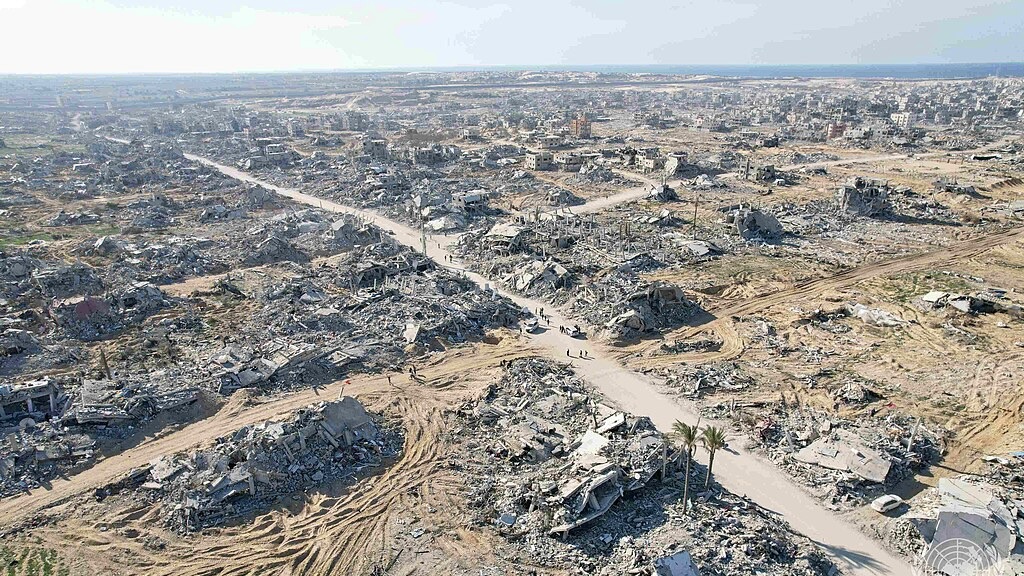
Volunteers organize an event in the Jawazat area of western Gaza City to entertain children and help them momentarily escape the effects of war through various performances and games, on November 28, 2025. [Khames Alrefi – Anadolu Agency]
Human Rights Day, commemorated annually on 10 December, is intended to reaffirm the principles of dignity, equality, and universal protection enshrined in the 1948 Universal Declaration of Human Rights (UDHR). Yet in the age of Gaza, these principles ring hollow. The world marks Human Rights Day with speeches and ceremonies, even as an entire civilian population endures bombardment, displacement, starvation, and the collapse of basic infrastructure—with almost complete impunity.
Gaza has become the starkest mirror of our time. It reveals a world in which “universal” rights are selectively defended, in which civilian lives can be extinguished during declared humanitarian pauses, and in which the international system proves unable—or unwilling—to enforce its own norms. The tragedy is not only that Gaza burns, but that it burns while the world insists it still believes in human rights.
The bitter paradox of Gaza is that even a “ceasefire” no longer guarantees safety. Israel announces pauses in fighting, yet strikes hospitals, refugee shelters, and residential blocks hours later. These are not accidents or isolated incidents; they signal a global shift. We live in an era where restraint has eroded, legality has weakened, and the protection of civilians has become politically negotiable. Each broken ceasefire broadcasts a dangerous message: the laws of war no longer function as limits for those powerful enough to ignore them.
Political theorist Carl Schmitt once argued that the sovereign is the one who decides the exception. Israel’s conduct in Gaza reflects this logic with unsettling clarity. By invoking “self-defence” without temporal or ethical boundaries, it asserts the authority to determine when international law applies and when it can be suspended. This produces a permanent state of exception—an elastic zone where lethal force can be justified regardless of circumstances, even during declared humanitarian pauses.
The post–World War II international order, built on the promise that war would be limited and civilians protected, now appears fragile and deeply inconsistent. The UN Charter and Geneva Conventions were meant to bind all states equally. Gaza shows that they do not. Instead, the enforcement of international law has become hierarchical and contingent on geopolitics rather than principles. Human Rights Day, intended as a celebration of universality, arrives as a glaring reminder of selective morality.
The double standards reveal themselves with painful clarity. Violations of ceasefires in Ukraine generate swift Western condemnation and calls for accountability. When similar violations occur in Gaza, they are reframed as “security measures,” “precision targeting,” or unfortunate collateral damage. This asymmetry destroys the credibility of the so-called “rules-based order” and reduces human rights to political rhetoric. It exposes a disturbing truth: rights are vigorously defended for some populations and quietly disregarded for others.
Israel’s repeated breaches of truces must also be understood as a philosophical act. Giorgio Agamben’s idea of the state of exception—a space where the law is suspended while still invoked to legitimise violence—describes Gaza with eerie accuracy. Ceasefires are transformed from humanitarian obligations into strategic intervals: time to reposition forces, tighten control, and resume bombardment. The truce becomes a tool of war rather than a reprieve from it.
Layered onto this political and legal impunity is a new technological dimension of violence. Israel’s military operations increasingly rely on AI-assisted targeting, biometric surveillance, predictive analytics, and real-time data extracted from Palestinians. Warfare is merging with digital governance; civilian life becomes a set of data points, and killing becomes “efficient.” Hannah Arendt’s “banality of evil” has evolved into a digital form—violence rendered algorithmic, bureaucratic, and shrouded in technological inevitability.
This raises a profound question for Human Rights Day: can human rights survive in a world where death can be administered through algorithms, where narratives are weaponised globally, and where geopolitics shields one state from accountability? Gaza suggests that without radical change, the answer may be no.
The UDHR proclaims the right to life, dignity, medical care, protection from collective punishment, and freedom from arbitrary violence. Yet in Gaza, families are bombed in their homes, displaced repeatedly under fire, denied water and electricity, and deprived of medical treatment even inside hospitals. These are not mere violations—they are the unravelling of the moral foundation on which Human Rights Day rests.
The crisis is not confined to Gaza. The collapse of enforcement in one place accelerates the decay of norms everywhere. When international law becomes optional for one state, it effectively becomes optional for all. The precedent now being set—that mass civilian casualties can be justified through political alliances—will reverberate globally. Other states will follow the model of impunity, confident that geopolitical alignment can shield them from scrutiny.
The Middle East has already begun to absorb the consequences. Across the region, the publics witness the destruction in Gaza with a sense of moral injury and political disillusionment. Trust in the international system—already strained by decades of selective intervention and unfulfilled resolutions—has further eroded. The perceived hypocrisy of global powers deepens instability and fuels the belief that justice cannot be obtained through institutions supposedly designed to deliver it.
Human Rights Day, in this context, risks becoming an empty ritual. States will issue statements praising the UDHR while declining to defend its principles in practice. International organisations will call for accountability, yet they are structurally unable to enforce it. And global powers will continue to speak the language of human rights while acting in ways that betray them.
In the age of Gaza, the meaning of Human Rights Day must be re-examined. It cannot remain a commemoration of ideals disconnected from reality. It must become a call to confront the political, legal, and technological structures that have allowed rights to erode so dramatically. That means addressing the paralysis of the UN Security Council, the political shielding of certain states, and the growing use of digital systems that dehumanise the populations they surveil.
Ultimately, the question for this Human Rights Day is not whether Israel has crossed the limits of lawful conduct. That question has been answered repeatedly, with every bomb dropped during a ceasefire, every hospital struck, and every civilian family buried. The real question is whether humanity still believes that limits must exist at all. If the world continues to tolerate the destruction of Gaza under the language of security and self-defence, then universality—the core promise of human rights—will not survive.
In Gaza, a city burns. And with it burns the credibility of the global human rights order. Whether Human Rights Day remains meaningful or becomes mere symbolism will depend on how the world chooses to respond to this moment.
The views expressed in this article belong to the author and do not necessarily reflect the editorial policy of Middle East Monitor.
Keir Starmer objects to criticism of the IDF. He asks how could anyone object to them starving people to death, forced marches like the Nazis did, bombing Gaza’s hospitals and universities, mass-murdering journalists, healthworkers and starving people queuing for food, killing and raping prisoners and murdering children. He calls for people to stop obstructing his genocide for Israel.Orcas discuss Genocide-supporting and complicit Zionists. Donald Trump, Keith Starmer, David Lammy, Rachel Reeves, Angela Rayner and Wes Streeting are acknowledged as evil genocide-complicit and supporting cnuts.Genocide denier and Current UK Prime Minister Keir Starmer is quoted that he supports Zionism without qualification. He also confirms that UK air force support has been essential in Israel’s mass-murdering genocide. Includes URLs https://www.declassifieduk.org/keir-starmers-100-spy-flights-over-gaza-in-support-of-israel/ and https://youtu.be/O74hZCKKdpA
The crisis of the trapped combatant constitutes one of 393 Israeli violations of the truce agreement, which came into effect on October 10.
Hamas warned in a statement issued on Wednesday, November 26, that Israel’s killing and arresting of its resistance fighters, who have been trapped in tunnels in Rafah, in the southern Gaza Strip for weeks, would jeopardize the ceasefire deal.
The Palestinian resistance movement considered the pursuit of the trapped fighters a “blatant violation” of the US-brokered ceasefire deal.
Hamas also clarified that it “made great efforts during the past month with different political leaders and mediators to solve the problem of the fighters, and secure their return to their homes by providing certain ideas and mechanisms” to address the crisis.
The statement was released one day after the Israeli Occupation Forces (IOF) announced that it killed four Hamas fighters and arrested two others, while they were getting out from underground tunnels in Rafah, within the Israeli-controlled “yellow-line” zone.
It is worth noting that around 200 fighters affiliated with Hamas have been trapped in Rafah since the ceasefire deal came into force on October 10. This is despite the fact that the Palestinian group as well as mediators have demanded a safe passage for the fighters to areas inside Gaza not controlled by Israel as part of the agreement.
On Sunday, November 30, family sources confirmed that Abdallah Hamad, who is the son of Ghazi Hamad, a senior Hamas official and member of the movement’s negotiation delegation, was among the trapped Al-Qassam fighters that were killed by the IOF in Rafah.
Moreover, the IOF announced in a statement that same day that it has killed over 40 of those fighters inside the tunnels during the past week, but Hamas has not confirmed the claim yet. The Israeli military further stated that it will intensify efforts to demolish the remaining tunnels in eastern Rafah and eliminate the trapped combatants therein.
The pursuit of Hamas combatants, one of over 393 Israeli violations
Israel’s continued pursuit of Hamas fighters constitutes one of at least 393 reported Israeli violations since the ceasefire took effect.
United Nations rapporteurs warned in a statement issued on Monday, November 24, that Israel’s flagrant infringements of the truce agreement resulted in the killing of 339 Palestinians, including more than 70 children, and the injuring over 870 others.
As Israeli violations continued in the days that followed the statement, the death toll increased to 352 based on the latest information provided by medical sources in Gaza, on Thursday, November 27.
These sources added that the tally of Palestinian fatalities since Israel’s genocidal aggression on Gaza began on October 7, 2023, has risen to 69,799, most of them children and women.
Israel responds to Hamas’s warning by offering a surrender proposal
An Israeli official was quoted by local media on Thursday, declaring that his government had sent a proposal to Hamas through mediators last week, suggesting that the trapped combatants should hand themselves to the Israeli authorities if they want to avoid being killed.
Arab and Palestinian sources: “no progress is visible” in implementing phase two of Gaza ceasefire
Israeli media reports surfaced on Thursday, regarding talks on the implementation of phase two of the Gaza ceasefire deal.
Israeli newspaper Haaretz cited Arab and Palestinian sources familiar with the negotiations, saying that no progress in the talks is visible as Hamas refuses to disarm before Israel withdraws from Gaza and a detailed plan to hand over its weapons is brought forward.
Meanwhile, Israeli Channel 14 said it was told by an official at the US-led Civil-Military Coordination Center (CMCC) for Gaza that first troops of the International Stabilization Force (ISF) are expected to arrive in Gaza next January.
The channel added that the “disarmament process” in the war-torn strip will be completed by the end of April.
Orcas discuss Genocide-supporting and complicit Zionists. Donald Trump, Keith Starmer, David Lammy, Rachel Reeves, Angela Rayner and Wes Streeting are acknowledged as evil genocide-complicit and supporting cnuts.Genocide denier and Current UK Prime Minister Keir Starmer is quoted that he supports Zionism without qualification. He also confirms that UK air force support has been essential in Israel’s mass-murdering genocide. Includes URLs https://www.declassifieduk.org/keir-starmers-100-spy-flights-over-gaza-in-support-of-israel/ and https://youtu.be/O74hZCKKdpAKeir Starmer objects to criticism of the IDF. He asks how could anyone object to them starving people to death, forced marches like the Nazis did, bombing Gaza’s hospitals and universities, mass-murdering journalists, healthworkers and starving people queuing for food, killing and raping prisoners and murdering children. He calls for people to stop obstructing his genocide for Israel.
On November 29, hundreds of thousands marched across Europe in support of Palestine and against government complicity in Israel’s genocide.
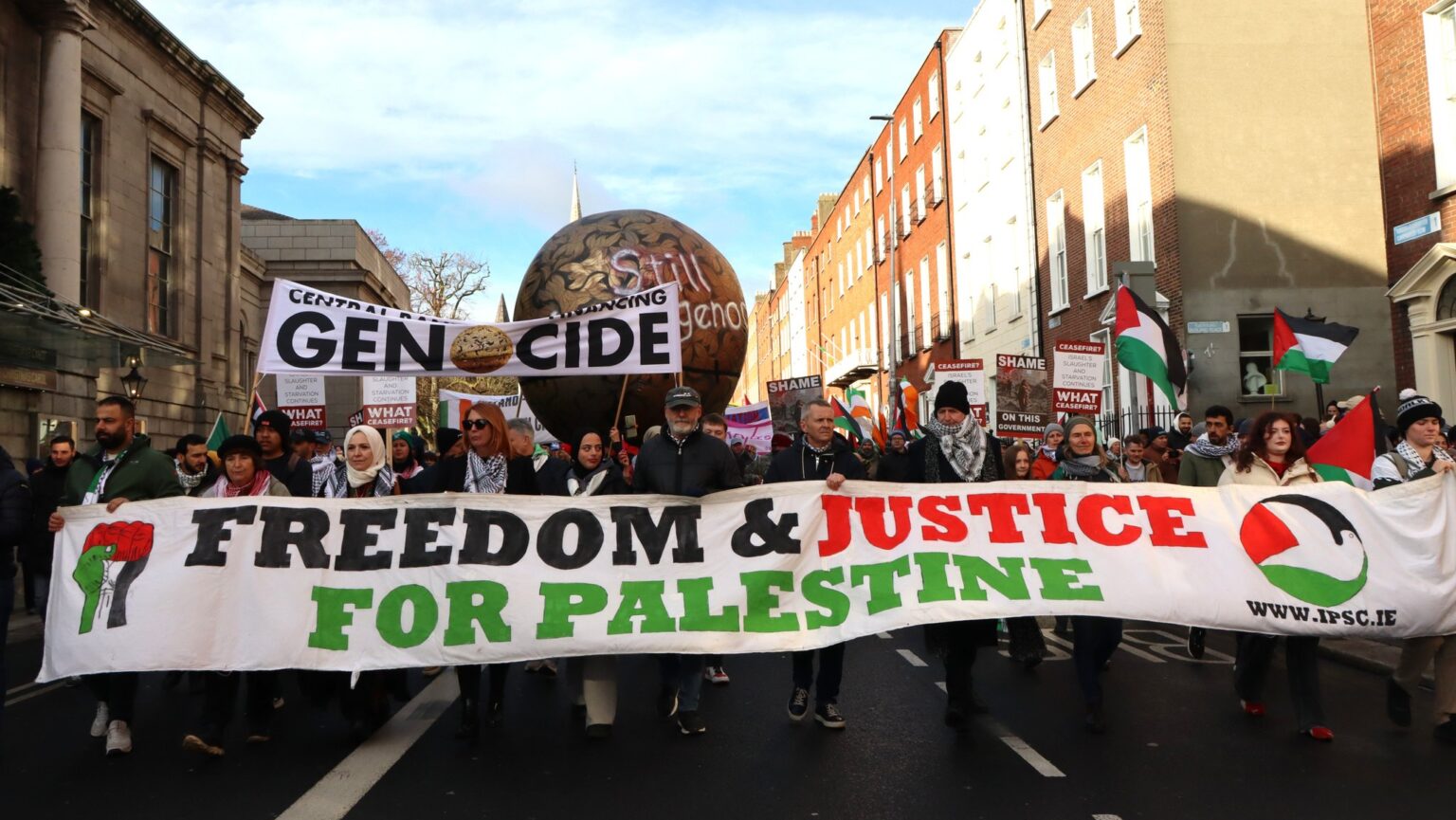
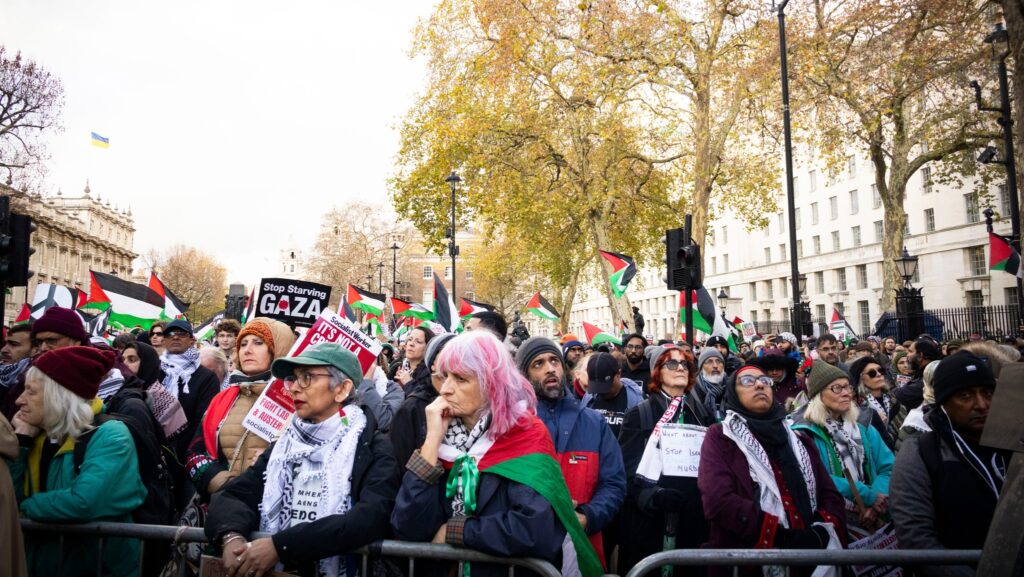
The Palestine solidarity movement in Europe again brought record numbers to the streets on the UN’s International Day of Solidarity with the Palestinian People, November 29, reaffirming demands for an end to government complicity in the ongoing genocide in Gaza and the occupation of Palestine. Hundreds of thousands marched across the region, with demonstrations in London and Rome each reaching an estimated 100,000 participants.
“On this day, people around the world express their support for the inalienable rights that are currently denied to Palestinians: the right to live free from discrimination, the right to self-determination, and the right to return to their lands,” the Palestine Solidarity Campaign (PSC) wrote on social media. “Despite this Britain continues to arm Israel and refuses to implement meaningful sanctions or end its diplomatic support. It still provides parts for Israel’s F-35 fighter jets, used to bomb Palestinians in Gaza and maintains contracts with Israeli weapons manufacturers like Elbit Systems.”
Saturday’s demonstration was the 33rd national march for Palestine in Britain. In addition to local activists, it also welcomed international guests who have stood with Palestinians since the beginning of the genocide, including Belgian MEP Marc Botenga of the Workers’ Party of Belgium (PTB-PVDA), French parliamentarian Nadège Abomangoli of France Unbowed (LFI), and Sinn Féin leader Mary Lou McDonald. While addressing the crowd in London, they emphasized the internationalist character of the mobilization and echoed demands that could be heard in their home countries around the same time.
As thousands marched in Paris and Dublin, they insisted on the need to continue organizing despite political obstruction and attacks. Irish actor Liam Cunningham, a vocal supporter of Palestine, helped lead Dublin’s demonstration. Responding to artists being de-platformed for speaking out against genocide, he said: “If anyone doesn’t want to employ me because I’ve taken a stand against injustice, against the refusal to give self-determination to a group of people who are politically, culturally on the same track that my country was on for 800 years […] they’re not going to be very good at their job, because they’ve no soul.”
Another recurring message across Europe refused the mainstream media allegation of a “ceasefire” in Gaza. “There’s no ceasefire just because it’s written on a Western media banner,” Cunningham added. “Let’s come up with another word, ‘ceasefire’ is not working.”
In Italy, the central mobilization followed a successful day of general strike organized by the grassroots union Unione Sindacale di Base (USB). The march welcomed UN Special Rapporteur Francesca Albanese and Freedom Flotilla activists Greta Thunberg and Thiago Ávila. Dockworkers and firefighters affiliated with USB, who have played key roles in earlier protests and faced reprisals for this, also formed notable protest blocs. The response of Italy’s political establishment to growing support for Palestine mirrors that of other European governments: attempting to suppress dissent and insisting that further militarization is the only path forward.
Palestine solidarity march in London, November 29, 2025. Source: Marc Botenga/Facebook
“Today we see what this path has created: a genocide, broadcast live, carried out with the complicity of Western governments; massacres in the Mediterranean; NATO wars; bombs across the world,” said Marta Collot, spokesperson for the left party Potere al Popolo, during the Rome demonstration. “But something has changed too. The September mobilizations, the three general strikes called by USB that brought everything to a halt, and our march today show that they were wrong […] Our demonstration is the message coming from Palestine, from socialist Cuba resisting, from Venezuela. It shows that an alternative path is not only necessary, but that it’s possible.”
“Today there are two Europes,” Marc Botenga emphasized in London. “There is the Europe of the establishment, the Europe of the governments that have funded this genocide, that have supported this genocide, and that are continuing to do so. And then, there’s the other Europe, there’s the Europe that we incarnate here today. That is the Europe of liberation, the Europe that says no to occupation.”
Orcas discuss Genocide-supporting and complicit Zionists. Donald Trump, Keith Starmer, David Lammy, Rachel Reeves, Angela Rayner and Wes Streeting are acknowledged as evil genocide-complicit and supporting cnuts.Genocide denier and Current UK Prime Minister Keir Starmer is quoted that he supports Zionism without qualification. He also confirms that UK air force support has been essential in Israel’s mass-murdering genocide. Includes URLs https://www.declassifieduk.org/keir-starmers-100-spy-flights-over-gaza-in-support-of-israel/ and https://youtu.be/O74hZCKKdpAKeir Starmer objects to criticism of the IDF. He asks how could anyone object to them starving people to death, forced marches like the Nazis did, bombing Gaza’s hospitals and universities, mass-murdering journalists, healthworkers and starving people queuing for food, killing and raping prisoners and murdering children. He calls for people to stop obstructing his genocide for Israel.
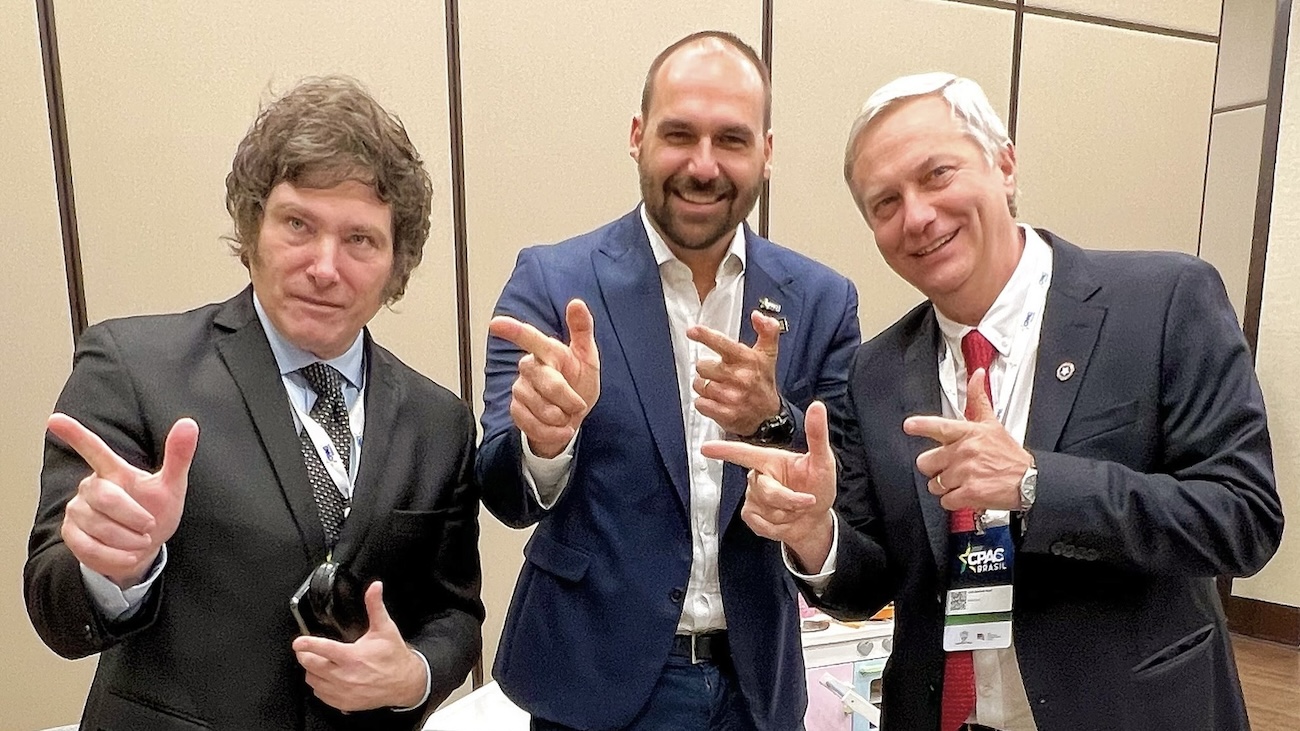
Argentine President Javier Milei, Brazilian legislator Eduardo Bolsonaro, and Chilean far-right presidential candidate José Antonio Kast at CPAC Conference in 2022. Photo: Eduardo Bolsonaro / X
The far right in Latin America is angry. Brazil’s Jair Bolsonaro and Argentina’s Javier Milei always look furious, and they always speak loudly and aggressively. Testosterone leaks from their pores, a toxic sweat that has spread across the region. It would be easy to say that this is the impact of Donald Trump’s own brand of neo-fascism, but this is not true. The far right has much deeper pedigrees, linked to the defense of the oligarchical families that have roots in the colonial era across the virreinatos (viceroyalties) from New Spain to Rio de la Plata. Certainly, these far right men and women are inspired by Trump’s aggressiveness and by the entry of Marco Rubio, a furious defender of the far right in Latin America, to the position of US Secretary of State. This inspiration and support are important but not the reason for the return of the far right, an angry tide that has been growing across Latin America.
On the surface, it looks as if the far right has suffered some defeats. Jair Bolsonaro is in prison for a very long time because of his role in the failed coup d’état on January 8, 2023 (inspired by Trump’s own failed coup attempt on January 6, 2021). In the first round of the presidential election in Chile, the candidate of the Communist Party, Jeannette Jara won the most votes and will lead the center-left bloc into the second round (December 14). Despite every attempt to overthrow the government of Venezuela, President Nicolás Maduro remains in charge and has mobilized large sections of the population to defend the Bolivarian Revolution against any threats. And, in late October 2025, most of the world’s countries voted for a UN General Assembly resolution that demands an end to the blockade on Cuba. These indicators – from Bolsonaro’s imprisonment to the vote on Cuba – suggest that the far right has not been able to move its agenda in every place and through every channel.
However, beneath the surface, there are indications that Latin America is not seeing the resurgence of what had been called the Pink Tide (after the election of Hugo Chávez in Venezuela in 1998) but is experiencing the emergence of an angry tide that slowly has begun to sweep the region from Central America down to the Southern Cone.
Elections in South America
The first round of the Chilean presidential election produced a worrying result. While Jara of the Communist Party won 26.85% of an 85.26% turnout, the far right’s José Antonio Kast came in second with 23.92%. Evelyn Matthei of the traditional Right won 12.5%, while the extreme right candidate who was once with Kast and now to his right, Johannes Kaiser, won 14%. It is likely that Jara will pick up some of the votes of the center, but not enough to overcome the advantage of the far right which looks to have at least more than 50% of the voters on its side. The so-called social liberal, Franco Parisi, who came in third, endorsed Kast in 2021 and will likely endorse him again. That means that in Chile, the presidency will be in the hands of a man of the far right whose ancestry is rooted in German Nazism (Kast’s father was a member of the Nazi Party who escaped justice through the intercession of the Vatican) and who believes that the dictatorship in Chile from 1973 to 1990 was on balance a good idea.
North of Chile, in Bolivia, the new president Rodrigo Paz Pereria, son of a former president, beat the far right’s Jorge Tuto Quiroga (a former president) in the second round of the election. This round had no candidate of the left, after the Movement for Socialism governed Bolivia continuously from 2006 to 2025. Paz’s own party has a minority position in the legislature and he will therefore have to align himself with the Quiroga’s Libre coalition and he will likely adopt a pro-US foreign policy and a libertarian economic policy. Peru will have its own election in April, where the former mayor of Lima – Rafael López Aliaga – is expected to win. He rejects the label far right but adopts all the generic policies of the far right (ultra-conservative Catholic, advocate for harsh security measures, and favors a libertarian economic agenda). Iván Cepeda of Colombia is the left’s likely candidate in their presidential election in May 2026, since Colombia does not permit second terms (so President Gustavo Petro cannot run again). Cepeda will face strong opposition from Colombia’s oligarchy which will want to return the country to their rule. It is too early to say who Cepeda will face, but it might be journalist Vicky Dávila, whose far right opposition to Petro is finding traction in unexpected parts of Colombian society. It is likely that by the middle of 2026, most of the states along the western edge of South America (from Chile to Colombia) will be governed by the far right.
Even as Bolsonaro is in prison, his party, the PL (or Liberal Party), is the largest bloc in Brazil’s National Congress. It is likely that Lula will be re-elected to the presidency next year due to his immense personal connection with the electorate. The far right’s candidate – who could be possibly Tarcísio de Freitas, the governor of São Paulo state, or one of the Bolsonaro’s (wife Michelle or son Flavio) – will struggle against him. But the PL will make inroads into the Senate. Their control over the legislature has already tightened the reins on the government (at COP30, Lula’s representative made no proposals to confront the climate catastrophe), and a Senate win will further their control over the country.
Common agenda of the angry tide
The Angry Tide politicians who are making waves have many things in common. Most of them are now in their fifties – Kast (born 1966), Paz (born 1967), Venezuelan politician María Corina Machado (born 1967), and Milei (born 1970). They came of age in the post-dictatorship period in Latin America (the last dictatorship to end was in Chile in 1990). The decade of the 1990s continued the economic stagnation that characterized the 1980s: the Lost Decade (La Década Perdida) that convulsed these countries with low growth rates and with poorly developed comparative advantages forced into globalization. It was in this context that these politicians of the Angry Tide developed their common agenda:
Anti-Communism. The far right in Latin America is shaped by an anti-left agenda that it inherits from the Cold War, which means that its political formations typically endorse the era of US-backed military dictatorships. The ideas of the left, whether from the Cuban Revolution (1959) or from the era of the Pink Tide (after 1998), are anathema to these political forces; these ideas include agrarian reform, state-led finance for industrialization, state sovereignty, and the importance of trade unions for all workers and peasants. The anti-communism of this Angry Tide is rudimentary, mother’s milk to the politicians and used cleverly to turn sections of society against others.
Libertarian Economic policies. The economic ideas of the Angry Tide are shaped by the Chilean “Chicago Boys” (including Kast’s brother Miguel who was the head of General Augusto Pinochet’s Planning Commission, his Minister of Labor, and his head of the Central Bank). They directly take their tradition from the libertarian Austrian School (Friedrich Hayek, Ludwig von Mises, and Murray Rothbard as well as Milton Friedman). The ideas were cultivated in well-funded think tanks, such as the Centro de Estudios Macroeconómicos de Argentina (founded in 1978) and the Chilean Centro de Estudios Públicos (founded in 1980). They believe the State should be a force to discipline the workers and citizens, and that the economy must be in the hands of private interests. Milei’s famous antics with a chainsaw illuminate this politics not only of cutting social welfare (the work of neoliberalism) but of destroying the capacity of the State itself.
Culture Wars. Drawing on the wave of anti-gender ideology and anti-migration rhetoric, the Angry Tide has been able to appeal to conservative evangelical Christians and to large sections of the working class that has been disoriented by changes seen to come from above. The far right argues that the violence in working class neighborhoods created by the drug industry is fostered by “liberalism” and that only tough violence (as demonstrated by El Salvador’s president Nayib Bukele) can be the solution; for this reason, they want to strengthen the military and police and set aside constitutional limitations on use of force (on October 28, the government of Bolsonaro ally Cláudio Castro in Rio de Janeiro sent in the police who killed at least 121 people in Operation Containment). It helps the far right that it adopted various conspiracy theories about how the “elites” have spread “globalized” ideas to damage and destroy the “culture” of their nations. This is a ludicrous idea coming from far right and traditional right political forces that champion full-scale entry of US corporations into their society and culture, and that have no respect for the histories of struggle of the working class and peasantry to build their own national and regional cultural worlds. But the Angry Tide has been able to construct the idea that they are cultural warriors out to defend their heritage against the malignancies of “globalization”. Part of this culture war is the promotion of the individual entrepreneur as the subject of history and the denigration of the necessity of social reproduction.
It is these three elements (anti-communism, libertarian economic policies, and the culture wars) that brings together the far right across Latin America. It provides them with a robust ideological framework to galvanize sections of the population to believe that they are the saviours of the hemisphere. This Latin American far right is backed by Trump and the international network of the Spanish far right (the Foro Madrid, created in 2020 by Fundación Disenso, the think tank of the far right Vox party). It is heavily funded by the old elite social classes, who have slowly abandoned the traditional Right for these new, aggressive far right parties.
Crisis of the Left
The Left is yet to develop a proper assessment of the emergence of these parties and has not been able to drive an agenda that sparkles with vitality. A deep ideological crisis grips the Left, which cannot properly decide whether to build a united front with the traditional right and with liberals to contest elections or to build a popular front across the working class and peasantry to build social power as a prelude to a proper electoral push. The example of the former strategy (the electoral alliance) comes from Chile, where first the Concertación de Partidos por la Democracia (Concertación) formed in 1988 to keep out the parties of the dictatorship from power and second the Apruebo Dignidad formed in 2021 that brought Gabriel Boric of the centrist Broad Front to the presidency. But outside Chile, there is little evidence that this strategy works. The latter has become harder as unionization rates have collapsed, and as uberization individualizes the working class to erode working class culture.
It is telling that Bolivia’s former socialist Vice President Álvaro García Linera looked northwards to New York City for inspiration. When Zohran Mamdani won the mayor’s race, García Linera said, “Mamdani’s victory shows that the left must commit to boldness and a new future.” It is hard to disagree with this statement; although, Mamdani’s own proposed agenda is mostly to salvage a worn-out New York infrastructure rather than to advance the city to socialism. García Linera did not mention his own time in Bolivia, when he tried with former president Evo Morales to build a socialist alternative. The left will have to be bold, and it will have to articulate a new future, but it will have to be one that emerges from its own histories of building struggles and building socialism.
Donald Fuhrump says that Amerikkka doesn’t bother with crimes or charges anymore, not being 100% Amerikkkan and opposing his real estate intentions is enough.