Climate activist targets Conservative election bus in protest at the government’s failure to adopt more ambitious climate policies
A Greenpeace activist climbed on to the top of the Conservative’s campaign bus this afternoon and unfurled a banner reading ‘Clean Power Not Paddy Power’, in protest at both the election date betting scandal engulfing the government and the Prime Ministers’ failure to deliver more ambitious climate policies.
Amy Rugg-Easey was able to get on to the bus at a campaign stop near Ollerton in Nottinghamshire, ahead of Prime Minister Rishi Sunak’s appearance in the last televised debate of the campaign, which is being hosted by BBC in Nottingham this evening.
“We’ve had enough of this government lurching from one scandal to the next, while gambling with our future,” Rugg-Easey said in a statement. “We need clean power, not Paddy Power.
“Fourteen years of Conservative governments has left this country broken. Sunak has gone backwards on climate action, ditching key pledges and promising to ‘max out’ the climate-wrecking oil and gas that are the cause of the cost-of-living crisis and our unaffordable bills. Our rivers are awash with sewage, and our economy, NHS and public services are on their knees.
“Enough is enough. We’ve climbed onto Sunak’s battle bus today to remind the British public that it is the Conservative government’s consistent failure to deliver greener, fairer policies that has created the mess we’re in. Don’t back the wrong horse – a vote for the climate is a vote for a better future.”
Rishi Sunak on stopping Rosebank says that any chancellor can stop his huge 91% subsidy to build Rosebank, that Keir Starmer is as bad as him for sucking up to Murdoch and other plutocrats and that we (the plebs) need to get organised to elect MPs that will stop Rosebank.Image of InBedWithBigOil by Not Here To Be Liked + Hex Prints from Just Stop Oil’s You May Find Yourself… art auction. Featuring Rishi Sunak, Fossil Fuels and Rupert Murdoch.
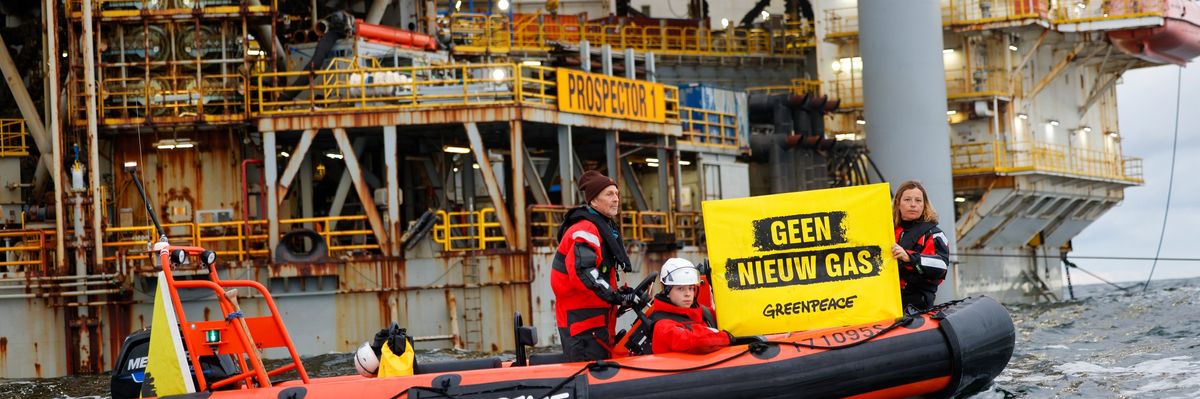
Greenpeace activists from Germany and the Netherlands hold up a “No New Gas” placard next to an gas drilling platform that they occupied on June 4, 2024. (Photo: Axel Heimken/Greenpeace)
“Today’s events show that people power works!” a campaigner said. “Whether it is occupying a gas rig or challenging it in court, people will not be silent, we are standing up to the fossil fuel industry.”
A Dutch court on Tuesday ordered a pause to a gas drilling initiative in the North Sea after Greenpeace activists occupied a platform owned by the company behind the project, leading the environmental group to declare “victory” as it pushes for an end to new fossil fuel infrastructure in Europe.
The activists sought to disrupt the work of Dutch energy company ONE-Dyas, which had just received the go-ahead for offshore drilling from the Dutch government last week and quickly sent the drilling platform to the site, which is about 12 miles from the German island of Borkum and straddles Dutch and German waters.
“The science is clear, we must stop digging and drilling for fossil fuels if we are to avoid the worst of climate chaos,” Mira Jaeger, energy expert from Greenpeace Germany, said in a statement released earlier on Tuesday, before the court decision. “We cannot afford any new fossil fuel extraction projects. Not in the North Sea or anywhere else.”
“Today’s events show that people power works!” Jaeger said in another statement following the ruling. “Whether it is occupying a gas rig or challenging it in court, people will not be silent, we are standing up to the fossil fuel industry.”
🔊VICTORY: The gas drilling platform currently occupied by @greenpeace_de and @greenpeaceNL activists has been ordered to stop their drilling activities by a Dutch court.
— Greenpeace International (@Greenpeace) June 4, 2024
Greenpeace, an environmental group that engages in nonviolent direct action, has previously occupied oil and gas rigs in the North Sea and elsewhere. Last year, the group’s campaigners occupied a platform contracted by Shell, a multinational oil and gas company, as it made its way to work in U.K. waters.
The planned Borkum drilling project, which Greenpeace has said would threaten rocky reefs and a local nature reserve, has been the subject of a legal and regulatory fight in recent years. Environmental and community groups filed a lawsuit against it in Dutch court, and a judge halted the project for over a year starting in April 2023. However, following court-ordered changes, the Dutch state secretary for economic affairs and climate approved the project last week. On Monday, Offshore Energy, a trade publication, declared that the project, which it said involves an investment of more than $500 million, had “no more legal woes” and would produce gas by the end of the year. A Dutch official noted the importance of a domestic supply of natural gas in approving the project, Offshore Energy reported.
With the company moving quickly, Greenpeace activists aimed to block the installation of the platform on Tuesday. Five of the 21 who went to sea for the action occupied the platform, called Prospector 1, and tied themselves to pillars, according to Greenpeace. The occupation lasted 8 hours, ending when news came of the court ruling.
Tuesday’s ruling suspended the approval granted by the Dutch state secretary for economic affairs, and is to be followed by a hearing on June 12. The decision came at the request of environmental and community groups, which submitted an application on Friday for “provisional relief.” The groups aim to block the drilling initiative entirely, arguing that ONE-Dyas should abandon its “legal tricks” and “accept reality and abandon the project.”
Greenpeace, which was one of the plaintiffs in the application, reiterated its demand on Tuesday that the project be permanently canceled, while calling for the E.U. to abandon all fossil fuel infrastructure projects.
“The Borkum project is just the tip of the iceberg: in Europe, fossil fuel companies are pushing European states into such massive, unnecessary investments just like TotalEnergies’ LNG terminal in France, or OMV’s Neptun Deep gas drilling project in Romania,” the first Greenpeace statement said. “But the European Union can and must put its member states on a path away from fossil fuels, by banning new fossil fuel projects and investing in an energy system based on renewables and energy sufficiency.”
How do Labour, Conservatives, Greens and Lib Dems compare on their promises for the environment
Groups and campaigners have called on parties to make climate and nature a core issue at the general election as meticulous scrutiny begins on party policies ahead of the general election.
Party manifestos are yet to be published, however environmental experts at Friends of the Earth have scored Labour, the Conservatives, Greens and the Lib Dems on their green commitments so far.
It comes as no surprise that the Conservative Party have come in a dismal last, scoring pretty disastrously on most of the ten policy areas analysed. Campaign group Greenpeace recently slammed the Tory Party for leaving the country, “crumbing, bereft of hope, and its climate record in tatters” after the last 14 years.
Most alarmingly the Tory Party scored the only 0 out of 10 in the category of ‘defending democracy’ based on its recent introduction of draconian legislation clamping down on protest.
Also unsurprisingly the Green Party came in top, with the Lib Dems second and Labour third. Labour’s commitment to creating Great British Energy has been praised by green campaigners. However Friends of the Earth has said the party must go further, as its score lagged behind the Lib Dems and Greens and “falls well short of what’s needed to deliver on the climate and nature emergencies”.
Friends of the Earth stressed that the ratings are a snapshot of the current moment, and policies published in the coming weeks will better reveal how the party’s commitments shape up in real terms.
Overall, the environmental group scored the Conservatives 27/100, Labour 51/100, the Lib Dems 68/100 and the Green Party 82/100.
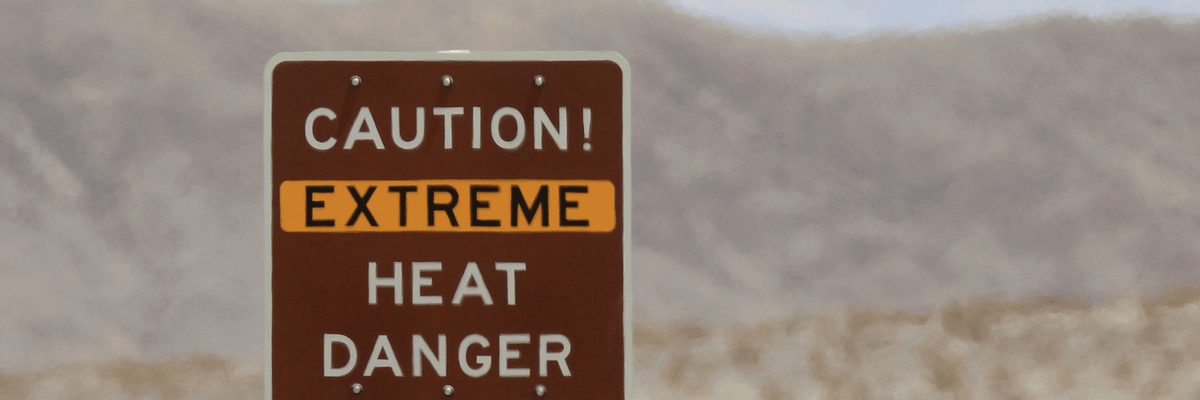
Heat waves rise near a heat danger warning sign in Death Valley National Park, California. (Photo: David McNew/Getty Images)
“These are not your grandparents’ heatwaves,” said one meteorologist.
Millions of people in the United States are facing the high likelihood of extreme heat in the coming weeks, with northern states that frequently have relatively temperate summers among those where higher-than-average temperatures are expected this summer, according to federal data.
As The Guardian reported Monday, the National Oceanic and Atmospheric Administration’s (NOAA) new predictions for the summer months state that most of New Mexico and Utah have a 60%-70% chance of hotter-than-normal weather, along with parts of Arizona, Texas, and Colorado.
Houston and the surrounding area has already experienced spiking temperatures that were tied to a heat dome that was positioned over Mexico for several weeks. The high atmospheric pressure drove record-breaking heat across Mexico and in Texas, as well as a powerful storm earlier this month that killed at least seven people and left hundreds of thousands of people in the Houston area without power.
NOAA’s Heat Risk tool showed that on Monday, a significant stretch of southern Texas was experiencing an “extreme” level of heat, defined as including “little to no overnight relief” and affecting the health and safety of “anyone without effective cooling and/or adequate hydration.”
The new tool takes into consideration whether the heat is unusual for the time of the year, whether residents get relief with cooler temperatures in the evenings, and whether temperatures pose an elevated risk of health impacts like heat stroke or heat exhaustion.
NOAA found that the entire Northeast, from Maine to New Jersey and Pennsylvania, has a 40%-50% chance of having above-average temperatures from June through August.
Too hot girl summer in a hot climate summer 🥵@noaa released their heat predictions for this summer and, you guessed it, it’s gonna be HOT, hotter than normal, as it has been for the last several years of record-breaking temperatures. #ClimateActionNowpic.twitter.com/NflVEdJINZ
“We can expect another dangerous hot summer season, with daily records already being broken in parts of Texas and Florida,” Kristy Dahl, climate scientist for the Climate and Energy program at the Union of Concerned Scientists, told The Guardian. “As we warm the planet, we are going to see climate disasters pile up and compound against each other because of the lack of resilience in our infrastructure and government systems.”
The predictions come days after the consumer advocacy group Public Citizenreleased a report, Scorched States, about state laws that protect outdoor workers from extreme heat—and those that don’t.
As many as 2,000 U.S. workers die every year from laboring in extreme heat, said Public Citizen, even though “every workplace illness, injury, and fatality caused by heat stress is avoidable, and relatively simple preventative measures—water, shade, and breaks—have proven extremely effective at protecting workers.”
The Occupational Safety and Health Administration’s forthcoming heat standard rules are not expected to be finalized until at least 2026, but states including Washington, Colorado, and Minnesota have issued their own labor laws to protect workers from heat-related injuries.
The Guardian pointed out that the extreme heat expected this summer will likely take hold as the Earth transitions away from El Niño—the natural phenomenon that causes ocean temperatures to rise—and toward La Niña.
“As we transition to La Niña, it still looks to be a potentially record-breaking year. That clearly suggests to me that the anthropogenic signal is there,” James Marshall Shepherd, director of the University of Georgia’s atmospheric sciences program, told The Guardian. “I am also worried about the ocean temperatures, which are very warm, particularly as we approach the Atlantic hurricane season.”
“Attribution studies are pretty decisive that heatwaves will continue to be more intense and frequent” as the planet warms, Shepherd said. “These are not your grandparents’ heatwaves.”
Last year, scientists found that neither the hot and dry conditions that led to destructive wildfires in Canada, nor extreme heatwaves that took hold in Europe and North America, would have been as likely to occur without the planetary heating that’s been linked to continued fossil fuel extraction.