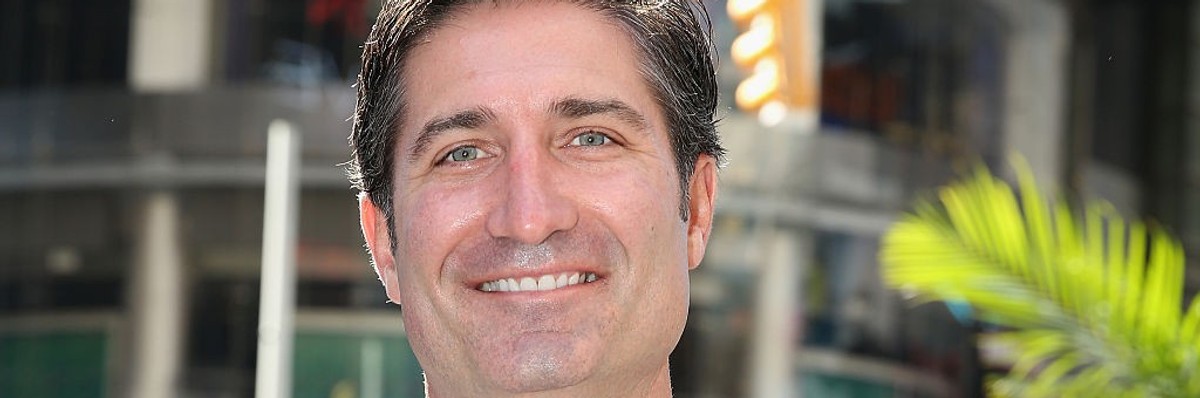
Brian Niccol, seen here in a 2015 photo, is Starbucks’ new CEO. (Photo: Robin Marchant/Getty Images)
“These jets are a stark symbol of social and climate injustice, where a privileged few indulge in the most environmentally damaging form of travel for mere convenience,” said one Greenpeace campaigner.
Green groups’ anger percolated this week after it was revealed that Brian Niccol, Starbucks’ new CEO, will “supercommute” approximately 1,000 miles between one of his homes in California and the coffee giant’s Seattle headquarters three times a week.
A Starbucks spokesperson said earlier this week that “while Brian will have an office in Southern California, his primary office and a majority of his time will be spent in our Seattle Support Center.”
“When he is not traveling for work, he will be in our Seattle office at least three days a week, in alignment with our hybrid work policies,” the spokesperson added. “He will also have a home in Seattle.”
“A private jet flight causes about 10 times more CO2 emissions than a regular flight per flight per person.”
Greenpeace—which for years has been running a campaign to ban private jets and regularly stages protests against them at airports around the world—led condemnation of Niccol’s harmful commute.
“As the world faces unprecedented heatwaves, droughts, floods, and other dire consequences of an accelerating climate crisis, it is unjustifiable for companies to offer company aircraft as employee perks,” Greenpeace campaigner Clara Thompson told The Washington Post on Thursday.
“These jets are a stark symbol of social and climate injustice, where a privileged few indulge in the most environmentally damaging form of travel for mere convenience,” Thompson added.
While most of us are being encouraged to choose a bike or public transport for our commute, these guys are taking a private jet to get to work.
A private jet flight causes about 10 times more CO2 emissions than a regular flight per flight per person, and 50 times more than the average train ride. Eighty percent of the world’s population have never flown, yet they’re the ones most impacted by the climate crisis. In just one hour, a single private jet can emit two tons of CO2. The global average energy-related carbon footprint is around 4.7 tons of CO2 per person per year.
While private jets account for a tiny fraction of global greenhouse emissions, the world’s richest 1% produce more than double the emissions of the poorest 50%, and a single billionaire produces a million times more emissions than an average person, according to a 2022 Oxfam study.
Some critics accused Starbucks—which in 2020 set a goal of reducing carbon emissions by 50% this decade—of hypocrisy, with one social media user contrasting Niccol’s private jet commute with the company’s introduction of widely despised and environmentally dubious paper straws. Another eagle-eyed observer spotted a book titled How to Avoid a Climate Disaster on display in Niccol’s office in a Wall Street Journal article photo.
Shameful for @Starbucks & CEO to fly private jet 1000miles 3x each week. Our forest are on fire; oceans are dying and glaciers are melting. Performative sustainability of banning plastic straws isn't enough
Starbucks CEO faces backlash over 1000mile commute by private jet
GREENPEACE has said that a legal case launched by Shell intended to intimidate it and drain its resources has instead had the opposite effect, with members of the public donating over £1 million to support the NGO.
The group launched the fundraiser last November after Shell announced that it was suing over a peaceful climate protest in the North Sea, in which activists occupied a moving oil platform to protest against the damage caused by the oil giant.
Although Shell, which reported a record £22.3 billion in profits last year, acknowledges no damage was caused to its equipment, it is still demanding extensive damages.
Donations are being used to fight the case and to campaign for oil giants to “stop drilling and start paying” for the environmental damage they have caused.
Almost 25,000 donations were received in just nine months, and the funds raised now exceed the amount Shell is seeking in damages ($1m, or £789,000), although it is likely legal costs will run into the millions.
Greenpeace UK campaigner Philip Evans said: “Shell’s attempt to intimidate us is only making us stronger.
Dakota Access Pipeline protesters rally at Standing Rock Indian Reservation on February 22, 2017. (Photo: Michael Nigro/Pacific Press/LightRocket via Getty Images)
“No matter who you are, no matter what your politics are, this is one of the most important issues in America right now,” one Greenpeace spokesperson said.
Nearly 300 organizations and tens of thousands of individuals have signed an open letter supporting Greenpeace USA against a $300 million lawsuit brought against the environmental group by Energy Transfer—a company with a majority stake in the Dakota Access pipeline.
The corporation is falsely accusing Greenpeace of being the driving force behind Indigenous-led protests against the Dakota Access pipeline (DAPL) in 2016 and 2017.
Greenpeace USA announced its supporters on Thursday as it launched a campaign to raise awareness about the lawsuit—which it said could “functionally bankrupt” the organization, threatening its “existence.” However, Greenpeace said that the dangers posed by strategic lawsuits against public participation (SLAPPs), like the one it faces, extend far beyond one organization.
“No matter who you are, no matter what your politics are, this is one of the most important issues in America right now,” Greenpeace USA spokesperson Rolf Skar said in a statement. “Energy Transfer built the Dakota Access pipeline. But they’re suing anyway in order to send a message: If you dare to oppose us, we will financially ruin you.”
We’re being sued by Big Oil @EnergyTransfer for $300 million. It’s an abusive lawsuit designed to end Greenpeace’s 50-year legacy of environmental activism. But it’s not just a threat to our existence. Learn more: pic.twitter.com/YrtObvuVKm
The Dakota Access pipeline drew massive protests from the Standing Rock Sioux Tribe, more than 300 other tribal nations, and non-Indigenous allies. While former U.S. President Donald Trump forced the pipeline through shortly after taking office in early 2017, the protests rattled the fossil fuel industry and their allies in government. After 2016, 18 states passed anti-protest laws that shielded around 60% of U.S. oil and gas production and related infrastructure from peaceful protests. The industry also turned to “judicial harassment.”
Energy Transfer (ET) initially brought suits against Standing Rock Tribal Chairman Dave Archambault and other Water Protectors, as well as a federal suit against Greenpeace in 2017.
At the time, ET CEO Kelcy Warren told a reporter: “Could we get some monetary damages out of this thing, and probably will we? Yeah, sure. Is that my primary objective? Absolutely not. It’s to send a message—you can’t do this, this is unlawful, and it’s not going to be tolerated in the United States.”
“Everyone who says they care about freedom—of whatever political stripe—should join together to support the Greenpeace campaign to protect people’s right to speak out against corporate abuses.”
While the 2017 cases were all dismissed, ET immediately filed a similar case against Greenpeace in North Dakota state court in 2019. The new case, which is scheduled to go to trial in February 2025, makes what Greenpeace called a “deeply racist” case that Greenpeace, and not Indigenous leaders, coordinated the Dakota Access protests.
“The lawsuit against Greenpeace is also an attack on the Indigenous movement in our fight for self-determination to protect Mother Earth, our waters, sacred and cultural sites, and our youth and future generations,” Morgan Brings Plenty of the Standing Rock Youth Council said in a statement. “These colonialist lawsuits are trying to send a warning to anyone who might consider speaking out and to be quiet—any of you could be next.”
ET also makes several claims that would set a dangerous precedent if upheld, including denouncing legitimate speech as defamatory and making anyone who is present at a protest liable for things that occurred at the same protest.
“The whole point of this type of lawsuit is to limit freedom of expression, so even if you don’t care about climate change, or you don’t care about Greenpeace, you should pay attention,” Skar said. “What’s at stake isn’t just Greenpeace or environmentalism, but the fundamental American rights to freedom of peaceful expression and advocacy for all of us.”
Greenpeace has circulated a letter to ET that has so far been signed by more than 290 organizations—including 350.org, Public Citizen, ACLU North Dakota, SEIU, Indigenous Environmental Network, and Amnesty International USA—and tens of thousands of individuals, including prominent celebrities and activists like Jane Fonda, Susan Sarandon, Billie Eilish, and Adam McKay.
“This is corporate overreach that is part of a disturbing trend of attacks on advocacy and speech around the world,” the letter reads. “We will not allow lawsuits like this one to stop us from advocating for a just, green, and peaceful future. On the contrary, we will ensure they have the opposite effect, increasing the support for organizations like Greenpeace and strengthening the broader movement for justice.”
“This legal attack on Greenpeace is an attack on us all,” the letter continues. “We will not stand idly by. We will not be bullied. We will not be divided and we will not be silenced.”
Organizations also issued individual statements of support.
“Everyone who says they care about freedom—of whatever political stripe—should join together to support the Greenpeace campaign to protect people’s right to speak out against corporate abuses,” said Robert Weissman, co-president of Public Citizen. “As Greenpeace knows from its own experience, too often corporations use their political, economic, and legal power not just to run PR campaigns justifying their wrongdoing, but to threaten public interest advocates with bad-faith lawsuits (SLAPPs) and other intimidation tactics.”
Brian Hauss, a senior staff attorney for the ACLU, said: “Protesters and advocacy groups should never have to fear the weight of groups like ETP as a condition for expressing their First Amendment rights. The court should see this lawsuit for what it is and toss it.”
Progressives are also calling for a national legislative solution to the problem of SLAPP suits. While most states do have laws on the books against them, North Dakota is one of the 18 that do not.
“The case against Greenpeace illustrates how mega-corporations can use lawsuits to silence, intimidate, and ruin their critics,” Raskin said. “America must demand, and Congress must pass, bipartisan legislation to protect First Amendment rights against ruinous litigation practices.”
Geenpeace activists set up a billboard during a protest outside Shell headquarters amid the company’s profits announcement on July 27, 2023 in London, England. (Photo: Handout/Chris J Ratcliffe for Greenpeace via Getty Images)
“We cannot let countries and communities that have done the least to cause climate change pay the price for Shell’s greed,” one green group said.
A little more than a week after Earth endured its four hottest days on record, fossil fuel giant Shell announced higher second-quarter profits than expected at $6.3 billion.
The company also announced a new share buyback program worth $3.5 billion through September, CNBC reported.
“It is shameful that Shell, as one of the world’s largest and most profitable fossil fuel companies, continues to reap billions in profits off the back of its planet-wrecking oil and gas operations,” Chiara Liguori, the senior climate justice policy adviser at Oxfam Great Britain, said in response to the news. “At a time when the company should be taking strong action to cut emissions it is instead weakening its climate targets and continues to invest in new oil and gas projects, in favor of short-term shareholder returns.”
“That the profits of two companies alone can outweigh the GDP of six countries already being battered by the climate crisis lays bare the shameful inequity at the heart of the fossil fuel economy.”
Shell’s announcement covers the months of April through June 2024. While the company made 19% less than it did during the first three months of the year, it made $400 million more than London Stock Exchange Group predicted for the quarter, according to CNBC.
A Global Witness analysis concluded that Shell paid $23 billion to shareholders since June 2023. Every month in that same 13-month period saw temperatures averaging 1.5°C or more above preindustrial levels—the more ambitious temperature goal enshrined in the Paris agreement. Each month in that stretch was also the hottest of its kind on record.
“Wildfires raging across the Arctic Circle and temperature records breaking by the day should be a wake-up call,” Greenpeace U.K. said on social media. “But Shell continues to bank billions from digging up climate-wrecking fossil fuels.”
Shell’s announcement caps a month in which high global temperatures fueled a number of extreme weather events. July began with Hurricane Beryl forming as the earliest ever Category 4 and Category 5 Atlantic hurricane on record, before it devastated several Caribbean islands. Last week, a fast-moving wildfire forced more than 20,000 people to flee historic Jasper in the Canadian Rockies before it destroyed nearly a third of the town. The same week, Typhoon Gaemi dumped more than 1,000 millimeters of rain on Taiwan in less than 24 hours.
“As people flee wildfires in Canada, floods in Taiwan, and rebuild in the wake of Storm Beryl, Shell is doubling down on fossil fuels, U-turning on renewables, and profiting to the tune of billions from an intensifying climate crisis,” Alice Harrison, head of Fossil Fuel Campaigns at Global Witness, said in a statement.
Shell’s announcement also comes days after BP posted $2.8 billion in second-quarter profits.
Global Witness calculated that BP and Shell’s second-quarter profits combined would be enough to pay one-tenth of the $100 billion in climate-related loss and damage money that developing nations have requested by 2030.
At the same time, the two oil giants’ profits over the past year—£31.2 billion ($39.8 billion)—exceed the £27.7 ($35.3) billion combined gross domestic products of the six nations most impacted by Beryl: Barbados, the Cayman Islands, Dominica, Jamaica, St. Vincent and the Grenadines, and Grenada, according to Global Justice Now.
“That the profits of two companies alone can outweigh the GDP of six countries already being battered by the climate crisis lays bare the shameful inequity at the heart of the fossil fuel economy,” Izzie McIntosh, climate campaigner at Global Justice Now, said in a statement. “People in the Caribbean devastated by the impacts of Hurricane Beryl are left to pick up the pieces, while rich shareholders and fossil fuel CEOs get to rake in the profits, removed from the chaos they’ve played a leading role in creating.”
The climate justice organizations called for governments to take action to stop fossil fuel companies before they can further destabilize Earth’s climate.
“We need accountability and a government that isn’t afraid to stand up to them—it can start by introducing measures to make these polluting megacorporations pay up for the climate damage they’ve caused in the Global South, as well as a fossil fuel phaseout,” McIntosh continued.
Harrison agreed: “We can’t keep letting polluters off the hook. Governments should be holding fossil fuel majors to account for the crisis they created and forcing them to pay for the damage they are inflicting on millions of families around the world.”
Oxfam G.B. and Greenpeace U.K. recommended policies for the United Kingdom—where Shell and BP are headquartered—specifically.
“As global temperatures and the huge costs of tackling the climate crisis continue to rise, the U.K. government has a chance to ensure those most responsible for contributing to global greenhouse gas emissions, like Shell, are held to account by taxing them more,” Liguori said. “This could help raise the vital funds needed to ensure a fair switch to clean, renewable energy in the U.K. as well as fulfilling our international commitments to support communities worst-hit by climate change to adapt and recover.”
Greenpeace concluded: “We cannot let countries and communities that have done the least to cause climate change pay the price for Shell’s greed. The new Labour government must prove it is different to its predecessor by reining in the fossil fuel giants and imposing bold new taxes on polluters to force them to pay their climate debts at home and abroad.”
Just Stop Oil are being branded “fanatics” for disruptive actions whose like hardly raised an eyebrow a decade ago
I wasn’t terribly surprised to see, in the weekend Morning Star, a letter suggesting that while the sentencingof theJust Stop Oil Five was overly harsh, they deserved punishment for their conspiracy to disrupt traffic on the M25.
The Star is, to be fair, generally quite supportive of JSO’s right to protest, while having some knee-jerk types in its readership, particularly in the crusty old tankie set. But such complaints get at the heart of an issue JSO has had for some time — they’re often really annoying even for their nominal allies.
Many of them are quite posh and can sound patronising or smug. Their targets are disruptive but less often to the wealthy and more to a cross-class cohort of art lovers, or pagans, or sports enthusiasts, or holiday makers. And motorists, of course. Roger Hallam, as their most famous face, often acts like a self-aggrandising edgelordwhose projects have a habit of getting people in trouble without much of a plan for long-term support.
It sometimes makes JSO hard to love, and it gives grouches in politics and the media an excuse to label them attention seekers, or cultists, or extremists.
But here’s the thing: for all their PR controversies, JSO aren’t actually extreme at all, and not only in comparison to, say, cops throwing their weight around on a Friday night, or any major event that gridlocks a city centre. Comparing them to similar campaigns from the 1990s or even the early 2000s, JSO are tamer than Lassie. The anti-roads movement,Animal Liberation Front, Earth First!,Reclaim The Streets, even Greenpeace — have all mounted considerably more disruptive campaigns within living memory. You can find reports on some of them in old issues of Freedom and Schnews.
In fact, a quick look through the latter’s archive for mentions of the M25 very quickly turns up this articlefrom 2012, with the Tories already in power, which notes the following action:
On Monday 16th July a Greenpeace co-ordinated swoop saw seventy-seven petrol stations within the M25 shut down, and another thirteen in Edinburgh - hitting Shell on the forecourt and in their pockets. Activists disassembled the emergency fuel shut off switches and chained the pumps together, stopping business for the day.
Twelve years ago, shutting down nearly the entire refuelling system around London and Edinburgh wasn’t considered big enough to fluster the Graun, which reported the whole thing as just another news story for the day. Shell were careful to say they respected the protesters’ views, and the police didn’t even bother to comment! My goodness what a difference a few years makes. Can you imagine the level of dribbling outrage the press would indulge in now?
This impressive gap in the treatment of disruptive protests on the same road is symptomatic of an issue touched on in a recent Freedom discussion, which has been worsening for a long time and accelerated, strangely, alongside the culture wars. While the left was accused of going woke and indulging in cancel culture, the right was becoming so pathetically unable to handle confrontation that it changed the laws to jail people for being annoying. Part of Suella Braverman’s anti-protest law(since struck down) literally gave police the power to break up protests for being “too noisy”.
And now we’re at the point where Hallam and co. are being jailed for 4-5 years each for conspiracy to disrupt the flow of traffic. But what’s worse is they’ve managed to somehow convince the public this is all a response to sudden rising environmental “fanaticism” entailing behaviour we’ve never seen before. A straight-up bald faced lie to a population who, if they are adults, should be able to personally remember examples of this not being the case which has nevertheless sunk in as truth. What a stunning propaganda victory! If the left had done it, you can bet your life the word “Orwellian” would be burning holes in printing presses across the nation.
Which brings us back to our letter writer in the Star. The left (and of course the anarchists) need to remember our history, and why it is that solidarity applies even to people we don’t get on with ideologically (or personally). We need to be much, much better at getting our heads out of our arses and fighting back against the demonisation of disruptive protest. It’s not a matter of whether we approve of JSO or Roger the Public Nuisance, or whether think their work is counterproductive in terms of public opinion.
Because not too long ago what they’ve been doing wouldn’t have been a jailable offence, or even a front page one. Not too long ago, columnists opining about disruptive protest being “anti-democratic” would have been quite rightly ridiculed for their lack of commitment to human rights. JSO’s re-designation as extremists courting much-deserved jail time is our re-designation.
Kier Starmer needs to be pressured on this from all sides. He has, after all, taken away the left’s voice in Parliament. Now he needs to hear it in the streets.