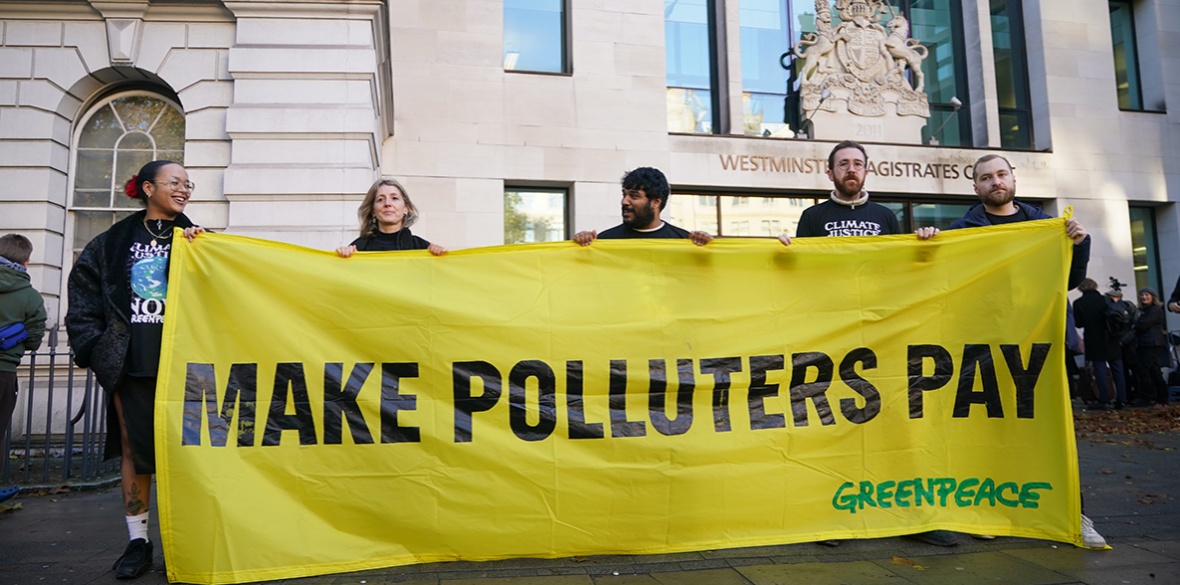
Greenpeace activists outside Westminster Magistrates’ Court, London, where environmental campaigner Greta Thunberg is due to appear charged with failing to comply with a condition imposed under Section 14 of the Public Order Act, November 15, 2023
ENVIRONMENTAL campaign Greenpeace UK has called for Westminster action after a United Nations report said governments are abjectly failing to meet carbon emissions targets.
The UN report covers 196 countries that were part of the 2016 Paris Agreement on climate change, warning: “Current national climate plans fall miles short of what’s needed to stop global heating from crippling every economy and wrecking billions of lives and livelihoods across every country.”
Greenpeace called on the government to take action. Policy director Dr Doug Parr said: “Together with ending all new oil and gas licences, the Labour government must at least triple renewables and double home energy efficiency rates by 2030, as well as properly support workers to transition away from polluting industries.
“Failure is not an option.”
The UN said its report must be a turning point, with “much bolder new national climate plans from every country.”
Climate activists protested against BP at the energy giant’s annual general meeting in Aberdeen, Scotland on May 21, 2019. Karen Murray / Friends of the Earth Scotland.
Oil major BP has scrapped its goal of reducing oil and gas production by the end of the decade, angering environmental groups who say the company is prioritizing profits over the planet.
According to three sources who have knowledge on the matter, BP CEO Murray Auchincloss scaled back the company’s energy transition plans in order to regain investor confidence, reported Reuters.
“As Murray said at the start of the year in our fourth-quarter results, the direction is the same but we are going to deliver as a simpler, more focused and higher-value company,” a spokesperson for BP said, as The Times reported.
In 2020, BP unveiled an ambitious strategy to reduce its production by 40 percent, while quickly ramping up renewables by 2030, reported Reuters. In February of 2023, the London-based company pared back the reduction goal to 25 percent, as investors concentrated on near-term profits instead of the energy transition.
In 2022, the oil giant recorded record profits of $28 billion, The Guardian reported.
“It’s clear that Auchincloss is hell-bent on prioritising company profits and shareholder wealth above all else as extreme floods and wildfires rack up billions of dollars in damages, destroying homes and lives all over the world,” said Philip Evans, senior climate campaigner of Greenpeace UK, as reported by The Guardian.
New analysis commissioned by Greenpeace Central and Eastern Europe reveals a sharp rise in private jet flights to European holiday hotspots last year, with a significant increase during peak vacation periods compared to off-season travel.
At European holiday destinations, private jet arrivals surged by 250% in July compared to January, indicating that most of these flights were for leisure purposes. Over 117,000 flights to 45 luxury destinations were recorded throughout 2023, resulting in more than 520,000 tonnes of CO2 emissions. Notably, Nice, Geneva and Palma de Mallorca emerged as the top three destinations for private jet traffic.
Clara Thompson, transport campaigner for Greenpeace Germany said: “While ordinary people face the devastating impacts of the climate crisis – extreme floods, droughts, heatwaves, and wildfires – the ultra-wealthy continue to hop aboard their private jets under the guise of business travel, but often for leisure trips to Europe’s most luxurious holiday spots. These private flights account for a disproportionate share of aviation emissions, accelerating the climate emergency. This extravagant luxury not only worsens environmental harm but also deepens inequality, leaving the majority to suffer the consequences of climate disasters and daily hardships.”
The research, conducted by the T3 Transportation Think Tank, focuses on destinations heavily promoted by luxury tour operators and private jet companies. The majority of private jet flights occurred in the Mediterranean during summer and shifted to the Alpine region in the colder months. The data reveals a significant seasonal spike, highlighting increased use for leisure and holiday purposes.
Furthermore, 93.2% of these flights were within Europe, with 11.9% covering short distances of up to 250 km – journeys that could have easily been made using more sustainable options like trains or ferries. A single private jet flight to these destinations emits almost as much carbon as the average European citizen’s annual energy-related emissions (4.46 vs. 5.37 tonnes of CO2), underscoring how the ultra-wealthy disproportionately contribute to the climate crisis.
Greenpeace is calling for an immediate ban on private jets, and for governments to consider a wealth tax for billionaires in Europe to fund public goods such as affordable housing and public transport.
Oil storage tanks and a container terminal are seen in the Port of Le Harve, northern France on June 12, 2023. (Photo: Peter Titmuss/UCG/Universal Images Group via Getty Images)
“E.U. leaders must make a choice: Stand with the people and the planet, or continue propping up an economy that’s driving us towards climate catastrophe,” said one advocate.
Warning that policymakers in the European Union are undermining the bloc’s own climate goals by continuing to subsidize fossil fuel extraction, climate scientists and other experts from across Europe were among the signatories of an open letter released Wednesday, demanding that officials redirect hundreds of billions of dollars in subsidies to “turbocharge climate solutions.”
The coalition United for Climate Justice spearheaded the letter, which comes ahead of a planned march in Brussels on Saturday, October 5.
“These subsidies go against Europe’s plans for a sustainable and just transition and fuel the devastating heatwaves we have seen this past summer in our continent,” reads the letter. “Europe is now the fastest warming continent; we have reached a turning point and cannot afford to delay any further.”
Groups including Extinction Rebellion, 350.org, and Greenpeace E.U. pointed to goals the bloc has set in recent years, including the 8th Environmental Action Program, which entered into force in 2022 and included a commitment to “phasing out fossil fuel subsidies.”
📜 More than 130 organisations and academics have endorsed an open letter to demand an immediate end to fossil fuel subsidies in the EU. 🛑 It’s time to walk the talk and put a stop to billions of euros fueling the climate crisis!#StopFossilSubsidiespic.twitter.com/sfXVyuNr6F
The subsidies, which were estimated at more than €400 billion ($441 billion) in 2023, also stand in the way of meeting climate targets put forward in the European Green Deal, said the signatories. The plan aims to make Europe “the first climate-neutral continent,” with no net emissions of greenhouse gases by 2050 and “interim targets of reducing greenhouse gas emissions by 55% by 2030 and by 90% by 2040,” notes the letter.
“This will not happen without an immediate phaseout of fossil fuel subsidies,” said the groups bluntly, “as a step towards a fossil-free Europe.”
By continuing to subsidize fossil fuel projects, they added, the E.U. is also flouting its own Parliament’s declaration of a climate emergency in 2019.
To act in line with the declaration and its climate commitments, said the groups, the E.U. must:
Set a timeline for the phaseout of fossil fuel subsidies by 2025, providing technical and financial assistance to member states facing challenges in meeting phaseout deadlines and offer incentives for achieving milestones ahead of schedule;
Adopt comprehensive methodological guidance for member states that accurately and transparently accounts for both explicit and implicit subsidies associated with fossil fuels; and
Develop a binding framework to monitor and report on member states’ progress towards phasing out fossil fuel subsidies, with noncomplying members facing consequences such as financial penalties and reduced access to E.U. funding.
The bloc’s fossil fuel subsidies “distort energy demand, perpetuate dependence on polluting energy sources, and undermine European energy security, while subsidizing industries that contribute significantly to greenhouse gas emissions,” said the groups.
Phasing out the subsidies would “future-proof the European economy, reducing climate-related financial risks,” they added.
The letter comes weeks after Storm Boris dumped record-breaking rains on European countries including Romania, Austria, and Poland, leading to deadly flooding.
“The E.U. cannot claim leadership on climate action while continuing to support polluting industries with billions,” said Angela Huston Gold, spokesperson for United for Climate Justice. “E.U. leaders must make a choice: Stand with the people and the planet, or continue propping up an economy that’s driving us towards climate catastrophe. The recent disastrous floods in Central and Eastern Europe are yet another wake-up call. We must end our fossil fuel dependency and therefore eliminate all fossil fuel subsidies.”
Also last month, the Portuguese government declared a “state of calamity” over wildfires that killed at least seven people. Last year, the World Meteorological Organization (WMO) and the E.U.’s Copernicus Climate Change Service (C3S) determined the Europe is the fastest-warming continent.
“Year after year, commitments have been made and left unfulfilled, and we can no longer accept inaction,” said the signatories of Wednesday’s letter, who also included Luca Mercalli, president of the Italian Meteorological Society, and Paul Stubbs of the Institute of Economics in Croatia. “Until these necessary changes occur, people will continue to take to the streets to make our voices heard and hold you accountable.”
A van flows in floodwaters near the Biltmore Village in the aftermath of Hurricane Helene on September 28, 2024 in Asheville, North Carolina. (Photo: Sean Rayford/Getty Images)
“To those insisting that, ‘This is not the time!’ to have those other conversations, I say: This is *exactly* when we need to be having them,” said one climate scientist.
As emergency crews have worked through the weekend to rescue people and restore essential services across several southeastern U.S. states, green groups in recent days have pointed to the death and damage from Hurricane Helene as just the latest evidence of the need for sweeping action on the climate emergency.
Helene made landfall as a Category 4 hurricane with 140 mph winds in Florida’s Big Bend region late Thursday, then left a path of destruction across hundreds of miles of Georgia, the Carolinas, and Tennessee. As of early Sunday, at least 64 people are confirmed dead—including at least two people in Virginia—though that figure is expected to rise.
“Moody’s Analytics said it expects $15 billion to $26 billion in property damage,” The Associated Press reported Sunday on what is now a post-tropical cyclone. “AccuWeather‘s preliminary estimate of the total damage and economic loss from Helene in the U.S. is between $95 billion and $110 billion.”
The youth-led Sunrise Movement said Sunday that “any reporting about Hurricane Helene needs to be clear—this is not normal. This is not just a tragedy. This is a crime. Fossil fuel companies have known this would happen for the last 50 years. They lied to the public and bought out our government just to make a profit. Make them pay.”
Greenpeace USA similarly declared on social media Saturday that “#HURRICANE HELENE MUST BE A WAKE-UP CALL FOR CLIMATE JUSTICE!”
“We are heartbroken,” the group said, noting the dozens of people killed. “Communities have been devastated. The corporations heating the climate must be held accountable.”
Climate chaos does not care if you deny it, it does not care if you vote Democratic, Republican, or Independent—climate chaos will impact us all.
Dozens of communities across the United States have already launched climate liability lawsuits against Big Oil, which knew for decades that fossil fuels would heat the planet but promoted disinformation and raked in huge profits. Recently there have been calls for legal action by the U.S. Department of Justice and potential homicide cases brought by state and local prosecutors.
“Our hearts and solidarity go out to everyone facing the devastation. Please support mutual aid relief efforts and demand oil companies #StartDrillingStartPaying!” Greenpeace said Saturday.
Sunrise executive director Aru Shiney-Aja on Sunday offered a “friendly reminder that fossil fuel companies get 20 BILLION dollars in [government] subsidies every year,” while the Federal Emergency Management Agency (FEMA) “runs out of money to respond to disasters like Helene.”
Both Shiney-Aja and Greenpeace shared footage from Asheville, North Carolina, which endured what Ryan Cole, the assistant director of Buncombe County Emergency Services, described as “biblical flooding.”
Just two years ago, The New Lede reported that “from wildfires racing through the drought-stricken West, to heavy flooding in the central and eastern regions of the United States, extreme weather events are spurring many Americans to seek refuge in more environmentally stable cities, so-called ‘climate havens,'” including Asheville.
This weekend, Asheville—which is over 2,000 feet above sea level and more than 250 miles from the coast—and surrounding communities are contending with disrupted water, power, and communications services due to what officials are reportedly calling “Buncombe County’s own Hurricane Katrina.”
Noting Asheville’s elevation and distance from the coast, Lucky Tran, director of science communications and media relations at Columbia University in New York City, said Sunday that “no place is safe from climate change. We all suffer the consequences. We must all take action. We are all in this together.”
If you think of hurricanes as a coastal danger, I invite you to look at a map and see where Asheville is located. https://t.co/JUplknI0UE
People across western North Carolina chainsawed their way to loved ones and drove for hours Saturday on dwindling gas tanks in search of food and power, in what one resident described as a “mini-apocalypse” after Hurricane Helene.
Authorities said the region was facing a historic disaster a day after the powerful storm swept through the Southeast, downing power lines and washing out highways. Landslides, spotty cellphone service, and a gas shortage complicated rescue and recovery efforts. Some stranded people were being airlifted to safety.
Antonia Juhasz, a leading climate and energy journalist and author, said Saturday that “Asheville, North Carolina is being wiped off the map by the worst storm to hit the region in a generation. This is what the climate crisis looks like: the production and use of fossil fuels changes the climate, intensifying extreme weather events and making them more frequent.”
As hurricane scientist Jeff Masters detailed Friday, fossil fuel-driven climate change “makes the strongest hurricanes stronger,” boosts rainfall from such storms, leads to more rapid intensification, and causes sea-level rise that increases storm surge damage.
In an effort to emphasize the climate change connection to extreme weather, from heatwaves to hurricanes, some climate campaigners have suggested naming such events after oil and gas companies.
“What did a Helene ever do to deserve getting this horrific hurricane named after her? We should be naming hurricanes after fossil fuel CEOs instead. How about Hurricane Darren?” said Fossil Free Media director Jamie Henn, taking aim at ExxonMobil’s Darren Woods.
This is Asheville, North Carolina. Fossil fuel companies and their ultra-rich CEOs are profiting from what causes pain and death to people and planet. Enough is enough. #PollutersPayhttps://t.co/EGyhAYTeEn
Daniel Swain, a climate scientist focused on extreme weather, said on social media Saturday, “The images and stories just beginning to emerge from eastern TN and western NC in the aftermath of widespread catastrophic flooding wrought by Helene are genuinely horrifying, and the full scale of the disaster is likely as yet untold.”
“This was, by far, the most extreme rain event in observed record across much/most of the region, where reliable records date back over 100 [years]. Unsurprisingly, the flooding which resulted has also been widespread, historic, and generally catastrophic across a broad region,” he explained. “These floods, which were concentrated in valleys containing rivers and typically modest creeks and streams, involved extremely large volumes of water moving downhill at high velocity. This was not a gradual or ‘gentle’ inundation by any means.”
Swain stressed that “sometimes ‘worst-case’ scenarios really do come to pass, and I think we often lack the collective imagination to fully envision what that looks like. That’s a problem, because being honest about risks that exist is [the] first step toward mitigating them and preventing harm!”
“Ultimately, there many folks in FL, GA, NC, and TN who are in need of urgent assistance—and that is/should be foremost priority,” he added. “But to those insisting that, ‘This is not the time!’ to have those other conversations, I say: This is *exactly* when we need to be having them.”
The AP reported that “in Atlanta, 11.12 inches (28.24 centimeters) of rain fell over 48 hours, the most the city has seen over two days since record-keeping began in 1878,” while “in Florida’s Big Bend, some lost nearly everything they own, emerging from the storm without even a pair of shoes.”
South of there, in Pinellas County, officials have identified over 18,000 homes damaged by Helene—and at least 11,000 are “uninhabitable,” as the Tampa Bay Times put it.
Trump's Project 2025 wants to ban the national weather service so that companies can profit off of you being trapped in a literal hurricane https://t.co/6P2gvoFFl5
Highlighting the connection between climate change and more intense hurricanes, Congressman Maxwell Frost (D-Fla.) said Thursday that “the climate crisis is here. We must act to save lives.”