PROTESTERS descended on Westminster today to demand that the government stop using taxpayers’ money to bankroll the destruction of forests.
More than 100 environmental activists from groups including Axe Drax, Fossil Free London and Greenpeace gathered outside the Department of Energy Security and Net Zero, calling for an end to the vast subsidies granted to the Drax biomass power plant.
The North Yorkshire plant is Britain’s largest carbon emitter, yet receives almost £1.5 million a day for burning biomass wood chips, a fuel source that Drax claims is “carbon neutral.”
As part of the action, a choir celebrated Christmas trees in song and handed out origami trees to civil servants entering the building.
Four people dressed as tree-like creatures representing the millions of trees burned by Drax presented the department with a Greenpeace petition, bearing the signatures of over 120,000 people, calling for an end to the subsidies.
The power plant burned six million tonnes of wood pellets last year, equivalent to about half a billion Christmas trees.
In February, a BBC Panorama investigation revealed that Drax had continued to burn wood from rare primary forests in Canada, after the programme first made the discovery two years ago.
The plant was then forced to pay £25 million to Ofgem for failing to provide adequate data on the type of wood it sources.
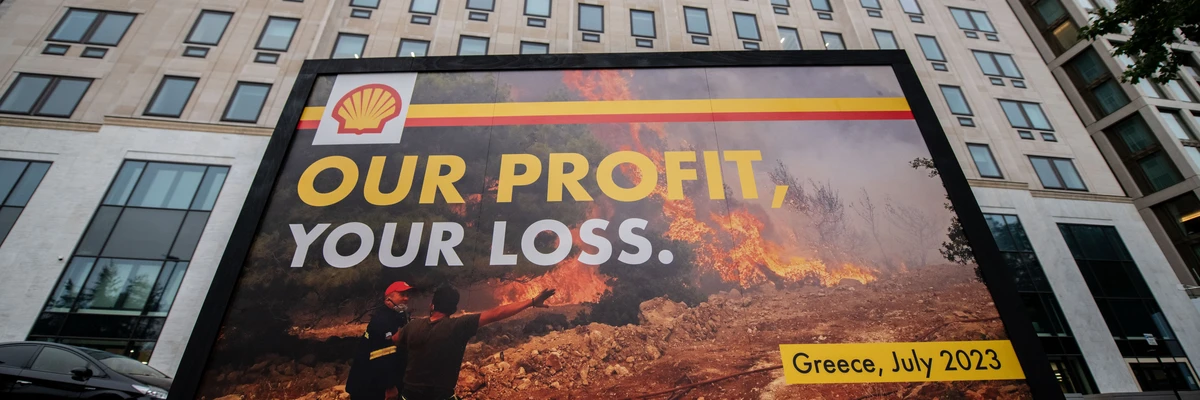
Greenpeace activists display a billboard during a protest outside Shell headquarters on July 27, 2023 in London. (Photo: Handout/Chris J. Ratcliffe for Greenpeace via Getty Images)
Storm Bert caused serious flooding in UK, particularly in the South Wales town of Pontypridd. Gross Capitalists scum and governments scum refuse to accept responsibility for their actions in destroying the climate at COP29. Yet more false solutions pushed by the fossil fuel industry pursued by governments …
It seems like nothing changes. Our climate is fekked. The fossil fuel industry and politicians are responsible for it since they have known since the 1960s. Governments and politicians are supposed to protect their populations. Instead they are controlled and quite willingly work for the rich and powerful. Despite the UK government committing to radical action to address climate, they still pursue false solutions i.e. carbon capture and nuclear power.
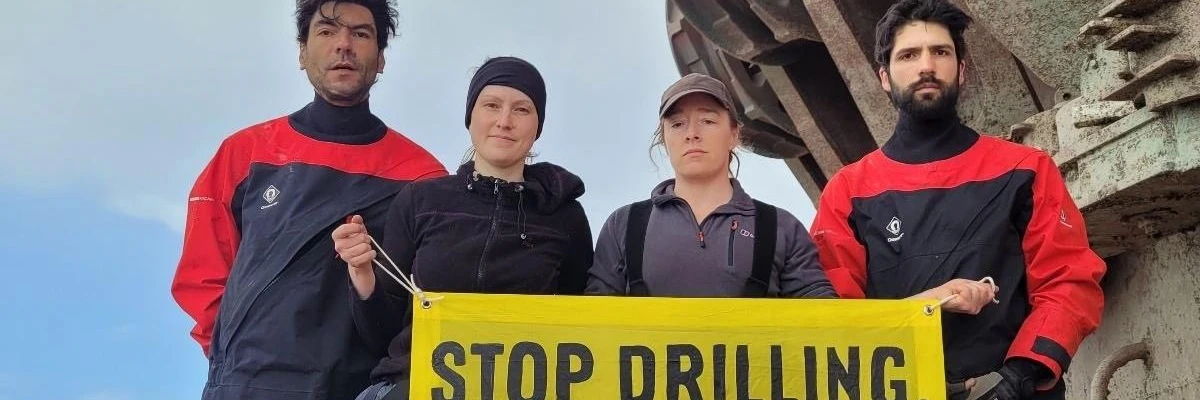
Four Greenpeace activists are pictured on a Shell vessel in the Atlantic Ocean on January 31, 2023.
ed: We are at 1.5C increase now, the limit proposed by the Paris Agreement. We’re flying past it because gross Capitalists and Capitalist politicians are refusing to address the climate crisis. We are on course to far more and far more severe extreme weather events because of these cnuts.
A small tax on just seven of the world’s biggest oil and gas companies could grow the UN Fund for Responding to Loss and Damage by more than 2000% and help address the costs of extreme weather events, according to new analysis published today by Greenpeace International and Stamp Out Poverty. The organisations are calling for a long term global tax on fossil fuel extraction, with year-on-year increases, combined with taxes on excess profits and other levies.
A ‘Climate Damages Tax’ would put a cost on every tonne of carbon emitted by the coal, oil and gas extracted – starting at $5 per tonne and rising each year thereafter. If it was imposed on ExxonMobil, Shell, Chevron, TotalEnergies, BP, Equinor and ENI it could raise $15 billion in the first year alone to help the world’s most climate-vulnerable countries pay for the escalating cost of damage caused by climate change. Currently, just $702 million has been pledged to the loss and damage fund, while the combined profits of those fossil fuel companies exceeds $148 billion.
Greenpeace activists display a billboard during a protest outside Shell headquarters on July 27, 2023 in London. (Photo: Handout/Chris J. Ratcliffe for Greenpeace via Getty Images)
Earlier this month, Barbados Prime Minister Mia Mottley, French President Emmanuel Macron and Kenyan President William Ruto stated their support for a Climate Damages Tax.
The briefing also highlights the financial costs of some of this year’s worst weather events that have been attributed to climate change, totalling over $64bn. These include Hurricane Beryl, Hurricane Helene, the heatwave in India in May, Typhoon Carina/Gaemi, the floods in Brazil in May, and the floods in Kenya and Tanzania in April. The costs of damage from the disasters surveyed range from US$2.9bn (Typhoon Carina) to US$ 25bn (heatwaves in India), and present just a fraction of the total cost of loss and damage globally over the last year.
A Climate Damages Tax imposed only on wealthy OECD countries could play an essential role in helping the poorest and most vulnerable to rebuild after climate-related disasters. Increasing annually by US$5 per tonne of CO2-equivalent based on the volumes of oil and gas extracted, the tax could raise an estimated US$900 billion by 2030 to support governments and communities around the world as they face growing climate impacts.
“While oil and gas giants keep raking in grotesque levels of profit from exploiting resources, the damages resulting from the industry’s operations are disproportionately borne by people who did not cause the crisis,” said David Hillman, Director of Stamp Out Poverty. “A climate damages tax – along with other levies on fossil fuels and high-emitting sectors – will make polluters pay for the cost of climate impacts, as well as supporting workers and affected communities in the transition to clean energy, jobs, and transport.”
“Who should pay? This is fundamentally an issue of climate justice and it is time to shift the financial burden for the climate crisis from its victims to the polluters behind it,” said Abdoulaye Diallo, Co-Head of Greenpeace International’s Stop Drilling Start Paying campaign. “Our analysis lays bare the scale of the challenge posed by climate loss and damage and the urgent need for innovative solutions to raise the funds to meet it. We reject Big Oil’s assault on people and democracy and call on governments worldwide to adopt the Climate Damages Tax and other mechanisms to extract revenue from the oil and gas industry.”
The Loss and Damage Fund was announced at COP27 in Egypt to help developing countries pay for impacts of natural disasters caused by climate change. Recently renamed the Fund for Responding to Loss and Damage (FRLD), it currently has US$702 million in pledged funds. According to Greenpeace International and Stamp Out Poverty’s calculations, a Climate Damages Tax levied on seven major international oil and gas companies would add in the first year alone US$15.02 billion, corresponding to over 21 times what is currently pledged to the fund.
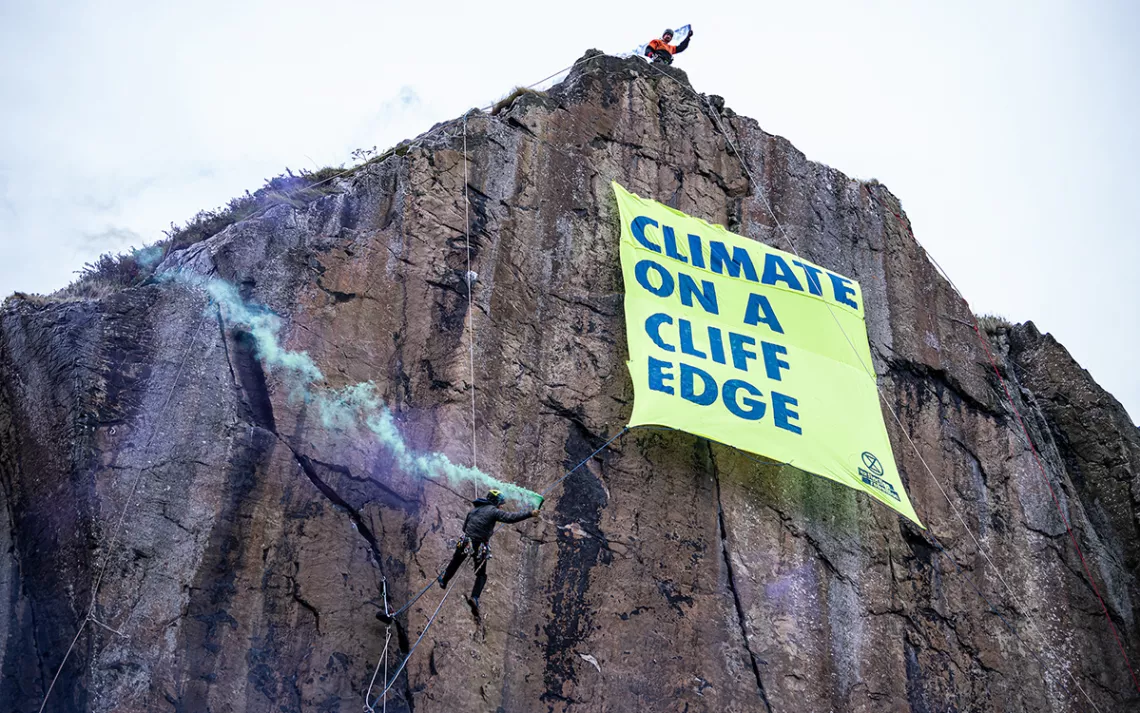
Experienced climbers scale a rock face near the historic Dumbarton castle in Glasgow, releasing a banner that reads “Climate on a Cliff Edge.” One activist, dressed as a globe, symbolically looms near the edge, while another plays the bagpipes on the shores below. | Photo courtesy of Extinction Rebellion and Mark Richards
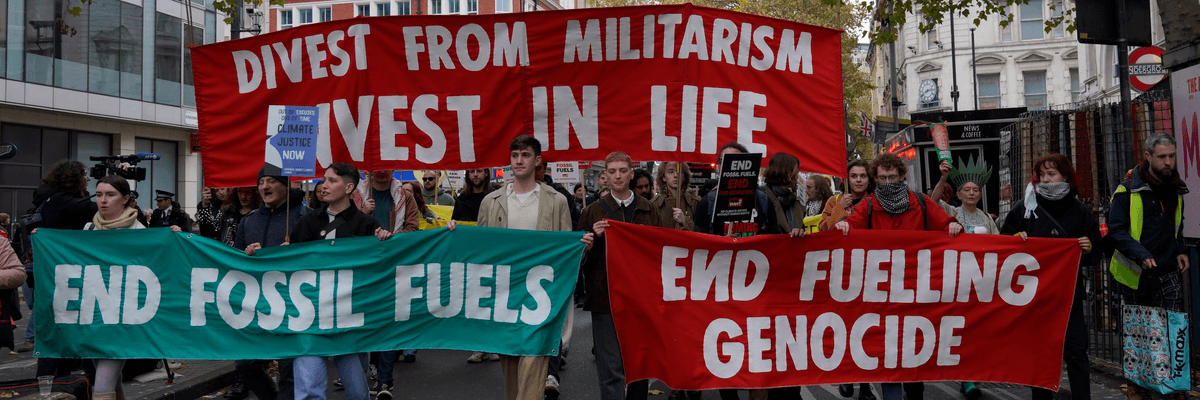
Activists march in London to demand an end to fossil fuels and militarism on November 16, 2024. (Photo: Denise Baker)
“We won’t stop until political leaders divest from war and destruction—and invest in a just, ecological, and equitable transition,” said one campaigner.
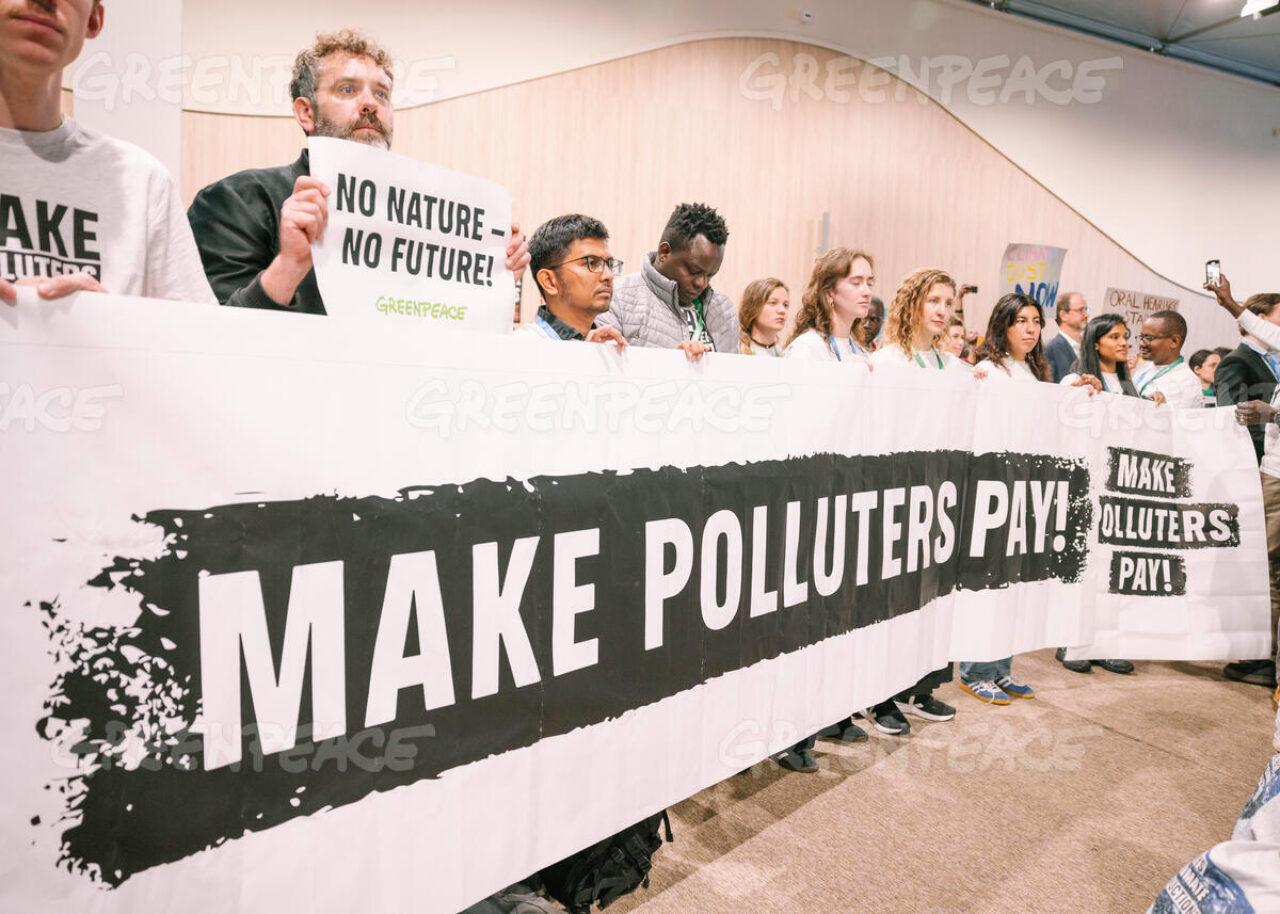
Thousands of climate justice advocates took to the streets of London on Saturday to demand the U.K. government “end its reliance on fossil fuels, commit to paying climate reparations, and end its complicity in the genocide in Gaza.”
Organizers said more than 60 groups—including Extinction Rebellion, Friends of the Earth, Greenpeace, Amnesty International U.K., Palestine Solidarity Campaign, War on Want, and Just Stop Oil—took part in the March for Global Climate Justice. The demonstration took place amid yet another shambolic United Nations Climate Change Conference and as Israeli forces continue a war on Gaza that U.N. experts this week called “consistent with the characteristics of genocide.”
More than two dozen associated protests were held in cities and towns across Britain and Ireland, including Dublin, Edinburgh, Manchester, and Sheffield. Over 150 actions around the world are planned for what organizers are calling a Global Day of Action for Climate Justice on Saturday.
“Thousands of us united today in a historic mobilization on the streets of London, across Great Britain, and worldwide to demand an end to the era of fossil fuels and an end to the genocide in Gaza,” Climate Justice Coalition national coordinator Angus O’Brien said in a statement.
“The issues we face are global, and so is our response,” O’Brien added. “We won’t stop until political leaders divest from war and destruction—and invest in a just, ecological, and equitable transition.”
Lauren MacDonald, the lead campaigner at Stop Rosebank, said: “Every day we are witnessing the worsening effects of climate change as they creep closer and closer to home. All this while governments insist on pandering to the demands of mega-polluters in an endless cycle of ignorance that endangers us all.”
“Oil money has been linked to violence throughout history—and this is no different now,” MacDonald continued. “Even the Rosebank oil field here in the U.K. will see £253 million in revenue flow towards a company that has been flagged by the U.N. for human rights violations in Palestine.”
Earlier this week, green groups including Oil Change International, Friends of the Earth Palestine/PENGON, and Tipping Point U.K. highlighted how fossil fuel companies including Britain’s BP “enable and profit from Israel’s genocide in Gaza” and perpetuate “a long history of the industry’s complicity in mass atrocities worldwide.”
Joanna Warrington, a campaigner at Fossil Free London—a group known for its bold direct action protests—said Saturday that “in gleaming London offices, fossil fuel giants like BP line their pockets while our planet burns and millions suffer.”
“Every day, they stop at nothing to maximize their profits, fueling genocide, corrupting politics, and pushing our climate closer to collapse,” she continued. “We are marching today to demand that the U.K. government breaks free from the grip of mega polluters, stands up to their relentless greed, and stops enabling the violence and destruction they profit from.”
“Another world is not just possible—it’s essential,” Warrington added, “and it starts with holding fossil fuel corporations accountable.”
MacDonald asserted that “if we want to maintain a liveable climate, and sever the toxic links between fossil fuels and atrocities across the globe, we must do everything we can to make a rapid and fair transition away from oil and gas.”
Scientists and campaigners are calling on governments and tech companies to tackle climate disinformation. Credit: MauriceNorbert via Alamy
An open letter from climate scientists and campaigners warns of the dangers associated with false climate claims.
Governments around the world must take “immediate and decisive action” to tackle climate disinformation, scientists and campaign groups have urged as talks at the COP29 climate summit in Baku, Azerbaijan enter their fourth day.
A coalition of 55 climate information integrity groups and 42 leading climate scientists and experts have signed an open letter urging countries to counter the risk of false and misleading claims that are wrecking efforts to slow climate change.
It comes two days after UK Prime Minister Keir Starmer spoke at COP29 arguing that “there is no national security without climate security” – and a week after the election in the United States of Donald Trump, who has previously called climate change a “hoax”.
The letter published today – signatories to which include Friends of the Earth, the Institute of Strategic Dialogue, and regional branches of Greenpeace and WWF – lists steps governments could take.
These include adopting a universal definition of climate disinformation, such as the working definition proposed by the Climate Action Against Disinformation (CAAD) coalition, another signatory.
According to the letter, the definition should cover anything that misrepresents scientific data or “falsely publicises” supposed solutions to climate change which in fact contribute to global warming, often referred to as “greenwashing”.
Such a definition should cover “deceptive or misleading online behaviour” that undermines public understanding of climate change, the fact it is caused by human activity, and the need for urgent mitigation and adaptation action, the letter said.
Signatories also urged governments to take action against organisations which give a platform to climate disinformation – including social media outlets, advertising technology providers, broadcasters, and publishing companies.
“The spread of disinformation continues to undermine and delay our collective ability to act, jeopardising progress at crucial negotiations and the upcoming G20 Summit in Brazil”, the letter said.
“Climate disinformation, waged by vested interests, undermines climate action and puts our collective future at risk. Our information ecosystem is being damaged, and those responsible must be held accountable.”
The letter ends by arguing that “by adopting these principles, governments can foster a healthier and safer online environment that supports informed decision-making and enables effective climate action.”
The world’s leading climate science group, the UN’s Intergovernmental Panel on Climate Change (IPCC), has warned that efforts to tackle climate change were being delayed by “rhetoric and misinformation that undermines climate science and disregards risk and urgency”.
“As disinformation continues to be an obstacle to vital climate action, the message from this open letter to decision makers globally is clear: protecting truth in the climate conversation is critical if we are to secure meaningful change”, said Max MacBride, Head of Counter-Disinformation at Roots Greenpeace, the NGO’s grassroots campaign initiative.
“At Roots, we see every day how climate disinformation stifles youth advocacy, and we join this call to hold governments and platforms accountable for enabling informed, equitable climate action”, he said.
Climate Disinformation Threats
A CAAD report published earlier this week found that climate disinformation is widespread online, and is hobbling efforts to address climate change.
The report said that social media platforms bear responsibility for allowing “super spreaders” to “pollute their platforms with debunked claims attacking renewable energy and electric vehicles”.
CAAD also found that fossil fuel companies were allowed to use digital advertising across Meta platforms to greenwash their reputations, by promoting false solutions or presenting fossil fuels as essential to the energy transition.
A study published in February found that 14 percent of Americans don’t believe climate change is real – even as growing numbers of Americans say they are concerned about the climate.
“In the US, we’ve painfully experienced the role disinformation has played in thwarting disaster response and threats to the lives of responders”, Kate Cell, Senior Climate Campaign Manager at the Union of Concerned Scientists, told DeSmog.
“As climate-fueled disasters become more common around the world, governments can protect their residents by addressing the problem of climate disinformation systemically.”
Another report released this week by the scrutiny NGO InfluenceMap found 2.500 cases of fossil fuel companies pushing arguments which contradict IPCC recommendations since COP28 last year.
Thais Lazzeri, founder of educational group FALA, a signatory to the letter, told DeSmog: “The letter comes at a unique time for Brazil, which is hosting the G20 and the incoming COP30 Presidency. The alliance of so many Brazilian institutes and professionals shows the urgency for answers and the intersectoral power of this Brazilian network, willing to work together.”
She added: “At the opening of the Brazil space at CO29, Environment Minister, Marina Silva, said that denialism doesn’t fit. The Brazilian government can lead by example and guarantee information integrity policies and strategic, connected actions to change the game.”
DeSmog has previously reported on news media spreading false climate claims, with The Telegraph newspaper in the UK attacking climate solutions – a trend that has increasing since July’s general election. As revealed by DeSmog in 2023, one in three presenters on the right-wing broadcaster GB News had spread climate disinformation during the previous year.
“It is much easier to pollute the waters of public discussion on climate change causes and consequences than it is to keep them clean and productive,” said Max Boykoff, signatory to the letter and professor of Environmental Studies at Boulder University in Colorado and founder of the Media Climate Change Observatory, a project which analyses mentions of climate change in news media.
“Therefore, more proactive, clear, accurate and effective communication efforts are consistently and repeatedly needed. That motivates this call for government action to curb disinformation about climate change.”