At least 102 climate activists from seventeen countries representing Greenpeace, Stay Grounded, Extinction Rebellion, Scientist Rebellion and other climate justice groups are still being detained in Geneva, Switzerland 20 hours after a peaceful protest against Europe’s largest annual private jet fair, the European Business Aviation Convention & Exhibition (EBACE) in Geneva.
“A unique, European coalition of courageous activists from 17 countries severely disrupted the excessive champagne party of a super-rich elite – Europe’s largest private jet sales event. Their demand is unequivocal, private aviation should be consigned to the history books. We support the activists and demand their immediate release.” – said Klara Maria Schenk, a transport expert for the European Mobility For All campaign.
Activists peacefully occupied jets exhibited at the business event by the Geneva airport and chained themselves to aircraft gangways in order to keep prospective buyers from entering. The protestors held giant tobacco-style health warning label hand banners marking the jets as toxic objects and warning that ‘Private Jets Burn Our Future’, ‘Kill Our Planet’, and ‘Fuel Inequality’. Public service announcements from loudspeakers carried by the activists exposed the devastating consequences of private jets for our planet and revealed the hypocrisy of promoting private jets amidst rising social inequality.
Contrary to several misleading media reports, the activists never entered the taxiways or runways of the airport. The activists make it clear that at no time they intended to disrupt commercial air traffic at Geneva Airport. A spokeswoman for air traffic control agency Skyguide confirmed protestors had not accessed the runway during the incident, according to Aviation International News.
🚨URGENT: We are extremely concerned about the reports of excessive use of force against the climate activists at #EBACE2023 Europe’s largest private jet fair. We demand the immediate release of the 100 detained activists. Updates to come. #BanPrivateJetshttps://t.co/2XTJhImYsypic.twitter.com/Ytf861IAG2
— Greenpeace International (@Greenpeace) May 23, 2023
Protesters from Greenpeace, Stay Grounded, Extinction Rebellion and others chain themselves to aircraft in Geneva
Dozens of climate activists have disrupted Europe’s largest private jet trade fair by chaining themselves to aircraft to protest against the sector’s carbon emissions.
The demonstrators on behalf of Greenpeace, Stay Grounded, Extinction Rebellion and Scientist Rebellion also attached themselves to the entrance gates of the event at Geneva airport in the hope of preventing prospective buyers from entering the annual show.
The activists, who were calling for a global ban on the use of private jets because of their carbon footprint, stuck tobacco-style health warning labels on some of the jets at the European Business Aviation Convention and Exhibition (EBACE) saying private jets “burn our future”, “kill our planet”, and “fuel inequality”.
— Stay Grounded – @staygroundednet on Bluesky 🦋 (@StayGroundedNet) May 23, 2023
❗HAPPENING NOW❗ More than 100 brave climate activists from @Greenpeace@staygroundednet @extinctionrebellion and @scientistrebellion demand #BanPrivateJets in #EBACE, the biggest private jet sales fair in Europe, an event for private jet users to keep buying and flying in their… pic.twitter.com/JUP7UCZnP2
— Greenpeace International (@Greenpeace) May 23, 2023
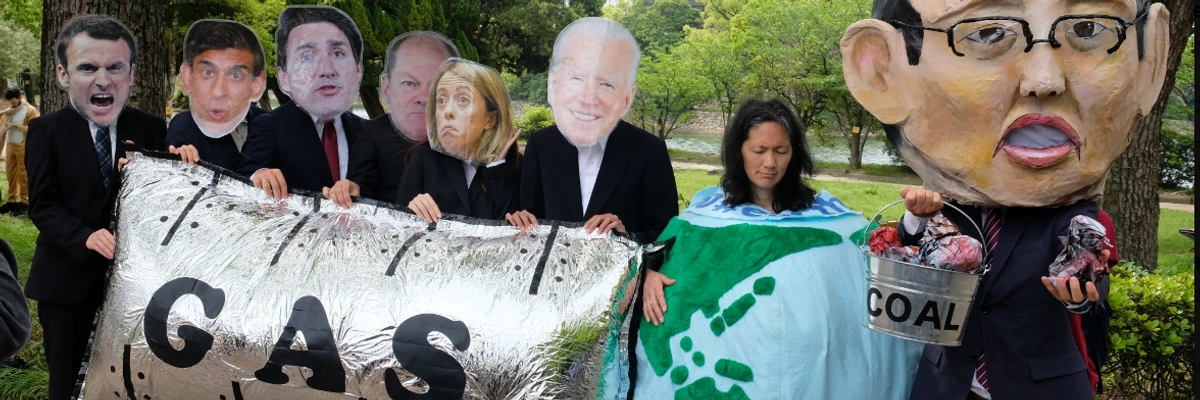
Activists with masks of Group of Seven leaders protest fossil fuels. (Photo: 350.org Japan/Friends of the Earth Japan/Oil Change International)
“Energy security can only be achieved by rapidly and equitably phasing out fossil fuels and transitioning to renewable energy, not locking in deadly fossil fuels and lining the pockets of oil and gas executives,” said one critic.
Since Group of Seven leaders on Saturday put out a wide-ranging communiqué from a Japan-hosted summit in Hiroshima, climate action advocates from G7 countries and beyond have blasted the statement’s support for future investments in planet-heating gas.
The statement comes after G7 climate, energy, and environment ministers were criticized for their communiqué from a meeting in Sapporo last month as well as protests around the world this week pressuring the summit’s attendees to ditch fossil fuels and “deliver a clear and just renewable energy agenda for a peaceful world.”
To meet the 1.5°C goal of the Paris climate agreement, the new statement commits to “accelerate the phaseout of unabated fossil fuels so as to achieve net-zero in energy systems by 2050 at the latest” along with “the elimination of inefficient fossil fuel subsidies by 2025 or sooner.”
“The G7 must stop using fossil fuels immediately—the planet is on fire.”
The statement also highlights that last year, G7 nations—Canada, France, Germany, Italy, Japan, the United Kingdom, and the United States—pledged to end “new direct public support for the international unabated fossil fuel energy sector, except in limited circumstances,” though as recent analysis shows, some are breaking that promise.
The communiqué then endorses liquefied natural gas (LNG) as a solution to “the global impact of Russia’s war on energy supplies, gas prices and inflation, and people’s lives,” referencing the invasion of Ukraine:
In this context, we stress the important role that increased deliveries of LNG can play, and acknowledge that investment in the sector can be appropriate in response to the current crisis and to address potential gas market shortfalls provoked by the crisis. In the exceptional circumstance of accelerating the phaseout of our dependency on Russian energy, publicly supported investment in the gas sector can be appropriate as a temporary response, subject to clearly defined national circumstances, if implemented in a manner consistent with our climate objectives without creating lock-in effects, for example by ensuring that projects are integrated into national strategies for the development of low-carbon and renewable hydrogen.
“The G7 energy outcome correctly diagnoses a short-term need for energy security, then promotes a dangerous and inappropriate lock-in of fossil gas that would do nothing to address this need,” responded Collin Rees, United States program manager at Oil Change International (OCI). “Energy security can only be achieved by rapidly and equitably phasing out fossil fuels and transitioning to renewable energy, not locking in deadly fossil fuels and lining the pockets of oil and gas executives.”
After accusing the summit’s attendees of “using the war as an excuse,” deflecting blame for current conditions, and neglecting Global South countries disproportionately suffering from the climate crisis, Max Lawson, head of inequality policy at Oxfam, declared that “the G7 must stop using fossil fuels immediately—the planet is on fire.”
— Fossil Fuel Treaty Initiative (@fossiltreaty) May 20, 2023
Greenpeace International global climate politics expert Tracy Carty also demanded a swift end to fossil fuels, charging that “G7 leaders’ endorsement of new fossil gas is a blunt denial of the climate emergency” which dooms “current and future generations.”
Gerry Arances, executive director of the Philippine Center for Energy, Ecology, and Development, similarly argued that “the endorsement of increased LNG deliveries and investment in gas in the G7 communiqué is no mere backsliding—it is a death sentence being dealt by the G7 to the 1.5°C limit and, in consequence, to the climate survival of vulnerable peoples in the Philippines, Southeast Asia, and across the world.”
“Unless they genuinely put forward the phaseout of all fossil fuels, Japan and all G7 nations spout nothing but lies when they say they have aligned to 1.5°C,” he continued. “They cannot claim to be promoting development while subjecting our people to decades more of pollution and soaring energy prices. We reject this notion of a development powered by fossil fuels.”
Looking to the United Nations Climate Change Conference (COP28) planned for later this year, Arances added that “Japan and G7 leaders should already be warned that civic movements will not tire in pushing back against fossil fuels and false solutions and in demanding a renewable energy transition.”
“Civic movements will not tire in pushing back against fossil fuels and false solutions and in demanding a renewable energy transition.”
Other campaigners also specifically called out the Hiroshima summit’s host—including Ayumi Fukakusa, deputy executive director at Friends of the Earth Japan, who asserted that the country “has used the G7 presidency to derail the global energy transition.”
“Japan has been driving the push to increase gas investments and has been promoting its so-called ‘green transformation’ strategy,” Fukakusa said of a “greenwashing scheme” featuring hydrogen, ammonia, nuclear, and carbon capture and storage technologies.
OCI Asia program manager Susanne Wong agreed that given the nation’s promotion of gas expansion and technologies to prolong the use of coal, “this year’s G7 is revealing Japan’s failure of climate leadership at a global level.”
“Activists mobilized 50 actions across 22 countries this week to demand that Japan end its fossil fuel finance and stop driving the expansion of gas and other fossil-based technologies,” Wong added. “Japan will continue to face intense international scrutiny until it stops fueling the climate crisis.”
Shame on Canada & other #G7 leaders for caving to the narrow financial interests of fossil gas companies
The world is burning and our leaders keep dumping more fuel on the fire https://t.co/j2aPHx24AB
Groups from other G7 countries also called out their political leaders. Petter Lydén, head of international climate policy at Germanwatch, said, “Most likely, the German chancellor, Olaf Scholz, has been a driving force behind the weak language on gas, which is a serious blow to Germany’s international credibility on climate.”
Citing sources familiar with summit negotiations, The New York Timesreported Saturday that “Britain and France fought the German effort” while U.S. President Joe Biden was caught between defending his climate agenda and “aiding other United States allies intent on increasing their access to fossil fuels.”
OCI’s Rees said the that “this betrayal continues a disturbing turn by President Biden and Chancellor Scholz from rhetorically committing to climate leadership to openly boosting fossil fuel expansion. History will not look kindly on world leaders who accelerate the pace of fossil fuel buildout in the face of worsening climate crisis.”
Three of the world’s most infamous supervillains – Darth Vader, Dr Evil and Thanos attend the deep sea mining summit in central London. The terrible trio are excited by the prospect of meeting like-minded people who they felt would share their passion for large-scale destructive machinery and wiping out entire ecosystems. Deep sea mining would strip bare vast areas of the deep ocean floor – one of the last untouched ecosystems on earth, causing irreversible damage to marine life.
London, Star Wars Day, 2023 – Three of the world’s most infamous supervillains – Darth Vader, Dr Evil and Thanos – convened today at a deep sea mining summit in central London.
The terrible trio were reportedly excited by the prospect of meeting like-minded people who they felt would share their passion for large-scale destructive machinery and wiping out entire ecosystems. Darth Vader had insisted the three attend the conference instead of ‘making a fuss’ over him for Star Wars Day.
Known for his strong track record of destroying whole planets with his death star, Darth Vader said of the conference: “Light doesn’t penetrate the bottom of the ocean so it’s the perfect place for the dark side to operate.”
Dr. Evil flew in directly from his volcano-lair to tell conference goers that he felt the ocean could undoubtedly be exploited for personal gain “in excess of one million dollars”. He urged those in attendance to join him in his quest for global domination, promising riches and power beyond their wildest dreams.
Thanos was quieter, possibly a little overwhelmed by the number of attendees, but sources say he was overheard asking delegates for the location of the “precious stones”.
Walking onstage with Dr Evil and Thanos to address conference attendees during a Q&A, Darth Vader said: “I’m delighted to be here and to learn more about deep sea mining because together, we can destroy the oceans!”
The three left the conference to the sound of The Imperial March from Star Wars, played on the kazoo, and laughter from the audience.
Andrew Tobert, Greenpeace UK Oceans campaigner, said: “Monetising the seabed might seem like a far-fetched, dastardly plan, but it’s worryingly real and the people trying to do it don’t wear obvious, villainous costumes. We have explored just 1% of the deep sea, on each visit discovering fascinating species found nowhere else on Earth – it’s one of our last untouched ecosystems. But it would be stripped bare by deep sea mining, causing irreversible damage to marine life. There’s no way it can be done sustainably.
“Companies from Samsung to Renault have called for a moratorium on deep sea mining. And governments from Europe to the Pacific are doing the same. It’s no surprise when the proposals read less like a business plan and more like a masterplan for ecological destruction. Deep sea mining poses untold threats to our already plundered oceans. It’s got to be stopped before it starts.”
The International Seabed Authority will meet in July where it faces commercial pressure to allow deep sea mining to start. From July any deep sea mining company can submit an application to start mining despite the absence of any rules or regulations to govern it and, thanks to the invocation of a controversial loophole, governments are legally obliged to “consider” it. The Metals Company, one of the most prominent and determined deep sea mining companies in the race, has stated it will put in an application this year.
Deep sea mining is a dangerous distraction from creating a truly green economy by profit-hungry companies wanting to make a quick buck. Vast areas of the deep ocean floor – one of the last untouched ecosystems on earth – would be stripped bare by deep sea mining, causing irreversible damage to marine life.
The UK government is currently supporting research into deep sea mining having approved exploratory deep sea mining licences 10 years ago to UK Seabed Resources (UKSR). The UK now sponsors some of the largest areas for deep sea mining exploration, covering 133,000km2 of the Pacific Ocean, through UKSR. That’s an area larger than the size of England.
Major disruption to Barclays AGM by Money Rebellion and other activist groups with searching questions, songs and Shakespeare
A major bank funding our extinction by pouring billions of pounds into new fossil fuel projects was left in disarray today as activists linked to a huge new climate crisis coalition disrupted their Annual General Meeting headquarters in the City of London.
The board of directors faced constant interruption and challenge making it almost impossible for the AGM to continue. When Barclays chairman Nigel Higgins tried to outline the bank’s own climate commitments, a protester shouted “bullshit.”
At 11am teams of activists infiltrated the AGM of Europe’s biggest funder of fossil fuels, Barclays. A 70-strong Climate Choir sang a climate crisis version of the Spice Girls “Stop Right Now” to bank board members. Further disruption followed as other shareholders from Fossil Free London, with a Shakespearean condemnation of Barclays as being on the wrong side of history.
Pulling out hidden ruffs and quills, they performed Shakespeare-based lines generated by ChatGPT about the bank’s funding of fossil fuels. Lines included: “The people thee harm, and our air thou pollute! And yet, there is more, I tell you this day, For Barclays is guilty in a vile way. Thou art on the wrong side of history, I say!”
At the action, Claude Fourcroy, of Money Rebellion, an off-shoot of Extinction Rebellion, said: “We need UK banks to stop funding fossil fuels today, but instead they are profiting from a rigged system where bankers sacrifice people and planet to make vast fortunes. This is why we have chosen to target these vastly wealthy and powerful establishments, in the interests of the public – because time for humanity and every other species on the planet is running out.
“These banks boast about being part of the solution to the climate and ecological emergency while taking baby steps toward pulling funding for the worst fossil fuel criminals, making empty promises full of loopholes, and greenwashing on an industrial scale
“The government and Bank of England are failing to challenge or regulate the power of the banks. But people power can and will stop them. No more carbon bombs, no more genocide and no more displacement. Until the banks stop funding new fossil fuels, we will use every tool in the box to stop them, including building the biggest bank boycott in history to hit them where it hurts – in their pockets.”
Extinction Rebellion co-founder Clare Farrell said: “These Money Rebellion actions disrupting financial power holders are just the start of an unprecedented movement of movements stepping up to challenge the corrupt elite in order to drive the urgent changes we need for survival of life on this planet.”
“In this new phase of Extinction Rebellion, we are connecting across groups to build a stronger climate alliance aimed at community resilience, inclusivity and fairness for all living beings. By linking up everyone who stands for a just and rapid response to the climate crisis we will create a formidable opposition. People are determined to challenge the misuse of power which threatens to bring an end to all life if we do not stop it.”
Barclays’ AGM was targeted by activists because the bank is the largest financier of fossil fuel expansion, heavily funding new fossil fuel exploration and drilling, while issuing net zero pledges.
According to Rainforest Action Network and Greenpeace since 2016 Barclays has been the worst bank in Europe for fossil fuel financing. In 2022 alone, the bank provided over $16 billion to coal, oil, and gas companies, and $190 billion since the Paris Agreement, making it the seventh largest fossil fuel funder in the world.
Barclays has said it is committed to aligning its financed emissions with the goals of the Paris Agreement, but in reality the bank has no policy dictating how it should reduce its financing of the oil and gas sector. Barclays is one of the only major UK banks which has not started the process of restricting financing for new oil and gas, putting it at odds with competitors HSBC, Lloyds, and NatWest.
Andrew Taylor from Money Rebellion, an offshoot of Extinction Rebellion, added: “As the UN Secretary General António Guterres has said, we have reached a tipping point on the need for climate action. The disruption to our climate and our planet is already worse than we thought, and it is moving faster than predicted. And what is the reaction of these banks to this frightening scenario?
“According to the London School of Economics and the Grantham Research Institute on Climate Change and the Environment Barclays scores 0% on its commitment to achieve net-zero emissions from its financing activities by 2050 or sooner, consistent with a 1.5°C scenario. It also scores 0% on climate policy engagement.
“A more accurate title for these AGMs would be Annual Greenwash Meetings.”