Meanwhile, at the Royal Courts of Justice, campaigners celebrated a High Court ruling that granted charity Greenpeace permission to proceed with a judicial review of new oil and gas licensing in the North Sea.
The UK’s Secretary of State for the Department of Energy Security and Net Zero, Grant Shapps, has reassured Britain’s oil and gas industry that it has his full support to continue North Sea drilling during a keynote speech given at the Spectator’s Energy Summit on Wednesday.
At the event, which was sponsored by National Gas as well as Drax, Shapps told an audience mostly composed of energy sector professionals that it “simply makes no sense whatsoever to deny our own oil and gas, and instead import it – with twice the embedded carbon – from elsewhere in the world”. He added that it is “very important” to understand that even the Intergovernmental Panel on Climate Change recognises the need for “some” oil and gas production in 2050 when the UK has reached net zero.
…
Meanwhile, just one mile down the road at the Royal Courts of Justice, campaigners celebrated a High Court ruling that granted charity Greenpeace permission to proceed with a judicial review of the government’s decision to launch a new oil and gas licensing round in the North Sea.
On Wednesday morning, the judge gave Greenpeace permission to conduct a full judicial review into the government’s failure to take into account the environmental effects of consuming the oil and gas due to be extracted in the new licensing round, in which fossil fuel companies submitted more than 100 licences for exploration.
“See you in court” one campaigner wrote on Twitter tagging Shapps, who was in the process of assuring his audience that the government “will not shy away from awarding new licences where they are justified”. The fate of the controversial Rosebank oil field, with the potential to produce 500m barrels of oil and therefore exceed the UK’s carbon budget, remains undecided.
…
Category: Greenpeace
Grant Shapps assures the UK’s oil and gas industry it has his full support to continue drilling

Greenpeace granted permission to proceed with a Judicial Review of the Government’s decision to launch a new licensing oil and gas round
The High Court yesterday granted Greenpeace permission to proceed with a Judicial Review of the Government’s decision to launch a new licensing oil and gas round, with fossil fuel companies submitting more than 100 licences to explore for new oil and gas.
The judge has granted permission to Greenpeace for a full Judicial Review of the Government’s decision not to take into account the environmental effects of consuming the oil and gas to be extracted in the new licensing round.
Greenpeace’s legal argument is that this is a glaring omission from the Government’s decision making, including its climate compatibility check. Since at no time do the test involve looking at the emissions created from burning fossil fuels, despite the fact that this will amount to more than 80% of the total emissions generated from the new licences.
This news comes one month after stark warnings from the IPCC and UN Secretary General which yet again restated that there must be no new fossil fuel development if the world is to limit warming to 1.5C, with current approved projects already enough to take us beyond that point.
Philip Evans, Greenpeace UK’s climate campaigner, said:
“This verdict is the first real setback for the Government’s reckless oil and gas licensing round. Ministers will now be forced to justify in front of a judge why they want to unleash a new drilling frenzy in the North Sea against the advice of leading scientists and the UN chief, without assessing the climate impact.
“The Government already has the solutions to tackle the scandal of the cost of living, guarantee our energy security, and help the climate but the Government is ignoring them in favour of their friends in the fossil fuel industry. They must instead upgrade our old fashioned electricity grid, invest in cheap home grown renewables and stop energy waste from our homes.”
North Sea drilling: Greenpeace prepares to challenge ‘disastrous’ UK decision
…
A court hearing on Tuesday will determine whether the environmental group will be permitted a judicial review of the decision, made during Liz Truss’s short-lived time as prime minister.
Last year, her administration kicked off an oil and gas licensing round under which companies could bid for more than 100 new licences to explore for oil and gas.
The North Sea Transition Authority began the process in October, offering up about 900 locations for exploration, and it is expected to conclude in June. It is the first new licensing round since 2019-20.
The decision was carried out by the then energy secretary, Jacob Rees-Mogg, under Truss despite warnings of possible legal action by Greenpeace. The green organisation has since carried out that threat, arguing in its court filing that the new licences will further harm the environment.
…
North Sea drilling: Greenpeace prepares to challenge ‘disastrous’ UK decision
Activists in swimwear queue up outside Sunak’s heated pool to highlight electricity grid scandal
‘While Sunak will enjoy doing lengths in his warm pool, the rest of us are stuck with an outdated power network’

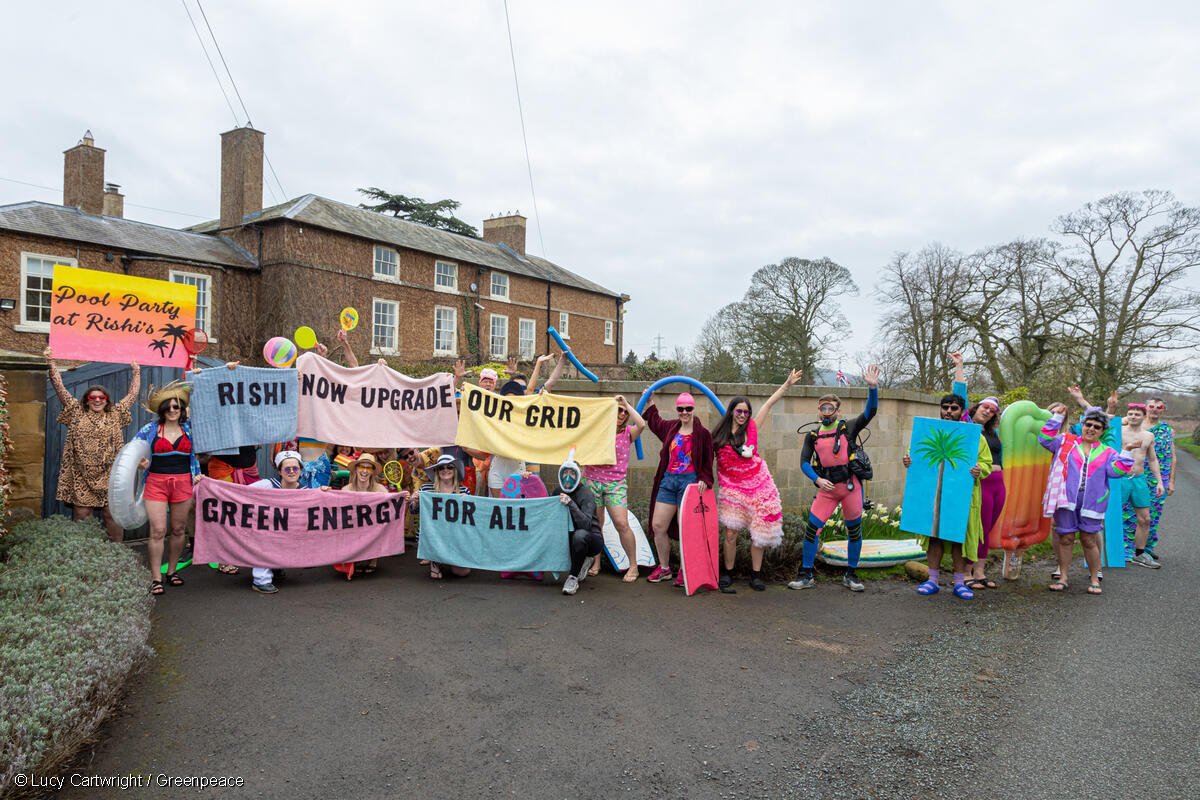
Greenpeace activists wearing swimming trunks, flip flops and caps have lined up outside Rishi Sunak’s Grade-II listed manor house in Richmond, Yorkshire. On Wednesday morning (29 March 2023), Greenpeace activists are staging a demonstration outside Rishi Sunak’s Grade-II listed manor house in Richmond, Yorkshire, where earlier this month it was revealed that Sunak paid privately for his local electricity grid to be upgraded to heat his £400,000 swimming pool.
Activists wearing swimming trunks, flip flops and scuba diving gear have lined up outside the gates of his house, valued at £2mn, waiting to get access to the Prime Minister’s private pool. They aim to highlight the hypocrisy of the UK’s richest ever Prime Minister paying for private upgrades to the grid for his own benefit, while failing to upgrade our outdated national grid, which remains unable to deliver the green energy revolution for the rest of us that would lower bills and help tackle the climate crisis.
This demonstration comes ahead of the Government’s so-called ‘Energy Security Day’ on Thursday 30 March. Ministers are expected to announce policies to boost carbon capture and new fossil fuel projects that campaigners argue would do nothing for our energy security and would be disastrous for the climate.
Greenpeace activists wearing swimming trunks, flip flops and caps have lined up outside Rishi Sunak’s Grade-II listed manor house in Richmond, Yorkshire. Greenpeace UK is urging the government to listen instead to energy experts, industry and its own auditors who have warned that without upgrading the outdated grid we won’t be able to roll out renewables at the speed needed to tackle the cost of energy and climate crisis. A wait of up to 13 years to connect new renewable and battery storage projects to Britain’s grid is threatening investment and undermining the shift away from fossil fuels. Meanwhile, hundreds of millions of pounds are being wasted to shut down electricity generators when the grid can’t take the extra power.
‘While Sunak will enjoy doing lengths in his warm pool, the rest of us are stuck with an outdated power network’
Philip Evans, Greenpeace UK’s climate campaigner, said:
“We’re queuing up for the Prime Minister’s heated pool because a better electricity grid should be a public good, not the private luxury of millionaires. While Sunak will enjoy doing lengths in his warm pool, the rest of us are stuck with an outdated power network, not fit for purpose, that’s blocking the roll-out of more cheap and clean renewables.
“Securing green energy for all should be the focus of the Government this week. Instead, they’re approving new oil drilling and giving tax breaks to fossil fuel giants, proving they really are out of their depth when it comes to tackling the climate and energy crisis.
“Sunak must upgrade our outdated grid and clear away other barriers to renewables so we can reap the full benefits of cheap energy from solar and wind, bringing down bills and carbon emissions alike. If he refuses, he leaves us stranded without a raft.”
Greenpeace activists wearing swimming trunks, flip flops and caps have lined up outside Rishi Sunak’s Grade-II listed manor house in Richmond, Yorkshire. Moving to a smart grid
Problems with the electricity grid are well documented, blocking our ability to use and store renewable energy all over the country. The grid needs upgrading and expanding so it can transmit power from where it is made to where it is needed at the scale we need.
According to Ofgem, a smart grid could save up to £4.7 billion a year by the end of this decade. Our bills are predicted to rise again if these issues are not addressed in the package of measures announced this week by the Government.
from a Greenpeace press release
BP boss could be in line for special bonus of up to £11.4m
Firm set for clash with investors over possible payout to Bernard Looney from three-year share award plan

Just Stop Oil protests at BP BP is set for a clash with investors after it emerged that its chief executive could be in line for a special bonus of up to £11.4m. The payment, in shares, would be on top of his £1.38m salary and annual bonus for 2022.
…
Charlie Kronick, a senior climate campaigner at Greenpeace UK, said: “These bumper bonuses would be a slap in the face for millions of UK people struggling with their bills and communities around the world reeling from the climate crisis … Instead of being stuffed in the pockets of shareholders and company bosses, all this extra cash should be redirected towards public goods, whether it’s insulating UK homes or supporting communities suffering the consequences of the oil industry’s carbon pollution.”
…
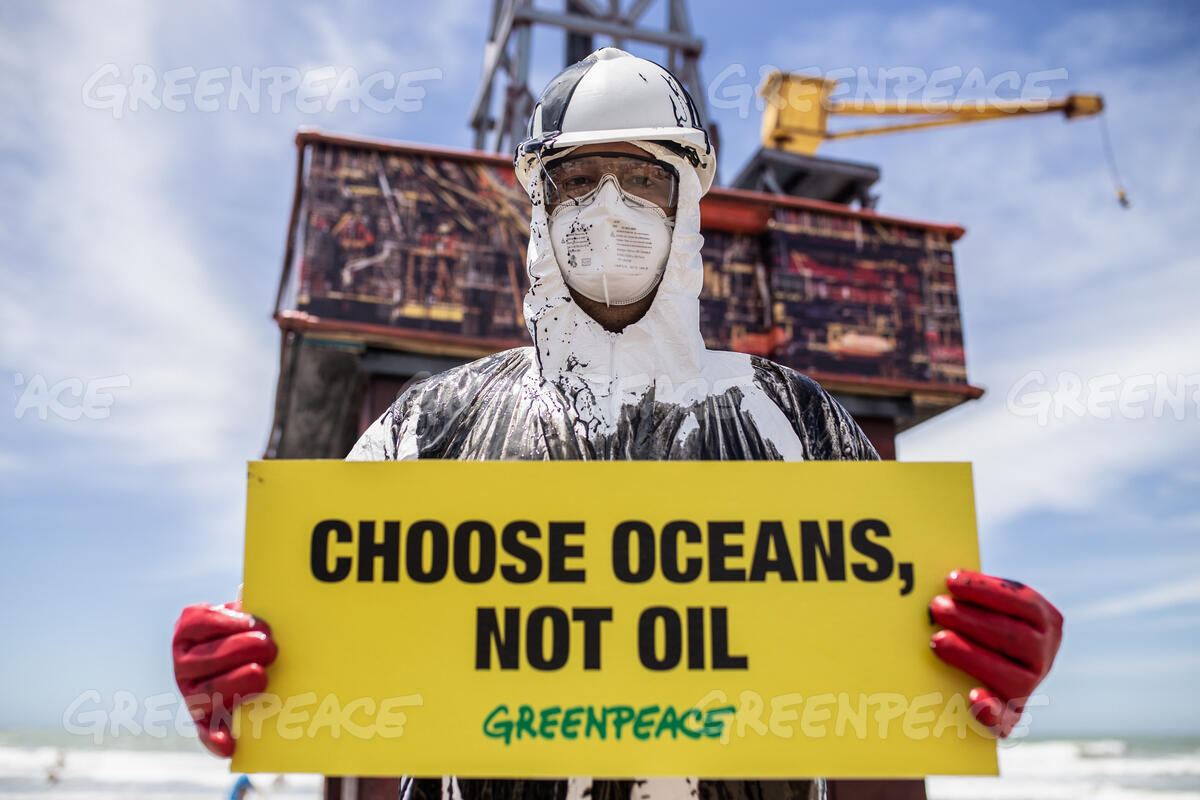
Greenpeace ends oil rig occupation as Shell launches legal action to sue group

Greenpeace activists in inflatable boats approaching Shell platform Image: Alice Russell / Greenpeace ENVIRONMENT activists ended their occupation of a 34,000-tonne oil rig today as it arrived in Norway.
But multibillion-pound energy corporation Shell is suing campaign group Greenpeace for more than £100,000 in compensation for costs incurred by the operation, including extra security.
Six activists began their occupation north of the Canary Islands as it was being towed to Haugesund in south-west Norway.
The occupiers boarded the rig from sea-going dinghies in a daring raid on January 31.
In a final stand at 10.30am at Haugesund today, the occupiers climbed the platform’s 125-metre flare boom and waved a banner saying “Stop drilling. Start paying.”
…