The Labour government will not hold a public inquiry into the influence of pro-Israel groups in British politics, even after more than 114,000 people signed a parliamentary petition calling for a probe.
In a response to the petition, the government said it “does not support a public inquiry on pro-Israeli influence, and does not have plans to hold an inquiry on wider foreign influence and lobbying more generally.”
It added: “However, the government takes concerns about foreign influence in politics and democracy seriously, and is already taking action to address this.”
Last month, the government published an urgent review into foreign financial interference in UK politics. It mentioned Iran, Russia and China but not Israel.
Because the petition got over 100,000 signatures, it will still be considered for debate in the Commons. The petition reads: “We are concerned about reported Israeli state-linked and pro-Israel lobbying activity in UK politics. We believe it is important to determine the scope and impact of any such influence campaigns.”
It adds: “We feel that the horrific devastation in Gaza, the ongoing suppression of Palestinians in the West Bank, and the UK’s political response underline the urgent need to scrutinise how pro-Israel organisations, networks, and lobbying efforts may shape government decisions, party policy, and public debate.”
Keir Starmer objects to criticism of the IDF. He asks how could anyone object to them starving people to death, forced marches like the Nazis did, bombing Gaza’s hospitals and universities, mass-murdering journalists, healthworkers and starving people queuing for food, killing and raping prisoners and murdering children. He calls for people to stop obstructing his genocide for Israel.Keir Starmer explains that UK is actively supporting Israel’s genocidal expansion and repeats his previous quotation that he supports Zionism “without qualification”. Keir Starmer said “I said it loud and clear – and meant it – that I support Zionism without qualification.” here: https://www.jewishnews.co.uk/keir-starmer-interview-i-will-work-to-eradicate-antisemitism-from-day-one/
Representatives from more than a dozen foreign diplomatic missions, United Nations offices, and the media view damage at sites bombed by the US and Israel on April 20, 2026 in Tehran, Iran. (Photo by Majid Saeedi/Getty Images)
“All cases of attacks on civilians are being legally pursued based on the Geneva Conventions,” said the head of the Iranian Red Crescent Society.
The head of the Iranian Red Crescent Society said Saturday that his organization has submitted evidence of US-Israeli war crimes to the International Criminal Court and other global bodies, seeking accountability for massive attacks on civilian infrastructure and other violations.
“The ICC prosecutor announced that the documents provided by the IRCS are accepted as official evidence,” said Pir-Hossein Koulivand, the head of the Iranian Red Crescent Society. “All cases of attacks on civilians are being legally pursued based on the Geneva Conventions.”
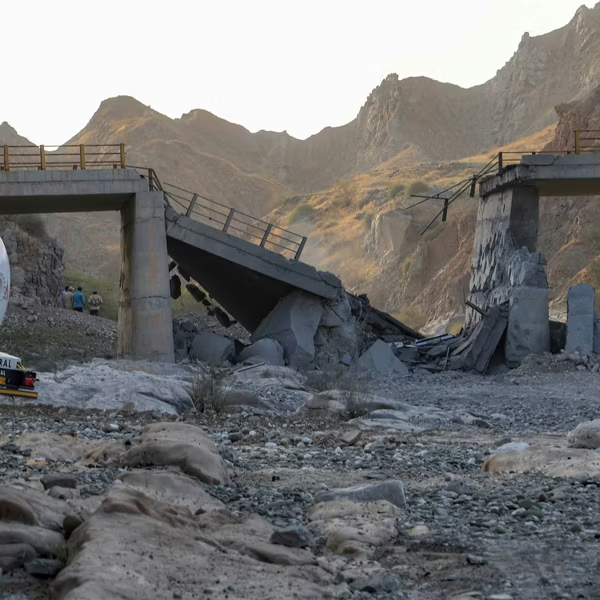
The IRCS estimates that US and Israeli airstrikes have destroyed more than 132,000 civilian structures throughout Iran, including hospitals, apartment buildings, universities, research facilities, and bridges. US President Donald Trump has repeatedly threatened to destroy all of Iran’s bridges and power plants if the country’s leadership does not succumb to his administration’s demands in negotiations to end the war.
Luis Moreno Ocampo, the founding chief prosecutor of the ICC, said earlier this month that Trump could be indicted if he follows through on his threats.
“My suggestion: You read the indictment of the Russians, change the name, and it is very similar,” said Ocampo, referring to ICC arrest warrants issued against senior Russian officials in 2024 for alleged war crimes in Ukraine.
In a series of social media posts on Saturday, the IRCS provided video footage and photographic evidence of what the group described as war crimes committed by the US and Israeli militaries.
“Among the most bitter war crimes of America and Israel in Iran is the attack on the home of 19-month-old Helma in Tabriz, in which four members of her family were martyred,” the IRCS wrote Saturday. “The only survivor of this family is Helma.”
از: جمعیت هلال احمر جمهوری اسلامی ایران به: همه مردم دنیا موضوع: سند جنایت جنگی – شماره ۱۴
از تلخ ترین جنایات جنگی آمریکا و اسرائیل در ایران، حمله به خانه حلمای ۱۹ ماهه در تبریز است که ۴ نفر از اعضای خانوادهاش شهید شدند. تنها بازماندهٔ این خانواده، حلما است… https://t.co/mMw77THEyHpic.twitter.com/FIjIbMyBiw
The ICC is tasked with investigating and prosecuting individuals for war crimes, crimes against humanity, and other grave violations of international law. Iran is not currently a party to the Rome Statute, which established the ICC—so the court does not have jurisdiction over war crimes committed on Iranian territory.
Human rights organizations and advocates have implored Iran to grant the ICC jurisdiction to pursue justice for war crimes committed during the illegal US-Israeli assault that began on February 28. On the first day of the war, the US bombed an elementary school in southern Iran.
“From the killing of over 150 students and teachers to strikes on hospitals full of newborns, every day more and more evidence emerges pointing to the commission of grave war crimes in Iran since the start of the war,” said Omar Shakir, executive director of DAWN. “Victims deserve justice. The mechanisms exist, and the US has no veto over them.”
Kenneth Roth, former executive director of Human Rights Watch, wrote earlier this month that “the Iranian government could join the court now and grant it retroactive jurisdiction, similar to what Ukraine did to allow prosecution of Russian war crimes.”
Last month, the IRCS formally requested that the ICC initiate “an investigation into war crimes arising from attacks by the United States of America and the Israeli regime against civilian objects.”
“According to field reports from relief workers, operational documentation, and data recorded by the Iranian Red Crescent Society, a wide range of residential areas, medical facilities, schools, humanitarian facilities, vital urban infrastructure, and public places were directly or indiscriminately targeted during the recent military attacks,” the group wrote in a letter to the ICC’s top prosecutor.
Keir Starmer explains that UK is actively supporting Israel’s genocidal expansion and repeats his previous quotation that he supports Zionism “without qualification”. Keir Starmer said “I said it loud and clear – and meant it – that I support Zionism without qualification.” here: https://www.jewishnews.co.uk/keir-starmer-interview-i-will-work-to-eradicate-antisemitism-from-day-one/Climate science denier Donald Trump confirms that he knows nothing about democracy and that more liquid gold is being secured according to his policy of global privateering.
In the wake of the temporary US/Iran ceasefire, hawkish commentary in leading American newspapers advanced the premise that the US can dictate terms to Iran in negotiations, with a faith in the power of Washington’s military might that was hard to justify by the previous course of the war.
Despite the massive damage inflicted upon the country by the US in recent weeks, the regime acts like it holds the cards. Its leaders are demanding the US pull all troops out of the Middle East and accept Iran’s right to pursue nuclear weapons. The question is why Trump would bend over backward to keep obviously unserious talks on track.
Whether the Post likes it or not, Iran has a decent hand to play. For instance, Iranian drones cost just $20,000 to produce, and the US uses missiles that cost $4 million each to try and destroy them (Bloomberg, 3/2/26). Less than three weeks into the war, the US was already estimated to have spent more than $18 billion attacking Iran (Guardian, 3/19/26). The longer Iran can hold out, the more it financially bleeds the US.
The majority of Americans already consistently oppose the war (NBC News, 4/1/26) and, as costs spiral, domestic opposition to the US’s assault is likely to grow. In this context, the paper may need to revise its definition of seriousness to include accepting that Iran has the power to resist US bullying and bluster.
‘More work to degrade’
An intelligence source tells CNN (4/2/26) that Iran is “still very much poised to wreak absolute havoc throughout the entire region.”
The WashingtonPost editorial also said that there “is still more work to be done to degrade Iran’s offensive capabilities and its capacity to rebuild them.” “Offensive” here is a propaganda term, as Iran has not launched an aggressive war in nearly two centuries—unlike the United States and Israel, which have attacked Iran twice in the last year.
By reversing victim and offender, the Post was transparently calling for the US to resume bombing Iran; after all, it’s through war that one country “degrades” another’s military capacity. But it’s not that the US and Israel didn’t try to destroy Iranian capabilities; rather, they tried and have not succeeded.
Less than a week before the ceasefire, a CNN report (4/2/26) said US intelligence had assessed that
roughly half of Iran’s missile launchers are still intact and thousands of one-way attack drones remain in Iran’s arsenal, despite the daily pounding by US and Israeli strikes against military targets over the past five weeks….
The intelligence, compiled in recent days, also showed a large percentage of Iran’s coastal defense cruise missiles were intact, the sources said, consistent with the US not focusing its air campaign on coastal military assets, though they have been hitting ships. Those missiles serve as a key capability allowing Iran to threaten shipping traffic in the Strait of Hormuz.
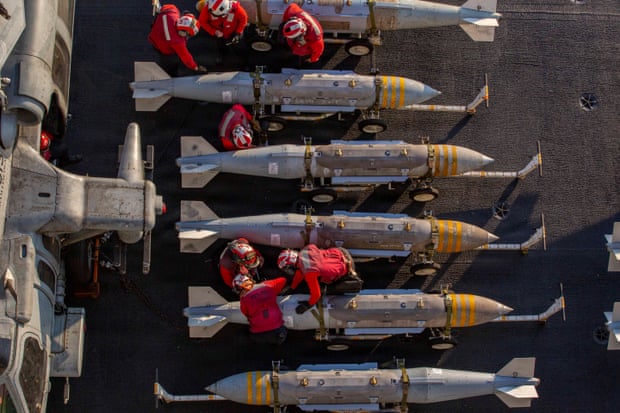
Iran retained that capacity despite the US hitting more than 12,300 targets in Iran, according to US Central Command. Israel, for its part, said it had dropped 15,000 bombs on Iran since February 28 (Jerusalem Post, 3/25/26).
The Post offered no insight into why it believes the US/Israeli assault will suddenly become more effective.
‘Finish the job’
“If the [Iranian] regime behaves as it always has, it will claim to want to reach a deal but never will,” the Wall Street Journal (4/8/26) writes—stuffing the 2015 Iran nuclear agreement down the memory hole.A Wall StreetJournal editorial (4/8/26) echoed the Post, writing that “the Iranian regime remains a threat in the Strait of Hormuz and the job is far from finished.” The Journal insisted that the US should restart the war if it doesn’t get its way:
The next test for Mr. Trump will be whether he takes his two-week ceasefire deadline seriously. If he does, and Iran plays its usual games, then he really will have to “finish the job.”
Such calls overlook the limits to US war-making capacity. Analysts at Colorado’s Payne Institute for Public Policy, cited by the Australian Broadcasting Corporation (4/1/26), “assessed that the US had lost nearly 46% of its Army Tactical Missile Systems (ATACMS),” one of the US’s main tactical ballistic weapons. Likewise, they estimated that
supplies of Terminal High Altitude Area Defense (THAAD) missile systems, used by the US and its partners in the region to defend against Iranian missiles, were also dropping significantly. Projections showed the THAAD interceptors could run out by mid-April.
The US also burned through 850 Tomahawk cruise missiles in the war’s first four weeks, “a rate that has alarmed some Pentagon officials” (Washington Post, 3/27/26). Meanwhile, the Arrow 2 and Arrow 3 interceptors that Israel used against Iran’s longer-range missiles “were also projected to be exhausted by the end of March” (Australian Broadcasting Corporation, 4/1/26). Unlike the Journal’s lust for violence, the US/Israeli arsenal is finite.
‘Circle of death’
Marc Thiessen (Washington Post, 4/8/26) asserts that Trump can “bring the war to a final and decisive conclusion…in a matter of weeks”—disregarding the fact that nearly six weeks of all-out war were far from decisive.
Nor did these constraints prevent the Washington Post‘s Marc A. Thiessen (4/8/26) from calling on Trump to create a “circle of death” around any former nuclear sites in Iran, and enforce it by “killing any Iranian who enters that circle.” He also suggested another round of assassinations, “eliminating the Iranian officials who had been spared for the purpose of negotiations,” so that the country’s leaders understand that if they fail to reach “a negotiated settlement to Trump’s liking…they will be killed.”
Murderous fantasies about the US imposing total domination over Iran are perhaps a symptom of the US being unable to do so in reality. As Thiessen’s own paper (4/3/26) reported, despite the US/Israeli assassinations of high-ranking Iranian officials,
Iran has continued to launch retaliatory attacks, often hitting high-value targets, demonstrating sustained command and control beyond the conflict’s initial days when units largely operated on autopilot under Iran’s “mosaic” defense strategy, which emphasizes decentralized autonomy. In recent weeks, Iranian attacks have struck critical energy infrastructure in the Persian Gulf, industrial and energy sites in Israel, and key US military installations, including a direct strike on an advanced US spy plane.
In other words, decapitating the Iranian government hasn’t caused it to capitulate or prevented it from responding to US/Israeli attacks, but Thiessen—for reasons he did not explain—thinks that doing the same thing again will produce a different result.
Thiessen also said that the US should
develop and implement a covert action plan to support the Iranian opposition…. Such a plan could involve supplying the Iranian opposition with weapons, much as the US once provided arms to anti-Communist “freedom fighters” across the world.
The overriding goal should be to help the Iranian people, over time, bring down this murderous regime.
Set aside that this plan would violate the UN Charter’s principle of nonintervention and that the US has zero right to shape who governs Iran. In reality, multiple US intelligence reports conclude that Iran’s government “is not in danger” of falling (Reuters, 3/11/26). Israeli officials also think that Iran’s government “isn’t likely to fall soon” (Wall Street Journal, 3/12/26).
While there’s little reason to believe that Thiessen’s proposal would produce regime change in Iran, we can be fairly confident that flooding Iran with weapons will have the same outcome that flooding countries with arms generally has—namely, a devastating bloodbath for its inhabitants (Electronic Intifada, 3/16/17; Jacobin, 9/11/21).
‘The easiest method’
Bret Stephens (New YorkTimes, 4/14/26) advises Trump to “keep turning the screws on the regime’s leaders”—a torture metaphor from an advocate of actual torture.
Bret Stephens of the New YorkTimes (4/14/26) likewise wrote from an alternate reality where the war showed that the US can impose its will on Iran. Stephens opened by quoting his own piece (4/7/26) from the previous week :
“The easiest method for the United States to reopen Hormuz,” I wrote last Tuesday, “is to start seizing tankers carrying Iranian crude once they reach the Arabian Sea.”
It’s not clear why Stephens thought seizing Iranian ships would cause Iran to back down. After all, assassinating many of the country’s leaders, attacking Iranian health facilities (Al Jazeera, 4/3/26) and vital civilian infrastructure (BBC, 3/19/26), and mass-murdering Iranian school girls (Guardian, 3/3/26) did not compel the country to stop defending itself.
Stephens went on to contend:
Trump should put Iran’s regime to a fundamental choice: It can have an economy. Or the regime can attempt to have a nuclear program while trying to control the Strait of Hormuz. But it can’t have both.
This quote suggests Stephens was unwilling to seriously grapple with Iran’s retaliatory power. For example, Iran has consistently responded to US aggression by attacking the empire’s regional nodes, killing Israelis (BBC, 3/1/26; Reuters, 4/6/26) and badly damaging Israeli infrastructure (Al Jazeera, 3/21/26).
Iranian countermeasures have likewise hit energy infrastructure in the US’s client states in the Gulf, leading—for example—to fires at Kuwaiti oil and petrochemical facilities, at a petrochemical plant in the UAE and at a storage tank in Bahrain (AFP, 4/5/26). In other words, Iran has illustrated that it has a multitude of options for raising the costs of US violence, indicating it would likely continue exercising these in the scenario Stephens advocates.
‘Broke the petrodollar’
Aaron Brown (Bloomberg, 4/6/26) notes that while investment generally flows into the US Treasury in times of crisis, “the calculus changes when the US itself is the belligerent.”
None of these commentators acknowledge what is likely the strongest blow that Iran has landed against the US. The Islamic Republic has undermined what’s called the petrodollar regime, a system in which the US promises to militarily protect the Gulf monarchies in exchange for these states putting money they earn from oil sales into US assets—most notably Treasury bonds. The arrangement, which has been in place since 1974, subsidizes US borrowing costs and keeps the US dollar as the de facto global reserve currency.
Bloomberg (4/6/26) reports that the war on Iran “broke the petrodollar,” because the conflict is “categorically different” from other political, military and economic crises of the post-1974 period:
Gulf producers can’t get their oil out. The Strait of Hormuz closure has stranded their barrels along with everyone else’s.
Gulf states including Kuwait, Iraq, Saudi Arabia and the UAE collectively cut production by at least 10 million barrels per day in March. Saudi Arabia and the UAE can export reduced volumes through alternative pipelines. But those routes handle only about a quarter of normal Strait throughput at full capacity, and they are under active Iranian drone and missile threat. Qatar declared force majeure on exports of liquified natural gas after strikes on its Ras Laffan facility.
Thus, Iran has shown that it can hinder, and possibly destroy, a central plank in the architecture of the US empire. Stephens, Thiessen and the editorial boards of the Journal and the Post appear to be deluding themselves about the gravity of this development. Iran has successfully resisted subjugation, largely by jeopardizing a key instrument of US global hegemony, but these authors have gone on writing as if Washington were in a position to force Iran to surrender to its diktats.
These observers traffic in illusions about a virtually omnipotent US that can indefinitely control the world through force of arms, consequence-free. Op-ed writing is supposed to be persuasive. In that regard, these authors have failed spectacularly.
FAIR’s work is sustained by our generous contributors, who allow us to remain independent. Donate today to be a part of this important mission.
Donald Trump sings and dances, says that it’s fun to kill everyone …Keir Starmer explains that UK is actively supporting Israel’s genocidal expansion and repeats his previous quotation that he supports Zionism “without qualification”. Keir Starmer said “I said it loud and clear – and meant it – that I support Zionism without qualification.” here: https://www.jewishnews.co.uk/keir-starmer-interview-i-will-work-to-eradicate-antisemitism-from-day-one/
By extending the ceasefire, Trump admits Iran has a strong negotiating hand. Tasos Katopodis/Getty Images
By extending the pause in fighting, Donald Trump admits that Iran is in a strong bargaining position – so what next?
The US-Israeli war on Iran has reached an unexpected pause. An easing of tensions between Washington and Tehran now extends to Donald Trump changing his mind yet again and extending the informal ceasefire deadline. His motive is allegedly to allow the Iranian government more time to agree to a proposal that meets US requirements, but it is also an admission that Iran is in a strong bargaining position.
There are complications, though. One is that while the Iranian Revolutionary Guard Corps (IRGC) maintain control of the Strait of Hormuz, US armed forces are blockading Iranian ports to stop commercial shipping. The aim is to put such pressure on Iran’s weakened economy that the leadership in Tehran will quickly accept US terms. That’s unlikely.
While a few days ago, Iranian sources were suggesting that they might loosen their control of the Strait of Hormuz, any progress in that direction has now been halted until the US maritime blockade is lifted. Only then might Iran participate in negotiations on a settlement.
Furthermore, while Israel is also participating in the pause in bombing, it is very much a separate actor. It has plenty of influence in Washington and is led by Binyamin Netanyahu, who wants nothing less than total victory over Iran.
All this is overshadowed by the current state of the conflict. In essence, the war failed to meet US or Israeli expectations almost from the start. Most of Iran’s theocratic and political leaders were assassinated by the Israeli Defence Forces (IDF) in the first week but were rapidly replaced, and the country held together. Then, not only did the powerful IRGC survive an intensive combined air assault by US and Israeli forces, it even went on the offensive, concentrating on targets such as radar, satellite communications, aerial refuelling and intelligence gathering.
Iran may have had thousands of people killed and billions of dollars of damage done to its economy, but it has not been defeated and is not ready to cede to the US’s demands. Moreover, one of the impacts of the losses among the theocratic, political and IRGC leaderships is that there has been a radicalisation as a new generation takes shape.
This is reflected particularly in the hard-line position of the powerful IRGC leader, Major General Ahmad Vahidi, who is prepared to withdraw from negotiations, at least for now. This contrasts with two political leaders, the speaker of the Majlis (parliament), Mohammad Bagher Ghalibaf, and the foreign minister, Abbas Araghchi, who seem to favour a more nuanced approach.
Compromise may be possible within Iran, but it is unlikely that it will be enough for the United States, where most of the key people around Trump have been appointed because they toe the line. Those who appear to disagree with the president have been sacked or have left, the latest being navy secretary John Phelan after barely a year in post, although he was reportedly ousted over a dispute about shipbuilding, rather than Iran.
Meanwhile, the IRGC’s control of the Strait of Hormuz has already had a long-term impact, according to a classified Pentagon briefing to Congress reported on by the Washington Post. Even if an end to the fighting was negotiated, post-war necessities such as clearing Hormuz of Iranian-laid mines could affect oil and gas prices for six months, right up to the Congressional mid-term elections.
More immediately, IRGC units have fired on some commercial ships, forcing them to abide by Iranian controls. The US Navy has done the same to enforce its blockade, with one case from last weekend having a political significance that has been largely missed in the Western media and that goes some way to explaining Iran’s response to intense US and Israeli military pressure.
The US destroyer USS Spruance attempted to board an Iranian cargo ship, Touska, in the Arabian Sea to force it to stop. The Iranian ship’s crew refused to do so for six hours until the US destroyer ordered the crew to evacuate its engine room. This they did, and the engine was then put out of action by the Spruance firing several rounds of its main armament, a 5-inch Mk 45 gun. The Touska was then boarded and taken into US Navy custody.
There is an important historical context to this. The Spruance’s firing of its main artillery armament in anger was the first time a US Navy warship had done so in nearly 40 years. Highly relevant is that the last time also came amid a conflict with Iran.
In the final months of Iraq’s eight-year-long war against Iran, in which the US had sided with Saddam Hussein’s Iraq, a US destroyer was damaged by an Iranian mine. Days later, on 18 April 1988, the US Navy mounted ‘Operation Praying Mantis’ in the Gulf, which involved an attack on an Iranian frigate, IRIS Joshan, by a formidable US Navy task force of a guided missile cruiser, a destroyer and a frigate. The Joshan was sunk with heavy loss of life, 45 crew killed, and the US operation continued to destroy two Iranian surveillance platforms and two other naval vessels.
Thirty-eight years ago, Operation Praying Mantis was seen as a great success by the Pentagon, but it was a wake-up call for the Iranians, and especially the IRGC. In recent years, the IRGC has built a fleet of around a thousand fast attack craft suited to swarm attacks on much larger warships, has a stockpile of around two thousand mines, shore-based anti-ship missiles and drone swarms.
As a result of that instance nearly four decades ago, Iran’s military resilience improved. Today, that’s resulting in two of the world’s most powerful states, the United States and Israel, being unable to win their war.
For the US, in particular, Iran now joins Afghanistan, Iraq and Libya in a line of failed wars over the past quarter century. Whether that lesson will be learned by a Pentagon led by Pete Hegseth and Donald Trump is doubtful.
Donald Trump explains why he established his Bored of PeaceDonald Trump calls for help from NATO allies in securing the Strait of Hormuz despite saying on 7 March 2026 that they don’t need people to join wars after they’ve already won. He’s challenged with the claim that he lies as much as the IDF.Climate science denier Donald Trump confirms that he knows nothing about democracy and that more liquid gold is being secured according to his policy of global privateering.
This work by Middle East Monitor is licensed under a Creative Commons Attribution-NonCommercial-ShareAlike 4.0 International License.
Iranian Foreign Minister Abbas Araghchi (L) meets with Pakistani Chief of General Staff Asim Munir (R) amid efforts to revive stalled peace talks between the US and Iran to end their eight-week war, in Islamabad, capital of Pakistan, on April 25, 2026. [Iranian Ministry of Foreign Affairs – Anadolu Agency]
Iran has shared a “workable framework” with Pakistan aimed at permanently ending the US war, Foreign Minister Abbas Araghchi said on Saturday, Anadolu reports.
In a post on the US social media company X following a visit to Pakistan, Araghchi said discussions focused on efforts to restore stability in the region and end the conflict.
“We shared Iran’s position concerning a workable framework to permanently end the war on Iran,” he said, without providing further details.
Araghchi described the trip as “very fruitful,” praising Pakistan’s role in facilitating dialogue and its “brotherly efforts” to help bring peace back to the region.
He also expressed skepticism about Washington’s intentions.
“Have yet to see if the U.S. is truly serious about diplomacy,” he said.
Pakistan has been acting as an intermediary between Tehran and Washington amid ongoing tensions following recent military escalation.
Araghchi arrived in Pakistan late Friday and met with Pakistan’s Prime Minister Shehbaz Sharif in Islamabad on Saturday, amid efforts to revive stalled peace talks between the US and Iran to end their eight-week war. He will also travel to Muscat and Moscow.
The first round was held in Islamabad two weeks ago but failed to reach an agreement to end the conflict that began on Feb. 28 and engulfed the entire Middle East. Those talks came after Pakistan brokered a two-week ceasefire on April 8, which was later extended by US President Donald Trump.
Meanwhile, US President Donald Trump on Saturday said that he has cancelled a planned trip to Pakistan by special envoy Steve Witkoff and adviser Jared Kushner.
“I’ve told my people a little while ago they were getting ready to leave, and I said, ‘Nope, you’re not making an 18 hour flight to go there. We have all the cards. They can call us anytime they want, but you’re not going to be making any more 18 hour flights to sit around talking about nothing’,” Trump told Fox News via phone.
Iran has refused to hold direct talks with the US and said observations would be conveyed to Pakistan.
Some of the sticking points are said to be the Strait of Hormuz, the US blockade of Iranian ports, and Iran’s enriched uranium.
This work by Middle East Monitor is licensed under a Creative Commons Attribution-NonCommercial-ShareAlike 4.0 International License.

Nigel Farage objects to criticism of the IDF. He asks how could anyone object to them starving people to death, forced marches like the Nazis did, bombing Gaza’s hospitals and universities, mass-murdering journalists, healthworkers and starving people queuing for food, killing and raping prisoners and murdering children. He calls for people to stop obstructing his genocide for Israel.Keir Starmer explains that UK is actively supporting Israel’s genocidal expansion and repeats his previous quotation that he supports Zionism “without qualification”. Keir Starmer said “I said it loud and clear – and meant it – that I support Zionism without qualification.” here: https://www.jewishnews.co.uk/keir-starmer-interview-i-will-work-to-eradicate-antisemitism-from-day-one/
Donald Trump calls for help from NATO allies in securing the Strait of Hormuz despite saying on 7 March 2026 that they don’t need people to join wars after they’ve already won. He’s challenged with the claim that he lies as much as the IDF.