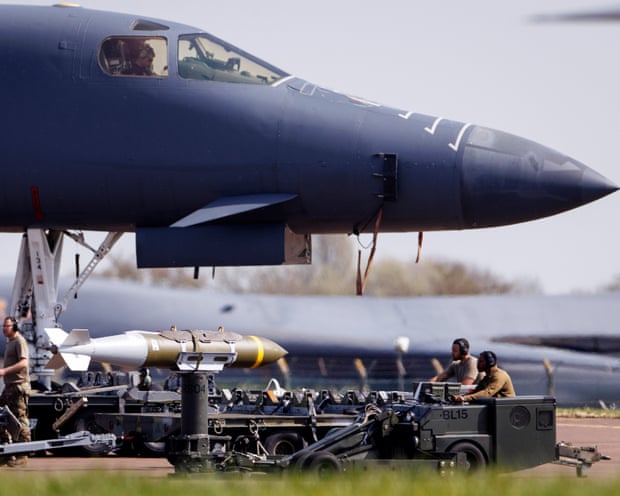
US air force personnel prepare to load munitions on to a heavy bomber aircraft at the RAF Fairford airbase in Gloucestershire. Photograph: Tolga Akmen/EPA
Trade unions say UK prime minister must begin by revoking permission for US to use RAF bases for airstrikes in Gulf
Trade unions have called on Andy Burnham to tackle the cost of living crisis at its source by pressuring Donald Trump to bring the conflict in the Middle East swiftly to an end.
Leaders from 10 unions, including Unison, the UK’s largest, urged the prime minister to oppose further fighting in the Gulf to help bring down energy and fuel costs.
To put pressure on Trump, unions said Burnham must begin by revoking permission for the US to use RAF bases to launch airstrikes on Iran.
…
The general secretaries of 10 UK trade unions, representing more than 2.3 million workers, said in their letter to Burnham that he should do more to oppose “the US and Israel’s devastating, illegal war on Iran”, which was “deepening the cost of living crisis faced by our members and the British public”.
“Since the war started, the average British household has seen its annual energy bill rise by £221, while monthly food bills are forecast to rise by £32.80. Without an end to the war, there will be no end to this cost of living crisis,” they wrote.
The general secretaries said they were encouraged by the new government’s focus on the cost of living and the measures it was taking “to make life more affordable”.
But they said they were “deeply concerned” that it had “authorised US airstrikes to be conducted from bases on British territories as part of the escalating war against Iran”.
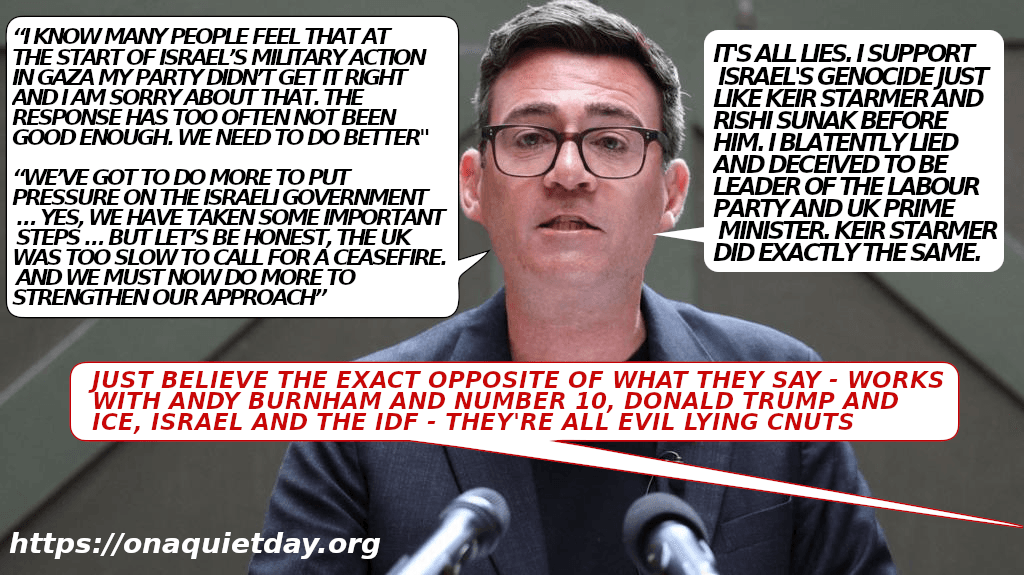
Donald Trump sings and dances, says that it’s fun to kill everyone … unless he gets distracted or falls asleep.UK Prime Minister Andy Burnham admits to blatently lying and engaging in deception to become leader of the UK Labour Party and Prime Minister.Orcas discuss Donald Trump and the killer apes’ concept of democracy. Front Orca warns that Trump is crashing his country’s economy and that everything he does he does for the fantastically wealthy.
This work by Middle East Monitor is licensed under a Creative Commons Attribution-NonCommercial-ShareAlike 4.0 International License.
Mohammad Bagher Zolghadr. [Photo/AA]
Iran’s top security official said Saturday that the Strait of Hormuz will remain closed until the US changes what he described as its hostile policies and meets a set of Iranian demands, Anadolu reports.
In a statement, Mohammad Bagher Zolghadr, secretary of Iran’s Supreme National Security Council, said Washington must “correct its behavior” before the strategic waterway can reopen.
He listed six conditions, including ending what he called threats against Iran’s supreme leader, permanently halting military action against Iran and its regional allies, withdrawing US naval and air forces involved in what he described as the blockade of Iran, compensating Tehran for damage caused during the recent conflicts, lifting US sanctions and releasing Iran’s frozen assets.
Zolghadr said the demands reflected the will of the Iranian people, citing nationwide rallies over the past six days.
“The Supreme National Security Council will not retreat from these demands, whether in war or in negotiations,” he said.
Separately, Iranian army spokesman Brig. Gen. Mohammad Akraminia said the “Iranian order” governing the Strait of Hormuz was “irreversible,” adding that the US had “no choice but to accept the existing reality” or face “far greater costs than before.”
The remarks come as negotiations over the future of navigation through the Strait of Hormuz remain at an impasse.
Iran and the US signed a memorandum of understanding on June 18 through Pakistani and Qatari mediation, ending active hostilities and launching negotiations toward a broader agreement. The memorandum envisaged a gradual restoration of commercial navigation through the Strait of Hormuz, but implementation later stalled as both sides exchanged accusations of violating its terms.
Donald Trump sings and dances, says that it’s fun to kill everyone … unless he gets distracted or falls asleep.Orcas discuss rotting brain, front Orca says Sundown Syndrome is a dead givaway and he wishes someone would Lock Him Up
This work by Middle East Monitor is licensed under a Creative Commons Attribution-NonCommercial-ShareAlike 4.0 International License.
Iranian President Masoud Pezeshkian delivers remarks during a meeting with officials from the Ministry of Roads and Urban Development in Tehran, Iran on July 26, 2026. [Iranian Presidency / Handout – Anadolu Agency]
Iranian President Masoud Pezeshkian on Saturday said that now is the “best time” to reach an agreement with the US, Anadolu reports.
“When people talk about reaching an agreement, I believe now is the best time, because there is cohesion, strength and unity in the country. As far as I know, Iran is regarded as having emerged from this war and this conflict victorious and strong,” Pezeshkian said at his second news conference since taking office.
He said the current situation provided an opportunity to pursue an agreement and resolve outstanding issues through dialogue.
According to the semi-official ISNA news agency, Pezeshkian said Iran could pursue its rights through dialogue and that it sought “nothing beyond the rights of the country and its people.”
He said wars alone could not resolve disputes and reaffirmed his government’s commitment to pursuing peace under the memorandum of understanding signed with the US in June.
“The issues cannot be resolved through war alone,” he said. “We are trying to move toward peace based on the provisions of the memorandum.”
“We are determined to make the memorandum the basis of our approach, provided the United States abandons the atmosphere of distrust it has created and trust can be rebuilt,” Pezeshkian said, adding that Washington remained “untrustworthy” in Tehran’s view.
In other remarks carried by the official IRNA news agency, Pezeshkian said dialogue had not altered Tehran’s long-standing position toward Washington.
“The US is colonialist, the US is criminal, and the Islamic Republic remains the Islamic Republic. There is no doubt about that,” he said.
Pezeshkian, however, argued that diplomacy had compelled Washington to negotiate with Tehran.
“The very fact that we held talks and pursued diplomacy forced the US to come to the table and reach an agreement and understanding with Iran,” he said.
He rejected criticism of the memorandum, saying it contained no provision requiring Iran to relinquish any of its interests or positions.
“You will not find a single clause in the memorandum in which we gave anything away,” he said, adding that Tehran “stands firmly” behind what it signed.
Pezeshkian accused Washington of violating the memorandum by pursuing alternative shipping arrangements in the Strait of Hormuz instead of adhering to procedures to be jointly agreed by Iran and Oman.
He said disputes over the alleged violations should be addressed through mechanisms established under the memorandum and expressed hope the implementation process would continue “with dignity and honor” for Iran.
Pezeshkian also defended Iran’s negotiating team, describing its members as “dedicated, expert and hardworking,” and said criticism directed at them was unfair.
He also said his administration was working with the heads of the three branches of government and the Supreme National Security Council to ease internet restrictions while taking security and infrastructure considerations into account.
Donald Trump sings and dances, says that it’s fun to kill everyone … unless he gets distracted or falls asleep.Orcas discuss rotting brain, front Orca says Sundown Syndrome is a dead givaway and he wishes someone would Lock Him Up
This work by Middle East Monitor is licensed under a Creative Commons Attribution-NonCommercial-ShareAlike 4.0 International License.
Iraqi Prime Minister-designate Ali al-Zaidi. [Photo/AA]
Iraqi Prime Minister Ali al-Zaidi said Saturday that his country seeks balanced relations with neighbouring states and will not allow its territory to be used to threaten their security, during a phone call with French President Emmanuel Macron, Anadolu reports.
The two leaders discussed strengthening bilateral relations and cooperation, regional developments and the scheduled end of the international coalition’s mission in Iraq, according to a statement from the Iraqi prime minister’s media office.
The statement said they also discussed economic and investment cooperation in Iraq, opportunities for French companies, and joint efforts to reduce tensions and promote regional security and stability.
Al-Zaidi highlighted the importance of relations between Baghdad and Paris and invited Macron to visit Iraq, calling for joint efforts to build a “sustainable economic and investment partnership” that serves the interests of both countries.
He said his government would continue working to strengthen stability and “transform Iraq into an influential economic and political power in the region,” citing the country’s resources and strategic position connecting international trade routes.
Al-Zaidi said Iraq remained committed to building balanced relations with neighbouring countries and “not allowing Iraqi territory to be used to threaten their security.”
He also reaffirmed Iraq’s commitment to protecting its security, sovereignty and national interests while relying on dialogue to address regional and international issues.
On security issues, al-Zaidi reiterated that 30 September would be the “final date for the withdrawal of coalition forces from Iraq.”
He said ending the coalition’s mission would give Iraq greater room to focus on reconstruction and development, promote economic growth and improve the welfare of its people.
Macron, for his part, praised steps taken by the Iraqi government and reaffirmed France’s support for Iraq’s efforts to combat corruption and implement economic reforms, according to the statement.
The French president also said Paris would continue supporting Iraq in combating terrorism and strengthening the capabilities of the Iraqi armed forces.
On 27 September, 2024, Washington and Baghdad announced in a joint statement that they had agreed on a two-phase plan to end the coalition’s mission in Iraq.
The first phase was scheduled to be completed by September 2025 and included ending the coalition’s military mission, withdrawing forces and handing over bases before transitioning to a bilateral security partnership.
The second phase runs through September 2026, during which the coalition’s military mission in Syria continues from an air base in Erbil, Iraq.
The US leads the coalition, which includes countries such as France and Spain. It was formed in 2014 to fight the ISIS (Daesh) terrorist group, which at the time controlled large areas of Iraq and Syria.
On 10 December, 2017, then-Iraqi Prime Minister Haider al-Abadi declared “victory” over ISIS after three years of fighting.
The group, however, continues to operate in northern, western and eastern provinces through sporadic attacks, while the Iraqi government conducts security and military operations to eliminate its remnants.
Donald Trump sings and dances, says that it’s fun to kill everyone … unless he gets distracted or falls asleep.Orcas discuss rotting brain, front Orca says Sundown Syndrome is a dead givaway and he wishes someone would Lock Him Up
This work by Middle East Monitor is licensed under a Creative Commons Attribution-NonCommercial-ShareAlike 4.0 International License.
U.S. Vice President J.D. Vance speaks during a press briefing in the James S. Brady Press Briefing Room at the White House in Washington, D.C., United States, on June 18, 2026. [Mehmet Eser – Anadolu Agency]
The US expects Iran to restore the flow of oil and gas through the Strait of Hormuz to pre-conflict levels and ensure the safe passage of commercial vessels, US Vice President JD Vance said Saturday.
“Our expectation is you’re going to see the same amount of oil and gas come out of the Gulf that you saw before the conflict started,” Vance told Fox News, saying Iran had communicated that intention to Washington.
“But you know, we don’t trust. We verify,” Vance said. “We actually look not at people’s words but people’s deeds.”
He said Washington was also monitoring Iranian statements about potentially imposing tolls on vessels using the strategic waterway.
“The Iranians have told us they have no plans to toll the Strait of Hormuz,” Vance said, adding that the US would judge Tehran by its actions.
Vance said Iran and Gulf countries, particularly Oman, had been discussing ways to maintain safe maritime traffic.
He said Iran had laid “a large number of mines” at the start of the conflict, making demining and the establishment of a safe traffic scheme key issues.
“What we’re really working through now is how you can actually set up a traffic scheme so that the ships that pass can pass through safely. That includes, of course, demining,” Vance said.
The US also expects Iran to commit to not firing on commercial vessels, Vance said.
“That also includes a commitment from the Iranians that they’re not going to fire at commercial vessels,” he said.
“They’re hurting in a big way. They want this thing to be over,” he said, adding that the key question was whether Iran’s system could provide what Washington considers necessary for an agreement.
Donald Trump sings and dances, says that it’s fun to kill everyone … unless he gets distracted or falls asleep.Orcas discuss rotting brain, front Orca says Sundown Syndrome is a dead givaway and he wishes someone would Lock Him Up