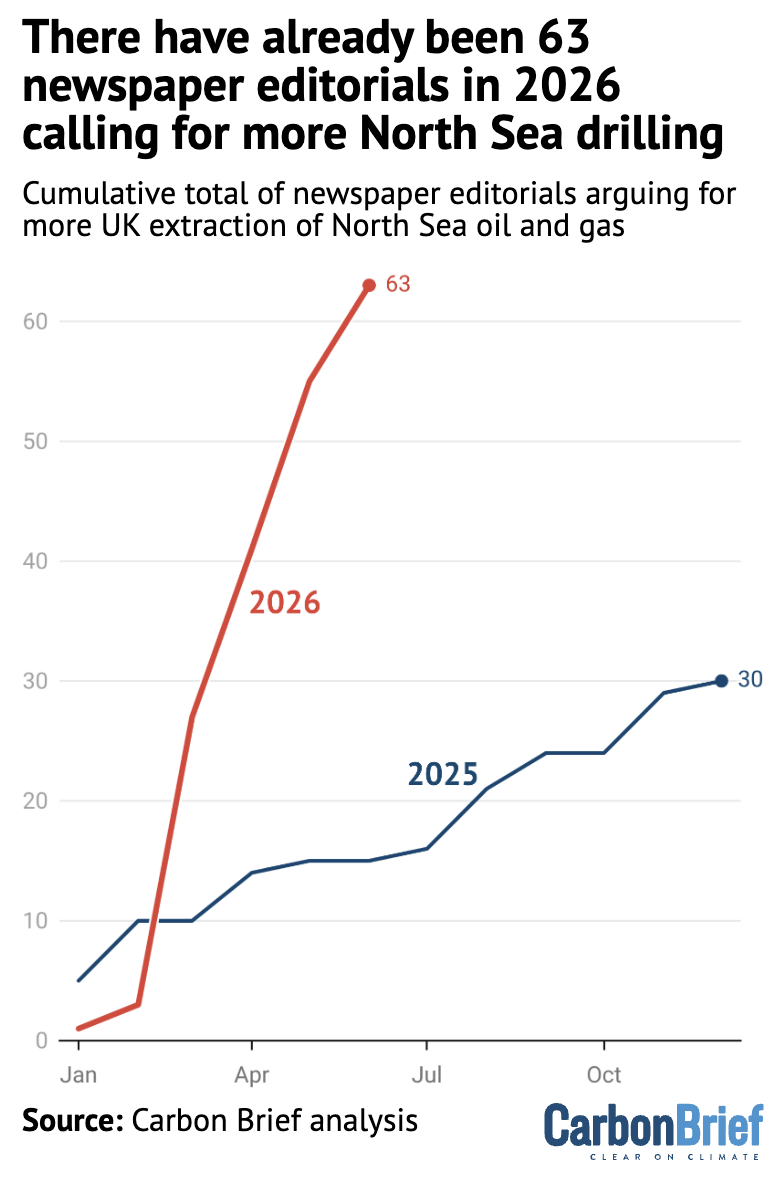
UK newspapers have already published 63 editorials this year calling for more oil and gas extraction in the North Sea, according to Carbon Brief analysis.
The national outlets, including the Sun, the Daily Telegraph and the Times, argue that the nation “needs” more North Sea drilling to provide “home-sourced oil and gas” amid a “full-blown energy crisis”.
These newspapers seek to blame energy secretary Ed Miliband’s “net-zero crusade” for curbing UK fossil-fuel production – despite supplies dwindling for decades before he took the role.
The push for North Sea drilling in newspaper editorials – considered a publication’s formal “voice” – is part of a wider rejection of net-zero policies by the UK’s right-leaning press.
Figures ranging from ex-Labour prime minister Tony Blair to hard-right Reform UK leader Nigel Farage have repeated similar arguments that more drilling will “boost” the UK economy.
Even US president Donald Trump has weighed in, attributing, in part, the resignation of Keir Starmer as UK prime minister to him “fail[ing] badly” on North Sea oil.
Despite these claims, experts say trying to extract the last barrels of domestic oil and gas would have no impact on people’s energy bills and very little effect on energy security.
More drilling
North Sea oil and gas production is a highly politically charged issue in the UK, especially under the current Labour government.
When Labour won the general election in 2024, the new government committed to a “phased and responsible” transition away from fossil-fuel extraction in the North Sea.
As part of this pledge, it ruled out issuing new exploration licences for oil and gas. Since then, the government has allowed some “tiebacks”, where new drilling is undertaken close to existing sites.
Roughly 90% of the fossil fuels that are likely to be extracted in the North Sea have already been burned. North Sea oil and gas extraction was, therefore, already on a clear downward trajectory long before Labour came to power, having dropped 75% between 2000 and 2024.
Nevertheless, many newspapers have relentlessly called for more oil and gas production, framing the Labour policy as “self-destructive” and compromised by “green ideology”.
This has ramped up significantly in 2026. Just six months into the year, newspapers have already published 63 pro-North Sea editorials, according to analysis by Carbon Brief. This is more than double the number published in 2025, as shown in the figure below.
Cumulative number of UK newspaper editorials supporting more fossil-fuel extraction in the North Sea in 2025 (blue) and January-June 2026 (red). Source: Carbon Brief analysis.
Right-leaning newspapers have led this campaign, with the Sun alone publishing 25 editorials, while the Daily Telegraph and the Times have published 10 each.
‘Full-blown energy crisis’
The biggest surge in pro-North Sea drilling editorials came in March, as the Iran war escalated and a global energy crisis began to take shape. Newspapers published 24 such editorials that month, despite the crisis largely arising from the world’s reliance on fossil fuels.
The Daily Express said the UK needed more “home-sourced oil and gas” and the Daily Mail highlighted the “perverse limit on domestic fossil-fuel production”.
As the weeks progressed, the Sun lamented price rises and potential fuel shortages, proposing North Sea drilling as a solution to the “full-blown energy crisis”.
Yet, UK oil and gas is sold by private companies on the open market at international rates. This means UK consumers have no particular right to the fuels or control over the prices they are bought for.
The Sun claimed – without evidence – that if the North Sea had been prioritised, the UK “might just have the cheapest electricity in the world”. It also said net-zero “forces us to spend billions” on imports.
In fact, the UK’s high energy prices are primarily the result of its reliance on gas to generate electricity.
The nation is reliant on oil and gas imports, in part, because the North Sea is a “mature basin” that saw its output collapse long before the UK even had a net-zero target.
Renewables and low-carbon technologies – often dismissed by the same newspapers – are expected to have a far greater impact on cutting imports than new drilling ever could.
Miliband’s ‘crusade’
Much of the criticism by these newspapers of Labour’s North Sea stance is tied to their highly personal criticism of Miliband. Of the 63 editorials arguing for more drilling, nearly three-quarters also attacked him as a “net-zero zealot” on a “green crusade”.
The Times said the energy and net-zero secretary was pursuing a “masochistic policy” by not expanding North Sea drilling and that he had “cloaked his zealotry in spurious rationality”.
This all fits with a broader trend that has seen right-leaning newspapers launch frequent, personal attacks on Miliband.
In the roughly two years since Labour won the election, giving the government a clear mandate for its net-zero policies, there have been around 230 editorials criticising Miliband.
(These have redoubled in recent days, amid rumours that he may be made chancellor under Andy Burnham, if the new Makerfield MP becomes the next prime minister, as is widely expected.)
Such attacks have increasingly spilled over into politics. Conservative shadow energy secretary Claire Coutinho has accused Miliband of “fanaticism” and Conservative leader Kemi Badenoch has even likened him to a “Nigerian military dictator”.
The newspapers have also interpreted any support for North Sea drilling as a rebuke of Miliband. Both the Sun and the Daily Telegraph welcomed an essay by Blair, in which he argued that “we must…use what is left of our North Sea oil and gas resources”.
The Sun heralded Blair as Labour’s “most successful election winner” and said he “nailed the chief mistakes” of the current government, including:
“Allowing Ed Miliband free rein on net-zero – especially the banning of North Sea drilling.”
Several of the newspapers have also thrown their support behind the Conservative party, as it frames itself as an anti-net-zero, pro-fossil fuel alternative to Labour.
The Daily Mail described Badenoch’s proposal to drill more in the North Sea as a “concrete plan”, while the Sun – in an echo of Trump’s slogan – has simply urged her to “drill, Kemi, drill”.
Nigel Farage urges you to ignore facts and reality and be a climate science denier like him and his Deputy Richard Tice. He says that Reform UK has received £Millions and £Millions from the fossil fuel industry to promote climate denial and destroy the planet.UK Conservative Party leader Kemi ‘not a genocide’ Badenoch explains her reality that the Earth is flat, the Moon is made of cheese and that she was born from Unicorn horn dustElon Musk urges you to be a Fascist like him, says that you can ignore facts and reality then.
Conservative Party leader Kemi Badenoch delivers a speech on the economy at Victory Services Club, central London, June 29, 2026
TORY leader Kemi Badenoch was accused today of a Trumpian obsession in a pro-oil and gas speech.
Ms Badenoch said the economy was “in limbo” while businesses waited to see what Andy Burnham would do if he became the next prime minister.
“Britain is facing a summer of chaos,” she said in a speech in London.
“It is time to get Britain drilling again and if Andy Burnham had any sense, he would sack [Energy Secretary] Ed Miliband, not make him chancellor.”
The MP for North West Essex has previously called for more oil and gas drilling in the North Sea.
Uplift deputy director Robert Palmer said: “Kemi Badenoch’s Trumpian obsession with oil and gas is blinding the Conservative Party to the reality of how climate change is affecting Britain right now.”
He said last week’s heatwave had seen schools shut, trains stopped and people’s health suffering, with likely fatalities, arguing that continued fossil fuel burning is driving more frequent and intense heatwaves in Britain.
“The science is clear, there can be no new oil fields if we want to stay within safe climate targets,” Mr Palmer said.
“Yet Kemi Badenoch’s response is to want to abandon those targets and drill even more.
“Pushing ahead with this reckless approach will leave ordinary people paying the price, through more extreme heat, more damaging floods, and the rising costs that come with climate breakdown.
“Either Kemi Badenoch believes, like Trump, that climate change is a ‘con job’ or she is simply willing to ignore the consequences for us and our children.”
He warned more drilling would not cut energy bills but would increase oil company profits and worsen the climate crisis, calling it “profoundly irresponsible.”
Nigel Farage urges you to ignore facts and reality and be a climate science denier like him and his Deputy Richard Tice. He says that Reform UK has received £Millions and £Millions from the fossil fuel industry to promote climate denial and destroy the planet.UK Conservative Party leader Kemi ‘not a genocide’ Badenoch explains her reality that the Earth is flat, the Moon is made of cheese and that she was born from Unicorn horn dust
Faster electrification is the best way to secure lower energy bills and stronger energy security, according to the Climate Change Committee (CCC).
The government’s official climate advisers have stressed the importance of electrification, noting that electric cars and heat pumps can “put money back into people’s pockets”.
Moreover, the UK’s net-zero targets face “significant risks” unless there is faster progress in electrifying cars, heating and industry, according to the CCC’s latest progress report.
The report notes that the government has closed some of the gaps to its upcoming targets and introduced more “credible” plans.
However, challenges remain in the UK’s climate strategy, including accelerating the expansion of heat pumps, cutting emissions from farms and supplying planes with “sustainable” fuels.
The CCC notes that 17% of the emissions cuts required to achieve the UK’s 2030 Paris Agreement climate target are currently not addressed by any government plans at all.
Amid political and industry pressure, the committee also says the government should “stand firm” on its climate goals, including its strategy for encouraging electric-vehicle (EV) sales.
Carbon Brief has covered the CCC’s annual progress reports in 2025, 2024, 2023, 2022, 2021 and 2020.
The report comes at a febrile moment in UK politics, with prime minister Keir Starmer having just resigned and with newly re-elected MP Andy Burnham widely tipped to take his place.
The opposition Conservatives and Reform are lobbying to scrap UK climate goals – and senior Labour figures want to row back on EVs and North Sea oil and gas drilling.
Against that backdrop, the CCC insists that it is the UK’s reliance on fossil fuels – and the secondfossil-fuelprice shock in four years – that has caused a “cost of living crisis”.
Speaking to journalists ahead of the launch, CCC chair Nigel Topping warned against any moves to weaken UK climate policies. He said:
“U-turns are really damaging to inward investment confidence…[We should] hold the course and focus on electrification…which will unlock very significant savings.”
Whereas the CCC said last year it had become “more optimistic” that UK climate goals could be met under the new government, its latest progress report strikes a more cautious tone.
It says that the UK’s emissions fell by 1.8% in 2025 and that there has been “some positive progress” in terms of delivery over the past year, but that this has been “too slow”.
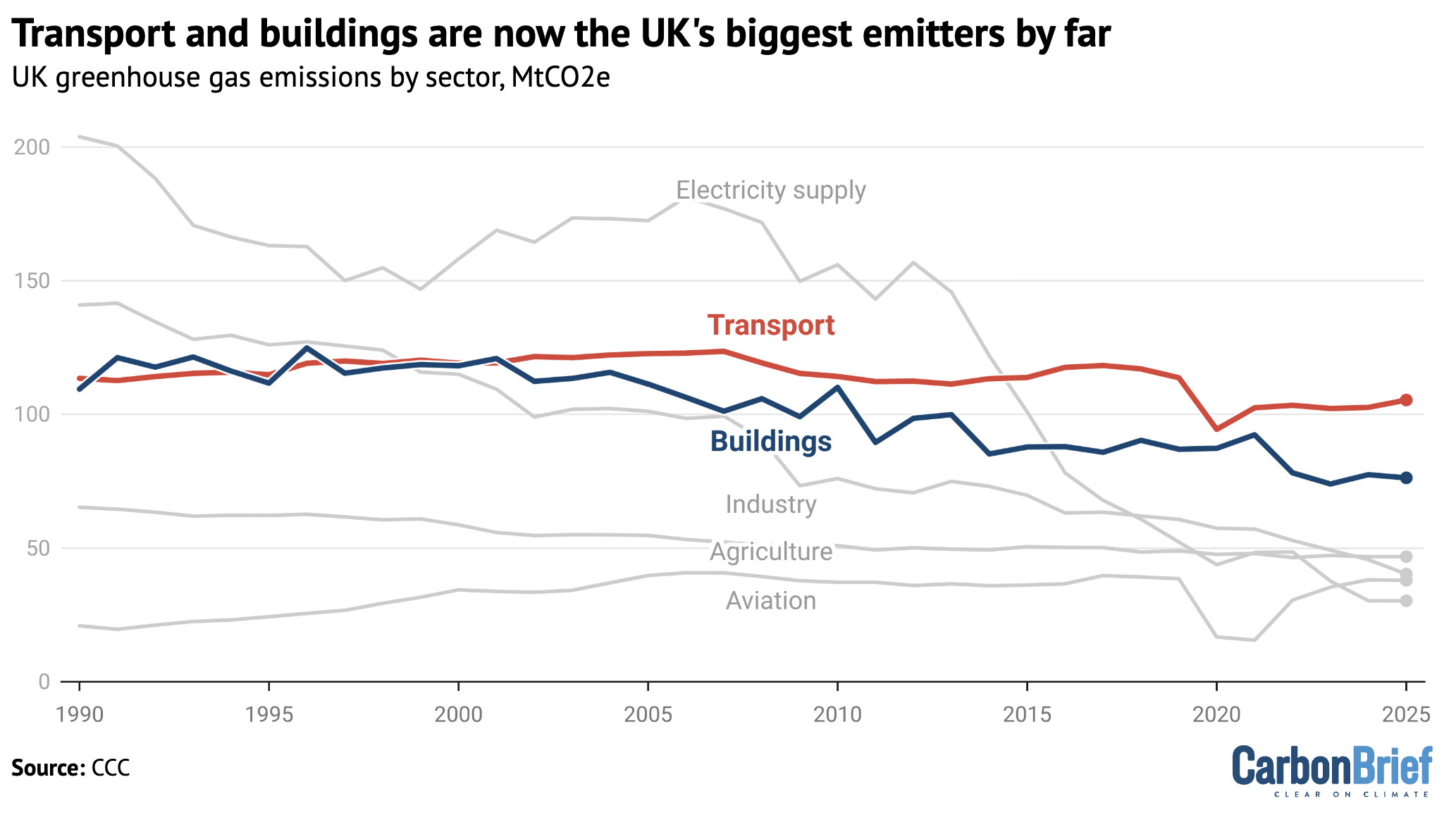
There was actually an increase in emissions from transport and electricity supplies in 2025, as shown below, despite the expansion of clean power and EVs.
UK greenhouse gas emissions by sector, million tonnes of CO2 equivalent. Source: CCC 2026 progress report.
The UK’s greenhouse gas emissions are now roughly 50% below 1990 levels, the CCC notes, with the lion’s share of this having come from cleaning up the power sector.
In contrast, there has been far less progress in transport, which is now the UK’s largest emitter, as well as in buildings, the second largest.
The CCC stresses that future emissions cuts will need to come from using clean power to decarbonise other sectors – particularly buildings, transport and industry.
It puts a major emphasis on the need to electrify these sectors by more rapidly rolling out EVs, heat pumps and electric heating for industrial sites.
The CCC adds that government plans for meeting future targets, published last year, leave a “significant gap” to the UK’s international climate pledge for 2030. (See: Policy gaps.)
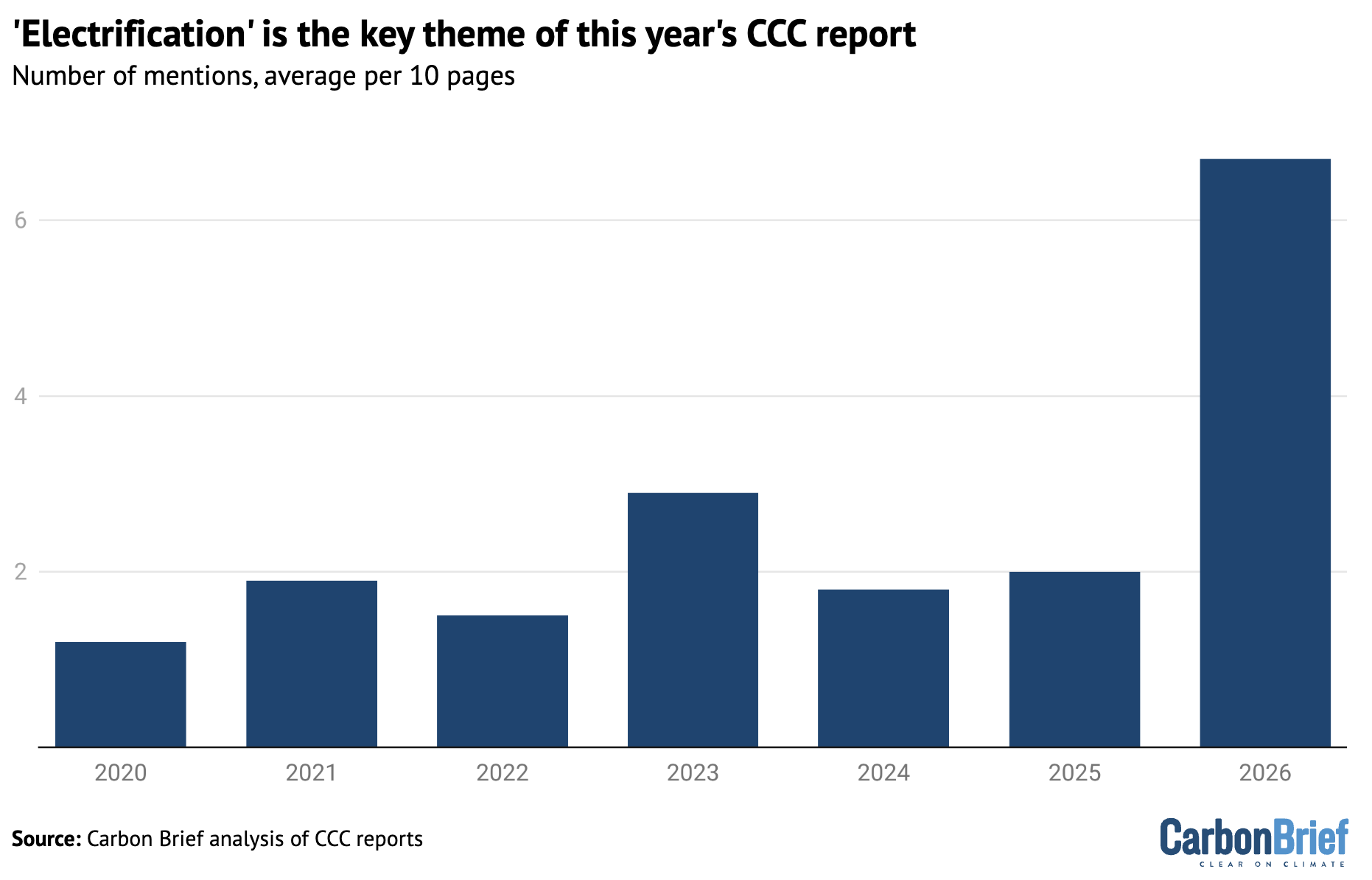
The most striking aspect of this year’s report is the way it centres on electrification, which the CCC says has been given “insufficient focus” to date.
Electrification has shot up the agenda in recent months, with the COP31 presidency calling for countries to back a global goal for 35% of “final” energy to come from electricity by 2035.
The text of the CCC’s latest report uses the word “electrification” far more often than previous editions, as shown in the figure below.
Number of times the word “electrification” appears in successive CCC progress reports, average per 10 pages. Source: Carbon Brief analysis of CCC reports.
Early last year, in advice on the seventh carbon budget, the committee singled out electrification as key to cutting UK emissions. It said electrification had won out over alternative options, thanks to rapid cost reductions for technologies such as EVs.
Now, the CCC says that electrification is also the best way to secure lower energy bills, stronger energy security and a host of other benefits.
Topping said these benefits include “putting money back into people’s pockets”, but also cleaner air, stronger energy security and protection from fossil-fuel shocks:
“The prize is really significant here. By 2030 alone, the UK could save up to 80m barrels of oil and 1.5bn therms of gas each year. That would cost almost £8bn at current oil and gas prices.”
The emphasis on the topic is also clear in the CCC press release for its report, which is titled: “Faster electrification would cut UK household bills, say climate advisers.”
The report fleshes this out in a dedicated chapter that explores the financial benefits of electrifying household energy use, including heat and transport.
Topping said that the “home of the future” will be equipped with an EV, a flexible “time-of-use tariff” for its electricity supplies and a heat pump for keeping warm.
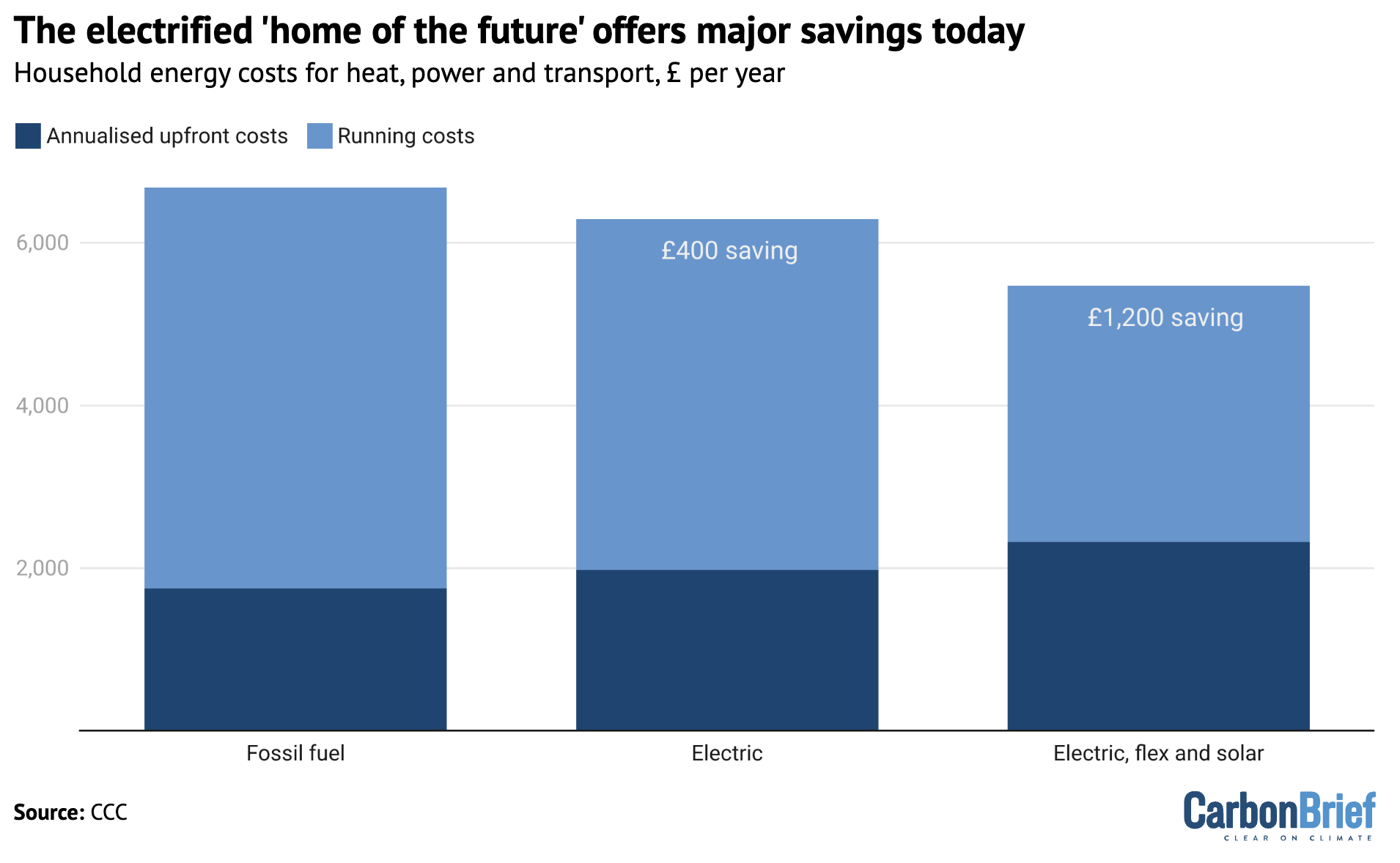
Moreover, the report shows that even today, this type of household would cut its annual energy bills by around £1,200, relative to using a petrol car and a gas boiler.
Crucially, this saving, shown in the figure below, includes the high upfront costs of installing an electric heat pump and solar panels. The analysis shows that electrified homes have far lower annual running costs, which easily outweigh this initial outlay.
(Due to “modelling limitations”, the CCC analysis does not consider home batteries, which can help unlock even larger savings.)
Household energy costs for heat, power and transport, £ per year. The upfront costs of purchasing cars, heating systems, chargers and solar panels are annualised. Source: CCC progress report 2026.
The CCC says that while not everyone is currently in a position to enjoy the financial benefits of electrification, its analysis points to savings both before and after the Iran crisis, as well as for high- and low-income households, with the latter eligible for grants to cover upfront costs.
Even more homes would be able to unlock these benefits if the government acts to resolve barriers, such as high public charging costs, says the CCC.
However, the report says that the government’s current plan to electrify the economy “lacks ambition” and that there are “worrying signs” in some areas, such as heat pumps and electric vans. (See: Road transport and Buildings.)
Ultimately, says the CCC, the best way to encourage faster and wider electrification is to make electricity cheaper. This has been its top recommendation for several years.
The CBGD “projects slower emissions reductions for surface transport and buildings compared to the previous government’s plan”, according to the CCC.
This reflects both the slow rollout of some technologies – such as heat pumps – and “areas of reduced policy ambition”, including less support for low-income homes to install insulation.
The CCC says that without “sufficient progress on electrification” this year, the UK’s 2030 emissions target “may become out of reach” and future goals would face “significant risks”.
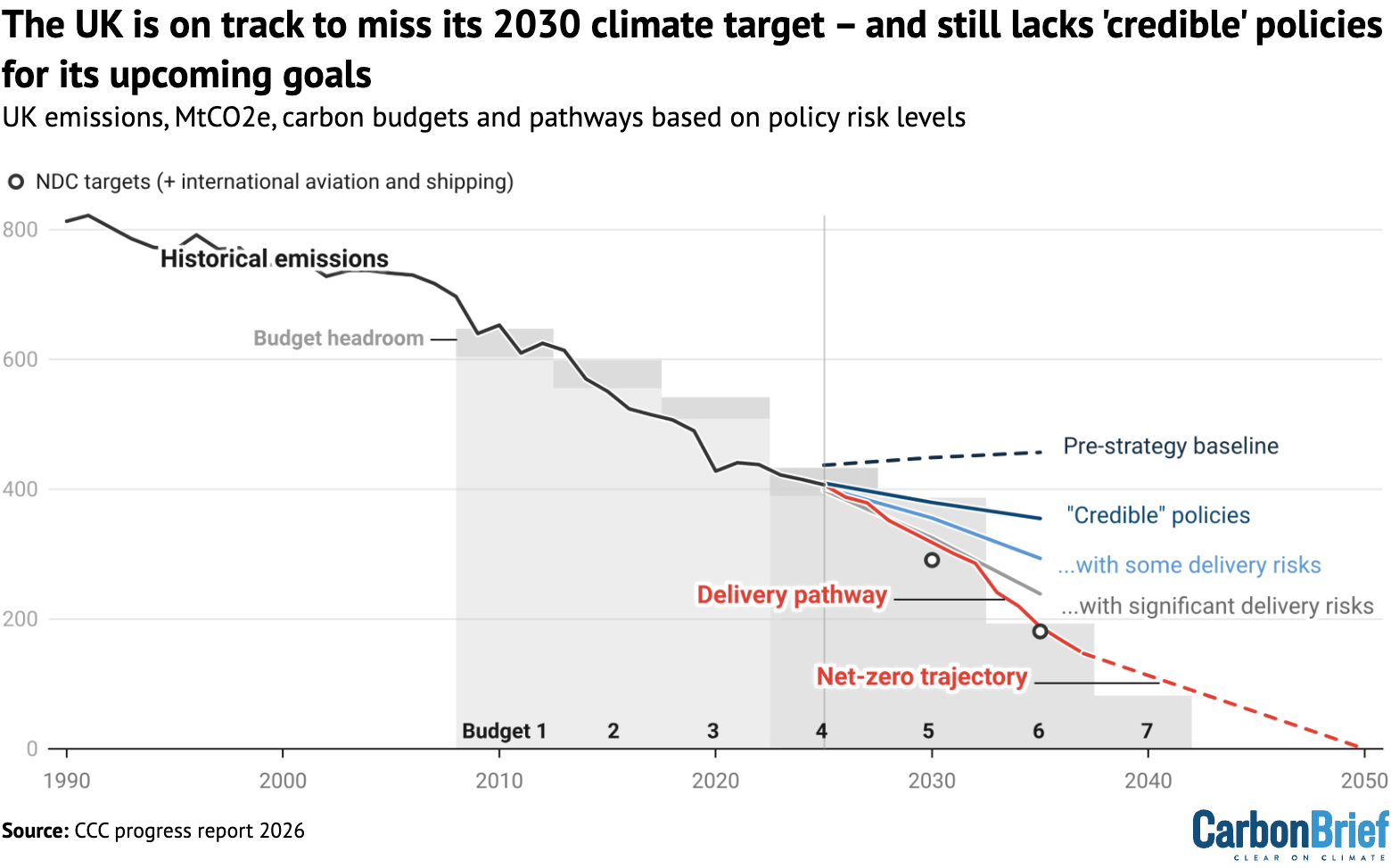
The chart below demonstrates the CCC’s view that the UK is “well on track” to meet its fourth carbon budget, between 2023 and 2027, and that there are “credible policies in place” to meet the fifth carbon budget out to 2032.
However, it also shows the “significant gap” that the CCC says still exists between projected emissions cuts (blue lines) and the UK’s international climate target for 2030, its nationally determined contribution (NDC) to the Paris Agreement (black circle).
(This is particularly notable as the NDC was the first official UK climate goal that was aligned with its 2050 net-zero target. The fourth and fifth carbon budgets were set before the net-zero goal and therefore need to be overachieved.)
Plans that are “credible” or only come with “some risks” are on track to cut emissions to 356m tonnes of carbon dioxide equivalent (MtCO2e) by 2030. This is 11MtCO2e lower than last year, but still a shortfall of 64MtCO2e.
UK greenhouse gas emissions, including international aviation and shipping (IAS), MtCO2e. Lines show historical emissions (black) and the UK’s “carbon budget indicative pathway” from the CBGD (red). Projected emissions are shown under what the CCC defines as “credible” policies (dark blue); credible policies, plus those with “some risk” (light blue); and policies that are credible, have some risk or “significant risk” (purple). The dotted black line indicates the trajectory for emissions before any net-zero policies were implemented. The dotted red line indicated an example trajectory to reach the target of net-zero emissions by 2050. Legislated carbon budget levels are shown as grey steps, including the suggested level of the seventh budget for 2038-42. The first five budgets did not include IAS, but “headroom” was left to allow for these emissions (darker grey wedges). Source: CCC 2026 progress report.
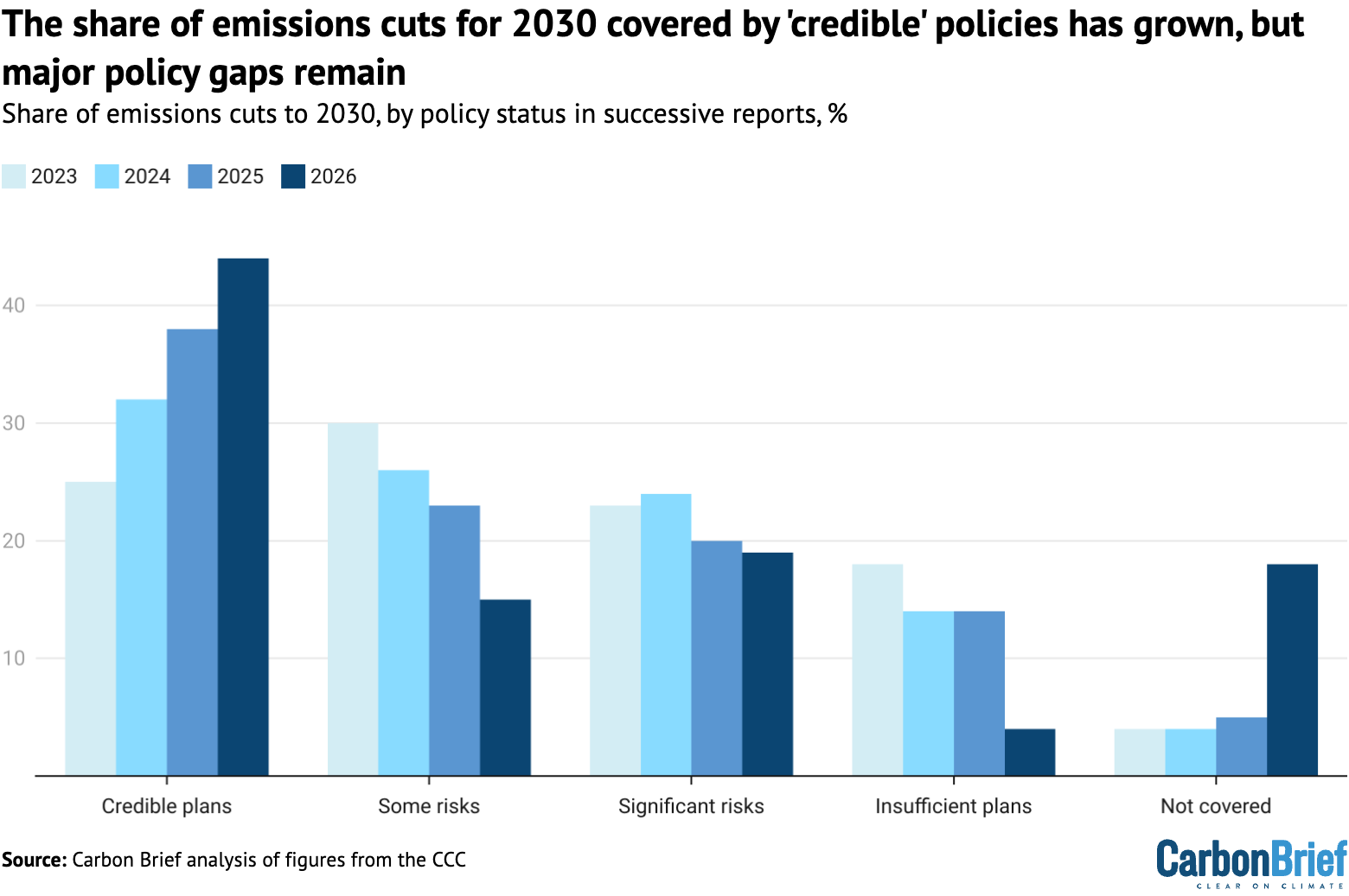
Overall, the CCC says there are “credible” plans in place for 44% of emissions reductions by 2030, including those linked to renewable energy, EV sales growth and electrification of steel production at Port Talbot in Wales. Another 15% of reductions come with “some risks”.
The report concludes that there are “significant risks” attached to 19% of emissions cuts, including the expansion of heat pumps, future “sustainable aviation fuel” (SAF) supply and agricultural policies.
There are also 4% of required emissions cuts for which the UK has “insufficient plans”, including much of the electrification of the UK’s heavy industry.
The chart below shows how this assessment compares to previous CCC analysis of government plans, with the share of “credible” government plans increasing.
(As the latest report is based on the new CBGD rather than the previous 2023 plan, the assessments have different levels of baseline emissions and are not directly comparable. However, this chart shows the rough direction of travel.)
Share of emissions cuts needed to hit the UK’s 2030 climate goal that are rated by successive CCC reports as being backed by “credible” policies, or that face “some” or “significant” risks to delivery, or where there are “insufficient plans”, %. The chart also shows the share of emission cuts required that are “not covered” by the government plans. Source: Carbon Brief analysis of CCC reports.
As the chart shows, a substantial chunk of the required emissions cuts need to meet the 2030 pledge – 17% of the total – are not covered by the CBGD.
This reflects the fact that the new plan simply does not achieve the 2030 target, according to the CCC, despite the government’s stated commitment to its NDC goal.
(The government’s plan had also acknowledged that it fell short of meeting the 2030 NDC.)
The CCC emphasises that “the government will need to bring forward additional policies and plans to make up this gap”.
The new report suggests several areas – including faster EV growth, more heat-pump installations and more ambitious recycling rates – that would close 17MtCO2e of the 26MtCO2e gap to the 2030 goal.
Unlike the 2030 NDC, the government’s plan does achieve the sixth carbon budget, between 2033 and 2037. However, the committee says “this is largely achieved through additional measures where we have assessed there to be significant risks or insufficient plans”.
Only around three-fifths of the required emissions cuts for the sixth carbon budget are covered by “credible” plans or plans with “some risks”.
According to the CCC, the government is relying on a rapid scale-up of engineered removals beyond 2030, but has provided little detail about how it will achieve this. (See: Other sectors)
“This approach carries substantial risks,” according to the committee.
Road transport remains the UK’s highest emitting sector and its emissions increased by nearly 3% last year, according to provisional data in the CCC report.
Electric-car sales have continued increasing, reaching nearly a quarter of new sales last year. The number of electric cars on the road surpassed 2m in May 2025.
However, the emissions benefit of this rollout of electric vehicles (EVs) “is likely to have been offset by other factors”, such as driving rates returning nearly to pre-Covid levels, according to the CCC.
The report notes that EV costs “continue to fall” and have met price parity in some parts of the market, with grants providing an extra boost to sales.
The committee’s pathway to net-zero assumes faster emissions cuts from road transport than the government’s pathway. This is largely because it assumes an imminent “tipping point” will be reached, when EVs reach upfront price parity with petrol cars.
Nevertheless, the report says that sales will still “need to accelerate fast” over the next few years and that this will require consistent government support.
There have been reports that the government is planning a “U-turn” after a review of the ZEV mandate. The CCC says it is “essential” that the review “does not lead to further concessions”:
“Doing so would severely undermine prospects of achieving the UK’s 2030 NDC, exacerbate the UK’s dependence on imported oil, and leave more households paying the higher costs of petrol or diesel cars.”
As well as “stand[ing] firm” on the ZEV mandate, the committee says it is important that the government “remove[s] barriers to EV adoption”.
One key policy highlighted by the report is increased access to cheap EV charging, so the one-third of UK homes without off-street parking access can “benefit from lower running costs”.
(CCC analysis suggests that while the average home would save at least £660 a year by switching from a petrol car to an EV, their running costs could actually increase if they have to rely on public charging infrastructure.)
The report also stresses the use of EV “time-of-use tariffs”, which it says can help people save even more money. It notes that “measures to support consumer awareness” of this “could drive further uptake”.
Also, with a new 3p per mile EV tax due to start from April 2028, the committee says it is “essential that this new tax is implemented in a straightforward manner” to minimise the “hassle factor” that could disrupt the EV transition.
While electric-car sales have so far remained slightly ahead of the level needed to hit the ZEV mandate, the CCC notes that both electric van sales and prices are “significantly off track”. Unlike cars, electric vans still cost considerably more than their combustion-engine equivalents.
The committee says government support, including improved access to fast charging and “regulatory reforms”, is also “key”. As an example of the latter, it notes that certain licensing and testing requirements are based on vehicle weight, which puts heavier battery-powered vehicles at a disadvantage.
Finally, the CCC criticises recent policy decisions that incentivise sales of plug-in hybrids (PHEVs) “based on emissions factors which underestimate real-world emissions”. It notes:
“Providing incentives for emissions savings that PHEVs do not deliver distorts the market and risks eating into the demand for EVs.”
The CCC says that the rate of growth in heat-pump installations in homes slowed last year, rising just 7%, compared to the 56% jump seen in 2024.
Around 52,000 heat pumps were installed in 2025, according to the report. Of these, 31,200 were installed with the support of grants from the “boiler upgrade scheme”.
This was not enough to meaningfully reduce emissions, says the CCC, only delivering around 0.1MtCO2e of extra savings in 2025.
(To eliminate emissions from homes by 2050, heat pump installations in existing homes need to reach 1.4m per year by 2035, according to the CCC.)
Overall, emissions from the buildings sector fell by 1.2MtCO2e in 2025, amounting to a reduction of 1.3% for non-residential and 1.6% for residential buildings compared to 2024.
This was despite the winter months being colder in 2025 than the previous year, generally meaning greater heating demand. This suggests factors other than weather are driving the reduction, it says, such as higher energy prices leading to lower heating use.
The CCC notes that while emissions did drop, this “does not indicate progress on decarbonising home heating”. It adds:
“Without further actions to decarbonise buildings, it is likely that emissions will rebound if energy prices fall or weather conditions revert to average.”
The slowdown in the rate of heat pump installations was largely due to the closure of the ECO scheme, which delivered around one-third of heat pump installations in existing homes over the last three years.
In terms of government policy, the CCC notes that there has been some “positive progress” for buildings, due to the new “warm homes plan” and the “future homes standard”.
The former provides support to help people install electric heat pumps, rooftop solar panels and insulation. In total, 5m homes are expected to benefit from £15bn of grants and loans earmarked by the government for these upgrades by 2030.
While installation rates in the UK in 2025 were significantly below this level, the CCC report says that growth rates in other European markets – and indeed, in the UK between 2023 and 2024 – suggest that higher rates could be achievable.
The CCC notes that while there is £1bn a year earmarked for supporting upgrades of low-income households under the warm homes plan, this is still a “significant decrease in investment” from that provided by ECO.
The future homes standard, meanwhile, is an update to existing regulations in England. From March 2028, new-build homes in England will be required to have on-site renewable energy generation and a low-carbon heating system.
From then on, newly built homes will produce 75% less greenhouse gas emissions than under previous regulations.
The CCC report notes that the installation of heat pumps in new homes, specifically, is currently on track to achieve targets, with 25% of new homes built with a heat pump in 2025. However, it says retrofit installations of existing homes are significantly below where they need to be and “urgently need to accelerate”.
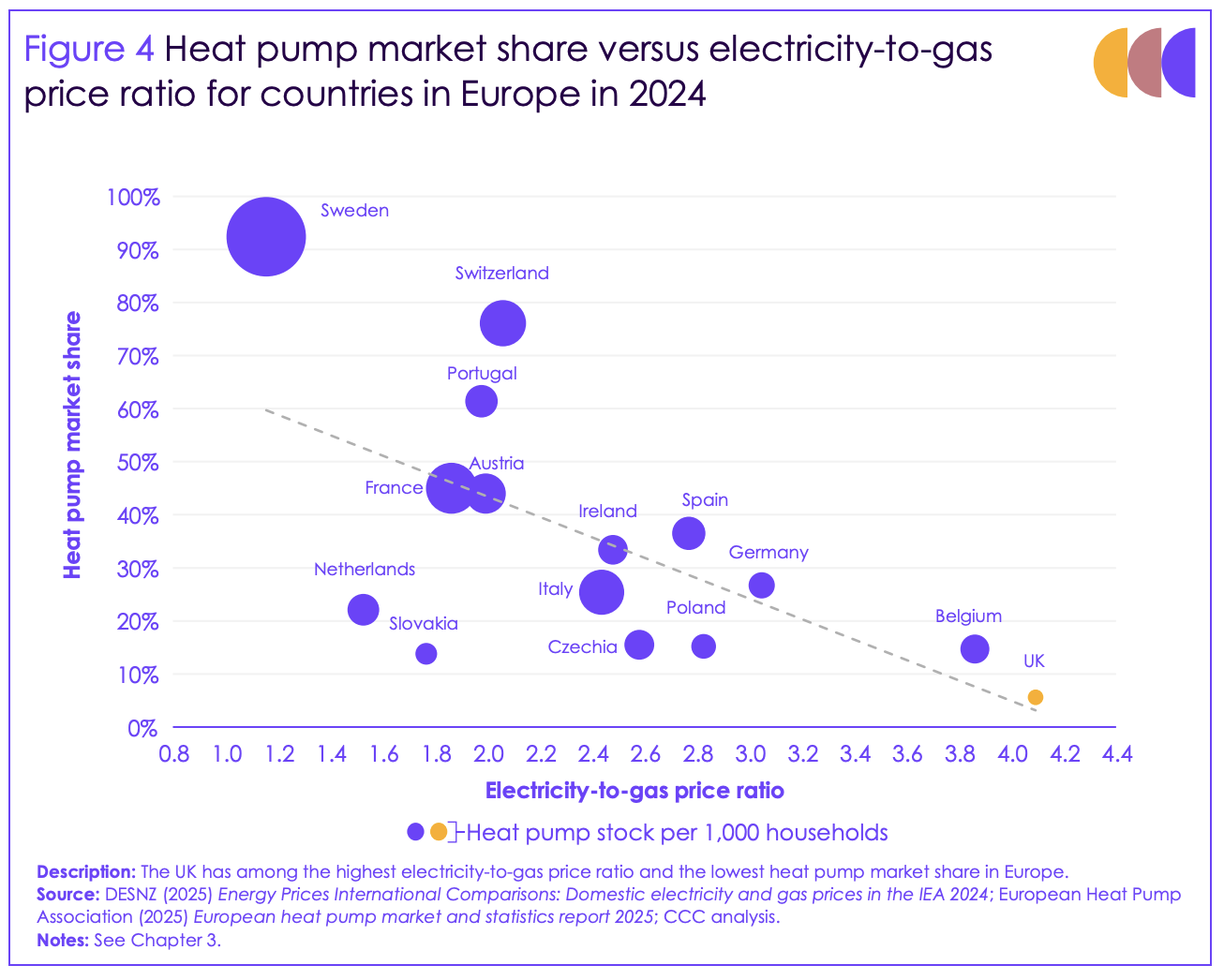
The CCC notes that while there has been some progress in removing policy costs from household electricity bills, the ratio of electricity to gas prices remains a major barrier to heat pump take-up. (See: The electrification ‘prize’.)
It also notes that there has been no action to address this barrier for non-residential buildings.
Fewer than 2% of homes have a heat pump in the UK, it says, placing the nation among the lowest rates of installation in Europe, as seen in the chart below.
Heat pump market share vs electricity-to-gas price ratio in Europe in 2024. Credit: CCC.
Industry accounted for the largest share of emissions reduction in the UK in 2025, according to the CCC, with a 5.4MtCO2e (12%) drop from 2024.
As such, sectoral emissions for industry are now 56% lower than they were in 2008.
This was largely due to the closure of blast furnaces at the Port Talbot steelworks towards the end of 2024, ahead of reopening with new electric arc furnaces. Emissions from iron and steel production therefore fell by 3.2MtCO2e year-on-year in 2025, according to the CCC report.
The rest of the reduction was due to a fall in the output of energy-intensive, which the CCC says is in line with the longer-term trend in UK manufacturing seen since the 1990s.
However, the CCC notes that while some specific progress has been made to decarbonise industry, barriers to further progress remain.
It urges the government to set a clear plan for how electrification can become the economically rational choice for a wide range of industries.
As for buildings, the CCC points to the high electricity prices, relative to gas, as a major barrier to the decarbonisation of UK industry.
Carbon capture and storage (CCS) has taken some “positive steps”, according to the report. This includes the government allocating £9.4bn of funding to support its development.
There has also been a final investment decision for the first CO2 storage facility at a UK manufacturing site and the construction of transport and storage infrastructure for the nation’s first CCS industrial “clusters”.
The CCC’s report states that “many countries are responding” to the current global energy crisis triggered by the Iran war by “rapidly reducing dependency on fossil fuels”.
It continues that emissions from the UK’s fossil-fuel supply sector fell by 1.5MtCO2e in 2025, in line with the “significant historical decline seen over the last three decades”.
Emissions in the sector are now 45% lower than 2008 levels, it adds.
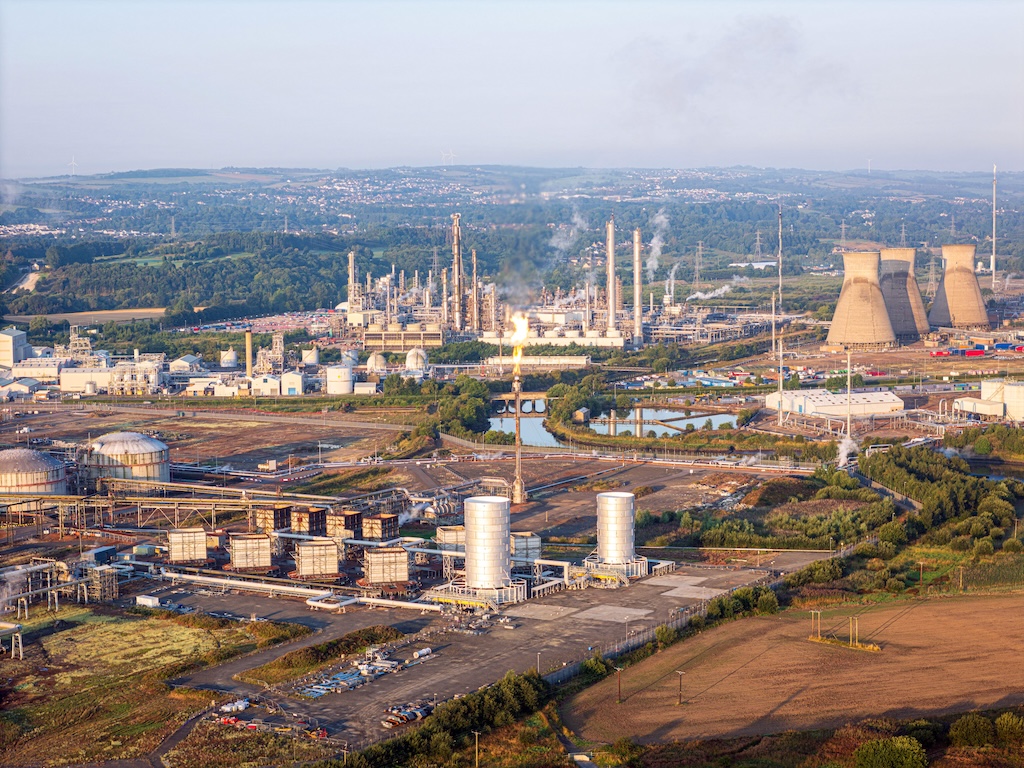
Key drivers of emissions decline from 2024-5 were a fall in emissions from oil refining of 0.9MtCO2e, mostly due to the closure of Grangemouth and Prax Lindsey refineries in 2025, according to the CCC.
Aerial view of industrial complex with towering chimneys and storage tanks under a hazy sky, Grangemouth, Scotland, United Kingdom. Credit: Andy Smith / Alamy Stock Photo
Declines in production emissions associated with oil and gas were due to the closure of North Sea fields “as they reach the end of life”, says the report.
It adds that this is a “continuation” in a longer-term trend. Production emissions from oil and gas have fallen by 58% since 2008 and by 75% since their peak in 2000. The CCC continues:
“The decline in oil and gas production is expected to continue as oil and gas reserves in the mature North Sea basin are increasingly depleted – the NSTA [North Sea Transition Authority] projects a further decline in combined oil and gas production of 93% by 2050.”
The report does not directly address the Labour government’s policies on oil and gas production in the North Sea.
Labour has ruled out new oil and gas licences – a manifesto commitment that has been subject to intense lobbying from the oil and gas industry and right-wing media. (See Carbon Brief’s factcheck on nine false or misleading myths about the North Sea.)
Speaking at a briefing for journalists, CCC chair Nigel Topping noted that oil and gas production is projected to continue to plummet in the coming decades, regardless of whether the government issues new drilling licences, adding:
“The real road to energy security is not through some marginal drilling decisions, but through electrifying the economy.”
Emissions from electricity supply rose in 2025, following a 5% increase in unabated gas generation year-on-year.
According to the CCC, this offset the reduction in emissions from coal, with the closure of the UK’s last coal-fired power plant in 2024.
This is in line with Carbon Brief’s analysis from January, which similarly found that there was a small increase in emissions per unit of generation in 2025.
This bucks the trend seen in the UK since 2008, over which period emissions from electricity supply have fallen by 82%.
The CCC says the rise in gas generation was likely due to a combination of factors, including a 12% drop in nuclear generation, an 11% decrease in net imports, underutilisation of wind capacity due to grid constraints and lower-than-average wind capacity additions.
Last year, offshore wind capacity increased by 0.7 gigawatts (GW), bringing the UK’s total to 16.6GW, according to the CCC.
This is expected to more than double to around 37GW by 2032, once the existing pipeline of new projects is built – including those that secured subsidies in the most recent auction for “contracts for difference” (CfDs).
The CCC notes, however, that further additions will be needed to reach the government’s “stretching goals” for offshore wind.
An additional 0.3GW of onshore wind capacity was added in 2025, bringing the national total to 16.4GW. It says between 2.1GW and 2.5GW will need to be added annually up to the end of the decade to meet government targets.
The UK installed more solar capacity in 2025 than in any year since 2015, adding 2.8GW to bring the national total capacity to 21.7GW.
To reach government targets, the CCC says installation of solar power still needs to increase, with around another 5GW required by the end of this decade.
The CCC highlights that faster progress is needed on expanding and modernising electricity networks, as well as deploying storage.
For example, in 2025, some 9.4 terawatt hours (TWh) of wind generation was “curtailed” – when windfarms are paid to turn off – up 77% on 2024.
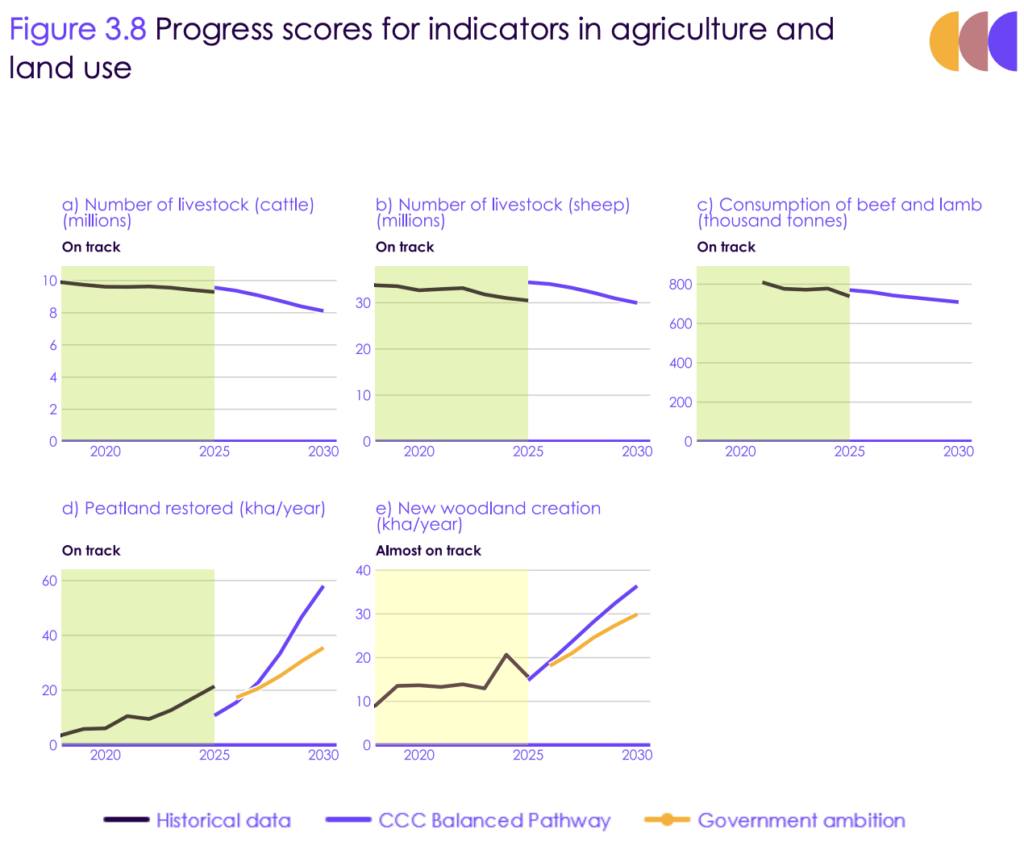
The CCC’s report says “emissions in agriculture and land use have not fallen significantly in recent years” and that progress addressing this has been “too slow”.
Cattle and sheep numbers fell by 1% and 2% respectively in 2025, continuing a longer-term trend, with livestock numbers at their lowest since 1990, says the report.
This has led to a reduction in methane emissions from 2022-24, but this was offset by an increase in CO2 emissions in these sectors. It continues:
“This was in part driven by a smaller forestry sink due to an ageing woodland profile and removal of trees for habitat restoration priorities.”
The report adds that household beef and lamb purchases fell by 5% in the last year and have dropped by 9% since 2021, likely “driven by high beef and lamb prices and cost-of-living pressures”.
It continues that one area of “positive progress” is an increase in peatland restoration rates.
Some 21,400 hectares of peatlands were restored in 2025 – a 26% increase on the previous year and around three times the level in 2020, according to the CCC.
It adds that there is grant funding in place for peatland restoration across the country “until at least 2027”.
Tree-planting has seen “more mixed” progress, says the report. Planting rates fell by 25% from 2024-5, following a large boost to forest creation the year before.
The reduction was “driven by funding cuts in Scotland, which continues to lead in the establishment of new woodlands for the UK, planting more than half of the total in 2024-25”, says the report.
It adds that planting rates increased in England and the Department for Environment, Food and Rural Affairs (DEFRA) is expected to launch a woodland creation strategy this year.
Despite this mixed progress, the chart below shows how the UK government is “on track” on most key agriculture and land use indicators, when compared to the CCC’s central pathway to net-zero and the government’s own ambitions.
The UK government is “on track” on most key agriculture and land use indicators when compared to the CCC’s central pathway to net-zero and the government’s own ambitions. Credit: CCC (2026)
The report says that another area of “positive progress” is the publishing of England’s long-awaited land-use framework in March of this year.
The framework used “high-resolution modelling” and found that there is enough land in England to meet climate and nature goals, while also producing more food and building new homes.
To increase progress, the report says that the government should “put policies and incentives in place to ramp up tree-planting and peatland restoration”.
One key upcoming policy development will be the “25-year farming roadmap”, the government’s long-term direction for farming in England. This is due to be published later this year, according to the CCC.
Emissions from flights fell by 0.5% in 2025, despite a 3% increase in overall distance flown by UK passengers.
The CCC says this is likely due to fuel-efficiency improvements within the nation’s aircraft fleet and “a small contribution” from the use of “sustainable aviation fuel” (SAF).
The report concludes that fuel-efficiency improvements are “almost on track” compared to the CCC’s net-zero pathway. The share of jet fuel provided by SAF reached 2.5% in 2025, which is above the level set by the government’s SAF mandate.
While people flew more last year, the overall distance travelled via planes is still below the projected levels in the CCC’s pathway for 2025.
The committee says emissions growth from aviation has “slowed down”, but notes that “it is too early to say whether aviation emissions will grow, plateau or decrease in the future”.
Overall, the CCC says there has been “mixed progress” in the aviation sector. This year’s SAF Act included a mechanism designed to drive domestic production of SAFs, but the report stresses that “significant challenges remain around scaling up supply”.
Meanwhile, for the first time, the government plans to use international carbon credits under CORSIA – the UN’s aviation emissions scheme – to deliver its sixth carbon budget. According to the CCC:
“This introduces significant risk, including uncertainty over the availability and quality of high-integrity credits.”
As for shipping, the CCC says this has seen “limited progress”. It welcomes the inclusion of domestic shipping in the UK emissions trading scheme (ETS) as “an important step”, but points out that this is only a small fraction of the sector.
Most emissions come from international shipping. The committee says delays to the International Maritime Organization’s (IMO) net-zero framework – following opposition from the US and big fossil-fuel producers – has “significantly increased” the risk of hitting emissions targets for this sector.
The CCC report highlights “significant risks” with the use of engineered removals in the coming years.
The government’s plan for achieving emissions targets over 2033-37 relies on a “rapid ramp-up” of technologies that suck CO2 out of the atmosphere, the report says, but there is still a lack of detail on how this will be achieved.
During this period, the amount of CO2 removed through these technologies is expected to reach an average of 17.4MtCO2e per year.
But the CCC says that 94% of removals planned for 2033-37 have “significant risks or insufficient plans”.
There is greater confidence in achieving planned removals over 2028-32, the report says, but this is due to scaled-back plans and policy progress.
The CCC says it is “essential” for the government to develop a strategy for delivering and monitoring engineered removals, along with “sufficient contingency plans…for any shortfall”.
The report also looks at emissions from waste, which are expected to reduce by an average of 1.1MtCO2e per year between 2024 and 2037.
The CCC has greater confidence in the government’s ability to meet waste goals compared to last year’s assessment.
But the report notes that there has been “little improvement” in recycling rates in UK homes. It says that further policies will be needed to meet plans to reduce waste, boost recycling and prevent waste going to landfill.
Looking at hydrogen, the CCC says there has been “good progress” in developing low-carbon hydrogen, but risks remain due to tight timelines and delays in funding.
The report mentions missed or upcoming deadlines to award contracts for some hydrogen projects and to update the UK hydrogen strategy. It notes that progress on hydrogen “must continue on the ground” in the meantime.
Donald Trump urges you to be a Climate Science denier like him. He says that he makes millions and millions for destroying the planet, Burn, Baby, Burn and Flood, Baby, Flood.Nigel Farage urges you to ignore facts and reality and be a climate science denier like him and his Deputy Richard Tice. He says that Reform UK has received £Millions and £Millions from the fossil fuel industry to promote climate denial and destroy the planet.UK Conservative Party leader Kemi ‘not a genocide’ Badenoch explains her reality that the Earth is flat, the Moon is made of cheese and that she was born from Unicorn horn dust
Keir Starmer explains that UK is actively supporting Israel’s genocidal expansion and repeats his previous quotation that he supports Zionism “without qualification”. Keir Starmer said “I said it loud and clear – and meant it – that I support Zionism without qualification.” here: https://www.jewishnews.co.uk/keir-starmer-interview-i-will-work-to-eradicate-antisemitism-from-day-one/Keir Starmer objects to criticism of the IDF. He asks how could anyone object to them starving people to death, forced marches like the Nazis did, bombing Gaza’s hospitals and universities, mass-murdering journalists, healthworkers and starving people queuing for food, killing and raping prisoners and murdering children. He calls for people to stop obstructing his genocide for Israel.


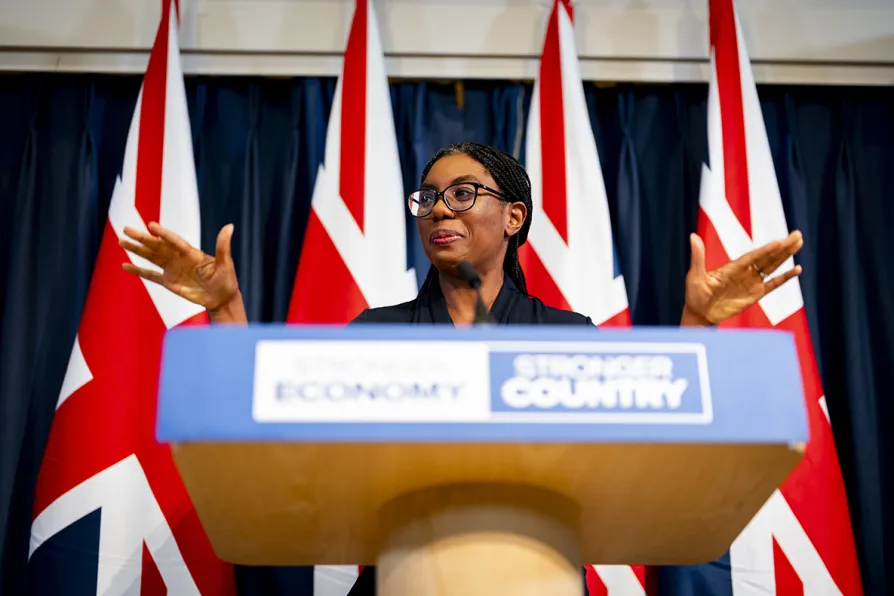
 Conservative Party leader Kemi Badenoch delivers a speech on the economy at Victory Services Club, central London, June 29, 2026