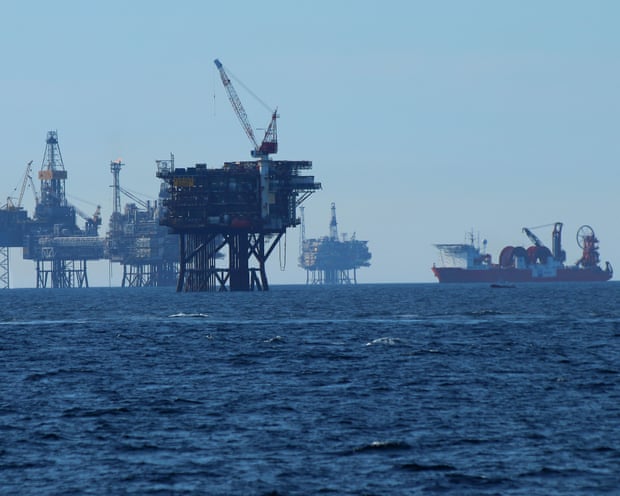
Fossil fuel lobbyists attended almost every government meeting about a temporary windfall tax on North Sea oil and gas companies’ ‘extraordinary profits’. Photograph: Nature Picture Library/Alamy
Lobbyists attended 48% more meetings than Tories, as Labour accused of giving them ‘backstage pass’
Government ministers met representatives from the fossil fuel industry more than 500 times during their first year in power – equivalent to twice every working day, according to research.
The analysis found that fossil fuel lobbyists were present at 48% more ministerial meetings during Labour’s first year in power than under the Conservatives in 2023.
The government defended the meetings, saying ministers held meetings with a wide range of representatives from “the energy industry, unions and civil society to drive forward our clean energy superpower mission”.
The findings have raised concern among critics about the extent of the fossil fuel industry’s influence over government at a time when ministers are trying to lower bills and transition to a more sustainable energy system.
A report from the International Energy Agency in 2023 found that fossil fuel companies still had “minimal” engagement with the global clean energy transition, contributing just 1% of clean energy investment globally.
Nigel Farage urges you to ignore facts and reality and be a climate science denier like him and his Deputy Richard Tice. He says that Reform UK has received £Millions and £Millions from the fossil fuel industry to promote climate denial and destroy the planet.Donald Trump urges you to be a Climate Science denier like him. He says that he makes millions and millions for destroying the planet, Burn, Baby, Burn and Flood, Baby, Flood.Orcas comment on killer apes destroying the planet by continuing to burn fossil fuels.
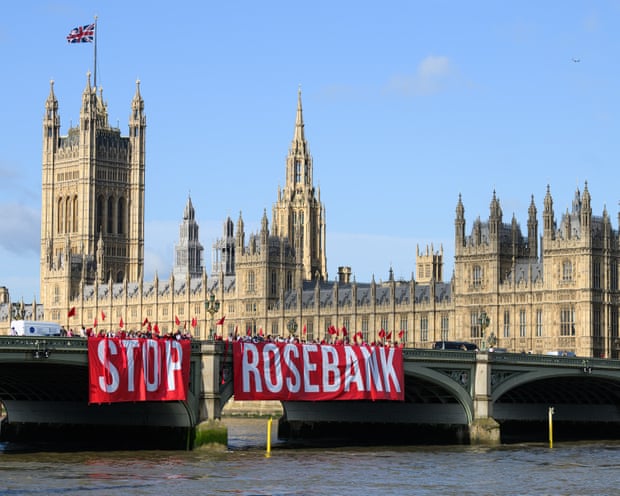
Fossil Free London protesters on Westminster Bridge, London, demonstrate against drilling at the UK’s largest untapped oilfield, 16 July 2025. Photograph: Leon Neal/Getty Images
…
The excuse most often provided for turning away from green measures, for expanding fossil fuel production, for ignoring the science, is pragmatism. The idea being that, yes, the climate emergency is serious, but we have to be practical – we have to consider other things too, inevitably ensuring business as usual, protecting the bottom line and keeping consumer capitalism in the fast lane. The fact is that this is dangerous drivel. Pragmatism is only possible when feasible alternatives are available. Where climate breakdown is concerned, there is no alternative. The climate doesn’t recognise pragmatism. We either slash emissions now or we are in deep, deep trouble.
In 2024, the temperature of the planet topped the 1.5C temperature-rise threshold for the first time (since preindustrial times), and according to the UK Met Office, there is a 70% chance that the average temperature rise over the next five years will be above this. A recent report by the UK Institute and Faculty of Actuaries and Exeter University forecasts that a 2C global temperature hike by 2050 would see a 25% collapse in the global economy and 2 billion people dead. This is what the end game of a “pragmatic” climate strategy looks like.
We can no longer pretend that we are sleepwalking into climate catastrophe. We are doing it consciously, with our eyes wide open, and hang the consequences. The truth is that on a rapidly heating planet, a pragmatic approach means that we are playing Russian roulette with all six barrels loaded. The only question is just how big a mess we will make when we pull the trigger.
Bill McGuire is professor emeritus of geophysical and climate hazards at UCL and author of Hothouse Earth: an Inhabitant’s Guide
Nigel Farage urges you to ignore facts and reality and be a climate science denier like him and his Deputy Richard Tice. He says that Reform UK has received £Millions and £Millions from the fossil fuel industry to promote climate denial and destroy the planet.Donald Trump urges you to be a Climate Science denier like him. He says that he makes millions and millions for destroying the planet, Burn, Baby, Burn and Flood, Baby, Flood.Orcas comment on killer apes destroying the planet by continuing to burn fossil fuels.
Climate campaigners say the Rosebank oil field will be a ‘defining test’ of the government’s credibility on climate change. (Lucy North/PA)
Equinor, which owns the majority of the oil field, stressed it was committed to advancing the ‘Rosebank project’
Climate campaigners have challenged the UK Government to “do the right thing” and turn down plans for drilling in the Rosebank oil field.
The group Uplift – which wants to see a “rapid and fair transition away from oil and gas production in the UK” – said whether the green light is granted for the development would be the “defining test of this Government’s credibility on climate change”.
It came as it was confirmed Equinor, which owns an 80% majority stake in the oil field, confirmed it has submitted a scope 3 assessment – setting out all associated greenhouse gas emissions for the project, in compliance with new guidelines from UK authorities.
And the company said it is “fully committed” to working with all relevant bodies to “advance the Rosebank project”.
The Rosebank field, which is located some 80 miles west of Shetland, is the UK’s largest untapped oil field and is estimated to contain up to 300 million barrels of oil.
…
Robin Wells, director of Fossil Free London, said: “In the face of this decision on the biggest undeveloped oil field in the North Sea, we must be crystal clear. Rosebank will be the defining test of this Government’s climate promise.”
Nigel Farage urges you to ignore facts and reality and be a climate science denier like him and his Deputy Richard Tice. He says that Reform UK has received £Millions and £Millions from the fossil fuel industry to promote climate denial and destroy the planet.Donald Trump urges you to be a Climate Science denier like him. He says that he makes millions and millions for destroying the planet, Burn, Baby, Burn and Flood, Baby, Flood.Orcas comment on killer apes destroying the planet by continuing to burn fossil fuels.
Chancellor of Exchequer Rachel Reeves during a visit to the Sipsmith Distillery in Chiswick West London, October 9, 2025
BRITAIN must brace for a misery Budget of tax rises and spending cuts, beleaguered Chancellor Rachel Reeves confirmed today as experts also warned of rising unemployment.
Ms Reeves alleged that the economic problems she is struggling with could be attributed to Brexit, as the government increasingly protests about Britain’s exclusion from the European Union, a pose with potentially far-reaching political implications.
She brought an end to weeks of speculation by confirming that tax rises will feature in her Budget, scheduled for the end of November.
However, she did not indicate where the burden would fall. Labour committed at the general election to not raise income tax, VAT or employees’ National Insurance, pledges now regarded as a straitjacket.
While there are other measures the Chancellor could announce, they would not be likely to raise as much cash. She has firmly set her face against a wealth tax so far.
Ms Reeves also indicated that spending cuts will be on the Budget agenda. Her drive to cut the welfare Bill through reducing benefits for disabled people was thwarted in the summer by a backbench Labour rebellion.
This work by Middle East Monitor is licensed under a Creative Commons Attribution-NonCommercial-ShareAlike 4.0 International License.
US President Donald Trump (C) is welcomed by Israeli Prime Minister Benjamin Netanyahu at Ben Gurion International Airport on October 13, 2025 in Tel Aviv, Israel. [Chip Somodevilla/Getty Images]
A single, candid statement by US President Donald Trump during a Fox News interview on 9 October may illuminate the true calculus behind Israel’s decision for a ceasefire in Gaza, following a relentless, two-year genocidal campaign that has tragically killed and wounded nearly a quarter of a million Palestinians.
“Israel cannot fight the world, Bibi,” Trump declared during the interview, a direct warning he said to have previously delivered to Israeli Prime Minister Benjamin Netanyahu.
The stark reality is that very few people around the globe currently support Netanyahu. Crucially, a significant segment of his own populace has already held him in contempt, a resentment that predates the war on Gaza — a war which he treated as a desperate, personal quest for renewed domestic popularity.
Yet, his delusion persists. Even as millions globally protest his systematic extermination of innocent Palestinians, Netanyahu has seemingly convinced himself that world opinion is miraculously shifting in his favour — a shift that would require the world to have liked him in the first place.
But what precisely did Trump mean by, “You cannot fight the world”?
The term ‘fight’ here clearly transcends physical combat. Gaza, besieged, starved, and devastated, was the entity enduring the physical confrontation. Trump’s reference is unambiguously to the combative surge of anti-Israel sentiment worldwide: the official sanctions imposed by nations like Spain, the critical legal proceedings initiated at the world’s highest courts, the widespread demands for boycott, the organising of freedom flotillas, and more.
It is profoundly significant that, in the minds of both Washington and Tel Aviv, these global events have registered as a serious strategic concern. Future historians will likely designate this moment as the definitive turning point in global attitudes toward the Israeli occupation of Palestine. If deliberately and strategically fostered by Palestinians, this burgeoning solidarity movement holds the potential to fully isolate Israel, compelling it to finally relent and free the Palestinian people from its enduring system of colonialism and apartheid.
However, ‘Bibi’ is not merely losing the world; he is fundamentally losing America itself. For decades, the United States has operated as Israel’s indispensable benefactor, underwriting every war, financing every illegal settlement, justifying every act of violence, and consistently blocking any international attempt to hold Israel accountable.
The reasons for America’s decades-long, unwavering commitment to sustaining Israel are profoundly complex. While the overwhelming influence of the powerful pro-Israel lobby in D.C. and Israel’s disproportionate sway over major media are correctly cited as factors, the dynamic is far deeper. The prevailing, mutually reinforced narrative in both nations has consistently framed Israel not merely as an ally, but as a crucial, essential extension of America’s political identity and core values.
Yet, cracks in this political edifice began to appear with unmistakable clarity. What were once marginalised dissenting voices, often labeled as ‘radicals’ within the American left, gradually solidified into mainstream dissent, particularly within the Democratic Party. Poll after poll demonstrated a mass shift, with the majority of Democrats turning against Israeli policy and lending their support, instead, to the Palestinian people and their rightful struggle for freedom. One of the most telling polls was conducted by Gallup in March 2025. It found that 59 percent of Democratic voters say they sympathize more with Palestinians, while only 21 per cent say they sympathise more with Israelis.
The Israeli genocide in Gaza catalysed more than just dissent within one of America’s two major political parties. Outright opposition to Israel has rapidly become mainstream, transcending traditional political lines — a rupture that has profoundly alarmed those determined to maintain the illusion that Israel can act with impunity, free from American objection.
The pro-Israel media apparatus in the US fought a shameful war to obscure the extent of the Israeli genocide. It consistently sought to blame Palestinians for Israel’s actions and brazenly promoted the insidious notion that the war against Gaza’s innocents was a necessary component of the ever-elusive ‘war on terror.’
But it was ordinary people, powerfully amplified by countless social media platforms, who collectively fought back. They successfully defeated a mainstream propaganda machine that had, for decades, served as the primary defense line for Israel.
A particularly troubling fact for Israel was the erosion of its newly established base of support: the Evangelicals and the broader Republican party. Polling indicated a significant exodus, especially among young Republican voters. A survey conducted by the University of Maryland Critical Issues Poll in August 2025 found that only 24 per cent of Republican voters aged 18–34 said they sympathise more with Israelis than with Palestinians.
According to Politico, Israel even attempted to manipulate social media by paying influencers significant sums of money to circulate Israeli fabrications and deception. That campaign employed roughly 600 fake profiles posting over 2,000 coordinated comments per week, targeting more than 120 US lawmakers.
But can Israel possibly swing the narrative back in its favor? While vast sums of money will, undoubtedly, be committed to launching sophisticated campaigns aimed at polishing Israel’s severely tarnished image, the efforts will prove futile. The once-marginalised Palestinian narrative has surged, becoming a powerful, compelling moral authority worldwide. The strong, unyielding, and dignified resilience of the Palestinian people has garnered global sympathy and galvanised support in ways unprecedented in history.
This new reality may very well represent hasbara’s final stand, as truly no amount of money, newspaper coverage, or Netflix specials can ever successfully polish the image of a state that has so openly committed a genocide, one of the most thoroughly documented in recorded history.
The views expressed in this article belong to the author and do not necessarily reflect the editorial policy of Middle East Monitor.
This work by Middle East Monitor is licensed under a Creative Commons Attribution-NonCommercial-ShareAlike 4.0 International License.
Keir Starmer objects to criticism of the IDF. He asks how could anyone object to them starving people to death, forced marches like the Nazis did, bombing Gaza’s hospitals and universities, mass-murdering journalists, healthworkers and starving people queuing for food, killing and raping prisoners and murdering children. He calls for people to stop obstructing his genocide for Israel.Genocide denier and Current UK Prime Minister Keir Starmer is quoted that he supports Zionism without qualification. He also confirms that UK air force support has been essential in Israel’s mass-murdering genocide. Includes URLs https://www.declassifieduk.org/keir-starmers-100-spy-flights-over-gaza-in-support-of-israel/ and https://youtu.be/O74hZCKKdpAGenocide denying UK Foreign Secretary David Lammy says that UK is suspending 30 of 350 arms licences to Israel. He also confirms the UK government’s support for Israel’s Gaza genocide and the UK government and military’s active participation in genocide.




 Chancellor of Exchequer Rachel Reeves during a visit to the Sipsmith Distillery in Chiswick West London, October 9, 2025