People on Westminster Bridge as they take part in a Palestine Solidarity Campaign march in central London, October 11, 2025
HUNDREDS of thousands of pro-Palestinian protesters took to the streets of central London on Saturday to mark two years since the start of the Israeli invasion of Gaza.
The march, assessed by organisers at over 600,000 people, came as preparations ramped up today to get desperately needed aid to Palestinians in the enclave following Friday’s ceasefire deal between Israel and Hamas-led resistance groups.
The protest in London was the 32nd national demonstration and came after the government questioned the need for it given the truce in Gaza. Ministers say they intend to give greater powers to restrict protests by allowing the police to consider the “cumulative impact” of repeated demonstrations.
…
Zarah Sultana, the independent MP for Coventry South and a co-founder of “Your Party,” slammed Home Secretary Shabana Mahmood for switching sides on Palestine and for “locking up pensioners and priests for opposing the ban on Palestine Action.”
She told the huge rally outside Downing Street that the Home Secretary “doesn’t want to just ban demonstrations, she wants to criminalise dissent — she want to send a message that if you march for Palestine, if you speak out against genocide, if you demand justice, then the state considers you the problem. Shame on her.”
Independent MP for Islington North and “Your Party” co-founder Jeremy Corbyn told the huge rally in Whitehall that despite declaring the ceasefire in Gaza “the Israeli army killed 17 Palestinians and injured 71 over the previous 24 hours.”
He said: “Peace will only come to Gaza when Israel is forced to leave Gaza. We will be here as often and as long as it takes.”
He slapped down a scheme to install former British Prime Minister Tony Blair in a “board of peace” running Gaza.
“Viceroy Blair will not bring peace,” Mr Corbyn told the Morning Star.
Stop the War Coalition convener Lindsey German compared the demonstration to the far-right “hate march” a few weeks ago.
She said: “This is what a large demonstration looks like. This is a march of solidarity. We should hold our heads up high today.”
But Ms German insisted that “a ceasefire is not enough. We want the war criminals brought to justice.”
Genocide denier and Current UK Prime Minister Keir Starmer is quoted that he supports Zionism without qualification. He also confirms that UK air force support has been essential in Israel’s mass-murdering genocide. Includes URLs https://www.declassifieduk.org/keir-starmers-100-spy-flights-over-gaza-in-support-of-israel/ and https://youtu.be/O74hZCKKdpAKeir Starmer objects to criticism of the IDF. He asks how could anyone object to them starving people to death, forced marches like the Nazis did, bombing Gaza’s hospitals and universities, mass-murdering journalists, healthworkers and starving people queuing for food, killing and raping prisoners and murdering children. He calls for people to stop obstructing his genocide for Israel.Orcas discuss Genocide-supporting and complicit Zionists. Donald Trump, Keith Starmer, David Lammy, Rachel Reeves, Angela Rayner and Wes Streeting are acknowledged as evil genocide-complicit and supporting cnuts.
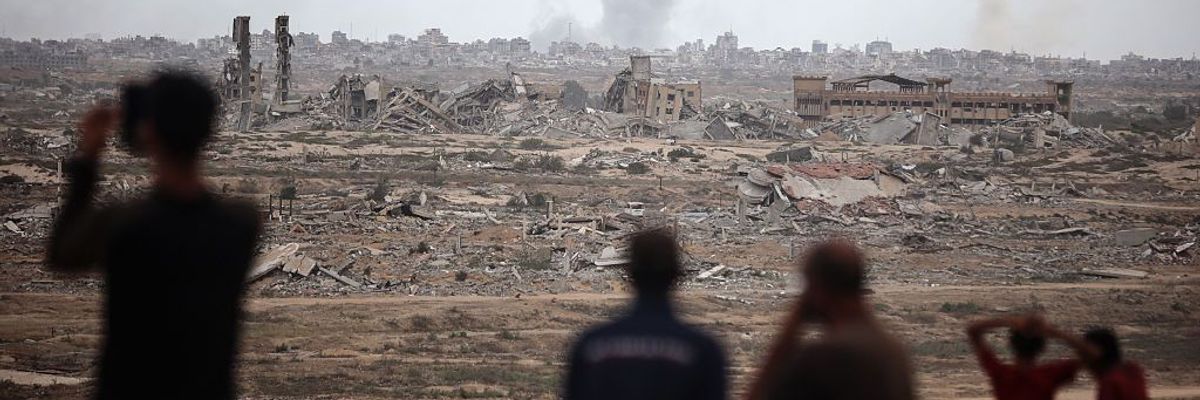
A smoke plume billows following Israeli bombardment on the Gaza Strip as seen from northwest of Nuseirat refugee camp in Gaza, on October 9, 2025. (Photo by Majdi Fathi/NurPhoto via Getty Images)
“This much-needed and welcomed ceasefire does not change the simple fact that Israel has just committed a genocide in Gaza,” wrote the co-founder of European Jews for Palestine.
After two years of destruction in the Gaza Strip, Israelsigned a ceasefire agreement with Hamas on Thursday that is expected to take effect within the next day. But even as the world reacts with jubilation that the nonstop death and destruction may soon abate, skepticism abounds about whether the agreement will result in a just and lasting peace.
Israel is expected to withdraw troops to an agreed-upon line and to allow an influx of aid into Gaza, along with releasing Palestinian prisoners in exchange for Israeli hostages. Already, signs have emerged that the Israeli government may seek to collapse the fragile agreement, as happened earlier this year.
Francesca Albanese, the UN special rapporteur on the occupied Palestinian territories, pointed out that within hours after the deal was announced by US President Donald Trump on Wednesday, Israeli tanks were filmed firing at civilians attempting to return to their homes in Gaza City.
BREAKING! “Ceasefire”, in Israel’s dictionary: you cease, I fire.
Just hours after the deal – as in January – Israel shoots at Palestinians waiting to return home. Before any next step, member states must ensure that Israel honours the ceasefire. https://t.co/ne0YvhrVOj
— Francesca Albanese, UN Special Rapporteur oPt (@FranceskAlbs) October 9, 2025
Middle East Eyereported: “Heavy airstrikes and artillery shelling were reported in Gaza City and Khan Younis overnight, according to local media. Israeli quadcopters were also reported to have dropped bombs on civilians in Gaza City. At least nine people were killed in the attacks since dawn, health officials said.”
Albanese said: “Just hours after the deal—as in January—Israel shoots at Palestinians waiting to return home. Before any next step, member states must ensure that Israel honors the ceasefire.”
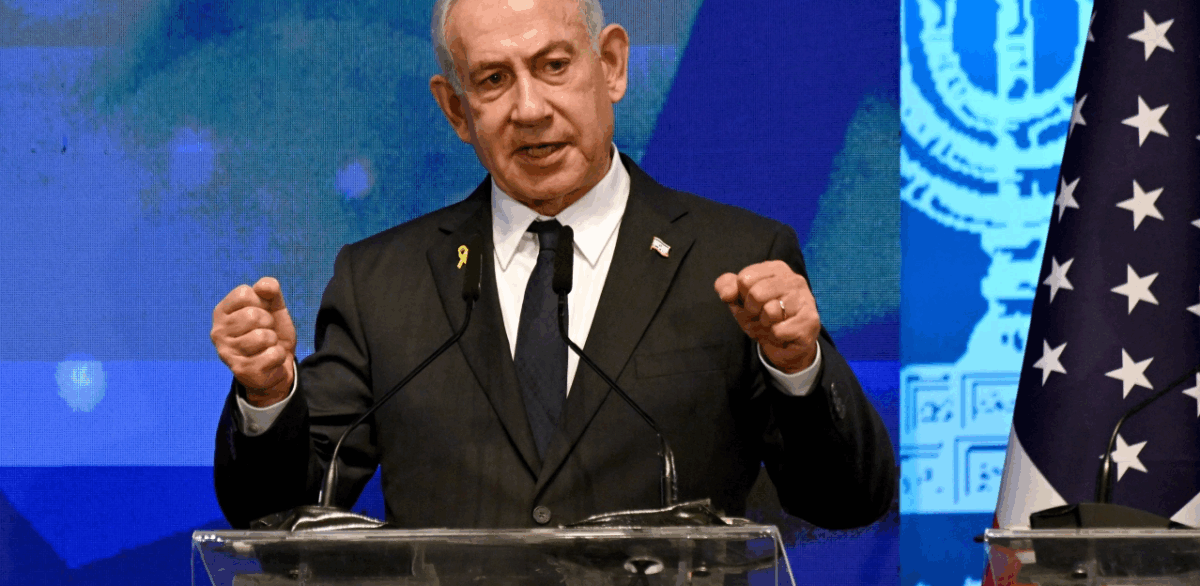
Whether the ceasefire will even be finalized remains an open question, as two leading far-right figures in Israeli Prime Minister Benjamin Netanyahu’s government—Finance Minister Bezalel Smotrich and Security Minister Itamar Ben-Gvir—have come out in opposition to the deal’s ratification and suggestedthat their parties may defect from Netanyahu’s government if they don’t get their way, which could be enough to collaose his narrow governing majority.
In a video at the Al-Aqsa Mosque compound on Jerusalem’s Temple Mount on Wednesday, Ben-Gvir said Israel must pursue “full victory in Gaza,” a move seen as deeply provocative by the Arab world outside one of Islam’s holiest sites, made only more so by his declaration that “we [Jewish Israelis] are the owners of [the] Temple Mount.”
In recent months, Ben-Gvir and Smotrich have said this goal of “total victory” includes carrying out the forced expulsion of Palestinians from Gaza so they can be replaced with Israeli settlers.
Even if this ceasefire proves more durable than previous ones, human rights advocates say that simply halting the violence is not enough.
“We can breathe again, in relief for the end of the daily killing, the starvation, the human suffering beyond imagination, beyond words,” wrote Yoav Shemer-Kunz, the co-founder of European Jews for Palestine in EUObserver. “This much-needed and welcomed ceasefire does not change the simple fact that Israel has just committed a genocide in Gaza.”
Over the past two years, more than 10% of Gaza’s population has been the casualties of Israeli attacks: At least 67,000 people—including over 20,000 children—have been killed, while at least 169,000 people have been injured, many with life-altering wounds, according to official estimates from the Gaza Health Ministry. Other studies suggest the death toll may be even higher when the effects of disease and starvation are taken into account.
Craig Mokhiber, a former United Nations human rights official, said that while Israel and the US had agreed to end the “military component of [the] genocide… they have not yet ended the food and medical components of the genocide.”
Nearly 78% of the buildings, including over 9 in 10 homes, in Gaza have been damaged or destroyed, leaving its medical, water, and sanitation infrastructure in ruins.
And as a result of Israel’s near-total blockade on humanitarian aid, Gaza is now the center of a historic famine. According to the United Nations-backed Integrated Food Security Phase Classification (IPC), nearly a third of the population—641,000 people—is estimated to face catastrophic conditions of hunger, while 1 in 4 children suffers from acute malnutrition.
“A temporary pause or reduction in the scale of attacks and allowing a trickle of humanitarian aid into Gaza is not enough,” said Agnès Callamard, the secretary general of Amnesty International.
“There must be a full cessation of hostilities and a total lifting of the blockade,” she said. “Israel must allow the unhindered flow of basic supplies, including food, medicine, fuel, and reconstruction material, into all parts of the occupied Gaza Strip, as well as the restoration of essential services, to ensure the survival of a population reeling from starvation, repeated waves of mass forced displacement, and a campaign of annihilation.”
Though the deal signed Thursday calls for 400 aid trucks to begin entering the strip each day, marking a massive surge from previous levels, it is still fewer than the 600 per day that were allowed to enter during January’s ceasefire, which occurred when starvation was at a less critical point.
Though the ceasefire will require the withdrawal of some troops, Israel has said it will still control 53% of the Gaza Strip after it goes into effect and the prisoner exchange ends.
“This fragile ceasefire must be the beginning of a sustained and principled effort that leads to ending Israel’s unlawful occupation and blockade,” said Oxfam International. “It must be focused on restoring rights and rebuilding lives. Any political or reconstruction plan must not entrench the occupation or further undermine Palestinian sovereignty.”
Others emphasized the importance not just of remedies to the suffering of Palestinians, but legal accountability for those in Israel’s government, including Netanyahu and former Defense Minister Yoav Gallant, for whom the International Criminal Court has issued arrest warrants for crimes against humanity.
“The current plan—the so-called ‘Trump peace plan’—falls woefully short in this,” said Callamard. “It fails to demand justice and reparations for victims of atrocity crimes or accountability for perpetrators. Stopping the cycle of suffering and atrocities requires an end to longstanding impunity at the heart of recurring violations in Israel and the occupied Palestinian territories. States must uphold their obligations under international law to bring to justice those responsible for war crimes, crimes against humanity, or genocide.”
Mokhiber said: “We must keep the pressure on until all perpetrators and complicit actors are held accountable for the genocide, the apartheid regime is dismantled, and Palestine is free.”
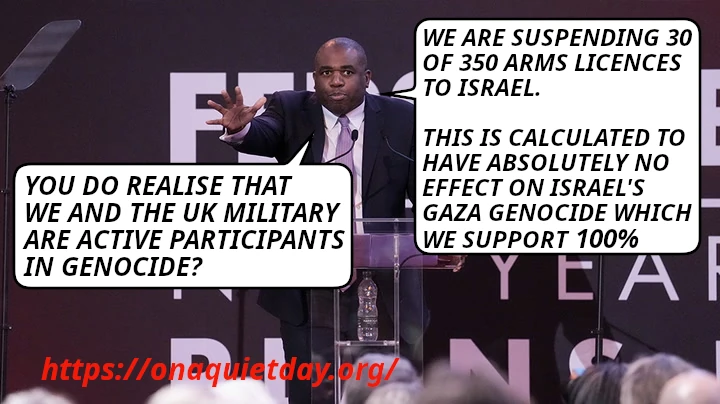
Keir Starmer objects to criticism of the IDF. He asks how could anyone object to them starving people to death, forced marches like the Nazis did, bombing Gaza’s hospitals and universities, mass-murdering journalists, healthworkers and starving people queuing for food, killing and raping prisoners and murdering children. He calls for people to stop obstructing his genocide for Israel.Genocide denier and Current UK Prime Minister Keir Starmer is quoted that he supports Zionism without qualification. He also confirms that UK air force support has been essential in Israel’s mass-murdering genocide. Includes URLs https://www.declassifieduk.org/keir-starmers-100-spy-flights-over-gaza-in-support-of-israel/ and https://youtu.be/O74hZCKKdpAGenocide denying UK Foreign Secretary David Lammy says that UK is suspending 30 of 350 arms licences to Israel. He also confirms the UK government’s support for Israel’s Gaza genocide and the UK government and military’s active participation in genocide.
As more and morescholars, and one rights groupafteranother, confirm that Israel is carrying out a genocide in Gaza, it’s becoming ever more obvious that those who deny the genocide are the intellectual and moral equivalents of people who deny other genocides, such as the ones inflicted on the Indigenous peoples of the Americas, or the Holocaust, or the Armenian Genocide.
Yet the Wall Street Journal persists in running genocide denial. Looking at how the paper does so enables us to not only refute their falsehoods, but also to gain insight into the tactics Gaza genocide denialists, and genocide deniers in general, employ. These include:
Hand-waving: brushing off the cataclysmic damage Israel and the US have done to Palestinians as merely the unavoidable byproducts of war;
Victim-blaming: saying that Palestinian resistance groups such as Hamas are to blame for the suffering in Gaza;
Inverting perpetrator and victim: presenting Palestinians, and not Israelis, as genocidal, with Israelis, rather than Palestinians, cast as the targets;
Obscurantism: offering dubious pieces of information, usually in a decontextualized manner, as if they showed that Israel has pursued its military objectives humanely;
Repudiation: flatly rejecting well-documented facts while offering little or no counter-evidence.
‘Justifiable, even necessary’
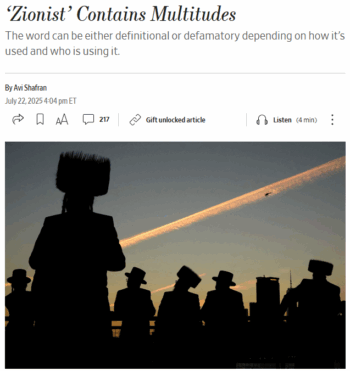
Avi Shafran (Wall Street Journal, 7/22/25): “When critics distort Israel’s goal of self-preservation into a desire for genocide, the accusers have gone from righteous protesters to ignorant haters.”
Ami Magazine columnist Avi Shafran’s Journal piece (7/22/25) utilized both hand-waving and victim-blaming. He asserted:
When critics distort Israel’s goal of self-preservation into a desire for genocide, the accusers have gone from righteous protesters to ignorant haters…. Civilians suffer and die in the prosecution of justifiable, even necessary, wars. That tragedy is intensified when you are fighting an enemy who hides behind human shields. Eradicating the engines of terror in Gaza requires attacking the places from which they operate: hospitals, schools and mosques.
Israel’s supposedly “justifiable, even necessary” war has entailed such policies (as Human Rights Watch—12/19/24—notes) as
intentionally depriv[ing] Palestinian civilians in Gaza of adequate access to water since October 2023, most likely resulting in thousands of deaths and thus committing the crime against humanity of extermination and acts of genocide.
Rather than offering a reasoned, evidence-based defense of such Israeli conduct, Shafran blithely wrote as if consciously withholding drinking water from a civilian population were as natural and inevitable as water boiling at a hundred degrees Celsius.
The author’s next move was to blame Palestinians for Israel killing Palestinians. Shafran, of course, didn’t offer a scintilla of proof for his claim that Palestinian fighters force their own people to be human shields, probably because it’s Israel—not Hamas—that routinely uses Palestinians as shields (FAIR.org, 5/13/25).
‘Systematically and deliberately devastated’
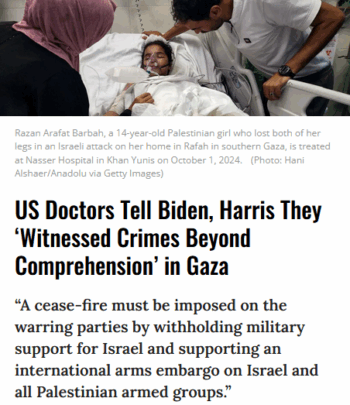
From the health workers’ open letter (Common Dreams, 10/2/24): “The human toll in Gaza since October is far higher than is understood in the United States. It is likely that the death toll from this conflict is already greater than 118,908, an astonishing 5.4% of Gaza’s population.”
Equally weak is Shafran’s suggestion that it’s Palestinians’ fault that Israel attacks Palestinian hospitals, schools and mosques. The UN Independent International Commission of Inquiry on the Occupied Palestinian Territory said that Israel damaged and destroyed more than 90% of the school and university buildings in Gaza, and found just one case where Hamas had also used a school for military purposes. The commission also said that Israeli attacks have damaged more than half of all religious and cultural sites in Gaza, and noted that
all ten religious and cultural sites in Gaza investigated by the Commission constituted civilian objects at the time of attack, and suffered devastating destruction for which the Commission could not identify a legitimate military need.
Similarly, the UN Human Rights Commission published a report late last year examining 136 Israeli strikes on at least 27 hospitals and 12 other medical facilities, and said that Israel did not substantiate its claims that Palestinian armed groups were using the structures for military purposes. In some cases, the report pointed out, Israel’s “vague” allegations “appear contradicted by publicly available information.”
Moreover, 99 American healthcare professionals who volunteered in the Gaza Strip in the months following October 7, 2023, published a letter saying that the signatories
spent a combined 254 weeks inside Gaza’s largest hospitals and clinics. We wish to be absolutely clear: Not once did any of us see any type of Palestinian militant activity in any of Gaza’s hospitals or other healthcare facilities.
We urge you to see that Israel has systematically and deliberately devastated Gaza’s entire healthcare system, and that Israel has targeted our colleagues in Gaza for torture, disappearance and murder.
Shafran pretended such evidence doesn’t exist, perhaps hoping that his audience is racist enough to believe his diatribes about wily Arabs who use places of healing, learning, worship and sanctuary to conceal “engines of terror.”
‘That side isn’t Israel’
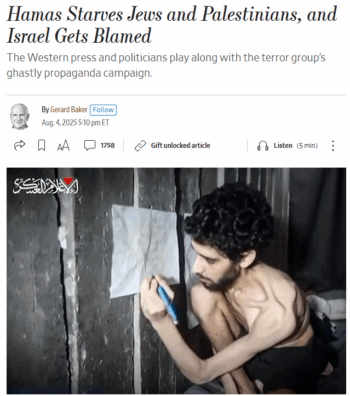
Israel blockades food going into the Gaza Strip, and the Wall Street Journal (8/5/25) blames Hamas.
Former Journal editor-in-chief Gerard Baker wrote a Journal piece (8/5/25) that inverted victim and perpetrator in Gaza. He asserted that, in the war between Israel “and its enemies in Gaza,” one side “would, if it could, conduct a genocide against the other, wiping every last remnant off the face of the planet. That side isn’t Israel.”
Baker’s strategy is to focus on what he claims Palestinian fighters “would” do in imaginary circumstances, rather than on the genocide that is actually taking place. Such speculation is pointless, because by definition it’s not possible to know what would happen in made-up scenarios. Since Baker doesn’t even bother to explain the reasons for his view that Palestinians “would” commit genocide if they could, his make-believe does not merit serious consideration.
While it is by definition impossible to decisively prove what might happen under nonexistent conditions, there is zero doubt that Israel has—in the really existing world—carried out a genocide and engaged in a pattern of conduct consistent with trying to “wip[e] every last remnant [of Palestinian life in Gaza] off the face of the planet.” Days before the Journal ran Baker’s screed, the Israeli human rights group B’Tselem published a report (7/25) documenting the Israeli genocide in Gaza:
Israel’s conduct of warfare in the Gaza Strip, which has included—among other things—massive, indiscriminate bombardment of population centers; starvation of more than 2 million people as a method of warfare; attempts at ethnic cleansing and formally including the ethnic cleansing of Gaza’s residents in the war aims; systematic destruction of hospitals and other medical facilities, which are entitled to special protection under international law, along with the vast majority of civilian infrastructure there; and the unprecedented killing of medical personnel, aid workers, persons in charge of maintaining public order, and journalists. Israel’s claim that Hamas fighters or members of other armed Palestinian groups were present in medical or civilian facilities, often made without providing any evidence, cannot justify or explain such widespread, systematic destruction.
Baker’s inversion of victim and perpetrator depends on ignoring the voluminous proof that Israel is carrying out a genocide, focusing instead on fantasies based on nothing more than orientalist depictions of Arabs as bloodthirsty savages.
‘Every martyr is a trophy’
Bernard-Henri Lévy (Wall Street Journal, 9/3/25): “To speak of genocide in Gaza is an offense to common sense, a maneuver to demonize Israel, and an insult to the victims of genocides past and present.”
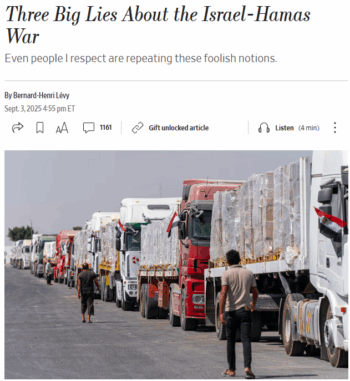
The notorious French intellectual Bernard-Henri Lévy published an op-ed in the Journal (9/3/25) headlined “Three Big Lies About the Israel/Hamas War.” In his view, one such lie is that “Israel is committing ‘genocide’ in Gaza.” He explained: “To say ‘genocide’ means a plan—a deliberate, targeted initiative to destroy a people. That isn’t what the Israeli army is doing.”
Here Lévy engaged in the repudiation approach to genocide denial, writing as if a well-established body of Israeli intent weren’t readily available to anyone with access to the internet. Just six days into the US/Israeli onslaught, Israeli historian Raz Segal wrote (Jewish Currents, 10/13/23) that what Israel had undertaken was “a textbook case of genocide.”
One piece of evidence Segal pointed to was Israeli Minister of Defense Yoav Gallant’s announcement that the state was “imposing a complete siege on Gaza. No electricity, no food, no water, no fuel. Everything is closed. We are fighting human animals, and we will act accordingly.”
For Segal, Gallant’s use of the phrase
“complete siege”…explicitly indexes a plan to bring the siege to its final destination of systematic destruction of Palestinians and Palestinian society in Gaza, by killing them, starving them, cutting off their water supplies, and bombing their hospitals.
Similarly, in February, US President Trump put forth a genocidal plan (Palestinian Centre for Human Rights, 2/5/25; Truthout, 2/9/25) to empty Gaza of its Palestinian inhabitants so that the US could annex the territory. Israeli Prime Minister Benjamin Netanyahu responded by saying he was “committed to US President Trump’s plan for the creation of a different Gaza.” Subsequently, Netanyahu suggested that implementing Trump’s scheme was a condition for ending the conflict.
More recently, Human Rights Watch (5/15/25) commented that an Israeli government plan codenamed “Gideon’s Chariot” was designed “to demolish what remains of Gaza’s civilian infrastructure and concentrate the Palestinian population into a tiny area,” and that this “would amount to an abhorrent escalation of its ongoing crimes against humanity, ethnic cleansing and acts of genocide.”
Thus Lévy’s denialism depends on repudiating the extensive record of Israeli leaders articulating “a plan” to “destroy a people.”
Lévy’s next move was to victim-blame: “Perhaps [Israel] is waging the war badly,” he wrote, but wondering, “who would do better in an asymmetric conflict when the enemy’s goal isn’t to minimize casualties on its own side but to maximize them, so that every martyr is a trophy?” Here Lévy traded on the racist myth that Palestinians are fanatical barbarians indifferent to the suffering of their own people.
His language is vague, so it’s hard to know for sure what he’s talking about, but it sounds like he might be invoking, as Shafran did, what Craig Mokhiber, former director of the New York office of the UN High Commissioner for Human Rights (OHCHR), calls the “double lie of ‘human shields’” (Mondoweiss, 9/21/24).
‘A genocidal army doesn’t take two years’
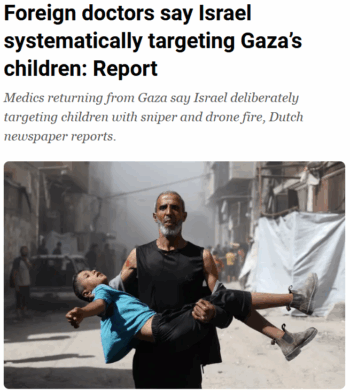
Al Jazeera (9/14/25): “Fifteen out of 17 doctors described encountering children under 15 with single bullet wounds to the head or chest. Together, they identified 114 such cases during their missions in Gaza.”
Lévy then engaged in obscurantism, denying the genocide by selecting questionable tidbits that he seems to think cast Israel in a positive light:
A genocidal army doesn’t take two years to win a war in a territory the size of Las Vegas. A genocidal army doesn’t send SMS warnings before firing or facilitate the passage of those trying to escape the strikes. A genocidal army wouldn’t evacuate, every month, hundreds of Palestinian children suffering from rare diseases or cancer, sending them to hospitals in Abu Dhabi as part of a medical airlift set up right after October 7.
That Israel hasn’t conquered Gaza to this point is a non sequitur. What Israel’s inability to subjugate Gaza shows is that Israel isn’t omnipotent, and that Palestinian fighters and their allies have mounted an effective resistance to the attempt to exterminate Gaza-based Palestinians (FAIR.org, 1/24/25). That tells us nothing about Israel’s intent or the severity of the devastation it has inflicted. (It’s worth recalling that the Warsaw Ghetto survived more than two and a half years under siege from genocidal Nazi forces.)
The SMS warnings that Lévy hails add to the “confusion, chaos and mass displacement” characterizing life in Gaza for the last two years (NPR, 12/7/23). More to the point, any “warnings before firing” that Israel has sent out aren’t going to save many Gaza residents when these messages are disseminated in the context of Israel leveling much of the Strip (BBC, 7/18/25; Guardian, 1/18/25) by bombing it with the “equivalent to six Hiroshimas,” leaving the population with effectively nowhere safe to go.
Approximately 70,000 Palestinians—the overwhelming majority of them civilians—are known to be dead, or are presumed dead under the rubble (to say nothing of the many more dead due to starvation, disease, unsanitary conditions, and lack of access to clean water), so it’s as absurd as it is obscene for Lévy to suggest that Israel is making a sincere effort to reduce Palestinian casualties. That’s what Lévy’s paragraph seems to be suggesting, irrespective of all data to the contrary.
For instance, a group of 45 American physicians and nurses who volunteered in Gaza wrote a letter to the Biden/Harris administration describing treating children whose injuries the medical professionals were sure had been intentionally inflicted; “specifically, every one of us on a daily basis treated pre-teen children who were shot in the head and chest,” the letter said (CNN, 7/26/24). Deliberately sniping children every day is, to paraphrase Lévy, something a genocidal army does.
‘Delayed or denied’
Bragging about the IDF evacuating “hundreds of Palestinian children” is actually an admission of the inadequacy of Israeli relief efforts (MSF, 7/17/25).
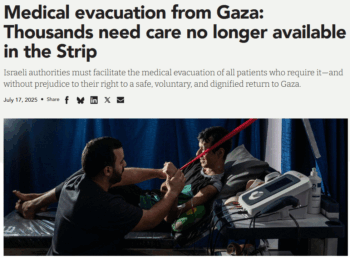
Nor was Lévy on solid ground when he denied that Israel policies are genocidal by claiming that it “evacuate[s], every month, hundreds of Palestinian children suffering from rare diseases or cancer.” Compare that to Doctors Without Borders/Médecins Sans Frontières report (7/17/25) that
an estimated 11,000–13,000 people—including more than 4,500 children—require medical evacuation to access care unavailable in the Strip. Yet Israeli authorities have allowed only a few of those requesting medical evacuation to do so, with many critical cases being delayed or denied regardless of medical urgency….
Doctors Without Borders/Médecins Sans Frontières (MSF) has only managed to medically evacuate 22 patients, including 13 children to our reconstructive surgery hospital in Amman, Jordan, for comprehensive rehabilitative care.
The World Health Organization (WHO) told a similar story (4/14/25):
Far too few patients have been able to leave Gaza for the urgent care they so desperately need. We estimate that up to 12,000 patients need medical evacuation but, since [Israel intensified its blockade of aid in March] we have only been able to evacuate 121 people, including 73 children.
The number of people allowed to leave Gaza for healthcare has been a minuscule portion of those who need it—never mind that the reason Palestinians need to leave Gaza for medical treatment could have something to do with destroying the Strip’s health system by “deliberately attacking and starving healthcare workers, paramedics and hospitals to wipe out medical care” in the territory. Because that’s the reality of Israel’s assaults on Palestinian healthcare, and because Lévy’s project is genocide denial, he has no choice but to obscure what Israel has done and is continuing to do.
‘Charges are a travesty’
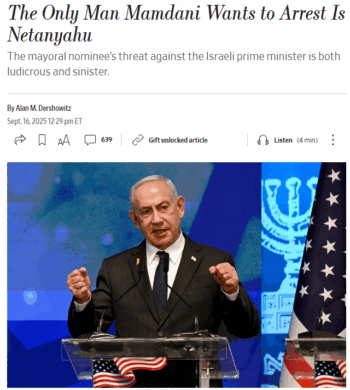
Alan Dershowitz (9/16/25) combines two of the Wall Street Journal‘s favorite causes: defending genocide and demonizing New York mayoral candidate Zohran Mamdani (FAIR.org, 7/30/25).
Attorney Alan Dershowitz—himself rathernotorious—also engaged in genocide denial on the Journal’s op-ed page (9/16/25), selecting obscurantism and repudiation as his rhetorical weapons. Dershowitz mocked New York City mayoral candidate Zohran Mamdani for saying that, if elected, he will enforce the International Criminal Court’s (ICC) arrest warrant for Netanyahu, should the prime minister visit the city:
The ICC’s charges against Mr. Netanyahu are a travesty. Its arrest warrant accuses him of intentionally starving civilians in Gaza—never mind that Israel has facilitated the delivery of more than a million tons of food to the strip. Mr. Mamdani also accuses the Jewish state of “genocide,” a charge that not even the ICC levies.
Dershowitz wrote as though it is self-evidently absurd for Mamdani to say that Israel is carrying out genocide, pointing to the fact that the ICC has not charged Israel with doing so. Yet the International Court of Justice ruled in January 2024 that it’s “plausible” Israel is committing genocide, and is working toward a definitive ruling (Guardian, 7/27/25). This is to say nothing of the many scholars and rights groups, already cited in this piece, who have concluded that the term aptly characterizes Israel’s actions. Dershowitz simply pretended this evidence doesn’t exist.
Dershowitz obfuscated Israeli policies by celebrating the volume of food allowed into Gaza, as though it were sufficient. A “million tons of food” sounds like a lot, but divided among 2 million people over two years, it amounts to a little more than one and a third pounds of food per day. (A pound and a third of rice has about 800 calories,while “the standard humanitarian ration is 2,100 calories per person per day”—London Review of Books, 5/14/25.)
It’s uncontroversial that Israel is deliberately starving civilians in Gaza. The UN’s Integrated Food Security Phase Classification (IPC) assessed that “half a million people—a quarter of Palestinians in Gaza—are suffering from famine,” a catastrophe resulting from Israeli policies, including what aid groups describe as its “systematic obstruction” of food entering the Strip (BBC, 8/22/25).
Even more contemptible
As I’ve argued previously (Electronic Intifada, 7/15/24), denying an unfolding genocide like the one in Palestine is even more contemptible than denying genocides that happened in the past, because an ongoing genocide can be stopped before even more people in the targeted population are killed, maimed and bereaved. That’s why every genocide denial is at the same time pro-genocide propaganda: Fewer people with an accurate grasp of the US/Israeli attempt to destroy Palestinians in Gaza as a people means fewer people to try and stop it from happening.
Fortunately, despite all the lies from outlets like the Journal, millions of people around the world have made Palestine solidarity activism a regular part of their lives. The more widely genocide-enabling mendacities can be exposed, the more likely to succeed will be the movements to stop the crime of crimes—and to achieve peace through liberation across the Middle East.
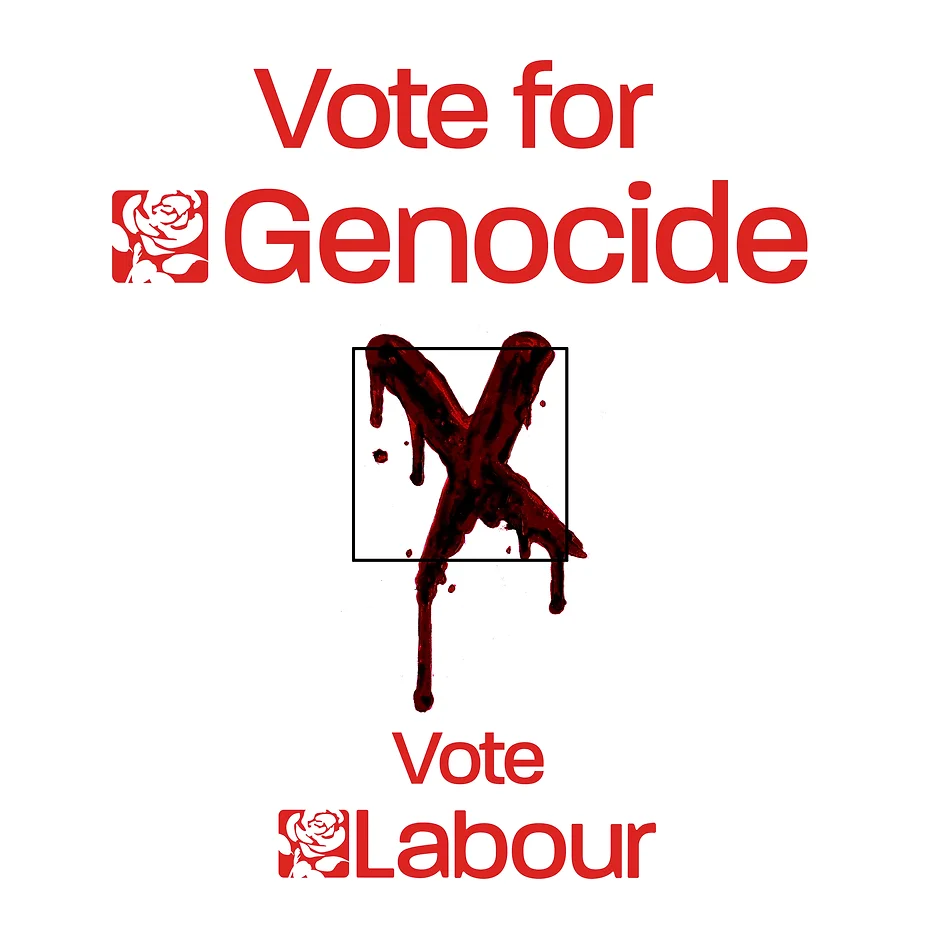
Keir Starmer objects to criticism of the IDF. He asks how could anyone object to them starving people to death, forced marches like the Nazis did, bombing Gaza’s hospitals and universities, mass-murdering journalists, healthworkers and starving people queuing for food, killing and raping prisoners and murdering children. He calls for people to stop obstructing his genocide for Israel.Genocide denier and Current UK Prime Minister Keir Starmer is quoted that he supports Zionism without qualification. He also confirms that UK air force support has been essential in Israel’s mass-murdering genocide. Includes URLs https://www.declassifieduk.org/keir-starmers-100-spy-flights-over-gaza-in-support-of-israel/ and https://youtu.be/O74hZCKKdpAVote Labour for Genocide.
Palestinians follow the news about the ceasefire agreement in Khan Yunis, Gaza, on 9 October 2025 | Abdallah F.s. Alattar/Anadolu via Getty Images)
For two years, our lives have been on hold amid constant air strikes and fighting. Now, we finally have reason to hope
Growing up in Gaza, my friends and I often heard older relatives’ stories of the Nakba; learning about the homes that Israeli troops forced them out of in 1948, and the keys they forever carried with them in hopes of returning. We never imagined that we would one day carry this pain ourselves.
For the last two years, history has repeated itself before the eyes of the world. Those of us in Gaza who have survived the Israeli genocide have lived a new Nakba, not knowing where to go or if we will ever return home.
This has not been one war, but multiple wars happening at once. It is the war of relentless bombing that destroyed homes and neighbourhoods, the war of forced displacement that has pushed hundreds of thousands into the unknown at a moment’s notice, and the war of tents that offer no protection from the scorching summer heat or the cold and rain of winter.
Today, as we hear news of a ceasefire, we’re caught between feeling joy and fear – between believing and doubting.
I was in my hometown of Rafah in May last year when the Israeli occupation launched its invasion of the city. In a single day, Rafah was transformed from an overcrowded city sheltering more than 1.5 million people – both its own residents and those who’d sought refuge there after being displaced from elsewhere in Gaza – to an empty wasteland.
Within hours, the roads filled with overloaded cars and carts as hundreds of thousands of people, my family included, abandoned their homes and most of their belongings, fleeing towards the unknown. There was no time to think or to salvage what remained; fearing what would happen to those trapped, we all chose survival over everything else.
A few days later, the evacuation operation expanded further, forcing tens of thousands of us to move to the Mawasi area in Khan Younis. I’d never been to Mawasi before, but I had heard about it from friends online: a barren land with sand dunes unlike anything we’d seen before. When we arrived, we found dilapidated plastic tents, extreme overcrowding, no sewage or basic services.
The tents’ flimsy fabric roofs offered no protection from the summer heat or the winter cold. Our daily life turned into a continuous struggle of finding water, trying to charge our phones, and dealing with internet cuts, with scorching days and freezing nights. Even sleeping and talking became difficult amid the complete lack of privacy.
Life in the camps offered no safety at all. One evening, my cousin Ali was returning from the sea at sunset when he was chased by a quadcopter – a small, remote-controlled drone that Israel has used to surveil, intimidate and even kill civilians in Gaza. Ali froze in place for minutes that he said felt like hours before the drone disappeared, and he ran away, terrified. After that, we no longer dared to leave the area once darkness fell.
Every night, we would lay awake listening to stray bullets from occupation snipers piercing the air, planting terror in our hearts. We would lie on the ground instinctively, fearing any bullet that might pierce the tent, and sometimes six of us would gather in a small stone room at my aunt’s place, seeking a sliver of safety. After a neighbour’s child was paralysed by a stray bullet that pierced their tent, some of my relatives dug small trenches inside theirs to hide in.
On 10 September 2024, we lived through a night we will never forget. The evening began like any other; my family was in the tent and I was laying out front, trying to escape the heat, reading Letter from Gaza, a short story about a young man who returns home to Gaza to find his neighbourhood destroyed. It could have been penned any day over the past two years, but was written nearly 70 years ago by Palestinian author and militant Ghassan Kanafani.
I was interrupted by the sound of a military helicopter, followed by five consecutive airstrikes that destroyed much of the camp. My family managed to escape unharmed, which was a miracle, but in an instant, we lost everything we owned for a second time: our tent, our few belongings, my university certificates, and the computer that I used for my studies.
I remember screams, blood, and mothers searching for their children in the smoke. The Palestinian Civil Defence Agency later reported that 40 people had died that night, and 60 others were injured. But we had nowhere else to go, so my mother and sisters moved briefly into a friend’s tent, and within a week my father and I had rebuilt a shelter for us.
Then came the ceasefire on 18 January 2025, bringing a ray of hope. I returned to my home in Rafah, clutching the key as if it were all I had left. But my joy did not last long. When I reached the neighbourhood, I found nothing but rubble. My house, the homes of my relatives and friends, even my grandmother’s house, the place I most loved spending time – they were all gone.
The key I had believed would take me back home became merely a symbol of a Nakba that my ancestors had already endured, a memory of a home that no longer exists. Still, we stayed in Rafah, staying with a relative and trying to rebuild our lives.
My family is far from alone. Since the start of the invasion, 1.9 million people, nearly 90% of Gaza’s population, have been internally displaced – many of them forced to move over and over again as Israel expands its war into areas it told us would be safe. The occupation now controls large parts of the Strip, leaving less than 30% of Gaza’s original area habitable and making freedom of movement impossible.
In mid-March, two months after it started, the ceasefire ended abruptly and the war’s devastation resumed overnight. The bombardment intensified worse than ever, and by the morning, Rafah was surrounded by Israeli tanks. We were forced to evacuate for a fifth time, returning to a tent in Mawasi without any of the belongings I had managed to salvage from our shelled home.
On that day, I realised my old life would never return. For me, it was a new phase of the war, a new chapter of terror. I had to face that the relentless and violent bombing was not just a passing event, but our everyday reality – everything I knew from before the war was gone, just memories.
For more than a year, Rafah has been entirely under occupation, with no news of when we might be able to go home. The city is no longer as I knew it growing up. There is no safety, and freedom of movement is impossible.
Despite all the loss and suffering tied into displacement, it has reunited me with friends whom war stopped me from seeing for over a year. Hamdan, my friend from Khan Younis, Mahmoud from Gaza City, and Ramez from East Khan Younis; we all found ourselves in the same area, a small solace in all the devastation.
My friends and I began sharing our stories and sorrows every day. Mahmoud, with whom I went to university before its buildings were destroyed and our dreams were shattered, told us of how his family spent most of the past two years refusing to leave Gaza City, in the north of the Gaza Strip, choosing to endure the war in their home.
Then, last month, Binyamin Netanyahu’s occupation announced its plan to fully occupy the city. The shelling intensified, and every time Mahmoud looked out of his window, he would see the trucks that were carrying more than half a million people and their belongings south.
Over 200,000 families remained in the city, though. Some had nowhere else to go, some could not afford the up to $5,000 it can cost to transport belongings and purchase tents, and some, like Mahmoud’s family, simply did not want to leave.
Eventually, the shelling hit the neighbourhood where Mahmoud and his family lived, and became a daily occurrence. Several nearby tower blocks were destroyed. All services in the area collapsed; there was no potable water, or even dirty water, and no people on the streets or in the markets. Life became impossible. Mahmoud’s family was finally forced to evacuate.
Mahmoud and I are no longer who we once were. We used to have breakfast together in the university cafeteria, walk through the lecture halls together to attend our daily classes, and go together to Gaza City’s central library to borrow a book or one of the English novels. Now, we still see each other most days – living as we do in nearby camps – but our lives are so different now; we are unrecognisable from who we once were.
Two years have passed in which life has been on hold. Every day we have asked ourselves the same question: will this nightmare ever end? Then, last night, we finally heard the news that we have all been waiting for: Israel and Hamas appear ready to reach a peace deal.
The camp instantly came alive. Women began to ululate and children laughed, it felt as though everyone had been waiting for just one moment to breathe, a brief pause from this long fear. No one knows if this is truly the end or just another pause in the war, but today, we all need to believe that peace – even for a moment – is still possible.
Hassan Herzallah is a Palestinian translator and writer based in Gaza.
Keir Starmer objects to criticism of the IDF. He asks how could anyone object to them starving people to death, forced marches like the Nazis did, bombing Gaza’s hospitals and universities, mass-murdering journalists, healthworkers and starving people queuing for food, killing and raping prisoners and murdering children. He calls for people to stop obstructing his genocide for Israel.Genocide denier and Current UK Prime Minister Keir Starmer is quoted that he supports Zionism without qualification. He also confirms that UK air force support has been essential in Israel’s mass-murdering genocide. Includes URLs https://www.declassifieduk.org/keir-starmers-100-spy-flights-over-gaza-in-support-of-israel/ and https://youtu.be/O74hZCKKdpAGenocide denying UK Foreign Secretary David Lammy says that UK is suspending 30 of 350 arms licences to Israel. He also confirms the UK government’s support for Israel’s Gaza genocide and the UK government and military’s active participation in genocide.

 People on Westminster Bridge as they take part in a Palestine Solidarity Campaign march in central London, October 11, 2025