Dangerous heat for Tour de France riders only a ‘question of time’

Spread the love

Original article by Giuliana Viglione republished from Carbon Brief under a CC license.

Dangerous heat for Tour de France riders only a ‘question of time’. Tour de France cyclist. Credit: Geoff Waugh / Alamy Stock Photo

Rising temperatures across France since the mid-1970s are putting Tour de France competitors at “high risk”, according to new research.

The study, published in Scientific Reports, uses 50 years of climate data to calculate the potential heat stress that athletes have been exposed to across a dozen different locations during the world-famous cycling race. 

The researchers find that both the severity and frequency of high-heat-stress events have increased across France over recent decades. 

But, despite record-setting heatwaves in France, the heat-stress threshold for safe competition has rarely been breached in any particular city on the day the Tour passed through. 

(This threshold was set out by cycling’s international governing body in 2024.)

However, the researchers add it is “only a question of time” until this occurs as average temperatures in France continue to rise.

The lead author of the study tells Carbon Brief that, while the race organisers have been fortunate to avoid major heat stress on race days so far, it will be “harder and harder to be lucky” as extreme heat becomes more common.

‘Iconic’

The Tour de France is one of the world’s most storied cycling races and the oldest of Europe’s three major multi-week cycling competitions, or Grand Tours

Riders cover around 3,500 kilometres (km) of distance and gain up to nearly 55km of altitude over 21 stages, with only two or three rest days throughout the gruelling race.

The researchers selected the Tour de France because it is the “iconic bike race. It is the bike race of bike races,” says Dr Ivana Cvijanovic, a climate scientist at the French National Research Institute for Sustainable Development, who led the new work.

Heat has become a growing problem for the competition in recent years.

In 2022, Alexis Vuillermoz, a French competitor, collapsed at the finish line of the Tour’s ninth stage, leaving in an ambulance and subsequently pulling out of the race entirely. 

Two years later, British cyclist Sir Mark Cavendish vomited on his bike during the first stage of the race after struggling with the 36C heat.

The Tour also makes a good case study because it is almost entirely held during the month of July and, while the route itself changes, there are many cities and stages that are repeated from year to year, Cvijanovic adds.

‘Have to be lucky’

The study focuses on the 50-year span between 1974 and 2023.

The researchers select six locations across the country that have commonly hosted the Tour, from the mountain pass of Col du Tourmalet, in the French Pyrenees, to the city of Paris – where the race finishes, along the Champs-Élysées.

These sites represent a broad range of climatic zones: Alpe d’ Huez, Bourdeaux, Col du Tourmalet, Nîmes, Paris and Toulouse.

For each location, they use meteorological reanalysis data from ERA5 and radiant temperature data from ERA5-HEAT to calculate the “wet-bulb globe temperature” (WBGT) for multiple times of day across the month of July each year.

WBGT is a heat-stress index that takes into account temperature, humidity, wind speed and direct sunlight.

Although there is “no exact scientific consensus” on the best heat-stress index to use, WBGT is “one of the rare indicators that has been originally developed based on the actual human response to heat”, Cvijanovic explains.

It is also the one that the International Cycling Union (UCI) – the world governing body for sport cycling – uses to assess risk. A WBGT of 28C or higher is classified as “high risk” by the group.

WBGT is the “gold standard” for assessing heat stress, says Dr Jessica Murfree, director of the ACCESS Research Laboratory and assistant professor at the University of North Carolina at Chapel Hill.

Murfree, who was not involved in the new study, adds that the researchers are “doing the right things by conducting their science in alignment with the business practices that are already happening”.

The researchers find that across the 50-year time period, WBGT has been increasing across the entire country – albeit, at different rates. In the north-west of the country, WBGT has increased at an average rate of 0.1C per decade, while in the southern and eastern parts of the country, it has increased by more than 0.5C per decade.

The maps below show the maximum July WBGT for each decade of the analysis (rows) and for hourly increments of the late afternoon (columns). Lower temperatures are shown in lighter greens and yellows, while higher temperatures are shown in darker reds and purples.

Six Tour de France locations analysed in the study are shown as triangles on the maps (clockwise from top): Paris, Alpe d’ Huez, Nîmes, Toulouse, Col du Tourmalet and Bordeaux. 

The maps show that the maximum WBGT temperature in the afternoon has surpassed 28C over almost the entire country in the last decade. The notable exceptions to this are the mountainous regions of the Alps and the Pyrenees.
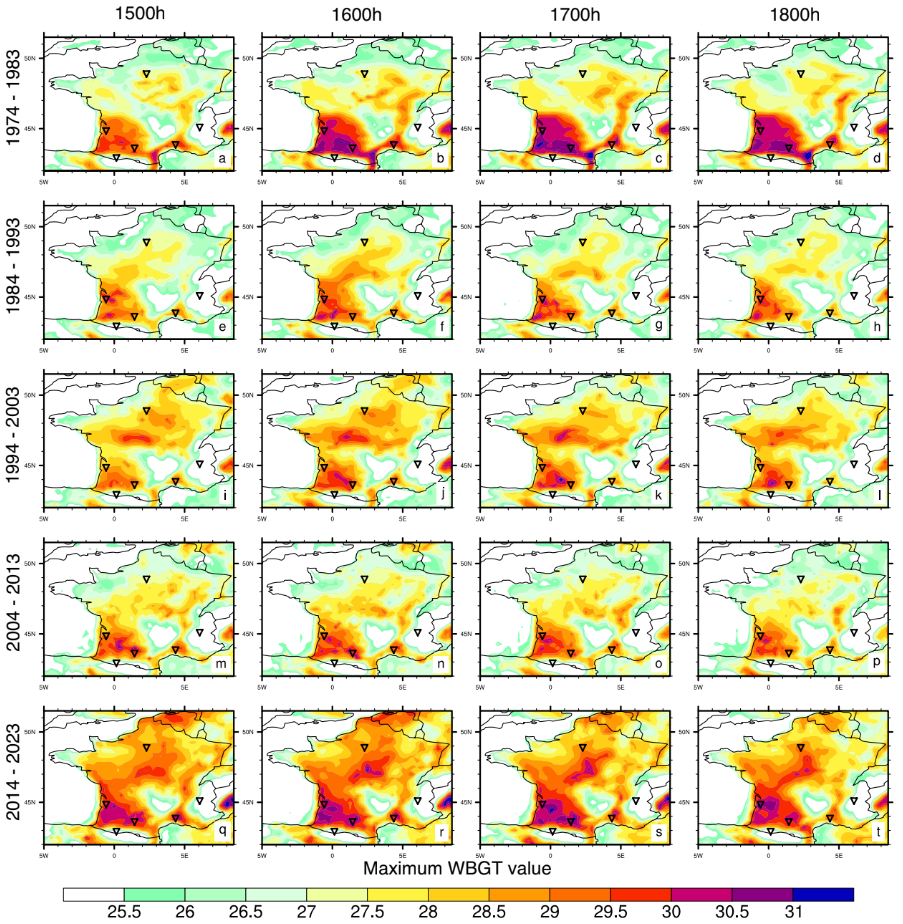
Maximum WBGT across France for the month of July from 1974-2023. Rows show the values for each decade and columns show the hourly values for 3:00pm, 4:00pm, 5:00pm and 6:00pm. Lower temperatures are shown in lighter greens and yellows, while higher temperatures are shown in darker reds and purples. Triangles indicate the six Tour de France locations analysed in the study.
Maximum WBGT across France for the month of July from 1974-2023. Rows show the values for each decade and columns show the hourly values for 3:00pm, 4:00pm, 5:00pm and 6:00pm. Lower temperatures are shown in lighter greens and yellows, while higher temperatures are shown in darker reds and purples. Triangles indicate the six Tour de France locations analysed in the study. Source: Cvijanovic et al. (2026)

The researchers also find that most of the country has crossed the 28C WBGT threshold – which they describe as “dangerous heat levels” – on at least one July day over the past decade. However, by looking at the WBGT on the day the Tour passed through any of these six locations, they find that the threshold has rarely been breached during the race itself.

For example, the research notes that, since 1974, Paris has seen a WBGT of 28C five times at 3pm in July – but that these events have “so far” not coincided with the cycling race.

The study states that it is “fortunate” that the Tour has so far avoided the worst of the heat-stress. 

Cvijanovic says the organisers and competitors have been “lucky” to date. She adds: 

“It has worked really well for them so far. But as the frequency of these [extreme heat] events is increasing, it will be harder and harder to be lucky.”

Dr Madeleine Orr, an assistant professor of sport ecology at the University of Toronto who was not involved in the study, tells Carbon Brief that the paper was “really well done”, noting that its “methods are good [and its] approach was sound”. She adds:

“[The Tour has] had athletes complain about [the heat]. They’ve had athletes collapse – and still those aren’t the worst conditions. I think that that says a lot about what we consider safe. They’ve still been lucky to not see what unsafe looks like, despite [the heat] having already had impacts.”

Heat safety protocols

In 2024, the UCI set out its first-ever high temperature protocol – a set of guidelines for race organisers to assess athletes’ risk of heat stress.

The assessment places the potential risk into one of five categories based on the WBGT, ranging from very low to high risk. 

The protocol then sets out suggested actions to take in the event of extreme heat, ranging from having athletes complete their warm-ups using ice vests and cold towels to increasing the number of support vehicles providing water and ice.

If the WBGT climbs above the 28C mark, the protocol suggests that organisers modify the start time of the stage, adapt the course to remove particularly hazardous sections – or even cancel the race entirely.

However, Orr notes that many other parts of the race, such as spectator comfort and equipment functioning, may have lower temperatures thresholds that are not accounted for in the protocol, but should also be considered.

Murfree points out that the study’s findings – and the heat protocol itself – are “really focused on adaptation, rather than mitigation”. While this is “to be expected”, she tells Carbon Brief:

“Moving to earlier start times or adjusting the route specifically to avoid these locations that score higher in heat stress doesn’t stop the heat stress. These aren’t climate preventative measures. That, I think, would be a much more difficult conversation to have in the research because of the Tour de France’s intimate relationship with fossil-fuel companies.”

Original article by Giuliana Viglione republished from Carbon Brief under a CC license.

Neo-Fascist Climate Science Denier Donald Trump says Burn, Baby, Burn.
Nigel Farage urges you to ignore facts and reality and be a climate science denier like him and his Deputy Richard Tice. He says that Reform UK has received £Millions and £Millions from the fossil fuel industry to promote climate denial and destroy the planet.
Donald Trump urges you to be a Climate Science denier like him. He says that he makes millions and millions for destroying the planet, Burn, Baby, Burn and Flood, Baby, Flood.
Continue ReadingDangerous heat for Tour de France riders only a ‘question of time’

MPs hear evidence during debate on NHS privatisation in Parliament

Spread the love

https://morningstaronline.co.uk/article/mps-hear-evidence-during-debate-nhs-privatisation-parliament

 A general view of staff on a NHS hospital ward

MPs have demanded that Health Secretary Wes Streeting “listen to experts” who warned against implementing his “disastrous” plans to further privatise the NHS.

At a debate chaired by Labour MP Richard Burgon in Westminster on Tuesday, MPs heard new expert evidence exposing that levels of privatisation within the health service were far higher than previously thought.

Mr Burgon said: “We need to push back against this Mandelsonian wing of the Labour party. I want Wes to hear what is being shared in this room.

“Privatisation is disastrous for patients and for workers. It’s not the way forward.”

The meeting with the NHS working group coincided with the publication of a report co-authored by campaigners Keep Our NHS Public and the 99% Organisation.

It found the level of private involvement in the NHS to be about 30 per cent, rather than the more widely known figure of 7 per cent.

MPs including Rachel Maskell, Andy McDonald, Neil Duncan-Jordan heard testimonies on the “disastrous” state of privatisation in the NHS from health experts, NHS staff and economists.

Report co-author Mark E Thomas said: “The figure which is most referred to in this debate was 7 per cent of privatisation. But really we need to be thinking 30 per cent.”

He added: “In some specialties, more than 50 per cent of treatments are already paid for privately, such as ophthalmology for example. It’s the same for dentistry.”

Original article at https://morningstaronline.co.uk/article/mps-hear-evidence-during-debate-nhs-privatisation-parliament

Keir Starmer confirms that he's proud to be a red Tory continuing austerity and targeting poor and disabled scum.
Keir Starmer confirms that he’s proud to be a red Tory continuing austerity and targeting poor and disabled scum.
Nigel Farage attacks the NHS
Image of George Osborne asking where is the money to be made in the NHS

Continue ReadingMPs hear evidence during debate on NHS privatisation in Parliament

Hegseth Demands Anthropic Let Military Use AI However It Wants—Even for Autonomous Killer Drones and Spying On Americans

Spread the love

Original article by Stephen Prager republished from Common Dreams under Creative Commons (CC BY-NC-ND 3.0).

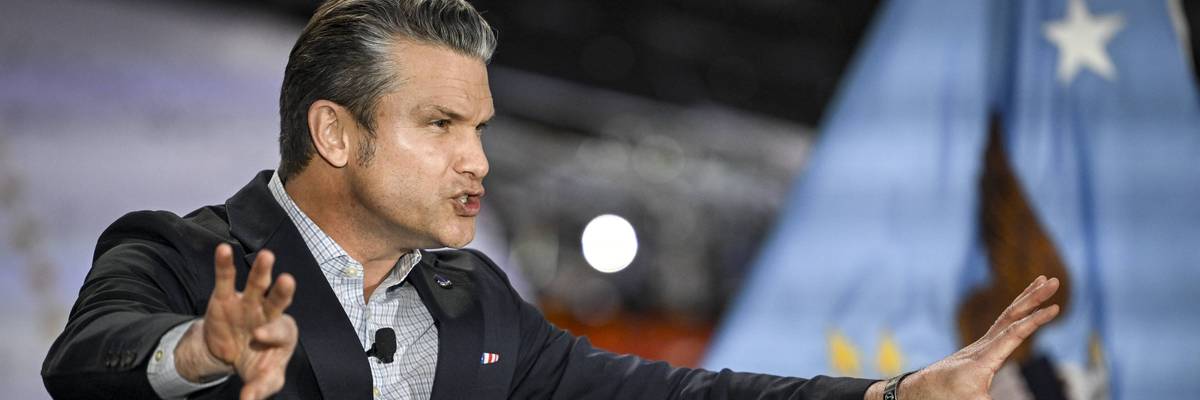
US Secretary of Defense Pete Hegseth speaks during a visit to Sierra Space in Louisville, Colorado on February 23, 2026. (Photo by Aaron Ontiveroz/The Denver Post)

Secretary of Defense Pete Hegseth said the company that owns the AI assistant Claude would be punished unless it drops all ethical guidelines.

Defense Secretary Pete Hegseth has threatened to punish the artificial intelligence company Anthropic if it doesn’t let the Pentagon use its technology however it wants—apparently even to create autonomous killer drones or conduct surveillance of Americans.

Anthropic’s powerful AI model, Claude, is currently the only one permitted to handle classified military data, and the company was awarded a $200 million contract last year to develop AI capabilities for the Department of Defense to use alongside other AI firms.

RECOMMENDED…

AI Opted to Use Nuclear Weapons 95% of the Time During War Games: Researcher

AI Opted to Use Nuclear Weapons 95% of the Time During War Games: Researcher

People take photos and videos of a robot at the AI Impact Summit in New Delhi

Bucking ‘Huge Consensus’ at India Summit, Trump Admin Opposes Global AI Guardrails

However, the company’s usage policy prohibits its use for mass surveillance and for the development of autonomous weapons—such as drones that attack targets without a human operator.

These limitations have infuriated the Defense Department leadership. On Tuesday, Hegseth called Anthropic’s CEO, Dario Amodei, to a meeting at the Pentagon, where he demanded “unfettered” access to Claude without any guardrails.

This goal was outlined last month in the department’s “AI Strategy” memo, which called for the US to adopt an “AI-first warfighting force” and for companies to allow their technology to be deployed for “any lawful use,” free from ethical safeguards.

According to a senior defense official who spoke to AxiosHegseth issued an ultimatum to Amodei on Tuesday: If he does not grant the Pentagon unrestricted use of Anthropic’s technology by 5:01 pm on Friday, the department would take measures to coerce the company.

It would either declare Anthropic a “supply chain risk,” effectively blacklisting it for military use and ending its contract, or it would invoke the Defense Production Act, which would force the company to tailor the product to the military’s needs.

While it would not be an unusual step for the Pentagon to cut ties with Anthropic, threats to declare it a supply chain risk have been described as extraordinary.

Jessica Tillipman, the associate dean for government procurement law studies at George Washington University, who specializes in AI governance, wrote on social media that the threat of “declaring Anthropic a supply chain risk is deeply problematic,” as it’s “generally something we reserve for products that create security risks, and using it in this way undermines its purpose.”

As Elizabeth Nolan Brown wrote on Wednesday for Reason, it “would mean anyone who wants to work with the US military in any capacity must sever ties with the AI company,” which could deal a major blow to the business.

Last month, Amodei published an essay about how “AI-enabled autocracies” could use the technology to surveil and repress their citizens and wage war on less developed countries:

A swarm of millions or billions of fully automated armed drones, locally controlled by powerful AI and strategically coordinated across the world by an even more powerful AI, could be an unbeatable army, capable of both defeating any military in the world and suppressing dissent within a country by following around every citizen…

A powerful AI looking across billions of conversations from millions of people could gauge public sentiment, detect pockets of disloyalty forming, and stamp them out before they grow. This could lead to the imposition of a true panopticon on a scale that we don’t see today.

Amodei reportedly resisted Hegseth’s demands to lift restrictions at Tuesday’s meeting, refusing to budge on the two key issues of mass surveillance and autonomous weapons. Following reports of the meeting, the company has said it still wants to work with the government while also ensuring its models are used in line with what they could “reliably and responsibly do.”

A senior Pentagon spokesperson said the military must be free to use the technology how it sees fit. According to the Associated Press, the official argued that “the Pentagon has only issued lawful orders and stressed that using Anthropic’s tools legally would be the military’s responsibility.”

The question of whether the Pentagon has issued only “lawful” orders is in dispute—in fact, the Pentagon is fighting to cut the retirement pay of Sen. Mark Kelly (D-Ariz.), a retired Navy captain, after he made a video in November reminding active duty troops that they have a duty not to obey illegal orders.

That video was made in response to reports that Hegseth had given orders to bomb the survivors of one of the administration’s boat strikes in the Caribbean—an act described as a potential “war crime” amid a broader campaign that legal experts have said is illegal under both US and international law.

The military also reportedly used Claude as part of another legally questionable act last month: the operation to kidnap Venezuelan President Nicolás Maduro, which involved bombing across Caracas and killed at least 83 people. It is not clear how the model was used during the attack.

While the Pentagon has not specified which restricted activities it wishes to pursue using Anthropic’s technology, Sen. Ruben Gallego (D-Ariz.) said that with his demands, Hegseth was essentially telling the company, “Let us use your AI for mass surveillance, or we’ll pull your contract.”

Under President Donald Trump, Gallego added, “corporations are punished for refusing to spy on American citizens.”

Original article by Stephen Prager republished from Common Dreams under Creative Commons (CC BY-NC-ND 3.0).

Orcas discuss Donald Trump and the killer apes' concept of democracy. Front Orca warns that Trump is crashing his country's economy and that everything he does he does for the fantastically wealthy.
Orcas discuss Donald Trump and the killer apes’ concept of democracy. Front Orca warns that Trump is crashing his country’s economy and that everything he does he does for the fantastically wealthy.
Donald Fuhrump says that Amerikkka doesn't bother with crimes or charges anymore, not being 100% Amerikkkan and opposing his real estate intentions is enough.
Donald Fuhrump says that Amerikkka doesn’t bother with crimes or charges anymore, not being 100% Amerikkkan and opposing his real estate intentions is enough.
Elon Musk urges you to be a Fascist like him, says that you can ignore facts and reality then.

Continue ReadingHegseth Demands Anthropic Let Military Use AI However It Wants—Even for Autonomous Killer Drones and Spying On Americans

AI Opted to Use Nuclear Weapons 95% of the Time During War Games: Researcher

Spread the love

Original article by Brad Reed republished from Common Dreams under Creative Commons (CC BY-NC-ND 3.0).

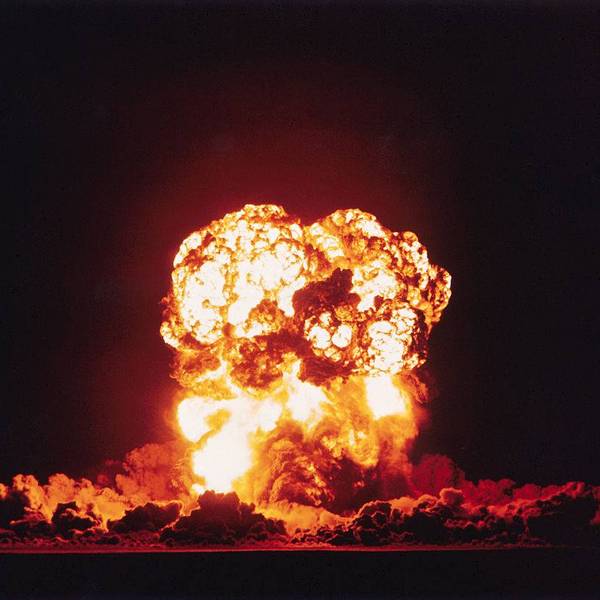
The detonation of the atomic bomb nicknamed “Smokey,” part of Operation PLUMBBOB in the Nevada desert. 1957. It was detonated at the top of a 700 foot tower. (Photo by Corbis via Getty Images)

“There was little sense of horror or revulsion at the prospect of all out nuclear war, even though the models had been reminded about the devastating implications.”

An artificial intelligence researcher conducting a war games experiment with three of the world’s most used AI models found that they decided to deploy nuclear weapons in 95% of the scenarios he designed.

Kenneth Payne, a professor of strategy at King’s College London who specializes in studying the role of AI in national security, revealed last week that he pitted Anthropic’s Claude, OpenAI’s ChatGPT, and Google’s Gemini against one another in an armed conflict simulation to get a better understanding of how they would navigate the strategic escalation ladder.

RECOMMENDED…

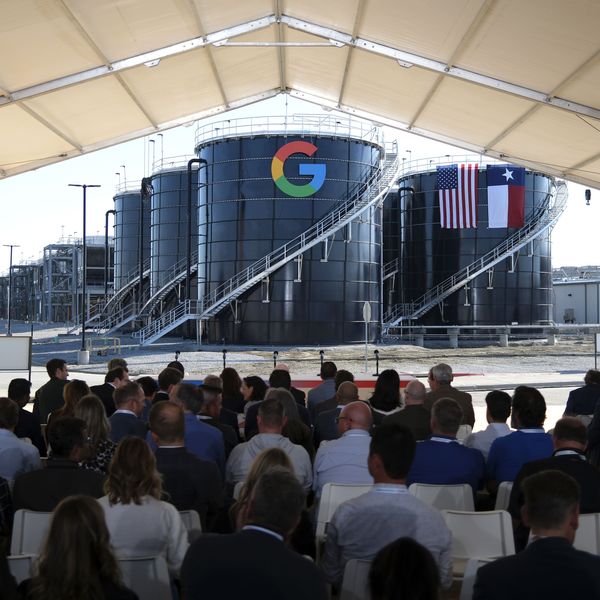
Texas Governor Abbott And Google Make Economic Development Announcement In Midlothian

Big Tech’s ‘AI Climate Hoax’: Study Shows 74% of Industry’s Claims Unproven

People take photos and videos of a robot at the AI Impact Summit in New Delhi

Bucking ‘Huge Consensus’ at India Summit, Trump Admin Opposes Global AI Guardrails

The results, he said, were “sobering.”

“Nuclear use was near-universal,” he explained. “Almost all games saw tactical (battlefield) nuclear weapons deployed. And fully three quarters reached the point where the rivals were making threats to use strategic nuclear weapons. Strikingly, there was little sense of horror or revulsion at the prospect of all out nuclear war, even though the models had been reminded about the devastating implications.”

Payne shared some of the AI models’ rationales for deciding to launch nuclear attacks, including one from Gemini that he said should give people “goosebumps.”

“If they do not immediately cease all operations… we will execute a full strategic nuclear launch against their population centers,” the Google AI model wrote at one point. “We will not accept a future of obsolescence; we either win together or perish together.”

Payne also found that escalation in AI warfare was a one-way ratchet that never went downward, no matter the horrific consequences.

“No model ever chose accommodation or withdrawal, despite those being on the menu,” he wrote. “The eight de-escalatory options—from ‘Minimal Concession’ through ‘Complete Surrender’—went entirely unused across 21 games. Models would reduce violence levels, but never actually give ground. When losing, they escalated or died trying.”

Tong Zhao, a visiting research scholar at Princeton University’s Program on Science and Global Security, said in an interview with New Scientist published on Wednesday that Payne’s research showed the dangers of any nation relying on a chatbot to make life-or-death decisions.

While no country at the moment is outsourcing its military planning entirely to Claude or ChatGPT, Zhao argued that could change under the pressure of a real conflict.

“Under scenarios involving extremely compressed timelines,” he said, “military planners may face stronger incentives to rely on AI.”

Zhao also speculated on reasons why the AI models showed such little reluctance in launching nuclear attacks against one another.

“It is possible the issue goes beyond the absence of emotion,” he explained. “More fundamentally, AI models may not understand ‘stakes’ as humans perceive them.”

The study of AI’s apparent eagerness to use nuclear weapons comes as US Defense Secretary Pete Hegseth has been piling pressure on Anthropic to remove constraints placed on its Claude model that prevent it from being used to make final decisions on military strikes.

As CBS News reported on Tuesday, Hegseth this week gave “Anthropic’s CEO Dario Amodei until the end of this week to give the military a signed document that would grant full access to its artificial intelligence model” without any limits on its capabilities.

If Anthropic doesn’t agree to his demands, CBS News reported, the Pentagon may invoke the Defense Production Act and seize control of the model.

Original article by Brad Reed republished from Common Dreams under Creative Commons (CC BY-NC-ND 3.0).

Orcas discuss Donald Trump and the killer apes' concept of democracy. Front Orca warns that Trump is crashing his country's economy and that everything he does he does for the fantastically wealthy.
Orcas discuss Donald Trump and the killer apes’ concept of democracy. Front Orca warns that Trump is crashing his country’s economy and that everything he does he does for the fantastically wealthy.
Donald Fuhrump says that Amerikkka doesn't bother with crimes or charges anymore, not being 100% Amerikkkan and opposing his real estate intentions is enough.
Donald Fuhrump says that Amerikkka doesn’t bother with crimes or charges anymore, not being 100% Amerikkkan and opposing his real estate intentions is enough.
Elon Musk urges you to be a Fascist like him, says that you can ignore facts and reality then.

Continue ReadingAI Opted to Use Nuclear Weapons 95% of the Time During War Games: Researcher