ICE ‘Not Welcome,’ Maine Officials Say as Reports Point to State as Trump’s Next Target

Spread the love

Original article by Julia Conley republished from Common Dreams under Creative Commons (CC BY-NC-ND 3.0).
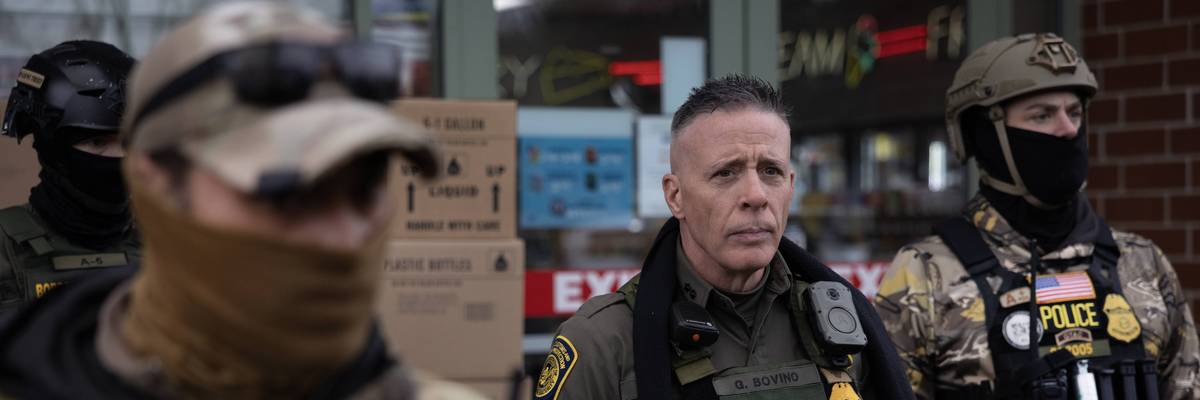
US Border Patrol Chief Gregory Bovino and his men stop at a gas station on January 13, 2026 in Minneapolis, Minnesota. The Trump administration has sent an estimated 2,000 federal agents into the area as they make a push to arrest undocumented immigrants. The president’s next target may be the state of Maine. (Photo by Scott Olson/Getty Images)

“Maine will not be intimidated, and we will not betray the values that make us who we are,” said Gov. Janet Mills.

Maine Gov. Janet Mills was among the leaders in the state who addressed reports late Wednesday that the Trump administration plans to send federal agents including those with US Immigration and Customs Enforcement to cities such as Portland and Lewiston, and said unequivocally that the violence masked officers have unleashed on Minneapolis in recent days would not be welcome by residents and officials.

Mills said ICE had refused to confirm the reports that its agents would be in the state and what the basis for the operations would be, but MS Now reported Wednesday that the administration is considering sending federal officers to Maine.

RECOMMENDED…
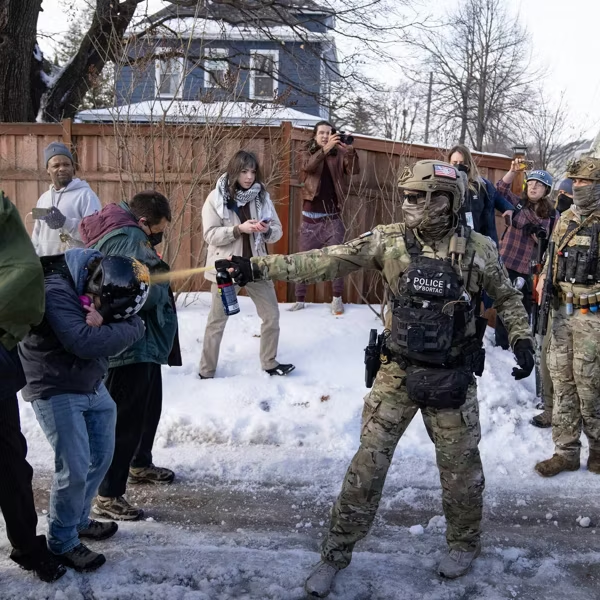
A Border Patrol Tactical Unit member pepper-sprays a protester in the face

Walz Puts National Guard—and Trump—On Notice as Protests Erupt Over ICE ‘Murder’ in Minneapolis
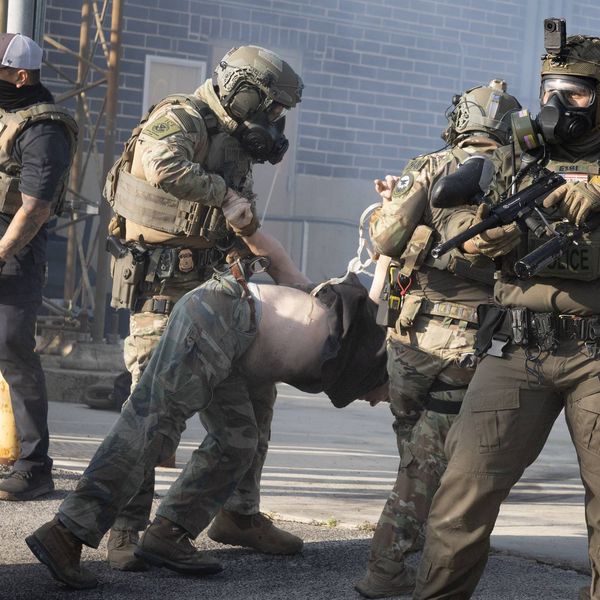
Protesters Denounce ICE Outside Chicago-Area Facility

‘Reign of Terror’: ICE Builds Appalling Record of Killings, Beatings, Kidnappings, and More

On Tuesday, President Donald Trump mentioned Maine’s Somali community in a speech at the Detroit Economic Club; Somali people in Minnesota have been a top target of ICE’s activities there.

Maine’s Democratic governor said her administration was “taking proactive steps to prepare.”

“If any operations take place, our goal as always will be to protect the safety and the rights of the people of Maine,” said Mills. “Maine knows what good law enforcement looks like because our law enforcement are held to high professional standards… and they are accountable to the law. And I’ll tell you this, they don’t wear a mask to shield their identities and they don’t arrest people in order to fill a quota.”

“To the federal government I say this: If your plan is to come here to be provocative and to undermine the civil rights of Maine residents, do not be confused. Those tactics are not welcome here,” she said.

Mills said state police had been directed to work closely with local law enforcement in cities including Lewiston and Portland, where the police departments do not cooperate with ICE.

Reports of the potential deployment—which Portland Mayor Mark Dion denounced as a “paramilitary approach”—come days after a bill, LD 1971, became law and prohibited all state and local law enforcement from engaging in federal immigration enforcement activities.

“This new law will ensure Maine towns and cities are not complicit in or liable for federal abuses of power, and will improve public safety by building trust between local law enforcement and the communities they are supposed to serve,” said ACLU of Maine policy director Michael Kebede on Tuesday.

The bill passed into law without the signature of Mills, a Democrat who is running in the US Senate primary in hopes of unseating Sen. Susan Collins (R-Maine). The governor has been trailing Graham Platner, a progressive who has called for the “dismantling” of ICE, in recent polls.

“One of the reasons I want to go to the Senate is that when we have power again, I want to haul all of these people and the ones that made them do it in front of a Senate subcommittee, make them take their masks off,” Platner said in October.

Dion and Lewiston Mayor Carl Sheline, also a Democrat, urged residents and businesses to know their rights in case they are approached by federal immigration agents.

Dion emphasized in a statement Wednesday that “there is no evidence of unchecked criminal activity in our community requiring a disproportionate presence of federal agents.”

“In that view, Portland rejects the need for the deployment of ICE agents into our neighborhoods,” said the mayor, a Democrat.

President Donald Trump’s recent escalation of federal immigration enforcement in Minneapolis has led to an ICE agent’s killing of 37-year-old Renee Good, who had been observing the agents as people across Chicago, Charlotte, and other cities have over the past several months. A federal agent also shot and wounded a man during a traffic stop there on Wednesday.

Trump has largely been targeting the Somali population in Minnesota amid a social services fraud scandal in the state in which some Somali people have been charged and convicted. He has called for all Somali immigrants to leave the US. On Tuesday, Trump said that “Somali scams” had happened “in Maine, too.”

Maine has a significant Somali community including many people who have become US citizens; the population is largely centered in Lewiston and Portland.

MS Now reported that according to people familiar with the administration’s plan, immigration operations in Maine were “being designed to arrest and detain Somali refugees for reviews that could last around 30 days.”

The Maine Monitor reported that immigration authorities visited Lewiston last month and visited Gateway Community Services, a healthcare provider for immigrants that the state suspended payments to after it alleged more than $1 million in interpreter fraud.

Mills said Wednesday that she fully supported the right of Maine residents to protest a federal immigration enforcement operation and urged them to do so peacefully and “to meet any hostility with reserve and resolve.”

“I know there are more unanswered than answered questions right now,” she said. “We will continue seeking out answers and continue to communicate our information and plans with you in the coming days. But know this: Maine will not be intimidated, and we will not betray the values that make us who we are.”

Original article by Julia Conley republished from Common Dreams under Creative Commons (CC BY-NC-ND 3.0).

Elon Musk urges you to be a Fascist like him, says that you can ignore facts and reality then.
Donald Fuhrump says that Amerikkka doesn't bother with crimes or charges anymore, not being 100% Amerikkkan and opposing his real estate intentions is enough.
Donald Fuhrump says that Amerikkka doesn’t bother with crimes or charges anymore, not being 100% Amerikkkan and opposing his real estate intentions is enough.
Orcas discuss how Trump was re-elected and him being an obviously insane, xenophobic Fascist.
Continue ReadingICE ‘Not Welcome,’ Maine Officials Say as Reports Point to State as Trump’s Next Target

Trump Admin Planning to Use Private Mercenaries to Shield Oil Plunder Efforts in Venezuela

Spread the love

Original article by republished from Common Dreams under Creative Commons (CC BY-NC-ND 3.0).

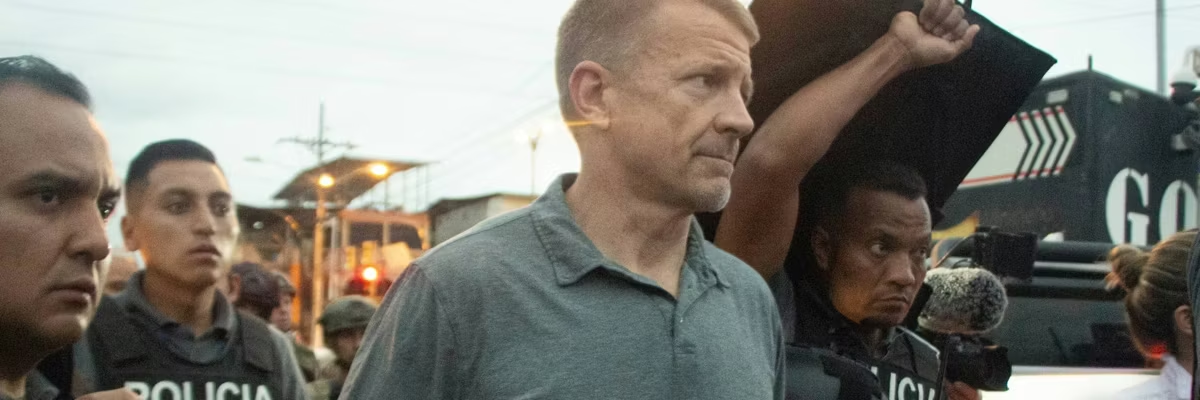
Blackwater founder Erik Prince walks with police on April 5, 2025 in Guayaquil, Ecuador. (Photo by Agencia Press South/Getty Images)

Erik Prince, the notorious founder of Blackwater, has reportedly been floated as a possible option as the Trump administration seeks help securing and exploiting Venezuela’s oil operations.

The Trump administration is reportedly planning to hire private military contractors—including possibly the notorious mercenary Erik Prince—to provide security as the US works to plunder Venezuela’s massive oil reserves.

CNN reported Thursday that “multiple private security companies are already jockeying to get involved in the US presence in Venezuela” as American oil giants push for physical security guarantees before they back President Donald Trump’s push for $100 billion in investment in the country.

RECOMMENDED…

People participate in a "No War on Venezuela" protest

‘Get the Oil Flowing’: Trump’s Own Words Make His War Aims in Venezuela Clear

President Trump Returns To The  White House After Spending Holidays In Florida

‘What an Authoritarian Oligarchy Looks Like’: Trump Says Oil Execs Tipped Off About Venezuela Attack

“Interest is high given the potential payday; during the Iraq War, the US spent some $138 billion on private security, logistics, and reconstruction contractors,” the outlet noted. “One source suggested that Erik Prince, the former Blackwater founder and controversial Trump ally, could also be tapped for help. Prince’s Blackwater played an outsized role in Iraq after the 2003 US invasion, providing security, logistics, and support for oil infrastructure. But the firm came under intense scrutiny following the 2007 deadly shooting of Iraqi civilians.”

Prince is currently operating in the region, having partnered with Ecuador’s right-wing government as part of a crackdown on organized crime that has been replete with human rights abuses.

News of the Trump administration’s potential use of private mercenaries in Venezuela came after the US officially completed its first sale of Venezuelan oil. The sale, valued at $500 million, came days after Trump met with top oil executives at the White House to discuss efforts to exploit Venezuela’s oil reserves following the illegal US abduction of President Nicolás Maduro earlier this month.

Darren Woods, the CEO of Exxon Mobil, said his company would need “durable investment protections” before making any commitments in Venezuela.

CNN reported Thursday that the Pentagon has “put out a Request for Information to contractors about their ability to support possible US military operations in Venezuela.”

“Contractors are also in touch with the State Department’s overseas building operations office to cite interest in providing security if and when the US embassy in Venezuela reopens,” according to CNN.

Elon Musk urges you to be a Fascist like him, says that you can ignore facts and reality then.
Donald Fuhrump says that Amerikkka doesn't bother with crimes or charges anymore, not being 100% Amerikkkan and opposing his real estate intentions is enough.
Donald Fuhrump says that Amerikkka doesn’t bother with crimes or charges anymore, not being 100% Amerikkkan and opposing his real estate intentions is enough.
Orcas discuss how Trump was re-elected and him being an obviously insane, xenophobic Fascist.

Continue ReadingTrump Admin Planning to Use Private Mercenaries to Shield Oil Plunder Efforts in Venezuela

Analysis Reveals Wall Street Titans Behind Big Oil Profiteering Push in Venezuela

Spread the love

Original article by Stephen Prager republished from Common Dreams under Creative Commons (CC BY-NC-ND 3.0).
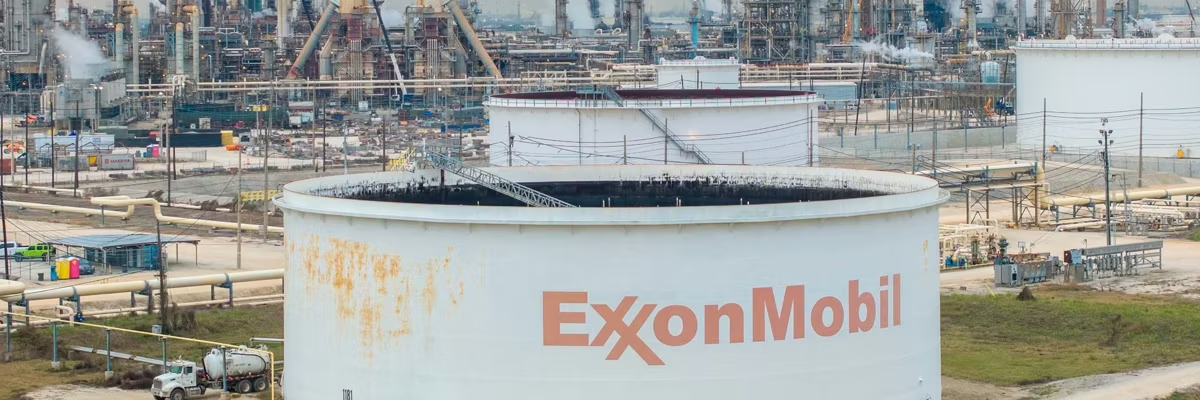
In an aerial view, the ExxonMobil Baytown Refinery is seen on January 13, 2026, in Baytown, Texas. (Photo by Brandon Bell/Getty Images)

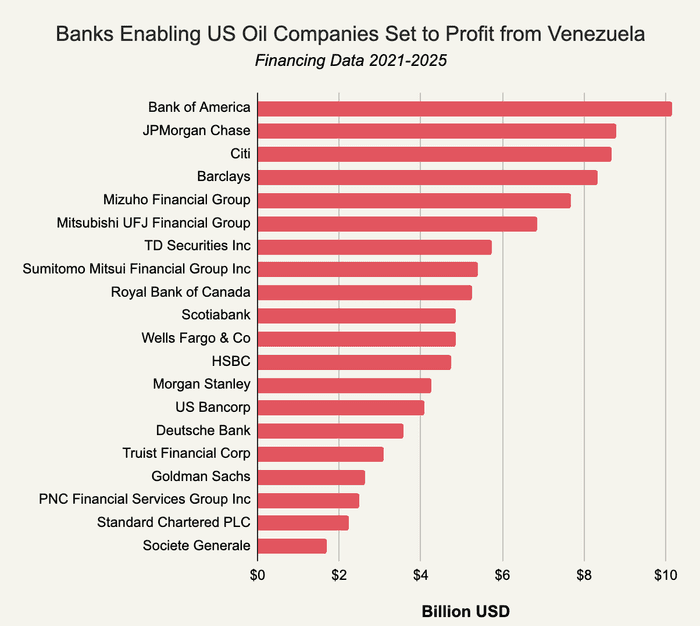
Since 2021, top Wall Street banks have committed more than $124 billion in investments to the nine companies set to profit most from the toppling of Venezuela’s government.

As oil industry giants are being set up to profit from President Donald Trump’s invasion of Venezuela, a new analysis shows the ample backing those companies have received from Wall Street’s top financial institutions.

Last week, Bloomberg reported that stock traders and tycoons were “pouncing” after Trump’s kidnapping of President Nicolás Maduro earlier this month, after having pressured the Trump administration to “create a more favorable business environment in Venezuela.”

RECOMMENDED…

VENEZUELA-US-CONFLICT-CRISIS-OIL

Democrats Launch Probe to Learn What Trump Told Oil Giants About Venezuela Attack—and When

People participate in a “No War on Venezuela” protest

Trump Meeting With Big Oil Underscores Venezuela Agenda: Enriching ‘Himself and His Fossil Fuel Donors’

dataset compiled by the international environmental advocacy group Stand.earth shows the extent to which these interests are intertwined.

Stand.earth found that since 2021, banks—including JPMorgan Chase, HSBC, TD, RBC, CitigroupWells Fargo, and Bank of America—have committed more than $124 billion in investments to the nine companies set to profit most from the toppling of Venezuela’s government.

More than a third of that financing, $42 billion, came in 2025 alone, when Trump launched his aggressive campaign against Venezuela.

(Graphic from Stand.earth)

Among the companies expected to profit most immediately are refiners like Valero, PBF Energy, Citgo, and Phillips 66, which have large operations on the Gulf Coast that can process the heavy crude Venezuela is known to produce. These four companies have received $41 billion from major banks over the past five years.

Chevron, which also operates many heavy-crude facilities, benefits from being the only US company that operated in Venezuela under the Maduro regime, where it exported more than 140,000 barrels of oil per day last quarter.

At a White House gathering with top oil executives on Friday, the company’s vice chair, Mark Nelson, told Trump the company could double its exports “effective immediately.”

According to Jason Gabelman, an analyst at TD Cowen, the company could increase its annual cash flow by $400 million to $700 million as a result of Trump’s takeover of Venezuelan oil resources.

Chevron was also by far the number-one recipient of investments in 2025, with more than $11 billion in total coming from the banks listed in the report—including $1.78 billion from Barclays, another $1.78 billion from Bank of America, and $1.32 billion from Citigroup.

According to Bloomberg, just weeks before Maduro’s removal, analysts at Citigroup predicted 60% gains on the nation’s more than $60 billion in bonds if he were replaced.

Even ExxonMobil, whose CEO Darren Woods dumped cold water on Trump’s calls to set up operations in Venezuela on Friday, calling the nation “uninvestable,” potentially has something major to gain from Maduro’s overthrow.

Exxon and ConocoPhillips each have outstanding arbitration cases against Venezuela over the government’s 2007 nationalization of oil assets, which could award them $20 billion and $12 billion, respectively.

The report found that in 2025, ExxonMobil and ConocoPhillips received a combined total of more than $12.8 billion in investment from major financial institutions, which vastly exceeded that from previous years.

Data on these staggering investments comes as oil companies face increased scrutiny surrounding possible foreknowledge of Trump’s attack on Venezuela.

Last week, US Senate Democrats launched a formal investigation into “communications between major US oil and oilfield services companies and the Trump administration surrounding last week’s military action in Venezuela and efforts to exploit Venezuelan oil resources.”

Richard Brooks, Stand.earth’s climate finance director, said the role of the financial institutions underwriting those oil companies should not be overlooked either.

“Without financial support from big banks and investors, the likes of Chevron, Exxon, ConocoPhillips, and Valero would not have the power that they do to start wars, overthrow governments, or slow the pace of climate action,” he said. “Banks and investors need to choose if they are on the side of peace, or of warmongering oil companies.”

Original article by Stephen Prager republished from Common Dreams under Creative Commons (CC BY-NC-ND 3.0).
Elon Musk urges you to be a Fascist like him, says that you can ignore facts and reality then.
Donald Fuhrump says that Amerikkka doesn't bother with crimes or charges anymore, not being 100% Amerikkkan and opposing his real estate intentions is enough.
Donald Fuhrump says that Amerikkka doesn’t bother with crimes or charges anymore, not being 100% Amerikkkan and opposing his real estate intentions is enough.
Orcas discuss how Trump was re-elected and him being an obviously insane, xenophobic Fascist.

Continue ReadingAnalysis Reveals Wall Street Titans Behind Big Oil Profiteering Push in Venezuela

Venezuela and the journey from Monroe’s Doctrine to Trump’s Jungle Law

Spread the love

Original article by Diana Cariboni republished from OpenDemocracy under a Creative Commons Attribution-NonCommercial 4.0 International licence

Donald Trump holds a press conference after US forces captured Venezuelan leader Nicolas Maduro and launched a ‘large-scale strike’ on the Latin American country | Jim Watson / AFP via Getty Images)

The US has a long history of military intervention in Latin America, but never before has it been so brazen

As the days pass, shock subsides over the kidnapping of Venezuelan president Nicolás Maduro and his wife, Cilia Flores, which was ordered by Donald Trump and carried out by the US military. That the victim is a dictator has helped to justify the illegal use of brute force.

There is a long history of US military intervention in Latin America. It’s been the expression of the most enduring principle that has governed relations in the American continent.

Everything Trump did in the first year of his second presidential term was old news: tariff wars, interventions in the internal affairs of other countries, threats, extortion and the revival of the old Monroe Doctrine.

What is new is the brazenness, the absence of even the slightest legal justification, or even the effort to frame actions within some interpretation of international law, however twisted it may be. There is no talk of democracy, freedom or human rights for millions of Venezuelans.

This is an unexplained and uncontested exercise of power. “What’s next, Mr President, Colombia?” journalists asked Trump like subjects asking their emperor. “It sounds good to me,” he replied. Mexico, Colombia, Cuba, Greenland… “American dominance in the Western Hemisphere will never be questioned again.”

The threat is material – Maduro in handcuffs, the naval deployment in the Caribbean, the boats bombed for months – and at the same time diffuse. No one knows what the logic or the alleged motive for the next action will be.

The effect of Trump’s actions, already tested with the so-called “peace deal” for Palestine in the aftermath of the Israeli genocide in Gaza, is to sow confusion and division, and paralysis. The era of this new power has begun with little to oppose it, and with international laws useless like broken toys. And we are all warned.

Maduro was extracted from his bunker in eight minutes, which was enough time to kill 32 Cuban guards who were protecting him. The rest of the regime remains intact, now as the executive arm of Trump’s designs, which have articulated only one priority: oil.

When asked about elections, democracy or the release of some 800 political prisoners, Trump and his secretary of state, Marco Rubio, reply that all this “is premature”. The nature of the events indicates the coup was orchestrated with a part of the regime whose head was Maduro.

Nothing remains of Venezuela’s Bolivarian revolution, not even dignity. Delcy Rodríguez, Maduro’s vice-president and one of the most vocal figures in his administration, has been appointed interim president, with Trump’s acquiescence. She and her brother Jorge, the president of the National Assembly, Diosdado Cabello, the minister of the interior, and Vladimir Padrino López, the head of the armed forces, have become administrators of a Trump protectorate – a new, perhaps provisional, status quo that sets Venezuela and all of Latin America sailing into uncharted waters.

The eternal misunderstanding

In a speech to the US Congress 202 years ago, US president James Monroe laid the foundations for his new country’s relationship with the other republics emerging across the American continent amid struggles against the European colonial powers.

That relationship would be one of US dominance and Latin American subordination, although the Monroe Doctrine was presented as a warning against new European colonial adventures in America.

“America for Americans” – Monroe’s phrase that coined the eternal misunderstanding – postulated that America, the continent, was for them, who called themselves “Americans”. In that single remark, the rest of the American peoples were left in an inferior category, confined to their nationalities or to a subordinate belonging to the same single continent (Latin Americans, South Americans, Central Americans or Caribbeans). Never simply Americans.

Other US presidents followed Monroe’s lead. More than five decades after his doctrine came Rutherford Hayes’s corollary of 1880, on the need for the US to have exclusive control in Central America and the Caribbean, and therefore of any interoceanic canal, followed by Theodore Roosevelt’s corollary of 1904, which postulated the freedom of the US to intervene by force in any country on the continent if it considered that its interests were affected.

Just a few weeks ago, on the anniversary of the Monroe Doctrine, Trump published his own corollary, which contains nothing new, though the foreign power to keep away now is no longer Europe but China. The novelty lies in what began in Venezuela.

The question of democracy

In December, the UN reported that Venezuela’s human rights situation was continuing to deteriorate. In 2021, the International Criminal Court’s prosecutor opened a formal investigation into crimes against humanity, such as torture, disappearances and executions at the hands of the state.

Like Delcy Rodríguez now, Maduro became interim president in 2013 after the death of leader Hugo Chávez. Shortly afterwards, he won the elections by a narrow margin and, from 2015 onwards, took an openly authoritarian turn when he refused to recognise the result of parliamentary elections that left him without a majority in the National Assembly.

Opponents of the regime tried different approaches to overthrow it. To name just a few: peaceful demonstrations, violent actions, calls for a military uprising, attempts to get neighbouring governments to blockade the country, support for economic sanctions by the US and the European Union, complaints to international organisations, boycotts of elections they considered rigged, negotiations with the regime mediated by third countries, and massive participation in elections. None of this moved the needle.

Despite the opposition’s victory in the 2024 presidential elections, Maduro was once again proclaimed president, through fraud.

Then Trump reappeared, with a military deployment unseen in decades, indiscriminate bombing of ships in the Caribbean and the Pacific, and persecution and stigmatisation of Venezuelan migrants as terrible criminals and mentally ill people ravaging US cities.

The main opposition leader, María Corina Machado, who recently won the Nobel Peace Prize, clung to this strategy like a lifeline in the storm. She argued that the military siege, the accusations of narco-terrorism against Maduro and his circle, and the imminent military action by Washington would bring down the regime and open the door to a transition. Shortly after Maduro’s kidnapping, Machado proclaimed: “Today we are prepared to assert our mandate and take power.”

Trump’s response could not have been colder. He removed her from the scene, claiming she lacked the necessary “respect” and “support” for the moment.

In an interview with Fox News on Monday, Machado tried again to court Trump and said she wanted to give him her Nobel Peace Prize, which the US president has long coveted and considers himself deserving of. Days later, Trump indicated to Fox News that he might meet with her in Washington, saying: “I understand she’s coming in next week sometime, and I look forward to saying hello to her.” The Norwegian Nobel Institute was forced to clarify that its peace prizes cannot be transferred to third parties.

There were celebrations by Venezuelans in exile in cities across the western hemisphere when Maduro’s overthrow was announced, but not within Venezuela. Maduro no longer governs there, but the same regime does, under Trump’s shadow.

Original article by Diana Cariboni republished from OpenDemocracy under a Creative Commons Attribution-NonCommercial 4.0 International licence

15 Jan 2026 Realized that I’ve featured this twice … Oh well.

Continue ReadingVenezuela and the journey from Monroe’s Doctrine to Trump’s Jungle Law

Six points to navigate the turmoil in Iran

Spread the love

Original article by Vijay Prashad republished from peoples dispatch under a Creative Commons Attribution-ShareAlike 4.0 (CC BY-SA) license.

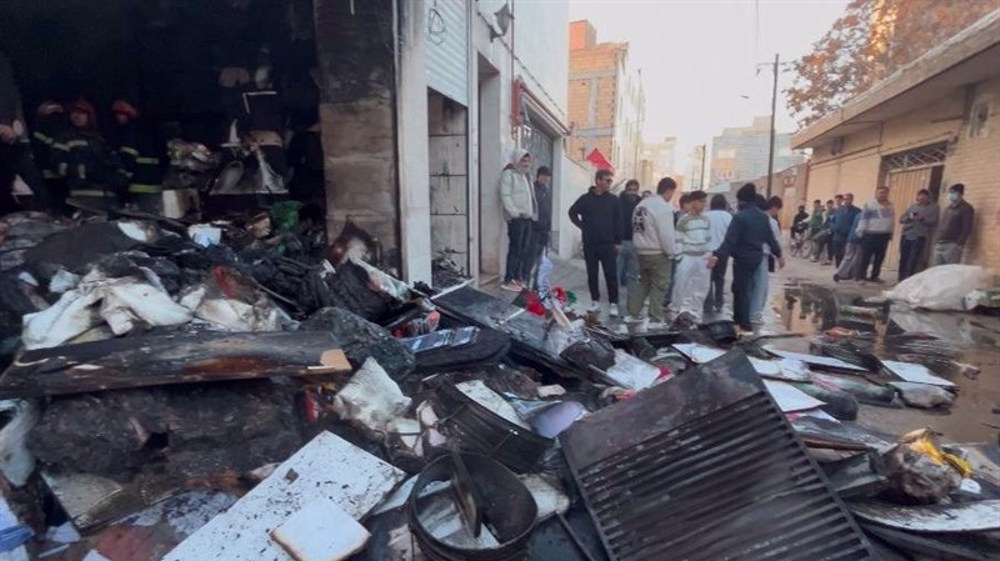
Aftermath of protests in Iran on January 10, 2025. Photo: IRIB

Vijay Prashad offers six points to make sense of the situation in Iran amid protests, violence, and threats of military intervention from Washington

Iran is in turmoil. Across the country, there have been protests of different magnitudes, with violence on the increase with both protesters and police finding themselves in the morgue. What began as work stoppages and inflation protests drew together a range of discontent, with women and young people frustrated with a system unable to secure their livelihood. Iran has been under prolonged economic siege and has been attacked directly by Israel and the United States not only within its borders, but across West Asia (including in its diplomatic enclaves in Syria). This economic war waged by the United States has created the situation for this turmoil, but the turmoil itself is not directed at Washington but at the government in Tehran.

There are reports – such as in the mainstream Israeli newspaper Ha’aretz in October 2025 about Israeli “influence operations aiming to install Reza Pahlavi as Shah of Iran” – that Israeli intelligence has a role in the protests, and the United States has openly told the protestors that it would bomb Tehran if the violence by the government increase. Last year, protests took place in twelve South Pars oil refineries, where 5,000 contract workers in the Bushehr Gas Refinery Workers Union marched with their families on December 9 in Asaluyeh to demand higher wages and better working-conditions. When the workers took their struggle to the National Parliament in Tehran, where they called for an end to the contract work system, the Israelis and the United States took advantage of these sincere protests to attempt to transform a legitimate struggle into a potential regime change operation.

To understand what is happening, here are six points of historical importance that are offered in the spirit of discussion. Since 1979, Iran has played a very important role in the movement beyond monarchies in the Arab and Muslim world, and it has been an important defender of the Palestinian struggle. Iran is no stranger to foreign interference, going back to the British control of Iran’s oil from 1901, the 1907 Anglo-Russian Convention that divided Iran into spheres of influence, the 1921 coup that put Reza Khan on the throne, the 1953 coup that installed his son, Mohammed Reza Shah Pahlavi to the throne, and then the hybrid war against the Iranian Revolution from 1979 to the present. Here are the six points:

1. The Iranian Revolution of 1978-79 overthrew the rule of the Shah of Iran Reza Pahlavi, and due to the strength of the religious clergy and its political formations resulted in the creation of the Islamic Republic in April 1979 with the Constitution of the Islamic Republic coming into effect in December 1979. The other currents in the revolution (from the communist left to the liberals) found themselves largely sidelined and even – in some cases – repressed. The March 1979 protests on International Women’s Day in Tehran followed the restrictions on women’s rights (particularly against the compulsory hijab policy), which forced the government to accept the demands of the protests – but this was a short-term win, since in 1983 a mandatory hijab law was passed.

2. The Revolution followed the military coup of Zia ul-Haq in Pakistan in 1977, the Saur Revolution in Afghanistan (August 1978), the establishment of the Yemeni Socialist Party (October 1978) that took the People’s Democratic Republic of Yemen into the Soviet sphere and that led to the North-South war in Yemen (February-March 1979), and the capture of power by Saddam Hussein Iraq in July 1979. The entire region of south-western and central Asia was catapulting in political somersaults. Some of these developments (Pakistan, Iraq) offered advantages to the United States, and the others (Afghanistan, Iran, Yemen) being counter to US objectives in the region. Very quickly, the United States attempted to press its advantages by trying to overthrow the Islamic Republic of Iran, the People’s Democratic Republic of Yemen, and the Democratic Republic of Afghanistan.

3. The pressure by the United States on these processes led to a war-like situation in all three countries: the US and its Gulf allies urged Iraq to invade Iran unprovoked in September 1980, starting a war that lasted till 1988; the Gulf Arab states urged North Yemen to invade South Yemen after the assassination of Salim Rubaya Ali (a Maoist who was negotiating the merger of the two Yemens); finally, in Afghanistan, the US began to fund the mujahideen to start an assassination campaign against cadre of the People’s Democratic Party of Afghanistan. Iran, Afghanistan, and Yemen saw their social projects narrowed by the attacks they faced from outside. Afghanistan crashed into over forty years of terrible violence and war, even though the Democratic Republic of Afghanistan remained in place for 18 years; the Marxist government in South Yemen remained until 1990, but it was a pale shadow of its own expectations; Iran, meanwhile, saw its Islamic Republic survive a harsh sanctions policy that followed the end of the war by Iraq (in 1988).

4. The Islamic Republic faced several important, consecutive challenges:

The most important came from US imperialism, which not only fully spurred Iraq’s war, but supported initiatives by the former Iranian elites to restore their rule and supported Israeli attempts to undermine the Islamic Republic (including direct attacks on Iran, sabotage operations, and assassinations of key figures from the science professions and military). It is the United States and Israel that have been systematically trying to erode Iran’s power in the region, with the assassination of General Qassem Soleimani in 2020, the harsh attack on Hezbollah during the Israeli genocide and the assassination of Sayyed Hassan Nasrallah in 2024, and the overthrow of the government in Syria in December 2024 with the installation of the former al-Qaeda chief as President in Damascus.

The old Iranian elites, led by the Shah at first till his death in 1980 and then his son, so-called Crown Prince Reza Pahlavi, joined with the Europeans and the US to restore their rule. It is important to know that while the Shah had sat on the Peacock Throne from 1941, he was forced to accept a democratic government from 1951 to 1953 – which was overthrown by Western intelligence services and then the Shah was encouraged to exercise absolute rule from 1953 to the revolution of 1978-79. The Shah’s bloc has consistently wanted to return to power in Iran. While the Green Movement of 2009 had a very small monarchical element, it represented the dominant classes who wanted political reforms against the more plebeian presidency of Mahmoud Ahmadinejad. It is telling that the United States has ‘chosen’ the Shah’s son, who lives in Los Angeles, as the figure of this uprising.

Limitations to the republic’s transformative social agenda were present as it tolerated sections of the old elite, allowing them to hold their property, and therefore allowing the formation of a stratified class system that benefited sections of these property owners and an emergent middle class. After the death of Ayatollah Ruhollah Khomeini in June 1989 and the end of the Iran-Iraq War, the government adopted large parts of the International Monetary Fund’s structural adjustment policies, which – one way or the other – remained in place for decades (the policy was driven by Mohsen Nourbaksh, who was the Minister of Economic Affairs from 1989 to 1994 and then head of the Central Bank from 1994 to 2003). The economy was not organized along socialist lines in 1979, but it had built a strong role for the state and for public planning due to the needs of the war economy and due to the commitment to Islamic social welfare. Nourbaksh could not totally dismantle the state, but he conducted currency and banking reform as well as he did cautiously integrate Iran into the global economy. The class divergence and the difficulties of life for the majority of Iranians increased due to the combined impact of the US-European sanctions regime, the military threats by the US-Israelis (that has led to high military spending in Iran – still at around 2.5% of GDP it is much lower than the 12% of GDP during the reign of the Shah), and to the neoliberal policies pursued by the increasingly neoliberal finance ministers of the government (such as Ali Tayebnia from 2013 to 2017 and Ali Madanizadeh from 2025). It was this limitation of the Islamic Republic that has led to cycles of economic protest: 2017-2018 (around inflation and subsidy cuts), 2019 (around fuel price hike), 2025 (by bakers), and 2025-26 (soaring inflation and the collapse of the Iranian rial).

5. While the current protests are largely driven by a record-high Rial to USD exchange and a 60% food inflation rate, the transition from labor strikes in South Pars to coordinated urban violence points towards a deeper level of intervention. The administration has favored sections of the import-export sector, which has worked in the context of the sanctions, to assist the commodity-exporters at the expense of the importers – a situation that is not easy to correct. Yet the abrupt 30-40% currency drop is a classic hallmark of external financial manipulation. Therefore, what began as business owners protesting the Central Bank without interference, soon morphed into a violent, top-down assault on the state fabric. The “protests” shifted overnight from peaceful assemblies to high-intensity urban sabotage resulting in the deaths of roughly 100 law enforcement officers, with claims that some officers were burned alive, a security member was beheaded, and a medical clinic was torched, claiming the life of a nurse, for instance. The use of close-range small arms fire against civilians further suggests an attempt to maximize domestic tension and provide a pretext for foreign intervention. The geopolitical orchestration behind the chaos became undeniable as the US State Department and Mossad openly cheered the violence in real-time. Once authorities disabled Internet access, the protests significantly lost strength, which places into question the spontaneity of the movement and lends truth to the thesis that there is a destabilization strategy at play, seeking to benefit from the current international conjuncture.

6. The opposition has taken to the streets but recognizes that it does not have the strength to seize power. There are reports of US and Israeli interference, and it does not help the opposition that the Shah’s son has been both claiming credit for the protests and seeing himself as its beneficiary. With Trump at the helm of hyper-imperialism, and with Israel amid a period of what it feels are endless victories, it is impossible to know what these dangerous cliques will do. As the mobilizations lose steam, which will take place, the US-Israel might take advantage of the situation to strike Tehran and other cities with more force than it did in June 2025. This should be a worry not only for the people in Iran, the vast mass of whom do not wish an attack on their country, but also the people of the Global South – who will find themselves as the next target after Venezuela and Iran.

Real problems bedevil the population, but these problems are not going to be solved through a hyper-imperialist aerial bombardment by the United States and Israel. The Iranians will need to sort out their own problems. The sanctions regime and the threats of violence do nothing to allow that to happen. It is easy to say “solidarity to the Iranians” in the West, where protesters are being beaten and even killed for their support of the Palestinians and their anger at the anti-immigration policies. And somehow, it seems to be much harder to say “end the sanctions,” and therefore allow the Iranian people to breathe into their own future.

Vijay Prashad is an Indian historian, editor, and journalist. He is a writing fellow and chief correspondent at Globetrotter. He is an editor of LeftWord Books and the director of Tricontinental: Institute for Social Research. He has written more than 20 books, including The Darker Nations and The Poorer Nations. His latest books are On Cuba: Reflections on 70 Years of Revolution and Struggle (with Noam Chomsky), Struggle Makes Us Human: Learning from Movements for Socialism, and (also with Noam Chomsky) The Withdrawal: Iraq, Libya, Afghanistan, and the Fragility of US Power. Chelwa and Prashad will publish How the International Monetary Fund is Suffocating Africa later this year with Inkani Books.

This article was produced by Globetrotter.

15 Jan 2026 2.25am UK: The inclusion of this article should not be regarded as approval of it’s analysis. It is instead included for the historical context and standard of discussion provided.

Original article by Vijay Prashad republished from peoples dispatch under a Creative Commons Attribution-ShareAlike 4.0 (CC BY-SA) license.

Elon Musk urges you to be a Fascist like him, says that you can ignore facts and reality then.
Donald Fuhrump says that Amerikkka doesn't bother with crimes or charges anymore, not being 100% Amerikkkan and opposing his real estate intentions is enough.
Donald Fuhrump says that Amerikkka doesn’t bother with crimes or charges anymore, not being 100% Amerikkkan and opposing his real estate intentions is enough.
Orcas discuss how Trump was re-elected and him being an obviously insane, xenophobic Fascist.

Continue ReadingSix points to navigate the turmoil in Iran