Resistance builds within the United States against Trump’s drive to war with Venezuela

Spread the love

Original article by Devin B. Martinez republished from peoples dispatch under a Creative Commons Attribution-ShareAlike 4.0 (CC BY-SA) license.
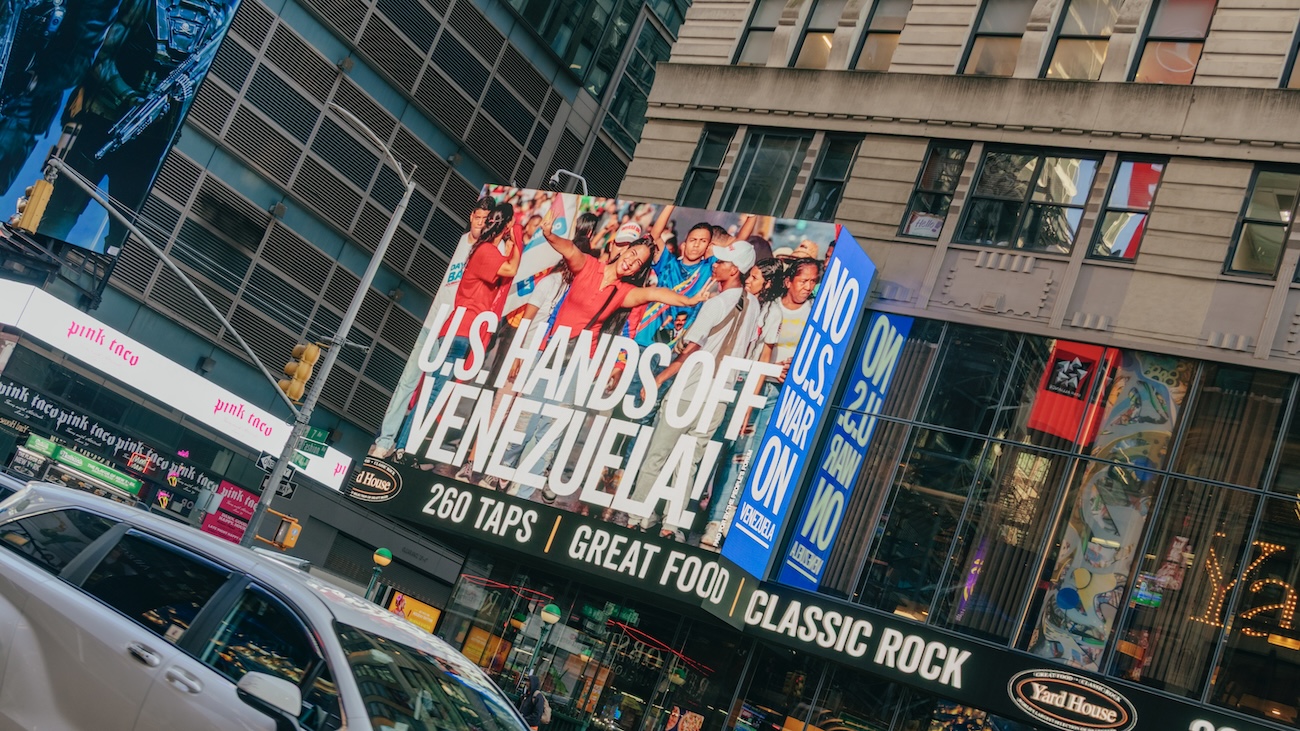
Billboard up in New York City against the US threats against Venezuela. Photo: The People’s Forum

As Trump continues to lodge threats against the Bolivarian Republic, US Congress and grassroots movements mobilize to stop a new war.

The US government has continued to accelerate its drive to war with Venezuela. While rumors circulate about phone calls and possible talks between US President Donald Trump and Venezuelan President Nicolás Maduro, in tandem, the US head of state has continued to launch bizarre and illegal threats and accusations against the South American nation. On Saturday, November 29, Trump unilaterally declared that Venezuelan airspace was closed, despite international law stipulating that only Venezuela has authority over the airspace above its territory and that air traffic above Venezuela has since continued.

While Trump, his Secretary of State Marco Rubio, and the Secretary of War Pete Hegseth have claimed land strikes and “action” against Venezuela could begin imminently and that the country should be on alert, as of now, only the aerial attacks on vessels in the Caribbean have continued. To date, the US missile strikes on boats in the Caribbean have killed at least 83 people. Washington claims they were trafficking drugs, without providing evidence.

The unprecedented military buildup in the region now consists of aircraft carrier USS Gerald R. Ford (CVN-78), F-35 fighter jets, at least eight war ships, and 15,000 US troops, as well as coordinated US military activity in Puerto RicoTrinidad and Tobago, and the Dominican Republic.

Despite Trump’s brazen appetite for war, it appears that public opinion in the United States is against Trump’s escalation against Venezuela. A recent poll conducted by CBS News/YouGOV found that 70% of people in the US would oppose the US taking military action in Venezuela. At the same time, some, albeit limited, bipartisan initiatives have been taken in Congress to attempt to use congressional authority to block Trump from taking military action. From the legislature down to the grassroots movements, opposition to a US war on the Caribbean nation is growing.

Pressure mounts in Congress against Trump’s threats of war

As the Trump cabinet prepares for fresh international law violations, they are already feeling the backlash of ones already committed. Committees in US Congress have reportedly launched investigations into US Secretary of Defense Pete Hegseth for crimes related to missile strikes on boats in the Caribbean, in which the order was reportedly to “kill everybody”.

“These are serious charges, and that’s the reason we’re going to have special oversight,” said Sen. Roger Wicker of Mississippi, the Republican chair of the Senate Armed Services Committee, as reported by PBS.

The mounting scrutiny follows a Washington Post report that details Hegseth’s direction to strike a bombed boat a second time, called a “double tap” strike, even as survivors clung to the edge of the burning vessel. In addition to the investigation, several congressional democrats are calling for Hegseth’s resignation.

When questioned about the targeting of boat strike survivors in an interview with The Hill on December 2, Trump distanced himself from the order and Hegseth blamed Admiral Mitch Bradley for the second strike.

“I moved on to my next meeting. A couple hours later I learned that that commander had made the … correct decision to ultimately sink the boat and eliminate the threat,” said Hegseth.

Adding to the pressure on Hegseth in particular, the Pentagon’s inspector general released a report on Thursday, December 4, concluding that the defense secretary violated department rules and put US forces at risk when he used a signal chat to share details of airstrikes on Yemen back in April.

The renewed scrutiny comes after a bipartisan coalition in both the Senate and the House attempted to check the US president’s ability to carry out deadly strikes in the Caribbean through the War Powers Act.

As opposition continues to build in the legislature, grassroots movements are also mobilizing against the US war drive on Venezuela.

As threat of war grows, so does the people’s resistance

In the same CBS/YouGov poll, 75% of people in the US said that the government needs to show evidence that the boats it is bombing are carrying drugs. Only 13% of Americans believe that Venezuela is a “major threat” to US national security.

“The Trump administration is wildly out of step with public opinion as he threatens to initiate a new forever war with the aim of looting Venezuela’s vast oil resources,” said Brian Becker, National Director of the ANSWER coalition.

After Trump declared Venezuelan airspace to be “closed”, claiming that land strikes would begin “very soon”, a coalition of organizations, including the ANSWER coalition, The Peoples Forum, the Palestinian Youth Movement, the Party for Socialism and Liberation, and others, announced a national day of action on December 6. According to a press release by the coalition, over 50 cities will host protest actions under the slogan “No war on Venezuela – Stop the war before it starts”.

“The Trump Administration’s repeated strikes in the Caribbean have shocked the world as brazen violations of international law,” the coalition asserts.

“Now, Trump is openly threatening to escalate his aggression to land strikes on Venezuelan territory – an unmistakable act of war. This could easily spiral into a ‘boots on the ground’ invasion, and lead to catastrophic death and destruction.”

Organizers expect the day of action to be a “powerful display of the mass opposition” to the US war drive against the Bolivarian nation.

In the wake of decades-long US wars in Iraq and Afghanistan, the growing resistance in Congress and the streets shows that the people of the United States refuse to be dragged into yet another imperialist disaster.

Original article by Devin B. Martinez republished from peoples dispatch under a Creative Commons Attribution-ShareAlike 4.0 (CC BY-SA) license.

Donald Fuhrump says that Amerikkka doesn't bother with crimes or charges anymore, not being 100% Amerikkkan and opposing his real estate intentions is enough.
Donald Fuhrump says that Amerikkka doesn’t bother with crimes or charges anymore, not being 100% Amerikkkan and opposing his real estate intentions is enough.
Continue ReadingResistance builds within the United States against Trump’s drive to war with Venezuela

US maintains “Christian genocide” narrative at UN special event

Spread the love

Original article by Nicholas Mwangi republished from peoples dispatch under a Creative Commons Attribution-ShareAlike 4.0 (CC BY-SA) license.
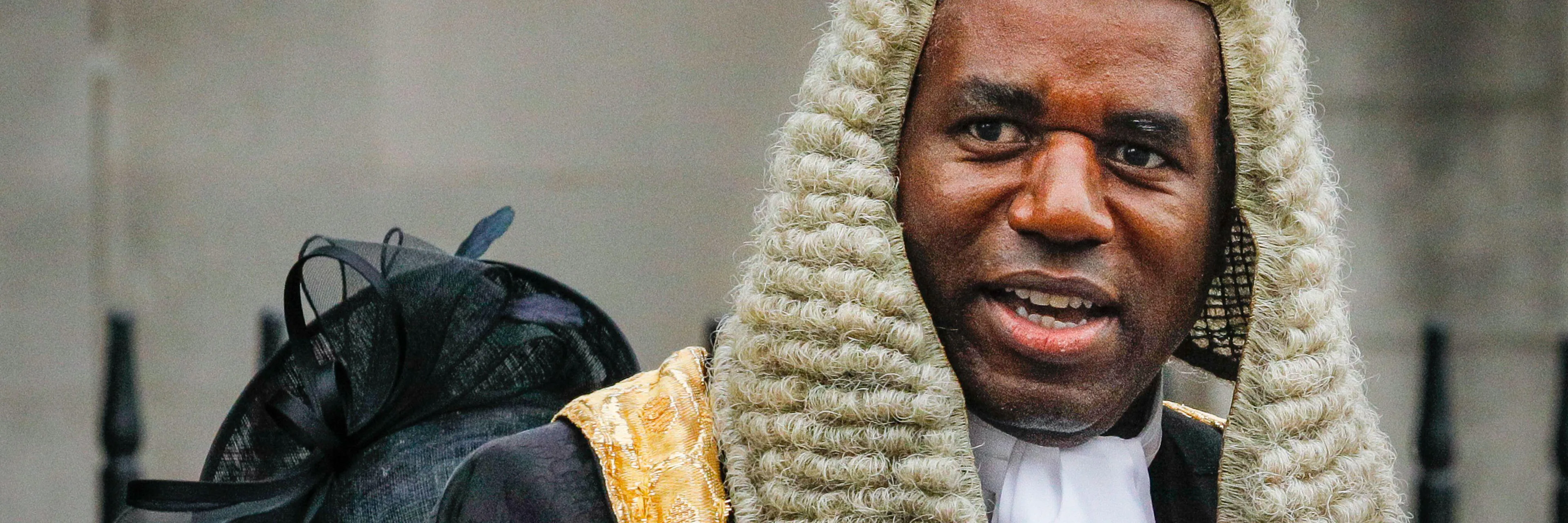
Nicki Minaj repeats US media narrative of Christian genocide in Nigeria at UN event in NY. Photo: screenshot

Analysts argue that framing the conflict as religious persecution masks a deeper geopolitical struggle over Nigeria’s enormous mineral wealth.

The United States intensified its claims that Nigeria is facing a “genocide against Christians” during a special event at the United Nations held in November called “Combating Christian Violence and the Killing of Christians in Nigeria”. The session, led by US Ambassador Mike Waltz, featured American rapper Nicki Minaj as one of the keynote speakers, and further amplified a narrative that Nigerian officials and regional analysts have repeatedly dismissed as misleading and politically motivated.

The UN event follows a recent wave of rhetoric by US President Donald Trump, who alleged widespread, systematic killings of Christians in the West African nation. Nigeria has rejected the accusations, insisting they are based on distorted reports and selective data that ignore the complex security realities in the country. Officials acknowledge the ongoing threat of Boko Haram and other armed groups but argue that the situation cannot be reduced to a one-sided religious persecution narrative.

Media organizations, including the BBC, have also noted that several of the claims circulating in US political circles cannot be independently verified.

Nicki Minaj repeats Trump’s narrative at UN stage

Nicki Minaj, whose earlier social media statements echoed Trump’s message, reiterated her comments at the UN event. She stated:

“In Nigeria, Christians are being targeted, driven from their homes and killed. Churches have been burned, families torn apart, and entire communities live in fear constantly, simply because of how they pray.”

Her remarks closely mirrored the religious persecution framing popularized in US conservative media, which African analysts argue oversimplifies a multidimensional conflict involving poverty, state fragility, armed groups, climate pressures, and competition over land and mineral resources.

African analysts push back

Journalist David Hundeyin, speaking to BreakThrough News, challenged the US framing, saying the violence in northern and central Nigeria cannot be understood simply as a religious conflict. He stressed that:

Boko Haram and affiliated groups have killed between 50,000 and 150,000 people, though the exact numbers remain unclear. The majority of victims have been Muslims, not Christians, since most violence occurs in predominantly Muslim regions of the north and middle belt.

Armed groups attack both Christians and Muslims, and “everyone is dying in numbers … they’re all poor people and powerless.”

According to Hundeyin, framing the conflict as religious persecution masks a deeper geopolitical struggle over Nigeria’s enormous mineral wealth, including rare earth elements crucial for global technology industries. He argues: Presenting the conflict as “Islamists killing Christians” provides a moral pretext for deeper US involvement in a region with strategic resources.

A key part of Hundeyin’s critique is the near-total absence of Muslim deaths in Western coverage. Although Muslims make up the majority of victims, their deaths rarely appear in narratives circulated in US conservative politics, which instead portray Nigeria as the world’s “epicenter of Christian persecution”.

Read more: Trump threatens war on Africa’s most populous country to “save” “our CHERISHED Christians”

As Pavan Kulkarni wrote in a Peoples Dispatch report last month, “The majority of people killed by the Boko Haram and Islamic State West Africa Province are Muslims, simply because they make up the majority in the northern region these Islamist insurgencies are ravaging. For the same demographic reasons, Muslims are also the majority victims of bandits who kill, loot, and kidnap in the northwest region, where the state is struggling to enforce the rule of law. In the central region, Christian victims of violence are in the majority, not because of their religious identity but because of their occupation: farming. Amid intensifying competition over depleting land and water due to climate change, raids on farmlands by mobile herders, groups of whom are armed, are a serious problem in several African countries suffering desertification.”

The Nigerian government maintains that while terrorism remains a serious challenge, portraying the crisis as a Christian genocide is inaccurate and dangerous. Officials argue that such language obscures the socio-economic drivers of violence, including state collapse in rural areas, the proliferation of weapons, land-use conflicts, and climate-related displacement across the Sahel.

Read More: World Bank acknowledges poverty increase in Nigeria, but doubles down on the reforms causing it

African Union issues statement

The African Union Commission (AUC), released a statement,  reaffirming its commitment to sovereignty, non-interference, religious freedom, and the rule of law as outlined in the AU Constitutive Act, and expressed concern over US allegations accusing Nigeria of targeting Christians and threatening military action, emphasizing that Nigeria is a longstanding and vital AU Member State whose sovereign right to manage its internal affairs, particularly regarding security, human rights, and religious freedom, must be fully respected by all external partners.

Nigeria’s struggles with insecurity demand nuanced understanding rather than a blanket accusation of Christians being targeted in the country.

Original article by Nicholas Mwangi republished from peoples dispatch under a Creative Commons Attribution-ShareAlike 4.0 (CC BY-SA) license.
Continue ReadingUS maintains “Christian genocide” narrative at UN special event

Jury trials: what the UK government’s plan to limit them would mean for victims, defendants and courts

Spread the love

Daniel Alge, Brunel University of London

Justice secretary David Lammy has announced one of the most significant changes to criminal justice in England and Wales in decades, by scrapping the use of jury trials for most offences that carry a likely jail sentence of less than three years.

Under the proposals, only the most serious offences such as murder, robbery and rape would continue to be tried by a jury. Most other cases would be heard by a judge alone. The reforms will also include creating new “swift courts” within the crown court division.

The government says judge-alone trials will take 20% less time than jury trials. Currently, cases can take an average of 332 days from charge to completion.

The criminal courts are undoubtedly under extraordinary pressure, compounded by cuts to public funding and the impact of the COVID-19 pandemic. There is currently a record backlog of over 78,000 crown court cases.

Yet the right to be tried by one’s peers has deep roots in the legal tradition of England and Wales. Its origins trace back to Magna Carta in 1215, which promised that no one would lose their liberty or property without “the lawful judgement of his peers and the law of the land”.

The judge and legal philosopher Lord Devlin described trial by jury as “the lamp that shows that freedom lives”. It is a symbolic cornerstone of justice in England and Wales.

These proposals go far beyond the recommendations put forward in Brian Leveson’s independent review of the criminal courts, published in July 2025. Leveson proposed trial by judge alone where the defendant requested it, or in particularly lengthy and complex trials. But Lammy’s proposals appear to be a watering down of leaked MoJ plans to restrict the use of jury trials to only “public interest” cases with sentences of over five years.

In practical terms, jury trials already form only a small part of the system, accounting for around 2% of all criminal cases. Ministry of Justice data shows that most criminal cases are resolved in the magistrates’ courts, in which three magistrates (who are volunteer lay people rather than professional judges), determine guilt as well as sentence.

Although magistrates deal with less serious offending, they currently have the power to imprison offenders for up to 12 months for a single offence, a power which, Lammy announced, would be increased to 18 months. Of those cases which are dealt with by the crown court, around 60% of defendants plead guilty, removing the need for a trial.

Front facade of the Royal Courts of Justice
The vast majority of criminal cases never reach a jury trial. Jane Rix/Shutterstock

Some might therefore regard juries as symbolically important, but an unnecessary burden on a struggling court system. While there are valid concerns about aspects of jury decision making, research has found that juries do generally make fair decisions.

There is limited research on judge-only trials, in part because they are relatively rare. Even in jurisdictions where juries are not used, judges more often sit in panels of three or more. There are concerns that judge-only trials risk exacerbating judicial bias.

Perhaps just as importantly, juries provide a form of lay participation that helps ensure public confidence in the fairness of verdicts.

Juries can act as a democratic check on official power. There have been cases, for example in protest-related trials, where juries have interpreted the law in ways that reflect broader community standards. Such instances are a reminder that the legitimacy of criminal justice depends on public consent.

The court backlog

The evidence suggests that jury trials are not the primary cause of the current backlog. Crown court backlogs began rising sharply in 2017, driven by years of budget reductions, court closures, maintenance backlogs and limits on the number of days courts were permitted to sit. However, the backlog has not fallen below 35,000 since 2000.

The pandemic brought unprecedented disruption into an already fragile system as many hearings were postponed and the transition to remote hearings caused delays. By late 2023, there were around 68,000 outstanding crown court cases, already the highest on record, and experts consistently identified lack of capacity as the central issue.

Given that jury trials make up such a small proportion of criminal cases, reducing them cannot, on basic numerical grounds, meaningfully reduce a backlog of this scale. The government has stated that restricting jury trials would save £31 million, just 0.2% of the MoJ budget.

It could, however, create new problems, including increased appeals, challenges on grounds of judicial bias and reduced public confidence in the outcome of trials.

The Institute for Government has warned that such changes could increase the risk of wrongful convictions and further erode trust in the justice system.

There is no doubt that long waits can be profoundly distressing for victims as well as defendants and witnesses. But victims’ interests also include trust in the process and confidence that decisions about guilt reflect a broad social judgement, not just the view of a single official.

This does not mean that the jury system is perfect or that reform is unnecessary. Leveson’s review of the courts suggested targeted changes, such as judge-only trials in highly complex fraud cases, or hybrid panels of judges and magistrates for certain intermediate offences. It also called for significant improvements in digital case management and infrastructure – investments that could address underlying inefficiencies more directly.

Restricting jury trials might appear to offer a fast route to clearing backlogs, but the data suggests that delays stem from wider capacity constraints, not the workings of juries themselves. England and Wales already rely overwhelmingly on magistrates’ courts and guilty pleas to handle most cases.

If the government is serious about improving outcomes for both victims and defendants, it should invest in the capacity of the courts, rather than remove one of the few remaining avenues for public participation in the criminal justice system.

Daniel Alge, Senior Lecturer in Criminology & Criminal Justice, Brunel University of London

This article is republished from The Conversation under a Creative Commons license. Read the original article.

Continue ReadingJury trials: what the UK government’s plan to limit them would mean for victims, defendants and courts

Tip the Scales: Take Back Power

Spread the love

https://chuffed.org/project/take-back-power

Britain is broken.


Britain is broken because the super-rich are pocketing billions, whilst most of us struggle to get by. Hungry kids, freezing pensioners and unemployed youth is not what we voted for. The UK is the sixth richest nation on earth – if we can’t fix our crumbling hospitals, sky-high rents and shit filled rivers, then something has gone very wrong. 

We need to tax the rich.

The super-rich are not paying their fair share because the tax system is riggedSince 2008, the wealth of the super-rich has increased four times faster than average household wealth, while more than a third of us now earn less than needed to make ends meet. The scales need balancing. We need to tax the rich.

Politics doesn’t work for us.

Everyone agrees we need to tax the rich. But when the rich have captured our democracy, we cannot vote our way out of this mess. For the 99% to get 99% of a say, we need to put ordinary people in charge through permanent citizen assemblies. People like us—your mum, your neighbour, nurses, teachers, posties—should set the agenda, not the leader of a political party in secret deals with powerful companies and the super-rich.

Take Back Power.


This week we launched, delivering an ultimatum letter to our Prime Minister. We demand that he instate a permanent House of the People with powers to tax the rich. And until we get more than just shit for Christmas we will keep engaging in non-violent action to take back our wealth and our democracy from the rich. 

We are demanding a House of the People with powers to decide how to tax the rich. The House of the People is a permanent, powerful chamber made up of ordinary people selected by a democratic lottery.

It’s simple. Everyone wants to tax the rich, but the politicians are not doing it. We will be mobilising people to take radical action and resist growing inequality in the UK. No one should have to put their kids to bed hungry while the super-rich are pocketing billions. Period.

https://chuffed.org/project/take-back-power

Orcas discuss Donald Trump and the killer apes' concept of democracy. Front Orca warns that Trump is crashing his country's economy and that everything he does he does for the fantastically wealthy.
Orcas discuss Donald Trump and the killer apes’ concept of democracy. Front Orca warns that Trump is crashing his country’s economy and that everything he does he does for the fantastically wealthy.

Continue ReadingTip the Scales: Take Back Power

What we told UK leaders about climate and nature at a national emergency briefing

Spread the love
Food security professor Paul Behrens (centre) joined a panel of climate scientists at the national emergency briefing to MPs in London in November 2025. Vuk Valcic/Alamy

Paul Behrens, University of Oxford

I joined eight other experts to deliver a national emergency briefing in late November on the climate and nature to around 1,200 of the UK’s leaders — across politics, business, faith and culture — in Central Hall Westminster.

Much like the televised national briefings delivered during COVID, the aim was to deliver sober, science-based overviews of the various climate and nature crises that the UK faces. Chaired by the academic and author Mike Berners-Lee, the aim was to set off a tipping point of engagement among politicians, faith leaders, CEOs, sport and cultural figures. TV presenter and naturalist Chris Packham opened the event.

The alignment among the scientists speaking was clear. Several of us had never met before, yet our research all linked to tell a story of unprecedented threat and opportunity.

Nathalie Seddon, a professor of biodiversity at the University of Oxford, laid bare the nature crisis. Nature, she emphasised, is not a luxury. It is critical infrastructure, and the state of depleted nature across the country is a national security issue.

Kevin Anderson, a professor in energy and climate change at the University of Manchester, presented the clear carbon arithmetic of how quickly we need to cut emissions. He pointed out what our political discourse studiously avoids: “It is now too late for non-radical futures.”

Hayley Fowler, spoke about how Valencia-style flooding is perfectly possible in the UK. Tim Lenton, a professor of Earth system science at the University of Exeter, spoke about how climate-driven changes in ocean currents may impact the UK.

I spoke about food security and the great food transformation that’s needed, including dietary change, waste reductions, production improvements and increased resilience. I explained how more plants in our diets are necessary to reduce climate and nature impacts, improve our health, increase food resilience and reduce reliance on imports.

Hugh Montgomery, chair of intensive care medicine at UCL, said: “You don’t respond to an emergency with talk and homeopathy. You respond with genuine action. … Climate change is the greatest threat to human health in the 21st century.”

Lieutenant General Richard Nugee, a retired senior British Army officer, spoke on national security implications and how the energy transition means greater stability and security for the UK, as the country would be less vulnerable to petrostates and the inherent volatility of fossil fuels.

Angela Francis, director of policy solutions at the environmental charity World Wide Fund for Nature, spoke about how innovation is the key to productivity and healthy economies. She highlighted how faster energy transitions are cheaper, and the cost of the UK energy transition is now 73% cheaper than what was thought five years ago. Had we made the transition already, recent inflation would have been 7% lower.

Tessa Khan is an environmental lawyer and the co-founder of the Climate Litigation Network: a global coalition of organisations using litigation to compel governments to ramp up their climate mitigation ambition. She described how the price of renewables has dramatically reduced, their efficiency has soared, and how investment in renewables pays dividends.

The science was news to many

The message was consistent: these are not distant projections but rapidly accelerating realities that will profoundly affect every aspect of British life.

There was anger too. Frustration at vested interests blocking action, and at the inequality of climate impacts. The UN’s annual climate summit, Cop30, had just concluded in Belém, Brazil, attended by a record 1,600 fossil fuel lobbyists.

The words “fossil fuel” were removed from the final Cop30 text. Our current collective response could not be more inadequate.

Some people I spoke to suggested that the panel at this event was preaching to the choir. It’s important to remember that MPs radically underestimate the urgency of the situation. Fewer than 15% of the 100 MPs surveyed in one study knew that global emissions needed to peak by 2025 to have any chance of limiting warming to 1.5°C.

The science was news to many present. The planet is heading into dangerous overshoot above 1.5°C within the next few years. As Anderson pointed out: for the UK to meet its fair share obligations in emissions reductions without relying on highly speculative and costly carbon dioxide removal, we would need to see roughly 13% year-on-year reductions for just 2°C – let alone 1.5°C.

There was a catharsis during the briefing. Knowing that people with the power to act were finally hearing the full picture: the health effects, the extreme weather, the collapsing nature, the food insecurity, the economic and geopolitical risks. As Rabbi Jonathan Wittenberg, senior rabbi of Masorti Judaism (a traditional movement for modern Jews), wrote afterwards in the Observer: “Those facts were hard to hear, but I also felt thank goodness, we’re being told it as it is.”

A just, equitable transition to a clean economy would improve countless aspects of our lives, from creating jobs and improving health to strengthening communities and increasing resilience. We will look back on this moment bewildered that we did not act sooner, if we are able to act in time.

This is why we are calling for a televised national emergency briefing, so that what happened in Central Hall Westminster can reach the public. Anyone can sign this open letter, calling on the prime minister, Keir Starmer, and the heads of the BBC, ITV, Channel 4, Channel 5, S4C and the media regulator Ofcom, for urgent, honest communication about the scale of the crisis and the solutions available.


Don’t have time to read about climate change as much as you’d like?
Get a weekly roundup in your inbox instead. Every Wednesday, The Conversation’s environment editor writes Imagine, a short email that goes a little deeper into just one climate issue. Join the 47,000+ readers who’ve subscribed so far.


Paul Behrens, British Academy Global Professor, Future of Food, Oxford Martin School, University of Oxford

This article is republished from The Conversation under a Creative Commons license. Read the original article.

Donald Trump urges you to be a Climate Science denier like him. He says that he makes millions and millions for destroying the planet, Burn, Baby, Burn and Flood, Baby, Flood.
Nigel Farage urges you to ignore facts and reality and be a climate science denier like him and his Deputy Richard Tice. He says that Reform UK has received £Millions and £Millions from the fossil fuel industry to promote climate denial and destroy the planet.
Orcas comment on killer apes destroying the planet by continuing to burn fossil fuels.
Continue ReadingWhat we told UK leaders about climate and nature at a national emergency briefing