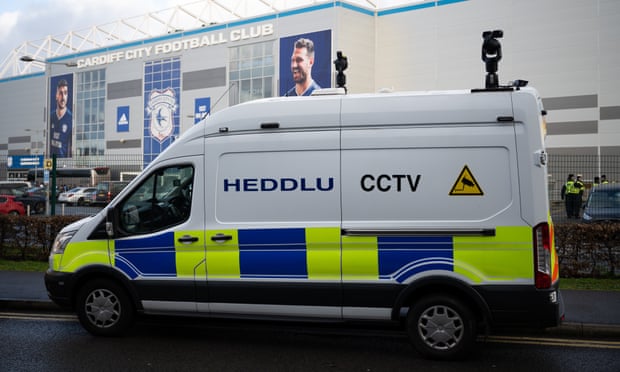
Live facial recognition is already used by the Metropolitan police and South Wales police. Photograph: Matthew Horwood/Getty Images
PM accused of ignoring civil rights and aping autocracies as he proposes new powers after far-right unrest
Civil liberties campaigners have said that a proposal made by Keir Starmer on Thursday to expand the use of live facial recognition technology would amount to the effective introduction of a national ID card system based on people’s faces.
“Expanding live facial recognition means millions of innocent Britons being subjected to automated ID checks,” said Carlo. “These are the surveillance tactics of China and Russia and Starmer seems ignorant of the civil liberties implications.”
…
Promising to create a national police capability to tackle the rioting, the new prime minister said forces needed to work better together, sharing intelligence and engaging in a “wider deployment of facial recognition technology”.
Details were scant but immediately after, Starmer suggested that trouble-makers could be subject to “criminal behaviour orders to restrict their movements before they can even board a train” – implying a wider use of live facial recognition at transport hubs such as railway stations.
Daragh Murray, a senior lecturer at Queen Mary University of London, said: “There is a clear danger that in responding to a tragedy and public unrest we expand and entrench police surveillance without appropriate scrutiny. Given that the police have responded to disorder and riots for decades, why is facial recognition needed now?”
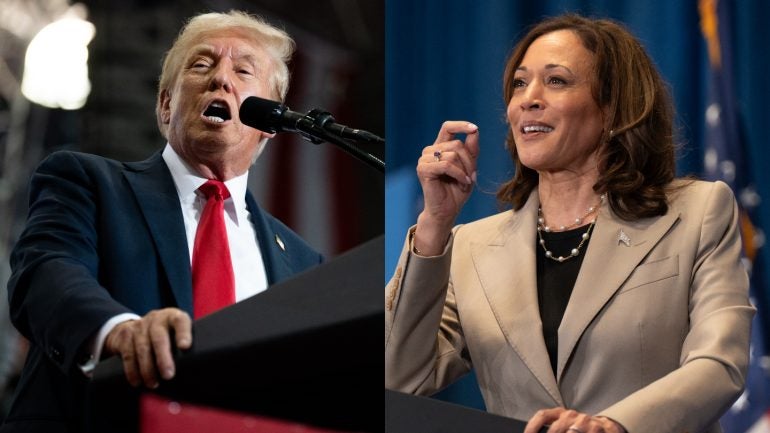
Trump and Harris’s environmental policies chart starkly different climate futures for the US and the world. Credit (from left): Stephen Maturen/Getty Images and Allison Joyce/AFP via Getty Images
The presidential candidates for the world’s largest fossil fuel producer have starkly different climate policies.
All eyes are on the US elections in November this year, with the decision of the 160+ million voters in the country to play a major role in determining the world’s trajectory towards a net-zero future.
According to the United Nations Environment Programme (UNEP), even with current pledges for emissions reduction, the planet is hurtling towards a rise of up to 2.9°C above pre-industrial levels by the end of the century. This would be catastrophic, and, one report indicates that the crisis could cost $178trn in global economic loss by 2070.
Projected 2030 emissions must fall by an additional 28-42% to limit warming to 2°C, per UNEP estimates. This means that global decisions on decarbonisation in this decade will have ramifications for this century of humanity.
…
Trump dismisses ‘green new scam’
Under a Trump administration, net-zero goals are expected to be in severe jeopardy.
During his former presidency, Trump not only reversed more than 100 Obama-era environmental protections but also pulled the US out of the landmark 2016 Paris Agreement, through which countries are working together to keep global emissions below the threshold of a 2°C rise.
During his campaign for re-election, Trump has dismissed rising environmental regulations as a “green new scam” and made no secret of his intentions to support the fossil fuel industry yet again.
Speaking to a Fox News journalist at a town hall event in Iowa, he shared plans to expand oil drilling on “day one” and also promised to “drill, baby, drill” in his presidential nomination speech on 18 July.
Moreover, at an April dinner at Trump’s Mar-a-Lago resort, he was reported to have asked oil industry executives to donate $1bn to aid his presidential campaign, citing benefits for them on avoided taxation and regulation as he plans to reverse environmental rules.
The projections are dire. According to analysis by Carbon Brief, a climate policy and science website, Trump’s likely policies would add four billion tonnes of greenhouse gas emissions to the atmosphere, which would cause global climate damages worth more than $900bn, as per the latest US government evaluations.
…
Harris hailed a ‘climate champion’
Harris, on the other hand, has a long history of enforcing climate action and is widely expected to carry on the legacy of the IRA.
She was an early co-sponsor for the Green New Deal, a comprehensive proposal for systemic decarbonisation in the US, including creating a 100% renewable energy grid and millions of green jobs.
Most notably, ahead of her brief presidential election campaign back in 2019, Harris unveiled a $10trn plan to reduce US greenhouse gas emissions to zero by 2045, including policies such as working to eliminate fossil fuel subsidies.
She also pledged to tax polluting industries and said she would establish an independent Office of Climate and Environmental Justice Accountability that would represent and support frontline communities, and monitor government compliance.
“Success in the presidential election in November would likely lead to Harris continuing to build on this existing climate legislation and defend against Republican criticism,” says Gregory.
“The idea that rich and poor are equal before government in democratic societies is ludicrous,” writes Polychroniou. “As disparities in wealth and income grow, so do the disparities in political influence.” (Photo: flickr/Creative Commons)
Wealth taxation may sound like a good idea, but can it really address, let alone solve, the problem of inequality?
Economic inequality is the scourge of the 21st century. The rich are getting richer and faster than any other time since the onset of neoliberalism, which calls for “free-market” capitalism, regressive taxation, fiscal austerity and the rejection of the social state. They get richer not only when the economy is on an upswing but even amid crises. Billionaires more than doubled their net worth during the pandemic, according to Bloomberg Billionaires Index.
The latest analysis shows that the richest 1 percent gained $42 trillion in new wealth over the past decade, which amounts to “nearly 34 times more than the entire bottom 50 percent of the world’s population.” In the meantime, the very poor and low-income people across the globe, including the U.S., are actually getting poorer. So much for trickle-down economics which was popularized during the 1980s by the Reagan administration’s vast capital gains and income tax cuts and continues to persist to this day in spite of its major flaws. Cutting taxes on the rich not only increases economic inequality but has no effect on economic growth and unemployment.
There must be something very rotten with an economic system that allows individuals to generate obscene amounts of wealth to the point they can hijack the political system and undermine democracy.
However, inequality should not be examined purely from an economic perspective. Over the years, numerous studies have shown that economic inequality influences public attitudes toward democracy by generating political disillusion and low trust in government and other institutions, like Congress. Inequality also undermines social mobility, contributes to political polarization and fuels authoritarianism.
Finally, inequality contributes to climate change. The richest 1 percent is responsible for more carbon emissions than the poorest 66 percent, according to a 2023 report by Oxfam. Of course, while the world’s wealthiest people make a huge contribution to climate change, they are also able to insulate themselves from the worst impacts of global warming.
In sum, the super-rich can be blamed for many of the most serious ills confronting societies in the twentieth-first century. The only consequential question here is this: what can be done about it then?
One of the most frequent responses to the problem of rising inequality is a call for the implementation of a wealth tax. Wealth taxation may sound like a good idea, but can it really address, let alone solve, the problem of inequality? The answer is an unqualified “no.” At least for the world’s advanced economies. Indeed, even if it’s possible to discover all the wealth that the very rich people own (much of which is hidden in companies or put in trusts) and then proceed with an accurate asset valuation, this will have very little impact, if any, on the daily lives of people who try to survive on minimum wages. Wealth taxation alone will have no impact on workers without social protection and no bargaining power at companies. It won’t protect workers at the “gig economy” and part-time workers.
To effectively address economic inequality, we must identify the root cause of the problem, and one simple way to do this is by asking a rather simple question: How does one become superrich? Where does this immense wealth come from? Because as the renowned progressive economist James K. Boyce recently put it “nobody ‘earns’ a billion dollars.
There must be something very rotten with an economic system that allows individuals to generate obscene amounts of wealth to the point they can hijack the political system and undermine democracy. Democracy cannot exist when we have wealth concentrated in the hands of a few. The idea that rich and poor are equal before government in democratic societies is ludicrous. As disparities in wealth and income grow, so do the disparities in political influence.
Take corporations, for example, which exert enormous influence, thanks primarily to campaign donations and lobbying Their actions, which range from opposing labor laws and policies that benefit workers to restricting unionization, exacerbate inequalities at all levels of society and across the globe. Moreover, the surge in billionaire wealth and the surge in “corporate power and monopoly power” form a powerful connection. The very rich are not simply beneficiaries of the existing economic order. They are in control of the working arrangements of the global economic system. Yet despite the enormous power that corporations have on people’s lives and the communities in which they operate, there are very few policies and mechanisms at national or international level to curtail that power.
Of course, we know that billionaires and big corporations pay very little in taxes, but we need much more than wealth and corporate taxation. We need ways to curb the power of big corporations and their drive to maximize shareholder value at the expense of everything else. We should also set a cap on extreme wealth. There is no social value for having billionaires. We should abolish the superrich, perhaps an easier task, politically speaking, than finding ways to tax them. Democratic societies could hold a referendum on whether we should abolish extreme wealth.
In addition, we could create economic arrangements that provide a minimum income to ensure that everyone’s basic needs are met. This can be done either through universal basic income or guaranteed income programs.
Last, but not least, we can challenge the rule of capital by advancing democratic forms of economic governance and economic planning. Participatory economics is one such alternative that would change the economy as we know it since it entails social ownership of production and self-managed workplaces. Worker cooperatives are established is various parts of Europe, particularly in Italy and Spain. The Mondragon Corporation in the Basque region of Spain is owned by its workers and represents the biggest and most successful case of worker cooperatives. Of course, for economic transformation to occur, breaking down hierarchical structures and putting workers in charge of business activities is not enough. What needs to happen is that the values of worker cooperatives spread across the economy and that power is wrested away from the capitalist class.In today’s world, we can tackle economic inequality only by shifting the conversation to its root causes and then coming up with blends of policies that work together to put an end to the driving forces behind inequality. Spending all political capital on something like a wealth tax will only help to prolong the life of an immensely cruel and dangerous economic system. An easier and far more effective way to end plutocracy is through the power of democracy via a binding referendum that calls on citizens to decide whether or not we should abolish altogether extreme wealth.
Israeli soldiers and police clash with a far-right mob that invaded the Beit Lid army base in Kfar Yona on July 29, 2024. (Photo: Oren Ziv/AFP via Getty Images)
Several Israeli lawmakers and one minister took part in the attempt to free the nine reservists, who were hailed as heroes by multiple Cabinet members.
Far-right Israelis including government officials stormed two military bases late on Monday, sparking clashes with troops and police over the arrest of Israel Defense Forces reservists who allegedly gang-raped a Palestinian prisoner.
Hundreds of protesters broke into the notorious Sde Teiman base in the Negev Desert in an attempt to stop the detention of nine reserve troops accused of sodomizing a Palestinian jailed there. According to the Israeli newspaper Haaretz, the victim is hospitalized with severe injuries and is unable to walk.
The nine suspects were then taken to the Beit Lid army base, which was also mobbed by at least dozens of demonstrators.
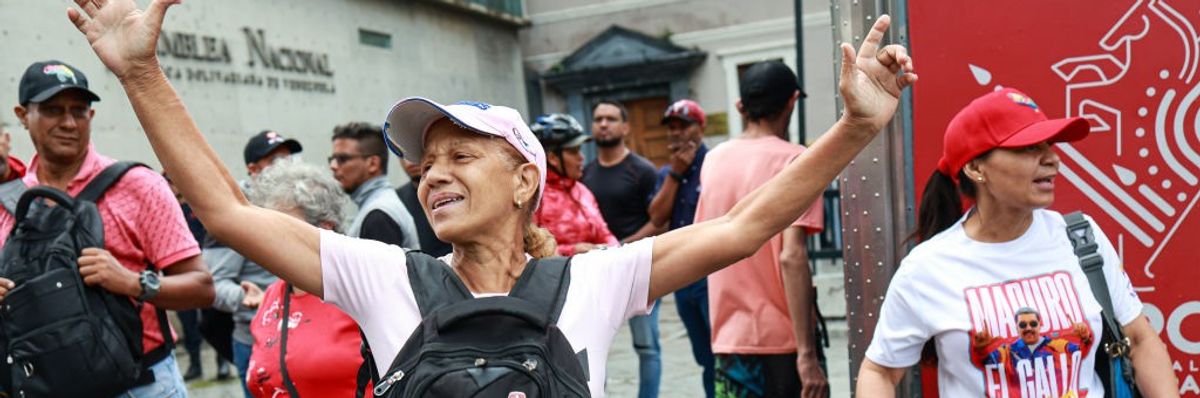
Supporters of president-elect Nicolas Maduro celebrate his proclamation as president-elect in the vicinity of the CNE headquarters during the ceremony to deliver the majority of the vote Certificate at CNE Headquarters on July 29, 2024 in Caracas, Venezuela. (Photo by Jesus Vargas/Getty Images)
Shortly before midnight on 28 July, Venezuela’s National Electoral Council (CNE) announced that — with 80 percent of the over 20 million votes counted — the trend was irreversible: Nicolás Maduro had been re-elected president of Venezuela.
According to the CNE, Maduro received 51.2 percent of the vote, while his primary opponent, the little-known Edmundo Gonzales, received 44.02 percent. With that result, it was clear that the Venezuelan majority chose to continue the project of Bolivarian socialism introduced by Hugo Chavez at the end of the nineties. Recognizing the economic turn-around of the last two years and proud of their achievements in building 5.1 million housing units, securing food sovereignty, and deepening communal democracy, Venezuelans re-elected Maduro for a third six-year term.
A former ambassador to Argentina, the opposition candidate Gonzales replaced far-right leader Maria Corina Machado as the candidate of the Unity Platform after Machado was disqualified from running. Machado has long been an outspoken critic of Chavismo, supporting US sanctions and advocating foreign intervention in the country. In 2018, she asked Benjamin Netanyahu for military assistance in dismantling the Maduro government. Machado has close ties in the United States. In 2009, she was a Yale World Fellow. On June 23, 2024 she spoke at a National Endowment for Democracy awards ceremony in Washington, DC. She has been nicknamed the new “iron lady” after her idol Margaret Thatcher. In contrast, Maduro supports the Palestinian liberation struggle, linking it to the struggle of the indigenous peoples of Venezuela against colonial genocide.
Venezuela’s far-right opposition is doubling down on its refusal to accept defeat in the country’s presidential election amid simmering unrest and violence in the streets of Caracas, sparking warnings of another coup attempt in a nation that has long faced interference from the United States and other Western powers.
Led by María Corina Machado, who was disqualified from running in Sunday’s election, Venezuela’s opposition claimed that its candidate—ex-diplomat Edmundo González—defeated President Nicolás Maduro with over 70% of the vote, contradicting the official results announced by the Consejo Nacional Electoral (CNE).
Machado, who once urged Israeli Prime Minister Benjamin Netanyahu to back an effort to topple Maduro’s elected government, pointed Venezuelans to a website the opposition is using to assemble its own vote counts.
“So far, she hasn’t presented any evidence [of fraud],” Caracas-based reporter Andreína Chávez Alava said in an appearance on Democracy Now! Tuesday morning. “In past elections they have also said they have evidence that they won and they never actually showed any proof.”
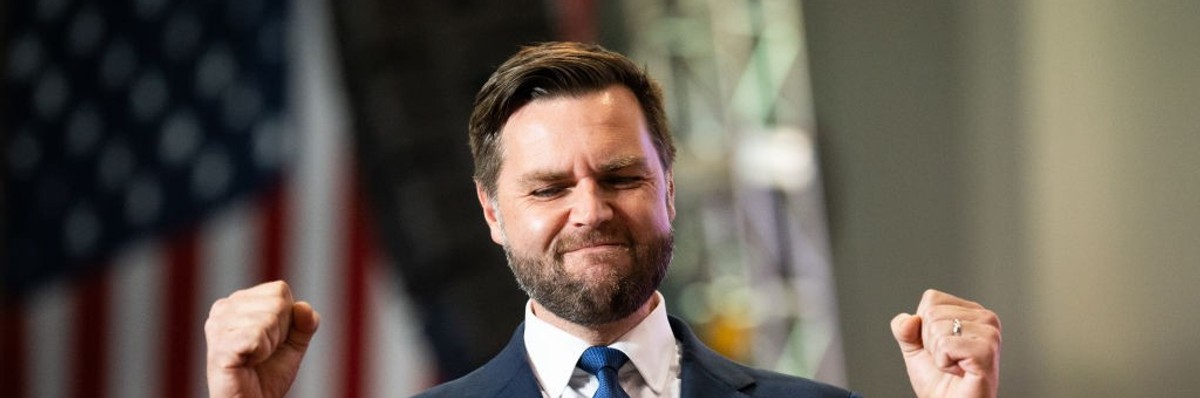
Republican vice presidential nominee U.S. Sen. J.D. Vance (R-OH) arrives to speak during a rally with running mate U.S. Republican Presidential nominee former President Donald Trump at Herb Brooks National Hockey Center on July 27, 2024 in St Cloud, Minnesota. (Photo by Stephen Maturen/Getty Images)
The former Republican president, despite all his allegedly populist rhetoric, has a deeply anti-worker record from his first term. Vance’s record is no different and he’s no better.
“These attempts to create the appearance of distance between Trump and Project 2025 are happening because Americans are starting to learn about this extreme takeover plan,” said one Democratic congressman.
At least 140 people who worked in the Trump administration—including six former Cabinet secretaries—have been involved with Project 2025, according to a CNN analysis published earlier this month. Among them is the outgoing director, Paul Dans.
“Dans served in the Trump administration as chief of staff at the U.S. Office of Personnel Management where he managed the federal agency in charge of human resources policy for the more than 2 million federal workers,” according to his profile on the Heritage website.
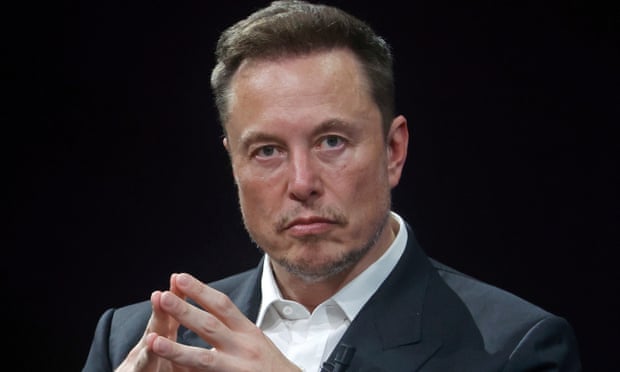
Elon Musk responded on X that ‘parody is legal in America’. Photograph: Chesnot/Getty Images
Doctored campaign video featuring US vice-president reposted by Tesla chief executive watched 128m times
Kamala Harris’s election campaign has accused Elon Musk of spreading “manipulated lies” after the Tesla chief executive posted a doctored video featuring the vice-president on his X account.
Musk reposted a manipulated Harris campaign video on Friday evening in which a fake Harris voiceover says: “I was selected because I am the ultimate diversity hire,” and that anyone who criticises her is “both sexist and racist”.
Amy Klobuchar, a Democratic senator, accused Musk of violating the platform’s guidelines. According to X’s synthetic and manipulated media policy, users are barred from sharing “synthetic, manipulated, or out-of-context media that may deceive or confuse people and lead to harm” although allowances are made for satire provided it does not “cause significant confusion about the authenticity of the media”.
A spokesperson for Harris’s presidential campaign said: “The American people want the real freedom, opportunity and security Vice-President Harris is offering; not the fake, manipulated lies of Elon Musk and Donald Trump.”