Lovebombed by lobbyists: How Labour became the party of Big Business
Original article by Ethan Shone republished from Open Democracy under a Creative Commons Attribution-NonCommercial 4.0 International licence.
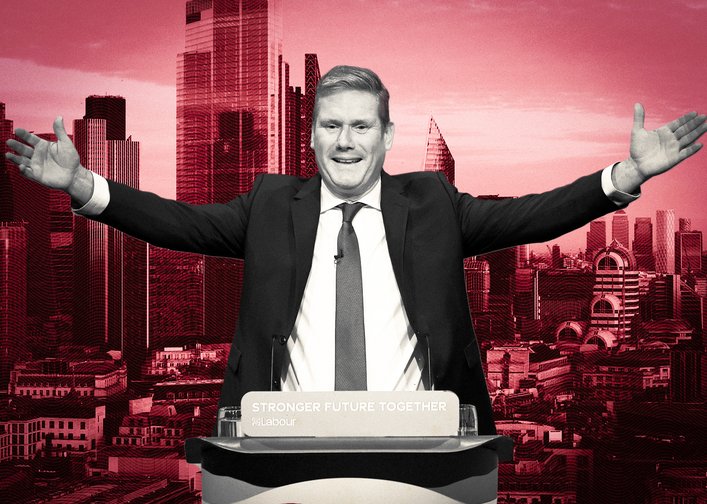
| Tim Grist Photography/Dan Kitwood/Getty / Composition by James Battershill
An openDemocracy investigation reveals the secretive mass lobbying campaign that shaped Starmer’s policies
Twelve months before seizing power in last week’s historic election victory, Keir Starmer and the Labour Party welcomed with open arms an unprecedented lobbying campaign by the UK’s most powerful corporations.
Weapons manufacturers implicated in human rights abuses in Gaza bent the ears of would-be defence secretaries. Incoming climate change ministers met with oil companies. Labour ministers who will now be responsible for curbing the excesses of the City of London were wined and dined by financial services executives. Public affairs firms representing asset managers, the tobacco industry, gig economy firms and tax-avoiding mega corporations secured meeting after meeting after meeting with future ministers.
In a high-voltage campaign that was simultaneously secretive yet enacted in plain sight, lobbyists worked hard to ensure the policies of the UK’s first ostensibly progressive government in 14 years reflected the interests of their influential clients. And Labour was only too happy to engage.
Westminster’s lax transparency rules mean there is no official record of this mammoth public affairs offensive. The rulebook says the public has no right to know which companies lobby the opposition – a position shared by Starmer’s Labour. In every instance, the party has refused to disclose what was discussed, what promises were made, and even who was at its meetings, saying: “We should not be treated as the government.”
Now, an investigation by openDemocracy lays bare the astonishing access that Big Business had to Starmer and his frontbench team.
openDemocracy spent months gathering information about lobbying meetings from a variety of open sources, including parliamentary meeting rooms’ booking logs, social media posts and events publicised by lobbying firms. These meetings, spanning the past 18 months, have included private meetings, exclusive Q&A sessions, dinners, mixers, briefings, client roundtables, overseas visits and seminars.
We have identified hundreds of meetings that senior figures in the party held with corporate lobbyists, financial institutions and business groups. On average, they met with influential business leaders every single working day of the past year.
This is about more than private dinners and smoked salmon breakfasts. Starmer’s cabinet is about to begin implementing the programme for government laid out in Labour’s manifesto. As Rachel Reeves, his new chancellor, said last month, the “fingerprints” of business are all over Labour’s policies, shaped as they were through an unprecedented level of engagement with corporate lobbyists, financial institutions and business groups.
Experts warn the consequences of the party effectively outsourcing its policy-making to private corporations will be far-reaching for British society. Labour has pledged to build new towns, to increase green investment, to reform health and social care and to launch major infrastructure projects. Mick McAteer, a former director of the UK’s financial services regulator has warned that the much-vaunted partnership with private finance which lies at the heart of all these plans “will result in a massive transfer of wealth from local communities to the City of London and global financial institutions over the next decade”.
The corporate lobbyists
Lobbying is a huge business in the UK. Dozens of agencies make millions every year advising clients on how to influence policy to their benefit and get their messages heard by the politicians who write laws, set regulations and sign off on public sector contracts. The last decent estimate of the industry’s size is from 2007, when Gordon Brown was still the prime minister. A study by the Hansard Society then put it at around £1.9bn. Insiders suggest it has certainly grown in the nearly two decades since.
A big part of a lobbyist’s work is getting their clients access to the right people, which often relies on the lobbyist themself knowing the right people – or having contacts who do. Around 18 months ago, after the spectacular implosion of the Liz Truss regime meant the chances of Labour taking power started to look more likely, the public affairs industry began to reorient en masse.
To prepare for a Labour government, lobby firms began establishing dedicated ‘Labour Units’. They hired former Labour MPs and staffers to make use of their contact networks, with a few even snapping up prospective candidates or seconding staff members directly into the offices of senior party figures. Lobbying firms Global Counsel, Lowick Group, FGS Global and Weber Shandwick have all sent members of staff to work in the offices of senior Labour figures in the past two years – at a combined cost to the firms of more than £100,000.
Other lobbying companies have given donations in cash or in-kind to influential MPs, despite industry rules seeming to bar this practice. New deputy prime minister Angela Rayner alone has received donations from two lobbyists – Sovereign Strategy and Pentland Communications – in the past year.
openDemocracy reached out to each of the firms mentioned above to ask whether they expect to receive anything in exchange for seconding members of staff at their own cost or donating to MPs, but received no response.
The lobbyists’ efforts bore fruit: in the twelve months leading up to the election, not a week went by without a member of Labour’s frontbench team attending a private client roundtable organised by a lobbying firm. These meetings, industry insiders say, represent only a fraction of the work a firm does in connecting its clients with politicians. They often serve merely as an introduction, with clients then able to follow up on issues discussed at the meetings or raise more sensitive matters, either through the agency or in some cases directly with politicians.
One firm, Arden Strategies, was able to secure more private client roundtables with Labour than any other, as far as openDemocracy can establish. The lobby shop, run by former Labour minister Jim Murphy, put its clients in a room with senior Labour figures on at least nine occasions – with politicians lobbied including Reeves, business and trade secretary Jonathan Reynolds and Starmer’s head of business engagement.
Unlike many firms, Arden doesn’t publish a general client list on the Public Relations and Communications Association register. But openDemocracy can reveal that the firm’s major clients include leading arms manufacturer Northrop Grumman and two of the UK’s largest power distribution companies, UK Power Networks and SGN.
Labour needs to take on the vested interests of big corporations, not give them the pen to write policy
Unlike in many other democracies, such as Canada, Germany and Scotland, voters have no right to know who is lobbying opposition politicians in Westminster. Only government ministers are required to regularly publish a list of any meetings they have with businesses, charities, think tanks and corporate lobbyists, along with a brief description of what was discussed. Details of government politicians’ meetings are not disclosed unless a specific Freedom of Information request is made asking about them, and the government may well decide to refuse to answer such requests.
This heavily flawed system is a major issue in a year such as this one, when the opposition’s election victory was almost a foregone conclusion and interest groups have been queuing up to influence its plans for government.
While firms do not need to declare which opposition politicians they’ve lobbied, many advertise their ability to secure access to the shadow frontbench. openDemocracy monitored the leading lobbying firms and found dozens of public references to meetings involving senior Labour politicians. In every instance where openDemocracy asked the lobbying firms and Labour which clients were present at these meetings, neither would provide any details.
Tim Bierley, campaigner at Global Justice Now, warned that Labour may be treating lobbyists as “independent experts” rather than people “responsible primarily for boosting their shareholders’ income”.
Bierley added: “On climate, trade and the economy, the interests of giant corporations are extremely different from the public’s – their outsized influence would blur any visions of progress under Labour.
“To provide a remotely adequate response to crises on multiple fronts, Labour needs to take on the vested interests of big corporations, not give them the pen to write policy.”
The City
Few interest groups carry as much sway with Labour as the representatives of the City of London – and the wider financial services sector that the City rests at the heart of. In recent years, no other industry has more effectively forged ties with the party.
In the weeks before polling day, Labour’s shadow City minister Tulip Siddiq – who is expected to keep the post in government – took to LinkedIn to share manifesto documents on three occasions. Tellingly, it wasn’t her party’s manifesto she was sharing, but those of three major financial services industry representative bodies, UK Finance, TheCityUK and the Association of British Insurers.
“I have worked closely with TheCityUK and its members in recent years,” wrote Siddiq in one of the posts, “to formulate the Labour Party’s policies for the financial and professional services sector.”
Her other two posts are seemingly copy-and-paste jobs, with near-identical wording. In both, Siddiq told of how “delighted” she had been to “work closely” with the Association of British Insurers and UK Finance “to inform Labour’s plans for the sector”.
All three posts suggest that the lobbyists for the City of London and the financial institutions were directly involved in shaping the policies and regulatory approach that will apply to their own industry.
When Labour published a policy document earlier this year laying out its plans for the financial services sector, the party held a no-press-allowed soiree in the City of London’s Guildhall, sponsored by the City of London Corporation, to thank the industry for its contributions. The plans were criticised for committing the party to the same lax regulatory approach taken by the Conservatives, with campaigners describing the document as “a love letter to the city”.
Labour’s frontbench team, including Siddiq, has met with City lobbyists on more than 20 occasions in the past year – not counting its significant engagement with the British Private Equity and Venture Capital Association, which openDemocracy revealed last month. BlackRock, Macquarie, HSBC, Bloomberg, Lloyds, Brookfield Asset Management and Blackstone are among firms to have secured access to leading members of the new government, including Starmer, Reeves, Reynolds and the chancellor of the Duchy of Lancaster, Pat McFadden.
Mick McAteer, a former board member at the Financial Conduct Authority and a campaigner for economic social justice at the Financial Inclusion Centre, told openDemocracy that the close relationship between incoming ministers and the Labour Party can essentially be seen as a kind of quid-pro-quo.
Lobbyists for financial institutions push Labour to commit to a favourable regulatory environment while dangling the promise of vast amounts of private capital. McAteer is increasingly concerned this relationship will amount to a rehashed form of the Private Finance Initiatives (PFI) favoured by New Labour, in which private firms provide all or most of the investment to build infrastructure such as hospitals and schools, and generate profits from lucrative contracts to maintain the infrastructure long after it has been built.
These public-private partnerships, McAteer warns, will shape almost every aspect of Labour’s agenda in government – from its plans for house-building to energy generation and distribution – and will represent a bad deal for the public.
“Private investment is by definition more expensive than public investment, because of the high returns that financial institutions expect to make for their shareholders,” MacAteer said. “These returns have to be paid for in some way, so ultimately, the costs get passed on to households through higher bills.”
The financial services sector has consolidated its relationship with Labour in different ways. HSBC has had a staffer in Reynolds’ office for almost a year, for example, and NatWest had a similar arrangement with the new business secretary for a few months prior to that. Staffers seconded from the firms have been involved in policy development and business engagement – but because they are still paid by their employers while working for Labour, the Electoral Commission classes the arrangements as political donations.
Then there are two advisory panels made up of executives from major financial institutions, which Labour set up while in opposition but that will continue to advise it on where and how to deploy billions worth of private sector investment in government. One board, the National Wealth Fund Taskforce, is headed by Mark Carney, the former Bank of England director general who now works for Brookfield Asset Management. The other, the British Infrastructure Council, includes senior figures from investment firms such as M&G and BlackRock.
McAteer warns these advisory panels constitute a major conflict of interest. “The British Infrastructure Council is full of representatives from firms that stand to financially benefit, who will not just be determining where the money goes, but in what form does the money go, what are the terms of the deals, and that the capital is de-risked before they’ll commit the finance.
“There’s a reason why they want to be on this infrastructure council, they’re not charities. This is not a criticism, it’s just how finance institutions work, and how markets work. They exist to get the best deal for their shareholders and their owners.
“This thing has been sold as a win-win for the economy and for the investors, but somebody pays for that. Ordinary households pay for it, and more importantly, because they don’t have a say in this, it will be future generations who will pay for this.”
He added: “Because these firms will have ownership of the economy and they’ll be able to extract value for as long as that infrastructure lasts. Ordinary people are really going to end up on the wrong side of some very, very badly designed transactions here, shaped by the financial institutions in the City of London.
“They’ve been lobbying for this for a couple of years – and they’ve got what they wanted.”
openDemocracy reached out to each of the firms mentioned above, but only HSBC provided a response. A spokesperson said: “HSBC regularly engages with the major political parties in the UK on issues facing our customers and the wider financial services industry.”
The consultants
If the City of London’s financial institutions stand to win big from Labour’s PFI 2.0, then so, too, do the City management consultancies and accountancies that work so closely with them.
Firms such as the ‘Big Four’ consultancies – Deloitte, KPMG, Ernst and Young (EY) and PriceWaterhouseCoopers (PwC) – and the industry lobbying body, the Management Consultants Association, have met with senior Labour figures at least 13 times since March last year.
Lord Sikka, a Labour peer and Emeritus professor of accounting at the University of Essex, said his party should not be working so closely with management consultancies.
“I think this new form of PFI would be disastrous, it would be a continuation of what we’ve seen in the UK since the late 1970s, a kind of right-wing coup which has seen a restructuring of the state so that it has become a guarantor of corporate profits, rather than an entrepreneurial state which invests,” Sikka said.
“PFI, privatisation and outsourcing – the very things these companies advise on and profit from – are all examples of that.”
Though Starmer doesn’t appear to have attended many of the meetings openDemocracy has uncovered, he was present at a day of business roundtable events at EY’s London offices in March 2023. There, the Labour leader, along with Reeves and Reynolds, heard from business leaders about “the potential value of public and private sector collaboration”, according to a LinkedIn post by EY’s managing partner. The trio returned to EY in November, along with the now chief secretary to the Treasury, Darren Jones, for similar discussions with a few dozen business leaders.
Jones has also attended secretive meetings with elusive consultant Hakluyt, which was founded by former MI6 operatives in 1995 and claims to work with “at least one of the world’s top five corporations in every major sector globally” and “three-quarters of the top 20 private equity firms in the world”. The firm also organised a dinner with Labour MP Peter Kyle, then the shadow secretary for science, innovation and technology, while he was in the US earlier this year.
Hakluyt counts among its advisory board former executives from Rolls Royce and Coca-Cola, as well as former senior civil servants and politicians. It has previously been linked with large oil and gas interests, having been accused by The Sunday Times in 2001 of deploying an agent to spy on Greenpeace campaigners on behalf of oil companies. In recent years Hakluyt has sought to “demystify” and says it now has “no relationship with the spooky world”. A spokesperson said Hakluyt is not a lobbying organisation and does not advise political parties.
Speaking at last year’s Labour Party Conference, Reeves pledged to slash public spending on consultants if elected. This promise also made it into the party’s manifesto. But as economists and authors Mariana Mazzucato and Rosie Collington highlight in their book, The Big Con, the industry has been known to offer its services pro-bono during times of austerity, in hopes of securing lucrative paid contracts in future. In 2011, the then head of public sector at KPMG described the strategy to the Guardian, in the context of working with David Cameron’s coalition government: “We can’t afford to [work pro bono] indefinitely, but we can in the short-term. We’re hoping to position ourselves well when the government decides it is willing to pay.”
In a similar vein, when Labour’s shadow Treasury team was working on its aforementioned plan for financial services, City consultancy Oliver Wyman donated a staff member to help out – at a cost of more than £58,000 for the past year, according to Electoral Commission data. Senior staffers at leading consultancies Grant Thornton and EY have held parliamentary passes as members of Starmer’s team for the past year or so, according to the register of MPs’ staff interests. Since 2021, firms including PwC and Baringa have provided combined pro-bono services to the party worth more than £650,000.
“There are huge questions about why these firms have been providing free staff,” Lord Sikka said, “because obviously that has a cost to them and they would expect a return because they’ve made an investment.”
None of the firms mentioned above responded to openDemocracy’s request for comment.
Labour is sending a clear message to arms dealers – that it will be business as usual
The arms dealers
In March last year, Labour’s then shadow defence secretary, John Healey, and minister for defence procurement, Chris Evans, filed into a function room in the Churchill War Rooms along with executives from 20 of the world’s biggest arms manufacturers, including BAE Systems, Leonardo, Lockheed Martin, RTX, Rheinmetall and Rolls Royce.
The private event at the historical attraction in Westminster was arranged by public affairs firm Rud Pedersen. The firm’s head of defence and security is a former Labour staffer who worked in the party’s shadow defence team between December 2018 and September 2020.
Since last March, party figures have met with representatives from defence firms on at least 13 occasions, including two visits to sites run by BAE Systems and German defence contractor Rheinmetall. Labour’s then shadow science minister Chi Onwurah and armed forces minister Luke Pollard attended a private meeting – hosted by the industry lobbying body, ADS Group – with BAE Systems, Rolls-Royce and Thales at the Labour Party Conference.
A BAE Systems spokesperson said: “As the UK’s largest defence company, employing more than 45,000 people in the UK with thousands more in the supply chain, we regularly engage with political representatives to increase awareness and understanding of the significant contribution our industry makes to the UK’s security and prosperity.”
Most recently, Reeves attended a private client roundtable event hosted by lobbying firm Headland in March this year. The CEO of German AI defence startup Helsing was also present, as was Headland staffer and new Labour MP, Gregor Poynton.
While Labour has consistently ruled out progressive policies such as scrapping the two-child benefit cap or boosting local government funding, it has committed to increasing defence spending to 2.5% of GDP, up from 2.3% last year. Despite a YouGov poll from April indicating that the majority of the public backs a ban on exporting arms to Israel, the party has declined to call for an end to arms sales to the country.
Emily Apple from the Campaign Against the Arms Trade described arms trade lobbyists’ access to the upper echelons of the Labour Party as “hugely alarming”.
She said: “These meetings give [some of] the companies profiting from Israel’s genocide in Gaza a huge amount of influence over Labour’s future defence and foreign policy. This rings alarm bells over whether a future Labour government will uphold international law and impose an arms embargo on Israel or any other human rights-abusing regime.
“These companies profit from death and destruction. Labour should be taking a stand and reducing the influence of these death merchants on political policy. Instead, these meetings mean Labour is sending a clear message to arms dealers – that it will be business as usual for them to continue boosting their share prices through perpetuating conflict and misery across the world.”
openDemocracy reached out to each of the firms mentioned above, but only BAE Systems responded. A spokesperson said: “As the UK’s largest defence company, employing more than 45,000 people in the UK with thousands more in the supply chain, we regularly engage with political representatives to increase awareness and understanding of the significant contribution our industry makes to the UK’s security and prosperity.”
If business wins, who loses?
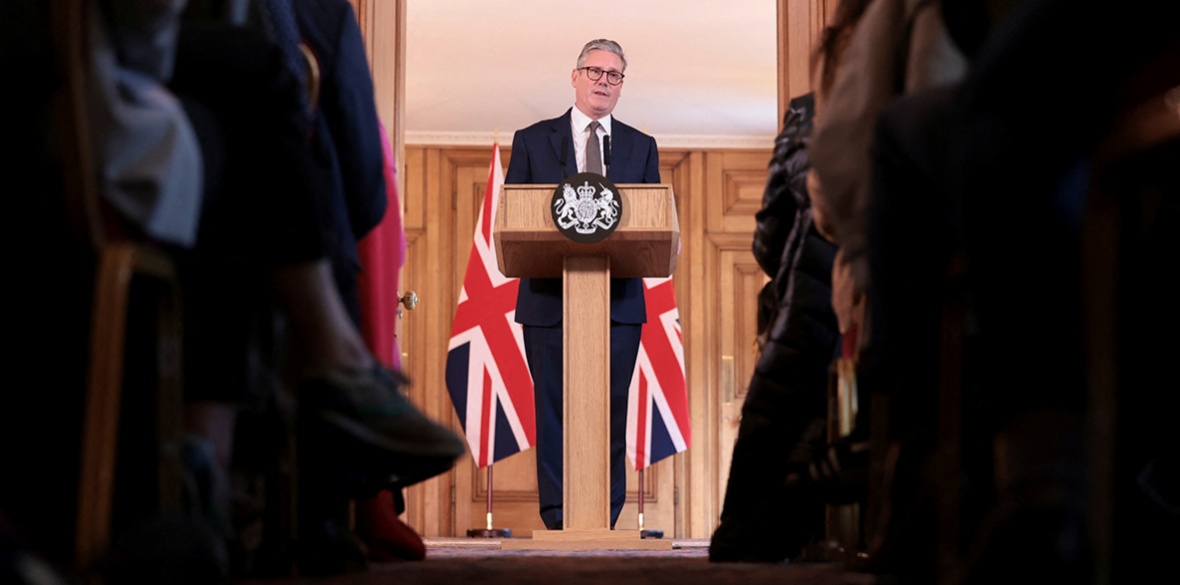
On Friday morning, during his first address to the nation as prime minister, Starmer said voters had given him a mandate “to do politics differently”. But the representatives of big business, finance and the arms trade, which have worked hard to influence his party, will hope it plans to continue the status quo: prioritising their interests over those of working people.
One week earlier, as now-chancellor Rachel Reeves prepared for a Monday morning sit-down with the heads of financial firms, the couriers’ branch of the IWGB trade union held its annual group meeting in a sunny courtyard in east London. There, some of the most marginalised workers in the UK reflected on the struggles and victories of the past year and looked ahead to the future.
The IWGB, one of many smaller independent trade unions with no affiliation to the Labour Party, works across a number of sectors where the power gap between workers and employers is most acute. From Hartlepool to Hackney, its members are outsourced security guards and cleaners, foster carers, receptionists and couriers.
Many of the corporations that have spent the past 18 months wooing Labour are the same firms severely exploiting these workers, the IWGB’s general secretary, Henry Chango Lopez, told openDemocracy.
“These huge corporations,” Chango Lopez said, “have access to vast sums of money to lobby governments – a method of policy influence that is simply not available to working people. That many senior members of the Labour Party have allowed those employers to get anywhere near influencing policy is indicative of where the government’s priorities lie.”
Original article by Ethan Shone republished from Open Democracy under a Creative Commons Attribution-NonCommercial 4.0 International licence.