Farage said Andrew Tate was ‘important voice’ for men in podcast interview

Spread the love
Image of Nigel Farage

https://www.theguardian.com/politics/article/2024/jun/20/nigel-farage-andrew-tate-important-voice-men-podcast-interview

Reform UK leader has also argued against diversity quotas and said people on benefits were ‘too stupid’ to work in appearances over past year

Nigel Farage has praised the misogynist influencer Andrew Tate for being an “important voice” for the “emasculated” and giving boys “perhaps a bit of confidence at school” in online interviews that appear to be aimed at young men over the past year.

The Reform UK leader spoke in favour of Tate for defending “male culture” in a Strike It Big podcast that aired in February, while acknowledging that the influencer had gone “over the top” and elsewhere that he had said some “pretty horrible” things.

Since December 2022, Tate has been facing charges in Romania of human trafficking, rape, and forming a criminal gang to sexually exploit women, which he denies.

Many politicians and teachers have spoken out against Tate’s influence on young boys in the UK, after the self-proclaimed misogynist said women belonged in the home and were a man’s property. “There’s no way you can be rooted in reality and not be sexist,” Tate said in one video.

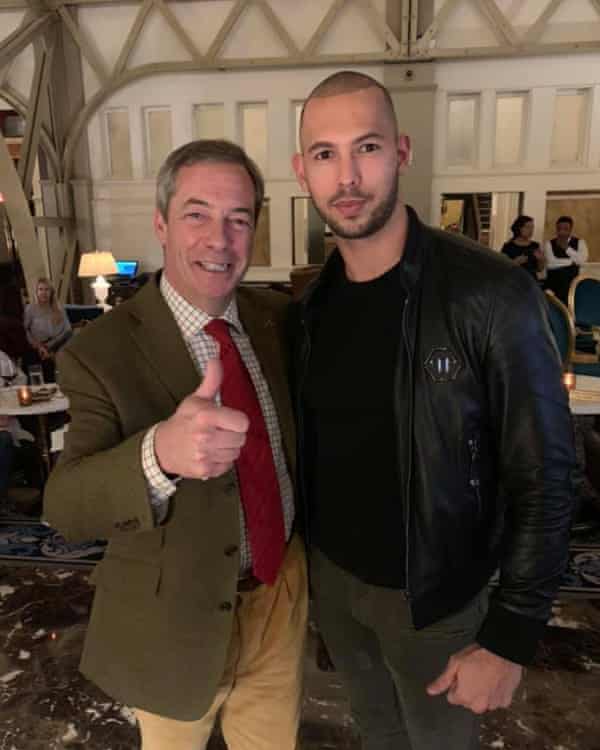
Andrew Tate pictured with Nigel Farage in a Facebook post by Tate from March 2019. The caption read: ‘Brexit baby.’ Photograph: Emory Andrew Tate/Facebook

Farage’s interview comments

February 2023
“‘I’m too fat, I’m too stupid, I’m too lazy, I don’t get out of bed in the morning. I smoke drugs, give me money’ … That’s what we’re saying. ‘I don’t need to work, the state will provide for me’ … We cannot afford it.

“I welcomed much of [Liz Truss’s] budget. I think if there is a criticism, they tried to do too much, too quickly, without prior explanation … What happened here is the backbenches wobbled really quite quickly because a lot of Conservative backbenchers are basically globalists and listened to those big noises from the multinationals and the IMF. As soon as she sacked Kwarteng, it was all over … I would much have preferred her to hold her nerve, keep making those arguments and see if the party dared get rid of them.”

August 2023
“I think Andrew Tate is a fascinating figure. I think his speaking to men, who because of the woke agenda were told they couldn’t be male in any way at all, was an important thing. But I feel some of his comments were pretty horrible.”

April 2024
Javier Milei is “Thatcherism on steroids – this is incredible, cutting and slashing public expenditure, doing all the things he’s done … That’s leadership … He is amazing.”

https://www.theguardian.com/politics/article/2024/jun/20/nigel-farage-andrew-tate-important-voice-men-podcast-interview

Continue ReadingFarage said Andrew Tate was ‘important voice’ for men in podcast interview

Argentine organizations reject attempts by Milei to silence dissent with fear

Spread the love

Original article by Pablo Meriguet republished from peoples dispatch under a Creative Commons Attribution-ShareAlike 4.0 (CC BY-SA) license.

Police in Argentina brutally repressed a mobilization against Milei’s controversial economic reforms. Photo: UP Diputados

Over 30 people were detained in Buenos Aires during the brutal repression of the protests against Milei’s economic reform law

Last week, the Argentine Senate debated the bill called “Law for Bases and Starting Points for the Freedom of Argentines” (Ley Bases), a set of economic and political reforms proposed by the far-right government of Javier Milei. While the Executive sought the necessary votes in the Senate to pass the law, thousands of demonstrators gathered around the legislature to demand that the law be shelved.

The protests were called by several social organizations and trade unions, including the country’s largest trade union confederations, the General Confederation of Labor (CGT), the Argentine Workers’ Central Union, and the Argentine Workers’ Central Union (Autonomous).

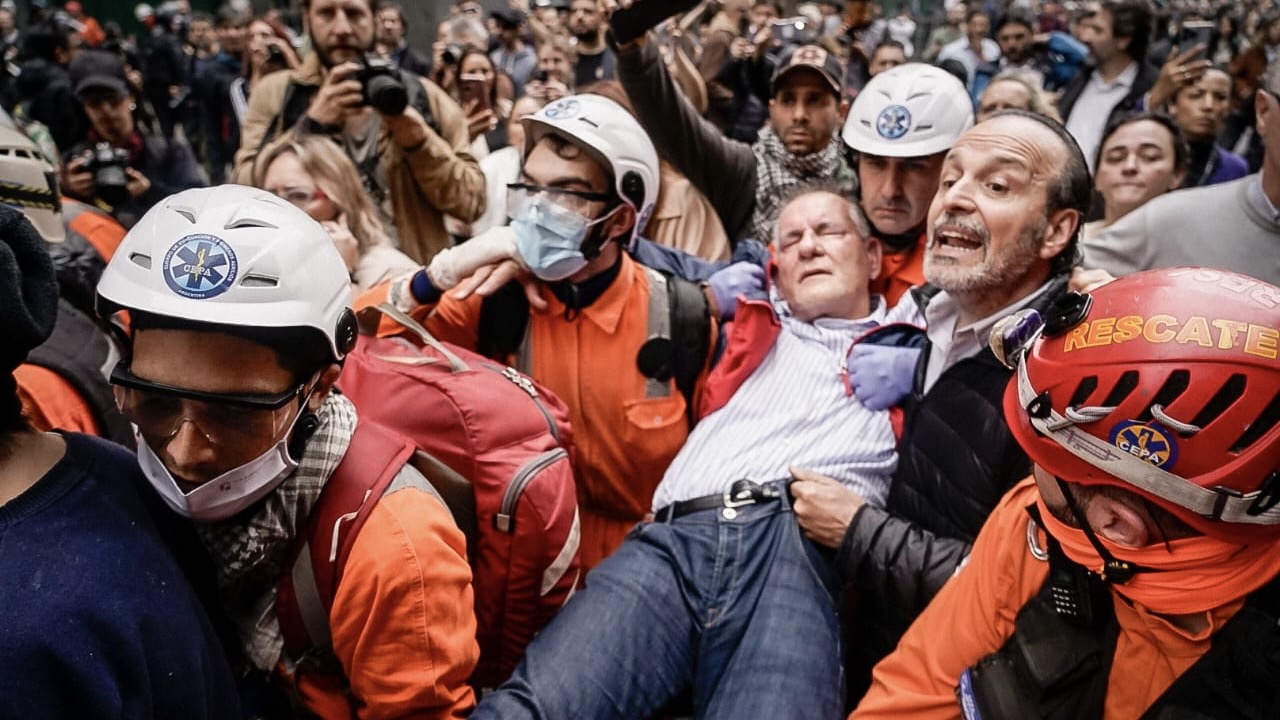
The action of the police, under the orders of the Minister of Security, Patricia Bullrich, was excessive and brutal. Even lawmakers were not spared the violent repression. Peronist legislators, Eduardo Valdés, Carlos Castagnetto, Leopoldo Moreau, Juan Manuel Pedrini, Carolina Yutrovic and Luis Basterra, denounced that they were beaten by the security forces. In addition, several detainees told press that “they were stripped naked and that pepper spray was thrown at them”.

Martin Dirroco, a worker detained during the protests, recounted: “We were in Congress and we began to feel the tear gas, our throats began to burn and we began to leave. We heard more and more shots fired; we could see the repression. […] Suddenly a lot of people started to come, we tried to leave and seven motorcycles appeared. The one on the back of the motorcycle was pointing a gun at us. They got off the motorcycle and told us to stay still. They shooted and shouted ‘everybody against the wall’. They started pushing and shoving, holding me and throwing me to the ground. […] We had to sleep in a courtyard with handcuffs on”.

On Wednesday, June 12, 33 people were arrested, with many held for several days. Carlos Lopez, a left Argentine political leader, told Peoples Dispatch that as of today there are still five people detained on alleged charges of “public intimidation” and “arson”. Lopez comments that some people were even arrested 15 blocks from the Senate, far away from the events for which they are accused. “They are trying to sow terror from the government, the State, so that the population feels fear and shuts its mouth”. In addition, López continues, the detainees did not have adequate access to water and food; some spent more than 15 hours in a police patrol car and many could not speak to their lawyers: “There was intimidation, torture and threats […] We ask for everyone’s solidarity so that this type of action does not happen again,” said López.

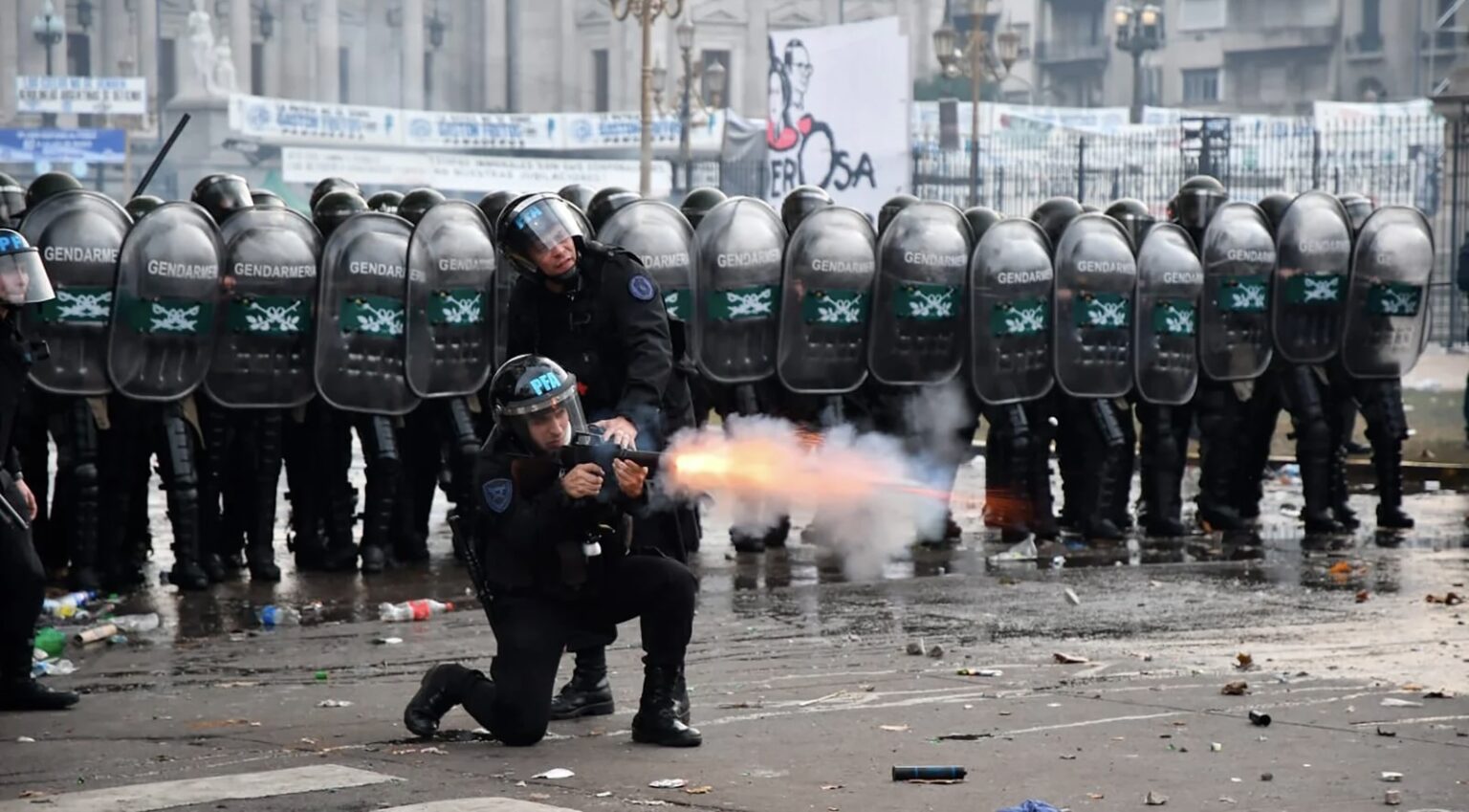
Police launching tear gas canisters at protesters on Wednesday June 12 in Buenos Aires. Photo: Somos Telam

The President’s Office celebrated the approval of the law and called the demonstrators “terrorists”: “Starting from 38 deputies and 7 senators, with terrorist groups attacking the Congress, having to deploy the Security Forces in defense of democracy, with the political caste resisting and operating until the last moment, and having to resort to the tie-breaker of the Vice President of the Nation, Victoria Villarruel, tonight’s is a triumph of the Argentine people and the first step towards the recovery of our greatness, having approved the most ambitious legislative reform of the last forty years.”

Several human rights organizations, such as the Grandmothers and Mothers of the Plaza de Mayo, the Permanent Assembly for Human Rights, the Relatives of the Disappeared and Detained for Political Reasons, among others, called for a demonstration on Tuesday June 18 to demand the release of the 16 people that were still detained (including several students and professors) accused of “terrorism”. During a press conference, various relatives of the detainees denounced the injustice of the accusations against the prisoners and affirmed that they are not terrorists and demanded their immediate release.

Milei’s “Ley Bases”

At the end of the debate last Wednesday, the law was approved thanks to the vote of Vice President Victoria Villarruel, who broke the tie. The controversial law must be approved a second time in the Chamber of Deputies.

The reforms of the “Ley Bases” propose a paradoxical transformation of the functioning of the Argentine State. At the same time that they seek to diminish the State’s capacity to control the economy, they strengthen the President’s political power to make economic and political decisions, which will no longer have to be approved by the legislative branch. In other words, the intention is to build a weaker but more agile State to execute President Milei’s neoliberal plan.

One of the most controversial changes is the creation of the “Incentive Regime for Large Investments” (RIGI, for its initials in Spanish). The purpose of this regime is to reduce the State’s control over large companies that invest more than USD 200 million in the country. The government promises these big companies a reduction in taxes, privileges in the project approval process, and protection of capital from state control for 30 years. RIGI seeks, among other things, the exploitation of natural resources by major companies.

According to the “Ley Bases”, the President may have “extraordinary powers” for one year if he declares a public emergency in the economic, financial, and energy fields. In this sense, Milei would have several powers that currently only the Legislative has. To achieve its approval in the Senate, the Executive committed itself not to interfere with 15 public agencies, such as the National Service of Food, Health and Quality (SENASA), the National Bank of Genetic Data (which has information on those who disappeared during the last dictatorship), among other institutions. However, the government will be able to legislate through expeditious decrees, which implies, in general, the first great legislative victory for its political project.

In addition, the “Ley Bases” authorizes the privatization of Intercargo, a state-owned company dedicated to provide services to air travel companies, and Energía Argentina S.A., which is in charge of the extraction and exploration of hydrocarbon deposits, their transportation, and storage. Although Milei wanted to privatize more than 40 public companies, the negotiations forced him to limit his aspirations. Nevertheless, Milei’s major project in this regard seems to be aimed, at first, at the privatization of the mining, energy and fuel sectors.

Finally, the “Ley Bases” seeks to make a discreet, although controversial, labor reform, as it proposes, among other things, to eliminate penalties for companies that use informal workers, which is currently sanctioned by law.

While the Executive celebrates its neoliberal legislative victory, the families of the prisoners continue to pressure the justice system to free the detainees and drop the serious charges that could mean several years in prison.

Original article by Pablo Meriguet republished from peoples dispatch under a Creative Commons Attribution-ShareAlike 4.0 (CC BY-SA) license.

Continue ReadingArgentine organizations reject attempts by Milei to silence dissent with fear

Reform targets Labour ‘red wall’ voters

Spread the love

https://morningstaronline.co.uk/article/-reform-targets-labour-red-wall-voters

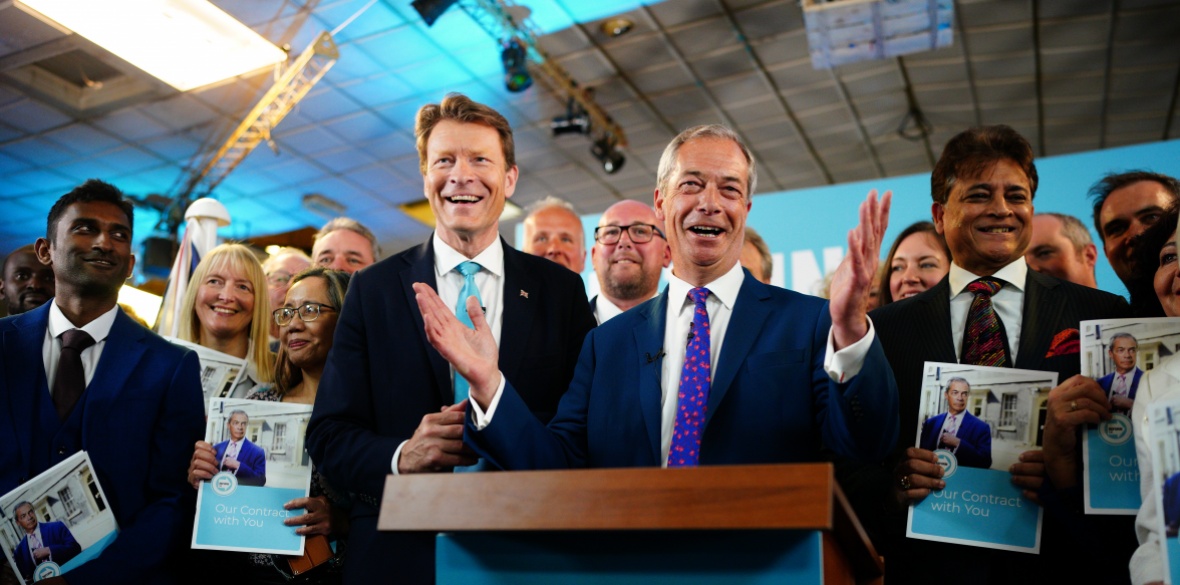
Reform UK chairman Richard Tice (left) and party leader Nigel Farage launch ‘Our Contract with You’ in Merthyr Tydfil while on the General Election campaign trail, June 17, 2024

REFORM started targeting Labour “red wall” voters today as the hard-right party launched its reactionary election manifesto in Wales.

The party’s owner and leader Nigel Farage went to Merthyr Tydfil, once represented by Labour pioneer Keir Hardie, to tell voters that “Labour is not very different to the Conservatives … it is just more incompetent.”

And he restated his aim of being the main challenger to Labour for government by 2029, likely date of the next general election following July 4.

The nationalist party’s platform is anti-migrant, opposed to climate action and supportive of NHS privatisation while cutting foreign aid and leaving the European Court of Human Rights.

It aims to take advantage of muted enthusiasm for Sir Keir Starmer’s Labour in working-class communities by rekindling the Brexit divisions it skilfully exploited in 2019.

Reform’s increasing prominence in the general election comes as the Tory Party’s campaign looks on the verge of expiring.

https://morningstaronline.co.uk/article/-reform-targets-labour-red-wall-voters

Continue ReadingReform targets Labour ‘red wall’ voters

Another election, another round of Nigel Farage hype, with no lessons learned

Spread the love
Image of Nigel Farage

Aurelien Mondon, University of Bath

Nigel Farage, a man who has never been elected to the House of Commons despite years of trying, has again been allowed to set the agenda in the UK.

Ten years after Ukip won the European parliament elections, throwing the Conservative party into turmoil and leading David Cameron to promise a referendum on the UK’s membership of the European Union, Farage is at it again. Or more precisely, he is being allowed to go at it again.

The mainstream elite in the media and in politics who claim to oppose Farage, and who pretend to stand as a bulwark against far-right politics, are again duly buying into the hype he has created for himself.

We could already feel that hype bubbling as Farage took over as leader of Reform. He’d seen the party’s fortunes rising and started to think there could be something in it for him to step into the campaign.

We could see it in the coverage of every move he made thereafter – every milkshake thrown, every inflammatory quip quoted and beer drunk, snapped and plastered all over the news as some kind of morbid excitement set in among the media. Finally, something exciting is happening in this otherwise rather dull campaign, where offers of “change” and pledges to be “bold” are hollow slogans for the sides of battle buses.

To understand how a party which only received 2% of the registered votes in the 2019 general election, failing to get even one MP elected, can get such attention, we must travel back in time.

Ukip was a party created by a eurosceptic elite, for a eurosceptic elite, to put pressure on the Conservatives via the EU elections. It all seemed a rather desperate move at the time, as the issue was marginal at best.

The party received 15.6% of the vote in the 2004 European elections and 16% in 2009. But these are second order elections, prone to low turnout and high protest vote. In these settings, Ukip really only received a mere 6% and 5.6% of the registered vote, once turnout was taken into account. Hardly the voice of the “silent majority”.

The 2005 and 2010 general elections clearly showed the limits of Ukip’s appeal. In 2005, the party received 1.4% of the vote and in 2010, it took 2%.

Ukip’s election vote share

A chart showing the performance of Ukip across general and European elections and what proportion that represented of the overall registered vote.
Ukip results in general elections (GE) and European elections (EU).
A Mondon., CC BY-ND

Still, the first “breakthrough” was in 2014 when Ukip won the EU elections with 26.6%. An “earthquake”, we were told. This was the start of the “left behind” myth which served Farage well as it diverted attention away from his elitist stance. The fantasised “white working class” would come to play a key role in shaping the narrative after the victories of both Donald Trump in the US and Brexit. Proper scrutiny of Ukip’s (and Reform’s) programmes (or Trump’s for that matter) would have also shown that beyond typical far-right measures and other gimmicks, their project was always deeply skewed in favour of the wealthy.

Yet even though Ukip really only received the support of one out of ten registered voters (9.5%) in 2014, in particularly favourable circumstances, the mainstream elite could not get enough of Farage. Finally, the UK had a “populist” contender worthy of the name. They too could feel the same voyeuristic thrills as their European counterparts, watching the “irresistible” rise of the far right (or “populism” to be politically correct, as we would not want to offend the far right, no matter how clear Farage has made his views).

What is striking is that it is this election which set in motion the 2016 referendum, even though Ukip was the only party running on a platform demanding that the UK leave the EU. For all the talk of “taking back control” and “sovereignty”, this reactionary experiment was decided based on the support of less than 10% of voters. Even in terms of votes cast, the referendum was forced onto almost three out of four voters who had decided to vote for parties who were not formally demanding the country leave the EU.
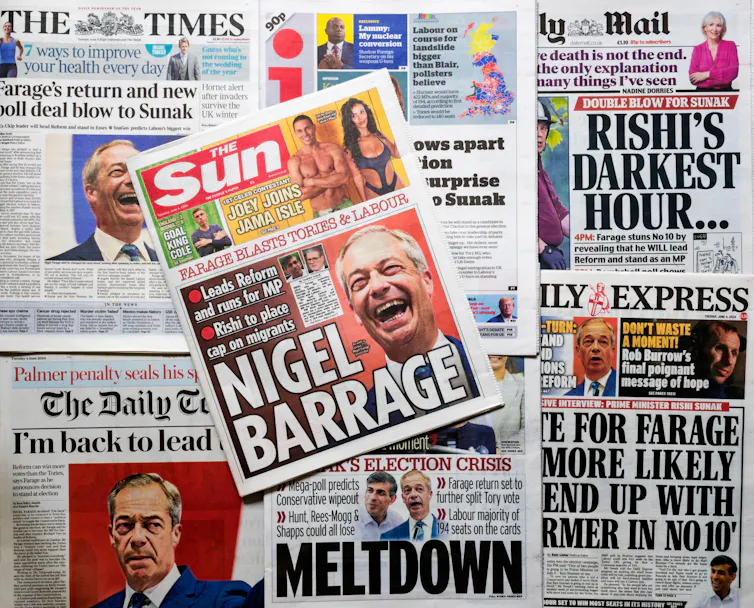
In case you missed it… Alamy/Urban images


All this is to say, Farage has simply never been that popular. This is despite him campaigning in incredibly fertile environments in which parts of the media are dedicated to propping him up, and where even those who seemingly oppose his politics cannot get enough of him – as demonstrated by his record number of appearances on the BBC or the countless articles on “populism” in the Guardian.

Just look at how much coverage a press conference given after one single poll has received, when other parties fail to get issues such as climate change, poverty or social care on the agenda.

And if you think this is because immigration is people’s key concern, think again. Indeed, as I explored with Lancaster university’s Aaron Winter in a report for the Runnymede Trust, the “immigration issue” is one that is clearly constructed in a top-down manner. Unsurprisingly, when people are asked about the key concerns in their personal lives, immigration doesn’t rate. Ironically, the exaggerated focus on immigration could be argued to be elite manipulation rather than the other way around.

So, what’s behind the rise of Farage? Well, the same processes which have been at play across much of Europe: the hyping of far-right politics as a diversion. As has become abundantly clear, there is no mainstreaming or rise of far-right politics without the active involvement of mainstream forces who normalise and platform them.


Want more election coverage from The Conversation’s academic experts? Over the coming weeks, we’ll bring you informed analysis of developments in the campaign and we’ll fact check the claims being made.

Sign up for our new, weekly election newsletter, delivered every Friday throughout the campaign and beyond.


The far right then plays a convenient role, serving to scare the electorate at a time when distrust in governing parties is sky high. The message is: “we are bad but they are worse”.

Yet this strategy is exhausted. Patience has run out and the far right is no longer as repulsive as it once was, now that most mainstream parties mimic its discourse.

The solution is simple. Stop fighting it on its turf. Instead, turn to issues which are not only core to people’s concerns, but far less amenable to far right hijacking. This takes bold actions and real change though – both being in short supply in our mainstream parties.The Conversation

Aurelien Mondon, Senior Lecturer in Politics, University of Bath

This article is republished from The Conversation under a Creative Commons license. Read the original article.

Continue ReadingAnother election, another round of Nigel Farage hype, with no lessons learned

What grief for a dying planet looks like: Climate scientists on the edge

Spread the love

https://www.aljazeera.com/features/2024/6/16/what-grief-for-a-dying-planet-looks-like-climate-scientists-on-the-edge-2

Environmental engineer Wolfgang Metzeler-Kick, centre, and energy engineer Richard Cluse, right, began a hunger strike in March in Berlin, Germany, under the motto “starving until you are honest” in a protest organised by Scientist Rebellion. The protesters seek acknowledgement from the German chancellor of the severity of the climate crisis [Sean Gallup/Getty Images]

Desperate climate scientists embrace civil disobedience and specialised therapy to deal with their growing anxiety over global warming.

“I was scared as hell. … I remember feeling very nervous.”

On April 6, 2022, Peter Kalmus, a climate scientist at NASA’s Jet Propulsion Laboratory, got a ride into downtown Los Angeles, where he was about to handcuff himself to the door of a JPMorgan Chase bank alongside three fellow scientists.

“There was a moment,” he says of the decision to engage in civil disobedience when he “realised that I just had to do it, to find that courage”.

He was joining more than 1,000 activists taking to the streets in nearly 30 countries across the globe under the slogan “1.5C is dead, climate revolution now!” – a campaign led by Scientist Rebellion, an activist group of scientists, academics and students committed to disruptive, nonviolent action to raise alarm over the global climate emergency.

“I was really scared,” Kalmus reiterates over a call, about how his colleagues, the police and, especially, his employer would respond. “I thought there was a very good chance that I’d get fired, which was probably my biggest concern.”

But by that point, he had exhausted all other avenues. For Kalmus, civil disobedience came as a culmination of decades of attempts to raise awareness of the climate emergency by other means. With what he sees as half the country being in denial of the urgency of the climate crisis, Kalmus says he didn’t know what else to do; this was the next logical step and one he admits has been the most effective.

Joining a global day of action in 2022 to ban private jets, Peter Kalmus and local activists chain the doors of a private airport in Charlotte, North Carolina, to underscore the disproportionately high impact the wealthy have in terms of carbon emissions [Courtesy of Will Dickson]

During a speech he delivered that day, which has gone viral around the world, Kalmus is visibly emotional, breaking down in tears as he tells the onlookers: “So I’m here because scientists are not being listened to. I’m willing to take a risk for this gorgeous planet – for my sons,” he gasps as he tries to control the tremor in his voice. “I’ve been trying to warn you for so many decades, and now we’re heading towards a f****** catastrophe.”

After a standoff with police and an eight-hour stint in jail, Kalmus was charged with misdemeanour trespassing, but the charges were later dropped. That first arrest felt exhilarating and freeing, he says, but the incident led to a months-long investigation by NASA’s ethics and human resources departments, and the resulting stress caused Kalmus’s diverticular disease to flare up. While he was stuck in a holding pattern awaiting the outcome of the inquiry, which ended in his favour (Kalmus is still employed by NASA and spoke to Al Jazeera in a private capacity), Kalmus felt like the institution was making a mistake by not supporting his activism “since climate activists are clearly on the right side of history”, he says.

Article continues at https://www.aljazeera.com/features/2024/6/16/what-grief-for-a-dying-planet-looks-like-climate-scientists-on-the-edge-2

Continue ReadingWhat grief for a dying planet looks like: Climate scientists on the edge