China cancels line of credit, pulling the plug on Argentina’s ‘anarcho-capitalist’ president

Spread the love

Original article by JAMES MEADWAY republished from People’s World under http://creativecommons.org/licenses/by-nc-nd/3.0/us/.
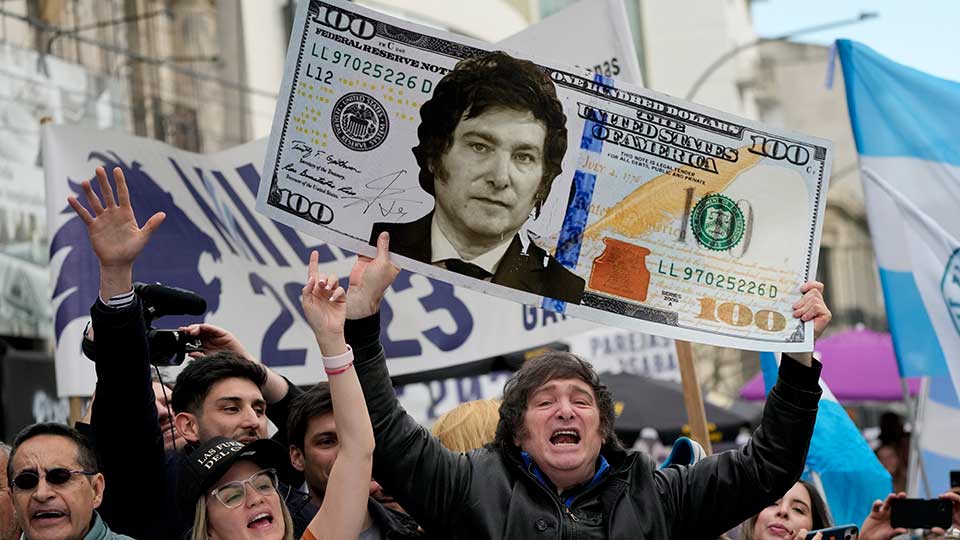
Dollarization: Javier Milei holds up a giant cardboard sign depicting a U.S. $100 banknote emblazoned with an image of his face during a rally in La Plata, Sept. 12, 2023. Milei wants to replace the peso with the U.S. dollar as Argentina’s currency and says that the country’s Central Bank should be abolished. He’s got a new financial challenge, though: China just cut his line of credit. | Natacha Pisarenko / AP

The Chinese government may have pulled the plug on far-right “anarcho-capitalist” President of Argentina Javier Milei, just weeks after his shock election win.

In a spectacular demonstration of how the lines of geopolitical power are shifting, the People’s Bank of China has withdrawn its “swapline” to the Argentinian central bank, depriving it of a vital source of cheap funding.

This leaves debt-ridden Argentina without ready access to funding to meet its promises to pay creditors. These international creditors include the IMF, to whom Argentina owes a world-record $43 billion. China provided the Argentinian government with funds for its $2.7 billion IMF repayment over the summer, lending it ultra-cheap foreign currency through its swapline arrangement.

Milei, a fanatical free marketeer, was elected with 55% of the vote in November from a population desperate for a break with the failed political Establishment. Developing his public profile through TV appearances and his 1.4 million followers on TikTok, Milei was able to present his program of ferocious spending cuts and the abolition of the Argentinian currency, the peso, as the bitter medicine the country needed to end its economic crisis. Younger voters, in particular, flocked to him in droves.

This was a product of desperation. Two-fifths of Argentinians live below the poverty line, and close to 60% of children. Inflation was over 140% when the election campaign ended, meaning prices doubling roughly every six months.

Since the government defaulted—halted payments—on its debts at the end of 2001, the two decades since have seen governments both pro and anti-neoliberal attempts to negotiate agreements with Argentina’s creditors and break the cycle of crises.

The latest round of these was a colossal 2018 loan from the IMF, attached to conditions on cutting government spending over the following three years.

But what tipped the country over the edge into its latest round of crisis has been the catastrophic drought that began in 2019. This ongoing drought is the worst for over 60 years, hammering farmers and severely cutting harvests—soybean production fell to its lowest level for a century.

For a country dependent on agricultural exports for foreign exchange earnings, it has been a disaster. Its trade deficit ballooned, taxes fell and government spending mushroomed. Government borrowing swelled and the Argentina central bank resorted to issuing more money to cover spending costs. Climate change almost certainly worsened the drought.

Milei’s program offered nothing on this—he is a climate change denier, claiming that those who “blame the human race” for climate change are “fake…only looking to raise funds for socialist bums who write for fourth-rate newspapers.”

The colorful language is very much part of his appeal, along with waving a chainsaw at his public appearances, to symbolize what he planned for government spending, and smashing a piñata of the central bank on live TV.

But cartoonish posing shouldn’t kid us: Milei’s program is neoliberalism on steroids. He campaigned on a promise to cut government spending by 15% of Argentina’s GDP.

His plan to abolish the peso and “dollarize” the economy was arguably even more radical, claiming this would prevent Argentinian bureaucrats and politicians from printing money. Although two other Latin American countries, Ecuador and Panama, use the dollar as their official currency, neither is the size of Argentina, the continent’s second-largest economy.

And while many Argentinians already use the dollar, with $246 billion in dollar savings, the government has no dollars to hand, and would have to either buy them to replace pesos, or perhaps seize them from those mostly middle-class savings.

The plan is a non-starter. Confronted with the economic realities, Milei has rapidly defaulted to conservative type, appointing a former president of the central bank, Luis Caputo, as his economy minister, and appointing a close associate of Caputo as the new central bank head. So much for “burning it down.”

The ferocious spending cuts are still planned, along with a 54% devaluation of the peso as part of a program approved by the IMF.

Far from a radical break, Milei is a stooge for the maintenance of Argentina’s failed elite—including even the rehabilitation of the dictatorship, with his running mate for Vice President, Victoria Villaruel, claiming the figure of 30,000 “disappearances” under the regime is a “myth.”

This is a familiar pattern. Across the world, supposed populists from the radical right have taken power, often with the promise of taking on corrupt local elites. They don’t follow through.

Italy’s radical right government, for example, in August threatened a windfall tax on banks that were profiteering from interest rate rises. But they rapidly backed down after howls of protests from the banks themselves.

Milei has almost certainly bitten off more than he can chew. Expecting protests, harsh new guidelines for police and military, including the criminalization of the parents of younger protests have been rushed through—“prison or bullet,” as one pro-government MP described them. Inflation has accelerated, to 3,678% a year, which the government are now using to justify their “shock therapy.”

However, it is anti-China posturing that could prove his undoing. China is Argentina’s second-biggest market for exports, and loans from China make up over 42 per cent of Argentina’s foreign exchange reserves.

Yet Milei called China an “assassin” during his election campaign, promising to sever ties and instead reorienting Argentina towards full-throated support for Israel and the U.S. Argentina’s foreign minister has confirmed that the country would not be joining the China-led BRICS coalition, as pledged by the last government.

This was treated as a “slap in the face” by China: Cutting loan support to Argentina is the inevitable response. As Milei himself might put it: Fuck around and find out.

Morning Star

Original article by JAMES MEADWAY republished from People’s World under http://creativecommons.org/licenses/by-nc-nd/3.0/us/.

Continue ReadingChina cancels line of credit, pulling the plug on Argentina’s ‘anarcho-capitalist’ president

Milei Couples ‘Total Crackdown’ on Protest With Economic Shocks in Argentina

Spread the love

Original article by Julia Conley at Common Dreams shared under Creative Commons (CC BY-NC-ND 3.0).

Argentinian President Javier Milei looks on after the polls close in the presidential runoff election on November 19, 2023 in Buenos Aires, Argentina. (Photo: Tomas Cuesta/Getty Images)

“Protest is elemental to Argentine social and political life, so it’s not difficult to imagine how this ends,” said one journalist.

As the human impact of Argentinian President Javier Milei’s “shock treatment” to the South American country’s economy became increasingly clear with rising prices on Thursday, Security Minister Patricia Bullrich announced what one journalist said were doubtlessly “preemptive” new controls on protests to discourage a struggling population from speaking out.

Bullrich said four security forces—the Federal Police, the Gendarmerie, the Naval Prefecture, and the Airport Security Police—will work together to stop protests that block streets and suggested the protocol is aimed only at ensuring “that people can live in peace” without demonstrators blocking traffic.

But as Progressive International co-general coordinator David Adler and others noted, the measures also include calls for armed forces to break labor strikes, create a national registry of people who organize protests, and sanctions against parents who bring their children to demonstrations.

The new package amounts to “a total crackdown on Argentine civil society,” Adler said.

https://twitter.com/davidrkadler/status/1735666098127733129?ref_src=twsrc%5Etfw%7Ctwcamp%5Etweetembed%7Ctwterm%5E1735666098127733129%7Ctwgr%5Edc4c076d58c4fd3232ae472103691fce93a38f1a%7Ctwcon%5Es1_c10&ref_url=https%3A%2F%2Fwww.commondreams.org%2Fnews%2Fmilei

Bullrich’s announcement came days after Milei, a far-right libertarian economist who has called the climate crisis “a socialist lie” and has been compared to former U.S. President Donald Trump, announced in the first weeks of his presidency an economic “shock treatment” package including a devaluation of the peso by 50%, from 400 pesos to the U.S. dollar to 820 pesos.

The administration also said it would cut public spending by closing some government ministries, increasing retirements ordered by decree, reducing energy and transportation subsidies, and freezing public works, with further “profound” measures expected in the future.

Milei claimed that with the spending cuts, government revenues will ultimately increase by 2.2 points, helping to confront an economic crisis in which annual inflation exceeds 160%, the country has a trade deficit of $43 billion, and $45 billion is owed to the International Monetary Fund (IMF).

But as Milei’s “open heart surgery of the economy,” as El País called the package, took hold, prices of some goods and services rose by 100% and some commuters worried that they will no longer to be able to afford their daily commutes it transit agencies are forced to raise prices due to lost subsidies.

“If [the bus fare] goes up, my salary will be spent on transport,” Julia González, who takes three buses and a train to her job in downtown Buenos Aires, toldThe Associated Press.

About 40% of Argentinians live below the poverty line and more than 9% are destitute, reported El País, with incomes insufficient to buy food.

Economist Juan Manuel Telechea told the outlet that monthly inflation could reach 30-40% due to the devaluation and that social aid will be “highly insufficient.”

Presidential spokesperson Manuel Adorni said of the economy Wednesday that Milei “found a patient in intensive care about to die,” but one trade unionist told El País the president is “exaggerating the inherited crisis situation to justify inadmissible measures, which will increase poverty levels in Argentina above 50% in a matter of days.”

“The mega-devaluation that is being carried out is a matter of concern because it may devolve into hyperinflation,” Pato Laterra, an economist at the National University of La Plata, told the newspaper.

Mark Weisbrot, co-director of the Center for Economic and Policy Research, said last month that Argentina’s current economic crisis is the result of right-wing former President Mauricio Macri’s administration, which took out the largest loan ever from the IMF and pushed the economy into a recession, with poverty and inflation rising by 50% or more.

“But a crazed, economically suicidal approach would only make things worse—and as Argentina has experienced, things can get a lot worse,” said Weisbrot. “Milei displays a callous disregard for most people’s living standards, values, and well-being, as well as a commitment to widely discredited economic policies, that is unprecedented.”

Jacob Sugarman of the Buenos Aires Heraldsaid Wednesday that it remains to be seen “how long Argentine society is willing to tolerate this kind of pain” and suggested that Bullrich’s announcement of a crackdown on dissent is likely to further anger the public.

“Protest is elemental to Argentine social and political life, so it’s not difficult to imagine how this ends,” said Sugarman, “especially with Bullrich announcing that the government will use federal forces including the National Military Police to break picket lines.”

Original article by Julia Conley at Common Dreams shared under Creative Commons (CC BY-NC-ND 3.0).

Continue ReadingMilei Couples ‘Total Crackdown’ on Protest With Economic Shocks in Argentina

Wes Streeting says NHS uses winter crisis as excuse to ask for more money

Spread the love

This is the evil Neo-Liberal siht who will be in charge of the NHS if Labour come to power at the next General Election

Official portrait of Wes Streeting crop 1

https://www.theguardian.com/society/2023/dec/10/wes-streeting-nhs-uses-winter-crisis-excuse-more-money-labour

Shadow minister tells health service ‘money is tight’ and that it must provide better value for taxpayers

The shadow health secretary has accused the NHS of using every winter crisis and challenge it faces as an excuse to ask for more money.

Speaking on a visit to Singapore, Wes Streeting said the health service needs to accept “money is tight”, and that it must rethink how the care it provides could provide better value for money for the taxpayer.

“I think people working in the NHS and the patients using the NHS can see examples of waste and inefficiency,” he told the Sunday Times. “I don’t think it’s good enough that the NHS uses every winter crisis and every challenge it faces as an excuse to ask for more money.”

He added: “The NHS is going to have to get used to the fact that money is tight and it’s going to have to get used to switching spend, and rethinking where and how care is delivered to deliver better outcomes for patients and better value for taxpayers’ money. At the moment, I think we get the worst of all worlds, which is poor outcomes alongside poor value for taxpayers.

“I’m willing to give people more freedom to innovate and create as long as they deliver. That’s the tough love that people can look forward to if I become the health and social care secretary.”

https://www.theguardian.com/society/2023/dec/10/wes-streeting-nhs-uses-winter-crisis-excuse-more-money-labour

Hospitals ‘falling to bits’ as NHS in England faces record £12bn repair bill

Continue ReadingWes Streeting says NHS uses winter crisis as excuse to ask for more money

Kissinger: a war criminal who served US imperialism

Spread the love

https://www.morningstaronline.co.uk/article/f/kissinger-a-war-criminal-who-served-us-imperialism

There was no regime so obnoxious, no tyrant too murderous, for Henry Kissinger’s blessings to be withheld, provided only it upheld US strategic interests

Celebrated for his diplomacy, especially over China, his true face was that of a callous murderer with the blood of millions on his hands, writes ANDREW MURRAY

HENRY KISSINGER, the US diplomat associated with some of the worst crimes of the cold war, has died at the age of 100.

He packed his worst offences against humanity into just six of those hundred years, when he served as national security adviser or secretary of state, and sometimes both, to presidents Nixon and Ford from 1969 to 1975.

A Metternich of the 20th century, Kissinger was a practitioner of cynical realpolitik in the service of the interests of US imperialism.

Even after leaving office, he retained considerable influence for decades, advising successive US administrations and various private clients on world affairs.

He is above all associated with the murderous bombing of Cambodia and the first outreach of Washington to socialist China, as well as support for the fascist coup in Chile in 1973, the pursuit of detente-through-strength with the USSR and peripatetic “shuttle diplomacy” during the Yom Kippur war between Israel and Arab states.

https://www.morningstaronline.co.uk/article/f/kissinger-a-war-criminal-who-served-us-imperialism

Continue ReadingKissinger: a war criminal who served US imperialism

COP28: oil pushers scrape the barrel as critical climate talks begin in Dubai

Spread the love
El Pollock / Oil tankers, Tranmere Oil Terminal / CC BY-SA 2.0

Jack Marley, The Conversation

Days before the latest climate summit is due to begin in Dubai, the first flight powered entirely by “sustainable aviation fuel” landed safely in New York.

The twin engines of this Boeing 787 Dreamliner ran on farm waste and used cooking oil, an alternative to the kerosene that is usually dug up, refined and burned to satisfy the wanderlust of a relatively wealthy minority of Earth’s people.

Sadly, the entire event was a stunt, say political economists Gareth Dale (Brunel University London) and Josh Moos (Leeds Beckett University). They point out that the market for cooking oil is poorly regulated, and so “sustainable fuels” can come from palm oil plantations which have devastated orangutan habitat in the tropics.

The result is “a smoke-and-mirrors exercise” designed to give the illusion of a world leaving fossil fuels behind, they say. With climate disasters mounting and greenhouse gas emissions at an all-time high, the same could be said for the UN negotiations themselves.


Imagine weekly climate newsletter

This roundup of The Conversation’s coverage of COP28 comes from our weekly climate action newsletter. Every Wednesday, The Conversation’s environment editor writes Imagine, a short email that goes a little deeper into just one climate issue. Join the 30,000+ readers who’ve subscribed.


First, let’s check in on the climate.

“Eight years ago, the world agreed to an ambitious target in the Paris Agreement: hold warming to 1.5°C to limit further dangerous levels of climate change,” says Brendan Mackey, an environmental scientist at Griffith University.

“Since then, greenhouse gas emissions have kept increasing … In 2023, the world is at 1.2°C of warming over pre-industrial levels. Heatwaves of increasing intensity and duration are arriving around the world. We now have less than 10 years before we reach 1.5°C of warming.”

COP28 in the United Arab Emirates (UAE) will proceed under the shadow of the UN’s global stocktake. This assessed whether humanity was on course to cut emissions in line with the Paris agreement’s targets by 2030.

The results are in: if all national pledges are fulfilled (not guaranteed), global warming will peak between 2.1-2.8°C this century. Blowing past 2°C, the upper temperature target of the Paris agreement, makes triggering feedback loops (like the release of potent greenhouse gas methane from Arctic permafrost) and catastrophic sea-level rise more likely.

For a chance to avoid climate breakdown and limit warming to 1.5°C, the world needs to prevent greenhouse gases equivalent to 22.9 gigatonnes of carbon dioxide (CO₂) from reaching the atmosphere over the next six years. This is roughly how much the top five polluters (China, US, India, Russia and Japan) emit in a year.

Tasked with leading negotiations to secure this outcome is Sultan Al Jaber, chief executive of Adnoc, the UAE’s state-owned oil company. Al Jaber and the UAE hosts were recently embarrassed by leaked documents showing they intended to pitch oil and gas deals to international delegates at the summit.

“The UK invited ridicule by expanding its North Sea oil fields less than two years after urging the world to raise its climate ambitions as summit host. The UAE seems destined for a similar fate – before its talks have even begun,” say Emilie Rutledge and Aiora Zabala, economists at the Open University.

On the agenda at COP28 is a proposed target for tripling renewable energy capacity and doubling the efficiency of existing sources by 2030. Delegates from countries within the High Ambition Coalition demand a written agreement to halt the burning of coal, oil and gas which accounts for roughly 90% of all CO₂ emissions.

Rutledge and Zabala argue that the UAE is an apt case study for the inertia which seems to prevent countries from meeting these aims. The Persian Gulf state subsidises rampant energy use among its public with oil and gas sales that total 80% of government revenues.

Little wonder the UAE would rather talk about the potential for technology to mop up its emissions.

“Adnoc, along with the wider oil and gas industry, has invested in carbon sequestration and making hydrogen fuel from the byproducts of oil extraction. According to the Intergovernmental Panel on Climate Change (IPCC), such measures, even if fully implemented, will only have a small impact on greenhouse gas emissions,” Rutledge and Zabala say.

Where’s the money?

Another test of the UN negotiations will concern the money needed to help developing countries phase out fossil fuels, adapt to a hostile climate and overcome the damage wrought by greenhouse gases overwhelmingly produced by developed countries.

According to the UN, 80% of climate change can be attributed to G20 countries, a group consisting of the world’s major economies.

“For decades, nations have wrestled over the fraught question of who should pay for loss and damage resulting from climate change,” says Mackey.

“Now we’re close to finalising arrangements for the new Loss and Damage Fund. This will be [a] major issue for negotiators at COP28.”

Lisa Vanhala, a professor of political science at UCL, has followed the wrangling over a fund to compensate poor nations for climate change since one was agreed in principle in 2013. Ten years later, questions remain over who will pay into it, who will be able to draw from it and who will control it.

The last of those three questions was at least partially answered in early November. The World Bank, headquartered in Washington D.C., will administer the fund for an interim period. This would give rich donor countries like the US disproportionate influence over loss and damage funding, Vanhala says, and is a far cry from the partnership model small-island developing states had urged.

The World Bank traditionally offers loans instead of grants. Developing countries have consistently argued this funding should not increase a recipient’s debt burden, Vanhala says. And a board member for another fund hosted by the World Bank has reported that the admin fees it charges are rising and absorbing a larger share of its aid.

“This could mean that, for every US$100 billion offered to countries and communities reeling from disaster, the World Bank will keep $US1.5 billion. This will be hard for an institution still funding the climate-wrecking oil and gas industry to justify,” Vanhala adds.

Aside from loss and damage, rich countries failed to keep a promise to raise US$100 billion of climate change mitigation and adaptation funding by 2020. This money would help the most vulnerable nations build sturdier storm defences and solar farms, for instance, and will be the subject of heated debate at COP28.

US and EU negotiators have argued that China, the world’s second largest economy and its current biggest emitter, should be obliged to contribute to such funding – despite sitting with other developing countries in the UN talks.

But a new analysis by Sarah Colenbrander, director at the Overseas Development Institute and guest lecturer in climate economics at the University of Oxford, tells a different story. By following the substantial climate aid China already provides via other channels, such as multilateral development banks, Colenbrander argues that the real laggard and obstacle to a financial settlement is the US.

“The fastest way to restore trust in the international climate regime would be for the US to step up with its fair share of climate finance,” she says.

“Only once the developed countries have fulfilled their longstanding promise does a conversation about new climate finance contributors become politically possible.”The Conversation

Jack Marley, Environment + Energy Editor, The Conversation

This article is republished from The Conversation under a Creative Commons license. Read the original article.

Continue ReadingCOP28: oil pushers scrape the barrel as critical climate talks begin in Dubai