Israel-US and Iran War: A geostrategic transformation

Spread the love

This work by Middle East Monitor is licensed under a Creative Commons Attribution-NonCommercial-ShareAlike 4.0 International License

U.S. Navy warplane takes off from the aircraft carrier USS Abraham Lincoln during Operation Epic Fury targeting Iran in the Gulf of Oman, on March 01, 2026. [U.S. Navy / Handout – Anadolu Agency]

by Dr Zakir Hussain

After the 12-day war in May last year, it was clear that both sides would be face-to-face soon. They restarted on 28th February 2026. Israel-US adopted the same pattern of targeting the top brass, including the Grand Leader, Ayatollah Ali Khamenei, on the very first day, thinking that in the absence of these officials, the Iranian administration would be like a rudderless ship. This would create confusion and provide an easy opportunity for regime change.

Thirteen days have passed, yet there are no visible signs of either the fall of the regime or a pause or ceasefire. Despite US-Israel’s anguish, Iran selected Mojtaba Khamenei as the new supreme leader – an act of defiance.

Both sides continue to bombard each other’s vital infrastructure, including civilian and military targets. Energy installations such as oil depots and refineries have become primary targets. Under a tit-for-tat policy, Iran has also declared that financial centers, banks, and offices of major technology companies such as Google, YouTube, and Microsoft could be the next targets. Already 26 US bases have been targeted. Following the assassination of Ayatollah Ali Khamenei, the conflict rapidly expanded from a limited confrontation into a regional war, and with the blockade of the Strait of Hormuz, its effects are now visible in the global economy and in the daily lives of ordinary people. Approximately 130 oil ships are anchored, stopping 20% oil which passes through the narrow strait of 33 km. Already four ships were targeted which tried to bypass the warning.

Among the GCC countries, the UAE faced the highest number of attacks.

Iran’s aggressive response and selection of Mojtaba, a hardliner, as Ayatollah, appear to indicate that Iran is prepared for a prolonged conflict, whereas the United States and Israel seem eager to conclude the war quickly. Meanwhile, President Trump’s plan to send Kurdish Peshmerga into Iran via Iraq seems like another disaster.

READ: Trump says US ‘ahead of schedule’ in Iran war, claims most missiles destroyed

Tehran had been closely and patiently observing military buildups in the Indian Ocean, the Gulf of Oman, and the Mediterranean Sea for several weeks. The United States mobilized a substantial part of its defence capabilities, including naval armadas and two aircraft carriers, Abraham Lincoln and Gerald Ford. Hundreds of fifth-generation stealth fighter jets were deployed along with advanced air-defence systems such as THAAD and large stockpiles of interceptors.

In addition, the United States strengthened its military presence across several bases in the Gulf region, including Qatar, Bahrain, Oman, the United Arab Emirates, Kuwait, Saudi Arabia, Jordan, and Iraq.

Israel also appeared determined to launch what it described as a “fight-to-the-finish” war with the Islamic Republic. Prime Minister Benjamin Netanyahu repeatedly stated that he had been waiting for such a war for nearly forty years. Iran, on the other hand, has long maintained that it began preparing for such a scenario after the 2003 US-led invasion of Iraq and the fall of Saddam Hussein.

The earlier conflict in May had already revealed the strengths and weaknesses of both sides. However, the current course of the war suggests that the US–Israel alliance underestimated Iran’s military capabilities, particularly its missile and drone systems, careful planning, and effective use of its military resources.

Compared with the US–Israel alliance, Tehran appears to possess a clearer understanding of its adversaries’ strengths, limitations, and operational constraints.

Iran was also aware of its own limitations. Its air force cannot match the capabilities of US and Israeli fighter jets, and its airspace remains vulnerable to aerial attacks. As the conflict expanded, these vulnerabilities became evident. At the same time, the United States and Israel appeared to have an incomplete assessment of Iran’s capabilities. Although they possessed precise intelligence about the locations of Iranian leaders and senior officials—they killed several commanders and Ayatollah Ali Khamenei-they appeared to lack detailed knowledge of Iran’s missile infrastructure, drone networks, and underground silos developed over several decades.

It also appears that the US–Israel side underestimated the possibility of indirect assistance from Russia and China, relying heavily instead on air superiority and defensive shield systems.

Iran’s war strategy

A detailed military assessment would require expert analysis, but developments in the conflict suggest that Iran followed a three-stage strategy.

First, Iran responded to the US-Israel attacks by deploying large numbers of drones, many reportedly stored since 2011 and 2013. These drones forced US–Israel defence systems to respond with expensive interceptors. In financial terms, this created an asymmetric dynamic: Iranian drones costing between $20,000 and $50,000 were intercepted by missiles costing between $1 million and $2 million. As the wave of drone attacks continued, interceptor stocks began to decline, gradually exposing the airspace of US bases and Israel to greater risk.

Second, once defensive systems were strained, Iran launched more advanced missiles targeting radar installations, communication centres, satellites, and data facilities. Reports indicate damage to communication and data infrastructure at the Al Udeid Air Base in Qatar and at military installations in Bahrain. Such attacks disrupted surveillance and communication systems that coordinate missile defence networks such as THAAD, David’s Sling, Arrow, and Iron Dome. Command and monitoring centres that once gathered and transmitted military data across thousands of kilometres became severely limited in their operations.

Third,

Iran escalated its attacks using hypersonic missiles while adopting a tit-for-tat strategy. These strikes targeted refineries, military bases, and strategic infrastructure in Israel. Some reports suggest the use of the Khorramshahr-1 missile equipped with submunitions capable of dispersing dozens of warheads over a wide area, complicating interception efforts.

Meanwhile, attacks on naval assets reportedly forced aircraft carriers operating in the Gulf of Oman to reposition farther from the Iranian coastline.

READ: Two weeks in, Iran strikes inflict nearly $4B in US military losses

Hormuz blockade and its impact

After weakening regional defence systems, Iran announced a blockade of the Strait of Hormuz. This strait is one of the world’s most critical energy corridors, through which roughly 20 percent of global crude oil and a similar share of liquefied natural gas passes.

At present, around 130 oil tankers are reportedly anchored in the strait. Iran claims effective control over the Hormuz chokepoint.

It has targeted four vessels, including one linked to India, that attempted to pass through. Iran has reportedly deployed underwater tunnels and small, agile boats to intercept or attack ships that violate the blockade.

At the same time, attacks on energy facilities in Saudi Arabia and the temporary closure of Qatar’s Ras Laffan gas facilities disrupted global energy supplies. As a result, gas prices in Europe rose sharply while crude oil prices increased from about $62 per barrel to more than $100. Some analysts warn that if the conflict continues, oil prices could rise further, potentially reaching $200 per barrel. Such developments could trigger inflation, supply-chain disruptions, and rising unemployment worldwide.

Future of the War

Iran appears determined to pursue its objectives and may not halt operations even if a ceasefire is proposed by the United States or Israel. The selection of Mojtaba Khamenei as the new supreme authority signals continuity of leadership, consolidation of political control, and a claim of legitimacy within the existing system.

Large public gatherings during funeral processions and demonstrations suggest that, at least during wartime, sections of the population have rallied around the leadership.

Reports have also mentioned proposals to deploy Kurdish Peshmerga forces into Iran through Iraq. However, the region’s history suggests that such operations would face significant geographical and logistical difficulties. During the Iran–Iraq War, Saddam Hussein also attempted to advance through the mountainous terrain of the Zagros region but faced serious constraints.

Some Iranian sources have claimed the capture of US special forces personnel and the killing of several Israeli officials during the conflict, although many of these claims remain difficult to verify independently.

Chances of a Ceasefire

Iranian authorities have reportedly outlined three conditions for a ceasefire. First, all military attacks by the United States and Israel must stop immediately. Second, Tehran seeks assurances that such attacks will not be repeated in the future. Third, Iran demands recognition of its sovereignty and compensation for damages caused during the conflict. These conditions are not easy. Who will ensure that the U.S. and Israel would not attack in the future? Second, who will pay the reconstruction cost, etc.? It is true that regional problems can be resolved only when the issue of Palestine is resolved in a fair and just manner. Lebanon and Yemen, Syria also need attention.

Future Trajectory-Palestine solution is the only solution

Even if the present war stops, regional stability will remain uncertain. Long-standing political and security disputes remain unresolved. Israel is unlikely to abandon its strategic objectives, Greater Israel, while tensions involving Hezbollah and Hamas are likely to persist. The United States may also increase pressure on Gulf states to revise their security arrangements so that regional partners become more directly involved in future conflicts.

Implications for India

For India, energy security remains a major concern. Disruptions in the Strait of Hormuz could affect oil supplies and trade routes. Approximately 50% oil passes through the route, while Houthis are there to choke off the Red Sea navigation. 

India must also prepare contingency plans for the evacuation of its 9 million workers from the region and strengthen logistical arrangements to safeguard trade and shipping routes in the event of prolonged instability. Chemical fertilizers are another major concern for India. The region provides the bulk of fertilizers and ensures food security. Disruption in supply line has significantly affected the supply of fresh vegetables, perishable items including agriproducts , poultry and meat products 

In the long term, India is to sign a long term energy agreement with the US. At the same time, India needs a more coherent West Asia policy and must avoid being drawn into the region’s strategic conflicts. The region is sensitive as well as vital to India’s economy and geostrategy. India needs a careful policy.

OPINION: Iran is not Venezuela: Gen-Z would fail to defeat diehard ayatollahs

The views expressed in this article belong to the author and do not necessarily reflect the editorial policy of Middle East Monitor.

This work by Middle East Monitor is licensed under a Creative Commons Attribution-NonCommercial-ShareAlike 4.0 International License

Climate science denier Donald Trump says that more liquid gold is being secured according to his policy of global privateering
Donald Trump explains why he established his Bored of Peace
Donald Trump warns against following the https://onaquietday.org blog, says that it's easy atm, she only needs to report war crimes supporting Israel's genocidal expansion.
Donald Trump warns against following the https://onaquietday.org blog, says that it’s easy atm, she only needs to report war crimes supporting Israel’s genocidal expansion.
Continue ReadingIsrael-US and Iran War: A geostrategic transformation

The economics behind wars

Spread the love

This work by Middle East Monitor is licensed under a Creative Commons Attribution-NonCommercial-ShareAlike 4.0 International License

People take part in a protest and march gathering at Times Square on Al-Quds Day, to oppose the joint U.S.–Israel war on Iran in New York City, United States on March 13, 2026. [Mostafa Bassim – Anadolu Agency]

by Muhammad Bilal Malik

War is not a violation of the international order. For a select few, it is the international order working exactly as intended; a machine that converts human suffering into corporate profit, political advantage, and generational wealth. The bombs that fall are not random. They are a calculated strategy, and behind every calculation sits a balance sheet.

In 2024, the world’s top 100 arms manufacturers generated a combined $679 billion in revenue; the highest figure ever recorded in human history. American firms alone accounted for $334 billion of that total. That wealth was not created in a vacuum. It was built, contract by contract, on the rubble of Ukraine, Gaza, Lebanon, and now Iran.

When Russia invaded Ukraine in February 2022, geopolitical tensions surged and a war of survival began on both sides. Ukraine rushed westward, particularly toward the United States, for aid and military hardware. What followed was framed publicly as an act of solidarity. What it actually triggered was one of the most profitable procurement cycles in modern American history.

Raytheon’s CEO Gregory Hayes stood before investors shortly after the invasion and declared the conflict would be “very, very good” for the company’s bottom line. He was not speculating. He was reading the market. Raytheon reported a record $180 billion order backlog in the months that followed. Lockheed Martin posted net earnings of $6.9 billion in 2023; a 21 per cent increase over the previous year, while sitting on $160.6 billion worth of unfulfilled weapons contracts. The US arms export figure hit $200.8 billion in fiscal year 2024, up sharply from $157.5 billion the year before.

These are not incidental numbers. They are the architecture of a system; one that political philosopher Max Weber identified more than a century ago. In The Protestant Ethic and the Spirit of Capitalism, Weber argued that Protestant; particularly Calvinist theology provided capitalism with its moral foundation. Wealth, in this tradition, was not greed. It was divine confirmation. Accumulation was virtue. Profit was blessing.

That theological inheritance echoes loudly in the American defence industry today. A $6.9 billion profit is not merely a financial result. Within the cultural logic that shaped Western commerce, it is evidence of righteousness. And every missile fired is not a tragedy to these corporations. It is an invoice, one paid in human blood, invoiced to the taxpayer, and deposited into shareholder accounts.

READ: “Where are we supposed to go?” The road out of Dahiyeh and Lebanon’s forced evacuations

The mechanism that sustains this system is not secret. It operates in full public view, protected by its own normalisation. It is called the revolving door; the seamless rotation of senior personnel between the Pentagon, the US Congress, and the private defence industry.

A 2021 report by the Government Accountability Office found that 1,700 senior US government officials had moved into arms industry positions over just five years. Over 80 per cent of retired four-star generals and admirals went directly onto defence company boards or into lobbying roles, men who spent their careers making war decisions, now paid to ensure those decisions keep coming.

In 2023, Lockheed Martin deployed 65 lobbyists in Washington. 48 of them were former government insiders. The company spent $14 million on lobbying that year alone. Since 2001, the weapons industry has collectively spent more than $2.5 billion lobbying the US Congress; roughly 700 lobbyists per year whispering into the ears of the men who decide where American bombs fall next.

The men who vote for war and the men who profit from war are, with remarkable frequency, the same men. Or they were last year. Or they will be next year.

President Dwight D. Eisenhower understood this danger intimately. In his farewell address of January 1961, he warned the American public of what he called the military-industrial complex, an alliance between the defence industry and the military establishment that, left unchecked, would corrupt democratic governance and manufacture the conditions for permanent war. He was right. The warning went unheeded. The complex grew.

Now observe what is happening in real time because theory without evidence is merely opinion, and the evidence today is overwhelming.

In the final days of February and the opening days of March 2026, the United States and Israel launched nearly 900 strikes against Iran within a single 12-hour operational window. The US military is burning through an estimated $890 million to $1 billion per day in expenditure. Iran has retaliated with hundreds of ballistic missiles and over 2,000 drones targeting US bases and Israeli territory. More than 1,700 people have been killed in eleven days of exchanges.

Israel-US and Iran War: A geostrategic transformation
The economic consequences have rippled immediately across the globe. Oil prices crossed $100 per barrel for the first time since the Russia-Ukraine war. The Strait of Hormuz: the narrow chokepoint through which 20 per cent of the world’s oil supply passes is under direct threat of closure. LNG prices in Asia more than doubled in a single week after Qatar Energy declared force majeure at the world’s largest liquefaction facility. The Dow Jones Industrial Average lost over 1,000 points in a single session. Global food prices are climbing again, driven by supply chain disruption and fuel cost surges.

Civilians across Iran, Israel, Lebanon, and the Gulf are paying with their lives and livelihoods. And somewhere in Bethesda, Arlington, and the corridors of Capitol Hill, the shareholders are watching the numbers go up.

This is the economics of war in its most brutal form. One conflict. One superpower and its defence industry. One shared outcome, an entrenched elite that profits from permanent conflict, sustained by institutions too compromised, too invested, and too structurally captured to stop it.

The revolving door keeps spinning. The lobbying budgets keep growing. The order backlogs keep lengthening. And with every new conflict, every new theatre of war, every new headline about missiles and drones and civilian casualties, another procurement cycle begins.

The missiles point outward. The money flows inward, upward, always upward, toward the architects of the machine. And the machine, as long as it keeps paying, will never stop.

The views expressed in this article belong to the author and do not necessarily reflect the editorial policy of Middle East Monitor.

This work by Middle East Monitor is licensed under a Creative Commons Attribution-NonCommercial-ShareAlike 4.0 International License

Climate science denier Donald Trump says that more liquid gold is being secured according to his policy of global privateering
Donald Trump explains why he established his Bored of Peace
Donald Trump warns against following the https://onaquietday.org blog, says that it's easy atm, she only needs to report war crimes supporting Israel's genocidal expansion.
Donald Trump warns against following the https://onaquietday.org blog, says that it’s easy atm, she only needs to report war crimes supporting Israel’s genocidal expansion.
Continue ReadingThe economics behind wars

Rocket attack targets US Embassy in Baghdad, damages defense system

Spread the love

This work by Middle East Monitor is licensed under a Creative Commons Attribution-NonCommercial-ShareAlike 4.0 International License

A view of the United States Embassy compound in Baghdad, Iraq, where a missile attack was reported to have caused damage on March 14, 2026. [Murtadha Al-Sudani – Anadolu Agency]

The US Embassy in Iraq’s capital Baghdad came under a rocket attack early Saturday, local media reported, citing a security source, Anadolu reports.

The source told Shafaq News Agency that the attack resulted in the destruction of the embassy’s C-RAM air defense system “completely,” which is used to intercept incoming rockets and projectiles.

The news agency quoted another unnamed security source as saying that “a satellite communications system was destroyed as a result of the attack that targeted the US Embassy compound in Baghdad.”

The source explained that the damaged system was designated “to secure and exchange data via satellites for diplomatic staff and employees inside the compound.”

The source added that the US C-RAM air defense system was unable to intercept an “unidentified drone” that carried out the attack, despite its proximity to the targeted location, which led to the satellite communications system being directly hit.

No immediate reports were issued regarding casualties, and US officials have not yet commented on the incident.

⁠Since Israel and the US launched joint attacks on Iran on Feb. 28, killing some 1,200 people, including then-Supreme Leader Ayatollah Ali Khamenei, hostilities have escalated.

Iran has retaliated with drone and missile strikes targeting Israel, Jordan, Iraq, and Gulf countries hosting US military assets.

B-2 stealth bombers used in operation against Iran: US Central Command

This work by Middle East Monitor is licensed under a Creative Commons Attribution-NonCommercial-ShareAlike 4.0 International License

Climate science denier Donald Trump says that more liquid gold is being secured according to his policy of global privateering
Donald Trump explains why he established his Bored of Peace
Donald Trump warns against following the https://onaquietday.org blog, says that it's easy atm, she only needs to report war crimes supporting Israel's genocidal expansion.
Donald Trump warns against following the https://onaquietday.org blog, says that it’s easy atm, she only needs to report war crimes supporting Israel’s genocidal expansion.
Continue ReadingRocket attack targets US Embassy in Baghdad, damages defense system

Farage regrets move to run ‘bankrupt’ council

Spread the love

https://www.bbc.com/news/articles/c93wv0ylq9yo

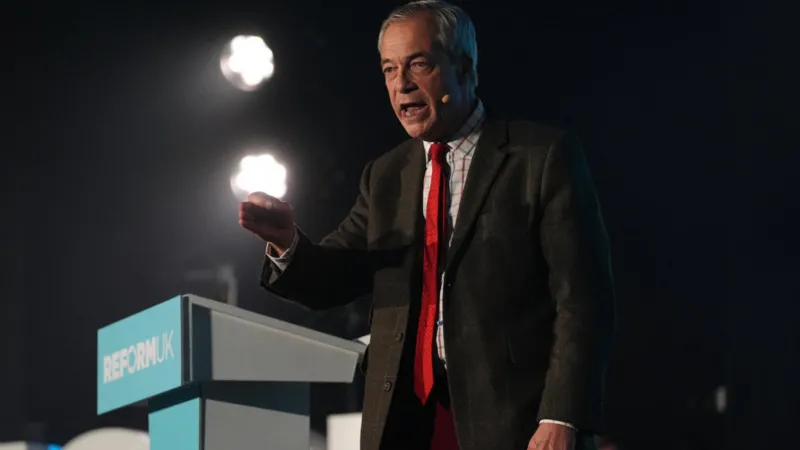
Reform UK leader Nigel Farage said he wished the party “hadn’t bothered” to take minority control of Worcestershire County Council

Reform UK leader Nigel Farage has said he wishes the party “hadn’t bothered” to take minority control of Worcestershire County Council, because of its financial problems.

The Reform-led authority recently approved a council tax rise of almost 9%, one of the largest in its history, in a bid to balance its books and avoid effective bankruptcy amid a budget shortfall.

When questioned about the decision to increase tax, which is higher than the standard 5% normally allowed, Farage said the party had inherited the council and “didn’t make it bankrupt”.

A Reform UK spokesman, addressing Farage’s comments, said the party had “stepped up” and had done its “civic duty”.

He added: “Despite inheriting a catastrophic mess from the Tories and a council that had to be propped up by government bailouts, our team has fought hard to deliver a responsible budget and avoid raising council tax to the maximum.”

Reform UK, which had previously pledged to cut tax during its election campaign, took over leadership of the authority from the Conservatives following the local elections in May, but has no overall majority.

Article continues at https://www.bbc.com/news/articles/c93wv0ylq9yo

Nigel Farage reminds you that he's the man that brought you Brexit and asks what could possibly go wrong.
Nigel Farage reminds you that he’s the man that brought you Brexit and asks what could possibly go wrong.
Nigel Farage explains the politics of Reform UK: Racism, Fake anti-establishmentism, Deregulation, Corporatism, Climate Change Denial, Mysogyny and Transphobia.
Nigel Farage blames the Muzzies.
Continue ReadingFarage regrets move to run ‘bankrupt’ council

How Europe’s Climate and Sustainability Rules Were Shredded While Citizens Remained in the Dark

Spread the love

Original article by Hugh Wheelan and Raj Thamotheram republished from DeSmog

(Credit: Mahen Rin/Unsplash)

Policymakers, civil society, investors, business, and the media all must answer key questions fast — before the regulatory rollback turns into a rout.

The European Union’s package of major corporate environment and sustainability laws was years in the making — and has just been quietly gutted.

A debate that reshaped corporate Europe unfolded almost entirely within Brussels policy circles. Millions of Europeans who believe climate action should be prioritised and favour greater corporate accountability never realized the regulations were under threat

This should prompt serious reflection among those of us who believe that the climate and human rights focus of the regulations was deadly serious, but that support among politicians was not.

The so-called “Omnibus” rollback — a regulatory rationalisation ascribed to competitiveness concerns amid pressure from the United States – has exempted 90 percent of Europe’s companies from climate reporting. In parallel, supply chain reporting has been seriously watered down and postponed until the end of the decade.

The overturned rules included mandatory reporting by most EU companies of their impact on climate change, and how environmental dangers could affect their business. They also forced companies selling products on the continent to report on child and forced labour issues, as well as potentially dangerous working conditions in their international supply chains.

In today’s economy, corporate lobbyists seize moments of regulatory weakness to ram home anti-growth or relative competitiveness arguments that instantly gather financial and political support.

Indeed, the printer ink had barely dried on the official publication of the EU Omnibus — finalised this month — before companies started attacking the EU’s 20-year-old Emissions Trading System (ETS) carbon pricing regime on similar international competition grounds.

If we don’t quickly digest the lessons of the Omnibus debacle, sterner tests will come as populists challenge for power across the bloc. 

Why Was the Rollback Invisible?

Why was the European public largely unaware of such a huge regulatory rollback?

The reason is that it took place in a legacy media vacuum. No major polling organisation measured citizen awareness. The BBC, The Guardian, Le Monde, and Der Spiegel barely — if at all — covered the vote. 

Further, how can we support and defend policies when we hide them behind letter jumbles like CSRD, SFDR, CSDDD — acronyms that mean nothing to the public? (The Corporate Sustainability Reporting Directive, Sustainability Finance Disclosure Regulation, and Corporate Sustainability Due Diligence Directive, respectively.)

Fluency in Brussels acronyms becomes a political liability when success requires public mobilisation. 

Campaigns succeed with vivid phrases that citizens quickly understand. Surveys consistently show that large numbers of Europeans support corporate accountability when it’s described in plain language. Germany’s “Supply Chain Law” campaign gathered over 200,000 supporters by using a clear, native-language label.

No comparable EU-wide branding effort for the sustainable finance regulations emerged. Defenders of the EU sustainability rules never attempted an equivalent translation.

By contrast, industry lobbyists framed their arguments with accessible language such as “simplification” and “cutting red tape,” while pushing the convenient elements of the Draghi report on EU competitiveness.  Advocates countered with “transposition deadlines,” “ESRS requirements,” and “regulatory coherence.” The contrast was decisive.

Post-defeat reflection on this communications failure has been nearly non-existent.

Green Groups: Bureaucratised and Compromised? 

Typically, the rallying call to voters on environmental and rights regulations comes from non-governmental organisations (NGOs). In the case of the EU climate and sustainability Omnibus, more than 360 NGOs and other civil society organisations signed a coalition statement against the “disastrous” and “dangerous” deregulation.

Over the decades, many European climate and human rights groups have evolved into Brussels-based policy shops that are staffed by lawyers and technical experts fluent in EU procedure, but which seem to be relatively poorly equipped for mass public and political campaigning.

Their efforts produced no mass protests, no breakthrough petitions, and no broad public mobilisation. 

Some NGO funding structures appear to reinforce this limitation. Major foundations often restrict grants against “political or partisan activities,” while EU funding frameworks have introduced reputational-risk benchmarks that discourage confrontational advocacy. Funders also often seek short-term results to long-term problems that require deep, structural change, not “hope-for-the-best” strategy thinking. 

A coalition spanning 27 countries that relies on consensus decision-making could not move quickly. The NGOs deployed the only tools their structures supported: letters, technical briefings, and procedural complaints. The limitation was not a strategic choice; it was institutional. 

Big-spending corporate lobbyists, meanwhile, began organising months before public announcements on the Omnibus were made. In addition, the accelerated legislative timeline of the Omnibus compressed the opposition response time from multiple years to less than one, leaving opponents flat-footed. 

ExxonMobil alone is reported to have had more than 25 meetings with the European Commission to lobby against the CSDDD, and allegedly threatened to withhold $20bn in renewables spending in Europe if it was not rolled back.

We hear there have been reflections by major NGOs on what went wrong. To stop mistakes from recurring, the publication of these learnings is essential.

Why Doesn’t Capital Defend Itself?

Institutional investors representing €6.6 trillion in assets had strong financial incentives to oppose the Omnibus. Their risk analysis was clear: Stranding of major fossil-fuel assets would likely accelerate without transition planning; weakened disclosure rules would leave investors short of necessary climate information; regulatory uncertainty would stall long-term investment; and Europe would forfeit advantages in green technology. 

Citizens’ pensions and long-term savings could face potential portfolio-wide losses if systemic climate risks go unmanaged. 

Investors wrote detailed letters explaining these dangers. 

Then they watched the regulations collapse. 

They did not mobilize beneficiaries, fund public campaigns, or coordinate with the 362 NGOs in the field. The UN-backed Principles for Responsible Investment, the huge investor environment, sustainability and governance (ESG) coalition, could only muster a hundred or so of its 5,000-plus investors to sign a letter warning against a serious unravelling of the regulations. Many of the heavyweight investors in its ranks weren’t there.

The failure reveals a deeper structural problem: Even when capital’s interests align with regulation, financial institutions often lack the political capacity and institutional mechanisms to defend those interests against coordinated opposition.

Why Didn’t Progressive Business and Labour Fight?

Allies with different tools and constituencies struggled to convert shared positions into effective action.

Eighty-eight companies — including Unilever, Mars, Nestlé, Ferrero, DP World, and Primark — signed letters opposing the rollback and acknowledged that customers demanded consistent sustainability standards.

Why didn’t they also launch consumer campaigns, threaten relocation, withdraw from trade associations backing deregulation, or apply coordinated market pressure?

Competitive dynamics discouraged unilateral action by business, and company executives feared appearing overtly political during an ESG backlash. Meanwhile, trade associations often lobbied in the opposite direction.

Trades unions showed similar restraint. Despite representing tens of millions of workers, major confederations limited their involvement largely to signing coalition letters.

Unions excel at domestic workplace negotiations but often struggle with international supply chain issues and EU-level regulatory processes. When industry framed the debate as “regulation kills jobs,” unions faced an apparent dilemma between global labour protections and local employment security. 

Did the Regulation Work?

Businesses and investors respond to clear regulatory signals. They rarely get out ahead of politics or the market without a strong policy or pricing foundation to lean on.

One of the overarching responses we’ve heard from business and finance professionals to the Omnibus policy rollback is that the EU regulatory approach in its Action Plan on green and sustainable finance suffered from a “first principles” problem, skewing heavily towards bureaucratic solutions for policy or incentives problems. 

Many told us, for example, that the EU was not prepared to put the budget stimulus alongside hard regulations to seize the future green technology opportunity. Instead, they opted for a lower cost, weaker, reporting-led investment approach (more data encourages more finance) where actual green output (business R&D, investment flows) may be slow or unclear.

This risks creating a sort of Potemkin Village of climate and sustainability progress, because reporting and compliance solutions cannot replace market drivers such as incentives, infrastructure, or price signals.  

Some of these issues are being addressed, but they have been long in the amendment, despite concerns being raised.

To work, reporting frameworks require a clear, gradual shift in rules or pricing that can surmount competition barriers by underpinning market shifts.

Without it, data collection and research are costly and lack an underlying economic “materiality” (policy push, pricing, time-horizon). They quickly become a comparative drag.

The addition of important but complicated regulations, like supply chain reporting, then gets scapegoated as a further cost to EU companies in globally competitive markets. Bureaucratic overreach is easily lobbied against on competitiveness grounds. Policy row-back then becomes itself highly disruptive, creating a cycle of negativity.

Rationalising data points for corporate reporting and focusing, for example, on the biggest corporate CO2 emitters, as the Omnibus proposes, are not in themselves problematic reforms.  

But it is vital to ensure that policy is smart, joined-up, backed by developments in the real economy, competitive, and road-tested for outcome. 

This will be key to embedding regulations that align with the capital spending decisions that companies are already taking (according to EU data) as a result of the EU’s green taxonomy for sustainable activities.

How Should We Understand the Authoritarian-Fossil Fuel Alliance? 

The Omnibus was not a result of routine corporate lobbying. It reflected a broader geopolitical alignment.

Corporate actors, political movements, and transnational advocacy networks converged around shared economic and ideological interests. Months before public announcement, extensive lobbying campaigns began, leveraging substantial financial resources to coordinate messaging across institutions.

This alignment shifted the terrain from a conventional policy dispute to a power asymmetry.

Civil society coalitions and institutional investors faced opponents with larger budgets and stronger political backing. Investor inaction and NGO limitations become more understandable in this context: The imbalance was structural, not incidental.

We need to reflect deeply on this and what it means for EU sustainability regulations. 

Europe’s Own Leverage: What Can Still Work?

The Omnibus outcome is not final. The EU rules can be improved and made to work with the right public and business support, political will, and technical know-how.

Member states can move ahead independently, setting stronger national standards like Germany’s Supply Chain Law, which companies must meet to access their markets. The EU can lean in to sustainability initiatives via issues of global security, energy transition, and justice.

The economic momentum favours transition: Renewable energy capacity continues to expand and market trends are rewarding low-carbon shifts.

Practical paths forward include coordinated member-state regulation, economic-sovereignty instruments tied to market access, judicial challenges, cross-sector coalitions among cities and businesses, and clearer public narratives that link sustainability to competitiveness and security.

Europe’s regulatory influence remains significant when it acts decisively. Large markets can still set de facto global standards. But to get there we need to start answering these hard questions.

Original article by Hugh Wheelan and Raj Thamotheram republished from DeSmog

Donald Trump urges you to be a Climate Science denier like him. He says that he makes millions and millions for destroying the planet, Burn, Baby, Burn and Flood, Baby, Flood.
Nigel Farage urges you to ignore facts and reality and be a climate science denier like him and his Deputy Richard Tice. He says that Reform UK has received £Millions and £Millions from the fossil fuel industry to promote climate denial and destroy the planet.
Elon Musk urges you to be a Fascist like him, says that you can ignore facts and reality then.
Continue ReadingHow Europe’s Climate and Sustainability Rules Were Shredded While Citizens Remained in the Dark