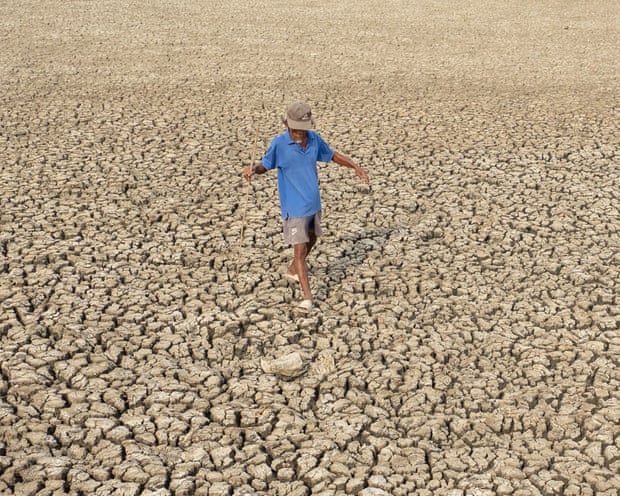
Parched land at Cueva de Las Niñas reservoir in the island of Gran Canaria, Spain, in March 2025. Photograph: Borja Suárez/Reuters
Exclusive: UCL scientists find large swathes of southern Europe are drying up, with ‘far-reaching’ implications
Vast swathes of Europe’s water reserves are drying up, a new analysis using two decades of satellite data reveals, with freshwater storage shrinking across southern and central Europe, from Spain and Italy to Poland and parts of the UK.
Scientists at University College London (UCL), working with Watershed Investigations and the Guardian, analysed 2002–24 data from satellites, which track changes in Earth’s gravitational field.
Because water is heavy, shifts in groundwater, rivers, lakes, soil moisture and glaciers show up in the signal, allowing the satellites to effectively “weigh” how much water is stored.
The findings reveal a stark imbalance: the north and north-west of Europe – particularly Scandinavia, parts of the UK and Portugal – have been getting wetter, while large swathes of the south and south-east, including parts of the UK, Spain, Italy, France, Switzerland, Germany, Romania and Ukraine, have been drying out.
Climate breakdown can be seen in the data, the scientists say. “When we compare the total terrestrial water storage data with climate datasets, the trends broadly correlate,” said Mohammad Shamsudduha, professor of water crisis and risk reduction at UCL.
Elon Musk urges you to be a Fascist like him, says that you can ignore facts and reality then.Donald Trump urges you to be a Climate Science denier like him. He says that he makes millions and millions for destroying the planet, Burn, Baby, Burn and Flood, Baby, Flood.Nigel Farage urges you to ignore facts and reality and be a climate science denier like him and his Deputy Richard Tice. He says that Reform UK has received £Millions and £Millions from the fossil fuel industry to promote climate denial and destroy the planet.
As the sun set on the Amazon, the promise of a “people’s Cop” faded with it. The latest UN climate summit – known as Cop30, hosted in the Brazilian city of Belém – came with the usual geopolitics and the added excitement of a flood and a fire.
The summit saw Indigenous protests on an unprecedented scale, but the final negotiations were once again dominated by fossil fuel interests and delaying tactics. After ten years of climate (in)action since the Paris agreement, Brazil promised Cop30 would be an “implementation Cop”. But the summit failed to deliver, even as the world recorded a devastating 1.6˚C of global warming last year.
Here are our five key observations:
1. Indigenous groups were present – but not involved
Located in Amazonia, this was branded the summit for those on the frontlines of climate change. Over 5,000 Indigenous people were there, and they certainly made their voices heard.
However, only 360 secured passes to the main negotiating “blue zone”, compared to 1,600 delegates linked to the fossil fuel industry. Inside the negotiating rooms it was business as usual, with Indigenous groups remaining as observers, unable to vote or attend closed-door meetings.
The choice of location was nicely symbolic but logistically tough. Hosting the conference in the Amazon cost hundreds of millions of dollars in a region where many still lack basic amenities.
A stark image of this inequality: with hotel rooms full, the Brazilian government even docked two cruise ships for delegates, which per head can have eight times the emissions of a five star hotel.
2. The power of protests
But this was the second largest UN climate summit ever, and the first since Glasgow Cop26 in 2021 to take place in a country that permits real public protest. That mattered. Protests of various sizes happened every day during the two-week conference, most notably an Indigenous-led “great people’s march” on the middle Saturday.
Indigenous protesters scored some small wins – but weren’t involved in the main talks. Fraga Alves / EPA
The visible pressure helped obtain recognition of four new Indigenous territories in Brazil. It showed that when civil society has a voice it can secure wins, even outside of the main emissions negotiations.
3. US absence creates a vacuum – and an opportunity
In Donald Trump’s first turn as president, the US sent at least a skeletal group of negotiators. This time, in a historic first, America did not send an official delegation at all.
Trump recently described climate change as “the greatest con job ever perpetrated on the world”, and since returning to power the US has slowed renewables and expanded oil and gas. It even helped scuttle plans for a net zero framework for global shipping last month.
As the US is rolling back its ambition, it is allowing other oil producing countries like Saudi Arabia to ignore their own climate pledges and to try and undermine others.
China has stepped into the void and become one of the loudest voices in the room. As the world’s largest supplier of green technology, Beijing used Cop30 to promote its solar, wind and electric vehicle industries and court countries looking to invest.
But for many delegates, the absence of America came as a relief. Without the distraction of the US attempting to “burn the house down” as it did at the shipping negotiations, the conference was able to get on with the business at hand: negotiating texts and agreements that will limit global warming.
4. ‘Implementation’ through side deals – not the main stage
So what was actually implemented? This year, the main action happened through voluntary pledges, not the binding global agreement.
The Belém pledge, backed by countries including Japan, India and Brazil, committed signatories to quadruple sustainable fuels production and use by 2035.
Brazil also launched a major trust fund for forests, with around US$6 billion (£4.6 billion) already pledged for communities working to protect rainforests. The EU followed by pledging new funds for the Congo Basin, the world’s second largest rainforest.
These are useful steps, but they highlight how the biggest advances at UN climate summits now often happen in the margins, rather than in the main talks.
The outcome of those main talks at Cop30 – the Belém package – is weak, and will get us nowhere near the Paris agreement’s target of limiting global warming to 1.5˚C. Most striking is the absence of the words “fossil fuels” from the final text even though they were central to the Glasgow climate pact (2021) and the UAE consensus (2023) – and of course they represent the main cause of climate change.
5. The Global Mutirão text: a missed opportunity
One potential breakthrough did emerge in negotiating rooms: the Global Mutirão text, a proposed roadmap to “transition away” from fossil fuels. More than 80 countries signed it, from EU members to climate-vulnerable Pacific island states.
Tina Stege, climate envoy for one of those vulnerable states, the Marshall Islands, urged delegates: “Let’s get behind the idea of a fossil fuel roadmap, let’s work together and make it a plan.”
On the final Thursday, a small fire broke out in the pavilion area of the summit. Brazil Photo Press / Alamy
But opposition from Saudi Arabia, India and other major fossil fuel producers watered it down. Negotiations stretched into overtime, not helped by a fire that postponed discussions for a day.
When the final deal was agreed, key references to a fossil fuel phase-out were missing. There was a backlash from Colombia, due to the lack of inclusion of transition away from fossil fuels, which forced the Cop presidency to offer a six-month review as an olive branch.
This was hugely disappointing, as earlier in the summit there seemed to be huge momentum.
A widening gulf
So this was another divisive climate summit. The gulf between oil-producing countries (in particular in the Middle East) and the rest of the world has never been wider.
One positive to come out of the summit was the power of organised people: Indigenous groups and civil society made their voices heard, even if they weren’t translated into the final text.
With next year’s summit to be held in Turkey, these annual climate summits are increasingly migrating to nations with authoritarian leanings where protests are not welcome or completely banned. Our leaders keep stating that time is running out, yet negotiations themselves remain stuck in never ending circles of delays.
Simon Chin-Yee, Lecturer in International Development, UCL; Mark Maslin, UCL Professor of Earth System Science and UNU Lead for Climate, Health and Security, UCL, and Priti Parikh, Professor of Infrastructure Engineering and International Development, UCL
Donald Trump urges you to be a Climate Science denier like him. He says that he makes millions and millions for destroying the planet, Burn, Baby, Burn and Flood, Baby, Flood.Nigel Farage urges you to ignore facts and reality and be a climate science denier like him and his Deputy Richard Tice. He says that Reform UK has received £Millions and £Millions from the fossil fuel industry to promote climate denial and destroy the planet.Orcas comment on killer apes destroying the planet by continuing to burn fossil fuels.
More patients than promised in NHS England’s recovery plan are still waiting more than six weeks for an X-ray or scan. Photograph: Lankowsky/Alamy
Public accounts committee finds Labour’s progress ‘appears to have stalled’ despite billions of pounds in investment
The NHS has failed to cut waiting times as promised in its recovery plan despite billions of pounds in investment, the public accounts committee (PAC) has warned.
The influential parliamentary committee’s verdict raises serious doubts over whether Labour can fulfil its key pledge to voters to “fix the NHS” by ensuring that patients can once again get hospital care within 18 weeks by 2029.
In a scathing report, the cross-party PAC warns that improvements in providing faster tests and treatment have “stalled”. And it criticises Keir Starmer and the health secretary, Wes Streeting, for ordering a costly, unplanned reorganisation of the NHS in England. It said this could damage care and was reminiscent of the shambles surrounding the HS2 rail project.
Far more patients than promised still have to wait more than 18 weeks for non-urgent hospital care – sometimes for more than a year – and more than six weeks for an X-ray or scan, it found. “Progress in reducing waiting times appears to have stalled, with the total elective care waiting list standing at 7.4m clinical pathways,” the report says – about 220,000 fewer than when Labour took power in July 2024.
The PAC’s conclusions will alarm ministers, who are keenly aware that the public’s top priority is to see NHS waiting times fall, and that Reform UK has recently supplanted Labour as the party that voters see as having the best policies on healthcare.
Its gloomy verdict contrasts sharply with the upbeat picture of progress in the NHS during Labour’s 16 months in power that Streeting painted last week.
… Reform UK has recently supplanted Labour as the party that voters see as having the best policies on healthcare. …
??? It’s remarkable that the electorate is so poorly informed …
Keir Starmer confirms that he’s proud to be a red Tory continuing austerity and targeting poor and disabled scum.Nigel Farage attacks the NHSNigel Farage reminds you that he’s the man that brought you Brexit and asks what could possibly go wrong.
More than 160 governments are nominally signed up to the global methane pledge. Photograph: Orjan F Ellingvag/Corbis/Getty Images
Analysis published at Cop30 summit shows adhering to pledges offer world hope of avoiding climate breakdown
Sticking to three key climate promises – on renewables, energy efficiency and methane – would avoid nearly 1C of global heating and give the world hope of avoiding climate breakdown, analysis published at the Cop30 climate summit suggests.
Governments have already agreed to triple the amount of renewable energy generated by 2030, double global energy efficiency by then, and make substantial cuts to methane emissions.
If they follow through on these promises – still a big if, even though countries are meeting for climate crisis talks in Brazil this week – it would be a “gamechanger”, shaving 0.9C from projected temperature rises this century, according to the Climate Action Tracker coalition.
Achieving all of these measures, among G20 countries alone, would reduce global greenhouse gas emissions by 18bn tonnes in 2035 – enough to cut the rate of global heating by a third in the next decade, and halve it by 2040.
Bill Hare, chief executive of Climate Analytics, one of the organisations behind the report, said: “If [governments] achieve this by 2035, it would be a gamechanger, quickly slowing the rate of warming in the next decade and lowering global warming this century from 2.6C to about 1.7C.”
Orcas comment on killer apes destroying the planet by continuing to burn fossil fuels.Donald Trump urges you to be a Climate Science denier like him. He says that he makes millions and millions for destroying the planet, Burn, Baby, Burn and Flood, Baby, Flood.Nigel Farage urges you to ignore facts and reality and be a climate science denier like him and his Deputy Richard Tice. He says that Reform UK has received £Millions and £Millions from the fossil fuel industry to promote climate denial and destroy the planet.
Protesters hold their banners, placards, and flags while they block the road during an anti-fascist counterprotest against a far-right anti-immigration protest on October 5, 2025, outside the Acacia Court in Faversham, UK. (Photo by Krisztian Elek/SOPA Images/LightRocket via Getty Images)
“Labour won’t redistribute wealth from billionaires,” said former party Leader Jeremy Corbyn. “But they will seize belongings from those fleeing war and persecution.”
A new asylum policy announced Monday by the UK Labour Party will allow authorities to confiscate the jewelry and other belongings of asylum-seekers in order to pay for their claims to be processed.
The policy, which some critics said was “reminiscent of the Nazi era,” was just one part of the Labour Party’s total overhaul of the nation’s asylum system, which it says must be made much more restrictive in order to fend off rising support for the far-right.
In a policy paper released Monday, the government announced that it would seek to make the status of many refugees temporary and gave the government new powers to deport refugees if it determines it to be safe. It also revoked policies requiring the government to provide housing and legal support to those fleeing persecution, while extending the amount of time they need to wait for permanent residency to 20 years, up from just five, for those who arrive illegally.
The UK government also said it will attempt to change the way judges interpret human rights law to more seamlessly carry out deportations, including stopping immigrants from using their rights to family life under the European Convention on Human Rights (ECHR) to avoid deportation.
In an article for the Guardian published Sunday, UK Home Secretary Shabana Mahmood called the reforms “the most significant and comprehensive changes to our asylum system in a generation.” She said they were necessary because the increase in migration to the UK had stirred up “dark forces” in the country that are “seeking to turn that anger into hate.”
Nigel Farage, the leader of the far-right Reform UK Party, is leading national polls on the back of a viciously anti-immigrant campaign that has included calls to abolish the UK’s main pathway for immigrants to become permanent residents, known as “leave to remain.”
Meanwhile, in September, over 100,000 people gathered in London for an anti-immigrant rally led by Tommy Robinson, a notorious far-right figure who founded the anti-Muslim English Defence League (EDL). The event saw at least 26 police officers injured by protesters.
Last summer, riots swept the UK after false claims—spread by Robinson, Farage, and other far-right figures—that the perpetrator of the fatal stabbing of two young girls and their caretaker had been a Muslim asylum-seeker. A hotel housing asylum-seekers was set on fire, mosques were vandalised and destroyed, and several immigrants and other racial minorities werebrutallybeaten.
Mahmood said that if changes are not made to the asylum system, “we risk losing popular consent for having an asylum system at all.”
But as critics were quick to point out, the far-right merely took Labour’s crackdown as a sign that it is winning the war for hearts and minds.
Robinson gloated to his followers that “the Overton window has been obliterated, well done patriots!” while Farage chortled that Mahmood “sounds like a Reform supporter.”
Many members of the Labour coalition expressed outrage at their ostensibly Liberal Party’s bending to the far-right.
“The government should be ashamed that its migration policies are being cheered on by Tommy Robinson and Reform,” said Nadia Whittome, the Labour MP for Nottingham East. “Instead of standing up to anti-migrant hate, this is laying the foundations for the far-right.”
In a speech in Parliament, she chided the home secretary’s policy overhaul, calling it “dystopian.”
“It’s shameful that a Labour government is ripping up the rights and protections of people who have endured unimaginable trauma,” she said. “Is this how we’d want to be treated if we were fleeing for our lives? Of course not.”
The UK has signed treaties, including the ECHR, obligating it to process the claims of those who claim asylum because they face persecution in their home countries based on race, religion, nationality, group membership, or political opinion. According to data from the Home Office, over 111,000 people claimed asylum in the year from June 2024-25, more than double the number who did in 2019.
The spike came as the number of people displaced worldwide reached an all-time high of over 123.2 million at the end of 2024, according to the Norwegian Refugee Council, with desperate people seeking safety from escalating conflicts in Sudan, Ukraine, Myanmar, the Democratic Republic of Congo, and across the Middle East.
In her op-ed, Mahmood lamented that “the burden borne by taxpayers has been unfair.” However, as progressive commentator Owen Jones pointed out, the UKtakes in far fewer asylum-seekers than its peers: “Last year, Germany took over twice as many asylum-seekers as the UK. France, Italy, and Spain took 1.5 times as many. Per capita, we take fewer than most EU countries. Poorer countries such as Greece take proportionately more than we do.”
The Labour government, led by Prime Minister Keir Starmer, already boasts that it has deported more than 50,000 people in the UK illegally since it came to power in 2024, but it has predictably done little to satiate the far-right, which has only continued to gain momentum in polls despite the crackdown.
Under the new rules, it is expected that the government will be able to fast-track many more deportations, particularly of families with children.
The jewelry rule, meanwhile, has become a potent symbol of how the Labour Party has shifted away from its promises of economic egalitarianism toward austerity and punishment of the most vulnerable.
“Labour won’t redistribute wealth from billionaires,” said former party leader Jeremy Corbyn, who is now an independent MP. “But they will seize belongings from those fleeing war and persecution.”
Keir Starmer refuses to be outcnuted by Nigel Farage’s chasing the racist bigot vote.The original Fascists Mussolini and HitlerClimate science denier Nigel Farage explains that it’s simple to blame asylum-seekers or Muslims for everything.