Temperatures above 15C ‘very strange’ say scientists, as snow melts and rain falls on glaciers in usually frozen region
On King George Island the landscape has changed from mostly white to brown, grey and green. Photograph: Luis Muñoz
Temperatures in the Antarctic climbed above 15C this month, shattering the previous winter heat record for the usually frozen region and raising concerns about the speed of climate breakdown.
The new winter peak temperature was logged by the Argentinian Esperanza base on the Trinity peninsula on 6 June amid a protracted heatwave, when the maximum daily temperature exceeded zero degrees for three consecutive weeks.
Scientists said the high of 15.4C broke the previous record set at the same station in 1998 by 2C. “This is absolutely crazy,” said Raúl Cordero, an Ecuadorian climate professor at the University of Groningen. “It is also about 20C above normal for this time of the year. That is a huge anomaly.”
Unusually strong warm winds from the north blew across much of the Antarctic peninsula. One Chilean weather station, Boonen Rivera, registered temperatures of close to 13C, Cordero said.
On King George Island, 100 miles (160km) from Esperanza, researchers said the landscape had changed from mostly white to brown, grey and green after temperatures hit 4.6C on 6 June.
“Last weekend was very strange. The temperatures here went very high so everything outside melted,” said Luis Muñoz, a Chilean glaciologist. “Usually there is 20cm of snow and a lot of ice on the ground at this time.”
Nigel Farage urges you to ignore facts and reality and be a climate science denier like him and his Deputy Richard Tice. He says that Reform UK has received £Millions and £Millions from the fossil fuel industry to promote climate denial and destroy the planet.Donald Trump urges you to be a Climate Science denier like him. He says that he makes millions and millions for destroying the planet, Burn, Baby, Burn and Flood, Baby, Flood.Elon Musk urges you to be a Fascist like him, says that you can ignore facts and reality then.
A DeSmog collage of Reform UK leader Nigel Farage and the party’s home affairs spokesman Zia Yusuf. Credit: Reform UK / YouTube (Farage), Yusuf (Z979)
Reform has been chasing even closer ties to Trump’s allies.
Reform UK’s Zia Yusuf is set to speak tomorrow at the Heritage Foundation, the group behind the “extreme” ‘Project 2025’ playbook for Donald Trump’s second term.
Yusuf, Reform’s home affairs spokesperson, is jetting to Washington, D.C., for an event with Nile Gardiner, director of the Heritage Foundation’s ‘Thatcher Center’.
The event description states that the pair will be discussing “key transatlantic priorities, including mass migration, border security, deportation policy, and the broader challenge of safeguarding Western institutions and values.”
The Heritage Foundation organised Project 2025, the 900-page document which proposed a series of radical, ultra-conservative policies that have served as a blueprint for Trump’s second-term agenda.
The dossier recommended banning abortion pills, restricting access to contraceptives, and removing federal funding for groups providing abortion services. “Conservatives in the states and in Washington, including in the next conservative administration, should push as hard as possible to protect the unborn in every jurisdiction in America,” it stated.
It also proposed bulldozing U.S. climate policies – slashing restrictions on fossil fuel extraction, scrapping state investment in renewable energy, and gutting the Environmental Protection Agency.
The Heritage Foundation said that the federal government should “eradicate climate change references from absolutely everywhere” – a policy carried out by Trump, who has called climate science a “hoax”.
A core recommendation of Project 2025 was to “dismantle the administrative state” by centralising power with the president, slashing government funding, and replacing career civil servants with ideological loyalists. Russell Vought, a Heritage Foundation alumni and one of the main co-authors of Project 2025, now serves as Trump’s director of Office of Management and Budget – wielding significant power in restructuring the federal government.
Much of this agenda is shared by Reform and its leader Nigel Farage. After years of silence on abortion, Farage recently called for the UK’s abortion limit to be reduced, labelling the current 24-week limit “utterly ludicrous”. The Reform leader has been forging alliances with U.S. anti-abortion groups, while appointing anti-abortion figures to key positions in the party – including its head of policy James Orr, who doesn’t think abortion should be allowed at any stage of foetal development, even in pregnancies resulting from rape.
“Zia Yusuf should be ashamed to share a platform with the Heritage Foundation,” said Abortion Rights chair Kerry Abel. “The architects of Project 2025 are a global threat to abortion rights, climate action and democracy.
“You cannot flirt with the far right in Washington and pretend it has no consequences here. Anyone giving credibility to this extreme agenda must be called out.”
Reform is a pro-oil party that calls for the UK’s climate targets to be scrapped. Farage has said it’s “nuts” for CO2 to be considered a pollutant. The party has also launched a ‘Department of Government Efficiency’ (DOGE) to identify public spending cuts in local authorities – mirroring Trump’s agency with the same name, which has overseen billions in cuts to vital public services.
“Advocates of this brand of right-wing politics, championed by Donald Trump and embraced by Reform UK politicians, are aiming to spread their divisive rhetoric and regressive policies, from opposing abortion to actively undoing climate progress,” said Cary Mitchell, executive director of operations at Best for Britain, which campaigns against populism. “Brits have been clear that they don’t trust Trump – and a knock-off version of his authoritarian approach here in the UK would only risk all our rights.”
Farage has received £52,000 in speaking fees and £12,500 in flights and accommodation for addressing pro-Trump, MAGA events since being elected to Parliament in July 2024.
In recent days, Farage announced that he would be making a keynote address to CPAC GB, a pro-Trump conference being held in London in July. The British spin-off is being organised by disgraced former Conservative prime minister Liz Truss, and Farage initially indicated that he would be “steering well clear” of the event, only to now reverse his decision.
A version of this article was published by The New World.
Farage, a longstanding Trump supporter, has recently been attempting to put some distance between his party and the U.S. government, following the president’s unpopular war in Iran, which Farage has supported.
However, Yusuf’s appearance at the Heritage Foundation – and Farage’s at CPAC GB – underscores Reform’s MAGA loyalty. According to The Spectator, key figures behind Project 2025 have been “shuttling between London and Washington” to bestow their wisdom on Farage, while Gardiner has reportedly been acting as a bridge between the White House and Reform.
Reform politician Matthew Goodwin and its economic spokesperson Robert Jenrick have also made speeches to the Heritage Foundation in recent years.
Gardiner and the Heritage Foundation have regularly been given a platform on the right-wing media channel GB News, Farage’s largest income source since becoming an MP in July 2024.
Gardiner, who served as a foreign policy researcher and aide to former prime minister Margaret Thatcher, has made dozens of appearances on GB News. During those appearances, he has called for the UK to reintroduce the death penalty, labelled the UK government “a bunch of cowardly appeasers” for not supporting Trump’s military intervention in Iran, and called for pro-Palestine protestors to be deported if they have been arrested and are foreign nationals.
Reform has been forging close ties to a number of pro-Trump groups for a number of years. In December 2024, Farage helped to launch the Heartland Institute, a co-author of Project 2025, in the UK and is now being advised by the climate science denial group.
As reported by DeSmog, two thirds of the party’s funding has come from those with financial interests in fossil fuels.
“Reform make out like they’re your mate down the pub, standing up for everyday people. But they’re actually working closely with the establishment think tanks that helped put Trump into power, and raking in millions in donations from billionaires,” said Green Party peer Natalie Bennett. “We can see who’s pulling the strings and who they’re really working for.”
Reform and the Heritage Foundation were approached for comment.
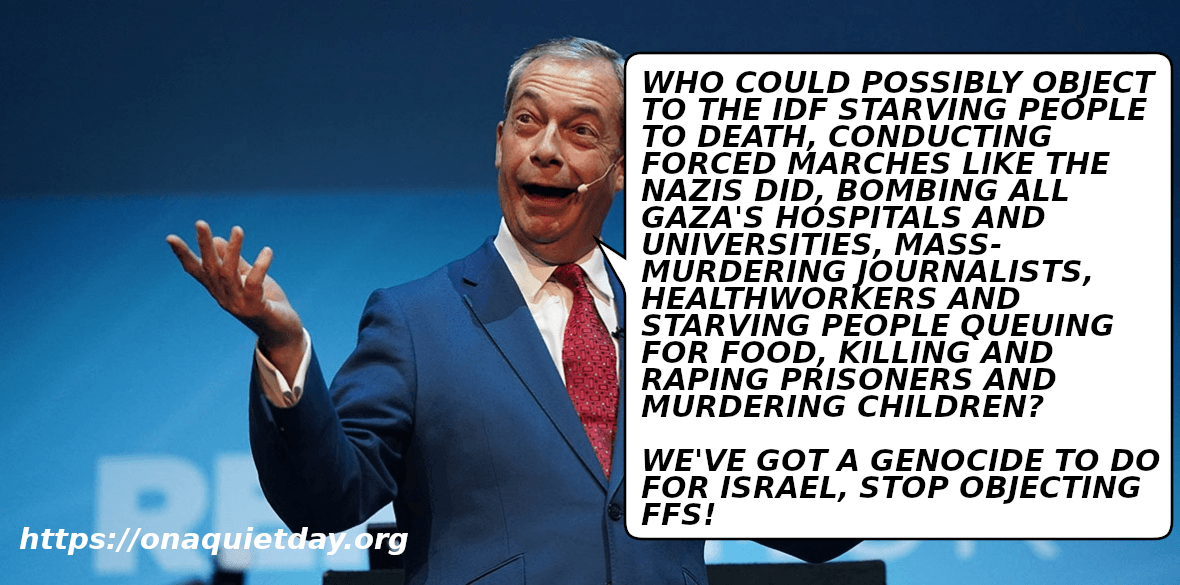
Nigel Farage explains the politics of Reform UK: Racism, Fake anti-establishmentism, Deregulation, Corporatism, Climate Change Denial, Mysogyny and Transphobia.Nigel Farage urges you to ignore facts and reality and be a climate science denier like him and his Deputy Richard Tice. He says that Reform UK has received £Millions and £Millions from the fossil fuel industry to promote climate denial and destroy the planet.Nigel Farage objects to criticism of the IDF. He asks how could anyone object to them starving people to death, forced marches like the Nazis did, bombing Gaza’s hospitals and universities, mass-murdering journalists, healthworkers and starving people queuing for food, killing and raping prisoners and murdering children. He calls for people to stop obstructing his genocide for Israel.
A DeSmog collage of Reform UK leader Nigel Farage and former Conservative prime minister Liz Truss in front of a CPAC sign. Credit: Gage Skidmore (Nigel Farage and CPAC sign), Tim Hammond / No 10 Downing Street (Liz Truss)
The Reform leader has opted to join the pro-Trump conference as it comes to the UK.
Reform UK leader Nigel Farage has announced that he will be speaking at CPAC GB in July – the pro-Trump conference brought to the UK by disgraced former prime minister Liz Truss.
Reform sources speaking to The Guardian previously suggested that Farage would be “steering well clear” of the event, following Truss’ involvement.
However, over the weekend, Farage announced that he would be the “keynote” speaker at the event, which is also set to feature fellow Reform politician Matthew Goodwin, who lost the Gorton and Denton by-election in February.
“Farage likes to pretend he’s on the side of the ordinary working man, but he’s really a 1980s yuppie, with out of date Thatcherite ideas,” said Nick Dearden, director of the campaign group Global Justice.
“Farage said he wouldn’t turn up to CPAC GB, Liz Truss’ embarrassing attempt at a comeback, but he just couldn’t stay away because this is where he belongs – with the grifters of recently failed governments. No one should be in any doubt – Farage is part of Britain’s out of touch elite and offers no solutions to the problems Britain faces today.”
Truss, who was prime minister for 49 days in late 2022, was forced to resign after announcing £45 billion worth unfunded tax cuts and spending hikes – causing an economic shock. Experts have warned that Farage’s agenda, which echoes Truss’ economic policies, would cause similar financial repercussions.
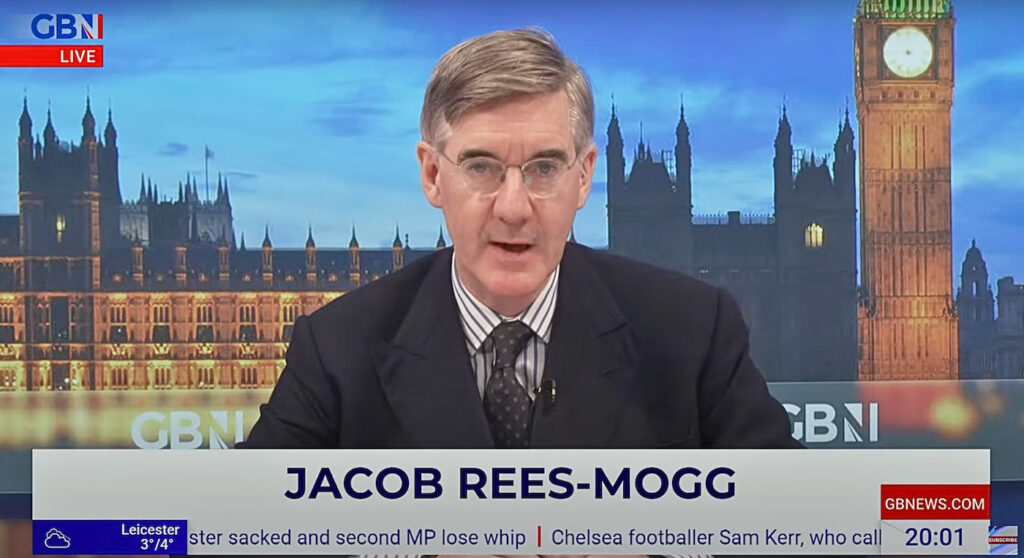
Farage and Truss will be joined by Jacob Rees-Mogg, a former Conservative MP who was a senior minister under Truss and currently works for GB News, which employs Farage as a presenter. The Guardian also previously reported that Rees-Mogg had “no interest in making an appearance” at CPAC GB.
Former Conservative MP Jacob Rees-Mogg on GB News.
Credit: GB News / YouTube
Truss and Farage share similar views on climate change. The Reform leader has claimed it’s “nuts” for CO2 to be considered a pollutant, while Truss has called on the UK, EU and U.S. to drop their landmark climate policies. The world’s leading climate scientists say it’s “unequivocal” that man-made CO2 is responsible for the majority of global warming experienced since the Industrial Revolution – driving extreme weather, droughts, and flooding.
The American Conservative Union has hosted annual Conservative Political Action Conferences in the U.S. since 1973, and has been closely linked to Trump and MAGA since his first presidency beginning in 2016. Farage has been a regular feature of CPACs in recent years, and has made tens of thousands speaking at pro-Trump events in since becoming an MP in July 2024.
At CPAC’s 2025 event in Washington D.C., Trump claimed that he had terminated the ”Green New Scam,” referring to Biden-era climate policies.
International CPAC leaders are now counting on the movement’s assistance to “take out” left-leaning politicians in Colombia and Brazil, while aiding the political campaigns of Europe’s staunchest Trump allies, according to audio recordings from recent CPAC events obtained by DeSmog.
Other speakers at CPAC GB include Tory peer Toby Young, Telegraph columnist Allison Pearson – who is a director of the Global Warming Policy Foundation, a climate science denial group, Talk TV host and former Farage advisor Alexandra Phillips, the radical right-wing YouTube hosts Mike Graham and Dan Wootton, Sun journalist Harry Cole, and Lucy Connolly, who was previously jailed for calling for people to “set fire” to hotels housing asylum seekers.
Nigel Farage reminds you that he’s the man that brought you Brexit and asks what could possibly go wrong.Lettuce complains about being compared to Liz Truss.Elon Musk urges you to be a Fascist like him, says that you can ignore facts and reality then.