This work by Middle East Monitor is licensed under a Creative Commons Attribution-NonCommercial-ShareAlike 4.0 International License.
Israeli military vehicles and soldiers patrol the streets during a raid on Balata Refugee Camp in Nablus, West Bank, Palestine, on June 18, 2026. [Nedal Eshtayah – Anadolu Agency]
Israeli forces raided a wedding celebration in the town of Anata, northeast of occupied Jerusalem, on Thursday evening, arresting the groom, his father and his brother. A young woman was also injured, while several Palestinians suffered tear gas inhalation during the raid.
Local sources told Anadolu that Israeli forces stormed the town and raided the wedding of the al-Refai family, arresting groom Saeed Nasser al-Refai, his father Omar Nasser al-Refai, and his brother Jamal Nasser al-Refai.
وسط إطلاق قنابل الغاز على الحاضرين.. قوات الاحتلال تقتحم حفل زفاف في بلدة عناتا شمالي القدس المحتلة، وتعتقل العريس ووالده وشقيقه وفق وسائل إعلام فلسطينية pic.twitter.com/081ej4uqIB
The sources said the forces detained wedding guests for more than two hours, preventing them from leaving the venue. They also pushed and assaulted several young men.
At the same time, Israeli forces raided a number of homes in the town, carrying out searches and causing damage to property and household contents.
A young woman suffered facial bruises after being assaulted by Israeli soldiers. The forces also fired large amounts of tear gas in several neighbourhoods, causing a number of Palestinians to suffer from suffocation. They were treated at the scene.
According to official Palestinian figures, since 8th October 2023, Israeli military escalation in the occupied West Bank has killed 1,173 Palestinians, injured 12,666 others, displaced around 33,000 people and led to the arrest of about 23,000 Palestinians.
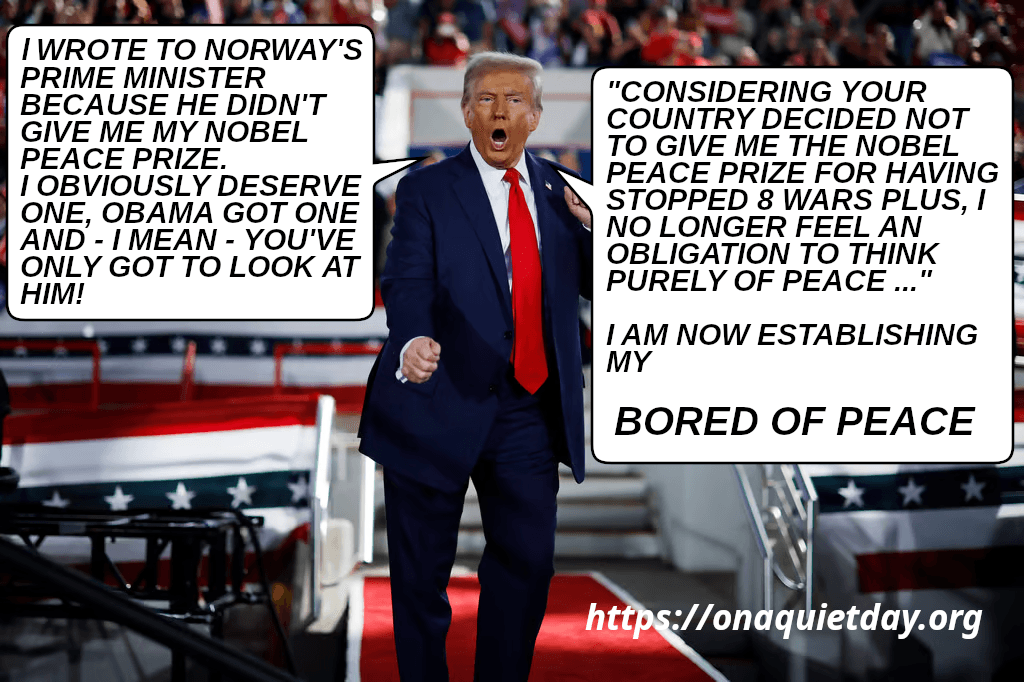
Donald Trump calls for help from NATO allies in securing the Strait of Hormuz despite saying on 7 March 2026 that they don’t need people to join wars after they’ve already won. He’s challenged with the claim that he lies as much as the IDF.Donald Trump explains why he established his Bored of Peace
Keir Starmer explains that UK is actively supporting Israel’s genocidal expansion and repeats his previous quotation that he supports Zionism “without qualification”. Keir Starmer said “I said it loud and clear – and meant it – that I support Zionism without qualification.” here: https://www.jewishnews.co.uk/keir-starmer-interview-i-will-work-to-eradicate-antisemitism-from-day-one/Keir Starmer objects to criticism of the IDF. He asks how could anyone object to them starving people to death, forced marches like the Nazis did, bombing Gaza’s hospitals and universities, mass-murdering journalists, healthworkers and starving people queuing for food, killing and raping prisoners and murdering children. He calls for people to stop obstructing his genocide for Israel.Orcas discuss Genocide-supporting and complicit Zionists. Donald Trump, Keith Starmer, David Lammy, Rachel Reeves, Angela Rayner and Wes Streeting are acknowledged as evil genocide-complicit and supporting cnuts.
Israeli colonialism entrenched an apartheid system. The reality has been documented multiple times and acknowledged even within Israel, most prominently by the non-governmental organisation B’Tselem in 2021. Recently, the EU High Representative Kaja Kallas was reported to have used the term apartheid during a visit to Mexico. Kallas has made several contradictory statements since the start of the genocide which reflect both the EU’s lack of political cohesion over sanctioning Israel, as well as the underlying concern to safeguard Israel’s impunity.
However, Kallas’s remark comparing Israel to South African apartheid, has been blown out of proportion and out of all realms of credibility by Israel’s Foreign Minister Gideon Sa’ar, who expressed displeasure at Kallas’s comment and blatantly called Israel “the only democracy in the Middle East”. Not even the world’s former colonial powers truly believe that statement, despite how times it is publicly uttered and endorsed. Former colonial powers recognise colonialism when they see it.
Kallas’s response to Sa’ar stating he will sever all contact was replete with the usual contradictions, except for the assertion that “The EU is always committed to a constructive relationship with Israel.” Other than that, prioritising the two-state paradigm as the only solution, while noting that the implementation is becoming impossible due to illegal settlement construction, represents the usual EU position, as reflected in Kallas’s post on X.
The two-state is not a solution, and it is not just settlement expansion that makes the two-state obsolete. It is colonialism, which the entire world refuses to address, in order to maintain Israel’s presence in Palestine.
The diplomatic spat is nothing but a useless spectacle. Israel revels in finding inconsequential distractions, many of them diplomatic, that briefly shift attention away from more pressing issues, such as the fact that Palestinians in Gaza remain forcibly displaced despite all the talk of reconstruction.
Kallas, meanwhile, responded with the usual statements that reassure Israel of the EU’s commitment to safeguarding colonialism, despite the visible purported disagreements. Sa’ar, for example, accused Kallas of “acting obsessively and with blatant unfairness towards the State of Israel”, yet the only unfairness has been solely directed against the Palestinian people.
Colonialism is abnormal, and the EU supports it. Why, for example, did Kallas seek to placate Sa’ar instead of taking a firmer stance against Israel’s apartheid system? An utterance by a high ranking official could have been followed by at least a stronger assertion, not to mention that the EU could take political, diplomatic and economic measures that directly target Israel. Instead, the rhetoric is shifted to the two-state paradigm, which is obsolete and which Israel opposes. So much for Kallas being described as anti-Israel, when the response to Sa’ar’s complaint was to find common ground for further Israeli colonial expansion.
Israel implemented apartheid, and it also committed genocide. In light of Kallas’s unofficial comment, the EU’s Ambassador to Israel Michael Mann told the Jerusalem Post, “It is not the official policy of the European Union that Israel is an apartheid state. I want to make that absolutely clear.”
It is absolutely clear. So much that there is no need for clarification, not even when a diplomatic dispute arises.
Donald Trump sings and dances, says that it’s fun to kill everyone … unless he gets distracted or falls asleep.Orcas discuss Donald Trump and the killer apes’ concept of democracy. Front Orca warns that Trump is crashing his country’s economy and that everything he does he does for the fantastically wealthy.
This work by Middle East Monitor is licensed under a Creative Commons Attribution-NonCommercial-ShareAlike 4.0 International License.
Palestinian Bedouin Arabs gather at Negev to stage a protest against displacement and eviction policies in Beersheba, Israel on June 25, 2026. [Mostafa Alkharouf – Anadolu Agency]
Hundreds of Palestinians protested Thursday in Beersheba in Israel’s southern Negev region against Israeli policies of home demolitions and land confiscation targeting Bedouin communities in the area, Anadolu reports.
According to the Israeli daily Yedioth Ahronoth, protesters included residents of Bedouin communities affected by demolitions or facing displacement, as well as supporters from among Arab Israelis.
The protest was organized by the Higher Steering Committee for Arabs in the Negev, the Committee of Heads of Bedouin Local Authorities, and the Regional Council for Unrecognized Villages.
Demonstrators carried banners affirming their rights to land and housing, with slogans including “The Negev belongs to its people and owners” and “No to house demolitions, yes to our right to housing.”
They also held signs bearing the names of villages facing demolition or evacuation, including Tel Arad, Al-Sirr, Wadi al-Khalil, Umm al-Hiran, and Al-Araqib.
Earlier Thursday, Israeli National Security Minister Itamar Ben-Gvir praised the demolition of Bedouin Palestinian homes and vowed to intensify the policy.
On Wednesday, Ben-Gvir said 5,700 homes had been demolished over the past year.
Successive Israeli governments have promoted what they call “development programs” for Palestinian Bedouin villages in the Negev, aimed at relocating residents to state-planned towns.
Palestinian Bedouins, however, view these policies as a tool of forced displacement that severs them from their historic lands and denies recognition to their villages.
This work by Middle East Monitor is licensed under a Creative Commons Attribution-NonCommercial-ShareAlike 4.0 International License.
Donald Trump sings and dances, says that it’s fun to kill everyone … unless he gets distracted or falls asleep.Orcas discuss Donald Trump and the killer apes’ concept of democracy. Front Orca warns that Trump is crashing his country’s economy and that everything he does he does for the fantastically wealthy.
Daniele Rugo’s documentary turns the testimony of British and international medics who worked in Gaza into a searing record of what is described in the film as Israel’s “genocidal frenzy”.
Hospitals represent life. The killing of people inside them, the doctors in Life Support say, is a line that should never have been crossed. Daniele Rugo’s 93-minute documentary opens with British doctors talking about Gaza, their connection to it, the resilience of the people there and a love of life that even decades of siege has not extinguished, before showing what happened when that line was crossed, again and again, over two years.
The film had its world premiere at Sheffield DocFest on 13 June 2026, where it was nominated for the festival’s Tim Hetherington Award, followed by a Q&A with Rugo and contributors Dr Ana Jeelani and Prof Nick Maynard. A public premiere follows at Curzon Mayfair on 9 July. Most of what is on screen was shot by the doctors themselves, on their phones, in the middle of treating patients. MEMO was given an early preview of Life Support ahead of its public premiere at Curzon.
Rugo’s starting point, as he puts it, was simple: surgeons, physicians and nurses went to Gaza to support their Palestinian colleagues and ended up as “the sole international observers” of a genocide. Foreign media have been barred from entering Gaza throughout the war. The doctors who passed through Medical Aid for Palestinians (MAP), Healthcare Workers 4 Palestine and similar routes were, for long stretches, among the only outsiders able to see what was happening inside the enclave.
The names will be familiar to anyone who has followed British medics’ accounts since October 2023: Dr Victoria Rose, the London-based reconstructive surgeon who has worked in Gaza since 2016 and has been on four missions since the war began; Prof Nick Maynard, the Oxford gastrointestinal surgeon who helped set up Gaza’s cancer services; and Dr Tanya Haj Hassan, the paediatric intensive care doctor and one of the few international witnesses to reach the north of the Strip. Dr James Smith, Dr Deborah Harrington, Dr Khaled Dawas and Dr Ana Jeelani also appear.
Their testimonies, painfully delivered, are as heart-wrenching as they are inspirational. Rose recalls using her own initiative to take essential medical kit into Gaza in 23 suitcases. Jeelani describes operating without electricity or proper instruments, on wounded children who often needed repeated surgery. Maynard, who has worked in other war zones, says the scale of destruction in Gaza was on a different level.
Outside the hospitals hours of unseen footages filmed a dystopian landscape of buildings razed as far as the eye can see, alongside the daily life that somehow continues around it. This footage is vital because the film is not only about the wounded, the starving and the dead, but about the destruction of the institutions that make human life possible: hospitals, schools, religious buildings and the civic centres that sustain a people, a culture and a civilisation.
What the doctors describe is not only the bombing of buildings, but the destruction of the conditions that allow human existence to continue. This gives the film its wider charge: it is not only a record of war, but of what the doctors repeatedly understand as genocide.
“This is a war on civilians,” Haj Hassan says, describing wards filled with children and elderly women. The cases the doctors treat reflect Gaza’s population under siege: children, women, the elderly and the displaced. They speak of Palestinian medics operating after being told their own relatives had been killed, and of health workers fainting from hunger and exhaustion mid-shift. The footage from inside Al-Shifa hospital after Israel’s withdrawal, including the mass graves hospital staff were left to exhume themselves, is among the hardest material in the film to sit through.
The film also addresses one of the central justifications used by Israel for its attacks on Gaza’s hospitals: the claim that they were being used by Hamas. The doctors answer this directly. Despite hearing the allegation repeated by Israeli officials and echoed by Western governments, they say they saw no evidence to support it. For them, the destruction of Gaza’s hospitals cannot be explained away as a military necessity. It is part of a wider assault on everything that sustains life.
That is where the film’s argument about genocide becomes unavoidable. Maynard says he did not use the word lightly and initially resisted it. But after what he witnessed in Gaza, he reached a different conclusion. The film follows that moral and intellectual shift carefully, showing how doctors who entered Gaza to provide medical care came out asking how such devastation had been allowed to continue.
The documentary then widens the lens, turning to genocide scholars to explain the role of dehumanisation. They describe it as a common feature of genocides, from Rwanda onwards: a process by which a people are stripped of their humanity before violence against them is normalised. In Gaza, the film suggests, that process has been visible not only in language, but in the targeting of the very environment needed for human life to continue. As one contributor puts it, Palestinians have been dehumanised “in a way that we’ve not seen anywhere else in modern times.”
The doctors do not leave Gaza as they entered it. They arrive to treat the wounded and support Palestinian colleagues, but what they see makes it impossible for them simply to return home and move on. “You cannot witness what is happening in Gaza and not emerge enraged and determined to stop it,” one doctor says. That sense of responsibility runs through the film: having seen what they have seen, the doctors know that silence is no longer possible.
The film also shows how Israel’s policy of starvation became another weapon deployed against Palestinians. We see what that meant for Gaza’s children, and for the parents and doctors trying desperately to keep them alive with almost nothing. The documentary links this suffering to the Gaza Humanitarian Foundation, whose aid distribution system turned the search for food into a life-and-death situation for Palestinians.
Yet Life Support is not only a film about suffering. It also shows how Palestinians continue to hold on to their humanity, dignity and will to live amid conditions designed to break them. The doctors help carry Gaza’s story to the outside world, but they are not the centre of it. At the centre are the Palestinian doctors, nurses and medical teams who keep treating patients with almost nothing, relying on courage, skill and sheer determination to keep people alive.
Rugo brings the same concern with memory and violence that shaped his previous film, The Soil and The Sea, which documented mass graves from Lebanon’s civil war. In Life Support, he works with editor Masahiro Hirakubo to hold together material that is often extremely painful to watch without losing sight of the people at the heart of the film: the doctors, the patients and the Palestinian medical workers trying to keep Gaza alive.
The film’s sound is equally important. Palestinian composer Habib Shehada Hanna is joined by Robert Del Naja and Euan Dickinson of Massive Attack, giving the documentary a soundtrack that deepens its emotional force. The film’s executive producers include Hollywood star Susan Sarandon, Melissa Barrera, Farah Nabulsi and Asif Kapadia. Ken Loach has called the film “compulsory viewing.”
He is right. Life Support does not try to make its subject easier to watch, and it should not. What it leaves you with is a record of who kept Gaza’s hospitals running, what it cost them, and how much of it the world chose not to see.
Keir Starmer objects to criticism of the IDF. He asks how could anyone object to them starving people to death, forced marches like the Nazis did, bombing Gaza’s hospitals and universities, mass-murdering journalists, healthworkers and starving people queuing for food, killing and raping prisoners and murdering children. He calls for people to stop obstructing his genocide for Israel.Orcas discuss Donald Trump and the killer apes’ concept of democracy. Front Orca warns that Trump is crashing his country’s economy and that everything he does he does for the fantastically wealthy.