Donald Trump’s Fossil Fuel Executive UK Ambassador Donated $4 Million to President’s Inauguration Fund

Spread the love

Original article by Adam Barnett and Sam Bright republished from DeSmog.
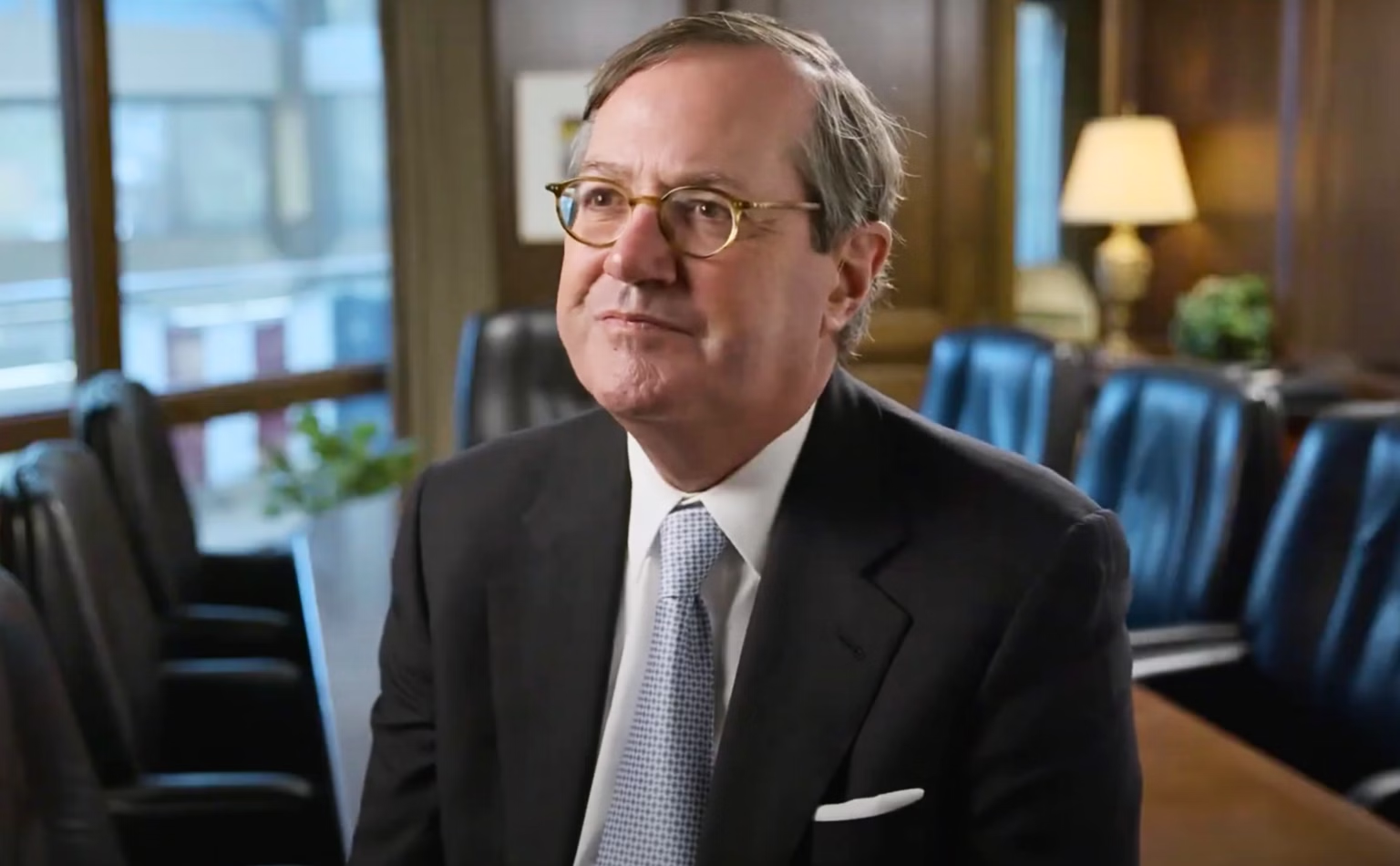
U.S. ambassador to the UK Warren Stephens. Credit: Arkansas Inc / YouTube

Warren Stephens made the donation alongside big tech firms and oil giants.

Donald Trump’s ambassador to the UK donated $4 million to the new U.S. president’s inauguration on the same day he was nominated for the diplomatic position, DeSmog can report.

Billionaire Warren Stephens gave $4 million (just under £3 million today) to the Trump Vance Inaugural Committee on 2 December, according to the official record of donations. The committee is appointed by the president-elect to arrange the inauguration ceremony, when a U.S. president is formally sworn into office.

“It’s not so surprising that a transactional president hands out favours to people who give him money, but that doesn’t make it any less outrageous,” said Agustina Oliveri, head of campaigns and communications at the Good Law Project.

There is no direct evidence that Warren secured the position due to this donation. However, U.S. presidents have a long history of handing out diplomatic roles to major donors, while the Trump administration has bestowed his patrons with a number of senior positions. Of the 37 people who gave $1 million or more to the inauguration committee, six have either been given a role in the administration or have been nominated for a role.

Tom Brake, a former Liberal Democrat MP and the director of the transparency campaign group Unlock Democracy, urged the UK government not to follow Trump’s lead.

“Whatever approach the U.S. administration adopts towards the appointment of its ambassadors, the UK government should make it clear that when it comes to appointing UK ambassadors or high commissioners, donating substantial sums of money directly or indirectly to the party of government will block an appointment not facilitate it,” he said. “There must never be a question mark over whether UK appointments are made on merit, or driven by a donor’s deep pockets.”

As DeSmog revealed on 5 December, Warren Stephens holds significant oil and gas interests. Prior to his appointment as Trump’s UK ambassador, he ran Stephens Inc. – one of the largest privately-owned investment banks in the United States. Stephens has since stood down as CEO, but remains its chairman.

The firm’s portfolio includes a number of companies that make their money from oil and gas exploration and production — including one, Stephens Natural Resources, which “has a rich history of drilling and producing both oil and natural gas”, according to its website.

The UK’s ambassador to the U.S. Peter Mandelson also co-founded a public affairs agency with major fossil fuel clients.

Trump’s inauguration committee – which raised almost $240 million – received donations from fossil fuel giants Chevron ($2 million), ExxonMobil ($1 million), the U.S. branches of BP and Shell ($500,000 each), and Valero ($250,000).

It also accepted donations from major tech platforms including Amazon and Meta, whose founders Jeff Bezos and Mark Zuckerberg received a front row seat to the event.
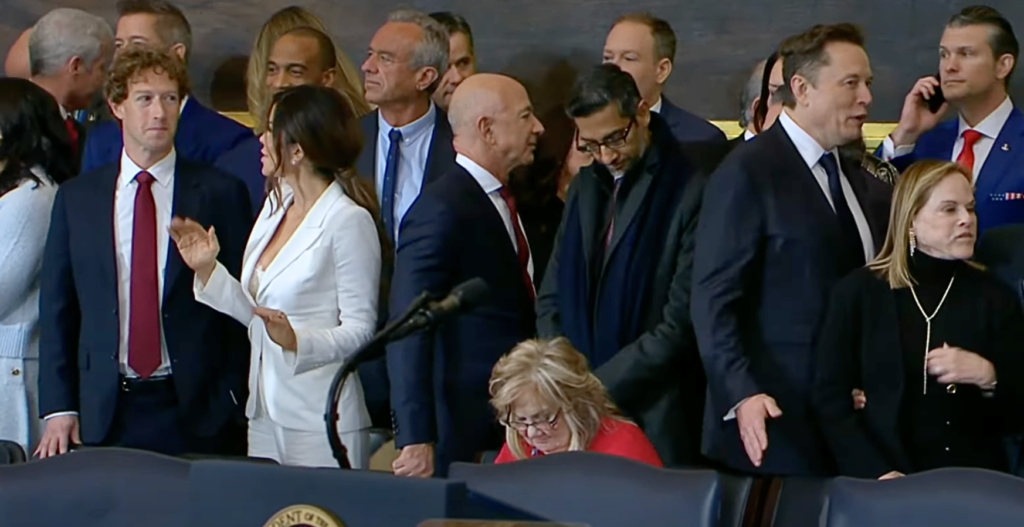
Mark Zuckerberg, Jeff Bezos, Elon Musk and others at Donald Trump’s 2025 inauguration. Credit: WSJ / YouTube

The inauguration committee received a further $1 million from the Heritage Foundation, a hard-right U.S. research and lobby group which drafted the “autocratic” Project 2025 blueprint for Trump’s second term.

Trump denied knowledge of Project 2025 during the election campaign but has subsequently appointed Russell Vought, one of its advisory board members and co-authors, as director of the Office for Management and Budget (OMB), a key department within the president’s office that helps to oversee and co-ordinate policy.

Project 2025 urged Trump to “dismantle the administrative state”, slash restrictions on fossil fuel extraction, scrap state investment in renewable energy, and gut the Environmental Protection Agency.

Since his inauguration on 20 January, Trump has announced a series of policies that have mirrored these demands.

The new president, who received more than $75 million from oil and gas interests for his re-election campaign, has pledged to once again withdraw the U.S. from the flagship 2015 Paris Agreement, which set an international target for limiting global warming. He has also declared a “national energy emergency” to allow the U.S. to “drill, baby, drill” for new fossil fuels.

“When we look at the dumpster fire of U.S. government policy – from trashing the planet to attacking basic human rights – there’s no point in asking ‘What are they up to?’. The question we need to focus on is ‘Who paid for that?,’” said Oliveri.

The U.S. embassy in London referred DeSmog’s enquiry to the U.S. State Department. The Heritage Foundation was approached for comment.

Original article by Adam Barnett and Sam Bright republished from DeSmog.

Neo-Fascist Climate Science Denier Donald Trump says Burn, Baby, Burn.
Elon Musk urges you to be a Fascist like him, says that you can ignore facts and reality then.
Orcas discuss how Trump was re-elected and him being an insane, xenophobic Fascist.
Continue ReadingDonald Trump’s Fossil Fuel Executive UK Ambassador Donated $4 Million to President’s Inauguration Fund

Farage’s Top Fundraiser Targets Oil and Gas Donations

Spread the love

Original article by Sam Bright republished from DeSmog.
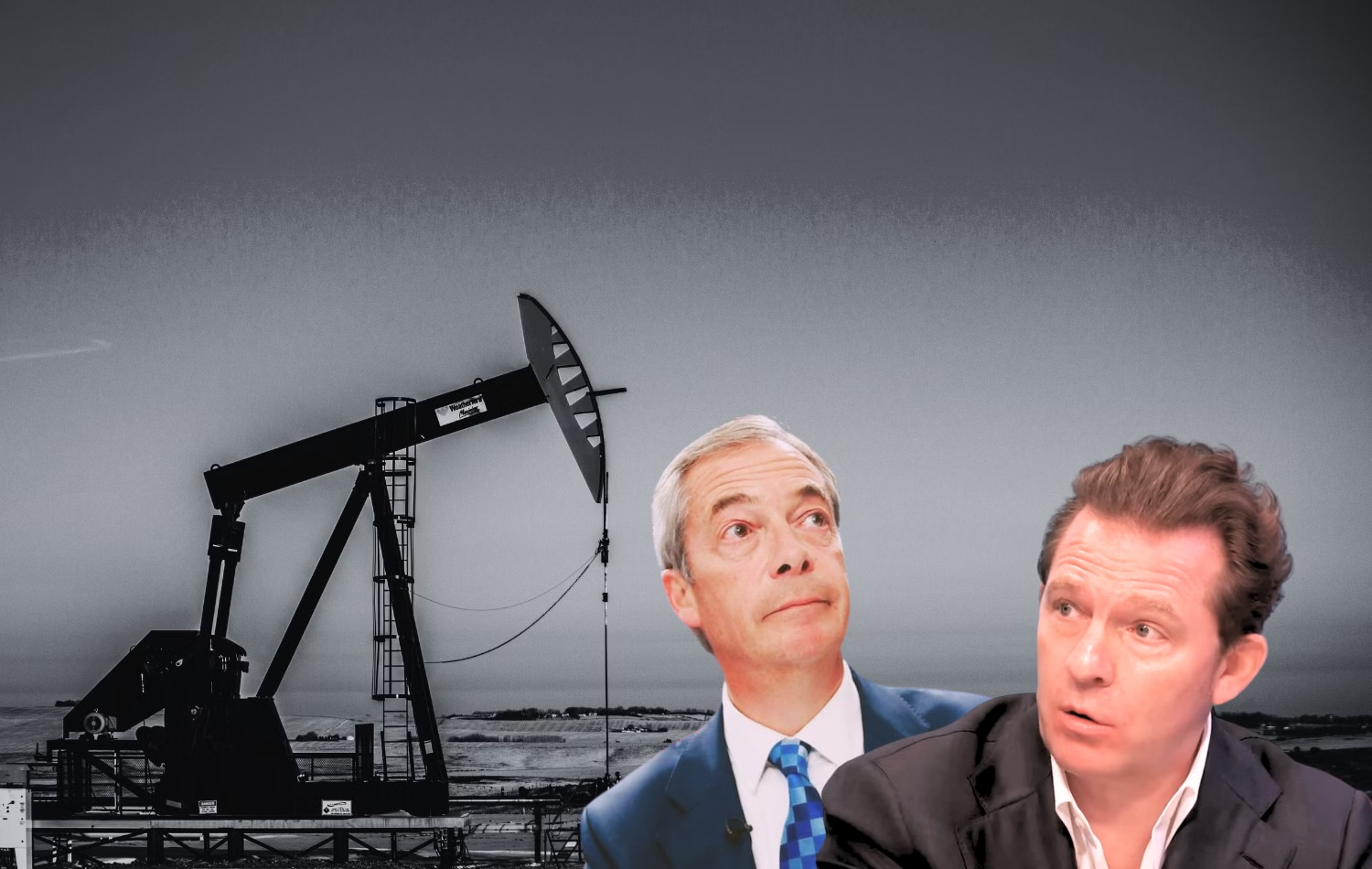
Reform UK leader Nigel Farage and Reform UK treasurer Nick Candy in front of an oil extraction site. DeSmog collage. Credit: GB News / YouTube / Damien Goodyear / SOPA Images / Alamy

Nigel Farage’s Reform UK is attempting to raise money from the fossil fuel industry, the Financial Times has revealed.

The newspaper reports that Reform UK treasurer Nick Candy – a billionaire property developer – has been launching a drive to raise funds from wealthy offshore donors in low-tax jurisdictions including Monaco, the United Arab Emirates (UAE), and Switzerland. Expatriates registered to vote in the UK can donate to UK political parties, as can foreign individuals with a business in the country.

Part of this drive has involved soliciting donations from oil and gas executives. Candy told the Financial Times that an energy executive had donated £100,000 to the party last week, and pledged to give up to £1 million. Candy added that Reform was targeting oil and gas donors who are “very disillusioned” with current UK government policies.

Prime Minister Keir Starmer yesterday said: “homegrown clean energy is in the DNA of my government”, as he pledged to accelerate the transition from fossil fuels to renewables. While the UK’s oil and gas reserves are dwindling, the country’s green economy grew by 10 percent in 2024.

By contrast, Reform advocates for clean energy policies to be scrapped, including cancelling the UK’s commitment to achieving net zero emissions by 2050.

“This is textbook Nigel Farage,” said Ami McCarthy, head of politics at Greenpeace UK. “While he may enjoy cosplaying as a ‘man of the people’, in reality, Reform’s agenda is a shopping list of policies that will turbo-drive the profits of the very richest. 

“Taking money from fossil fuel execs whilst pushing their misinformation will keep families tied to volatile oil and gas with sky-high energy bills, and further climate breakdown for our children and grandchildren. 

“By going cap in hand to fossil fuel firms and millionaires in offshore tax havens, Farage is making it very clear who he’s working for: his elite mates, not us.”

Reform UK and its senior figures have repeatedly questioned basic climate science. Speaking at the Alliance for Responsible Citizenship conference in February, while admitting that he knew little about climate science, Farage claimed it was “absolutely nuts” that CO2 is considered to be a pollutant. He also suggested on the BBC’s Today programme this week that climate change may not be caused by humans.

Farage’s deputy Richard Tice, who has donated substantial sums to the party in recent years, has claimed that “CO2 is not poison; it’s plant food”.

In reality, authors working for the world’s foremost climate science body, the UN’s Intergovernmental Panel on Climate Change (IPCC), have said that “it is a statement of fact, we cannot be any more certain; it is unequivocal and indisputable that humans are warming the planet”.

The IPCC has also stated that carbon dioxide pollution “is responsible for most of global warming” since the late 19th century, which has increased the “severity and frequency of weather and climate extremes, like heat waves, heavy rains, and drought” – all of which “will put a disproportionate burden on low-income households and thus increase poverty levels.”

As revealed by DeSmog, Reform received at least £2.3 million from fossil fuel interests, polluters and climate deniers prior to the 2024 general election campaign – equivalent to 92 percent of its funding during the period.

“This is further evidence that Reform is copying Donald Trump and pretending that climate change does not exist,” said Bob Ward, Bob Ward, policy and communications director at the Grantham Research Institute on Climate Change and the Environment at the London School of Economics. “But the reality of making the UK more dependent on fossil fuels is that we would be more at the mercy of international markets and so would have energy that is more insecure, more unaffordable and more unsustainable.”

Reform UK treasurer Nick Candy has been attempting to extract cash from fossil fuel executives.

Original article by Sam Bright republished from DeSmog.

Led by Donkeys poster quotes Nigel Farage "Brexit has failed"
Led by Donkeys poster quotes Nigel Farage “Brexit has failed”
Nigel Farage explains the politics of Reform UK: Racism, Fake anti-establishmentism, Deregulation, Corporatism, Climate Change Denial, Mysogyny and Transphobia.
Elon Musk urges you to be a Fascist like him, says that you can ignore facts and reality then.
Continue ReadingFarage’s Top Fundraiser Targets Oil and Gas Donations

The UK’s social security system falls way below international human rights standards: new report

Spread the love
9to9studio/Shutterstock

Koldo Casla, University of Essex

The right to social security is enshrined in several international agreements on human rights. But the UK’s system – even before the disability benefits cuts announced earlier this year – falls way below these standards.

For a new report published today, Amnesty International asked my colleague Lyle Barker and me to review the evidence about the state of the UK’s social security in relation to international human rights law.

The UK has signed and ratified a number of international agreements on human rights. One of these is the 1966 International Covenant on Economic, Social and Cultural Rights (ICESCR), which lays out the right to social security. An accompanying document defines the three key principles of this right as:

  • Availability A social security system established in law, administered publicly, and materially reachable by those who need it.
  • Adequacy Benefits must be suitable, both in amount and in duration, to realise essential socioeconomic rights.
  • Accessibility Everyone should be covered by the social security system, paying particular attention to disadvantaged and marginalised individuals and groups.

The conclusion of our study for Amnesty International is crystal clear: even disregarding the cuts announced in March, the UK’s social security system does not meet these standards.

Availability

Our review of the literature shows a widespread underclaiming of benefits. It has been estimated that in 2024, £22.7 billion in income-related benefits went unclaimed, a £4 billion increase from the previous year.

Gaps in official data hinder a clear understanding of why many people are missing out on the support they are entitled to. But qualitative evidence suggests this is largely due to fear, stigma, bureaucratic and digital hurdles, and eligibility cliff edges for means-tested benefits.

In recent years, the UK government has adopted a contentious and punitive stance toward benefit recipients. Media and political rhetoric have portrayed those who claim benefits as idle or undeserving scroungers.

This stigma harms the mental health and self-esteem of people experiencing poverty. It can result in shame and secrecy, and create barriers to people accessing support they are entitled to.

Our research for Amnesty International concludes that UK claimants do not get enough information and support about their rights to benefits. Combined with the stigma of claiming, the UK is falling far short of making benefits “available” in line with international standards.

Adequacy

Since the austerity policies of the 2010s, the UK’s social security system has become significantly less adequate in supporting vulnerable people and families. The basic rate of universal credit (the main benefit for working-age people on a low income) is at 40-year low in real terms amid a cost of living crisis.

Restrictive policies, such as the benefit cap (introduced in 2013 to set a maximum limit to the total benefits received by a household) and the two-child limit have curtailed access to essential benefits. Although inflation adjustments in the last two years provided some relief, many benefits still fail to keep up with rising living costs.

The two-child limit is the cruellest expression of the inadequacy of the UK’s social security system. Introduced by the Conservative government in 2017, the two-child limit restricts financial support through universal credit to two children. It is likely to be the most significant single cause of child poverty in the UK, including in families where adults work but do not earn enough to make ends meet.

When Labour returned to power, there was much speculation about whether they would reverse the two-child limit. But despite pleas from experts and people with direct experience, the government has persisted in retaining it.

Accessibility

Our study lays out the many barriers to accessibility in the UK’s system. For example, the bureaucratic hurdles in the assessment process, and the disproportionate impact of punitive sanctions on lone mothers and on minority ethnic claimants.

The UK operates a benefits sanction regime, which imposes penalties on claimants who fail to meet certain conditions. These include attending jobcentre appointments or accepting job offers. In general, sanctions and the fear of sanctions erode the trust between benefit claimants and the social security system.

An adult holding a child's hand walk past a jobcentre
Benefits sanctions are just one of the barriers to accessing social security. 1000words/Shutterstock

As it did in its previous review in 2016, in February the UN Committee on Economic, Social and Cultural Rights recommended that the UK review the use of benefit sanctions to ensure they are used proportionately and are subject to prompt and independent dispute resolution mechanisms.

Another accessibility concern is the shift to a digital-by-default system in the 2010s. While intended to make accessing benefits more efficient, it has become an administrative barrier.

Many people, particularly the elderly and others who are less digitally literate, struggle to navigate the benefits system. It excludes people without reliable internet access, underscoring a digital divide that prevents meaningful access to social security.

Meeting standards

Given the evidence, it is no surprise that earlier this year, the UN Committee on Economic, Social and Cultural Rights urged the UK government to assess the cumulative effects of the austerity measures introduced in the 2010s.

In particular, the committee recommended reversing the two-child limit, the benefit cap and the five-week delay for the first universal credit payment, and increasing the budget allocated to social security. These recommendations were made before the changes announced in the spring statement.

To live up to the internationally recognised right to social security, the UK should recognise in law, policy and practice that social security is a human right. And, that it is essential to the fulfilment of other human rights.

Amnesty International recommends the government set up a commission with statutory powers, to produce a strategy for “wholesale reform” of the social security system. The UK must establish a minimum support level and an essentials guarantee, to ensure beneficiaries can consistently meet their basic needs. A good way to start would be abolishing the two-child limit once and for all.

Koldo Casla, Senior Lecturer, Essex Law School, University of Essex

This article is republished from The Conversation under a Creative Commons license. Read the original article.

Keir Starmer says that the Labour Party under his leadership all feel a small part of Scunthorpe.
Keir Starmer, Angela Rayner and Rachel Reeves wear the uniform of the rich and powerful. They have all had clothes bought for them by multi-millionaire Labour donor Lord Alli. CORRECTION: It appears that Rachel Reeves clothing was provided by Juliet Rosenfeld.
Continue ReadingThe UK’s social security system falls way below international human rights standards: new report

‘Sick’: Trump Marks Earth Day With Layoff Notice for Hundreds of EPA Staff

Spread the love

Original article by Jessica Corbett republished from Common Dreams under Creative Commons (CC BY-NC-ND 3.0).

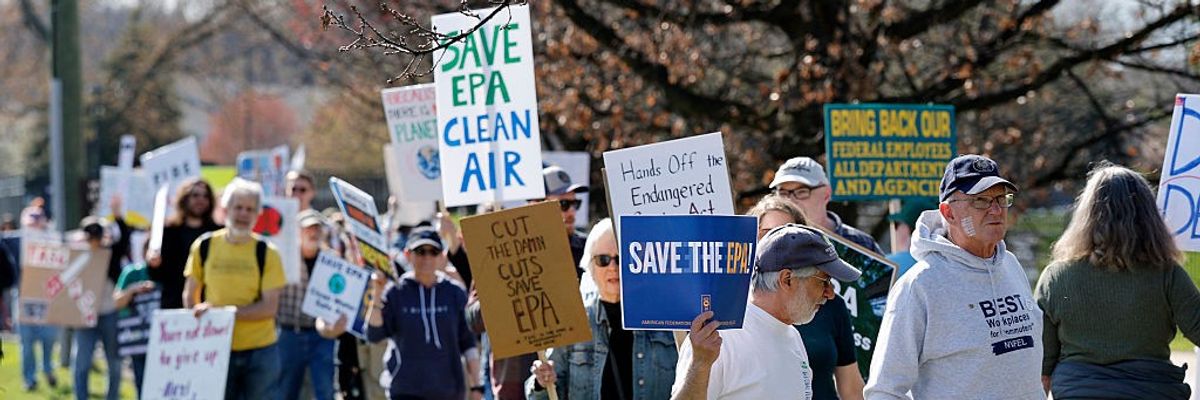
Demonstrators march during a “Hands off the EPA” rally outside the Environmental Protection Agency office in Ann Arbor, Michigan, on Earth Day, April 22, 2025. (Photo: Jeff Kowalsky/AFP via Getty Images)

“The only people who will benefit from their firings are corporate polluters.”

As defenders of the planet marked Earth Day with pledges to fight the destructive agenda of U.S. President Donald Trump, some green groups on Tuesday responded with alarm to the administration’s plans for layoffs at the Environmental Protection Agency.

Several news outlets obtained the notice that EPA Assistant Deputy Administrator Travis Voyles sent on Monday evening to staffers with the Office of Environmental Justice and External Civil Rights as well as regional EJ divisions, warning of a reduction in force (RIF) that will cut 280 employees and reassign about 175 others this summer.

“This action is necessary to align our workforce with the agency’s current and future needs and to ensure the efficient and effective operation of our programs,” Voyles said. “With this action, EPA is delivering organizational improvements to the personnel structure that will directly benefit the American people and better advance the agency’s core mission of protecting human health and the environment.”

The Washington Post noted that “the news comes months after the agency placed 171 of the office’s employees on administrative leave and then reversed course, reinstating dozens of regional employees in offices across the country,” and as decision-makers at the EPA have been weighing how to implement Trump’s executive order targeting diversity, equity, and inclusion (DEI).

“It’s a gut punch but long expected,” said an employee who was put on leave in February and spoke with the Post on the condition of anonymity. “Announcing a RIF of the EJ program on the eve of Earth Day is sick and shows exactly who they are.”

Joyce Howell, executive vice president of the American Federation of Government Employees Council 238 that represents over 8,400 EPA workers nationwide, toldReuters that “decimating our agency and environmental justice workforce goes against our oath to protect human health and to keep our planet healthy and habitable for future generations.”

In a Tuesday statement, Sierra Club executive director Ben Jealous similarly said that “the Trump administration is determined to destroy the stated mission of the Environmental Protection Agency to protect human health and the environment. All of us deserve to have clean air to breathe, safe water to drink, and be protected from toxic pollution.”

“Instead, the Trump administration is selling us out to corporate polluters by actively working to slash clean air and water protections and laying off critical environmental justice staff,” he continued. “The people that Donald Trump is putting out of work are hardworking, dedicated civil servants who have devoted their careers to protecting our clean air and water and securing a livable future for us all. The only people who will benefit from their firings are corporate polluters.”

Chitra Kumar, a former official with the impacted EPA office who’s now managing director at the Union of Concerned Scientists’ Climate and Energy Program, said in a statement that “the layoff notice sent to employees claimed their dismissal would ‘better advance the agency’s core mission of protecting human health and the environment,’ which is the height of hypocrisy given that these staffers are working to reduce pollution and toxins in the communities suffering the most harm.”

“Scientific data shows that, due to historic and ongoing injustices, communities overburdened by polluting industries, smog-forming traffic, and contaminated waterways and soil are predominantly low-income, Black, Brown, and Indigenous. Exposure to consistently higher levels of pollution increases the risk of asthma, heart and lung ailments, cancer, and even death,” said Kumar, who took aim at EPA Administrator Lee Zeldin.

“Zeldin and the Trump administration continue to focus on propping up the profits of coal, oil, and gas companies and other big polluters who take advantage of every loophole available at the expense of public health. This is about all of us, our children, and grandchildren,” she stressed. “If Administrator Zeldin goes forward with this destructive move, he will be responsible for ending decades of work intended to help set right the harmful legacy of pollution in overburdened communities in a handout to big polluters.”

Kumar pointed out that “this is also part of the Trump administration’s larger ongoing strategy to dismantle EPA and its core functions and undermine its very mission, which is to help keep all people in America safe. In the time ahead, Zeldin is expected to launch a repeal, or ‘no enforce’ order, for a host of science-backed environmental regulations and engage in a wholesale ‘reorganization’ of the agency, including gutting the Research and Development Office that produces science undergirding EPA decisions.”

As criticism of Zeldin and Trump’s plans for the EPA mounted, people protested against the administration in communities across the country. Aru Shiney-Ajay, executive director of the youth-led Sunrise Movement, said in a statement that “Donald Trump, backed by fossil fuel billionaires, is waging a full-scale assault on the very lifesaving protections that Earth Day was created to demand.”

While Republicans currently control the White House and both chambers of Congress, some elected Democrats used Earth Day to advocate for policies that would protect the planet. Multiple senators used the day to promote bills that would protect the Pacific and Atlantic oceans from offshore oil and gas drilling.

Original article by Jessica Corbett republished from Common Dreams under Creative Commons (CC BY-NC-ND 3.0).

Orcas comment on killer apes destroying the planet by continuing to burn fossil fuels.
Neo-Fascist Climate Science Denier Donald Trump says Burn, Baby, Burn.
Elon Musk urges you to be a Fascist like him, says that you can ignore facts and reality then.
Continue Reading‘Sick’: Trump Marks Earth Day With Layoff Notice for Hundreds of EPA Staff

Pope’s climate letter is a radical attack on the logic of the market

Spread the love

Steffen Böhm, University of Esse

What makes Pope Francis and his 183-page encyclical so radical isn’t just his call to urgently tackle climate change. It’s the fact he openly and unashamedly goes against the grain of dominant social, economic and environment policies.

While the Argentina-born pope is a very humble person whose vision is of a “poor church for the poor”, he seems increasingly determined to play a central role on the world stage. Untainted by the realities of government and the greed of big business, he is perhaps the only major figure who can legitimately confront the world’s economic and political elites in the way he has.

However his radical message potentially puts him on a confrontation course with global powerbrokers and leaders of national governments, international institutions and multinational corporations.

The backlash has begun even before the encyclical has been officially published. US presidential candidate Jeb Bush, a Catholic, feels the pope should stay out of the climate debate, joining other Republicans, fossil fuel lobbyists and climate denier think-tanks in seeking to discredit Pope Francis’s intervention.

What makes the pope so radical?

There are several meanings of the word “radical” that can be applied to the Pope and in particular his forthcoming encyclical.

First, radical can be understood as going back to the roots (from Latin radix, root). The majority of Catholics live in the Global South; in Latin America and sub-Saharan Africa. Francis is the first pope from the Global South, and naming himself in honour of Saint Francis of Assisi, “a man of poverty and peace who loved nature and animals”, signalled to the world a commitment to going back to the roots of human existence.

The pope knows the plight of the majority world. Before he became Archbishop of Buenos Aires, he was a priest in the vast, poor neighbourhoods, the villas miserias or slums, of Argentina’s capital.

Improving the lives of slum dwellers and addressing climate change is, for Pope Francis, one and the same thing. Both require tackling the structural, root causes of inequality, injustice, poverty and environmental degradation.

For example, his encyclical says:

Even as the quality of available water is constantly diminishing, in some places there is a growing tendency, despite its scarcity, to privatize this resource, turning it into a commodity subject to the laws of the market. Yet access to safe drink- able water is a basic and universal human right, since it is essential to human survival and, as such, is a condition for the exercise of other human rights. (p. 23)

This stands in stark contrast to, for example, Peter Brabeck-Letmathe, the chairman of Nestlé, the world’s largest food and bottled water company, who thinks water is a normal commodity with a market value, and not a human right. Nestlé is far from unusual. Its stance is backed up by the official water privatisation policies of the World Bank, IMF and other international institutions.

In fact, the encyclical is a radical – for a pope and international leader, unprecedented – attack on the logic of the market and consumerism, which has been expanded into all spheres of life.

The document states:

Since the market tends to promote extreme consumerism in an effort to sell its products, people can easily get caught up in a whirlwind of needless buying and spending. Compulsive consumerism … leads people to believe that they are free as long as they have the supposed freedom to consume. But those really free are the minority who wield economic and financial power. (p. 149-150)

The pope rejects market fundamentalism, instead arguing that “the market alone does not ensure human development and social inclusion.”

In the same way, he warns us of the brave new world of carbon markets such as the EU Emissions Trading System and the UN’s Clean Development Mechanism, which have been created to reduce the world’s carbon emissions.

The encyclical states:

The strategy of buying and selling “carbon credits” can lead to a new form of speculation which would not help reduce the emission of polluting gases worldwide. This system seems to provide a quick and easy solution under the guise of a certain commitment to the environment, but in no way does it allow for the radical change which present circumstances require. Rather, it may simply become a ploy which permits maintaining the excessive consumption of some countries and sectors. (p. 126)

The pope’s right. The same criticisms of carbon markets have been made by myself and others.

Will he make any difference?

Pope Francis has already angered conservative Catholics in the US by clearly stating that:

Climate change is a global problem with grave implications: environmental, social, economic, political and for the distribution of goods. It represents one of the principal challenges facing humanity in our day. (p. 20)

While the pope is not a politician – or maybe precisely because he is not one – he commands high moral and ethical authority that goes beyond traditional partisan lines. His encyclical speaks truth to power, and he might be the only person with both the clout and the desire to meaningfully deliver a message like this:

Many of those who possess more resources and economic or political power seem mostly to be concerned with masking the problems or concealing their symptoms, simply making efforts to reduce some of the negative impacts of climate change. However, many of these symptoms indicate that such effects will continue to worsen if we continue with current models of production and consumption. There is an urgent need to develop policies so that, in the next few years, the emission of carbon dioxide and other highly polluting gases can be drastically reduced, for example, substituting for fossil fuels and developing sources of renewable energy. (p. 21)

The bosses of Shell, ExxonMobil and other fossil fuel companies will not like this message, as it threatens their fundamental business model, and it also stands in contrast to the underwhelming ambitions of the G7 leaders who recently pledged to phase out fossil fuels only by 2100.

The time for bold, radical action on the environment as well as poverty eradication has come. This seems to be Pope Francis’ message: “The same mindset which stands in the way of making radical decisions to reverse the trend of global warming also stands in the way of achieving the goal of eliminating poverty.” (p. 128)

We need to think beyond the current, taken-for-granted logic that believes only markets and consumerism can solve the world’s social and environmental problems. The pope himself believes the situation is so grave that only a new, “true world political authority” will be able to address these problems.


This article was updated on 18 June to include quotes from the final encyclical rather than the earlier draft leaked to L’Espresso magazine.

Steffen Böhm, Professor in Management and Sustainability, and Director, Essex Sustainability Institute, University of Essex

This article is republished from The Conversation under a Creative Commons license. Read the original article.

Continue ReadingPope’s climate letter is a radical attack on the logic of the market