Category: politics

  • Doctor Who 60: show has always tapped into political issues – but never more so than in the 1970s

    Spread the love

    Jamie Medhurst, Aberystwyth University

    Doctor Who hit television screens at a key period in British television history. It launched on Saturday November 23, 1963, at 5.15pm, being somewhat overshadowed by the assassination of US president John F. Kennedy the previous day.

    Set firmly within the BBC’s public service broadcasting ethos of informing, educating and entertaining, Doctor Who quickly became a mainstay of Saturday-evening viewing. By 1965, it was drawing in around 10 million viewers.

    Throughout its history, Doctor Who has tapped into political, social and moral issues of the day – sometimes explicitly, other times more subtly. During the 1970s, when the Doctor was played by Jon Pertwee and Tom Baker, there were a number of examples of this.

    Doctor Who in the 1970s

    The 1970s were a period of political and social divisions: relationships between the government the unions in the first part of the decade was strained, exemplified by the miners’ strikes of 1972 and 1974. The political consensus that had dominated since 1945 was under pressure with talk of a break-up of the UK in the form of Welsh and Scottish Assemblies.

    In his cultural history of Doctor Who, Inside the Tardis, television historian James Chapman argued that the 1970s painted “an uncomfortably sinister projection of the sort of society that Britain might come”.

    It was never clear if Doctor Who storylines during this time were set in the present or at some point in the future. The fact that one of the lead characters, Brigadier Lethbridge-Stewart of the United Nations Intelligence Task Force (UNIT), calls the prime minister “Madam” in a telephone conversation in one episode suggests the latter.

    The opening credits for Doctor Who in the 1970s, with Jon Pertwee as Doctor.

    As for some of the more politically engaged stories, The Green Death (1973), or “the one with the giant maggots” as it is known by fans, certainly pulled no punches. Described by Chapman as an “eco disaster narrative”, it pitted corporate greed and capitalism against environmental activists (portrayed here as Welsh hippies) and their concerns for the planet.

    In the episode, Global Chemicals, run by a faceless machine, is tipping waste from its petrochemical plant into a disused mine in the south Wales valleys (cue awful Welsh stereotypes). The green sludge not only kills people, but creates mutant maggots which also attack. As fears grew and the green movement gained momentum in the early 1970s, this story would have resonated with large parts of the audience.

    When the Doctor visits the planet Peladon in The Curse of Peladon (1972), the planet is attempting to join the Galactic Federation. There are those on the planet who argue for joining, while opponents are just as vociferous, arguing that joining the Federation would destroy the old ways of the planet.

    Sound familiar? This is the time that Britain was negotiating to join the European Economic Community, as it did in 1973. Interestingly, the serial was broadcast during the time of the 1972 miners’ strike (leading to many viewers missing later episodes due to power cuts).

    The follow-up story, The Monster of Peladon (1974), is set against a backdrop of industrial strife and conflict involving miners.

    Tom Baker’s Doctor

    In what many consider to be one of the best classic serials, Genesis of the Daleks (1975) Tom Baker’s doctor continued the tradition of raising complex political, social and moral issues.

    Jon Pertwee’s Doctor regenerates to become Tom Baker’s.

    Sent back in time by the Time Lords to change the course of history, the Doctor at one point has an opportunity to destroy the mutations which form the “body” of the Dalek (inside their metal casing) and destroy the Dalek race forever. Holding two wires close to each other, about to create an explosion in the incubation room, he asks himself and his companions: “Have I that right?”

    Having the ability to see the future, he says that future planets will become allies in fighting the evil of the Daleks. Had he the right to change the course of history? Given the symbolism used in the story (salutes, black outfits, references to a “pure” race) this was a clear reference to the rise of the Nazis.

    The political allegories didn’t end in the 1970s. One of the most blatant can be seen in the 1988 serial, The Happiness Patrol. The main antagonist, Helen A (played by Sheila Hancock), a ruthless and tyrannical leader is said to be modelled on Conservative prime minister, Margaret Thatcher. The fact that Hancock appears to be impersonating Thatcher lends a certain degree of credence to this belief.

    Anybody who argues that the revival of Doctor Who in 2005 saw a more political edge to the storylines need only look back over 60 years. Now that we can do this thanks to the BBC uploading more than 800 episodes onto iPlayer, it will become clear to all.

    Doctor Who – especially during its Golden Age in the 1970s – has always been political.


    Looking for something good? Cut through the noise with a carefully curated selection of the latest releases, live events and exhibitions, straight to your inbox every fortnight, on Fridays. Sign up here. The Conversation


    Jamie Medhurst, Professor of Film and Media, Aberystwyth University

    This article is republished from The Conversation under a Creative Commons license. Read the original article.
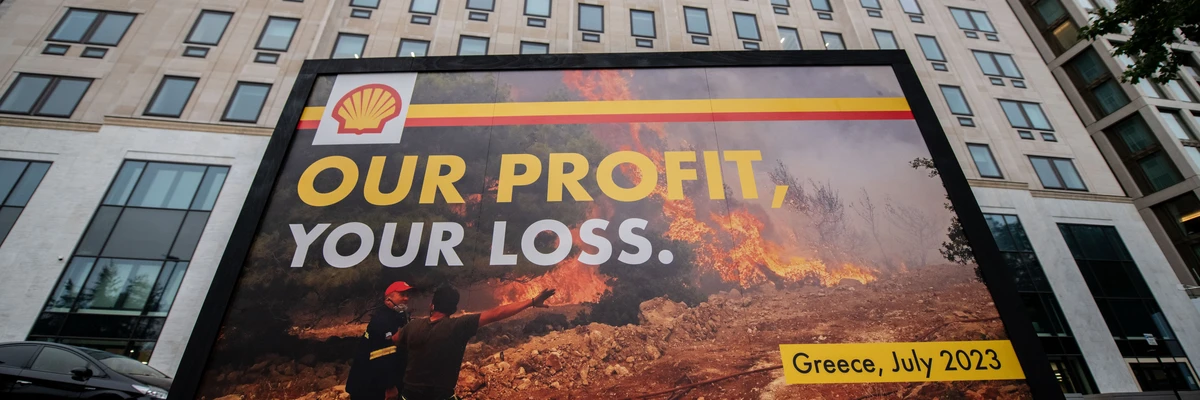
  • 28 Years Later – Shell still trying to crush opposition

    Spread the love
    https://priceofoil.org/2023/11/21/28-years-later-shell-still-trying-to-crush-opposition/

    …

    Some will rightly argue that Shell never embraced sustainable development, it only ever pursued long-term profitability at the expense of people and planet. The days of Mark Moody Stuart at Shell are long gone. The new boss at the helm is Wael Sawan, who joined Shell two years after the murder of the Ogoni 9 and Brent Spar, just at the time that Shell began to spin its image towards being a caring company.

    Under Sawan’s leadership, Shell keeps courting controversy. Month by month, the company doubles down on fossil fuels, and sheds its last remaining veneers of being a company that cares about people and planet.

    He has reversed what pitiful progress that Shell had made to address the scale of its CO2 emissions, angering climate campaigners and scientists. In June, the Guardian reported that Sawan “has rowed back on the oil giant’s climate commitments.” The paper added that since taking over, Sawan has emphasised financial returns for investors. He told financiers at the New York stock exchange that he wanted to “reward our shareholders today and far into the future.”

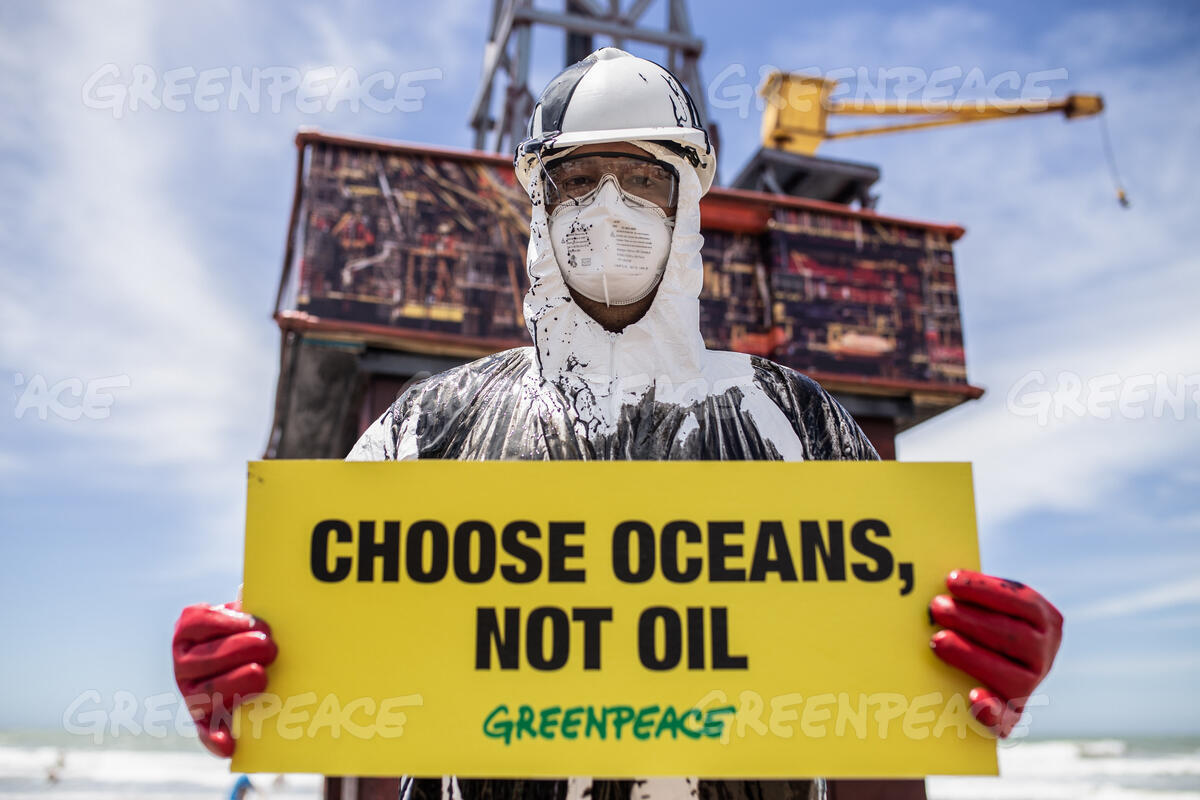
    Greenpeace sign reads CHOOSE OCEANS, NOT OIL

    In September, Reuters reported that Sawan “has come under pressure over his strategy from within the energy company after two employees issued a rare open letter urging him not to scale back investments in renewable energy.” The following month, in October, Sawan responded by cutting 200 jobs from the company’s low-carbon division to focus on high-earning oil profits.

    And now, last week, the day before the Ogoni 9 anniversary, it was announced that Shell was suing Greenpeace for over $2.1million in damages. But that is just the start. The legal action also calls for an indefinite blocking against Greenpeace protests at all Shell infrastructure worldwide, otherwise, the claims could be as high as $8.6 million.

    …

    The lawsuit, which the Guardian notes is one of the “biggest ever legal threats against the group”, was served by Shell after Greenpeace campaigners occupied one of Shell’s moving oil platforms earlier this year.

    …

    Greenpeace activists display a billboard during a protest outside Shell headquarters on July 27, 2023 in London. (Photo: Handout/Chris J. Ratcliffe for Greenpeace via Getty Images)

    Whenever Shell cuts a climate commitment or threatens its critics, it loses its social license to operate. Day by day, it looks like a corporate Dodo. It may not happen tomorrow or even in the next decade, but Shell’s days are numbered. A just, equitable future does not include the bully boys from Shell who still threaten their critics. In our collective future, they will become extinct.

    Greenpeace is running a fundraising campaign and also a petition related to Shell.

    https://priceofoil.org/2023/11/21/28-years-later-shell-still-trying-to-crush-opposition/

  • Newborns in Gaza Dying From Preventable Causes Due to Israeli Siege: Oxfam

    Spread the love

    Original article by JULIA CONLEY republished from Common Dreams under Creative Commons (CC BY-NC-ND 3.0). 

    “Oxfam is urgently calling for a full cease-fire and unimpeded humanitarian access,” said the group, explaining that a four-day pause in fighting is not sufficient.

    Humanitarian workers in Gaza on Thursday said their daily experiences struggling to take care of pregnant people and babies demonstrate why a four-day pause in fighting is far from sufficient to save the lives of the blockaded enclave’s most vulnerable residents, including newborns who have begun to die from preventable causes.

    As Israel’s blockade continues to keep Gaza authorities from providing clean water, food, sanitation, and heat to homes and hospitals, babies aged three months and younger “are dying of diarrhea, hypothermia, dehydration, and infection,” said Oxfam International.

    Juzoor, an organization partnering with Oxfam in northern Gaza, said premature births have increased by 25-30% since October 7 when Israel began its bombardment of Gaza in retaliation for an attack by Hamas.

    The group has been supporting about 500 pregnant women in 13 shelters—where a total of 35,000 people are living—and many have gone into labor prematurely as they have the ongoing trauma of “walking long distances in search of safety, running away from bombs, and being crowded into shelters with squalid conditions.”

    Humanitarian workers are struggling to adequately care for thousands of people who have taken refuge in shelters, with waste piling up due to a lack of sanitation services and up to 600 people sharing one toilet.

    Sally Abi Khalil, Middle East regional director for Oxfam, said the fact that the crisis has reached a stage where babies are dying of preventable illnesses is “abhorrent.”

    “Last month we lost at least one baby in every shelter, it’s heartbreaking,” said Umaiyeh Khammash, director of Juzoor. “Access to hospitals is extremely dangerous and virtually impossible, so many women are having to give birth with little or no maternity support in shelters.”

    As Common Dreams has reported, more than 50,000 Gaza residents are facing Israel’s onslaught while pregnant, and more than 5,500 are expected to give birth within a month. Juzoor estimates that 30% of women will face pregnancy complications that require extra medical attention, putting their babies at greater risk—particularly in the first 28 days of life, when newborns are most vulnerable.

    Khammash expressed fear that the group will soon be entirely out of food for residents.

    “The absence of fuel has affected hospitals in the north and the shelters where we operate,” he said. “There is no light, there is no heat. Now winter is coming and it’s cold. It is really a disaster for everyone, but especially for expectant mothers.”

    Some women have given birth in recent weeks in repurposed classrooms surrounded by dozens of refugees, without qualified medical personnel present or any capacity for providing “basic hygiene,” Khalil said.

    “I don’t think there is anyone anywhere in the world that would disagree that is simply inhumane,” she added.

    Oxfam is working to provide the Juzoor shelters with hygiene kits and food, while 60 health professionals have been mobilized to work with thousands of displaced people.

    “But the ongoing violence, siege, and acute shortages of fuel and clean water severely hinder these efforts,” said Oxfam as it called on officials to go further than negotiating only a four-day “humanitarian pause.”

    “Oxfam is urgently calling for a full cease-fire and unimpeded humanitarian access in order to restore vital services and provide desperately needed medical support particularly to pregnant women and newborn babies,” said the group.

    Original article by JULIA CONLEY republished from Common Dreams under Creative Commons (CC BY-NC-ND 3.0). 

  • openDemocracy shortlisted for news provider of the year award

    Spread the love

    Original article by Indra Warnes republished from Open Democracy under a Creative Commons Attribution-NonCommercial 4.0 International licence. 

    We’re up against industry giants at the British Journalism Awards for our work on the NHS, politics and civil rights

    openDemocracy has been shortlisted for news provider of the year at the British Journalism Awards  | openDemocracy

    OpenDemocracy has been shortlisted for the most prestigious prize of its 22-year history: news provider of the year at the British Journalism Awards.

    We are one of six news organisations to be shortlisted for the award, putting us up against industry giants Sky News, The Guardian, The Times, the Daily Mail, and the Financial Times.

    The news follows a year in which openDemocracy broke scandal after scandal in the UK, revealing the hands of lobbyists, corporations and vested interests behind crucial decisions about the NHS, housing, the Covid inquiry and restrictions on protest.

    Satbir Singh, the CEO of openDemocracy, said: “Being shortlisted for an award of this size is such a well-deserved boost for this brilliant team. And being up against five much larger newsrooms shows we really do punch above our weight.

    “I’m extremely proud of how far we’ve come and look forward to our next chapter.”

    Ramzy Alwakeel, the head of news, said: “I’m beyond proud of everyone. To come out of this year with our biggest-ever award nomination is a giant credit to this team’s brilliance and commitment.”

    openDemocracy reporter Adam Bychawski has also been individually shortlisted in the health and life sciences category.

    Adam was announced as a finalist for work that has caught ministers lying about new NHS centres, exposed a businessman getting rich off supplying unusable PPE, and highlighted how eating disorder patients have been failed by the government.

    The winners will be announced on 14 December.

    Original article by Indra Warnes republished from Open Democracy under a Creative Commons Attribution-NonCommercial 4.0 International licence. 

    Well done OpenDemocracy, well deserved.

  • This chart perfectly sums up how badly the Tories have ruined the economy

    Spread the love

    https://leftfootforward.org/2023/11/this-chart-perfectly-sums-up-how-badly-the-tories-have-ruined-the-economy/

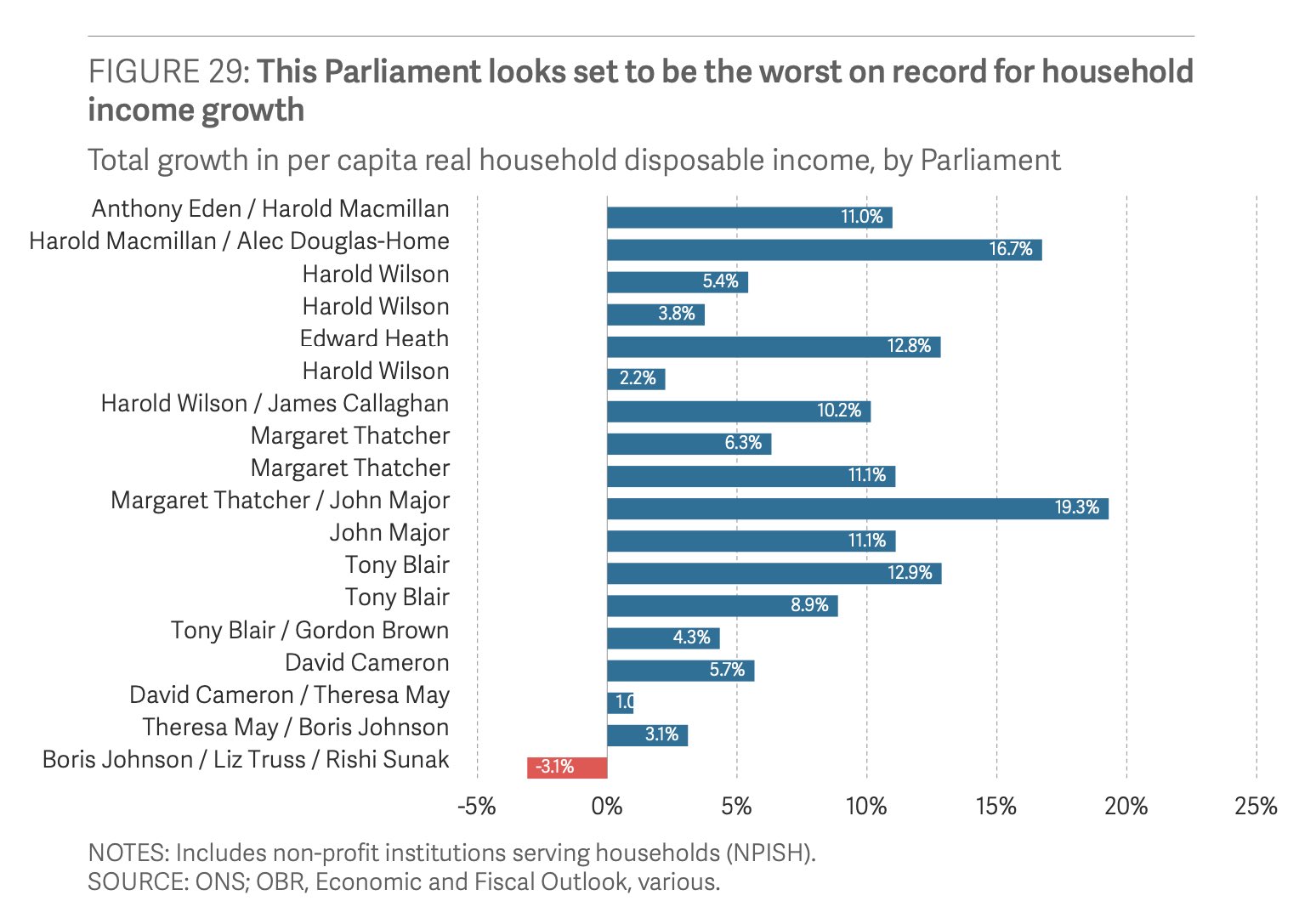
    While Jeremy Hunt was keen to portray an optimistic picture of his autumn statement, bragging about tax cuts and how he was ‘growing the economy’, even though the facts show otherwise

    …

    The below chart illustrates just how bad this Parliament is for household income growth. So much for the Tories being the party of sound finances.

    This parliament worst on record for household income growth (Picture credit: Resolution Foundation)
    This parliament worst on record for household income growth (Picture credit: Resolution Foundation)

    https://leftfootforward.org/2023/11/this-chart-perfectly-sums-up-how-badly-the-tories-have-ruined-the-economy/