‘Far Too Little, Far Too Late,’ Say Critics as Biden Finally Removes Cuba From Terror List
Original article by Brett Wilkins republished from Common Dreams under Creative Commons (CC BY-NC-ND 3.0).
“Seriously? You wait until six days before leaving office to do what you promised to do during your 2020 campaign?” said one observer.
In a move likely to be reversed by the incoming Trump administration, President Joe Biden on Tuesday notified Congress of his intent to remove Cuba from the U.S. State Sponsors of Terrorism list, a designation that critics have long condemned as politically motivated and meritless.
Noting that “the government of Cuba has not provided any support for international terrorism” and has “provided assurances” that it will not do so in the future, the White House said in a memo that the Biden administration is moving to rescind the first Trump administration’s January 2021 addition of Cuba to the State Sponsors of Terrorism (SSOT) list and take other measures to ease some sanctions on the long-suffering island of 11 million inhabitants.
Cuba’s SSOT designation was based mostly on the socialist nation’s harboring of leftist Colombian rebels and several U.S. fugitives from justice for alleged crimes committed decades ago, even though no other country has been placed on the SSOT list for such a reason and despite right-wing Cuban exile terrorists enjoying citizenship—and even heroic status—in the United States.
“Despite its limited nature, it is a decision in the right direction and in line with the sustained and firm demand of the government and people of Cuba, and with the broad, emphatic, and repeated call of many governments, especially Latin America and the Caribbean, of Cubans living abroad, political, religious and social organizations, and numerous political figures from the United States and other countries,” the Cuban Ministry of Foreign Affairs said in a statement.
“It is important to note that the economic blockade and much of the dozen coercive measures that have been put into effect since 2017 remain in force to strengthen it, with full extraterritorial effect and in violation of international law and human rights of all Cubans,” the ministry added.
Sorry, this content could not be embedded.
X
For 32 straight years, the United Nations General Assembly has overwhelmingly voted for resolutions condemning the U.S. blockade of Cuba. And for 32 years, the United States, usually along with a small handful of countries, has opposed the measures. Last year’s vote was 187-2, with Israel joining the U.S. in voting against the resolution.
Cuba followed Biden’s move by announcing it would “gradually” release 553 political prisoners following negotiations with the Catholic Church, The New York Timesreported.
Many progressives welcomed Biden’s shift. Congresswoman Nydia Velázquez (D-N.Y.) said in a statement that Cuba’s SSOT designation “has only worsened life for the Cuban people without advancing U.S. interests” and “has made it harder for Cubans to access humanitarian aid, banking services, and the ability to travel abroad.”
“It has also deepened food and medicine shortages and worsened the island’s energy crisis, especially after Hurricane Rafael,” she added. “These hardships have driven an unprecedented wave of migration, leading to the largest exodus in Cuba’s history.”
Rep. Ilhan Omar (D-Minn.) called Biden’s move “a long overdue action that will help normalize relations with our neighbor.”
“This is a step toward ending decades of failed policy that has only hurt Cuban families and strained diplomatic ties,” Omar added. “Removing this designation will help the people of Cuba and create new opportunities for trade and cooperation between our nations. I look forward to continuing the work to build bridges between our countries and supporting policies that benefit both the American and Cuban people.”
Sorry, this content could not be embedded.
X
David Adler, the co-general coordinator at Progressive International, called the delisting “far too little, far too late.”
“POTUS removing Cuba’s SSOT designation in the final days of his presidency only means one thing: He knew—from day one—that the designation was simply an excuse to punish the Cuban people,” Adler added. “But he maintained it anyway. Sickening.”
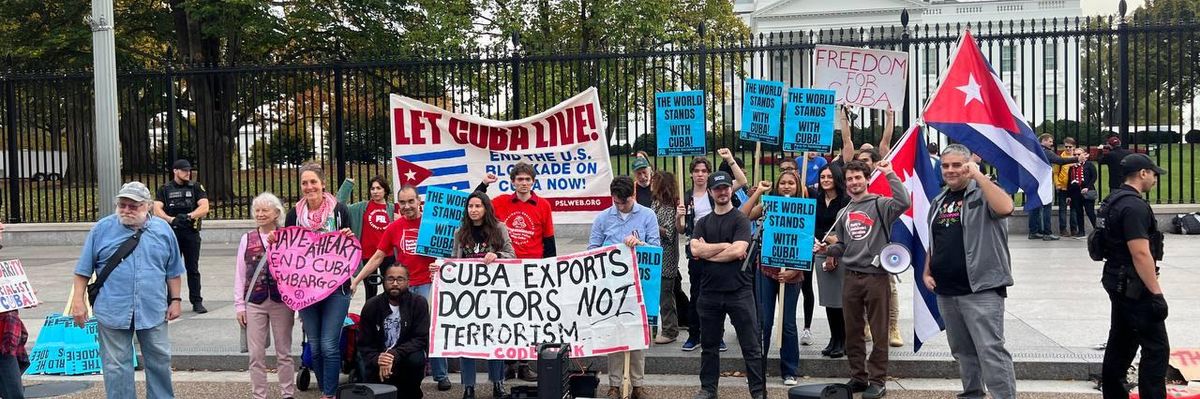
The peace group CodePink released a statement welcoming Biden’s shift, but adding that “it is unacceptable that it took this administration four years to address these injustices.”
“President Biden made the inhumane decision every single day to not alleviate the suffering of millions of Cubans by keeping this designation in place,” the group added. “As we mark this overdue progress, we can only hope that the Trump administration does not reverse these crucial steps towards justice and diplomacy.”
Trump’s nominee for secretary of state, Sen. Marco Rubio (R-Fla.) is the son of Cuban immigrants and a fierce critic of Cuba’s socialist government. In 2021, Rubio introduced legislation aimed at blocking Cuba’s removal from the SSOT list. Trump has also tapped Mauricio Claver-Carone—a staunch supporter of sanctioning Cuba—as his special envoy for Latin America.
Alex Main, director of international policy at the Center for Economic and Policy Research, said Tuesday that “while this decision, which comes years after 80 members of Congress urged Biden to reverse Trump’s ‘total pressure’ approach should have been made long ago, it is better late than never.”
“Sixty years of failed policy should be more than enough, and hopefully the new administration will have the wisdom and the courage to pursue a new course, one that’s in the best interest of both the U.S. and the Cuban people,” Main added.
Cuba was first placed on the SSOT list by the Reagan administration in 1982 amid an ongoing, decadeslong campaign of U.S.-backed exile terrorism, attempted subversion, failed assassination attempts, economic warfare, and covert operations large and small in a futile effort to overthrow the revolutionary government of longtime leader Fidel Castro. Cuba says U.S.-backed terrorism has killed or wounded more than 5,000 Cubans and cost its economy billions of dollars.
In stark contrast, Cuba has not committed any terrorism against the United States.
Former President Barack Obama removed Cuba from the SSOT in 2015 during a promising but ultimately short-lived rapprochement between the two countries that abruptly ended when Trump took office for the first time in 2017.
“Cuba will continue to confront and denounce this policy of economic war, the interference programs, and the disinformation and discredit operations financed each year with tens of millions of dollars from the United States federal budget,” the Cuban Foreign Ministry said Tuesday. “It will also remain ready to develop a relationship of respect with that country, based on dialogue and noninterference in the internal affairs of both, despite differences.”
David Adler, the co-general coordinator at Progressive International, called the delisting “far too little, far too late.”
“POTUS removing Cuba’s SSOT designation in the final days of his presidency only means one thing: He knew—from day one—that the designation was simply an excuse to punish the Cuban people,” Adler added. “But he maintained it anyway. Sickening.”
The peace group CodePink released a statement welcoming Biden’s shift, but adding that “it is unacceptable that it took this administration four years to address these injustices.”
“President Biden made the inhumane decision every single day to not alleviate the suffering of millions of Cubans by keeping this designation in place,” the group added. “As we mark this overdue progress, we can only hope that the Trump administration does not reverse these crucial steps towards justice and diplomacy.”
Trump’s nominee for secretary of state, Sen. Marco Rubio (R-Fla.) is the son of Cuban immigrants and a fierce critic of Cuba’s socialist government. In 2021, Rubio introduced legislation aimed at blocking Cuba’s removal from the SSOT list. Trump has also tapped Mauricio Claver-Carone—a staunch supporter of sanctioning Cuba—as his special envoy for Latin America.
Alex Main, director of international policy at the Center for Economic and Policy Research, said Tuesday that “while this decision, which comes years after 80 members of Congress urged Biden to reverse Trump’s ‘total pressure’ approach should have been made long ago, it is better late than never.”
“Sixty years of failed policy should be more than enough, and hopefully the new administration will have the wisdom and the courage to pursue a new course, one that’s in the best interest of both the U.S. and the Cuban people,” Main added.
Cuba was first placed on the SSOT list by the Reagan administration in 1982 amid an ongoing, decadeslong campaign of U.S.-backed exile terrorism, attempted subversion, failed assassination attempts, economic warfare, and covert operations large and small in a futile effort to overthrow the revolutionary government of longtime leader Fidel Castro. Cuba says U.S.-backed terrorism has killed or wounded more than 5,000 Cubans and cost its economy billions of dollars.
In stark contrast, Cuba has not committed any terrorism against the United States.
Former President Barack Obama removed Cuba from the SSOT in 2015 during a promising but ultimately short-lived rapprochement between the two countries that abruptly ended when Trump took office for the first time in 2017.
“Cuba will continue to confront and denounce this policy of economic war, the interference programs, and the disinformation and discredit operations financed each year with tens of millions of dollars from the United States federal budget,” the Cuban Foreign Ministry said Tuesday. “It will also remain ready to develop a relationship of respect with that country, based on dialogue and noninterference in the internal affairs of both, despite differences.”
Original article by Brett Wilkins republished from Common Dreams under Creative Commons (CC BY-NC-ND 3.0).