The world prepares to vote against the US blockade on Cuba
Original article by Pablo Meriguet republished from peoples dispatch under a Creative Commons Attribution-ShareAlike 4.0 (CC BY-SA) license.
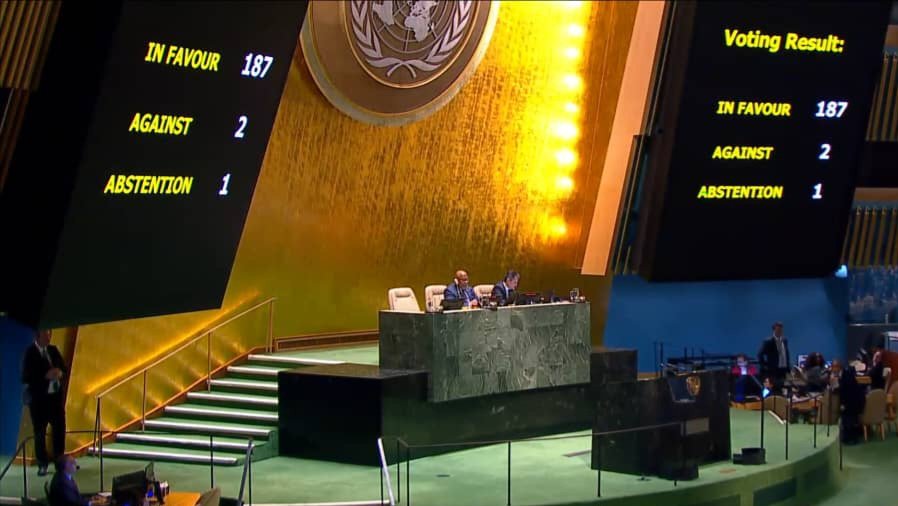
The US blockade on Cuba has been widely condemned by the majority of the world, yet in recent years, instead of lifting it, successive US administrations have made it worse.
On October 29, the United Nations General Assembly began a series of debates to discuss the resolution on the long-standing economic blockade applied by the United States against the island of Cuba. Since the 1960s, the United States has systematically punished the Cuban people through a stringent blockade on its economy for having declared and built a political and economic model different from the one advocated and directed by the United States. The vote on the resolution will take place on Wednesday, October 30.
On more than 30 occasions, the United Nations Assembly has discussed the blockade against Cuba, which costs the island 5 billion dollars annually, according to some estimates. Every year the resolution is proposed and the whole world, through the vote of the absolute majority of the member countries of the United Nations General Assembly, has condemned the imperialist attitude of the United States towards Cuba.
This year, several regional platforms including, the Community of Latin American and Caribbean States (CELAC), the Association of Southeast Asian Nations, the Organization of Islamic Cooperation (OIC), the Non-Aligned Movement (NAM), the Caribbean Community (CARICOM), among others, announced their support for Cuba at the United Nations General Assembly in the face of the criminal blockade.
In this regard, the Russian delegate Vasily Alekseyevich Nebenzya said at the UN Assembly on Tuesday, “We continue to strongly advocate for the immediate lifting of the illegal embargo that has been imposed by the United States against Cuba for more than 62 years.”
The Mexican representative to the UN, Héctor Vasconcelos, stated in the session that he categorically rejects the blockade against Cuba and that it is in direct violation of international law. “It is time to open a new chapter and allow Cuba to participate fully in the global community without the restrictions imposed by this unjust and inhumane blockade,” Vasconcelos declared.
Almost all countries, except the United States, Israel, and one or two other governments allied with Washington’s policy, vote against the blockade and request the elimination of the sanctions against the socialist country. This, for many, reflects the anti-democratic attitude of the US government, which claims to represent the highest values of human rights and global cooperation, although, in this type of case, it scandalously ignores the demands of the vast majority of countries in the world.
For his part, the Cuban Secretary of State, Bruno Rodríguez, expressed his gratitude for the support given on October 29 by more than 30 delegations that expressed their desire for the United States to lift the blockade against Cuba: “We are grateful for the statements made by the 31 delegations that took the floor at the United Nations General Assembly, demanding the end of the US blockade against Cuba. Tomorrow [October 30] we will continue the debate and the vote against this genocidal policy will take place.”
The blockade tightens
Despite this enormous show of support for Cuba, the United States insists on the economic measure. It has even gone so far as to radicalize it, as happened during the administration of Donald Trump, who applied 243 new sanctions, including the removal of certain travel categories which allowed individual US citizens to visit the island, and included Cuba in the list of state sponsors of terrorism, which further hindered the development of the Cuban economy.
Instead of reversing the measures of his predecessor and returning to the opening policy started by Barack Obama, Biden maintained the more stringent measures against Cuba. In 2023, the US Department of Homeland Security added an additional coercive measure, stating that the ESTA visa waiver program, used largely by citizens of Europe, would be denied to anyone from eligible countries if they had traveled to Cuba anytime after July 2021. In essence, a direct punishment to anyone, even beyond US borders, who dares to visit the Caribbean nation.
A history of systematic political-economic punishment
The first time the US government applied an economic embargo on Cuba was in 1958, during the dictatorship of Fulgencio Batista. Although the Cuban Revolution overthrew that military government, the US government punished the Caribbean Island again in 1960.
In the beginning, the restrictions did not include food and medicine, but from 1962, during the radicalization of the Cuban Revolution, the embargo became almost absolute. Cuba’s natural and historical trading partner, both because of its large territorial extension and its purchasing power, had been the United States.
In 1959, 73% of Cuban exports were destined for the United States, which shows the enormous impact that the decision had on the island, aimed at promoting the fall of the government led by Fidel Castro. Nevertheless, the USSR and Cuba reached several economic agreements that allowed the island to somehow withstand (never easily) the portentous US punishment.
However, after the dissolution of the USSR, the blockade began to acquire increasingly challenging characteristics. This is even more so if one takes into account that since 1992, through the Cuban Democracy Act, the US government has not only prohibited US companies from trading with Cuba but also sanctioned any third party that does business with Cuba.
This makes any attempt to overcome the economic crisis induced by outside powers even more difficult. In addition, the US government in 2021 decided, without adequate technical justification, to include Cuba among the countries sponsoring terrorism.
It is foreseeable that Cuba will again feel the backing of international solidarity in the coming days, although the US government will ignore the request of the international community and continue to punish a small country that did not accept to be dominated and undertook a socialist revolution just a couple hundred miles south of the most powerful capitalist country in history.
Original article by Pablo Meriguet republished from peoples dispatch under a Creative Commons Attribution-ShareAlike 4.0 (CC BY-SA) license.