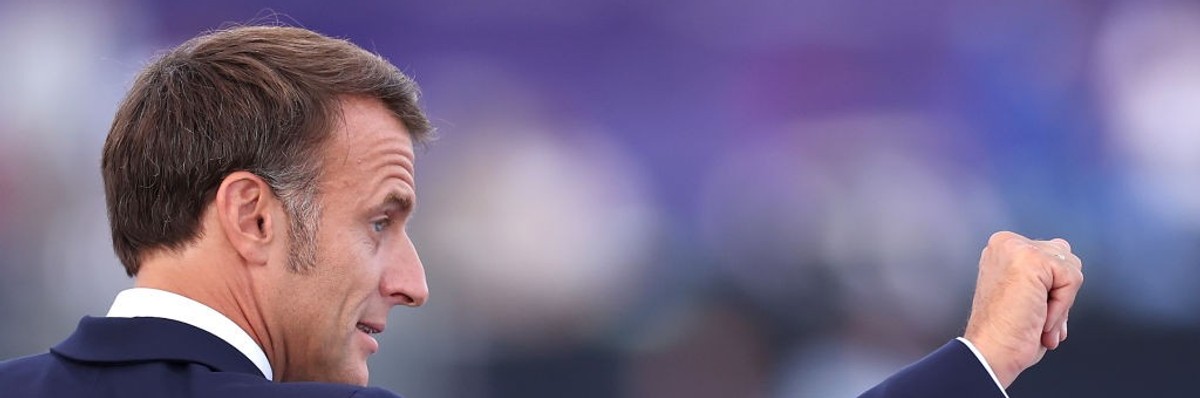
French President Emmanuel Macron gestures to the crowd before the opening ceremony of the 2024 Paralympic Games at Place de la Concorde on August 28, 2024 in Paris, France. (Photo: Alex Davidson/Getty Images)
The president’s rejection of a center-left coalition’s prime minister candidate “is not merely a political maneuver to hold onto power, but a direct attack on French progressive forces.”
Progressive International on Wednesday issued a scathing critique of French President Emmanuel Macron and backed calls for protests next month over his rejection of a leftist alliance’s candidate for prime minister following recent snap elections.
Nouveau Front Populaire (NFP), a coalition of left-of-center parties formed to counter the far-right in this summer’s elections, won the most seats, beating out Macron’s centrist alliance and Marine Le Pen’s right-wing Rassemblement National (RN), but lacks an absolute majority.
Macron has since refused to appoint NFP’s chosen candidate, Lucie Castets, as prime minister, which the Progressive International Observatory blasted as “blatant disregard of the election results and the precedent established throughout the French Fifth Republic.”
Progressive International launched in May 2020 to unite, organize, and mobilize progressive groups and individuals around the world, and since then it has built a global Observatory “with the legal expertise, data science, and parliamentary power to track the attacks on our democratic institutions and provide a real-time defense against them.”
“The attempt to stifle political competition and subvert the democratic process is a direct assault on these core values.”
France’s snap elections—which Macron called after his party performed poorly in European elections—were held on June 30 and July 7. Since then, the Observatory noted, “a caretaker government has led France, with Macron citing the Paris Olympics as a reason to delay the appointment.”
While the Olympic Games have concluded, Macron opened the Paralympic Games in the French capital Wednesday evening. They are set to run through September 8.
Macron—defending his refusal to appoint Castets—has argued that because centrist and right-wing parties would block any actions by NFP, “the institutional stability of our country therefore requires us not to choose this option.” His critics in France are now planning “a large demonstration against Macron’s coup on September 7.”
Echoing the French critics, the Observatory declared Wednesday that “Macron’s move is a direct challenge to the democratic will of the people and an affront to the foundational tenets of political pluralism.”
“This action is not merely a political maneuver to hold onto power, but a direct attack on French progressive forces,” the Observatory said, pointing to pledges by RN and centrist leaders to move a no-confidence motion against any prime minister nominated from the NFP.
The Observatory also highlighted Macron’s “sinister divide-and-rule move” to isolate the far-left La France Insoumise (LFI), led by Jean-Luc Mélenchon, by appealing to other NFP parties “to break the political paralysis.”
The other parties that make up NFP have rebuffed the French president and, according toFrance 24, “Mélenchon even threatened to start impeachment proceedings against Macron.”
Progressive International’s Observatory emphasized that “democracy thrives on the diversity of ideas and the peaceful transition of power. The attempt to stifle political competition and subvert the democratic process is a direct assault on these core values.”
The Observatory concluded with a “call to democratic forces worldwide to oppose Emmanuel Macron’s authoritarian efforts to repress the will of the French people—and join the call for the September 7 mobilization to defend it.”
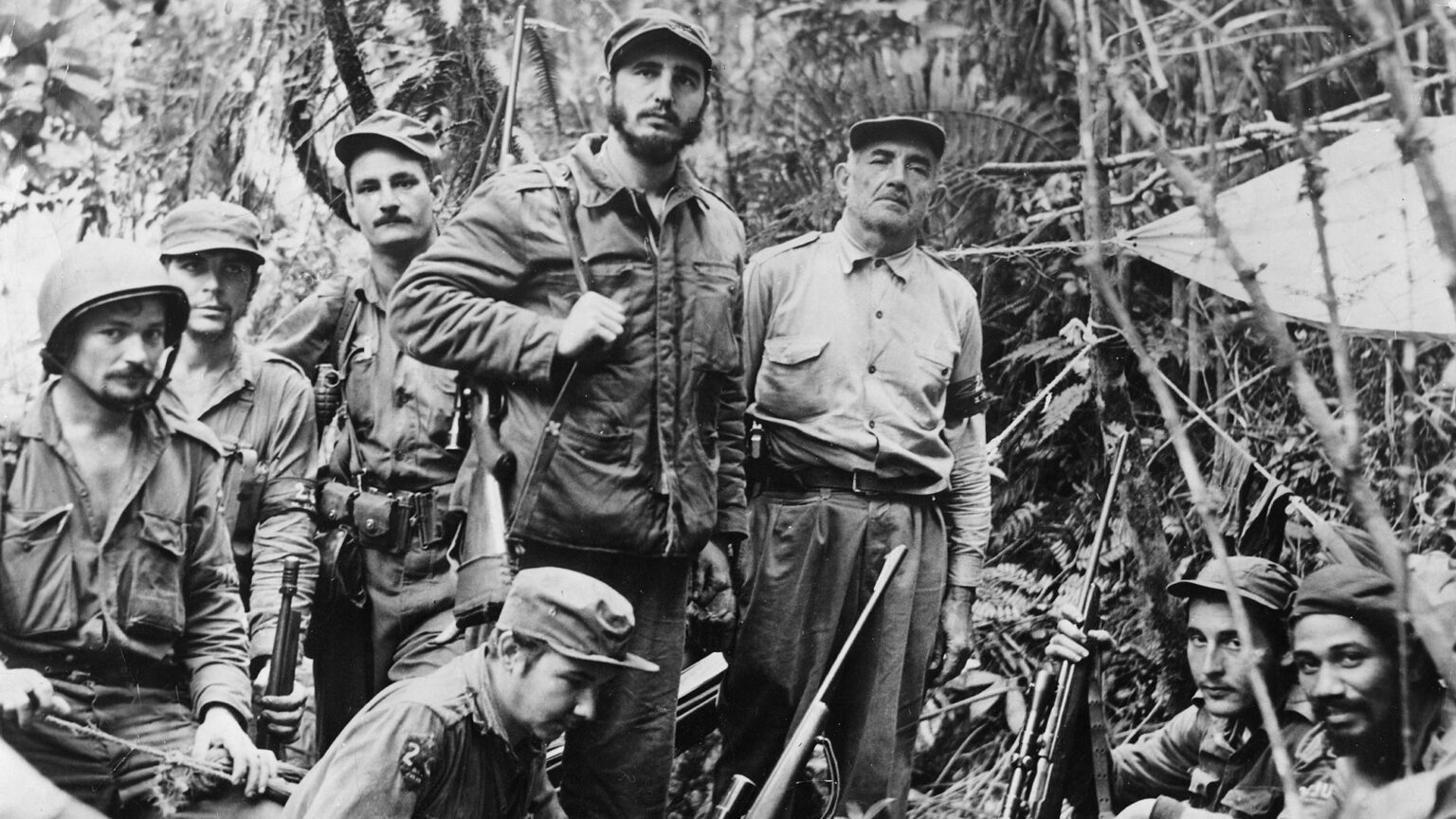
Fidel Castro in the Sierra Maestra with Guillermo García, Ernesto “Che” Guevara, Universo Sánchez, Raúl Castro, Crescentio Pérez, Jorge Sotus, and Juan Almeida. Photo: Wikimedia Commons
August 13 marks the anniversary of the birth of Marxist and communist revolutionary Fidel Castro, one of the most influential political leaders of the 20th century. Read our series of articles about the political life of the revolutionary leader.
Fidel Castro was born in Biran, in the east of the island of Cuba, in 1926, and died in Havana on November 25, 2016. His historical figure however, transcends the time in which he lived. Even when historians study the period in the region before the Cuban Revolution, they always keep in mind that, during the 1950s, on a Caribbean island, social, economic, and political changes would take place that would transform the entire history of the continent.
In this case, Fidel’s name cannot be detached from a process that shook the foundations of the entire Latin American and Caribbean society. Although the “Comandante” himself disavowed the simplification of revolutionary and historical processes to a few names, it seems that human memory prefers to engrave in its memory certain individuals rather than economic forces, cultural disputes, or political ideas. At least this has been the case with Fidel, whose figure is tied to the destiny of a country, just as Bolívar is tied to Venezuela, Juarez to Mexico, and Martí to Cuba.
The young student
Fidel studied at a Jesuit school, and perhaps because of this he always maintained an unyielding intellectual discipline, as well as an almost stoic confidence in the unity of any political group that has clear general objectives. At university, he studied law and social sciences. There he began to read several books on politics while presiding over the Federation of University Students (FEU), a space which he was active in during the struggle against the government of Ramón Grau San Martín, and in which he began to denounce the bloody dictatorship of the infamous Rafael Trujillo in the Dominican Republic.
As president of the FEU, he traveled to Colombia to attend the Inter-American Student Conference and meet personally with Jorge Eliecer Gaitan, the Colombian politician, whose assassination, a few hours before his meeting with the young Fidel, would set off a historical process in Colombian society that began with the famous “Bogotazo”.
Once he finished his university studies, he tried to enter national politics by running for the House of Representatives in 1952, but the disastrous coup d’état of Fulgencio Batista overthrew the government of Carlos Prío Socarrás and prohibited future elections. Fidel tried to denounce Batista before the courts for violating the constitution, but the denunciation was denied. Faced with this adversity, the young Fidel understood that elections and legal denunciations were not an adequate way to engage in political struggle at that time in Cuba.
The beginning of the revolutionary struggle
That is how several young revolutionaries decided to follow the path of armed struggle. On July 26, 1953, they attacked two military bases (the “Moncada” in Santiago de Cuba and the “Carlos Manuel de Céspedes” in Bayamo) which stored thousands of weapons and were located in areas where the people were mostly opposed to the Batista dictatorship. They had hoped that the attack would provoke sympathy among the population and the young military who doubted the dictatorship. But all plans, including the escape plans, failed. More than 80 young revolutionaries were tortured and killed by the repressive forces.
Fidel quickly understood that not every military failure necessarily implies a political failure. In the trial against him, he gave a famous and brilliant self-defense in which he defended two fundamental theses. In the first place, he said that the intellectual author of the attack was named José Martí, implying that the Cuban independence hero, who had died more than 50 years ago, inspired the sovereign ideals of the young revolutionaries. This implied that the revolutionary struggle in Cuba had not ended with Independence from Spain, but continued, thus establishing a political thesis to be followed by the various revolutionary movements in Latin America and the Caribbean during the sixties and seventies of the 20th century: the struggle for independence has not ended because there is still imperialist subjugation. Secondly, he concluded that, although they had been defeated and imprisoned, they were right to act in that way, and that historical time would know how to judge better what at that time seemed a risky adventure of a few young people: “History will absolve me,” Castro said before the judge.
He was imprisoned for almost two years on the Isla de Pinos before being acquitted and banished from Cuba on May 15, 1955. Batista thus hoped to get rid of an uncomfortable political prisoner, although in reality, by doing so, he sentenced himself (in the not-too-distant future) to be defeated militarily and to die in exile in the Spain of fellow dictator Francisco Franco.
After prison, Fidel Castro traveled to the United States and Mexico. In Mexico, he trained (under an ex-combatant of the Spanish Civil War named Alberto Bayo) and organized an expedition of fighters, among them Ernesto “Che” Guevara. The emerging political-military group was called the “26th of July Movement”, in honor of the attack on the military bases. The purpose was clear: to defeat the Batista dictatorship and create a more equitable country. Several months earlier Fidel said in the Palm Garden Hotel in New York City that “In the year 1956 we will be free or we will be martyrs. This struggle began for us on March 10, has lasted almost four years and will end on the last day of the dictatorship or on our last day.”
The Cuban Revolution
Aboard the now revered yacht Granma, a group of 82 expedition members left the coast of Veracruz for Cuba on November 25, 1956. They arrived in Cuba on December 2. Fidel imitated Martí’s military strategy, which consisted of disembarking in the eastern part of the country and approaching the capital from the extreme east of Cuba, passing through the Sierra Maestra, a slight mountain range on the island.
At first, it seemed that the new revolutionary struggle would fail…again. Batista’s army had discovered Castro’s plans and attacked the revolutionary troops with all its might. In Santiago de Cuba, the dictatorship managed to suppress the urban uprising commanded by Frank País, also a member of the Movement 26 of July, in support of the landing of the Granma (which, however, was several days late in arriving). They also quickly discovered the place of arrival of Castro and the rest of the combatants, attacking the guerrillas by air and sea.
After several combats, dispersions, persecutions, and regroupings, only 17 of the 82 original expedition members survived. Despite the obvious adversity, Fidel exclaimed upon meeting with the few survivors: “Now we will win the war!”, which shows a position of historical certainty that Che Guevara would explain years later: “Fidel was certain that, if we left Mexico, we would reach Cuba. If we arrived in Cuba, we would disembark. If we disembarked, we would fight. And if we fight, we will win.
During the coming months, hundreds of new fighters joined Castro’s troops, which were eventually divided into five columns commanded by him, his brother Raul, Camilo Cienfuegos, Che Guevara, and Juan Almeida. However, Batista’s army had more than 70,000 soldiers, so the Movement 26 of July launched a guerrilla war in various parts of the country. Batista launched a military offensive called “Operation Summer”, in which he sent 17 battalions to destroy the Rebel Army, but they were surprised with a series of victories by the revolutionary forces.
Fidel’s popularity began to increase. The Revolutionary Directory, another anti-Batista armed group, attacked the Presidential Palace in Havana to assassinate Batista but were defeated. Despite this, Batista’s invincible image began to be demystified. In addition, the dictatorship increased extrajudicial assassinations and torture against political opponents (the most famous case is the death of Frank País), which eroded the government’s public image. On September 5, the Cienfuegos naval base revolted along with several members of the Movement 26 of July. The government responded to the uprising with a bombing in which more than 400 people died. The majority of the Cuban people repudiated the cruelty with which Batista’s troops acted. The government’s repression only made the revolutionaries more popular.
In addition, after several interviews with international media, Fidel and his followers began to gain support outside Cuba, while denouncing the horrendous crimes of the Batista dictatorship.
During several months of armed struggle, Fidel proved to be the only leader capable of uniting the different factions opposing the dictatorship. The most important political movements recognized that he was the only figure capable of commanding the overthrow of Batista. In addition, Fidel proved to be a very astute military strategist, withdrawing his troops in difficult moments and counter attacking fearlessly when he found the slightest opportunity to gain territory. In this way, he managed to conquer most of the East and Center of the country by the end of 1958. Guevara and his troops managed to take the city of Santa Clara, the last strategic defense of Havana.
Despite the attempt of several military men to carry out an orderly withdrawal of Batista and his troops, Fidel ordered a final attack against the forces of the dictatorship. In this way, Castro sought to curtail the installation of a puppet government and assure the establishment of a truly revolutionary government. “Revolution yes, military coup no!” was Fidel’s phrase repeated by radio throughout the Caribbean island. Batista managed to flee Cuba with the support of US Ambassador Earl T. Smith.
Despite the apparent impossibility of the geopolitical situation, the Cuban Revolution triumphed on January 1, 1959 just to the south of the United States.
Fidel was right: victory was possible in Cuba despite all possible disadvantages. It was a matter of finding the right strategy. The Cuban Revolution inspired dozens of political groups to fight to seize power throughout Latin America and across the Global South, often with Cuban support. Thus began a new era in the history of the Caribbean island, which will never forget the name of Fidel Castro.
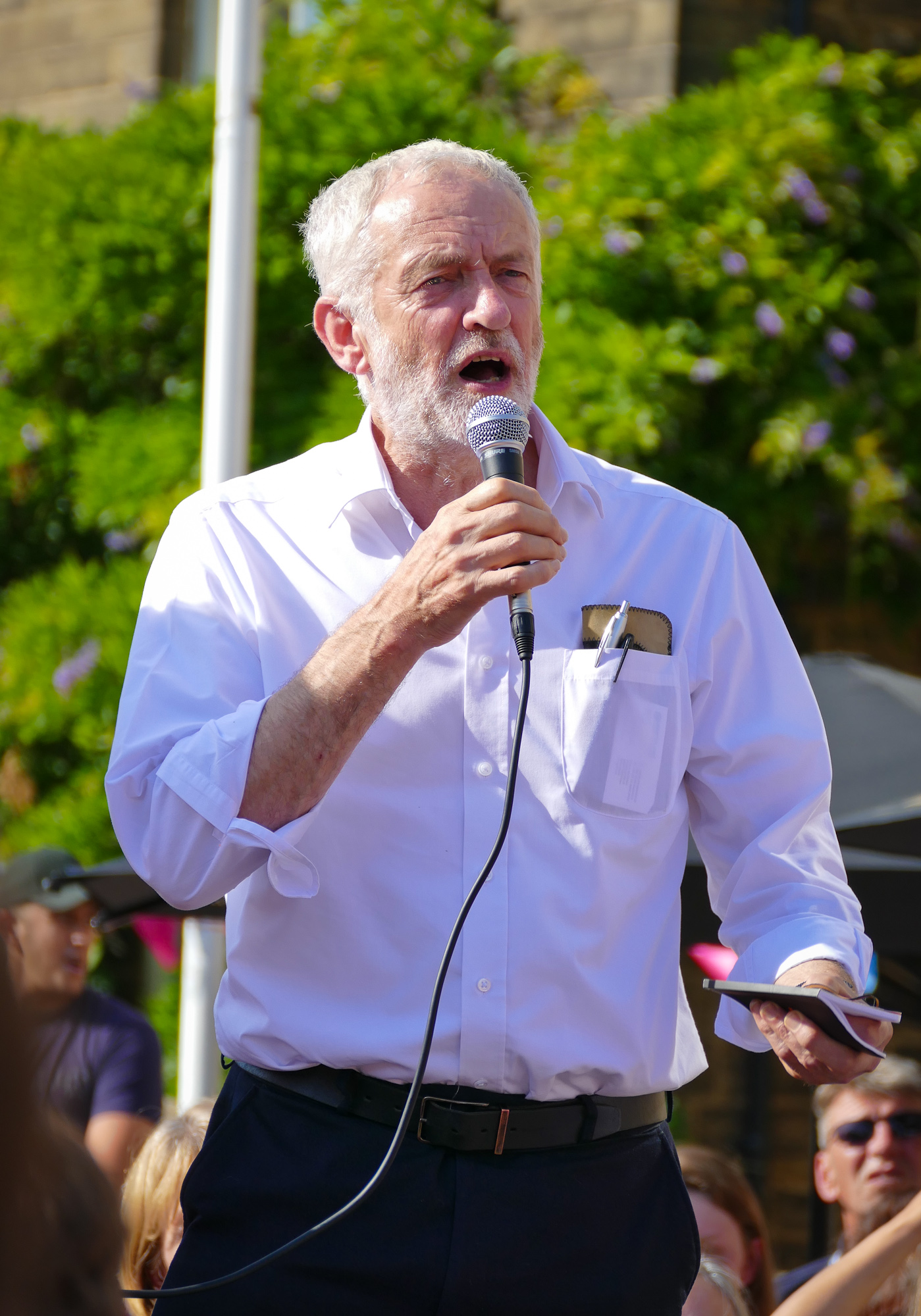
Jeremy Corbyn MP, former leader of the Labour Party
Migrants and refugees are not responsible for Britain’s ills – a message we must make absolutely clear, says JEREMY CORBYN MP
LAST week, a horrendous murder took place in Southport as three children were brutally hacked to death in a violent knife attack. What followed showed both the best and worst of society.
The best was the outpouring of support for the grieving families of the children. The worst was the far-right forces who attacked the mosque in Southport, a hotel housing refugees in Rotherham, and Muslim-run businesses across the country.
These far-right attacks on the Muslim community echo the tactics of the Nazis against Jewish people, shops and businesses in Germany in the 1930s. In both scenarios, the far right use violence against minorities and blame them for poverty, housing shortages and pressures on health and education services.
The emboldening of the racist right has come from the growing use of anti-migrant language by supposedly mainstream politicians, claiming that desperate people crossing the Channel in flimsy boats are an “invading force.”
The same voices seem unable or unwilling to acknowledge that wars cause refugee flows, and that the migrants who have made their homes in Britain work tirelessly to try and make underfunded services work at all.
At the same time, we are witnessing an economic strategy inherited from the Tories which increases the huge wealth gap in our society, perpetuates austerity and ignores the desperate poverty of so many children.
The response of the left must be to stand with the victims of far-right terror, challenge the far-right racism and call for the government to address the common issues facing all communities: the housing crisis, crumbling education and the collapse of our NHS.
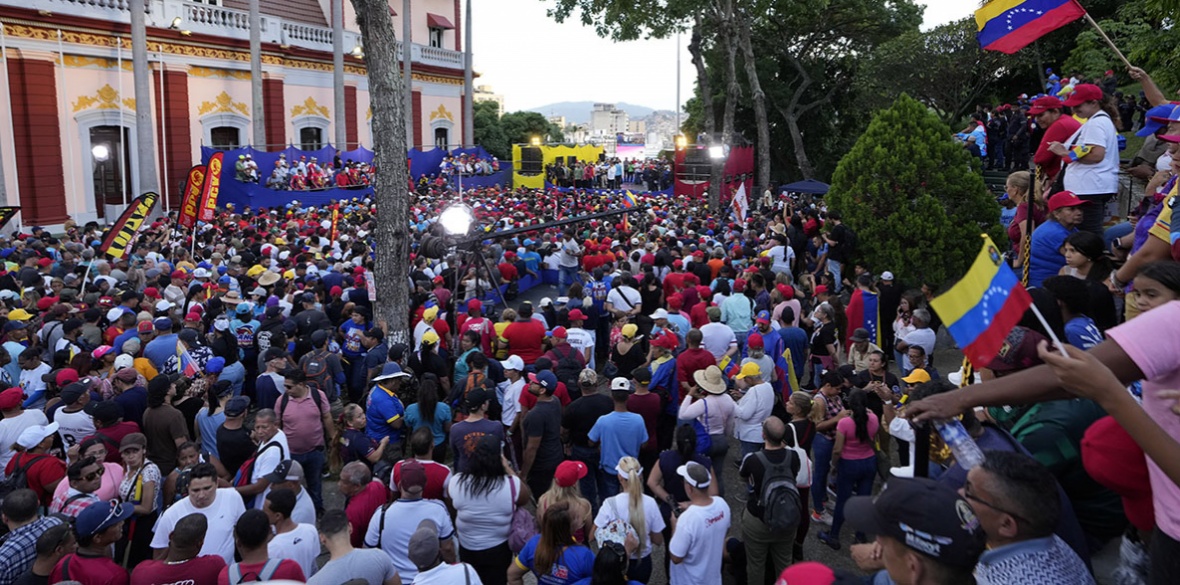
Supporters of President Nicolas Maduro gather for a government rally in Caracas, Venezuela, August 3, 2024Supporters of President Nicolas Maduro gather for a government rally in Caracas, Venezuela, August 3, 2024
VENEZUELANS hit the streets on Saturday in a series of massive demonstrations to safeguard the country’s Bolivarian revolution.
The marches, called by the United Socialist Party of Venezuela and labelled as the Great National March for Peace, came as the US-backed opposition continued to cast doubt on the victory of Nicolas Maduro in the presidential election.
Thousands rallied in the capital Caracas to the presidential Miraflores Palace, to give their support to President Maduro and show their support for the outcome of the poll, which took place on July 28.
Demonstrators shouted slogans such as “The streets belong to the people of Bolivar, Chavez and Maduro;” “We are joy, we are the majority” and “There is no room for violence in Venezuela.”
A large caravan of motorcyclists also toured the capital to show their support for the president.
Before the demonstration began, representatives of the motorcyclists called for respect for the democratic process in Venezuela, telling Venezuelan Television that “they must prevent their children from being used by fascism.”
They, along with the other marchers, also rejected the imperialist attack that is being mounted against the country through economic sanctions.