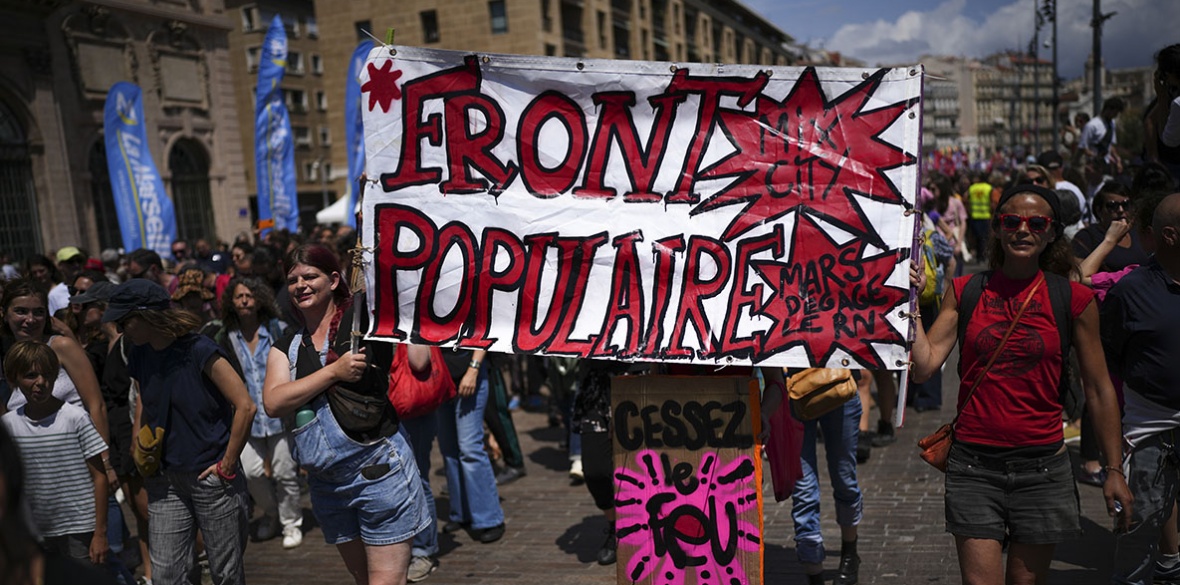
Protesters march with a banner that reads “Popular Front”, during a demonstration in Marseille, southern France, June 15, 2024
HUNDREDS of thousands of people marched against the far right in Paris and other French cities at the weekend.
Trade unionists and supporters of the quickly assembled Popular Front — an alliance of left forces announced on Friday to contest snap elections called by President Emmanuel Macron — chanted “Liberty for all, equality for all, fraternity for all” in a variant of France’s famous revolutionary motto.
Police estimated 250,000 marchers through a rain-swept Paris on Saturday and deployed more than 20,000 officers to watch them. Thousands marched in dozens of other locations, with placards denouncing not just Marine Le Pen’s far-right National Rally — which leads in polls for the first round of parliamentary elections — but Mr Macron’s anti-refugee legislation. Cries of “Free Palestine” echoed through the streets.
The Popular Front brings together the revolutionary left in Jean-Luc Melenchon’s France Unbowed and the French Communist Party with the Greens and the Socialist Party. Its founding statement calls for “rupture” with the status quo in the first 100 days of government and declares that “the arrival of the National Rally in power is no longer inevitable.”
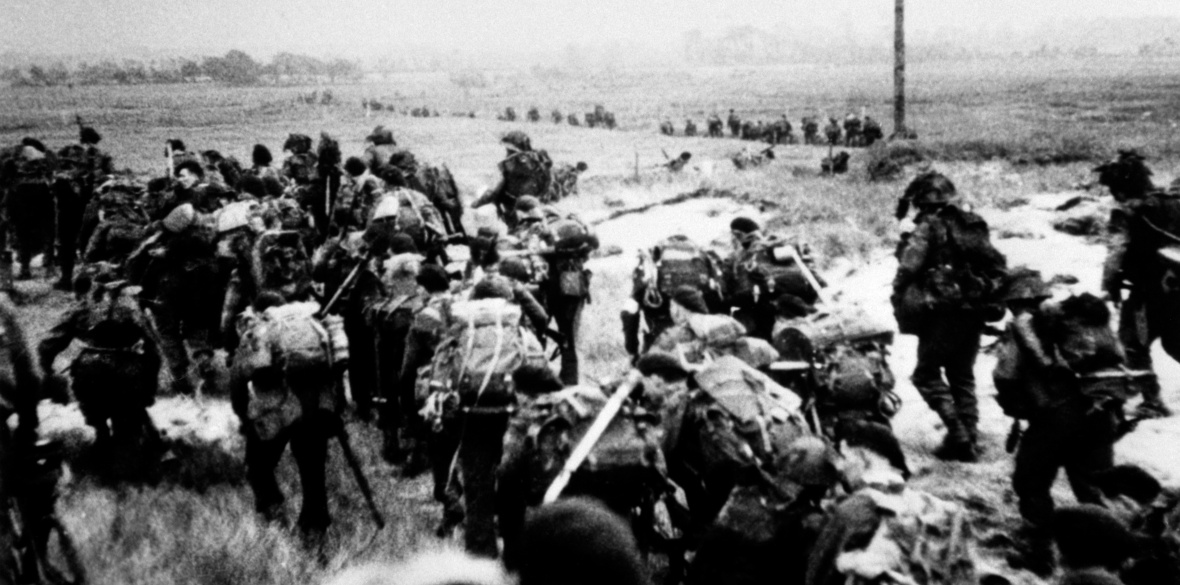
Royal Marine commandos moving off the Normandy Beaches during the advance inland from “Sword” beach, June 6, 1944
WITH the Tories and Labour exchanging blame over Channel crossings, we mark 80 years since a Channel crossing of a different kind.
On June 6 1944 British, US and allied troops crossed the Channel to open a second front against the Nazis in Europe, something the Soviet Union, which had borne the brunt of the war against fascism for the previous three years, had long urged.
Veterans are arriving in Normandy for commemorations of this heroic chapter in Europe’s liberation. Modern hostilities overshadow celebration of the anti-Nazi alliance of the 1940s, with the US and Britain criticising France for inviting Russia because of its invasion of Ukraine, though they themselves have never been excluded from World War II memorials while laying waste to countries from Vietnam in the cold war to Afghanistan, Iraq and Libya more recently.
These diplomatic divisions raise a question we should be asking our own politicians. Have you any right to claim the inheritance of anti-fascist victory if you are dismantling its achievements?
The world war against fascism was the crucible of international institutions as we know them today. The United Nations was established in a joint declaration by Britain, the United States, the Soviet Union and China on January 1 1942: it formalised the alliance against the Axis powers Germany, Italy and Japan, and a condition of membership was to declare war against Nazi Germany and its allies.
The foundation of the UN and new treaties like the Geneva Conventions of 1949 (on the conduct of war) and 1951 (on the treatment of refugees) expressed hope that a more civilised world order would stop any future descent into Nazi barbarism.
These agreements are not perfect, and powerful countries have often ignored them. But their existence is a legacy of the sacrifice made by those who gave their lives to smash fascism on D-Day, or at the battles of Stalingrad or Berlin, or among the heroic resistance movements that sprang up across Nazi-occupied Europe.
Politicians talk now as if the rules are outdated: the refugee conventions were drawn up by people who couldn’t conceive of the scale of “irregular” migration today. It isn’t true: World War II and its aftermath saw huge population displacement, the uprooting of millions of people. The Refugee Convention of 1951 set out universal obligations to refugees because of these horrific experiences.
Those obligations are ones governments across Europe, including ours, are trying to erase. The end of EU search-and-rescue operations, the active persecution of civil rescue crews by states like Italy, have fatally undermined the binding responsibility to aid anyone in distress at sea. The odious Nigel Farage clearly approves, having insulted brave volunteer lifeboat crews by calling the Royal National Lifeboat Institution a “migrant taxi service” for presuming to save people from drowning.
Farage has never yet been elected, but his ability to call the tune at Westminster is as great as ever if the first leaders’ debate is anything to go by: with Labour’s Keir Starmer calling Rishi Sunak, the PM of the Rwanda deportations scheme and the Bibby Stockholm prison barge, “the most liberal prime minister we have ever had on immigration.”
This is gutter politics, and a betrayal of what the D-Day heroes fought for. But so, at home, is the systematic destruction of the NHS and welfare state built after defeating fascism, fruits of a victorious people’s war and a recognition that fascism had emerged from a Europe wracked by poverty and unemployment.
It is no coincidence that today, with living standards falling, public services failing and the brazen theft of our wealth by an ever smaller corporate elite, the far-right politics of grievance and hate are on the march across the continent.
The real commemoration of D-Day must be to mobilise against them. For peace and socialism, against fascism and war.
There is no risk of letting the Tories in in Islington North. This will be a Corbyn versus token-Labour contest. Given the Labour Party nationally echoes Tory policies on public spending, crackdowns on protest rights and effective support for Israel’s brutal war in Gaza, the value of having a voice for peace and socialism who has never been afraid to challenge ministers, Tory or Labour, on their actions in Parliament is obvious.
It matters that we send the bullies and political fixers who dominate Westminster politics a message that they will not always get away with it.
It matters too that re-electing Corbyn, a nationally recognised figure, sends a national message that the socialist resurgence his 2015-20 Labour leadership represented has not been snuffed out.
Majorities consistently tell the pollsters they want higher taxes on the rich, more public spending, rail, mail, water and energy back in public hands.
A deeply undemocratic political system and a deeply dishonest and manipulative media are adept at obscuring that reality. Re-electing Jeremy Corbyn will make it that bit harder for them to do so.
‘If arms company bosses and Britain’s political elite won’t impose an arms embargo, we, the workers, will enforce it from below’
This May Day, over 1,000 workers across Britain have mobilised to blockade four sites involved in the supply of arms to Israel, in a response to calls from Palestinian trade unions.
In solidarity with Palestinian workers as the onslaught on Gaza reaches its 208th day, trade unionists in Britain have blocked entry to the UK Department of Business and Trade in London and three BAE Israeli arms factories in Scotland, Wales and Lancashire to protest the government’s refusal to suspend the sale of UK arms to Israel.
BAE Systems has been targeted as the UK’s leading military goods manufacturer which profits from arming Israel, while workers have blocked the UK Trade Department in support of civil servants who have expressed fears that they could be complicit in war crimes in Gaza if Israel is found to have broken international law.
Civil servants’ union PCS is considering bringing legal action to prevent their members being forced to carry out potentially unlawful acts, after staff requested to “cease work immediately” on arms export licences to Israel.
Canada, the Netherlands, Japan, Spain and Belgium have suspended the sale of arms to Israel, while the British government continues to refuse. It comes as a legal challenge over the British government’s role in allowing weapons to be sent to Israel has been given the go-ahead to be heard in the High Court later this year.