Labour forces Holocaust survivor out of party with expulsion threat email

Spread the love

Original article republished from The Skwawkbox for non-Commercial use

Stephen Kapos says he has a duty to teach others about his experience whether Starmer and co like it or not
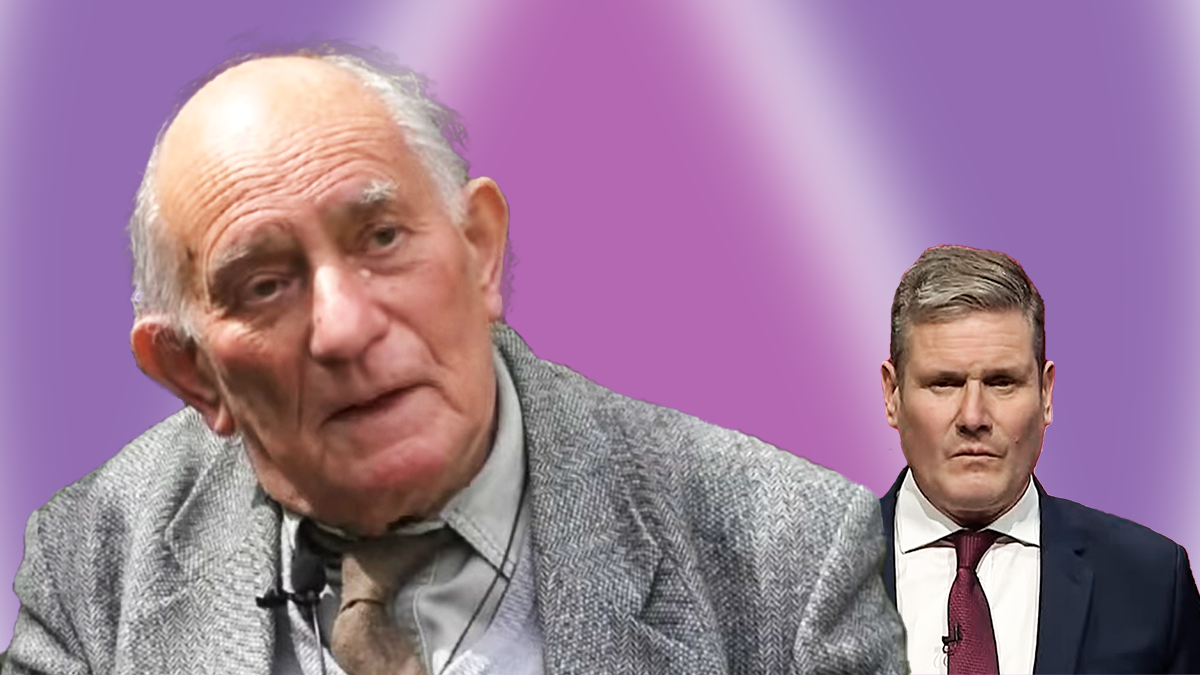
As Skwawkbox predicted last week, Holocaust survivor Stephen Kapos has been driven out of the Labour party in yet another demonstration of the antisemitism and arrogance of the Labour right.

Kapos, who survived the slaughter of Jewish people as a boy, received an email last week from the party threatening him with expulsion if he spoke about his experience at a Socialist Labour Network event last Friday, which was Holocaust Memorial Day:

Date: 24 January 2023 at 20:09:05 GMT

Subject:FAO: Stephen Kapos

Dear Stephen, 

It has been brought to the attention of the Labour Party that you have been advertised as a speaker for an event entitled ‘Zionism During the Holocaust – Reclaiming the Memory of All Those Who Died’,  hosted by Socialist Labour Network on Friday 27th January 2023.

In line with Labour Party rules, Socialist Labour Network is a group which the NEC of the party has determined is incompatible with Labour Party values. Any support for the organisation would likely be deemed in breach of Party rules and may lead to expulsion. 

Yours sincerely,

London Labour 

But rather than back down to the cowardly threat, to which the party drone who sent it didn’t even dare put his or her name, Kapos – a constituent of party leader Keir Starmer – resigned his membership, saying that his duty to teach people about the terrible slaughter at every opportunity – and to stand up against Israeli apartheid against Palestinians – was too important to bow to petty tyrants and their so-called ‘Labour values’:

Dear London General, 

Thank you for your emailed letter of the 24th of January giving me advance warning that I am likely to be expelled from the Party if I were to speak from the panel as a Holocaust survivor at the SLN (Socialist Labour Network) Webinar on the 27th January — on Holocaust Memorial Day.

The Holocaust is the most important single example of genocide, which at its worst descended into an industrial process of mass murder of millions.

As a child survivor and one of the fewer and fewer still living direct witnesses to the Holocaust I feel a compelling duty to bear witness and speak out about it at any platform that would invite me and to any audience ready to listen.

I am an activist for Palestinian human rights and an active member of the Palestine Solidarity Campaign in its Camden Branch. The defence of Palestinians living under a brutal occupation is very important to me, particularly as a Holocaust survivor. Palestinians live under a system of apartheid as recognised by Amnesty International and other major human-rights organisations. Those are my political beliefs which I claim are protected characteristics under the Equalities Act 2010.

I am not a member of SLN nor have I been following its activities, but via the book to be discussed on the 27th I have a general understanding of SLN’s views on present-day Zionism (as a political movement ) and on some of the actions of the Zionist movement during the Holocaust and WWII.  I am in sympathy with some of those views on the grounds of my political beliefs mentioned above. I have personal experience of the Kastner project in Hungary which was driven by Zionist ideology.

Email and letter details courtesy of Tony Greenstein

Left-wing Jewish activist Tony Greenstein, one of the first to be expelled during Labour’s mass purge of Jews who stand up for Palestinian human rights, published the video of Kapos speaking at the event about what he saw and suffered:

https://youtu.be/WRxwEbtt2Zc

The real and naked antisemitism of the Labour right has somehow failed to feature in the supposed ‘mainstream’ media discourse, despite being far more widespread and concrete than the grossly-exaggerated and often fictional ‘left antisemitism’ that even the Starmer-commissioned Forde Inquiry had to admit was weaponised against the left and Jeremy Corbyn, despite the revelations of the leaked Labour report and Al Jazeera’s ‘Labour Files’ documentary series.

The right’s racism and abuse has also been directed at blackMuslim and Roma Gypsy members with impunity from the party leadership – on the contrary, some culprits have been protected while others have been promoted, while Starmer himself has been accused of covering up for ‘criminal’ abusers of domestic violence victims and for alleged sex pests in his shadow cabinet.

Solidarity with Stephen Kapos and all those targeted by the Labour right’s regime.

SKWAWKBOX needs your help. The site is provided free of charge but depends on the support of its readers to be viable. If you’d like to help it keep revealing the news as it is and not what the Establishment wants you to hear – and can afford to without hardship – please click here to arrange a one-off or modest monthly donation via PayPal or here to set up a monthly donation via GoCardless (SKWAWKBOX will contact you to confirm the GoCardless amount). Thanks for your solidarity so SKWAWKBOX can keep doing its job.

Original article republished from The Skwawkbox for non-Commercial use

Continue ReadingLabour forces Holocaust survivor out of party with expulsion threat email

The solution is resistance

Spread the love

Now is the time to be joining demonstrations, occupations and the picket lines writes JOHN MCDONNELL MP

(Socialist) Labour MP John McDonnell Image: John McDonnell, Shadow Chancellor 21-25 September 2019
Brighton by Socialist Appeal at Wikimedia  Creative Commons Attribution 2.0 Generic license

https://morningstaronline.co.uk/article/f/blackrock-power-behind-throne

We need to be out there in the streets, taking every opportunity we can to hold this government to account and linking up all the forms of resistance taking place.

As well as the large numbers of people taking industrial action to try and secure decent wages, there are renters campaigning against eviction, people with disabilities campaigning to ensure their benefits are not cut, climate justice campaigners and a whole range of social movements saying no to the Tories’ agenda.

So, what way forward for our movement? The solution is deepening this resistance at all levels, and that means joining demonstrations, occupations and the picket lines — and it also means discussing the alternatives we need around a socialist policy programme.

This programme must be based on redistributive taxation that will fund our public services and address the poverty and inequality that scar our society. And it must include securing stable, long-term investment in our infrastructure and in our people — including through extending public ownership — so we can mobilise our whole economy to tackle the challenges ahead and the rising challenge of climate change.

Follow John on Twitter @johnmcdonnellmp.

Continue ReadingThe solution is resistance

Keith Starmer’s alternative Labour Party speech

Spread the love
Keir Starmer commits to play the caretaker role for Capitalism through the "hard times".
Keir Starmer commits to play the caretaker role for Capitalism through the “hard times”.

11/9/24 Image added 10/9/24. This article has proved to be prophetic. It may continue to be prophetic in 20 or 30 years.

[Responding to applause] Thank you, thank you, thank you. 

Here we are at the Labour Party conference 2022 - and thanks to the Tory party appointing simple maths misunderstanding incompetents - on the cusp of being elected the UK's government. 

I'll let you into a secret conference. I am the Establishement's man (more on that later). What I want to tell you right now is that I will govern, WE will have a Labour govenment looking after the Capitalists' interests through the hard times ahead until the Conservatives can take over again, after the hard times ahead, with an almost sane leader. 

Yes, I promise to you conference that you can depend on me to look after the rich and powerful just as the Tories do while they take a break and duck out of the total chaos that they've caused. And I say clearly to you conference, that I am proud to do this work for the rich and powerful, to be their servant, to keep them safe while I perform my caretaking role for Capitalism. 

It has been a long road for me to achieve power and I want to thank those that have helped me. I particularly want to thank the Labour officials who were so hostile to and totally undermined the previous leader. And I particularly want to thank the Zionists. 

I know that all of you in this hall, in this party can't say that word Zionist - that ist forbidden - but I can because I'm leader. So thanks to all the Zionists that hounded out the previous Labour leader and his supporters so that I was able to expell them for being opposed to Zionist apartheid, for being Socialists and anti-racist.(2) We can't have any of them in this party, this is a new era, we are at the centre of UK politics, we are New Labour, the New Red Tories.   

We are in a new era conference. You will be aware that I thanked the Zionists by installing a former Israeli spy into the centre of Labour Party activities, actually a member of 8200 Unit, to spy on you members and pursue the interests of Israel.(1)

I am in thrall to Israel - but don't you dare call me a Zionist - dat is forbidden. As I said I am an Establishment man but unfortunately, what I have yet to realise is that the Establishment moves very slowly but ever so occasionally has seismic shifts. I still have yet to realise that the UK establishment may not be too pleased with me being so in thrall to a foreign state and installing a former Israeli spy in my office. 

As I finish this sermon, I ask you all to join me in singing the National Anthem ... 


(1) Also responsible for rapid rebuttal according to the job description. 
(2) This is all well documented by al Jazeera in their 2 investigative reports 'The Lobby' and 'The Labour Files'.


Continue ReadingKeith Starmer’s alternative Labour Party speech

What nationalising energy companies would cost – and how to do it

Spread the love

UK could bring National Grid and retailers in-house and build public renewable energy, says ex-Labour policy chief

Andrew Fisher

17 August 2022, 12.01am

Image of banknotes and a prepayment meter key by Lydia, https://creativecommons.org/licenses/by/2.0/

Republished from OpenDemocracy under Creative Commons Attribution-NonCommercial 4.0 International licence.

When 62% of Conservative voters want energy run in the public sector, it’s fair to say the left has won the argument (75% of Labour voters agree, 68% of Lib Dems).

Yet public ownership is opposed passionately by the Conservative government, while the leader of the opposition has said he is “not in favour” of it – despite his election on a platform that committed to “bring rail, mail, water and energy into public ownership to end the great privatisation rip-off and save you money on your fares and bills”.

Public ownership is on the media’s radar, too. When Labour leader Keir Starmer announced his policy to freeze bills this week, he was asked why he wouldn’t also nationalise energy, replying that: “In a national emergency where people are struggling to pay their bills … the right choice is for every single penny to go to reducing those bills.”

But so long as energy remains privatised, every single penny won’t. Billions of pennies will keep going to shareholders instead.

The energy market was fractured under the mass privatisations of the Thatcher governments in the 1980s. It contains three sectors: producers or suppliers (those that produce energy), retailers (those that sell you energy), and distribution or transmission (the infrastructure that transports energy to your home).

It is important to bear this in mind when we’re talking about taking energy into public ownership. We need to be clear about what we want in public ownership and why.

By 2019, Labour had a detailed plan on how to do this – worked up by the teams around then shadow business and energy secretary Rebecca Long Bailey and then shadow chancellor John McDonnell. The plan is not the only way, but it illustrates what exists and how one could go about re-establishing a public energy ecosystem, run for people not profit.

The recent TUC report shows the cost of nationalising the ‘Big 5’ energy retailers – British Gas, E.ON, EDF, Scottish Power and Ovo – to be £2.8bn, which would go on buying all the companies’ shares. That’s a lot of money, equivalent to more than the annual budget of the Sure Start programme in 2009/10 (its peak year). But it’s a one-off cost, not an annual one.

And it’s not like the current privatised system doesn’t have its costs: since June 2021, the UK government has spent £2.7bn bailing out 28 energy companies that collapsed because they put short-term profits ahead of long-term stability – companies like Bulb Energy. We have spent billions of pounds already to get nothing in return. So £2.8bn is not a large amount of money to pay to gain these assets, rather than just bailing them out.

The big energy retail companies made £23bn in dividends between 2010 and 2020 according to Common Wealth, and £43bn if you include share buy-backs. What you choose to do with that surplus in public ownership is another matter: you could use it to invest in new clean energy or to lower bills or fund staff pay rises, rather than subject your workers to fire-and-rehire practices as British Gas did last year.

Labour’s previous plan also involved taking the distribution networks – the National Grid – into public ownership. This would end the profiteering at this level, too – with £13bn paid out in dividends over the five years prior to 2019. As Long Bailey said at the time, we need “public driven and coordinated action, without which we simply will not be able to tackle climate change”. Like previous nationalisations, the purchase of the grid and distribution networks could be achieved by swapping shares for government bonds. By international accounting standards, the cost is fiscally neutral as the state gains a revenue-generating asset, which more than pays for the bond yield.

The final part of the plan – and the most complicated – is production and supply. It would be impossible to nationalise the oilfields of Saudi Arabia or Qatar – and for good reasons we should want to leave fossil fuels in the ground, anyway, rather than contest their ownership.

And so what Labour proposed in 2019 was a mass investment in new renewable energy generation projects, with the public sector taking a stake and returning profits to the public. For example, under the ‘People’s Power Plan’, we proposed 37 new offshore wind farms with a 51% public stake, delivering 52GW alone by 2030, equivalent to 38 coal power stations. There were additional proposals for onshore wind, solar, and tidal schemes, as part of a 10-year £250bn Green Transformation Fund, which included other schemes like the Warm Homes insulation initiative.

Labour’s new shadow chancellor Rachel Reeves has promised a similar level of investment – a £28bn a year climate investment pledge.

Any surplus energy would then be sold on international markets, with a People’s Power Fund – a sort of sovereign wealth fund – to deliver public investment in local communities’ social infrastructure: a genuine levelling-up fund, perhaps.

Many people will say this can’t be done, but of course it has been before. The 1945 Attlee government nationalised energy and successive Conservative governments – including those of Churchill, MacMillan and Heath – were happy to have a nationalised asset. Harold MacMillan famously accused Margaret Thatcher of “selling off the family silver” when she privatised state industries.

When I was born in 1979, the National Coal Board, British Gas and British Petroleum were all publicly-owned or majority publicly-owned companies. Between them, they were the major suppliers of our energy. Our gas bills came from British Gas and our electricity bills from our regional electricity board (in my case Seeboard, the South Eastern Electricity Board), and coal and oil fuelled our power stations.

The regional electricity boards had been brought into being by the Attlee government’s Electricity Act 1947, when electricity companies were forcibly merged into regional area boards and nationalised. The Coal Industry Nationalisation Act 1946 and the Gas Act 1948 had together brought energy into public ownership.

Seeboard was privatised in 1990, and later became part of EDF Energy – ironically, the nationalised French energy company, whose profits from the UK’s stupidity are used to subsidise French consumers.

The French government has now fully nationalised EDF (previously it was 84% publicly owned), and household energy bills rose by just 4% this year – compared to over 50% in the UK and a forecast 200% by January 2023.

If Starmer doesn’t want to listen to me (or his own commitments from 2020), perhaps emulating the centrist Emmanuel Macron in this instance would be palatable?

From the depletion of fish stocks to the burning of the Amazon, profit has proved a failed regulator for use of our natural resources

In his later years, Robin Cook argued: “The market is incapable of respecting a common resource such as the environment, which provides no price signal to express the cost of its erosion nor to warn of the long-term dangers of its destruction.”

From the depletion of fish stocks to the burning of the Amazon, profit has proved a failed regulator for use of our natural resources. The market has also failed to decarbonise at pace, or to end the scourge of fuel poverty.

On the media this week, shadow energy secretary Ed Miliband said Labour is “continuing to look at what the right long-term solution is for our energy system”. It is up to all of us to campaign for that solution to be public ownership – whether that’s from within the Labour Party (like me) or from the outside.

Republished from OpenDemocracy under Creative Commons Attribution-NonCommercial 4.0 International licence.

Related at OpenDemocracy

Revealed: UK household energy debt hit record high even before price hikes

Revealed: Energy crisis has made 30 House of Lords members wealthier

On energy strategy, the government is leaving women in the cold

Continue ReadingWhat nationalising energy companies would cost – and how to do it

State of the UK Labour Party

Spread the love

Two articles about the UK Labour Party, Craig Murray discusses the pointless Keir Starmer:

Starmer’s role has been simply to emasculate the Labour Party, and to purge it of any elements that might seek to pose a threat to rampant neo-liberalism and wealth inequality. His efforts to ban Labour MPs from supporting striking railway workers must be anathema to anybody who has the slightest feel for the history and traditions of that party and indeed the most basic understanding of its very raison d’etre.

This Tony Benn quote from the 1980’s has come into vogue because it is prophetic, and the process appears now complete:

If the Labour Party could be bullied or persuaded to denounce its Marxists, the media – having tasted blood – would demand next that it expelled all its Socialists and reunited the remaining Labour Party with the SDP to form a harmless alternative to the Conservatives, which could then be allowed to take office now and then when the Conservatives fell out of favour with the public. Thus British Capitalism, it is argued, will be made safe forever, and socialism would be squeezed off the National agenda. But if such a strategy were to succeed… it would in fact profoundly endanger British society. For it would open up the danger of a swing to the far-right, as we have seen in Europe over the last 50 years.

Starmer is in one sense the apotheosis of this process. Not only has he acted to purge the Labour Party of socialism, he also offers so very little of a meaningful alternative to the Tories that there is very little danger of the Tories being voted out of office. Not only is he a safe right-wing backstop, he is a self-redundant safe right-wing backstop.

Jeremy Corbyn Sophie BrownCC BY-SA 4.0, via Wikimedia Commons

and Jeremy Corbyn openly discusses the many parties that obstructed him. The article also discusses Julian Assange.

The Guardian has long been viewed as the voice of the liberal-left in Britain, so it surprised many during the Corbyn leadership to see it act as one of the main media vehicles through which the campaign to bring him down was fought. 

The paper was a key part of the “anti-semitism crisis” that engulfed Corbyn’s leadership. From 2016-19, the Guardian published 1,215 stories mentioning Labour and anti-semitism, an average of around one per day, according to a search on Factiva, the database of newspaper articles. 

In the same period, the Guardian published just 194 articles mentioning the Conservative Party’s much more serious problem with Islamophobia. A YouGov poll in 2019, for example, found that nearly half of the Tory party membership would prefer not to have a Muslim prime minister. 

The Guardian’s coverage of anti-semitism in Labour was suspiciously extensive, compared to the known extent of the problem in the party, and its focus on Corbyn personally suggested that the issue was being used politically.

The late Jewish anthropologist David Graeber commented after the 2019 election: “As for the Guardian, we will never forget that during the ‘Labour antisemitism controversy’, they beat even the Daily Mail to include the largest percentage of false statements, pretty much every one, mysteriously, an accidental error to Labour’s disadvantage”.

Keir Starmer says he is scrapping Labour’s manifesto and ‘starting from scratch’ on policy

Continue ReadingState of the UK Labour Party