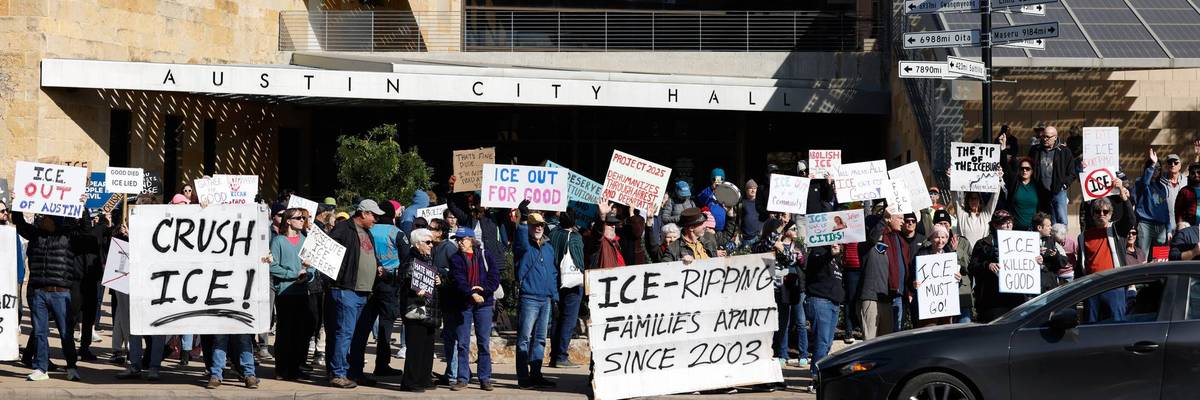
Hundreds of people protest against US Immigration and Customs Enforcement outside Austin City Hall in Austin, Texas, on January 10, 2026. (Photo by Stephanie Tacy/NurPhoto via Getty Images)
“ICE has been terrorizing our country for far too long,” said Congressional Progressive Caucus Chair Greg Casar, who represents the district where the shooting occurred.
An Immigration and Customs Enforcement agent shot and wounded a man in Austin, Texas on Sunday, prompting demands for an independent investigation and renewed calls from progressive lawmakers and activists to abolish ICE amid the Trump administration’s deadly immigration crackdown.
Local ABC affiliate KVUE reported that the shooting occurred in the 7000 block of West Anderson Lane, near the intersection of Research Boulevard and Anderson Square. An unidentified man was taken to a hospital. His condition was initially unclear; the Austin American-Statesman later reported that he was alert and talking.
The circumstances leading to the shooting are under investigation.
Independent journalist Emiliano Tahui Gómez spoke with two witnesses.
“Nedevia Bolaños and her husband, Carlos, own a business just off the intersection where the shooting happened,” Gómez reported on social media. “Shortly before 1 pm they say they heard what sounded like two gunshots. Carlos ran out first. A blue Toyota sedan and a black Escalade were stopped under the highway.”
Carlos said he saw a man who looked like he was in his 30s “leaning backwards against his seat. A masked agent was standing outside the car. The agent refused to answer questions. Within a few minutes, as many as 10 other ICE agents arrived.”
Gómez continued:
Carlos asked the victim if he was ok. “Yes,” the man said in Spanish, but he looked exhausted. Carlos asked why they had shot him. “Because I didn’t stop.”
Bolaños ran up next. She said she continuously asked the ICE agents about why they’d shot him and if they were going to render aid. They didn’t answer her. It was an [Austin Police Department] officer who later arrived and cut open the young man’s shirt, revealing a deep hole between his shoulder blades.
The ambulance arrived about 10 minutes after and carried him off.
“I’ve never seen all this. Thank God I’m a citizen,” Bolaños said in Spanish. “Or I’d be living like this. In a dream of terror.”
CBS Austin reporter Vinny Martorano said on social media that Austin City Councilman Mike Siegel told him that “an ICE agent, who is well-known in the city’s Latino community, sideswiped the man’s car. Then the officer got out and shot the driver five times through the windshield.”
Congressional Progressive Caucus Chair Greg Casar (D-Texas)—who represents the district where the shooting occurred—said on social media that “the horror has come to our city: ICE has shot a person in Austin this morning.”
“As the facts emerge, I am demanding a full, independent investigation, immediate release of the body camera footage, and accountability for any ICE officer who broke the law,” he continued. “Over and over, ICE has shot people and then lied about what happened. We can see the lies with our own eyes. We will demand truth, transparency, and accountability.”
“Just like Americans have from Minneapolis to Houston, Austinites will speak out peacefully against this deadly mass deportation machine,” Casar added. “ICE has been terrorizing our country for far too long. We will not be silent.”
Breaking: ICE shot and injured a man in Austin, Texas, earlier today. Trump has allowed ICE to flood our streets and put our communities in harms way again and again and Governor Abbott is complicit every time.I am demanding the body camera footage and full accountability.
Austin Mayor Kirk Watson, a Democrat, said at a press conference: “I’m very angry about this. I’m extremely unhappy. A person being shot on the streets of Austin by someone purporting to be law enforcement, particularly when it’s ICE, is something that causes me to be unhappy and angry about it.”
“And while I’m unhappy and I’m angry about it, I’m not surprised at all,” he added. “It’s happened in other cities with the nature of ICE and the way ICE is doing its business these days and the chaos that we see it performing and fomenting. There’s no reason for us to be surprised by it.”
Texas state Rep. Vikki Goodwin (D-47), who is running for lieutenant governor, said that “this violence cannot continue.”
“This weekend, after abusing and hurting peaceful protesters in Illinois, they have just shot another person in Austin, Texas,” she added. “The pattern is clear. The agency can’t be reformed. I’ve heard the community: I am ready to melt ICE and dismantle DHS! My colleagues in Congress should be too.”
Sunday’s shooting came 10 weeks after an ICE agent fatally shot Lorenzo Salgado Araujo, a 52-year-old Mexican man, in Houston. Salgado’s death followed a series of shootings involving federal immigration agents, including the January killing of US citizens Renée Good and Alex Pretti in Minneapolis.
A letter sent in July by Democratic lawmakers to DHS officials noted that agents had shot at least 22 people since President Donald Trump’s return to office, with six of those shootings fatal. The lawmakers said that in multiple cases, federal authorities had made allegations against shooting victims that were later contradicted by evidence.
More than 50 people have died in ICE custody during Trump’s second term.
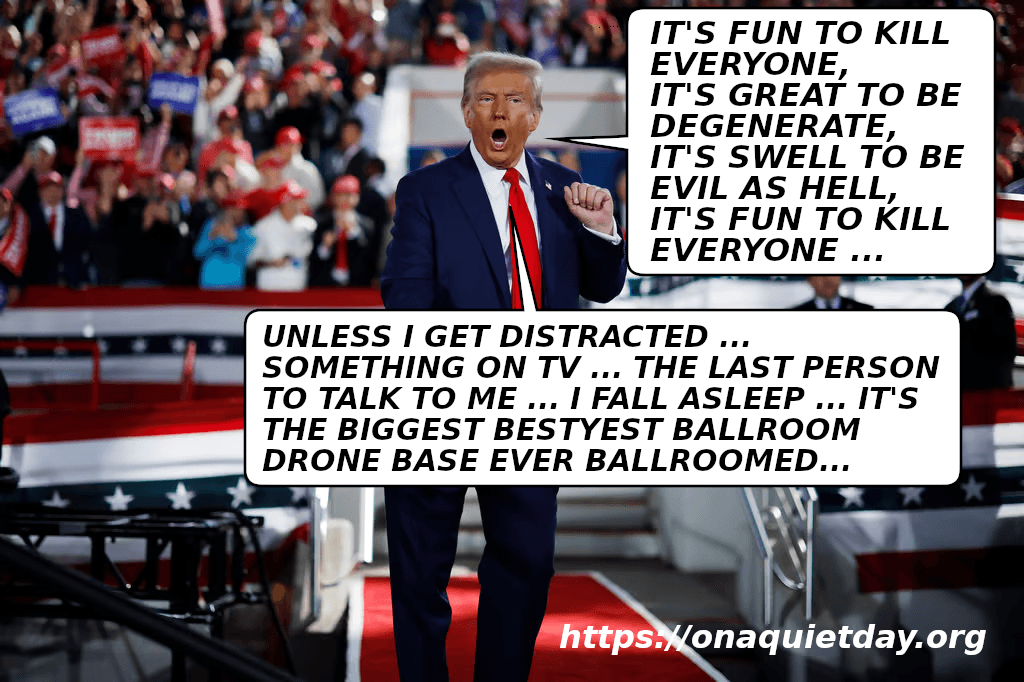
Donald Trump sings and dances, says that it’s fun to kill everyone … unless he gets distracted or falls asleep.Orcas discuss Donald Trump and the killer apes’ concept of democracy. Front Orca warns that Trump is crashing his country’s economy and that everything he does he does for the fantastically wealthy.Climate science denier Donald Trump confirms that he knows nothing about democracy and that more liquid gold is being secured according to his policy of global privateering.
This work by Middle East Monitor is licensed under a Creative Commons Attribution-NonCommercial-ShareAlike 4.0 International License.
UN Special Rapporteur on Palestine Francesca Albanese holds a press conference at the lower house of the Italian Parliament, the Chamber of Deputies, to present her new report titled “Genocide in Gaza: A Collective Crime” in Rome, Italy on February 03, 2026. [Barış Seçkin – Anadolu Agency]
UN Special Rapporteur on the human rights situation in the occupied Palestinian territories Francesca Albanese on Saturday compared Israel’s killing of thousands of children in the Gaza Strip to practices carried out by the Nazis during the Holocaust.
Albanese made the comment in a post on X in response to remarks by Israeli model Sarai Givaty to the Hebrew-language i24NEWS channel.
The UN rapporteur reposted part of Givaty’s interview, in which she asked: “Is it possible for me not to feel sad about every child crying in the world?”
“I am sad. But I also realise that if we don’t act, this child will grow up to become a terrorist,” Givaty said.
Albanese responded: “(Children will grow up.) This was also the argument made by Nazi officials during the Nuremberg trials to justify why they killed children during the Holocaust.”
Throughout the war in Gaza, Albanese has taken strong positions in support of Palestinians and against Israel’s actions in the territory.
She has faced pressure and criticism over her positions and reports on Israel’s war in the Gaza Strip.
In July 2025, the United States imposed sanctions on Albanese, saying they were linked to her efforts to push the International Criminal Court to act against US and Israeli officials, companies and executives.
Washington had also previously asked UN Secretary-General Antonio Guterres to dismiss her, accusing her of “antisemitism”.
The Gaza government media office said on 24 August that the Israeli army had killed more than 21,500 children since the war in the territory began in October 2023.
“The occupation continues to shed the blood of innocent people, particularly children. The number of children killed since the start of the genocidal war on 7 October 2023 has exceeded 21,500 as of 24 August,” the office said in a statement, describing the figure as a “catastrophic toll” reflecting the “brutality of this organised crime”.
This work by Middle East Monitor is licensed under a Creative Commons Attribution-NonCommercial-ShareAlike 4.0 International License.
Orcas discuss Donald Trump and the killer apes’ concept of democracy. Front Orca warns that Trump is crashing his country’s economy and that everything he does he does for the fantastically wealthy.
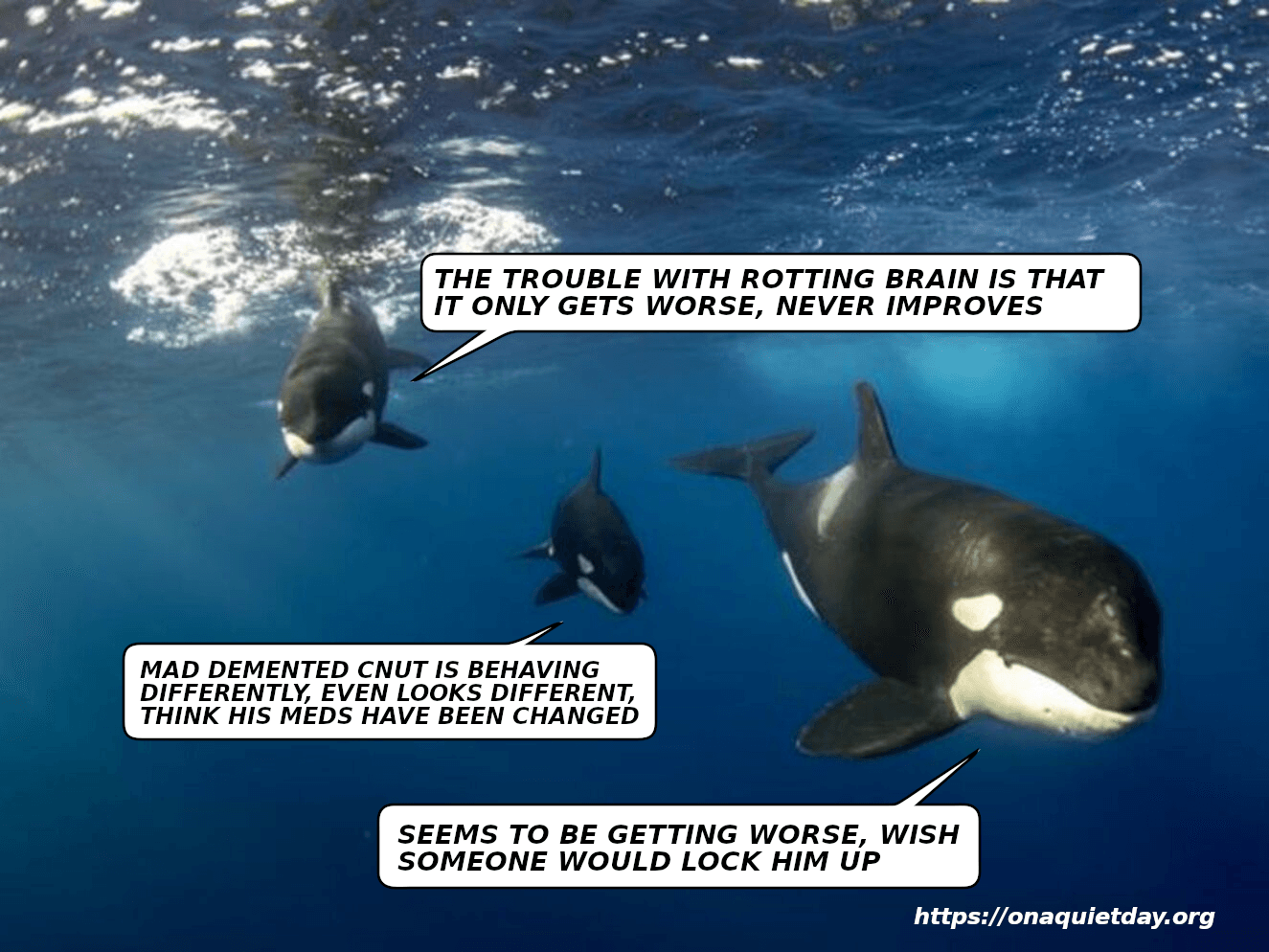
Keir Starmer objects to criticism of the IDF. He asks how could anyone object to them starving people to death, forced marches like the Nazis did, bombing Gaza’s hospitals and universities, mass-murdering journalists, healthworkers and starving people queuing for food, killing and raping prisoners and murdering children. He calls for people to stop obstructing his genocide for Israel. New Labour UK Prime Minister Andy Burnham continues Labour party policy of active support and complicity in Israel’s genocide.Orcas discuss rotting brain, front Orca says he wishes someone would Lock Him Up, small Orca says he thinks that his meds have been changed.
Spread the love
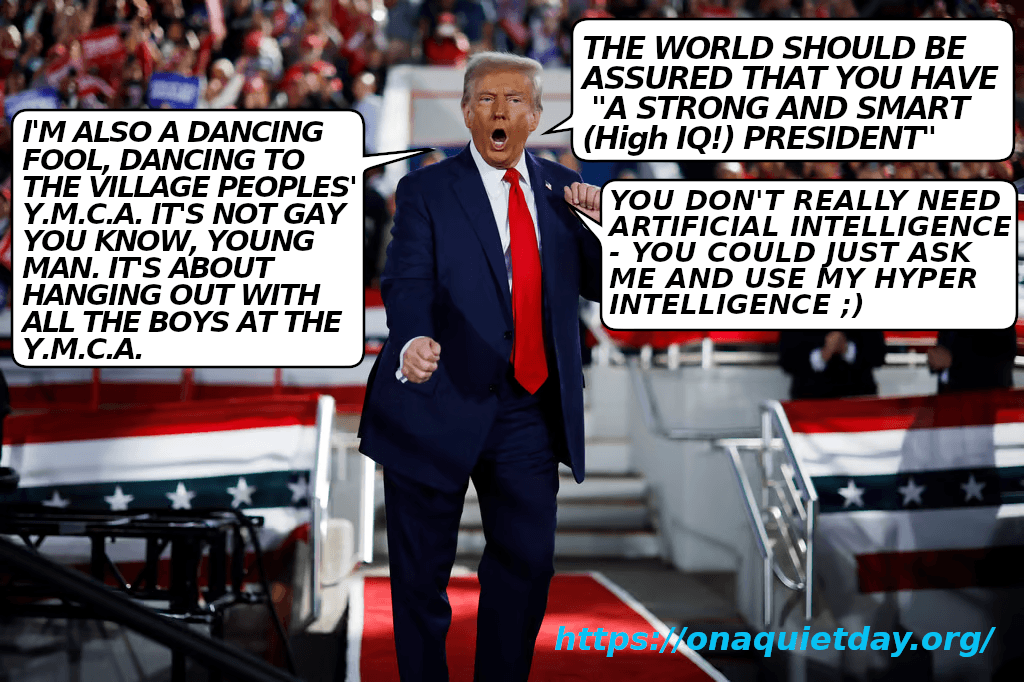
Donald Trump, the strong and smart (High IQ!) president in spades also explains that he’s a dancing fool but that YMCA is not gay young man. He says that you don’t really need Artficial Intelligence, you could ask him instead and use his Hyper Intelligence.
Spread the love
Donald Trump, the strong and smart (High IQ!) president in spades also explains that he’s a dancing fool but that YMCA is not gay young man.
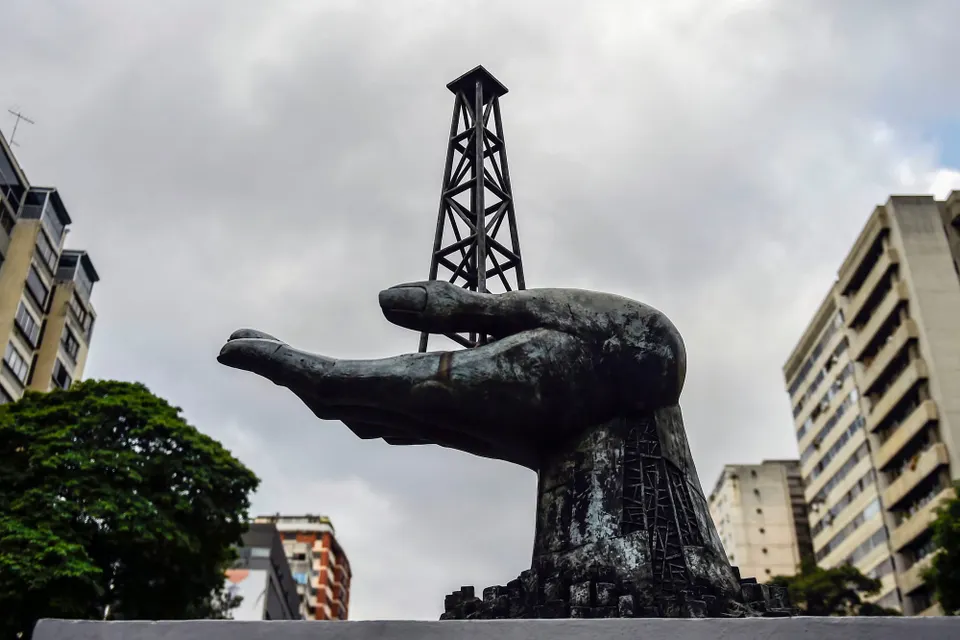
A monument in homage to the struggles of the Venezuelan people for the conquest of their oil | by LUIS ROBAYO/AFP/Getty Images
The Trump administration’s forcible appropriation of a fifth of Venezuela’s oil reserves is worse than the theft of national assets in post-Soviet Russia.
Nine months after United States special forces abducted Venezuelan President Nicolás Maduro and his wife in an early morning raid, the US claims to have struck a highly unusual deal to take control of about a fifth of Venezuela’s oil reserves, or about 65 billion barrels, over the course of a 100-year lease period.
The deal, which is structured through the US Department of Defense (which the Trump administration calls the Department of War), has no recent precedent. While the United States has often engineered military and covert regime change in countries around the world to appropriate resources, the Trump administration’s actions in Venezuela recalls the sorts of 20th century US interventions that lead to a series of revolutions in Latin America and also Iran in the 1950s.
To make sense of this moment, I caught up with Francisco Rodríguez, a Venezuelan economist, a senior research fellow at the Center for Economic and Policy Research, and professor of public and international affairs at the University of Denver. Rodriguez is also the author of four books, including his latest, The Collapse of Venezuela: Scorched-Earth Politics and Economic Decline.
The following is an edited excerpt of our interview. You can listen to the whole interview on our In Solidaritypodcast.
Aman Sethi: I’d like us to start with just getting your reactions to this, this oil deal. Specifically, if you could just talk through what you know so far, what this means, and whether this is how oil deals are normally done in Venezuela.
Francisco Rodriguez: Okay, a bit of the background. Venezuela had been under oil sanctions from the US between 2019 and this year. And the US after it carried out a military operation to capture Nicolás Maduro, it decided that it was going to try to forge, let’s call it a “cooperative relationship,” with the government of Delcy Rodriguez, who was Maduro’s vice president.
And what the US has been trying to do is sell the idea of ‘Now we’re gonna help the Venezuelan oil sector recover’. Venezuela is sitting on the world’s largest oil reserves , but it produces just 1% of world oil output.
January of this year just a few days after the military operation to take out Maduro, President Trump actually calls a lot of oil industry executives to the White House, says, “I want you to invest in Venezuela.” Many of these executives say, “We’re not so sure.” One of them actually says this country is really uninvestable under current conditions. So he gets a lukewarm reaction.
So now we have the announcement of this plan, and this plan — it promises that Venezuela is going to get $100 billion in oil investment. And that’s really important here, because that’s what most experts have said is needed to get Venezuela to produce what it was producing before the sanctions back in 2016 which was around two and a half million barrels.
Now it’s producing roughly one [million barrels per day]. It’s increased a bit to 1.2 million. So you want to get that up by 1.5 million barrels. You need 100 billion to do that. That sounds fine. Actually, that sounds great. If I’m Venezuela, and I’m told, “Hey, here’s the $100 billion you can put into your oil industry, and you’ll get more tax revenue. We’ll benefit.” I say, “Where do I sign?” So that part looks good.
But then let’s look at it in more detail because President Trump actually says two things almost in the same breath. He says Venezuela’s gonna get $100 billion of investment in the oil sector, but this is not going to cost a dime to US taxpayers.
Okay, wait.
So the US is not gonna pay for it. Venezuela is broke, so Venezuela is not gonna pay for it. Who is going to pay for it? Well you would think oil companies, large oil companies, right? Chevron, Exxon, Conoco. But they’re not here. They’re nowhere in the deal. No, they don’t wanna be part of this.
So where are these 100 billion going to come out of ?
Here’s where it gets really interesting and really murky. These $100 billion are going to be put out by a Barbados-based company that was created just a few years ago. It’s a company owned by a businessman with not the best reputation in the world. His name is Alejandro Betancourt. He’s best known for getting billions of dollars in no-bid contracts from the Chavez administration to build electrical plants, at least one of which was never completed. And he’s offering to the US a thirty-five percent stake in his company.
So the US Department of War is going to now own thirty-five percent of that company. And it’s also going to have the right to purchase at cost twenty percent of the company’s output. So that’s the deal.
The White House yesterday put out a statement saying that Venezuelan barrels of oil are going to start flowing into US reserves as of November. And basically, President Trump had already said that they were going to replenish the US Strategic Petroleum Reserve with oil that was a gift from Venezuela.
That’s the word that President Trump used.
So that means that probably as of today you will have Venezuela sending 40,000 barrels of oil to the US at cost. That’s a loss of about $500 million a year for Venezuela.
What is Venezuela getting in return? A promise that somebody, someday, is going to come up with $100 billion is going to be willing to lend them to Mr. Betancourt so that he can invest in the oil sector.
This deal is all wrong. This is the most impoverished country in Latin America.
How legal is this? Like, is this from a Venezuelan perspective, from an international contracts perspective?
There’s a set of legal objections to it. Now of course the problem is that in developing countries Venezuela ranks 146 out of 146 countries in terms of the rule of law.
Asking what is legal or not in a country that has no rule of law, this is almost like a theological question, really.
Because when we think about the law, laws are interpreted by courts, but the courts are controlled by the government. Article 150 of the Venezuelan Constitution says that the National Assembly has to approve the deal.
The National Assembly is 90% controlled by the government, so they could have taken the deal before the National Assembly. They didn’t. Why didn’t they do it? Because then they’d have to publish the contract, but they don’t want to publish the contract. Nobody wants to publish the contract.
There’s a set of other problems I could go down out of all of the different laws that have been violated. But one important one is Article 39 of the country’s hydrocarbons law states that you have to assign contracts in the oil sector through public competitive bidding. There was no public competitive bidding here.
In fact, a government vice-minister recently said, “The thing is that we’re under an economic emergency decree that we declared after the earthquake.” Really? You’re gonna use the earthquake as an excuse to give away 20% of the country’s reserves?
What does it smell like to you?
It smells like Trump essentially said, “I wanna do something about gas prices before the midterm and I wanna claim that I’m getting some of this oil from Venezuela. So I want some of that oil from Venezuela to come in and for me to say that I’m putting it into a strategic reserve, and this is bringing down oil prices. I wanna do that before the midterms. Sign me a deal.”
I think that’s essentially all there is. But from the standpoint of Venezuela, Venezuela has just given away 20% of its reserves to a company owned by a very shady figure.
After the invasion of Iraq when you had the occupation there was a public bidding round for the rights to exploit Iraqi oil. This was a competitive bidding process, it was transmitted through public television, so Iraqis could actually see the bidding taking place in real time.
This process was transparent. This is the complete opposite. This firm is going to get, over the life of the concession, the equivalent of $303 billion.
That’s the, that, that is what the private firm gets in profits.
That is what it’s going to get. That is the equivalent of three years of Venezuelan GDP. 65 billion barrels. Venezuela has a huge level of reserves. The Russian privatization program of 1996 was for 20 billion barrels of oil.
This is more than three times the size. And in Russia, which was a steal, which was horrible, there was a free-for-all. That’s what led to the rise of the Russian oligarchs. They at least had the decency to rig an auction. Here, there was no auction. They didn’t even pretend.
So this is not going to end up well. If you’re handing over these massive resources to connected political insiders this is not helping create a democracy. This is consolidating a crony capitalist oligarchy.
In your book you’ve likened studying the Venezuelan economy to the equivalent of being a rare disease specialist. For all of us outside who honestly don’t know very much about Venezuela, what is your analysis of the regime in power right now?
What is the point at which the people just say, “We’re done with this regime,” and they just get swept out?
We can understand the American motivations. We can understand Delcy Rodriguez is some kind of captive, but what about the entire country that sits below her? How are people taking this?
That’s a great question. And it forces one to think about how we got here. So Venezuela got here after about a quarter of a century of very deep polarization. Hugo Chávez, who came into power in 1999 was a populist and popular politician.
And, like many populist politicians, his message was, “Throw the bums out, people are tired of the old politics. You need change. You need to refound the republic.” And that convinced a lot of people. He was able to get a clear electoral mandate. He reformed the constitution.
He did what many leaders who have at least an authoritarian bent will do in those circumstances, which is say “We really need to change this, give more power to me.” So he really made the Venezuelan presidency all-powerful in that constitutional reform. And that really shaped Venezuelan politics over the next quarter century because you created a winner-take-all political system in which the opposition was completely out of anything.
So you ended up in this, this politics which was very polarized between the government and the opposition. Now, Chávez did some things that a lot of Venezuelans liked at the time. He was definitely somebody who sought out ways to let very large disadvantaged majorities which had been excluded from Venezuelan social, economic, and political life have a stake.
He also did a lot of things very badly.
He got a huge oil boom. He spent a lot of that money. He ran the country into debt. He hired people like Alejandro Betancourt to build electrical plants, some of which were never built. So the country lived through this deep polarization. And then Chávez died, and then he leaves Maduro. Then the economy starts doing poorly. Then he [Maduro] becomes more repressive because the opposition is really going after him. And then the opposition goes to the US, and the US says “Let’s get tough on this, let’s impose sanctions.”
They hurt the country’s oil industry. It leads to a huge decline in the country’s oil production. So they, they effectively create an economic catastrophe. So you end up in this trap, which is what in my book I call the trap of economically destructive political conflict.
And the whole– the puzzle that I try to explain in my book is, how is it that you get an economy to collapse, to lose seventy-one percent of per capita income? This is the equivalent of three consecutive great depressions without a war. And my answer is that this happens because there’s a moment in which this politics becomes so destructive that both sides are essentially playing scorched earth.
So you end up having this battle for the country that turns the economy into a political battlefield, and that’s where it collapses.
Then all of a sudden Trump decides to send in US forces, captures Maduro, and decides that he’s going to run the country with the people who are there. What we know and what he has said literally is that he’s put a gun to Delcy Rodriguez’s head. We also know that Delcy Rodriguez is complying with everything that Trump is asking for.
Is she doing it because she has a gun to her head, or is she doing it because this actually works in her favor and she can stay in power? Probably both.
I have, well, several questions from this, but, but let’s start with the question of sanctions. It’s possible for many governments to make many bad decisions and to do bad things to the economy.
But there is a very specific kind of bad thing that happens once sanctions are imposed, right? When you’re cut out of the US financial system, for example, that is a very, very particular form of economic punishment.
What is your assessment of the role that, that sanctions have actually played here? Because one thing that I’m struggling with is this narrative of “Venezuela let its oil industry completely collapse, and now we’re gonna fix it, and now everything will be fine”. I’m struggling with the dissonance, but maybe I don’t know enough.
That’s a very interesting question. It’s a very important question. It’s not an easy question to answer because well, you have many factors going on, and definitely there was a lot of mismanagement.
There were poor economic policies, so you have to disentangle the effects of those poor policies from the effect of sanctions.
My estimate is that approximately half of Venezuela’s economic contraction during its collapse period between 2012 and 2020 can be attributed to sanctions.
So in other words, this is a country that in the absence of sanctions would have gone through a major crisis. It would have seen, by my estimates, GDP decline by thirty-six percent, but not by seventy-one percent. And in fact, that thirty-six percent decline that would have occurred in the absence of sanctions actually puts it in line with other collapses generated by similar episodes of protracted exercise of bad policies particularly in Latin America.
And all of them have a very similar pattern. You have a commodity-dependent economy. You have a period in which deep imbalances accumulate. You start getting high levels of debt.
The country starts going into a current account deficit. You start seeing high levels of capital flight, and then you get a decline in the price of the commodity like what you got between 2014 and 2016. And there you get this deep economic crisis.
That is what happened in Venezuela between 2012 and 2016, which were the first three years of Maduro in power. In 2017 something different starts happening. And you start seeing that markets are expecting that the Venezuelan economy will begin to recover.
Because oil prices had fallen from $100 to $30, and then they had recovered to around $50, $60. What history teaches us is that the economy stabilizes and then begins to recover in that situation. That’s not what happened in Venezuela. In Venezuela, the economy continued shrinking at an accelerating rate. And the difference was that was the year in which sanctions began to be imposed.
So yes, sanctions did deep damage to this economy. These sanctions didn’t come out of the blue. These sanctions were part of a political strategy by the country’s opposition that was reacting to things that Maduro was doing which were very bad and were very evil and very authoritarian, and said, “We need to up the ante here by doing what we can do. We have allies in the US, that can help us start taking Maduro’s control from the country’s purse strings away.”
So in 2019, the Trump administration decided to recognize Juan Guaido, an opposition legislator, as Venezuela’s legitimate President. This is something that the US had never done before. The US had never recognized somebody with no de facto control over the territory as the President. And what happened as a result of that was that all of the country’s offshore assets, including all of the assets of PDVSA, the state-owned oil company, were transferred to the management of Guaido or his appointees. What that meant is that the country no longer had access to its funds. These funds were essentially handed over to the opposition. It made it impossible for the government even to carry out the most basic economic policy.
There’s nothing in politics that is for free, right? So you acquire a commitment when you have an external power like that, that is helping you. And that means that you can’t question what that external power is doing in your country because you essentially live off of them, right? And this, by the way, was literally true. The Venezuelan opposition — the Venezuelan National Assembly elected in 2015, whose term ended in 2020 — had around 80 opposition legislators who were getting paid monthly salaries out of an account in the Federal Reserve. So the US could literally cut the salaries of the opposition politicians if the opposition decided to go against it.
This is the typical Faustian bargain, right? You say, “I’m willing to do anything if you will help me regain power,” for good reasons.
But the reality is that these Faustian bargains don’t end well.
I’m imagining an Indian opposition leader touring Europe and America and asking for support to become the Prime Minister of India, and they would be, you know, laughed out of the country.
I understand that the dynamics are different but it does strike me as an unusual theory of power. In your book, you also talk about the fact that while Venezuela is shown as an exception to kind of ordinary politics, it in many ways is almost like a weather vane that shows you where politics is going.
But what does this moment in Venezuela tell us if we say Venezuela is, in some ways, the country of the future? What is it telling us now, especially in light of this deal?
I would love to be wrong but I do think that Venezuela might be initiating a model that the US is probably going to try to imitate in other countries.
President Trump actually considers Venezuela a success story, and he’s been trying to produce similar outcomes in Cuba and Iran. And there have been negotiations between Trump administration officials and officials in those countries where they’re proposing this type of deal. The type of deal is you stay in power, the opposition doesn’t come to power but you change completely the way in which you’re doing things, and you follow our orders essentially.
And I want to emphasize that this isn’t a government that rules the country with US support. This is a government that is carrying out the orders of the US . This is a government that has carried out military operations with US troops and Venezuelan troops in Venezuelan territory. It recognized Israel. And three days after Marco Rubio announced that the US was launching a campaign to dismantle the International Criminal Court, Venezuela says, “We’re leaving the International Criminal Court.” The first Latin American country to do so.
So this has become the most dependable US ally in the region. And it’s led to this thesis in Washington of, why seek regime change if you can get regime compliance? That’s essentially what they’re trying to do.
You were saying this looks like a somewhat of an odd concept coming from India and thinking about it in terms of the dynamics in that region.
I would say it’s not that foreign in Latin America. But you have to dig a little bit into history to go there. What the US did in Venezuela was actually what the US did in a number of countries at the beginning of the [20th] century including Cuba, Dominican Republic, Haiti, Panama. It basically imposed protectorates in these countries.
The Cuban one is interesting because Cuba, the US kind of occupied and took control of after the Spanish-American War. And then what the US did is that it forced the Cubans as a condition for independence to accept into their constitution to grant the US a standing right of intervention.
So basically, if the US disagreed, if it took exception to any key decisions of the Cuban government, the US had the right to intervene militarily, and the US, in fact, exercised that right four times in the subsequent twenty years from the signing of that amendment, known as the Platt Amendment.
And one of the problems with that, it’s no coincidence that it was precisely Cuba that saw the political movement that has been most antagonistic to the US emerge.
If you study the early 20th century in Cuba what you find is that Cuban politicians were acting very much in the way in which Venezuelan politicians are acting now
They understood that whoever was in power needed the support of the US. So they became politicians who were adept at lobbying Washington and at building political coalitions between Washington stakeholders to support them. And this means that they were not politicians that built a domestic political base, that were trying to answer the demands of their constituencies. So the protectorate regime, what it does is that it stifles institutional development in a way that basically doesn’t let the institutions of a democracy emerge.
And of course, if you have an electorate that cannot express its grievances, cannot express its demands through the political system, a big part of that electorate is going to become very angry, and then you end up with something like the Cuban Revolution. I think that is a very distinct risk now.
It’s a risk that we will enter into a pattern as a result of Washington’s idea that it can run Latin American countries by remote control, that we’re going to enter into a very similar political dynamics, which, in the end, is going to be bad for the region, but it’s also going to be very bad for the US standing in the region.
Climate science denier Donald Trump confirms that he knows nothing about democracy and that more liquid gold is being secured according to his policy of global privateering.Orcas discuss Donald Trump and the killer apes’ concept of democracy. Front Orca warns that Trump is crashing his country’s economy and that everything he does he does for the fantastically wealthy.Donald Trump urges you to ignore facts and reality and be a Climate Science denier like him. He says that he makes millions and millions for destroying the planet, Burn, Baby, Burn and Flood, Baby, Flood.