Hands off my hat! The hidden power of headwear and ‘hatiquette’ in early modern England – new study

Spread the love
Roundhead and cavalier soldiers, wearing partisan hats, face each other and urge their dogs to attack each other (1643). State Library Victoria, Melbourne , CC BY-SA

Bernard Capp, University of Warwick

Around 8pm on a cold February evening in 1733, a gentleman named Francis Peters was returning to his home near Knightsbridge, London, in a hackney cab, when someone knocked on the wooden shutters of the door. An armed horseman thrust a pistol inside, demanded Peters’s money and valuables and snatched a ring from his finger. Peters handed them over without fuss. But when the thief also snatched his hat and wig, he protested vigorously, though in vain – the robber rode away with his booty.

The puzzle, to the modern reader, is that the hat was worth only five shillings – far less than the watch (worth £4), the ring and the cash he had already handed over. So why make such a fuss?

Woodcutting showing three Levellers wearing hats
Levellers wearing their hats. Bodleian Libraries, University of Oxford

The robber was later arrested and Peters made a point of going to see him in Newgate Prison as he awaited trial. He told him it had been bad manners to take his hat. The Old Bailey trial records tell us that the highwayman apologised.

Historically, hats had a significance that went far beyond fashion and keeping the head warm. For any respectable man in Tudor, Stuart and Hanoverian England, to go hatless was almost unthinkable, while for people lower down the social scale, it suggested total destitution. Suspects awaiting trial were often desperate to obtain a hat before appearing in court, to present at least a shred of respectability. But what made it so unthinkable for respectable men to appear hat-less?

As my new research explains, the power of social convention is certainly one part of the answer. Another is contemporary concerns over health and the belief that it was important to keep the head warm at all times. Wearing a nightcap, after all, was common practice. Peters raised his own health concerns when he pleaded with the highwayman. A man who wore a wig as well as a hat would generally have had his head shaved, so the theft left him bare-headed and vulnerable on a cold winter night.

Madness and status

There was another factor, too – the association of a bare head with madness, which was familiar through images of the shaven inmates of Bedlam. The strength of that association can be seen through another strange story – that of Thomas Ellwood, the teenage son of an Oxfordshire gentleman.

In 1659, by chance, Ellwood and his father had come across the Quakers, a new movement at the time. Thomas was intrigued but his father was appalled, and forbade him to attend any Quaker meetings. Thomas sneaked away regardless, even after his father had beaten him and banished him from the dinner table.

Eventually his father found a bizarre tactic that did work: he confiscated all his son’s hats. Many years later, Ellwood explained in his autobiography that the move had rendered him effectively a prisoner for many months, “unless I would have run about the country bare-headed, like a mad-man: which I did not see it my place to do”. He would have appeared deranged, and he recognised the shame that such behaviour would bring to a gentleman’s family.
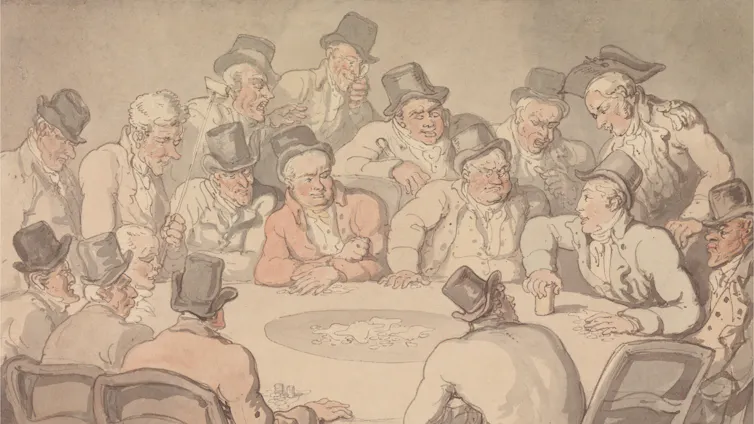
Painting of men wearing top hats
Hats were an indicator of status in early modern England. The only man not wearing a hat in this illustration is a servant in the gaming house and so a social inferior. Yale Center for British Art, Paul Mellon Collection, CC BY

As that concern suggests, the hat also had a far wider significance in this period as a marker of status and in associated gestures of deference. Unlike today, almost everyone wore a hat or, in the case of labourers and poor artisans, a flat cap. And convention required men and boys to doff the hat or cap in the presence of someone of higher status – a parent, master, employer, gentleman, magistrate, peer, or monarch.

Though there was no law to underpin “hat-honour”, the convention was firmly enforced. Many people who had grown up with this convention may have accepted it as part of the natural order of things, but having to “bow and scrape” to a harsh landlord, for example, was deeply resented by others. And in times of political upheaval, such as the civil wars of the 1640s, hat-honour could take on an ideological significance.

John Lilburne was a leader of the radical Leveller movement that was pressing for social reforms and a more accountable form of government. He refused to doff his hat when he was summoned to appear before the House of Lords for publishing illicit tracts, and announced his defiance in a pamphlet.

Many other radical leaders made similar gestures of defiance. Most notorious were the early Quakers, who refused on principle to doff their hats to anyone, explaining it as a gesture against the sin of pride and vanity.

Changing fashions

Refusing hat honour was an overt gesture of defiance associated with radicals, whether political, religious. But after the civil war of the 1640s ended with parliament’s victory over Charles I, the political order was turned upside down, and such gestures might now appeal to the defeated royalists.

At the trial of the king in January 1649, Charles himself refused to remove his hat when brought into court. As sovereign, he refused to recognise any superior on earth, or to accept that any court had the right to try him.

The importance of hat-honour gradually faded in later centuries, as manners became more informal and crowded cities made it ever less practicable. And finally, in the 1960s, the practice of men wearing hats abruptly ceased, for reasons that remain largely unexplained. The “swinging sixties” celebrated youth, informality and the rejection of old, hidebound conventions – and that cultural shift may provide at least a part of the answer.

Bernard Capp, Emeritus Professor of History, University of Warwick

This article is republished from The Conversation under a Creative Commons license. Read the original article.
Continue ReadingHands off my hat! The hidden power of headwear and ‘hatiquette’ in early modern England – new study

Tens of thousands demand end to child poverty and Israel’s massacre at Durham Miners’ Gala

Spread the love

https://morningstaronline.co.uk/article/tens-of-thousands-demand-end-to-child-poverty-and-israel-massacre-at-durham-miners-gala

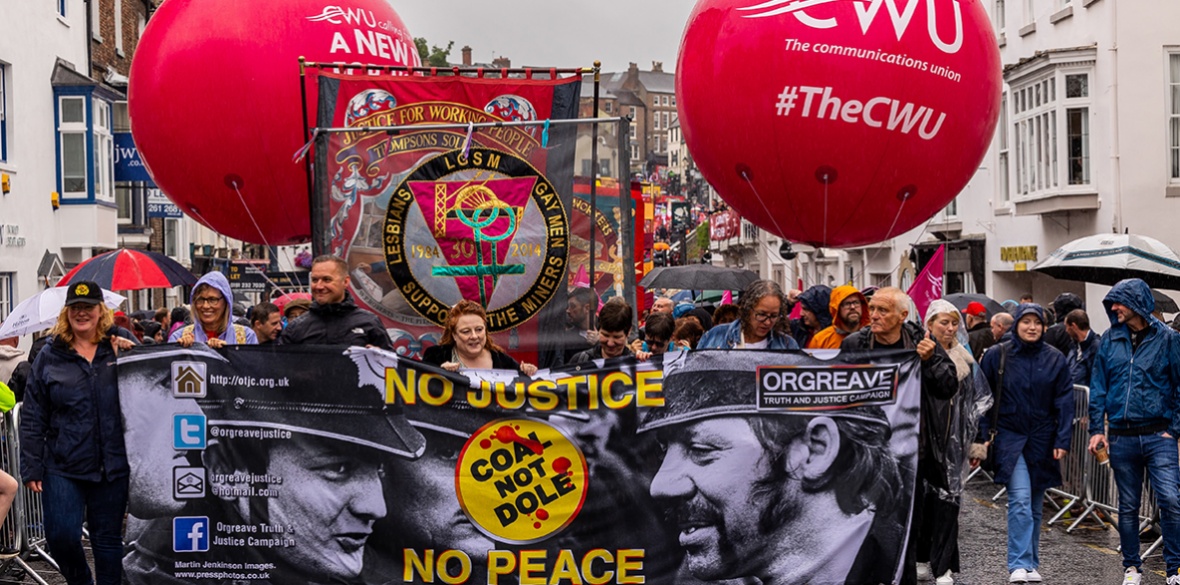
Marchers at the Durham Miners’ Gala, July 13, 2024 Photo: Neil Terry / neilterryphotography.co.uk

DEMANDS for action by the Labour government to end child poverty, end arms sales to Israel and abolish all Tory anti-trade union laws were cheered at the 138th Durham Miners’ Gala.

The gala crowd of tens of thousands roared on Saturday as speakers called on Labour to use its record 172-seat majority in the Commons to transform society for working people in Britain.

Speakers called on the government to end arms sales to Israel and Britain’s complicity in the continuing slaughter in Gaza.

The 138th Durham Miners’ Gala began with the traditional marching of dozens of proudly raised trade union and campaign banners and brass bands through the streets of the city to the gala field for Durham Miners’ Association’s (DMA) Big Meeting.

The gala celebrated the 40th anniversary of the miners’ strike against pit closures, and Matt Wrack, general secretary of the Fire Brigades Union (FBU), praised the courage of the miners for the strike which he said “has been vindicated ever since.”

He said the strike had also seen the power of the state unleashed.
“They used the press to lie, the police to batter, the courts to lock people up for defending their jobs and communities,” he said.

He warned: “That was the message from the boss class in 1984-5.

https://morningstaronline.co.uk/article/tens-of-thousands-demand-end-to-child-poverty-and-israel-massacre-at-durham-miners-gala

Continue ReadingTens of thousands demand end to child poverty and Israel’s massacre at Durham Miners’ Gala

Trade unionists block 4 sites involved in arms supplies to Israel on International Workers’ Day

Spread the love

https://leftfootforward.org/2024/05/trade-unionists-block-4-sites-involved-in-arms-supplies-to-israel-on-international-workers-day/. Many articles feeatured from LeftFootForward today.

‘If arms company bosses and Britain’s political elite won’t impose an arms embargo, we, the workers, will enforce it from below’

This May Day, over 1,000 workers across Britain have mobilised to blockade four sites involved in the supply of arms to Israel, in a response to calls from Palestinian trade unions.

In solidarity with Palestinian workers as the onslaught on Gaza reaches its 208th day, trade unionists in Britain have blocked entry to the UK Department of Business and Trade in London and three BAE Israeli arms factories in Scotland, Wales and Lancashire to protest the government’s refusal to suspend the sale of UK arms to Israel. 

BAE Systems has been targeted as the UK’s leading military goods manufacturer which profits from arming Israel, while workers have blocked the UK Trade Department in support of civil servants who have expressed fears that they could be complicit in war crimes in Gaza if Israel is found to have broken international law. 

Civil servants’ union PCS is considering bringing legal action to prevent their members being forced to carry out potentially unlawful acts, after staff requested to “cease work immediately” on arms export licences to Israel. 

Canada, the Netherlands, Japan, Spain and Belgium have suspended the sale of arms to Israel, while the British government continues to refuse. It comes as a legal challenge over the British government’s role in allowing weapons to be sent to Israel has been given the go-ahead to be heard in the High Court later this year.

https://leftfootforward.org/2024/05/trade-unionists-block-4-sites-involved-in-arms-supplies-to-israel-on-international-workers-day/. Many articles feeatured from LeftFootForward today.

Continue ReadingTrade unionists block 4 sites involved in arms supplies to Israel on International Workers’ Day

Anti-strike law: Paul Nowak perfectly dismantles bill ahead of Parliament vote

Spread the love

https://leftfootforward.org/2023/05/anti-strike-law-paul-nowak-perfectly-dismantles-bill-ahead-of-parliament-vote/

The legislation is an attempt to ‘drive a wedge between working people’

General Secretary of the Trades Union Congress (TUC) Paul Nowak took to the airwaves this morning to speak out about the anti-strikes bill which will be voted on by MPs this evening.

He slammed media accusations of union ‘scare tactics’ by laying out the reality of the Strikes (Minimum Service Levels) Bill which could see workers lose their job for taking strike action.

As media presenters sought to play down the implications of the bill, Nowak said threatening workers with the sack was ‘untenable’ and that the real reason it was being put through was to ‘demonise trade unions’ and ‘drive a wedge between working people’.

“There is no public appetite at all to see nurses, paramedics, teachers, railway [ workers …] sacked for exercising what most people will think as a fundamental British liberty, the right to strike,” Nowak said on Sky News.

“To remove it would put the UK as a real international outlier.”

https://leftfootforward.org/2023/05/anti-strike-law-paul-nowak-perfectly-dismantles-bill-ahead-of-parliament-vote/

Continue ReadingAnti-strike law: Paul Nowak perfectly dismantles bill ahead of Parliament vote

RMT rejects ‘unacceptable’ offer from train operators in pay and jobs dispute

Spread the love

https://morningstaronline.co.uk/article/b/rmt-rejects-offer-train-operators-in-dispute-over-pay-jobs

RAIL bosses’ latest offer to end six months of strikes across the network was rejected today by the RMT union, which warned of “thousands of job losses and the use of unsafe practices.”

RMT condemned the “unacceptable” proposals from the Rail Delivery Group (RDG), which represents the 14 train operators involved.

Talks continued today ahead of the next round of industrial action — a series of intermittent 48-hour strikes between next Tuesday and January 7.

Bosses claimed that their pay offer amounts to an 8 per cent pay rise by next year — still below soaring double-digit inflation — but the union pointed out that the deal is conditional on damaging changes to working practices.

Continue ReadingRMT rejects ‘unacceptable’ offer from train operators in pay and jobs dispute