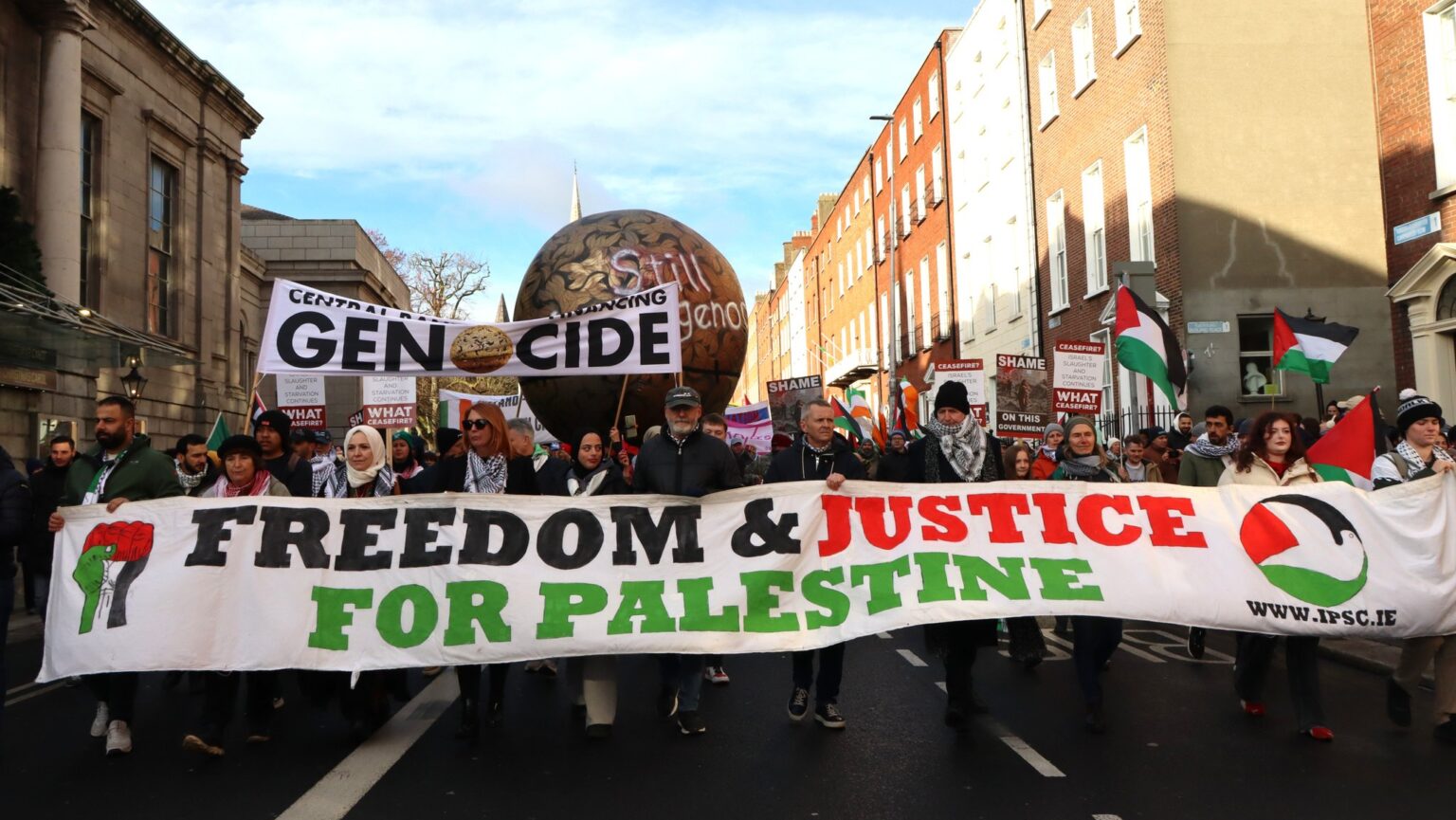
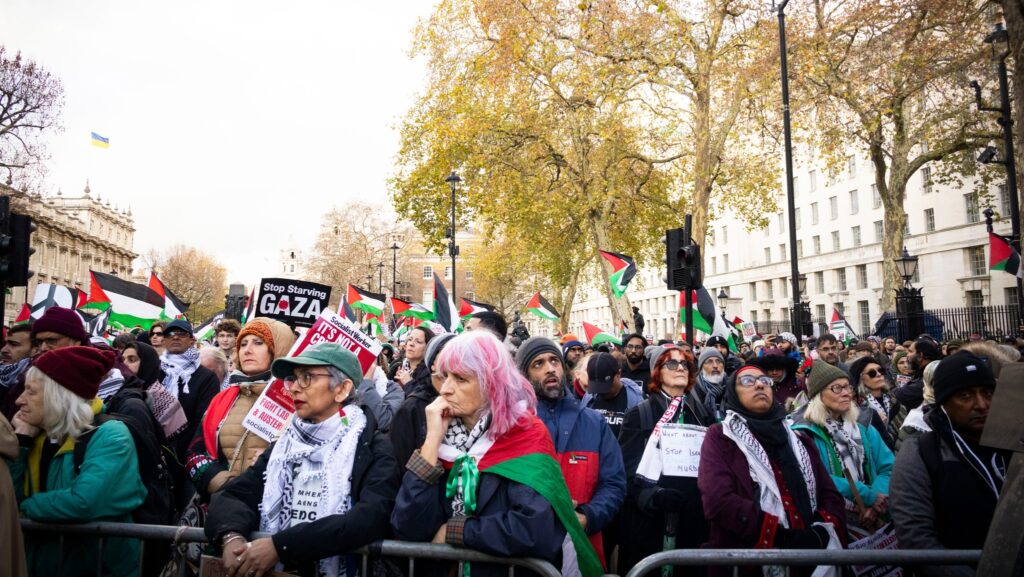
On November 29, hundreds of thousands marched across Europe in support of Palestine and against government complicity in Israel’s genocide.
The Palestine solidarity movement in Europe again brought record numbers to the streets on the UN’s International Day of Solidarity with the Palestinian People, November 29, reaffirming demands for an end to government complicity in the ongoing genocide in Gaza and the occupation of Palestine. Hundreds of thousands marched across the region, with demonstrations in London and Rome each reaching an estimated 100,000 participants.
“On this day, people around the world express their support for the inalienable rights that are currently denied to Palestinians: the right to live free from discrimination, the right to self-determination, and the right to return to their lands,” the Palestine Solidarity Campaign (PSC) wrote on social media. “Despite this Britain continues to arm Israel and refuses to implement meaningful sanctions or end its diplomatic support. It still provides parts for Israel’s F-35 fighter jets, used to bomb Palestinians in Gaza and maintains contracts with Israeli weapons manufacturers like Elbit Systems.”
Saturday’s demonstration was the 33rd national march for Palestine in Britain. In addition to local activists, it also welcomed international guests who have stood with Palestinians since the beginning of the genocide, including Belgian MEP Marc Botenga of the Workers’ Party of Belgium (PTB-PVDA), French parliamentarian Nadège Abomangoli of France Unbowed (LFI), and Sinn Féin leader Mary Lou McDonald. While addressing the crowd in London, they emphasized the internationalist character of the mobilization and echoed demands that could be heard in their home countries around the same time.
As thousands marched in Paris and Dublin, they insisted on the need to continue organizing despite political obstruction and attacks. Irish actor Liam Cunningham, a vocal supporter of Palestine, helped lead Dublin’s demonstration. Responding to artists being de-platformed for speaking out against genocide, he said: “If anyone doesn’t want to employ me because I’ve taken a stand against injustice, against the refusal to give self-determination to a group of people who are politically, culturally on the same track that my country was on for 800 years […] they’re not going to be very good at their job, because they’ve no soul.”
Another recurring message across Europe refused the mainstream media allegation of a “ceasefire” in Gaza. “There’s no ceasefire just because it’s written on a Western media banner,” Cunningham added. “Let’s come up with another word, ‘ceasefire’ is not working.”
In Italy, the central mobilization followed a successful day of general strike organized by the grassroots union Unione Sindacale di Base (USB). The march welcomed UN Special Rapporteur Francesca Albanese and Freedom Flotilla activists Greta Thunberg and Thiago Ávila. Dockworkers and firefighters affiliated with USB, who have played key roles in earlier protests and faced reprisals for this, also formed notable protest blocs. The response of Italy’s political establishment to growing support for Palestine mirrors that of other European governments: attempting to suppress dissent and insisting that further militarization is the only path forward.
Palestine solidarity march in London, November 29, 2025. Source: Marc Botenga/Facebook
“Today we see what this path has created: a genocide, broadcast live, carried out with the complicity of Western governments; massacres in the Mediterranean; NATO wars; bombs across the world,” said Marta Collot, spokesperson for the left party Potere al Popolo, during the Rome demonstration. “But something has changed too. The September mobilizations, the three general strikes called by USB that brought everything to a halt, and our march today show that they were wrong […] Our demonstration is the message coming from Palestine, from socialist Cuba resisting, from Venezuela. It shows that an alternative path is not only necessary, but that it’s possible.”
“Today there are two Europes,” Marc Botenga emphasized in London. “There is the Europe of the establishment, the Europe of the governments that have funded this genocide, that have supported this genocide, and that are continuing to do so. And then, there’s the other Europe, there’s the Europe that we incarnate here today. That is the Europe of liberation, the Europe that says no to occupation.”
Orcas discuss Genocide-supporting and complicit Zionists. Donald Trump, Keith Starmer, David Lammy, Rachel Reeves, Angela Rayner and Wes Streeting are acknowledged as evil genocide-complicit and supporting cnuts.Genocide denier and Current UK Prime Minister Keir Starmer is quoted that he supports Zionism without qualification. He also confirms that UK air force support has been essential in Israel’s mass-murdering genocide. Includes URLs https://www.declassifieduk.org/keir-starmers-100-spy-flights-over-gaza-in-support-of-israel/ and https://youtu.be/O74hZCKKdpAKeir Starmer objects to criticism of the IDF. He asks how could anyone object to them starving people to death, forced marches like the Nazis did, bombing Gaza’s hospitals and universities, mass-murdering journalists, healthworkers and starving people queuing for food, killing and raping prisoners and murdering children. He calls for people to stop obstructing his genocide for Israel.
Presidential candidate Fernando Dias da Costa of the Party for Social Renewal (PRS) in a pre-election meeting. Photo: JAAC / Facebook
Claiming to be under arrest, President Embaló has left the country while his opponents remain in custody after a military coup a day ahead of the announcement of the final results
The military coup in Guinea-Bissau on November 26 was not directed against the outgoing president, Umaro Sissoco Embaló, but orchestrated by him to thwart the return to constitutional order, opposition parties and members of the dissolved parliament allege.
Claiming to be arrested by the coup leaders – while still communicating with the French media – Embaló flew to neighboring Senegal the following day. His opponents, on the other hand, are still held in military custody.
The coup came on the heels of the long-delayed elections on Sunday, November 23. Both domestic and international observers had reportedly agreed that Embaló was voted out of the presidency.
“Why would anyone do a coup against a losing candidate?” asked Imani Umoja, Central Committee member of the African Party for the Independence of Guinea and Cape Verde (PAIGC).
Having led the country’s liberation struggle against Portuguese colonialism under the leadership of the Marxist revolutionary Amilcar Cabral, PAIGC is the country’s largest party. Its presidential candidate, Domingos Simões Pereira, Embaló’s main opponent, was barred from contesting the election by the Supreme Court, whose legitimate president had been replaced in 2023 by militias of the presidential guard under Embaló’s command.
“We had three options. One was to boycott the election,” which would have only handed over power to Embaló for the second term without a fight, Umoja told Peoples Dispatch. “Or we could have taken the streets in protest, but that is what the regime wanted. They would have killed us and postponed the election,” further extending his rule that had already continued beyond his term.
“So we decided to back one of the candidates approved to contest. Dias was our natural choice,” because he is the head of the Party for Social Renewal (PRS) – a splinter from the PAIGC. “There is no great ideological difference between us,” he added, explaining the split was over tactical differences, overcoming which the two parties had often collaborated on broader struggles.
Although the leadership of the PRS identified the party as “social-democratic” as opposed to PAIGC’s “socialist” identification, the rank-and-file of both parties are Cabralists.
“So we were able to reach an agreement that once Dias becomes the president, he would reverse all the unconstitutional decrees by Embaló.”
An unconstitutional regime
Swearing himself in as the country’s president at a hotel guarded by soldiers in February 2020 after a disputed election against the PAIGC leader Pereira, who was barred from contesting this time, Embaló had the president of the Supreme Court replaced, practically at gunpoint, in November 2023. Then, in December that year, he unconstitutionally dissolved the parliament, where the PAIGC had the majority, justifying the action by citing a coup attempt he had allegedly staged himself.
Removing the ministers constitutionally chosen by this parliament, he replaced them with a so-called “Government of Presidential Initiative.”
Thus, grabbing all power and dismantling democratic structures, Embaló has allegedly been signing away in secret valuable natural resources and lucrative infrastructure projects to France and the neighboring West African states under its neocolonial yoke.
A reversal of this neocolonial penetration was set to begin under Dias’s presidency, starting with the restoration of the dissolved parliament, the National People’s Assembly, dominated by the PAIGC and presided by its leader and barred candidate, Pereira.
According to the vote count from each region published by the Regional Electoral Councils, Embaló bagged around 43% of the votes, while Dias had won with about 53%, said Umoja.
A staged coup
However, one day before the National Electoral Council was set to publish the final results, summing up the nationwide count and the votes from the diaspora, gunfire erupted near the presidential palace.
“But there was no fighting. Soldiers were shooting in the air,” said Umoja. Embaló then told the French media that he had been removed from power in a coup led by a group of soldiers who had put him under arrest. “It was all staged. The coup was not against Embaló, but Dias… the president-elect.”
Opening fire near the National Election Council, “another group of armed people from the Ministry of Interior, accompanied by some soldiers, barged into its office and seized the phones of all the workers there, including the representatives of the candidates,” he added.
“A group of heavily armed militias associated with the Presidential Palace” also “invaded the campaign headquarters of the presidential candidate [Dias],” said Ruth Monteiro, Director of the Office of the President of the National People’s Assembly, namely Pereira.
Pereira was arrested with Dias’s National Representative, Octávio Lopes, and several others, Monteiro added. Dias himself managed to escape arrest “through a back door,” he later said in a video message.
Shutting down the radio, the officers who carried out the coup read out a statement on television, declaring themselves in charge, christening their junta as the “High Military Command for the Restoration of Order.”
Announcing the closure of borders, they ordered the suspension of the electoral process “until further notice”, ostensibly to thwart the “capture of Guinean democracy” by “narcotraffickers”.
Labeling this as “a self-coup orchestrated by Umaru Sissoko Embaló, who was overwhelmingly defeated at the polls,” the West Africa People’s Organization said: “The very clear aim is to prevent the electoral body from announcing results that are unfavorable to this well-known agent of the neo-colonial system.”
On November 27, when General Horta Nta Na Man swore in as transitional president for one year, the junta announced that it “strictly prohibits any demonstration, march, strike or action that disrupts peace and stability.”
Protests
“We cannot fold our hands while our leadership is imprisoned unjustly. When our leader and candidate was barred from contesting, we chose to avoid” a confrontation by not taking to the streets, backing another candidate instead. “But now we have run out of options. We have to protest.”
The Amílcar Cabral African Youth (JAAC) posted videos of protest marches in some neighborhoods around the Ministry of Interior. Large-scale protests are at high risk at the moment in Guinea-Bissau. A large section of “our leadership is still in hiding,” Umoja added.
However, the diaspora is mobilizing. In Dakar, the capital of Senegal, progressive Senegalese activists protested alongside the diaspora outside the Guinea-Bissau embassy against hosting Embaló in the country. “Dictators are not wanted anywhere!” Umoja remarked.
JAAC Portugal and Firkidja di Pubis, an organization of Guinean students and workers abroad, protested in Lisbon, capital of their former colony, outside the Community of Portuguese Language Countries (CPLP), chaired by Embaló.
“The CPLP and the so-called international community” is complicit with Embaló, who “orchestrated a fake coup d’état with the sole purpose of derailing the electoral process in which the people had defeated his dictatorship,” Firkidja di Pubis accused. Protesters demanded the “completion of the electoral process in which the people chose Fernando Dias da Costa as their President.”
Should the junta not pay heed, Umoja warns, “Embaló’s followers in the military are only those who are paid” for their loyalty, but the bulk of the rank-and-file soldiers are unpaid.
The PAIGC denounced on Saturday, November 29, that a group of masked and armed men raided their headquarters, attacking party leaders and those present. In statements released, the party alleges that the objective of the raid was to plant weapons in the office to later serve as evidence against them. The party called on the international community to “follow these events closely and support all of the efforts to preserve democratic legality.” The party has also called for authorities to release Pereira and all others arrested amid the coup plot.
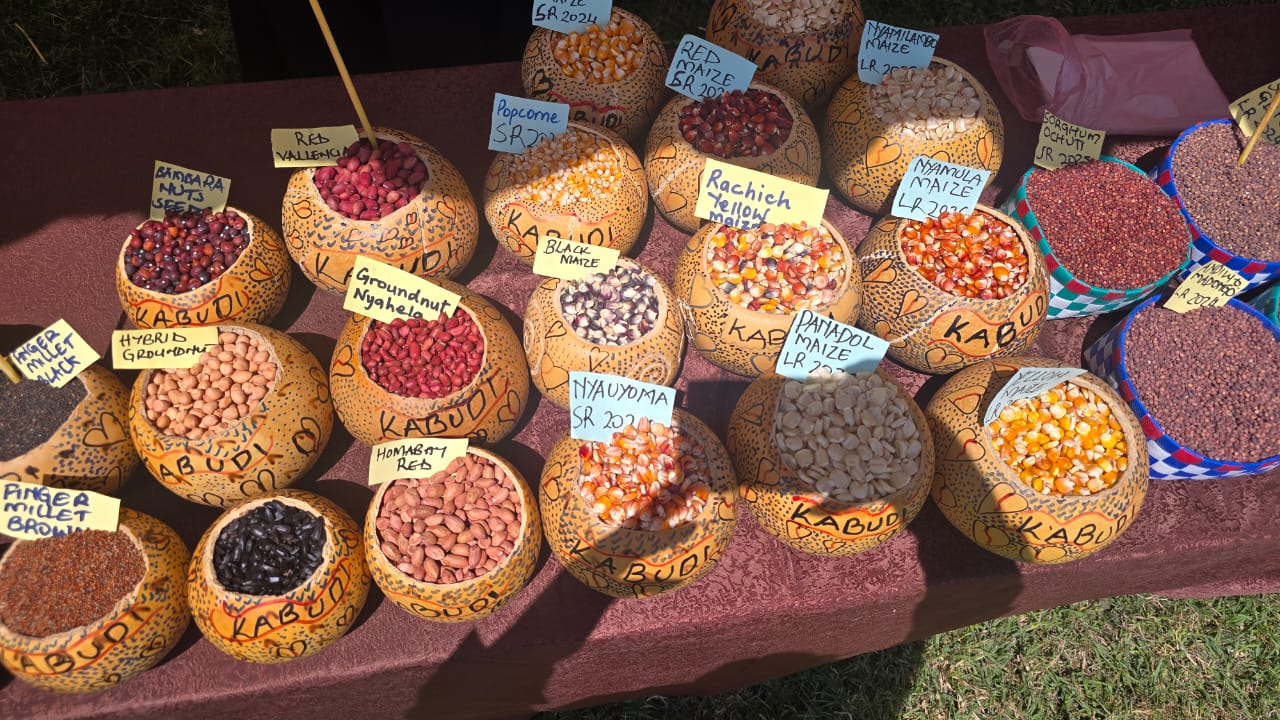
Indigenous seed exchange. Photo: Seed Savers Kenya
The landmark ruling secures farmers’ right to save, share, and exchange indigenous seeds, by decriminalizing it and safeguarding traditional farming heritage.
In a historic judgment, Kenya’s High Court on November 27, 2025, declared the Seed and Plant Varieties Act unconstitutional, delivering a significant victory for smallholder farmers and advocates of food sovereignty across the country. The case, filed in 2022 by fifteen smallholder farmers from various regions of Kenya, challenged provisions in the law that criminalized the long-standing tradition of saving, sharing, and exchanging indigenous seeds, practices at the heart of Kenyan agriculture for generations.
The lawsuit was supported by civil society organizations, including Greenpeace Africa, the Seed Savers Network, and the Biodiversity and Biosafety Association of Kenya (BIBA). It was argued that the Act imposed unfair restrictions on informal seed systems, which form the backbone of smallholder farming, and disproportionately penalized farmers who rely on indigenous seeds for sustenance and livelihood.
Under the law, farmers risked fines of up to KSh 1 million (USD 7,734) or two years in prison for participating in informal seed exchanges. The legislation also granted breeders exclusive economic rights over seed production, sale, and exchange, effectively restricting farmers to commercial seed markets and increasing their vulnerability to corporate control. Legal experts and activists argued that such provisions violated constitutional guarantees, including the rights to culture, non-discrimination, food security, and fair administrative action.
Hamisi Omolo, an ecological farming activist, described the ruling to Peoples Dispatch as “a wake-up call for farmers and grassroots activists to organize and strengthen structures that advance the struggle for land, food, and freedom.” Omolo reiterated the importance of indigenous seeds, noting that “the culture of sharing seeds must continue, not only to preserve biodiversity but also to support herbal medicine and traditional knowledge that benefit entire communities.”
The decision is a relief and expected to have an impact for food sovereignty and agricultural sustainability in Kenya. Smallholder farmers, who account for over 70% of agricultural production in the country, often rely on farmer-saved seeds adapted to local climates and conditions. By affirming their right to maintain and exchange these seeds, the court has reinforced the role of farmers as custodians of biodiversity and protectors of sustainable agricultural practices.
Grassroots and organizations fighting for food sovereignty welcomed the ruling, calling it a major step toward protecting farmers’ rights and resisting corporate monopolies over seeds.
This decision empowers farmers to safeguard their seeds, culture, and livelihoods,” Omolo added. “While it’s only the start, it is a reminder that food sovereignty is not just about growing crops, it is about protecting our way of life, our traditions, and our future.”
And the need for active engagement and organized campaign to ensure that future policies support, rather than undermine, the agricultural practices that sustain the livelihoods of so many Kenyans.
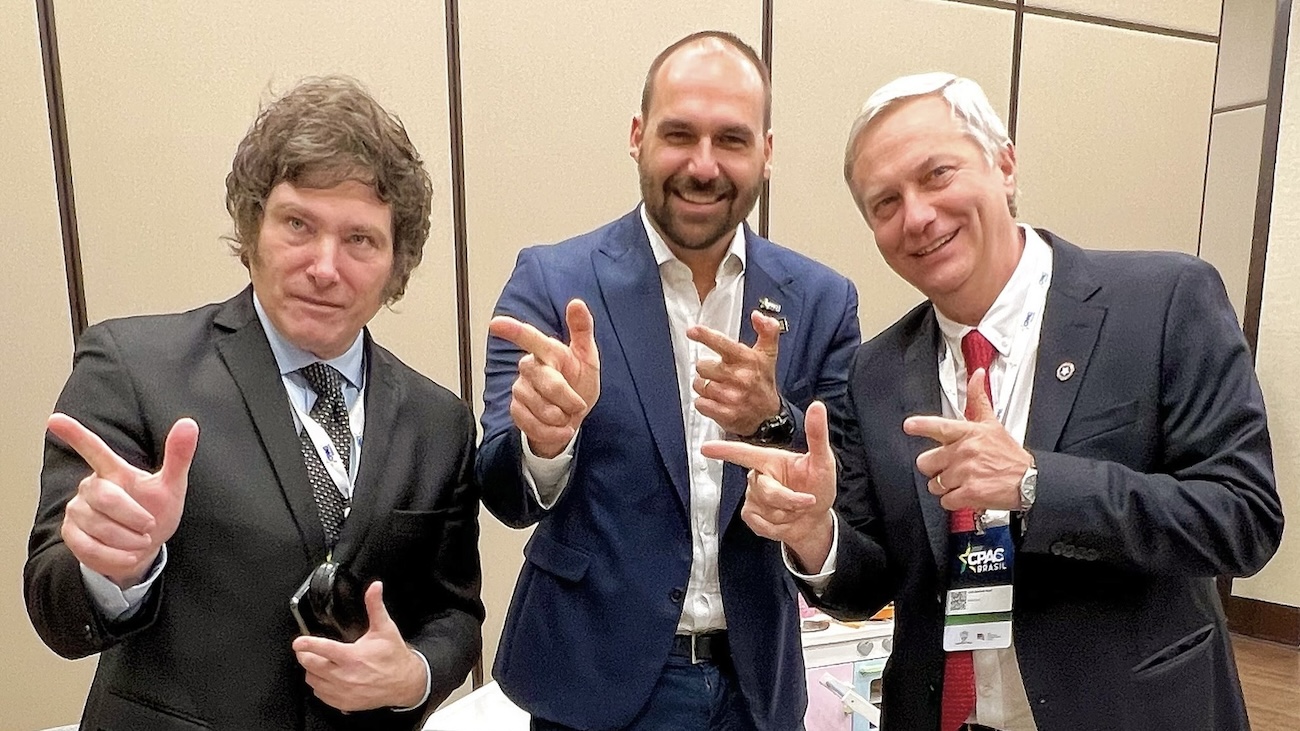
Argentine President Javier Milei, Brazilian legislator Eduardo Bolsonaro, and Chilean far-right presidential candidate José Antonio Kast at CPAC Conference in 2022. Photo: Eduardo Bolsonaro / X
The far right in Latin America is angry. Brazil’s Jair Bolsonaro and Argentina’s Javier Milei always look furious, and they always speak loudly and aggressively. Testosterone leaks from their pores, a toxic sweat that has spread across the region. It would be easy to say that this is the impact of Donald Trump’s own brand of neo-fascism, but this is not true. The far right has much deeper pedigrees, linked to the defense of the oligarchical families that have roots in the colonial era across the virreinatos (viceroyalties) from New Spain to Rio de la Plata. Certainly, these far right men and women are inspired by Trump’s aggressiveness and by the entry of Marco Rubio, a furious defender of the far right in Latin America, to the position of US Secretary of State. This inspiration and support are important but not the reason for the return of the far right, an angry tide that has been growing across Latin America.
On the surface, it looks as if the far right has suffered some defeats. Jair Bolsonaro is in prison for a very long time because of his role in the failed coup d’état on January 8, 2023 (inspired by Trump’s own failed coup attempt on January 6, 2021). In the first round of the presidential election in Chile, the candidate of the Communist Party, Jeannette Jara won the most votes and will lead the center-left bloc into the second round (December 14). Despite every attempt to overthrow the government of Venezuela, President Nicolás Maduro remains in charge and has mobilized large sections of the population to defend the Bolivarian Revolution against any threats. And, in late October 2025, most of the world’s countries voted for a UN General Assembly resolution that demands an end to the blockade on Cuba. These indicators – from Bolsonaro’s imprisonment to the vote on Cuba – suggest that the far right has not been able to move its agenda in every place and through every channel.
However, beneath the surface, there are indications that Latin America is not seeing the resurgence of what had been called the Pink Tide (after the election of Hugo Chávez in Venezuela in 1998) but is experiencing the emergence of an angry tide that slowly has begun to sweep the region from Central America down to the Southern Cone.
Elections in South America
The first round of the Chilean presidential election produced a worrying result. While Jara of the Communist Party won 26.85% of an 85.26% turnout, the far right’s José Antonio Kast came in second with 23.92%. Evelyn Matthei of the traditional Right won 12.5%, while the extreme right candidate who was once with Kast and now to his right, Johannes Kaiser, won 14%. It is likely that Jara will pick up some of the votes of the center, but not enough to overcome the advantage of the far right which looks to have at least more than 50% of the voters on its side. The so-called social liberal, Franco Parisi, who came in third, endorsed Kast in 2021 and will likely endorse him again. That means that in Chile, the presidency will be in the hands of a man of the far right whose ancestry is rooted in German Nazism (Kast’s father was a member of the Nazi Party who escaped justice through the intercession of the Vatican) and who believes that the dictatorship in Chile from 1973 to 1990 was on balance a good idea.
North of Chile, in Bolivia, the new president Rodrigo Paz Pereria, son of a former president, beat the far right’s Jorge Tuto Quiroga (a former president) in the second round of the election. This round had no candidate of the left, after the Movement for Socialism governed Bolivia continuously from 2006 to 2025. Paz’s own party has a minority position in the legislature and he will therefore have to align himself with the Quiroga’s Libre coalition and he will likely adopt a pro-US foreign policy and a libertarian economic policy. Peru will have its own election in April, where the former mayor of Lima – Rafael López Aliaga – is expected to win. He rejects the label far right but adopts all the generic policies of the far right (ultra-conservative Catholic, advocate for harsh security measures, and favors a libertarian economic agenda). Iván Cepeda of Colombia is the left’s likely candidate in their presidential election in May 2026, since Colombia does not permit second terms (so President Gustavo Petro cannot run again). Cepeda will face strong opposition from Colombia’s oligarchy which will want to return the country to their rule. It is too early to say who Cepeda will face, but it might be journalist Vicky Dávila, whose far right opposition to Petro is finding traction in unexpected parts of Colombian society. It is likely that by the middle of 2026, most of the states along the western edge of South America (from Chile to Colombia) will be governed by the far right.
Even as Bolsonaro is in prison, his party, the PL (or Liberal Party), is the largest bloc in Brazil’s National Congress. It is likely that Lula will be re-elected to the presidency next year due to his immense personal connection with the electorate. The far right’s candidate – who could be possibly Tarcísio de Freitas, the governor of São Paulo state, or one of the Bolsonaro’s (wife Michelle or son Flavio) – will struggle against him. But the PL will make inroads into the Senate. Their control over the legislature has already tightened the reins on the government (at COP30, Lula’s representative made no proposals to confront the climate catastrophe), and a Senate win will further their control over the country.
Common agenda of the angry tide
The Angry Tide politicians who are making waves have many things in common. Most of them are now in their fifties – Kast (born 1966), Paz (born 1967), Venezuelan politician María Corina Machado (born 1967), and Milei (born 1970). They came of age in the post-dictatorship period in Latin America (the last dictatorship to end was in Chile in 1990). The decade of the 1990s continued the economic stagnation that characterized the 1980s: the Lost Decade (La Década Perdida) that convulsed these countries with low growth rates and with poorly developed comparative advantages forced into globalization. It was in this context that these politicians of the Angry Tide developed their common agenda:
Anti-Communism. The far right in Latin America is shaped by an anti-left agenda that it inherits from the Cold War, which means that its political formations typically endorse the era of US-backed military dictatorships. The ideas of the left, whether from the Cuban Revolution (1959) or from the era of the Pink Tide (after 1998), are anathema to these political forces; these ideas include agrarian reform, state-led finance for industrialization, state sovereignty, and the importance of trade unions for all workers and peasants. The anti-communism of this Angry Tide is rudimentary, mother’s milk to the politicians and used cleverly to turn sections of society against others.
Libertarian Economic policies. The economic ideas of the Angry Tide are shaped by the Chilean “Chicago Boys” (including Kast’s brother Miguel who was the head of General Augusto Pinochet’s Planning Commission, his Minister of Labor, and his head of the Central Bank). They directly take their tradition from the libertarian Austrian School (Friedrich Hayek, Ludwig von Mises, and Murray Rothbard as well as Milton Friedman). The ideas were cultivated in well-funded think tanks, such as the Centro de Estudios Macroeconómicos de Argentina (founded in 1978) and the Chilean Centro de Estudios Públicos (founded in 1980). They believe the State should be a force to discipline the workers and citizens, and that the economy must be in the hands of private interests. Milei’s famous antics with a chainsaw illuminate this politics not only of cutting social welfare (the work of neoliberalism) but of destroying the capacity of the State itself.
Culture Wars. Drawing on the wave of anti-gender ideology and anti-migration rhetoric, the Angry Tide has been able to appeal to conservative evangelical Christians and to large sections of the working class that has been disoriented by changes seen to come from above. The far right argues that the violence in working class neighborhoods created by the drug industry is fostered by “liberalism” and that only tough violence (as demonstrated by El Salvador’s president Nayib Bukele) can be the solution; for this reason, they want to strengthen the military and police and set aside constitutional limitations on use of force (on October 28, the government of Bolsonaro ally Cláudio Castro in Rio de Janeiro sent in the police who killed at least 121 people in Operation Containment). It helps the far right that it adopted various conspiracy theories about how the “elites” have spread “globalized” ideas to damage and destroy the “culture” of their nations. This is a ludicrous idea coming from far right and traditional right political forces that champion full-scale entry of US corporations into their society and culture, and that have no respect for the histories of struggle of the working class and peasantry to build their own national and regional cultural worlds. But the Angry Tide has been able to construct the idea that they are cultural warriors out to defend their heritage against the malignancies of “globalization”. Part of this culture war is the promotion of the individual entrepreneur as the subject of history and the denigration of the necessity of social reproduction.
It is these three elements (anti-communism, libertarian economic policies, and the culture wars) that brings together the far right across Latin America. It provides them with a robust ideological framework to galvanize sections of the population to believe that they are the saviours of the hemisphere. This Latin American far right is backed by Trump and the international network of the Spanish far right (the Foro Madrid, created in 2020 by Fundación Disenso, the think tank of the far right Vox party). It is heavily funded by the old elite social classes, who have slowly abandoned the traditional Right for these new, aggressive far right parties.
Crisis of the Left
The Left is yet to develop a proper assessment of the emergence of these parties and has not been able to drive an agenda that sparkles with vitality. A deep ideological crisis grips the Left, which cannot properly decide whether to build a united front with the traditional right and with liberals to contest elections or to build a popular front across the working class and peasantry to build social power as a prelude to a proper electoral push. The example of the former strategy (the electoral alliance) comes from Chile, where first the Concertación de Partidos por la Democracia (Concertación) formed in 1988 to keep out the parties of the dictatorship from power and second the Apruebo Dignidad formed in 2021 that brought Gabriel Boric of the centrist Broad Front to the presidency. But outside Chile, there is little evidence that this strategy works. The latter has become harder as unionization rates have collapsed, and as uberization individualizes the working class to erode working class culture.
It is telling that Bolivia’s former socialist Vice President Álvaro García Linera looked northwards to New York City for inspiration. When Zohran Mamdani won the mayor’s race, García Linera said, “Mamdani’s victory shows that the left must commit to boldness and a new future.” It is hard to disagree with this statement; although, Mamdani’s own proposed agenda is mostly to salvage a worn-out New York infrastructure rather than to advance the city to socialism. García Linera did not mention his own time in Bolivia, when he tried with former president Evo Morales to build a socialist alternative. The left will have to be bold, and it will have to articulate a new future, but it will have to be one that emerges from its own histories of building struggles and building socialism.
Donald Fuhrump says that Amerikkka doesn’t bother with crimes or charges anymore, not being 100% Amerikkkan and opposing his real estate intentions is enough.
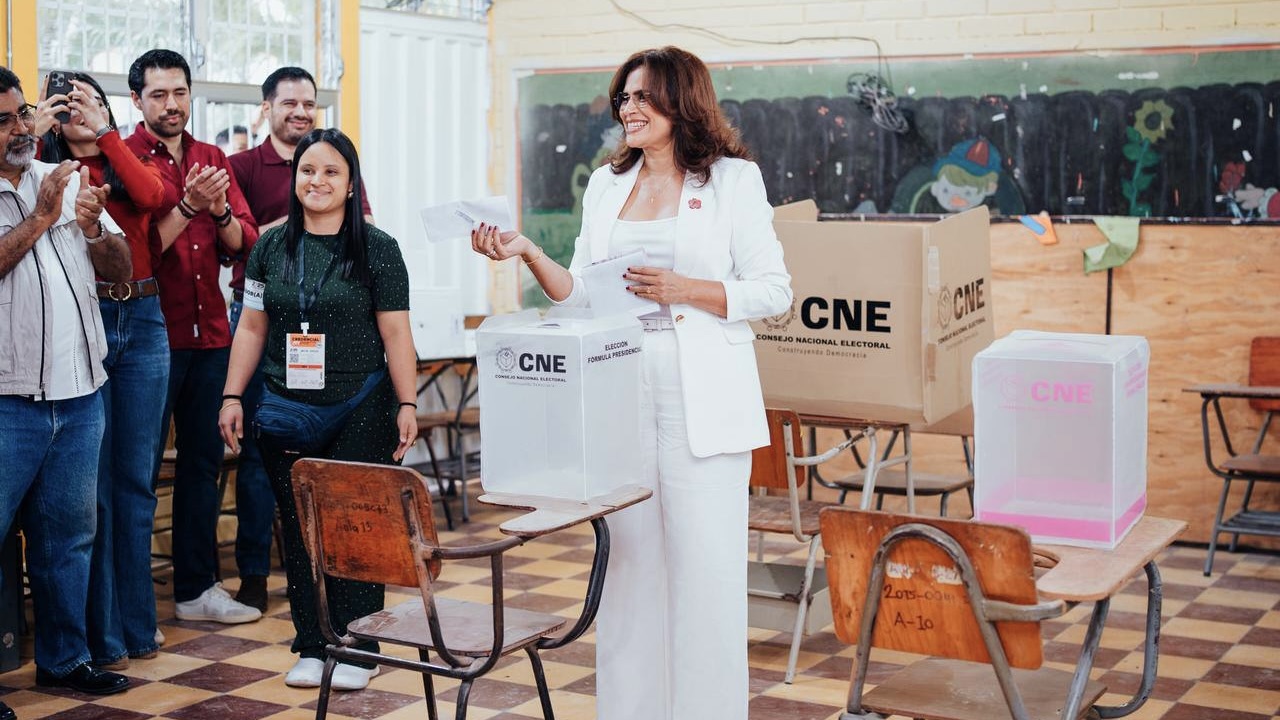
Progressive candidate Rixi Moncada voting on Sunday, November 30, 2025. Photo: LIBRE Party / X
The US escalation of interventionist discourse regarding the polls in Honduras reveals the deep-seated fear of the victory of a progressive project in the Americas
The people of Honduras are voting in general elections to decide their next president, 128 deputies to the Honduran Congress, 20 deputies to the Central American Parliament, 298 mayors, and more than 2,000 councilors. Most of the attention has been focused on the presidential election, which will be decided in a single round. The three frontrunners for the presidency are progressive candidate for the LIBRE Party Rixi Moncada; right-wing Liberal Party candidate Salvador Nasralla; and far-right National Party candidate Nasry Asfura.
Six million Hondurans are eligible to vote in these general elections which have become the subject of debate of far-right figures from across the world, who are all warning about the possible “triumph of communism” in the Central American country. However, the external intervention in the elections has gone beyond comments on social media about the “danger” represented by progressive candidate from the LIBRE Party Rixi Moncada.
In a move shocking many, on Friday, November 28, US President Donald Trump announced that he would pardon former Honduran president Juan Orlando Hernández (JOH), adding, “according to many people that I greatly respect, [he has been] treated very harshly and unfairly. This cannot be allowed to happen, especially now, after Tito Asfura wins the Election, when Honduras will be on its way to Great Political and Financial Success.” In the message, Trump reiterated his support to National Party candidate Tito Asfura and declared that if he doesn’t win the US will “not be throwing good money after bad, because a wrong Leader can only bring catastrophic results to a country.”
Is communism really on the ballot? Why has the electoral process in the Central American country become a focus of the right wing internationally? Peoples Dispatch spoke to Camilo Bermúdez, the Director of Strategic Litigation and Management of the Civic Council of Popular and Indigenous Organizations of Honduras (COPINH) about what is at stake in this political moment in the country.
Beyond who, what is on the ballot?
As previously mentioned, the candidates polling the highest ahead of the elections are Rixi Moncada, Salvador Nasralla, and Tito Asfura. For Bermúdez, while there are three candidates, there are “clearly two political models in confrontation”.
He explains that at the base of the political project represented by LIBRE veteran Moncada is “a strong criticism of the economic system and the economic elites in Honduras”. Moncada, he emphasizes, “has been very open in criticizing, from her positions as Finance Minister and other roles she has held, the control of the country’s economy by ten families and about 26 economic groups that have [historically] controlled the main sectors of the country’s economy. She has criticized this control, the lack of tax justice, and the lack of economic democratization.” In addition to her critiques of the neoliberal economic model dominant in the country, Rixi represents “a project of continuity with President Xiomara Castro’s social program and LIBRE Party, who are heirs to the resistance and opposition to the 2009 coup d’état that overthrew Manuel Zelaya Rosales.” It is a progressive project which calls itself socialist, but mired with “many internal contradictions due to the same contradictions in LIBRE Party’s composition,” Bermúdez adds.
The other model is represented by Asfura and Nasralla, who, despite running with the country’s historically opposed parties, represent a very similar political project. This is “a traditional project of the Honduran right” which is one aligned with “private enterprise, aligned with the interests of large landowners, of large national and international corporations, and that seeks the approval of the United States Embassy in order to govern.”
The difference, Bermúdez underscores, is that Asfura is “more related to the post-coup regime, an authoritarian regime very linked to organized crime and drug trafficking. He’s from the party of President Juan Orlando, who was extradited and sentenced to 45 years in prison in the United States for drug trafficking.”
Meanwhile, Nasralla, while maintaining similar political and economic proposals to the National Party, has attempted to distance himself from organized crime, declaring himself “clean” and corruption free. Nevertheless, the COPINH organizer warns, “the political support and backing for candidate Nasralla clearly also comes from that background – for example, from business groups, corporate media groups, and also financial companies like Banco FICOHSA, which is linked to the assassination of Berta Cáceres and also to money laundering from drug trafficking.”
Under the National Party rule following the coup d’état in 2009, an all out neoliberal offensive was unleashed in the country to accelerate natural resource plundering in Indigenous and Garifuna territories, establish Special Economic Development Zones ( ZEDES) to favor international investment with the suspension of labor laws, and the privatization of state companies. Rolling back this model, which caused environmental devastation, social conflict, territorial breakdown, deep inequality and poverty, and the extraction of the country’s wealth by national and international private companies, was a cornerstone of Xiomara Castro’s 2021 campaign.
This effort has been the basis of much of the opposition she faces both by Honduran elites and international capital that, for years, had heeded the call of “Honduras is open for business” and profited immensely from the country’s cheap labor, natural resources, and relaxed labor and environmental laws. In 2017, the National Party committed outright electoral fraud, recognized even by the Organization of American States (OAS) in order to maintain their grasp on power.
Is fraud or non-recognition on the table?
The 2017 fraud is fresh in people’s minds, not only for how US President Donald Trump provided the necessary stamp of approval to his ally Juan Orlando Hernández to consolidate the fraud, but also how the event provoked mass protests and unrest across the country and the death of at least 35 protesters, with dozens imprisoned.
This time around, the possibilities for the right wing to influence the outcome of the polls are different. The leading scenario that analysts predict is an attempt by the right wing to orchestrate a non-recognition in the case of Moncada’s victory, which for Bermúdez has the sole purpose of “triggering a process of instability”. Suspicion has already been raised both within Honduras and outside the country by right-wing actors questioning the effectiveness of the electoral system for the mere reason that there is a progressive government in office. Some analysts warn that right-wing media and figures may seek to heavily promote exit polls and any results from the rapid count that would contradict the official results that will take some time to be released. Some may remember this formula from the 2019 Bolivian elections which were followed by a month of right-wing street protest against “fraud”, and ended with the overthrow of Evo Morales. Last year’s elections in Venezuela, saw a similar formula implemented: right-wing fraud allegations, echoed by the United States, which fed and fomented violent street protests a day after the elections, yet popular mobilization by Chavismo was successful in defeating this coup attempt.
Bermúdez explains, “We believe this could be what the opposition wants, with the backing of the United States government: a process of instability in which they seek to delegitimize Rixi Moncada’s victory and try to apply pressures similar to what has happened in Venezuela, trying to destabilize a progressive project, a possible progressive government project like Rixi Moncada’s.”
In this scenario, the COPINH organizer underlines, “The position taken by the Honduran Armed Forces will be very important, since they are supposedly called upon to defend the electoral process – but in 2009 they carried out the coup.” Notably though, “the current Xiomara Castro government has had a very close relationship with this Armed Forces sector.”
Bermúdez highlights that the streets will become the most important scenario in coming days if actions of non-recognition and attempts to destabilize the country after a Rixi Moncada victory go forward. In this case, “the Libre Party militants will take to the streets, because this is a militancy that emerged in the streets, from the post-coup resistance movement, and it’s a party and militancy accustomed to social protest. So we foresee that faced with any such action, there will also be a response of popular mobilization.”
“What will be very important won’t really be election day itself, because there isn’t an immediate vote counting system – moreover, it has been denounced as a system that could have been hacked or is unreliable. So the results won’t come on the same day; results will possibly come the following day, a couple of days later, after all the tally sheets from the polling stations have arrived at a location for manual counting of each sheet, and then that becomes the official result,” Bermúdez emphasizes.
US interference
A constant in Honduran politics, has been the outsized role of the United States leaders, in shaping the country’s present and future. Yet, Trump’s recent statements and actions have gone a step further.
“There is great concern in the country about that statement from the United States government…Obviously the US Embassy and State Department have great influence in Central American countries and great influence in Honduras, but we’ve never seen such blatant and interventionist pronouncements, which demonstrate the nature of US government policy,” Bermúdez remarks.
This in reference to the pardon of JOH couched in the endorsement of National Party candidate Asfura.
JOH was arrested on February 16, 2022, by Honduran police following an extradition request from the United States for conspiring to traffic drugs in the US. Two months later, on April 21, 2022, Hernández was extradited to the United States. In June 2024, JOH was sentenced by a US judge to 45 years in prison for the crime of exporting more than 400 tons of cocaine to the United States and for the possession of “destructive devices”. At the time, the judge, Kevin Castel, called Hernández “a two-faced politician” because, on the one hand, he claimed to fight drug trafficking in his country, while, on the other hand, he supported the drug cartels. Prosecutors alleged that the former president built a “Narco-State” in which he personally received millions of dollars in bribes from drug traffickers.
Bermúdez believes that the explicit support from Trump and other US officials for Asfura, and the explicit rejection of Moncada and LIBRE, “has to do with an international campaign to fight against any kind of progressive perspective in Latin America, under the outdated discourse of communism linked to a supposed fight against drug trafficking and what they call ‘narcoterrorism.’” “Narcoterrorism”, he explains, “is the policy the United States government develops to attack Venezuela, to enter into deep contradiction with the governments of Colombia, Mexico, and Brazil. So we believe this fits within this dynamic of the growth of the right-wing that we are seeing internationally, of these authoritarian and extreme-right discourses that seek shelter in this narcoterrorism discourse, attempting to link it to the revolutionary processes in Venezuela and Cuba.”
Yet, the outright violations of Honduran sovereignty and rule of law by the US president and their potential to sow chaos, are also telling. Bermúdez said, such actions show “the fear they have of a progressive project that could be executed by candidate Rixi Moncada, and also the expectation and perspective they have that she could be the candidate favored by the popular vote – because if that weren’t the case, we believe they wouldn’t take such a decisive, forceful, and strong position like that of the US president, who, it goes without saying, very possibly doesn’t even know where Honduras is, yet is speaking in favor of one of the candidates.”
Bermúdez states that at the end of the day, “no matter how blatant this interference is and no matter how powerful Donald Trump’s government is, the decision lies with the people. And I think it’s also a call to awareness for the people to take the reins and make decisions about their future.”
Donald Fuhrump says that Amerikkka doesn’t bother with crimes or charges anymore, not being 100% Amerikkkan and opposing his real estate intentions is enough.