Trump’s Venezuela Drug War Gambit and the Militarization Playbook at Home

This article by Michelle Ellner republished from Common Dreams under Creative Commons (CC BY-NC-ND 3.0).

National Guard troops are deployed to the Washington Monument as part of US President Donald Trump’s mobilization of law enforcement on August 12, 2025 in Washington, DC. (Photo by Andrew Leyden/Getty Images)

Whether it’s a wall in the desert or barricades in front of the White House, the message is the same: Perceived threats, real or manufactured, are met with troops, not talks.

US President Donald Trump has quietly authorized the Pentagon to carry out military operations against what his administration calls “narco-terrorist” networks in Latin America. On paper, it’s a counter-narcotics policy. In practice, it serves as a green light for open-ended US military action abroad, bypassing congressional approval, sidestepping international law, and stretching the definition of “national security” until it becomes a catchall justification for the use of force.

The directive allows the US to target groups unilaterally labeled as both criminal and terrorist. Once that designation is made, the military can operate without the consent of the targeted country, a move that violates international law. In a region with a long history of US-backed coups, covert wars, and destabilization campaigns, the risk of abuse isn’t hypothetical; it’s inevitable.

While the order applies across Latin America, Venezuela stands at the top of the list. The Trump administration has accused President Nicolás Maduro’s government of working with transnational cartels, and has doubled the bounty on him to $50 million (double the bounty for Osama bin Laden). It’s a lawfare tactic designed to criminalize a head of state and invite mercenaries and covert operatives to participate in regime change. The accusations fueling this escalation have grown increasingly far-fetched casting Maduro in turn as a partner of Colombia’s FARC, the head of the “Cartel de los Soles,” a patron of Venezuela’s Tren de Aragua, and now, as an ally of Mexico’s Sinaloa Cartel. a charge even Mexico’s own president says has no evidence, revealing how politicized and unfounded this allegation is.

The core premise of the accusation is that Maduro is involved in a cocaine trafficking network of Venezuelan military and political figures called Cartel de los Soles. The Venezuelan government denies the cartel’s existence, calling it a fabrication to justify sanctions and regime change efforts. Multiple independent investigations have shown no hard evidence exists and that this narrative thrives in a media-intelligence echo chamber. Reports from outlets like Insight Crime cite anonymous US sources; those media stories are then cited by policymakers and think tanks, and the cycle repeats until speculation becomes policy.

The communities in Caracas and Los Angeles, in the Venezuelan plains, and in the US-Mexico border may seem worlds apart, but they are facing the same war machine.

Fulton Armstrong, a professor at American University and a former longtime US intelligence officer, has stated that he knows no one in the intelligence community, apart from those currently in government, who believes in the existence of the Cartel de los Soles.

Drug monitoring data also contradict this narrative. The Washington Office on Latin America (WOLA) reports that only about 7% of US-bound cocaine transits through the Eastern Caribbean via Venezuela, while approximately 90% takes Western Caribbean and Eastern Pacific routes. The United Nations Office on Drugs and Crime’s 2025 World Drug Report likewise confirms that trafficking remains concentrated in major Andean corridors, not through Venezuela. Yet Venezuela is targeted anyway, not for its actual role in the drug trade, but because neutralizing its government has become a pillar of US foreign policy, seen in Washington as a step toward reshaping the country’s political system and prying open its economy to foreign control.
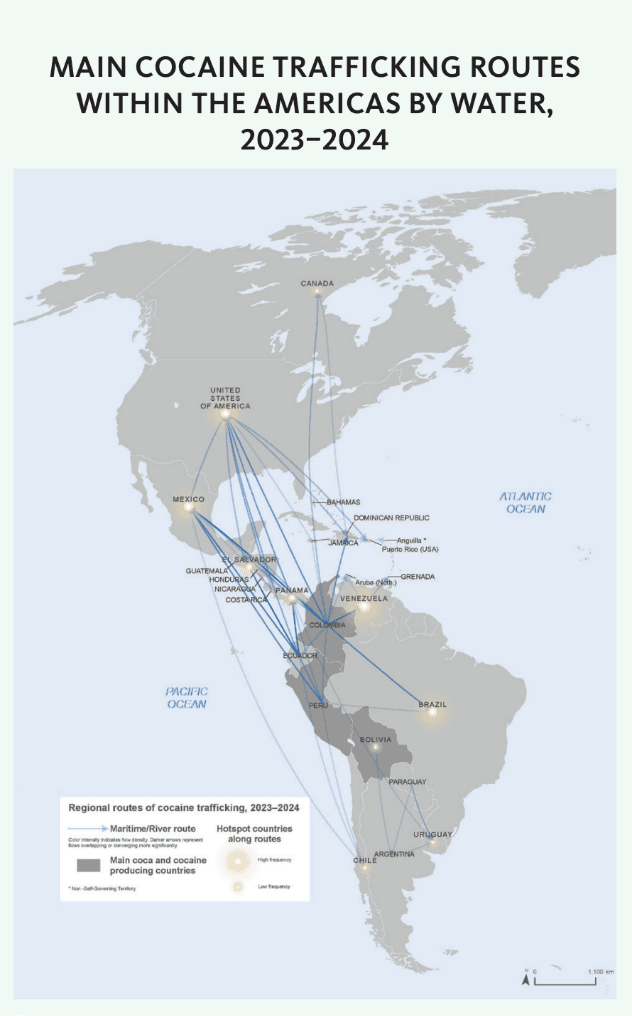
The “narco-terror” label put on Venezuela also attempts to rope Venezuela into the US fentanyl crisis, despite the absence of evidence that the country plays any role in fentanyl trafficking. Even US drug enforcement assessments make no mention of Venezuela as a source or transit point.

This link exists only in political rhetoric, a way to fold Venezuela into a domestic public health crisis and recycle the same logic used to brand it a “national security threat.” That accusation dates back to 2015 when then-President Barack Obama created the legal and political scaffolding for an open-ended campaign of coercion. Once the “narco-terror” framework is in place, Washington can sustain and escalate military measures over time, regardless of the immediate pretext.

This framing turns a political standoff into a declared security imperative. It broadens the range of permissible military tools, from ISR (intelligence, surveillance, reconnaissance) to direct action.

The pattern is familiar. In Panama (1989), Colombia (2000s), and Honduras (2010s), US militarized antidrug campaigns failed to dismantle supply chains or reduce trafficking volumes. What they did accomplish was shifting routes, militarizing criminal actors, and destabilizing governments, and left societies more fragile—costing lives and destroying communities in the process.

The Mirror at Home: Militarization and Communities of Color

The same militarized logic driving US policy in Venezuela is being applied inside the United States. In August 2025, President Trump signed an executive order placing the DC Metropolitan Police Department under federal control and deployed the National Guard, citing a public safety “emergency,” despite official data showing violent crime at multiyear lows. Even US law enforcement statistics contradict the White House narrative, but the administration dismissed them, casting the city as overrun by “roving mobs,” “wild youth,” and “drugged-out maniacs.”

DC is only one example. The same militarized logic has sent thousands of troops to the US-Mexico border, converted military bases into detention centers from Texas to New Jersey, and stationed soldiers inside Immigration and Customs Enforcement detention facilities in over 20 states. In Los Angeles, Marines and National Guard units patrolled immigrant neighborhoods in a show of force, a deployment beaten back only by mass community resistance and the threat of labor action.

Whether it’s a wall in the desert or barricades in front of the White House, the message is the same: Perceived threats, real or manufactured, are met with troops, not talks. The playbook never changes: In Venezuela, the “threat” is cast as narco-terrorism; in the US, it’s a “border surge” or a manufactured public safety emergency built on racially coded depictions of Black and brown communities. In both cases, the logic is identical: Treat political disputes and social crises as security emergencies, sideline diplomacy and community solutions, usurp greater executive powers, and make military force a routine tool of governance.

The Real Threat

Trump’s “narco-terror” authorization uses the language of fighting drugs and crime to mask a deeper project: expanding the military’s role in governance and normalizing its use as a tool of political control both at home and abroad.

In Latin America, that means more interventions against governments the US wants to topple. At home, it means embedding the military deeper into civilian life, particularly in Black and brown neighborhoods.

The communities in Caracas and Los Angeles, in the Venezuelan plains, and in the US-Mexico border may seem worlds apart, but they are facing the same war machine. Until we reject militarization in all its forms, the targets will keep shifting, but the people under the gun will look the same.

This article by Michelle Ellner republished from Common Dreams under Creative Commons (CC BY-NC-ND 3.0).

Continue ReadingTrump’s Venezuela Drug War Gambit and the Militarization Playbook at Home

Green Party reaction to Nigel Farage’s mass deportation plan

Ellie Chowns, Green Party MP for North Herefordshire. CC image Wikipedia.

Responding to plans announced by Nigel Farage to rip up swathes of international law and deport thousands of migrants if Reform UK ever gained power, Green Party MP Ellie Chowns said: 

“More inflammatory rhetoric from Farage at a sensitive time in many communities. This dangerous toxic bluster is clearly aimed at whipping up anger, hatred and even disorder. The way he talks about asylum seekers – our fellow global citizens – is reprehensible.

“The policy proposals themselves are unworkable. They rely on ripping up swathes of international law and would likely face many legal obstacles in the UK courts that could use British common law to block such cruelty. 

“Iran, Afghanistan, Eritrea, Sudan and Syria feature in the top ten countries for asylum seekers in the UK  – all places where people face oppression, conflict, extreme poverty or famine. Asylum claims from people arriving from these countries have high approval rates – almost 100% in the case of Sudan and Syria [1]. 

“Yet former Reform UK Chair Zia Yusuf has suggested that a Reform government would pay brutal regimes like the Taliban to accept the return of migrants – including unaccompanied children. They must know what could happen to these people when they are returned – they will likely be abused, tortured or executed. 

“This is not who we are as a nation. The vast majority of the British public are willing to show compassion towards those fleeing the terrible situations they leave behind.”

Climate science denier Nigel Farage explains that it's simple to blame asylum-seekers or Muslims for everything.
Climate science denier Nigel Farage explains that it’s simple to blame asylum-seekers or Muslims for everything.
Continue ReadingGreen Party reaction to Nigel Farage’s mass deportation plan

Argentina’s president Milei pelted with rocks on campaign trail amid corruption scandal linked to sister

https://www.theguardian.com/world/2025/aug/28/argentina-javier-milei-hit-with-rocks-on-campaign-trail-amid-corruption-scandal-ntwnfb

Argentina president Javier Milei escapes election rally after being pelted with rocks – video

Argentinian president campaigning for midterm elections – the first big test of his popularity – when protesters threw bottles and rocks at his vehicle

The president of Argentina, Javier Milei, was pelted with stones while campaigning near the capital Buenos Aires on Wednesday by demonstrators protesting about a corruption scandal.

The far-right leader, who was whisked from the scene by his security detail, sustained no injuries after his motorcade was attacked, presidential spokesperson Manuel Adorni wrote on X.

Milei, who is campaigning for October midterm elections, was riding in the back of a pickup truck and greeting supporters in the city of Lomas de Zamora, 20km south of Buenos Aires, when protesters began throwing plants, rocks and bottles at his vehicle.

The vehicle carrying the president and his sister, Karina Milei, along with other officials, quickly left the scene.

Afterwards, scuffles broke out between supporters and opponents of the libertarian leader.

The skirmishes arose amid a scandal in Argentina over alleged corruption at the public disability agency involving Milei’s highly influential sister who works closely with the president, Karina Milei.

Article continues at https://www.theguardian.com/world/2025/aug/28/argentina-javier-milei-hit-with-rocks-on-campaign-trail-amid-corruption-scandal-ntwnfb

Continue ReadingArgentina’s president Milei pelted with rocks on campaign trail amid corruption scandal linked to sister

Farage to Share Stage with Architects of Trump’s Anti-Climate Agenda

Original article by Adam Barnett republished from DeSmog.

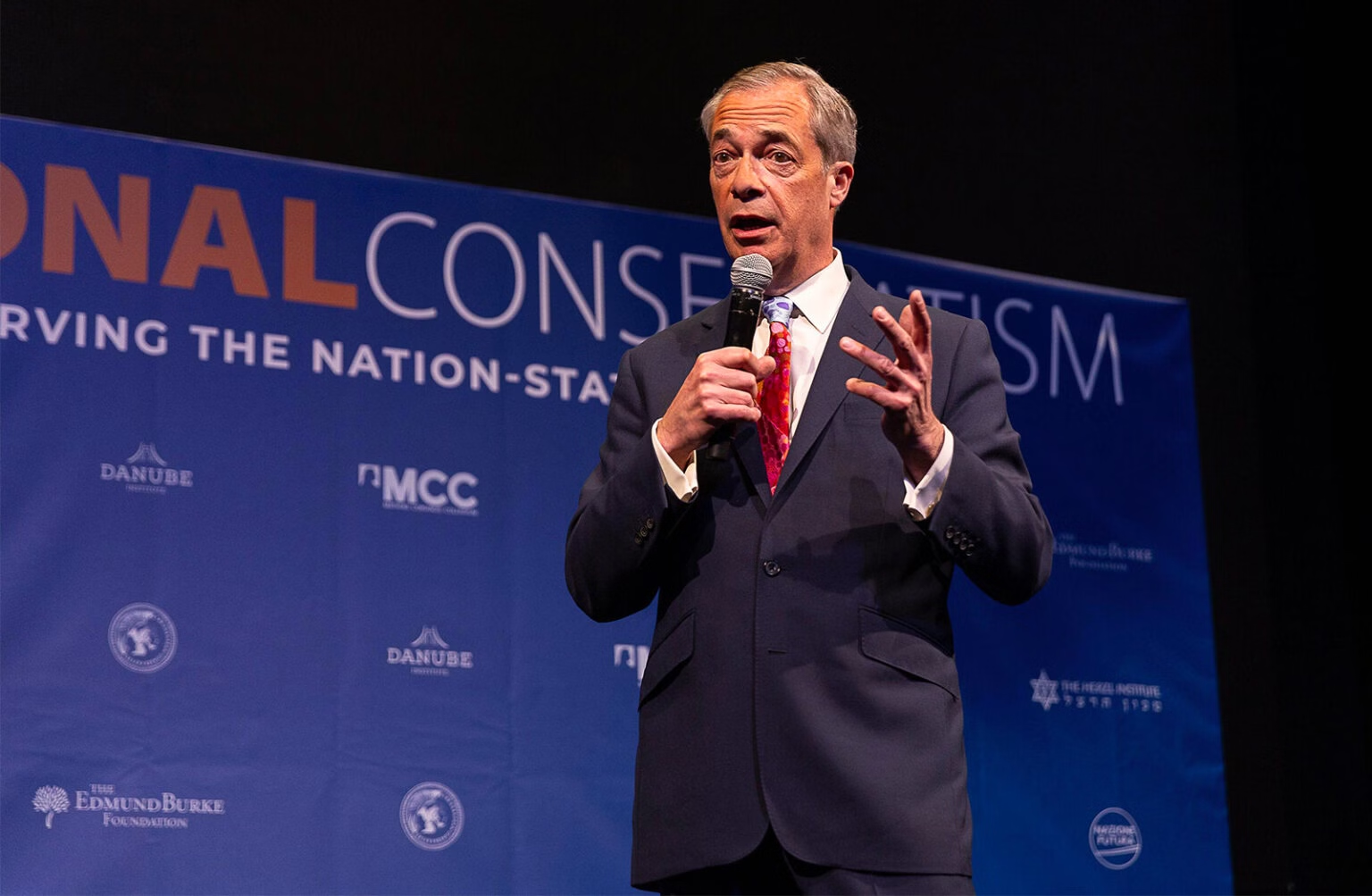
Nigel Farage at the National Conservatism conference in Brussels. Credit: Belga News Agency / Alamy

The Reform leader will be skipping Parliament again in favour of a conference in Washington DC.

Reform UK leader Nigel Farage will speak next week alongside the authors of Donald Trump’s plans to “dismantle the administrative state” and scrap climate policies. 

Farage is a featured speaker at the National Conservatism (NatCon) conference in Washington DC – at least his tenth visit to the U.S. since being elected as an MP.

As reported in The Mirror, Farage’s trip – during which he will also reportedly speak to Congress about free speech in the UK – means he will miss Parliament’s return from summer recess. 

version of this article was published by The Mirror

DeSmog’s analysis reveals that more than a fifth of the speakers at the NatCon event have roles at groups which contributed to Project 2025, the radical blueprint for Trump’s second term convened by the Heritage Foundation.

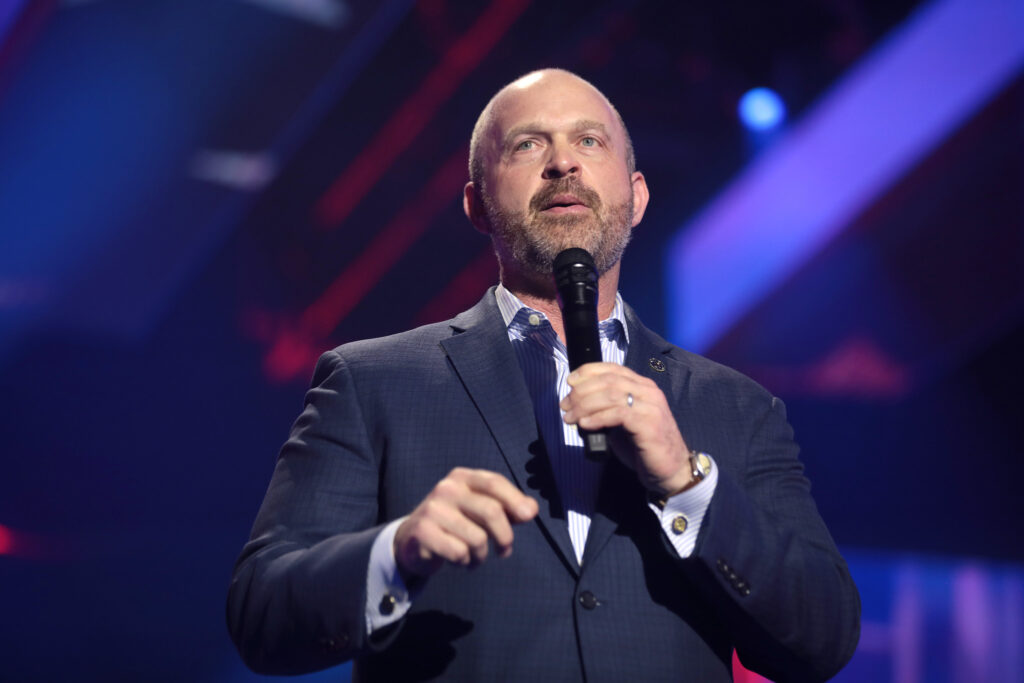
They include Russell Vought, Trump’s budget chief. Before entering office, Vought was a key author of Project 2025 and the vice president of Heritage Action, the campaign arm of the Heritage Foundation, whose president Kevin Roberts will be speaking at NatCon.

The listed speakers also include senior members of the Trump administration, including his Director of National Intelligence Tulsi Gabbard, who launched her book For Love of Country at a Heritage Foundation event with Roberts last year; and Tom Homan, Director of U.S. Immigration and Customs Enforcement (ICE), who is a former visiting fellow at the Heritage Foundation and a contributor to Project 2025.

NatCon is organised by the Edmund Burke Foundation, a conservative think tank based in Washington DC. Its UK chairman James Orr runs the pro-Reform think tank the Centre for a Better Britain, is a close friend of U.S. Vice President JD Vance, and recently told BBC Radio 4 that he admires the Heritage Foundation and Project 2025. Farage spoke at a NatCon event in Brussels last year.

The lengthy Project 2025 policy document, titled ‘The Mandate for Leadership’, proposed reversing climate policies, unleashing fossil fuel extraction, scrapping investment in clean energy, and gutting the Environmental Protection Agency (EPA) – policies imposed by the Trump administration. 

As DeSmog has reported, 70 percent of Trump’s cabinet has ties to Project 2025, which also seeks to “dismantle the administrative state”, further restrict abortion, and access to contraception.

A Liberal Democrat source told DeSmog: “Nigel Farage is far more interested in pleasing Trump and jostling for his affections than he is in turning up to Parliament on time or standing up for British values.”

Farage in DC

Farage will speak on a panel alongside Larry Arnn, who sits on the Heritage Foundation’s board of directors.

It will be the second time Farage has shared a stage with Arnn following a fundraiser in September 2024 for the Heartland Institute, which also contributed to Project 2025 and has described itself as “the world’s most prominent think tank supporting scepticism about man-made climate change”.

At the fundraiser, Farage claimed that the UK’s efforts to reduce carbon dioxide emissions don’t “make any bloody difference at all” – and reiterated Trump’s call to “drill baby drill” for fossil fuels.

Farage and Trump have both denied basic climate science. The Reform leader has claimed it’s “absolutely nuts” for CO2 to be considered a pollutant, while Trump has called climate change a “giant hoax”.

Next week’s event in Washington lists at least 22 speakers with current or recent roles at the Heritage Foundation and other Project 2025 member groups.

Other UK speakers at the event include Rupert Darwall, who has claimed there is “strong evidence for the non-existence of a climate crisis,” and former GB News presenter Calvin Robinson.

Senior members of the Conservative Party including shadow justice secretary Robert Jenrick and shadow foreign secretary Priti Patel have met with Heritage Foundation leaders or spoken at their events in recent years. 

Reform UK did not reply to DeSmog’s request for comment.


Project 2025 speakers at NatCon Washington DC

Heritage Foundation president Kevin Roberts. Credit: Gage Skidmore / Flickr (CC BY-SA 2.0)

Kevin Roberts – president of the Heritage Foundation

Russell Vought – director of the Office for Budget Management, and former vice president of Heritage Action

Tom Homan – director of Immigration, Customs and Enforcement (ICE), and a former visiting fellow at the Heritage Foundation

Christopher DeMuth – Heritage Foundation Fellow

John Backiel – visiting fellow for the Capital Markets Initiative at the Heritage Foundation

Robert Greenway – director of the Allison Center for National Security at the Heritage Foundation

Rob Bluey – executive editor of the Heritage Foundation’s Daily Signal

Victoria Coates – vice president of the Heritage Foundation’s Kathryn and Shelby Cullom Davis Institute for National Security and Foreign Policy

Tom Klingenstein – chairman of the board of directors at the Claremont Institute

Spencer Klavan – associate editor at the Claremont Review of Books

Ryan Williams – president of the Claremont Institute and publisher of the Claremont Review of Books

John Eastman – senior fellow at the Claremont Institute, and a contributor to the Heritage Guide to the Constitution

Will Thibeau – director of the American Military Project at the Claremont Institute’s Center for the American Way of Life, and previously a policy analyst in the Heritage Foundation’s Tech Policy Center

Kristen Waggoner – CEO, president, and general counsel of Alliance Defending Freedom

Gene Hamilton – president and co-founder of America First Legal

Curt Mills — executive director of the American Conservative

Mark DiPlacido — policy advisor at American Compass, and a former Heritage Action staffer

Rachel Bovard — vice president of programs at the Conservative Partnership Institute

Rupert Darwall — strategy consultant and policy analyst at the Competitive Enterprise Institute

Mark Krikorian — executive director of the Center for Immigration Studies

Alex Petkas — a senior fellow at the Center for Renewing America

Clare Morell — fellow at the Ethics and Public Policy Center

Original article by Adam Barnett republished from DeSmog.

Nigel Farage urges you to ignore facts and reality and be a climate science denier like him. He says that Reform UK has received millions and millions from the fossil fuel industry to promote climate denial and destroy the planet.
Donald Trump urges you to be a Climate Science denier like him. He says that he makes millions and millions for destroying the planet, Burn, Baby, Burn and Flood, Baby, Flood.
Elon Musk urges you to be a Fascist like him, says that you can ignore facts and reality then.
Continue ReadingFarage to Share Stage with Architects of Trump’s Anti-Climate Agenda