Shetland Schoolchildren Study in Classrooms Sponsored by Norwegian Oil Giant

Original article by Ellen Ormesher republished from DeSmog.
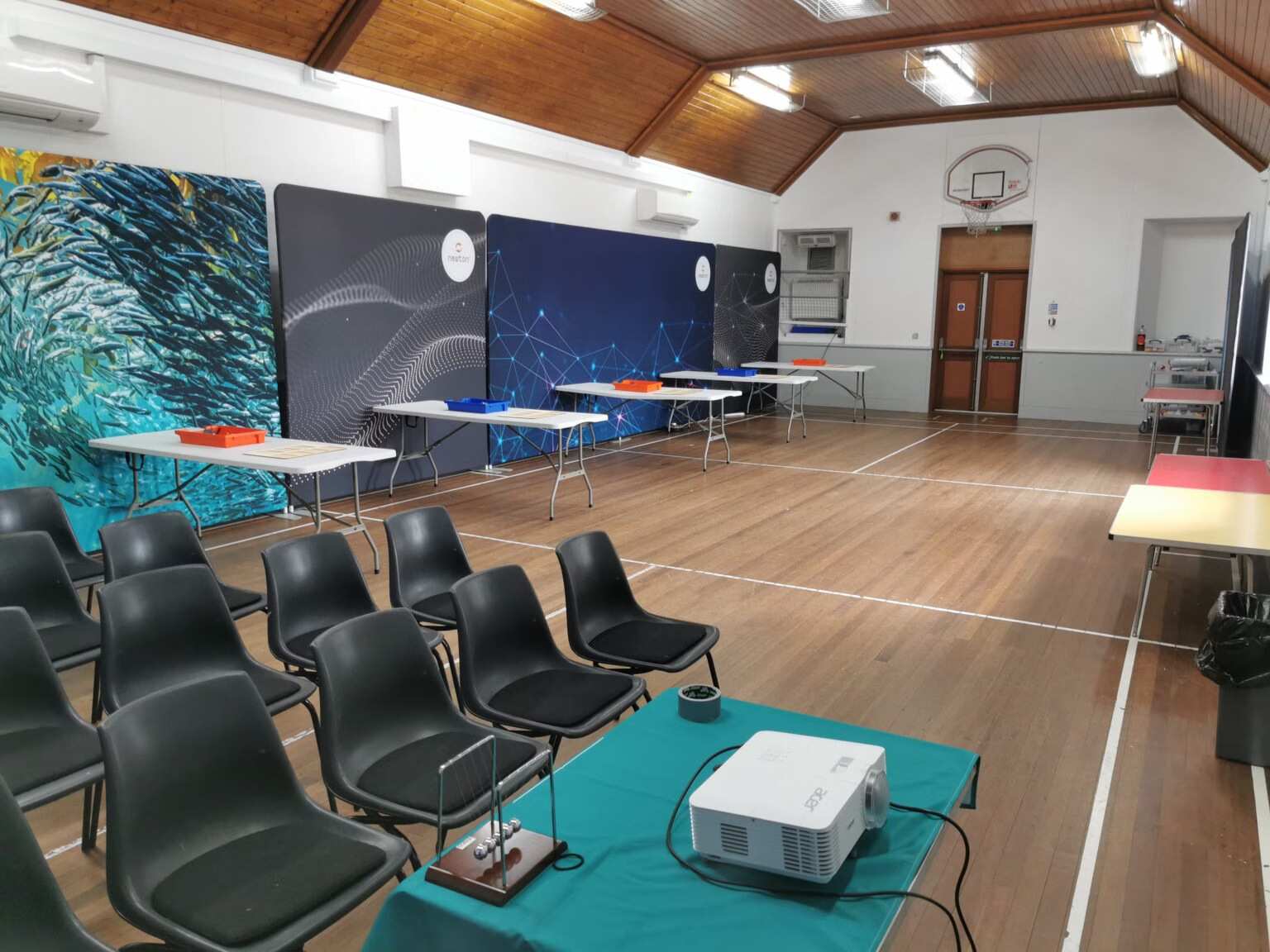
A mobile “Newton Room” classroom operating in Scotland. Credit: Scott O’Hara

Critics fear that Equinor’s latest UK education deal is aimed at quelling opposition to North Sea drilling.

This story was published in partnership with Norway’s E24.

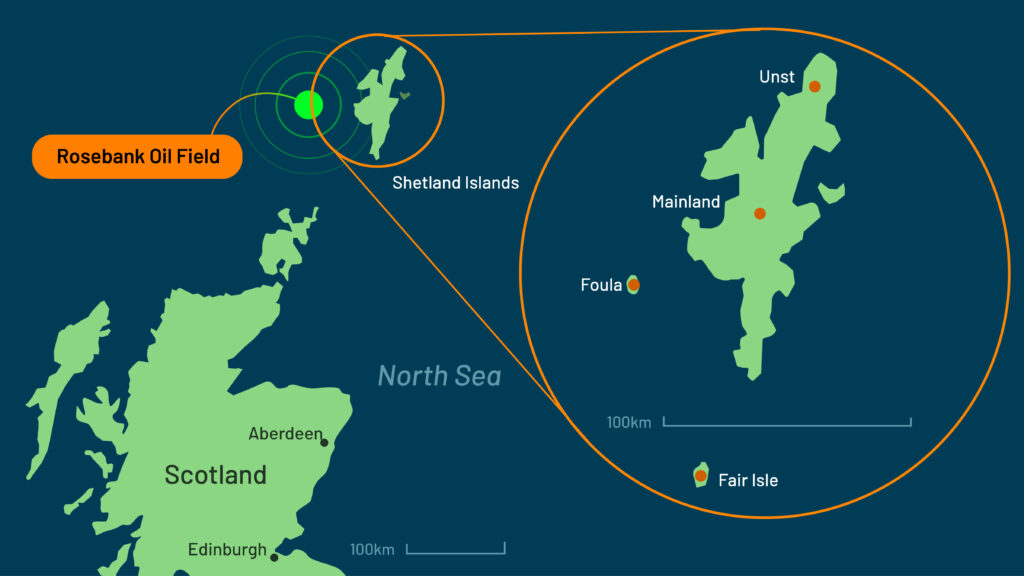
Norwegian oil company Equinor is spending more than £200,000 to sponsor science classrooms in the Shetland Islands, as it seeks approval for plans to develop the vast Rosebank oilfield 80 miles off the coast.

Opponents of Rosebank — the largest new oil and gas field in the North Sea — have accused Equinor of using its deep pockets to dilute concerns over further drilling. Developing the project would result the release of millions of tonnes of planet-heating carbon dioxide (CO2) emissions when the oil it pumps is burned.

Ariane Burgess, a Scottish Green Member of the Scottish Parliament, said Equinor’s backing for the classrooms was “concerning.”

“The timing and location of these investments raise questions about the motives behind them, particularly in light of Equinor’s broader strategy to secure social license to operate in sensitive areas,” said Burgess, one of seven Scottish Green law-makers in the 129-seat assembly in Edinburgh.

The pop-up classroom — known as a “Newton Room” — launched in March and aims to reach 1,000 children aged 10 to 14 across the archipelago of 20,000 people over the next two years, said Highlands and Islands Enterprise, a Scottish agency partnering on the project.

The classroom will be set up in community centres near primary and secondary schools on several of Shetland’s 16 inhabited islands, taking in the Shetland mainland, Unst, Foula, Yell and Fair Isle.

Equinor, which is majority-owned by the Norwegian state, said the project would deliver “pioneering, face-to-face” programmes to develop science, technology, engineering and mathematics skills. The decision to fund the initiative had “no link” to Equinor’s plan to develop Rosebank, and it had declined an opportunity to include its corporate logo, the company said.

“We are proud to support the first Shetland mobile Newton Room and to assist its core operations in the Highlands and Islands,” said Alice Baxter, Equinor’s UK spokesperson. “We look forward to seeing how the mobile Newton Room benefits the wider Shetland community and are delighted to be a key partner in this great programme for the region.”
Credit: Sabrina Bedford

‘Brainwash Children’

Equinor spent a total of $82.7 million on sponsorships between 2020 and 2024, with science, education and research as the main focus, according to a government response to a parliamentary question submitted by Lars Haltbrekken, an MP for the Socialist Left Party, on June 16.

Haltbrekken, a long-time critic of Equinor’s 30-year history of sponsoring education in Norway, had submitted the question in response to reports in Norwegian media detailing the company’s backing for a computer game aimed at UK schoolchildren. The game, called EnergyTown, was developed in partnership with London-based marketing agency We Are Futures and the Association for Science Education, a professional teachers’ body.

Climate campaigners said the game crossed the line between education and promoting fossil fuels because it portrayed renewable energy as “less reliable.”

EnergyTown was part of a two-year-old science education initiative called Wonderverse which has reached over 80,000 schoolchildren in the UK, according to Equinor’s website. Website copy that has since been deleted described Wonderverse as designed to “build future talent pipelines and secure permission to operate at a time of sensitivity around fossil fuels, particularly in light of approval for the Rosebank development.” We Are Futures did not respond to a request for comment.

“[Equinor] is trying to brainwash children into thinking it has the solution to the climate crisis, when in reality, fossil fuels are the reason we are struggling with the climate crisis today,” Haltbrekken told DeSmog. 

Equinor, formerly known as Statoil, was the founding partner of the Newton Rooms mobile classroom programme developed by the nonprofit FIRST Scandinavia in Norway in 2003.

“It’s interesting to see how Equinor has developed a playbook for influencing children in Norway and then copy-pasted it to other countries like Scotland,” said Julie Forchhammer, co-founder of Norwegian climate advocacy group Klimakultur. 

In Scotland, Equinor’s current education partnerships include a deal with the Aberdeen Science Centre, a museum near the Norwegian company’s UK headquarters in Aberdeen, and another with the city’s TechFest annual science festival.

Equinor committed £208,500 for the Shetland Islands mobile classroom project as part of a total package of £385,000 to support the Science Skills Academy education initiative run by Highlands and Islands Enterprise, said Morven Fancey, the agency’s head of housing, skills and population.

“Our core content and supporting educational materials for Newton Room activities were developed at the beginning of the Highland operation and are branded by [Science Skills Academy] independently of any industry involvement,” Fancey said.

Island Opinion Divided

The sponsorship deal with Highlands and Islands Enterprise was agreed in 2023, Fancey said. That was the same year that Equinor won approval for Rosebank from the UK’s former Conservative government, sparking outcry among climate campaigners.

Equinor is now seeking re-approval for Rosebank after Scotland’s highest court dealt a blow to the project in January by ruling the original decision unlawful because it had failed to consider the environmental impacts of burning the fossil fuels extracted from the oilfield.

Opening any new oil and gas fields in the North Sea is incompatible with achieving 2015 Paris Agreement goals of avoiding catastrophic climate change by limiting global warming to 1.5°C, according to a June report by academics at University College London. Burning Rosebank’s oil and gas would produce up to 200 million tonnes of CO2 over the project’s lifetime, which is more than the combined annual emissions of 28-low income countries, wrote one of the report’s authors in an article for The Conversation. 

Opinion over Equinor’s role in sponsoring the classrooms is divided on the Shetland Islands, which have historically benefitted from oil and gas money.

“In Shetland, the fact that our kids have amazing leisure facilities, the roads have no potholes, and the care homes are good is all because of fossil fuels,” said Margaret Goddard, a doctor who lives on the islands of Burra, and who has daughters aged 11 and 14.

But she expressed concerns over the climate crisis, and Equinor’s motives, acknowledging, “These things are very difficult.”

Alex Armitage, a Scottish Green councillor for Shetland Islands Council said he found Equinor’s role “quite dystopian.”

“An oil company that’s making very little effort to reduce carbon emissions and is greenwashing all of its operations is seeking to show that it’s trying to help the next generation,” Armitage said. “Everything it’s doing goes against that.”

Like other oil companies, Equinor has rowed back on its climate commitments in the past year, having announced in February that it would slash planned investment in renewables and low-carbon solutions by around 50 percent between 2024 and 2027. By 2026, Equinor plans to maintain over 95 percent of its energy production from fossil fuels, according to analysis by the environmental law nonprofit ClientEarth.

Equinor holds an 80 percent stake in Rosebank in a joint venture with Ithaca Energy, which is owned by Israel’s Delek Group. In 2023, Delek Group appeared on a UN list of 97 companies whose activities in the West Bank “raised particular human rights concerns.”

‘Extensive Influence’

Oil companies view educational and cultural sponsorships as crucial tools for deflecting pressure from climate activists, influencing legislation, and portraying themselves as gatekeepers to climate solutions, according to a previous DeSmog review of internal industry documents subpoenaed by the U.S Congress as part of an investigation into oil industry disinformation that concluded last year.  

Equinor was not a direct target of the investigation, which focused on the U.S. businesses of ExxonMobil , Chevron, Shell USA Inc. and BP America. The Norwegian company is, however, a member of the American Petroleum Institute lobby group, which described sponsored community groups as among the “best and most influential voices with targeted policymakers on industry issues,” according to a subpoenaed document from October 2017. 

The findings built on previous research showing how the fossil fuel industry has spent nearly a century using educational sponsorships to shape public opinion about energy and the environment. As early as 1928, Standard Oil of California (which became Chevron) was sponsoring educational radio broadcasts that reached millions of American students over decades. Recent programmes include BP’s Science Explorers, a series of free online resources that now reaches over half of UK secondary schools.

In the latest sign of the oil and gas industry seeking to influence young people, DeSmog reported on June 30 that a group of six Canadian fossil fuel companies known as Pathways Alliance had been sponsoring science fairs for children. The finding followed a report issued by the Canadian Association of Physicians for the Environment earlier this year that documented the sector’s “extensive influence on climate education for elementary and secondary school students.”

‘Cynical Tactic’

Equinor has been a sponsor of the Aberdeen Science Centre since 2019, funding the facility and supporting its partnership with Norway’s Vitenfabrikken (The Science Factory), a children’s science museum in the city of Bergen. The two institutions are linked via an initiative called the North Sea Collaboration Project, which develops science and technology activities aimed at children, focused on “carbon emissions reduction solutions” and climate awareness, according to the Aberdeen Science Centre’s website.

Aberdeen Science Centre did not respond to a request for comment.

The TechFest event, which Equinor sponsors alongside BP and Shell, includes Equinor branding in its 2025 programme directory next to listings for workshops aimed at children as young as four. TechFest did not respond to a request for comment.

Through its Hywind floating wind project, Equinor provided £60,000 to transform a disused classroom at Peterhead Academy into what the school called an “ultra-modern” renewables space, complete with screens, break-out areas and turbine models, which opened in 2018, according to trade publication Energy Voice.

Peterhead is also the site of a planned Equinor carbon capture and storage project, which is facing questions over its likely economic viability and climate impact. DeSmog revealed in June that UK Chancellor Rachel Reeves had told Equinor last year that the industry would receive a “quid pro quo” in return for higher taxes on its windfall profits in the form of carbon capture subsidies.

Such programmes reflect a broader oil industry strategy to preserve its reputation among future generations, said Klimakultur’s Forchhammer. “It’s a cynical tactic, but they wouldn’t do it if it wasn’t working.”

Additional reporting by Daniel Shailer, Shetland Times

Original article by Ellen Ormesher republished from DeSmog.

Continue ReadingShetland Schoolchildren Study in Classrooms Sponsored by Norwegian Oil Giant

Cartoonists Can Compare Victims of Genocide to Nazis—But Not the Perpetrators

Original article by Hank Kennedy republished from FAIR under a Creative Commons Attribution-NonCommercial-NoDerivs 3.0 Unported License.

Cartoonists Can Compare Victims of Genocide to Nazis—But Not the Perpetrators

Image of men in front of a US/Israeli flag drinking blood from glasses, saying of the dove of peace: 'Who invited that lousy antisemite?'

This Mr. Fish cartoon (Scheer Post12/5/23) was called antisemitic because in calling attention to the Israeli army’s ongoing and very real killing of more than 17,000 children, it might evoke associations with the false trope used across centuries that Jews killed children in religious rituals.

Cartoonist Mr. Fish (real name Dwayne Booth) posted an update to his Patreon on March 20 headed “Fish: Laid Off!” Fish’s work has accompanied columns by Chris Hedges, appeared in Harper’s Magazine and currently can be found on ScheerPost. He collaborated with Ralph Nader to create The Day the Rats Vetoed Congress, a fable of a citizen uprising against Washington corruption. Fish announced he had been laid off from the Annenberg School of Communication at the University of Pennsylvania after teaching there for 11 years. Fish states that, officially, “the reason for the termination was budgetary.”

Unofficially, Fish has been subject to an assault stoked by right-wing media since last February. The Washington Free Beacon (2/1/24) fired the starting gun with its piece, “Penn Lecturer Is Behind Grotesque Antisemitic Cartoons.” Writer Jessica Costescu freely conflates criticism of Israel with antisemitism in her piece. She includes as antisemitic a cartoon of accused war criminal Benjamin Netanyahu as a “butcher holding a long knife and a crumpled Palestinian flag,” and another showing “an Israeli holding a gun to a hospitalized baby’s head.”

Even more serious is the charge Costescu makes that Fish evokes the “blood libel,” the myth that Jews murdered Christian children to use in religious rituals, via a cartoon of American and Israeli leaders drinking cups of blood labeled “Gaza.” Fish maintains he was “playing off of the New Yorker style” in drawing “upper-crust power brokers,” and that he was unaware of the blood libel myth (Real News Network5/6/25).

Costescu claims that other Fish cartoons are antisemitic because they compare Israeli policies to those of Nazi Germany. She cites one showing soldiers marching under a combination Nazi and Israeli flag, and another showing prisoners in a concentration camp holding signs reading “Gaza, the World’s Biggest Concentration Camp” and “Stop the Holocaust in Gaza.”

‘A Holocaust in Gaza’

An IDF soldier holds a gun to the head of a baby.

Another cartoon by Mr. Fish (Scheer Post11/11/23) was called antisemitic because it depicted an IDF soldier holding a gun to the head of a baby. Medical personnel in Gaza report frequently treating children who have been shot in the head by Israeli snipers (Guardian4/2/24).

It’s hard to maintain that comparing Israeli policies to Nazism is antisemitic when Israeli Prime Minister Yitzhak Shamir belonged to Lehi, a Zionist militant group so sympathetic to fascism that it offered to ally with Germany during World War II. In 1948, Albert Einstein, Hannah Arendt and others wrote a letter to the New York Times (12/4/48) criticizing the right-wing Freedom Party (Herut), home of future Prime Minister Menachem Begin, for similarity “in its organization, methods, political philosophy and social appeal to the Nazi and Fascist parties.” The Freedom Party was one of the major parties that allied to form Likud in 1973, the faction that has governed Israel for most of the last 50 years.

Pre–October 7, an editorial in Haaretz (10/3/23) warned that “neo-fascism in Israel seriously threatens Israelis and Palestinians alike.”

Israeli politicians and public figures have not shied away from using genocidal rhetoric that compares with Nazi propaganda during the Final Solution. Yitzhak Kroizer of the Jewish Power party (Guardian1/3/24) proclaimed: “The Gaza Strip should be flattened, and for all of them there is but one sentence, and that is death.”

Israeli parliamentarian Moshe Feiglin (Middle East Eye5/21/25) said in May: “Every child in Gaza is the enemy. We need to occupy Gaza and settle it, and not a single Gazan child will be left there. There is no other victory.”

Israeli TV presenter Elad Barashi (New Arab5/5/25) made the parallels explicit when he called for “a Holocaust in Gaza.” He maintained he couldn’t “understand the people here in the State of Israel who don’t want to fill Gaza with gas showers…or train cars.”

‘Antisemitism forever!’

Nazi officers gathered around Hitler, who has been promised a student visa by Columbia.

Cartoonist Henry Payne (Andrews McMeel3/17/25) responded to the Trump administration’s arrest of Mahmoud Khalil for protesting genocide by suggesting that Khalil was akin to Hitler.

If Israeli military and political actions are off-limits to comparisons to the Nazis in the field of cartoons, the same is not true for Palestinians. This creates a situation where the Israeli government perpetrating a genocide, per Amnesty International and Human Rights Watch, cannot be compared to the Nazis, but the Palestinians—the victims of the same genocide—can.

Since our last survey of anti-Palestinian cartooning (FAIR.org3/27/25), some of those profiled have continued to paint pro-Palestine protests as Nazi-like or inherently antisemitic.

Henry Payne (Andrews McMeel3/17/25) made reference to the Trump administration’s deportation proceedings against student protester Mahmoud Khalil. He drew a despondent Adolf Hitler poring over a military map, lamenting battlefield reverses. He takes consolation in that “Columbia U. has offered [him] a student visa.”

Kirk Walters (King Features Syndicate5/29/25) drew a college president side-by-side with George Wallace. As the segregationist yells out, “Segregation now…Segregation tomorrow… Segregation forever!!” the college president yells out, “Antisemitism now… Antisemitism tomorrow… Antisemitism forever!!” The cartoon is a reference to colleges who have been accused by the Trump administration of not doing enough to crack down on pro-Palestinian protests (Politico4/6/25).

‘Generated threats of personal violence’

Israeli Prime Minister Benjamin Netanyahu covered with blood and holding a knife.

A Mr. Fish cartoon (Scheer Post12/1/23) was called antisemitic because it depicted Israeli Prime Minister Benjamin Netanyahu—who has overseen the killing of more than 57,000 people in Gaza—as a butcher covered in blood and holding a knife.

Within two weeks of the Free Beacon article, the University of Pennsylvania chapter of the American Association of University Professors felt compelled to release a statement on the targeted harassment of Fish. The AAUP stated that the article “generated threats of personal violence against him and calls for the university to discipline him,” and that by publishing the date and time of his next class, the Free Beacon “endangered the physical safety of both [Fish] and his students.” The AAUP also criticized the interim president of the university for publicly calling Fish’s cartoons “reprehensible” and saying that Fish should not have published them.

Fish himself has long opposed censorship, writing in the Comics Journal (Summer–Fall/20), “I don’t believe there are images that are so problematic and so hurtful they should be censored, for the same reasons why I don’t believe in censoring the written word.”

After Fish announced his firing, the Free Beacon (3/22/25) could barely contain its glee. It included a quote from the AAUP crediting the publication with launching a campaign of “targeted harassment” against Fish.

It’s clear that right-wing media and pro-Israel pressure groups still have the capacity to threaten the employment of cartoonists who do not toe the pro-Israel line. There is no such organized push-back against anti-Palestinian cartoonists, even though they are targeting the victims of an ongoing genocide.


Featured image: This Mr. Fish cartoon (Scheer Post12/31/23) was called antisemitic because it imagined that victims of Nazi genocide were opposed to Israeli genocide.

Original article by Hank Kennedy republished from FAIR under a Creative Commons Attribution-NonCommercial-NoDerivs 3.0 Unported License.

Continue ReadingCartoonists Can Compare Victims of Genocide to Nazis—But Not the Perpetrators

Rachel Reeves Promised Oil Industry ‘Quid Pro Quo’ Over Windfall Tax in Private Meeting

Original article by Sam Bright republished from DeSmog.

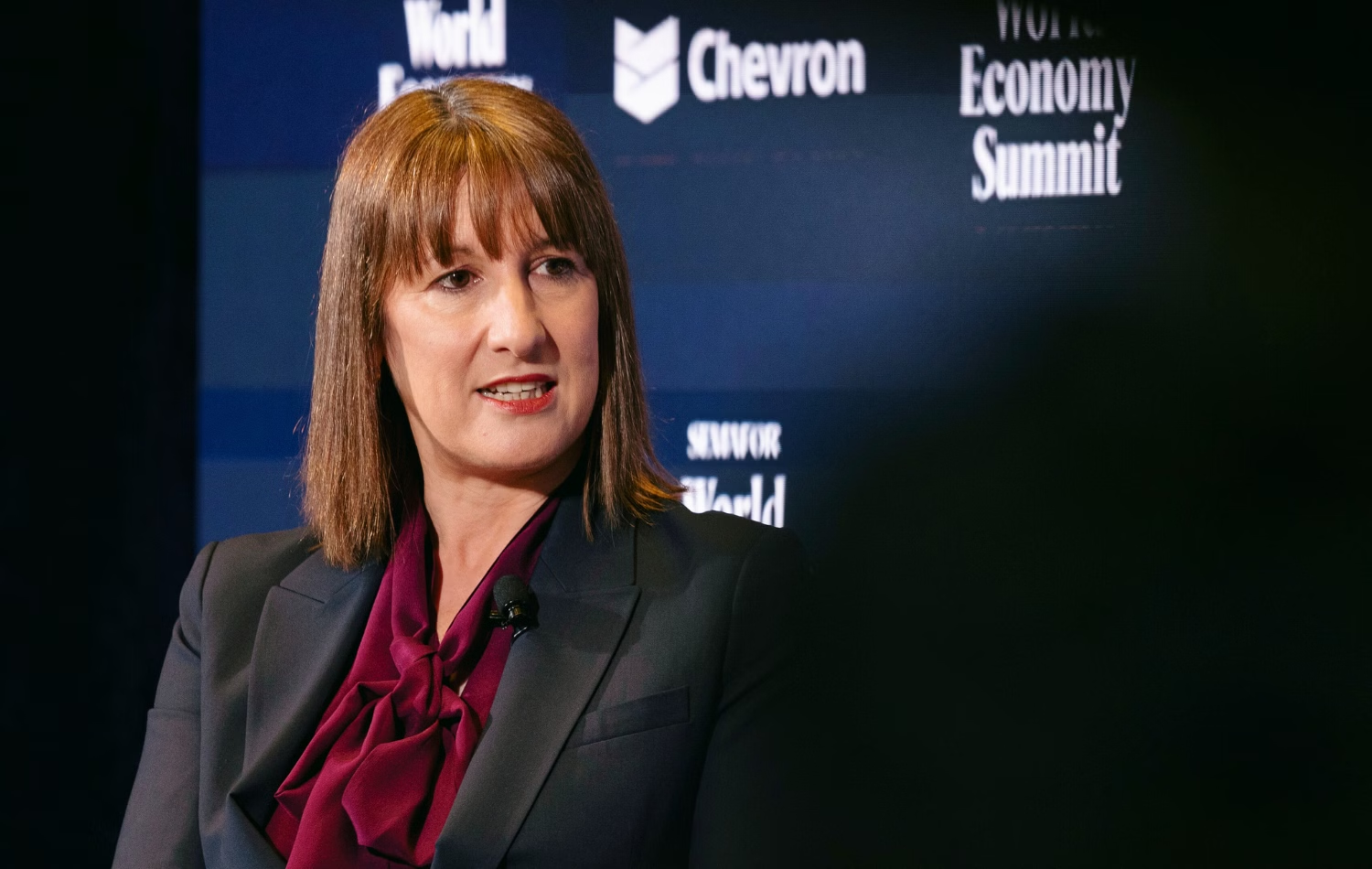
Chancellor Rachel Reeves speaks at the Semafor World Economy Summit in Washington D.C in April 2025. Credit: Credit: Kirsty O’Connor / Treasury (CC BY-NC-ND 2.0)

The government has been accused of making a “secret exchange deal” with fossil fuel firms to compensate for the tax hike.

Chancellor Rachel Reeves told a fossil fuel giant that the industry would receive a “quid pro quo” in return for higher taxes on its windfall profits, DeSmog can reveal.

In a meeting with the Norwegian state energy company Equinor on 27 August last year, Reeves suggested that the government’s carbon capture, utilisation and storage (CCUS) subsidies were a payoff for oil firms being hit with a higher tax rate.

Minutes of the meeting obtained by DeSmog state that Equinor CEO Anders Opedal raised concerns over the Energy Profits Levy – also known as the “windfall tax” – and “its impact on the value” of Equinor’s UK portfolio.

In response, Reeves said that raising the windfall tax from 35 percent to 38 percent was a “manifesto commitment”, but stated that “Equinor should recognise the quid pro quo – the funds raised enable government investment in CCUS etc.”.

This article was co-published with The Guardian.

CCUS is the controversial practice of trapping the emissions produced by fossil fuel plants before they enter the atmosphere.

The technology is accused of being a favourite climate “solution” of the fossil fuel industry since it allows for the continued extraction of oil and gas. Experts have also suggested that the technology is not economically viable at scale.

The Labour government announced in October that it would provide £22 billion in subsidies to CCUS projects over 25 years following a surge in lobbying by the fossil fuel industry, as revealed by DeSmog.

Green Party co-leader Carla Denyer MP claimed that Reeves and the Labour government had been “caught out making promises in a secret exchange deal which goes against the interests of the British people”.

Denyer added: “In public they claim to be taxing fossil fuel giants more fairly by raising the windfall tax, but behind closed doors they are giving back with dodgy deals to allow the fossil fuel corporates to continue with business as usual under the guise of CCUS – an expensive distraction and largely unproven technology.”

An Equinor spokesperson said: “Government regularly meets with companies like Equinor. This is standard and necessary practice. As with any official meeting, minutes were taken of the conversation between the chancellor and Equinor CEO as a public record of what was said and readily available via a Freedom of Information request.”

Equinor is one of the principal firms investing in the UK’s CCUS sector. In December, the government signed deals with Equinor, BP, and TotalEnergies to develop carbon capture facilities in Teesside. This will involve the development of the Net Zero Teesside Power plant, which will be 25 percent owned by Equinor and aims to be the world’s first gas-fired power station featuring CCUS.

Earlier this year, following a DeSmog investigation, Equinor retracted the claim that it stores 1 million tonnes of carbon dioxide annually at its flagship carbon capture project in the North Sea. Equinor has not captured 1 million tonnes of CO2 per year at the site since 2001, and only captured a tenth of that figure in 2023.

The firm made an $28.7 billion (£21.2 billion) post-tax profit in 2022 after Russia’s invasion of Ukraine triggered higher oil and gas prices – a figure that stood at $8.8 billion (£6.6 billion) in 2024.

Tessa Khan, executive director of the campaign group Uplift, said: “Oil companies, like Equinor, have held sway over successive UK governments, for years shaping policies to benefit their bottom line and slowing down climate action. This Labour government must stand up to them and put our needs – for affordable clean energy and a safe climate that we can pass on to our children – ahead of their insatiable need to profit.”

The House of Commons’ Public Accounts Committee (PAC) – which scrutinises government spending decisions – released a report in February describing the UK’s CCUS subsidies as “risky”.

The report noted that the government has downgraded its ambitions for CCUS storage, scrapping its previous commitment of storing 20 to 30 million tonnes annually by 2030. It also highlighted that the UK’s new CCUS projects don’t allow the government to share any potential profits or for local consumers to benefit from lower energy bills.

The committee also reported that producing liquid natural gas, which will be used in the UK’s CCUS projects, leaks more greenhouse gases into the atmosphere than previously thought.

“This could undermine the rationale for pursuing certain schemes,” the report said.

After being sued by environmental consultant Andrew Boswell over the Net Zero Teesside scheme, the previous Conservative government admitted that it had not taken into account the plant’s full potential emissions, which Boswell estimated could reach more than 20.3 million tonnes during its lifetime.

In summer 2024, a judge rejected Boswell’s case, which argued that officials did not fully explore the environmental impacts of the scheme before approving it. The government also won the appeal in May.

Boswell, who leads the Scrap Carbon Capture campaign, called Reeves’ Equinor meeting “an outrageous spectacle”.

“She begs Norway’s oil colossus to tax its huge profits, and then gifts it with far more in return – many billions over decades for climate-wrecking CCUS.”

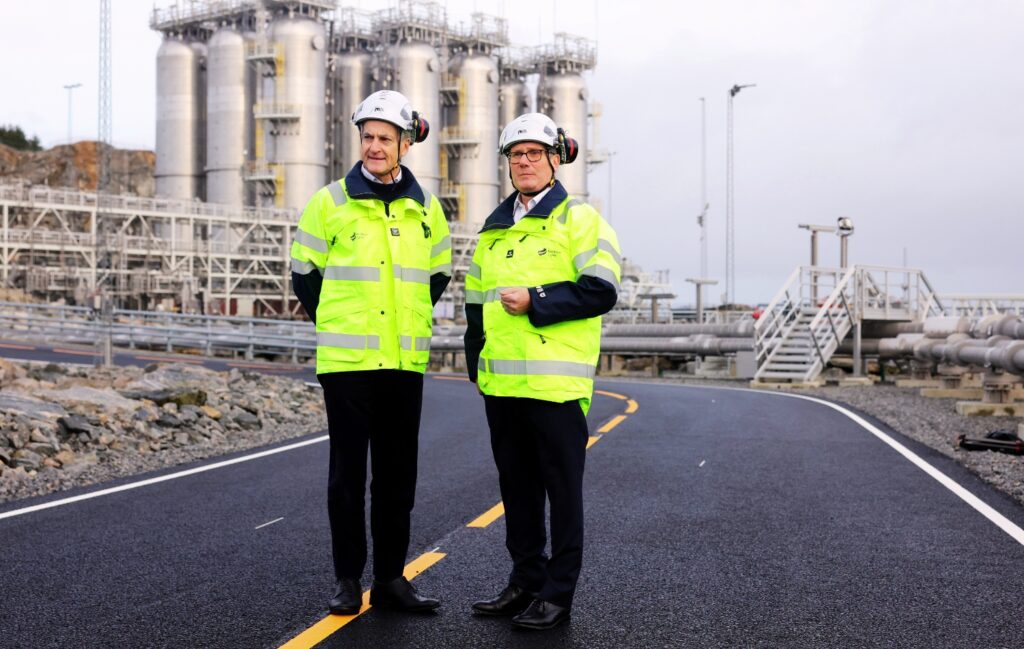
Prime Minister Keir Starmer visits Equinor’s Northern Lights CCUS plant with Norway Prime Minister Jonas Gahr Støre in Bergen in December 2024. Credit: Credit: Simon Dawson / No 10 Downing Street (CC BY-NC-ND 2.0)

Equinor and Shell have formed a joint venture to become the UK’s largest North Sea fossil fuel producer. In November, the government admitted that it had unlawfully approved the development of the country’s largest untapped oilfield, Rosebank, which is operated by Equinor, by not taking into account the climate effects of burning the oil and gas extracted from the field. Equinor intends to re-apply for approval to develop the project.

The Labour government has been steadfast in its support for the UK achieving net zero emissions by 2050, with Prime Minister Keir Starmer stating that “home grown clean energy” is “in the DNA” of his administration.

The Climate Change Committee stated in its 2025 appraisal of the government’s net zero policies that the UK needs to scale up its CCUS capacity to 73 million tonnes a-year by 2050 to help meet its climate commitments.

“Investment in carbon capture and storage is a gamble on unproven technology,” said Lily-Rose Ellis, campaigner at Greenpeace UK. “All it does is give oil and gas giants carte blanche to continue causing planet destroying emissions in the hopes that one day they might be able to capture the carbon and store it for all of eternity. Public money should be spent on renewables which guarantee to lower emissions, bring bills down, and boost the economy with new jobs.”

“Equinor has been a reliable energy partner to the UK for over 40 years,” a company spokesperson said, “providing a stable supply of oil and gas, developing the UK’s offshore wind industry, and pioneering solutions to decarbonise the UK economy, including carbon capture and storage.

“Using our experience of decarbonising energy production in Norway, including safely storing carbon emissions under the North Sea for over 25 years, we are supporting the UK to develop its own home grown energy transition.”

A government spokesperson said: “We are delivering first of a kind carbon capture projects in the UK, supporting thousands of jobs across the country, reigniting industrial heartlands and tackling the climate crisis.

“Money raised from changes to the Energy Profits Levy made at the Autumn Budget last year support the transition to clean energy, enhance energy security and independence, provide sustainable jobs for the future, and help protect electricity bills against future price shocks”.

This article was co-published with The Guardian.

Original article by Sam Bright republished from DeSmog.

Continue ReadingRachel Reeves Promised Oil Industry ‘Quid Pro Quo’ Over Windfall Tax in Private Meeting

Austerity’s authoritarian trajectory: why jury trials are under attack

https://morningstaronline.co.uk/article/austeritys-authoritarian-trajectory-why-jury-trials-are-under-attack

 FW Pomeroy’s Statue of Justice standing atop the Central Criminal Court building, Old Bailey, London

PROPOSALS to restrict the right to trial by jury are presented as the only way to salvage a system in crisis.

Former judge Sir Brian Leveson says we must act to avoid “total system collapse.” The backlog in court cases is huge — 77,000 cases await trial in the Crown Court — and Leveson is right that leaving defendants and victims of crime waiting years can have a terrible impact on their lives.

But these are dangerous proposals which must be seen in context: firstly, of the cuts to justice budgets from 2010 onwards, and secondly, of the increasing authoritarianism of the state and the courts which is already undermining jury trials.

[M]inisters may have other motives. As Tim Crosland of Defend Our Juries has warned, authorities are increasingly wary of the way a “jury of one’s peers” — that is, of randomly selected ordinary people — tends to resist political instruction and acquit defendants for actions they deem morally justifiable.

Judges have resorted to ordering defendants not to explain their actions, even banning references to climate change in court in some cases involving direct action by environmentalists.

Removing the right to a jury trial entirely from a swathe of offences increases the state’s power to shape prosecution outcomes.

https://morningstaronline.co.uk/article/austeritys-authoritarian-trajectory-why-jury-trials-are-under-attack

Keir "I support Zionism without Qualification" Starmer supporting genocide.
Keir “I support Zionism without Qualification” Starmer supporting genocide.

Continue ReadingAusterity’s authoritarian trajectory: why jury trials are under attack

No more jam tomorrow – it’s time for Labour to deliver

https://morningstaronline.co.uk/article/no-more-jam-tomorrow-its-time-labour-deliver

 Health Secretary Wes Streeting, Chancellor of the Exchequer Rachel Reeves and Prime Minister Sir Keir Starmer at the launch of the government’s 10-year health plan, July 3, 2025

The electorate see no evidence of the government’s promises of change, and the good jobs and decent pay that people are crying out for. Bold action is needed right now, warns SHARON GRAHAM

IT IS true that Labour have taken over an economy ravaged by 14 years of Tory austerity. But that should mean a profound opportunity to deliver change. Britain is broken, yes. But they cannot keep making everyday people pay.

Today MPs will be voting on the government’s despicable plan to cut disability benefits. Just as with every other wrong decision, such as scrapping the winter fuel allowance, rowing back on investment in British industry or failing to ensure proper local authority funding, the excuse will be the same — “we have no choice.” And again it will be absolute rubbish. Of course they have choices.

We are the sixth-richest economy in the world. But the way that wealth is divided is increasingly unequal. The richest 50 families are worth about £500 billion, the same as half the entire UK population. In 1990 there were just 15 billionaires in the UK, but since then their number has jumped to 156.

So, there is a choice. If we taxed the richest 1 per cent just 1 per cent, that would generate about £25 billion. That is a choice. We need a wealth tax now.

Continues at https://morningstaronline.co.uk/article/no-more-jam-tomorrow-its-time-labour-deliver

Yougov: Would you support or oppose introducing a wealth tax of 2% on wealth above £10 million?
Keir Starmer says that the Labour Party under his leadership all feel a small part of Scunthorpe.

Continue ReadingNo more jam tomorrow – it’s time for Labour to deliver