Actuaries and Scientists Warn Climate Shocks Risk ‘Planetary Insolvency’

Original article by Jessica Corbett republished from Common Dreams under Creative Commons (CC BY-NC-ND 3.0). Published Jan 16, 2025
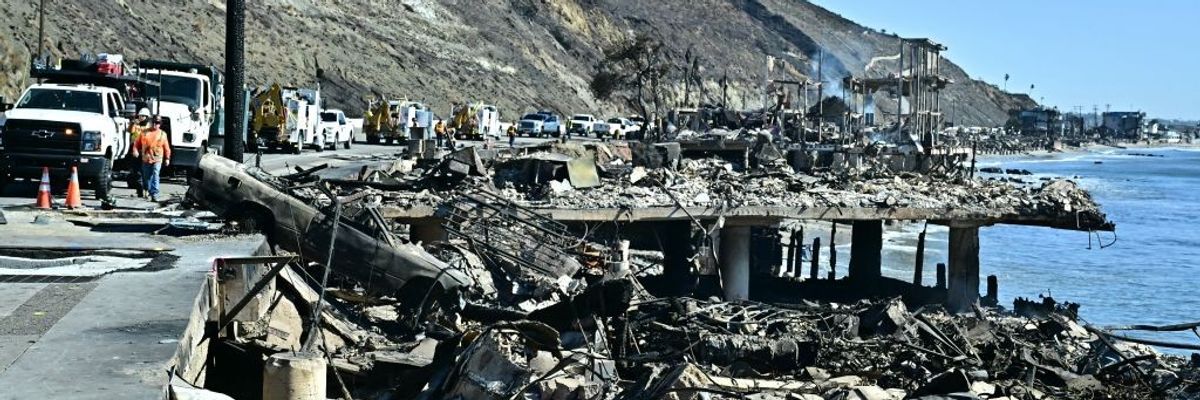
Gas company employees work in Malibu, California, after the Palisades Fire destroyed beach homes on January 12, 2025. (Photo: Frederic J. Brown/AFP via Getty Images)

A new report “shows a 50% GDP contraction between 2070 and 2090 unless an alternative course is chartered,” said the lead author.

U.K. actuaries and University of Exeter climate scientists on Thursday warned that “the risk of planetary insolvency looms unless we act decisively” and urged policymakers to “implement realistic and effective approaches to global risk management.”

Actuaries have developed techniques that “underpin the functioning of the global pension market with $55 trillion of assets, and the global insurance market, collecting $8 trillion of premiums annually, to help us manage risk,” Tim Lenton, University of Exeter’s climate change and Earth system science chair, noted in the foreword of a report released Thursday.

Planetary Solvency—Finding Our Balance With Nature is the fourth report for which the Institute and Faculty of Actuaries (IFoA) has collaborated with climate scientists. In financial terms, solvency is the ability of people or companies to pay their long-term debts. Co-authors of one of the previous publications coined the phrase planetary solvency, “setting out the idea that financial risk management techniques could be adapted to help society manage climate change and other risks.”

Three IFoA leaders—Kalpana Shah, Paul Sweeting, and Kartina Tahir Thomson—explained in their introduction to the latest report how “planetary solvency applies these techniques to the Earth system,” writing:

The essentials that support our society and economy all flow from the Earth system, commodities such as food, water, energy, and raw materials. The Earth system regulates the climate and provides a breathable atmosphere, it is the foundation that underpins our society and economy. Planetary solvency assesses the Earth system’s ability to continue supporting us, informed by planetary boundaries, tipping points in the Earth system, and other scientific discoveries to assess risks to this foundation—and thus to our society and the economy.

Our illustrative assessment of planetary solvency in this report shows a more fundamental, policy-led change of direction is required. Our current market-led approach to mitigating climate and nature risks is not delivering. There is an increasing risk of severe societal disruption (planetary insolvency), as our economic system drives further global warming and nature degradation.

“Impacts are already severe with unprecedented fires, floods, heatwaves, storms, and droughts,” the document points out, emphasizing that human activity—particularly burning fossil fuels—drives climate change and biodiversity loss. “If unchecked they could become catastrophic, including loss of capacity to grow major staple crops, multimeter sea-level rise, altered climate patterns, and a further acceleration of global warming.”

The report was released as wildfires ravage California and shortly after scientific bodies around the world concluded that 2024 was the hottest year on record and the first in which the average global temperature exceeded a key goal of the Paris agreement: 1.5°C above preindustrial levels. In the United States, experts identified 27 disasters with losses exceeding $1 billion.

“We risk triggering tipping points such as Greenland ice sheet melt, coral reef loss, Amazon forest dieback, and major ocean current disruption,” the new publication warns, adding that “tipping points can trigger each other,” and if multiple are triggered, “there may be a point of no return, after which it may be impossible to stabilize the climate.”

Food system shocks and more frequent and devastating disasters increase the risk of mass mortality for humanity—including due to hunger and infectious diseases—along with mass migration and conflict, the report highlights.

“Climate change risk assessment methodologies understate economic impact, as they often exclude many of the most severe risks that are expected and do not recognize there is a risk of ruin,” the document stresses. “They are precisely wrong, rather than being roughly right.”

Specifically, lead author and IFoA council member Sandy Trust said in a statement, “widely used but deeply flawed assessments of the economic impact of climate change show a negligible impact” on gross domestic product (GDP).

However, Trust continued, “the risk-led methodology, set out in the report, shows a 50% GDP contraction between 2070 and 2090 unless an alternative course is chartered.”

To mitigate the risk of planetary insolvency, the co-authors called on policymakers around the world to implement independent, annual assessments; set limits and thresholds that respect the planet’s boundaries; enhance governance structures to support planetary solvency; and “enhance policymaker understanding of ecological interdependencies, tipping points, and systemic risks so they understand why these changes are needed.”

They also underscored the need to limit global warming and avoid triggering tipping points with actions such as accelerating decarbonization, removing greenhouse gases from the atmosphere, restoring damaged ecosystems, and building resilience.

“You can’t have an economy without a society, and a society needs somewhere to live,” said Trust. “Nature is our foundation… Threats to the stability of this foundation are risks to future human prosperity which we must take action to avoid.”

Original article by Jessica Corbett republished from Common Dreams under Creative Commons (CC BY-NC-ND 3.0).

Orcas discuss Donald Trump and the killer apes' concept of democracy. Front Orca warns that Trump is crashing his country's economy and that everything he does he does for the fantastically wealthy.
Orcas discuss Donald Trump and the killer apes’ concept of democracy. Front Orca warns that Trump is crashing his country’s economy and that everything he does he does for the fantastically wealthy.
Neo-Fascist Climate Science Denier Donald Trump says Burn, Baby, Burn.
Elon Musk urges you to be a Fascist like him, says that you can ignore facts and reality then.

Continue ReadingActuaries and Scientists Warn Climate Shocks Risk ‘Planetary Insolvency’

The atmosphere is getting thirstier and it’s making droughts worse – new study

luchschenF/Shutterstock

Solomon Gebrechorkos, University of Oxford

Droughts are becoming more severe and widespread across the globe. But it’s not just changing rainfall patterns that are to blame. The atmosphere is also getting thirstier.

In a new study published in Nature, my colleagues and I show that this rising “atmospheric thirst” – also known as atmospheric evaporative demand (AED) – is responsible for about 40% of the increase in drought severity over the last four decades (1981-2022).

Imagine rainfall as income and AED as spending. Even if your income (rainfall) stays the same, your balance goes into deficit if your spending (AED) increases. That’s exactly what’s happening with drought: the atmosphere is demanding more water than the land can afford to lose.

As the planet warms, this demand grows – drawing more moisture from soils, rivers, lakes, and even plants. With this growing thirst, droughts are getting more severe even where rain hasn’t significantly declined.


Get your news from actual experts, straight to your inbox. Sign up to our daily newsletter to receive all The Conversation UK’s latest coverage of news and research, from politics and business to the arts and sciences.


The process of AED describes how much water the atmosphere wants from the surface. The hotter, sunnier, windier and drier the air is, the more water it requires – even if there isn’t less rain.

So even in places where rainfall hasn’t changed much, we’re still seeing worsening droughts. This thirstier atmosphere is drying things out faster and more intensely and introducing more stress when this water is not available.

Our new analysis reveals that AED doesn’t just make existing droughts worse – it expands the areas affected by drought. From 2018 to 2022, the global land area experiencing drought rose by 74%, and 58% of that expansion was due to increased AED.

Our study highlights that the year 2022 stood out as the most drought-stricken year in over four decades. More than 30% of the world’s land experienced moderate to extreme drought conditions. In both Europe and east Africa, the drought was especially severe in 2022 – this was driven largely by a sharp increase in AED, which intensified drying even where rainfall hadn’t dropped significantly.

drought ridden corn crop, bare field, grey sky
Crop yields are severely affected by water stress. Scott Book/Shutterstock

In Europe alone, widespread drying had major consequences: reduced river flows hindered hydropower generation, crop yields suffered due to water stress, plus many cities faced water shortages. This put unprecedented pressure on water supply, agriculture and energy sectors, threatening livelihoods and economic stability.

My team’s new research brings clarity to the dynamics of drought. We used high-quality global climate data, including temperature, wind speed, humidity and solar radiation – these are the key meteorological variables that influence how much water the atmosphere can draw from the land and vegetation. The team combined all these ingredients to measure AED – essentially, how “thirsty” the air is.

Then, using a widely recognised drought index that includes both rainfall and this atmospheric thirst, we could track when, where and why droughts are getting more severe. With this metric, we can calculate how much of that worsening is due to the atmosphere’s growing thirst.

The future implications of this increasing atmospheric thirst are huge, especially for regions already vulnerable to drought such as western and eastern Africa, western and south Australia, and the southwestern US where AED was responsible for more than 60% of drought severity over the past two decades.

Without factoring in AED during drought monitoring and planning, governments and communities may underestimate the true risk they face. With global temperatures expected to rise further, we can expect even more frequent and severe droughts. We need to prepare. That involves understanding and planning for this growing atmospheric thirst.

Driving drought

Knowing what is causing droughts in each specific location enables smarter climate adaptation. AED must be a central part of how we monitor, model and plan for drought.

Identifying the specific drivers of drought is essential for tailoring effective ways to cope with drought. If droughts are mainly due to declining rainfall, then the focus should be on water storage and conservation. But if AED is the main driver – as it is in many places now – then strategies must address evaporative loss (i.e. the amount of water lost from the surface and plants to the atmosphere) and plant water stress. This might involve planting drought-resistant crops, constructing irrigation systems that use water more efficiently, improving soil health or restoring habitats to keep moisture in the land.

As our research shows, rising AED – driven by global warming – is intensifying drought severity even where rainfall hasn’t declined. Ignoring it means underestimating risk.


Don’t have time to read about climate change as much as you’d like?
Get a weekly roundup in your inbox instead. Every Wednesday, The Conversation’s environment editor writes Imagine, a short email that goes a little deeper into just one climate issue. Join the 45,000+ readers who’ve subscribed so far.


Solomon Gebrechorkos, Reserach Fellow in Climate Change Attribution, University of Oxford

This article is republished from The Conversation under a Creative Commons license. Read the original article.

Continue ReadingThe atmosphere is getting thirstier and it’s making droughts worse – new study

Thomas Tuchel responds to England fans labelling Keir Starmer a ‘****’ after supporters sang abusive chants about the Prime Minister during the Three Lions’ lacklustre 1-0 win over Andorra

https://www.dailymail.co.uk/sport/football/article-14790719/Thomas-Tuchel-responds-England-fans-Keir-Starmer-abusive-chants.html

Around 7,000 Three Lions supporters made the trip to Barcelona to watch the dire World Cup qualifying victory, settled by Harry Kane‘s 50th-minute goal.

Some foul-mouthed individuals made their feelings toward Starmer clear during an uneventful first half and their songs were audible during ITV‘s live coverage.

To the tune of KC & The Sunshine Band’s hit Give It Up, they sang: ‘Na-na, na-na, na-na, na-na-na-na now, Starmer is a ****, is a ****, Starmer is a ****.’

Supporters at RCDE Stadium also chanted: ‘Keir Starmer is a w****r, is a w****r.’

https://www.dailymail.co.uk/sport/football/article-14790719/Thomas-Tuchel-responds-England-fans-Keir-Starmer-abusive-chants.html

Keir Starmer justifies why he has to travel abroad so much
Continue ReadingThomas Tuchel responds to England fans labelling Keir Starmer a ‘****’ after supporters sang abusive chants about the Prime Minister during the Three Lions’ lacklustre 1-0 win over Andorra

UNRWA slams Israeli ban on international journalists reporting on Gaza, calls to allow it to work

This work by Middle East Monitor is licensed under a Creative Commons Attribution-NonCommercial-ShareAlike 4.0 International License.

UNRWA Commissioner General Philippe Lazzarini on April 30, 2024 [FABRICE COFFRINI/AFP via Getty Images]

Philippe Lazzarini, the commissioner-general of the UN agency for Palestinian refugees (UNRWA), on Saturday condemned Israel’s ongoing ban on international journalists entering Gaza, calling it an unprecedented act in modern conflict, Anadolu reports.

“This is unprecedented in any other conflict in modern history,” Lazzarini said in a statement.

“It is a ban on the truth. It is a ban on reporting the facts. It is the perfect recipe to fuel misinformation, deepening polarization and dehumanization.”

He stressed the importance of allowing independent reporting and supporting local journalists: “International journalists must independently report from Gaza and support their Palestinian colleagues who continue to do a heroic job at a heavy price.”

“Nearly 200 of them were reported killed since the war began,” said Lazzarini, stressing that “the ban on international media must be lifted.”

Separately, the UN agency for Palestinian refugees (UNRWA) on Saturday reiterated its call for cooperation from the Israeli government over allegations made against the agency, stating that no credible evidence has been provided despite repeated requests.

“UNRWA has repeatedly requested cooperation and evidence from Israel regarding the serious allegations made against the Agency,” the agency said in an official statement.

READ: At least 65 Palestinians killed, 100 more injured as Israel continues attacks on Gaza on 2nd day of Eid

“After 20 months, UNRWA has not received any response, nor has the Government of Israel shared any sufficient evidence.”

The agency emphasized its continued commitment to its humanitarian mandate, stating: “UNRWA remains committed to its mandate and is ready to deliver humanitarian assistance at scale in Gaza, together with other UN agencies.”

Israel, rejecting international calls for a ceasefire, has pursued a genocidal offensive in Gaza since October 2023, killing nearly 54,700 Palestinians, most of them women and children. Aid agencies have warned about the risk of famine among the enclave’s more than 2 million inhabitants.

Last November, the International Criminal Court issued arrest warrants for Israeli Prime Minister Benjamin Netanyahu and his former Defense Minister Yoav Gallant for war crimes and crimes against humanity in Gaza.

Israel also faces a genocide case at the International Court of Justice for its war crimes against civilians in the enclave.

READ: Israeli lawmaker shows off keys to locked UNRWA Headquarters in Jerusalem in Knesset session

This work by Middle East Monitor is licensed under a Creative Commons Attribution-NonCommercial-ShareAlike 4.0 International License.

UK Labour Party government ministers Keir Starmer, Angela Rayner and Rachel Reeves explain that they are partners complicit in Israel's Gaza genocide. The UK has provided Israel with arms, military and air force support. They explain that they don't do gas chambers but do do forced marches, starvation, destroy hospitals, mass-murders of journalists and healthcare workers.
UK Labour Party government ministers Keir Starmer, Angela Rayner and Rachel Reeves explain that they are partners complicit in Israel’s Gaza genocide. The UK has provided Israel with arms, military and air force support. They explain that they don’t do gas chambers but do do forced marches, starvation, destroy hospitals, mass-murders of journalists and healthcare workers.
Continue ReadingUNRWA slams Israeli ban on international journalists reporting on Gaza, calls to allow it to work

At least 65 Palestinians killed, 100 more injured as Israel continues attacks on Gaza on 2nd day of Eid

This work by Middle East Monitor is licensed under a Creative Commons Attribution-NonCommercial-ShareAlike 4.0 International License.

A view of devastation after Israeli strikes on various areas in Gaza on the second day of Eid al-Adha, June 7, 2025. [Khames Alrefi – Anadolu Agency]

Beginning early Saturday, Israeli air strikes and gunfire killed at least 65 Palestinians and injured around 100 more in the Gaza Strip, according to Palestinian sources, Anadolu reports.

Medical sources told Anadolu that on day two of the Muslim holiday of Eid al-Adha, at least 15 Palestinians, including six children, were killed and over 50 others injured when Israeli warplanes struck a residential home with two missiles in the Sabra neighborhood of Gaza City.

Rescue teams on the ground fear that the death toll will rise to more than 30, as many people are still missing and possibly trapped under the rubble.

Twelve people, including four members of a single family, were killed and over 40 others wounded in Israeli shelling that targeted tents sheltering displaced Palestinians west of Khan Younis, in the southern Gaza Strip.

Seven more Palestinians were killed in an Israeli air strike that targeted a house sheltering displaced people west of Gaza City.

Two Palestinians were killed when Israeli artillery targeted a group of civilians in the Al-Saftawi neighborhood in northern Gaza.

READ: From Al-Aqsa to Gaza’s ruins: Palestinians observe Eid amid war, Israeli occupation

Three others were killed in an air strike targeting a civilian gathering in the Abu Shrekh area, west of the Jabalia refugee camp.

Another three Palestinians, including a child, were killed in a separate strike on a house near the Al-Mujayda fuel station in the same area.

A medical official at Nasser Hospital reported that six people were killed when an Israeli drone struck the town of Bani Suheila, east of Khan Younis.

Elsewhere in Khan Younis, a separate drone strike in the al-Amal neighborhood killed one person and wounded another.

Eight more Palestinians were killed when an Israeli strike targeted a group of civilians in the Jabalia al-Nazla area, medical sources told Anadolu.

Two more people were killed in another Israeli strike that hit the al-Faluja area of Jabalia, the same sources added.

Separately, six Palestinians were shot dead by Israeli forces near an aid distribution center west of Rafah. Several others were injured.

The total number of Palestinians killed by Israeli gunfire while trying to access humanitarian aid under a controversial new system since May 27 has risen to 115, with more than 580 wounded and nine still missing, according to a tally by Anadolu based on Palestinian sources.

On Friday alone, the first day of Eid al-Adha, 33 Palestinians were killed in Israeli air strikes and shelling across several areas of the Gaza Strip.

With two Eids (major Muslim holidays) per year under the Muslim calendar system, this is the fourth Eid for Gazans since October 2023, when Israel launched a genocidal war which has killed nearly 54,800 Palestinians, created famine conditions, and left the enclave all but uninhabitable.

READ: Israel orders evacuation of several neighborhoods in northern Gaza on Eid’s 1st day with plan to bomb

This work by Middle East Monitor is licensed under a Creative Commons Attribution-NonCommercial-ShareAlike 4.0 International License.

Continue ReadingAt least 65 Palestinians killed, 100 more injured as Israel continues attacks on Gaza on 2nd day of Eid