78 miners found starved and dehydrated to death in South African police operation against unlicensed mining

EXTRA WARNING by dizzy: Brace yourself if you’re going to read this article, it recounts very disturbing details of abuse, death and suffering.

Original article by Pavan Kulkarni republished from peoples’ dispatch under a Creative Commons Attribution-ShareAlike 4.0 (CC BY-SA) license.

Rescue operation underway in Shaft 11. (Photo: GIWUSA)

The bodies of 78 dead miners have been retrieved from a shaft in Buffelsfontein mine’s Shaft 11 after being trapped underground since last August by the South African police who cut-off food and water supply in its attempt to crackdown on unlicensed mining.

The bodies of 78 artisanal miners, starved and dehydrated by the South African Police which had trapped them underground since last August in a crackdown on illegal mining, were retrieved from the Buffelsfontein gold mine’s Shaft 11 last week.

Dozens more bodies and body parts allegedly remain in the Shaft 10 of this abandoned mine in the town of Stilfontein, 150 km southwest of Johannesburg. Without retrieving the dead bodies or searching for survivors in this shaft, the police have announced the end of the rescue operation, which they had prevented for months until a court ordered it on January 10.

Beginning on January 13, the rescue operation was concluded on January 16, hauling out 246 emaciated survivors from Shaft 11. Even as they struggled to walk, with little muscle left on their bony frames, most of them were arrested by the police for illegal mining. 

“There has been an explosion of unlicensed, artisanal mining in recent years,” explained Mametlwe Sebei, president of the General Industries Workers Union of South Africa (GIWUSA), to Peoples Dispatch. With the deepening of neoliberal de-industrialization, companies have abandoned an estimated 6,000 mines over the last two decades, without properly sealing the entrances.

Left in the lurch, large sections of the mining community, unable to find other jobs amid the worsening unemployment crisis, have been eking out a living from these abandoned mines. Descending on ropes without adequate safety gear into the dark bowels of some of the deepest mines in the world, they dig for leftover deposits of gold.

The government estimates that it loses a billion dollars annually due to this illicit mining. In the absence of government oversight, crime syndicates have capitalized on this underground economy.

To address this problem, “we have to develop a regulatory regime that allows licensing of artisanal miners and provides them with proper equipment to ensure they work safely, efficiently and productively,” maintains Sebei. 

“According to the government over 2,000 of these abandoned mines still have substantial deposits of minerals. If capitalized, it can become a source of employment for hundreds of thousands of miners and unemployed people across the country,” he added. Instead, the government has criminalized the artisanal miners, who are among the poorest of the poor working class — mostly migrants from neighboring countries. 

Crackdown on the mine in Buffelsfontein

A nation-wide crackdown on such miners was launched in December 2023 under the name Operation Vala Umgodi (Plug the Hole). In August, the police came for the miners in Buffelsfontein, abandoned by a mining company in 2014. Chasing away the workers on the surface who were operating the pulley to lower down food, water and the miners themselves into shaft 11, the police removed the ropes, trapping the miners 2 km underground with no supplies.

“There are makeshift shops underground, where miners can buy food and water for gold,” Sebei said. But without fresh supplies from the surface, underground stocks quickly ran out. It was November by the time the first tranche of food and water was permitted by the police after protests by the community, said Sebei, who was involved in the months-long legal battle to secure their rescue.

“But they dismantled the pulley again.” Even after a court order in December instructing the police to permit community members to supply the miners underground, “police repeatedly interfered with the pulley system and blocked the supplies,” he added.

“They were demanding that the miners should come out and surrender. But there is no lift, no staircase, there was no way the miners could come out of Shaft 11” without the pulley and ropes, he explained.

Severed body parts in Shaft 10

Desperate, many of the stranded miners made a treacherous journey to Shaft 10 which has a pole they were hoping to climb back up. Crawling for 3 to 4 days in narrow, dark, flooded tunnels, often “with no sense of direction when their lights ran out of battery”, the miners who had not perished enroute reached Shaft 10, Sebei said. 

“Climbing from its bottom to the surface took another three days on average,” he added. Weakened by hunger and dehydration, many of them, unable to continue holding on to the handlebars of the pole, fell back to the bottom of the 2.5 km-deep shaft. The impact of their falling bodies against the handlebars they had already climbed below “cut them to pieces”.

Those who successfully endured this climb were arrested. Since November, over 1,500 miners had surfaced before the rescue commenced on January 15, according to the police. They had either managed to climb out of Shaft 10 or journeyed on to shafts of neighboring mines, Sebei said.

The police used the first few miners they arrested “in dubious press conferences to claim that they have options to take other exits, but choose to remain underground” to evade arrest. 

“But when I spoke to those miners, they refuted everything they told the media. They had been pressured by the police. They told me all the miners were desperate to come back up. That was evident because every time we sent a rope down with supplies, a miner came back up with it. Not once did the rope come back up empty. Every time the police disrupted the pulley, miners died underground,” he told Peoples Dispatch. But too weak to crawl to other shafts, many stayed behind, dying a slow death from starvation and dehydration while awaiting rescue.

“We are going to smoke them out”

“We are not sending help to criminals. We are going to smoke them out,” cabinet minister Khumbudzo Ntshavheni said in November. Instead of dismantling the pulley, if the police had offered to lift the miners out of Shaft 11 after cutting off supplies, everyone could have been arrested without loss of lives or incurring the expenditure for the rescue operation, Sebei argued. But insisting that the miners had other exits they could take, the police blocked supplies and stalled rescue for months.

Finally, on January 10, in a case brought by Zinzi Tom for the rescue of her 26-year-old brother Ayanda, the Pretoria High Court ordered a rescue operation. A crane was brought in to lower down a cage into Shaft 11. But the state refused to provide search-and-rescue professionals to go underground. The company it had hired for the rescue operation threatened to leave unless two people from the local mining community volunteered, Sebei said.

The deathly stench

In an act of repentance for his past, 36-year-old Mzwandile Mkwayi, who was released from prison in 2021 after serving a seven-year term for robbery, volunteered for the mission, along with Mandla Charles. Pooling in money, community members organized rituals and ceremonies to protect the duo from evil spirits, before they were lowered in the cage into the deathly stench at the bottom of Shaft 11 where dozens of the bodies were decomposing. After hauling 78 dead bodies and helping up another 246 survivors, they were welcomed by their community as heroes.

But their heroism has left them scarred. Mkwayi is unable to eat the meat. Survivors had reportedly told him that apart from cockroaches, many of them had sustained by consuming human flesh of their fellow dead miners.

Rescue volunteers intimidated

Mkwayi has not been provided with counseling. Instead, the police arrested him after he spoke to the media, claiming that he had missed community service, in violation of his parole terms, said Sebei. After 48 hours in jail, he was released with a prohibition against speaking to the media. “This is a clear attempt to intimidate and silence him, preventing him from revealing the testimony of atrocities at Shaft 10,” GIWUSA said in a statement.

“Mkwayi is one of the only two witnesses to the scene of more extremely horrific and massive deaths at Shaft 10,” GIWUSA said. Severed limbs and other body parts of the miners, who fell to their deaths midway through their climb, still hang from the handlebars of this pole their bodies crashed against during the fall, added Sebei. Headless torsos lie in the bottom of Shaft 10, “which the police insisted was a viable exit.”

The other volunteer, Charles, has not been unreachable over the phone after the first few interviews he gave to the press. Having argued in court that the Shaft 10, which is scattered with body parts, was a viable exit for the miners, the police want to suppress the truth about the “horrors of Shaft 10”, Sebei maintains.

Plumes of smoke rising from the area after an explosion heard by the local residents prompted rumors that the police had bombed this shaft in an attempt to destroy evidence amid calls for an inquiry. While refuting this claim, the police are not allowing anyone at the site to verify, said Sebei.

Several miners, including Ayanda Tom, whose sister Zinzi brought the case in which the court ordered the rescue, remain missing. “The survivors last saw him two weeks ago,” Sebei said. Convinced that no rescue was arriving after months at the bottom of Shaft 11, he set off crawling in search of alternative exits.

“We believe” that many miners including Ayanda “have been in Shaft 10, possibly dead, injured or too weak to get to Shaft 11 to be rescued,” GIWUSA said in its statement.

Demanding a professional rescue team be sent down this shaft with sniffer dogs to retrieve the dead bodies and search for any survivors, it added: “We cannot accept a situation where hundreds of community members know all the names… of miners who went down into the shaft and who were not rescued, and now they are just expected to accept that those miners are trapped down there forever. If they are alive, they will die gruesome deaths and if they are dead, their bodies will never be found.”

Lives of survivors in danger

Lives of the survivors who were rescued also hang in the balance. They are in danger of life-threatening malnutrition, typhus and heavy metal toxicity which “may cause multiple organ damage”, warned Healthcare Workers 4 Palestine – South Africa (HCW4P-SA). 

“Due to a combination of factors such as immune-compromise due to malnutrition and prolonged time in damp, enclosed spaces, the risk of contracting TB is high and poses a significant health risk if left undiagnosed. Without proper screening and treatment, there is also a significant risk of spread” of the disease. 

Pointing out that the preliminary assessment by on-site paramedics is not adequate to screen for these risks, HCW4P-SA has called for “urgent in-hospital assessment”. However, the police have hospitalized only 32 of the 246 survivors to hospital as of Tuesday, January 21, holding the rest in custody.

“All the miners currently hospitalized and some at the detention facility are exhibiting refeeding syndrome, a potentially lethal condition that occurs when malnourished individuals suddenly consume food or fluids, leading to severe electrolyte imbalances. These imbalances then trigger heart and kidney failure, and eventual demise, if not properly managed in a hospital setting,” the Mining Affected Communities United in Action (MACUA) said in a statement on January 20.

Doctors treating the hospitalized miners, shackled to their beds despite being barely able to walk, have “informed us that they have never seen this kind of starvation before… They have advised that it would be difficult to assess the health of those” held in police custody “without performing tests on them” in a hospital, the statement added.

With legal representation from Lawyers for Human Rights, MACUA has raised concerns with the attorneys of the state and the Health Minister, that “without an individual and comprehensive medical assessment of each detainee rescued from shaft 11, including laboratory analyses and radiological imaging, there is an imminent risk of severe health consequences, and even possible death.”

Original article by Pavan Kulkarni republished from peoples’ dispatch under a Creative Commons Attribution-ShareAlike 4.0 (CC BY-SA) license.

Continue Reading78 miners found starved and dehydrated to death in South African police operation against unlicensed mining

Trump returns: nine things to expect for the climate

Below the Sky/Shutterstock

Jack Marley, The Conversation

Climate scientists are probably among those most aggrieved by Donald Trump’s return as US president.

Trump has scoffed at the increasingly dire warnings of these scientists and declared his enthusiasm for digging up and burning the coal, oil and gas that is overheating Earth. His empowerment of the far right dims prospects for collective solutions to collective problems, but what is he likely to change about US climate policy?


This roundup of The Conversation’s climate coverage comes from our award-winning weekly climate action newsletter. Every Wednesday, The Conversation’s environment editor writes Imagine, a short email that goes a little deeper into just one climate issue. Join the 40,000+ readers who’ve subscribed.


Trump has not published a climate agenda. To discern his impact on domestic and international policy, we have to sift through statements, appointments to political positions and the record of his first term.

Here, our academics glean grim portents for the years ahead – and some continuities with supposedly pro-climate presidents of the past.

1. It’s still ‘drill, baby, drill’

Trump’s three-word campaign slogan, “drill, baby, drill”, is intended to sum up his plans for the US oil and gas industry. It’s also an apt summary of existing US energy policy.

Since 2008, when Democrat Barack Obama was elected, oil production has soared from a 50-year low of 6.8 billion barrels a day to 19.4 billion in 2023.

A dry landscape littered with oil derricks.
Not starved of investment: an oil field in California. Alizada Studios/Shutterstock

“The United States is already producing more crude oil than any country ever,” says Gautam Jain, an energy and finance expert at Columbia University.

“Oil and gas companies are buying back stocks and paying dividends to shareholders at a record pace, which they wouldn’t do if they saw better investment opportunities.”

2. We won’t always have Paris (or even Rio)

Trump withdrew the US from the 2015 Paris agreement on the first day of his second term (it took him six months to do it last time).

Jain frets that he may go further and exit international negotiations entirely, by rescinding his country’s membership of the UN Framework Convention on Climate Change, which was adopted in Rio de Janeiro in 1992.

Rejoining would be “nearly impossible”, Jain says, as a future president would need the consent of two-thirds of the Senate.

The US risks dropping the mantle of climate leadership on China, he adds. A recent analysis by Oxford economists Matthew Carl Ives and Natalie Sum Yue Chung suggests that that ship may have sailed years ago.

“China already processes most of the clean energy supply materials and has an advanced manufacturing base that is more capable of scaling up production to meet the rising demand,” they say.

3. The bucks stop here?

A US retreat from international climate diplomacy would afflict people who are particularly vulnerable to the mounting crisis in Earth’s atmosphere. Jain highlights how Trump’s predecessor Joe Biden donated several billions of dollars more towards renewable energy and adaptation in the developing world, compared with Trump in his first term.

However, a 2023 study that estimated each country’s “fair share” of this climate finance pot according to income, population size and historical emissions, issued this withering assessment while Biden was president:

“Based on these metrics, we found that the US is overwhelmingly responsible for the climate finance shortfall,” says environmental economist Sarah Colenbrander (University of Oxford).

“The world’s largest economy should be providing US$43.5 billion of climate finance a year. In 2021, it gave just US$9.3 billion – a meagre 21% of its fair share.”

4. Biden’s green tax credits may endure…

Trump could keep some Biden-era investments in clean energy (tax breaks for investors in renewables, for example) as the benefits are accruing in Republican states, Jain says.

He may still cut tax credits for people buying electric vehicles, though. This would slow the transition from combustion-engine transport by making it harder for people to afford an EV. (Biden’s 100% tariff on Chinese-made EVs hasn’t help either).

5. … but his methane tax probably won’t

Jain predicts that the greatest damage inflicted by Trump will be to the regulation of fossil fuels and emissions. In his crosshairs is a federal charge for the release of methane from oil and gas wells and pipelines.

Biden identified cutting methane emissions as a potential brake on the accelerating pace of global heating. That’s because methane is a greenhouse gas that lingers in our atmosphere for decades instead of centuries like CO₂ and is far more potent in trapping heat during that time.

Reducing methane emissions could reduce climate change quickly – a climate action lifeline we will be sorry to see thrown away.

6. The nuclear option

Trump seems to have a soft spot for one low-carbon energy source: nuclear power. Perhaps because civil nuclear maintains the skills and supply chains needed for its military applications?

7. Up is down, left is right

Democrats may regret making “trust the science” their dividing line against Trump.

Eric Nast, an environmental governance expert at the University of Guelph, tracked how the first Trump administration altered language on US government websites.

He expects Trump to disguise his regulation bonfire as “strengthening transparency” (blocking air pollution standards that rely on private health data) and championing “citizen science” (dismissing academics from advisory boards for private citizens rich in time and money, who might benefit from scrapping rules and limiting scrutiny).

8. Fighting fire with money

Tesla’s Elon Musk, Amazon’s Jeff Bezos and Meta’s Mark Zuckerberg attended Trump’s second inauguration. Their presence – plus a pointed farewell speech by Biden – has provoked murmurs of “oligarchy”: rule by people whose immense wealth and influence has utterly captured ostensibly democratic societies.

At the still-raging LA fires, an oligarch-friendly response to climate change has presented itself: firefighters-for-hire.

“As public firefighters struggle to cope, affluent residents and businesses have turned to private firefighting services to protect their properties,” says Doug Specht, a University of Westminster geographer.

9. Arctic relations

What explains Trump’s sudden interest in the Arctic? Oil, gas and critical minerals newly liberated by thawing ice in a region warming four times faster than the global average says engineer Tricia Stadnyk at the University of Calgary.

“The second Trump administration is aware of both the new opportunities and risks as global temperatures shatter new records and thresholds, and an ice-free Arctic becomes a possibility,” she says.

Jack Marley, Environment + Energy Editor, The Conversation

This article is republished from The Conversation under a Creative Commons license. Read the original article.

Orcas comment on killer apes destroying the planet by continuing to burn fossil fuels.
Continue ReadingTrump returns: nine things to expect for the climate

Trump’s Second Inauguration Took Influence Peddling to a Whole New Level

https://www.commondreams.org/opinion/trump-inauguration-donations

Meta and Facebook CEO Mark Zuckerberg (L), CEO of Apple Tim Cook, and Founder of Amazon and Blue Origin Jeff Bezos attend services as part of Inauguration ceremonies at St. John’s Church on January 20, 2025 in Washington, D.C. (Photo: Anna Moneymaker/Getty Images)

The very ripeness for scandal this time around calls for reasonable restrictions on the sources and amounts of inaugural donations.

U.S. President Donald Trump sounded a lot of populist notes on the campaign trail. But as he took the oath of office for the second time, he was joined onstage by billionaires and CEOs who’d spent millions to be there—leaving supporters who’d traveled across the country to attend literally out in the cold.

Presidential inaugurations have always been an opportunity for wealthy special interests to curry favor with the incoming administration with generous inaugural donations. But the nation has never seen influence peddling like we just witnessed at Trump’s second inauguration.

Shattering all records, the Trump Vance Inaugural Committee, Inc. raised and spent over $200 million in special interest money celebrating the 2024 election victory. (The all-time previous record was $107 million for Trump’s first inauguration in 2017. By contrast, former President Joe Biden’s 2021 inauguration raised and spent nearly $62 million.)

The sheer volume of today’s inaugural donations suggests that wealthy special interests believe it is worth the investment.

All the self-reporting donors—including Big Tech firms like Google, Microsoft, Meta, Amazon, and OpenAI—pledged $1 million or more. The cryptocurrency firm Ripple pledged $5 million. In fact, the cryptocurrency industry even hosted its own inaugural ball.

And of course, Wall Street is cozying up with major donations from Goldman SachsBank of America, and billionaire hedge fund manager Ken Griffin.

“EVERYBODY WANTS TO BE MY FRIEND!!!” Trump marvels on his Truth Social account.

https://www.commondreams.org/opinion/trump-inauguration-donations

Elon Musk urges you to be a Fascist like him, says that you can ignore facts and reality then.
Continue ReadingTrump’s Second Inauguration Took Influence Peddling to a Whole New Level

As Trump II Begins, Bezos Swaps Scrutiny for ‘Storytelling’

Original article by Julie Hollar republished from FAIR under a Creative Commons Attribution-NonCommercial-NoDerivs 3.0 Unported License.

As the Washington Post faces a staff rebellion and plummeting subscription rates, billionaire owner Jeff Bezos has introduced a new mission statement: “Riveting Storytelling for All of America.”

The Washington Post‘s new slogan, “Riveting Storytelling for All of America,” is “meant to be an internal rallying point for employees,” the New York Times (1/16/25) reported.

The new path forward, as introduced in a slide deck to staff by Suzi Watford, the paper’s chief strategy officer, demands that the paper “understand and represent interests across the country,” and “provide a forum for viewpoints, expert perspectives and conversation” (New York Times1/16/25). It will do this as “an AI-fueled platform for news” that delivers “vital news, ideas and insights for all Americans where, how and when they want it.”

This appears to mean shifting resources toward opinion, specifically opinions from the right. According to the New York Times report:

Bezos has expressed hopes that the Post would be read by more blue-collar Americans who live outside coastal cities, mentioning people like firefighters in Cleveland. He has also said that he is interested in expanding the Post’s audience among conservatives.

The Post has already begun to consider ways to sharply increase the amount of opinion commentary published on its website, according to two people with knowledge of the talks. An adviser to the Post, Lippe Oosterhof, has conducted brainstorming sessions about a new initiative that would make it easier to receive and publish opinion writing from outside contributors.

How AI is meant to play into this is unclear.

The Post already has more columnists than you can shake a stick at. This new direction sounds like the Foxification of the Washington Post, a move away from any attempt to hold the powerful to account, toward inexpensive clickbait punditry.

‘Make money’

The red area represents the proportion of Jeff Bezos’s total wealth that would be required to cover the Washington Post‘s losses for a year.

Watford’s slide deck presented three pillars of the Post‘s new model: “great journalism,” “happy customers” and “make money.” The Post lost roughly $77 million in 2023. (It also lost some 250,000 subscribers after Bezos killed the paper’s planned endorsement of Kamala Harris—FAIR.org10/30/24.)

In order to make money, its new “Big Hairy Audacious Goal” (yes, that’s what the Post slide deck apparently called it) is to reach 200 million “paying users.” The paper currently has about 3 million subscribers, making it an “audacious” goal indeed. As the Times pointed out, even if the Post could achieve the impossible task of monetizing every visit to its website, no major corporate media outlet has been getting more than 100 million monthly unique visits—paying and non-paying—outside of the spike in traffic around the election.

Back in 2019, the Post was claiming 80–90 million unique visitors per month. Those visits peaked in November 2020 at 114 million, but quickly and steadily dropped after Biden’s inauguration. The Post stopped posting its audience numbers online after January 2023, when they were down to 58 million.

Of course, most online corporate media have been struggling. The thing about the Post is that its absurdly wealthy owner, the second-richest person on Earth, can easily afford to lose $77 million a year. That’s 0.03% of Bezos’s current net worth.

‘We are deeply alarmed’

Guardian (1/15/25): “The plea from staff…comes a week after the Post laid off roughly 100 employees…roughly 4% of the publication’s staff.”

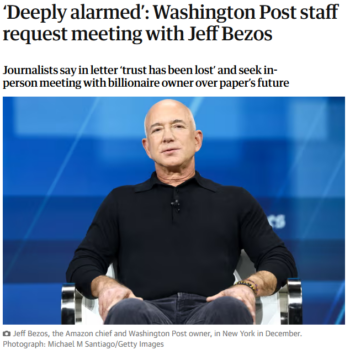
No doubt the Post needs help. Just days before the new mission statement was revealed, over 400 staff members signed a letter to Bezos asking for a meeting (Guardian1/15/25).  The letter read:

We are deeply alarmed by recent leadership decisions that have led readers to question the integrity of this institution, broken with a tradition of transparency, and prompted some of our most distinguished colleagues to leave, with more departures imminent.

Bezos’s response—a slide deck about “riveting storytelling” on “an AI-driven platform” that prioritizes churning out opinions to draw in conservatives—is hardly likely to ease the mind of any serious journalist at the paper.

Nor is trying to “expand the Post audience among conservatives,” while still paying lip service to “great journalism,” likely to solve the Post‘s problems. As CNN‘s former CEO Chris Licht discovered (FAIR.org6/8/23), you can’t do good journalism while trying to appeal to both sides in the context of an increasingly radical right, because that side demands acceptance of lies and conspiracy theories that are incompatible with actual journalism.

When Bezos bought the Post (Extra!3/14), he assured the paper’s employees that “the paper’s duty will remain to its readers and not to the private interests of its owners.” That sentiment was repeated in Watford’s slide deck this week. But Bezos’s actions in the past months—including the killing of the Harris endorsement, Amazon donating $1 million donation to Trump’s inaugural fund and paying Melania Trump $40 million for her self-produced documentary, and, most recently, Bezos appearing onstage with other multibillionaires at Trump’s inauguration—make clear that the principle is as meaningless to Bezos as the slogan that debuted after Trump’s first election: “Democracy Dies in Darkness.”

That slogan will continue to adorn the front page for the time being, perhaps in the hope that readers searching for an actual news organization that holds those in power to account will be fooled into subscribing.


ACTION ALERT: You can send a message to the Washington Post at letters@washpost.com.

Please remember that respectful communication is the most effective. Feel free to leave a copy of your message in the comments thread here.

FAIR’s work is sustained by our generous contributors, who allow us to remain independent. Donate today to be a part of this important mission.

Original article by Julie Hollar republished from FAIR under a Creative Commons Attribution-NonCommercial-NoDerivs 3.0 Unported License.

Continue ReadingAs Trump II Begins, Bezos Swaps Scrutiny for ‘Storytelling’

Greens respond to possible airport expansions

Green Party MP for Brighton Pavilion Siân Berry. Image by Kelly Hill, Wikimedia CC BY-SA 4.0.

Responding to the news that Rachel Reeves is expected to give the go-ahead to a series of airport expansions across the UK, Green Party MP for Brighton Pavilion, Sian Berry, said:

“We must ask who these decisions would be made for and why. Whose advice is the Government listening to, when record-high wealth inequality is causing harm to the economy and society in many different ways, while frequent flying is the preserve of the super-rich?

“The aviation lobby is loud and well-funded, but the Government should instead be listening to scientists and its own Climate Change Committee, which has already urged a halt to overall airport expansion. The previous Labour government’s poor record on airport expansion doesn’t have to continue.

“If Ed Miliband is serious in his role as Net-Zero Minister, he will work to prevent the Chancellor and Transport Secretaries making a huge mistake, and advise the Chancellor to not make any dangerous new decisions until they have heard and listened to the new advice from the Climate Change Committee which is due in February.”

Orcas comment on killer apes destroying the planet by continuing to burn fossil fuels.
Continue ReadingGreens respond to possible airport expansions