An image of Republican presidential nominee former President Donald Trump hangs in the window of a campaign office in Hamtramck, Michigan, November 4, 2024
TIM YOUNG warns that the president-elect’s record of economic and political interference from his last stint in the White House show dangerous potential for escalated aggression against the Bolivarian government from 2025
THE US election result raises the spectre of Trump renewing the assault on Venezuela that his loss to Biden interrupted in 2020.
In office between 2016 and 2020, Trump’s approach to Latin America showed an implacable hostility towards Venezuela, as well as other governments in the region determined to advance their population’s interests, not those of the US.
Venezuela has been subjected to US extraterritorial intervention and interference for over two decades. From the early days of Hugo Chavez’s election as president in 1998, the US has sought, in conjunction with Venezuela’s economic and political elites, to topple the Venezuelan government and re-establish its control and influence over the country and its oil wealth.
…
While the global situation has changed since 2020, with wars in Ukraine and the Middle East and the US’s developing aggressive strategy towards Russia and China, there is no reason to believe the US’s long-standing desire to destabilise the Venezuelan government and achieve “regime change” is off the table.
For his part, Trump made it plain when campaigning this year in North Carolina what motivated his drive to unseat Maduro: “When I left, Venezuela was ready to collapse. We would have taken it over; we would have gotten all that oil.”
The solidarity movement in Britain must be prepared to defend Venezuela’s sovereignty against any renewed offensive by Trump when he assumes the presidency in 2025 — as well as continuing to campaign for Britain to give Venezuela back its gold.
Original article republished from MEMO under a Creative Commons Attribution-NonCommercial-ShareAlike 4.0 International License.
Palestinians wait in line to receive aids at the school where UNRWA distributes food parcels in Deir al-Balah, Gaza on November 07, 2024. [Ashraf Amra – Anadolu Agency]
President Joe Biden’s administration has concluded that Israel is not currently impeding assistance to Gaza and, therefore, is not violating US law, the State Department said on Tuesday, although Washington acknowledged the humanitarian situation remained dire in the Palestinian enclave, Reuters reports.
US Secretary of State, Antony Blinken, and Defence Secretary, Lloyd Austin, in a 13 October letter gave their Israeli counterparts a list of specific steps that Israel needs to take within the next 30 days to address the worsening situation in Gaza. Failure to do so may have possible consequences on US military aid to Israel, they said in the letter.
But, on Tuesday, the deadline mentioned in the letter, State Department deputy spokesperson, Vedant Patel, repeatedly declined to say if the specific criteria were fulfilled. Instead, he told reporters that Israel has taken steps to address the demands and that Washington would continue to assess the situation.
“We’ve seen some progress being made. We would like to see some more changes happen. We believe that had it not been for US intervention, these changes may not have ever taken place,” Patel said, adding that Washington will continue to assess Israel’s compliance with US law.
International aid groups said Israel had failed to meet the series of US demands intended to improve the humanitarian crisis in Gaza by the Tuesday deadline.
Patel, fielding repeated questions from reporters in the briefing, declined to explain why Washington chose to make the assessment based on Israel’s measures to address the problems instead of actual results on the ground, which US officials have repeatedly said would be their measuring stick.
Earlier this month, the State Department said the results on the ground as of 4 November were not good enough.
On Tuesday, Patel said Israel had taken some steps, including reopening the Erez Crossing, waiving certain customs requirements and opening additional delivery routes within Gaza.
For more than a month, Israeli forces have been pushing deeper into north Gaza, surrounding hospitals and shelters and displacing new waves of people in an operation they say is designed to prevent Hamas fighters regrouping.
Biden, whose term ends soon, has offered strong backing to Israel since Hamas-led gunmen attacked Israel last October, killing 1,200 people and taking more than 250 hostages.
However, since then, it has been revealed by Haaretz that helicopters and tanks of the Israeli army had, in fact, killed many of the 1,139 soldiers and civilians claimed by Israel to have been killed by the Palestinian Resistance.
More than 43,500 Palestinians have been killed in Gaza over the past year and Gaza has been reduced to a wasteland of wrecked buildings and piles of rubble where more than 2 million Gazans seek shelter as best they can.
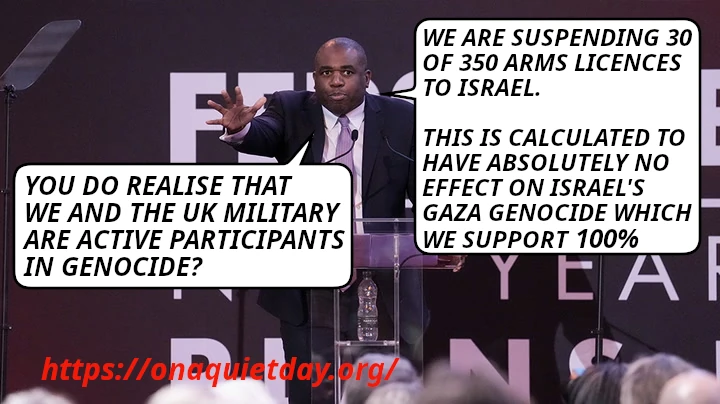
Current UK Prime Minister Keir Starmer is quoted that he supports Zionism without qualification. He also confirms that his active support and that of UK’s air force has been essential in Israel’s mass-murdering genocide. Includes URLs https://www.declassifieduk.org/keir-starmers-100-spy-flights-over-gaza-in-support-of-israel/ and https://youtu.be/O74hZCKKdpAUK Foreign Secretary David Lammy says that UK is suspending 30 of 350 arms licences to Israel. He also confirms the UK government’s support for Israel’s Gaza genocide and the UK government and military’s active participation in genocide.
I urge political parties and trade unions to adopt policies to enact and apply international law, to hold war criminals to account. It is well worth doing even if it takes a decade or more to get to that position.
2.05pm Possibly better to phrase it as uphold and enforce international law.
Current UK Prime Minister Keir Starmer is quoted that he supports Zionism without qualification. He also confirms that his active support and that of UK’s air force has been essential in Israel’s mass-murdering genocide. Includes URLs https://www.declassifieduk.org/keir-starmers-100-spy-flights-over-gaza-in-support-of-israel/ and https://youtu.be/O74hZCKKdpAUK Foreign Secretary David Lammy says that UK is suspending 30 of 350 arms licences to Israel. He also confirms the UK government’s support for Israel’s Gaza genocide and the UK government and military’s active participation in genocide.
Israeli Prime Minister Benjamin Netanyahu (R) and Minister of Finance Bezalel Smotrich attend the weekly cabinet meeting in Tel Aviv on 7 January 2024 (Ronen Zvulun/AFP)
Finance minister describes Donald Trump’s election victory as an ‘opportunity’ to extend Israeli ‘sovereignty’ over the entire Palestinian territory
Israeli Finance Minister Bezalel Smotrich has told his department to prepare for the annexation of the occupied West Bank in the wake of Donald Trump’s victory in the US elections.
Speaking at a meeting of his far-right Religious Zionism party, Smotrich said that Trump’s victory provided an “important opportunity” and that “the time has come to apply sovereignty” over the West Bank.
According to a statement from his office, Smotrich said he had instructed Israeli authorities overseeing West Bank settlements “to begin professional and comprehensive staff work to prepare the necessary infrastructure” for extending sovereignty.
As well as finance minister, Smotrich has a role in the defence ministry overseeing illegal settlements in the West Bank and East Jerusalem.
Current UK Prime Minister Keir Starmer is quoted that he supports Zionism without qualification. He also confirms that his active support and that of UK’s air force has been essential in Israel’s mass-murdering genocide. Includes URLs https://www.declassifieduk.org/keir-starmers-100-spy-flights-over-gaza-in-support-of-israel/ and https://youtu.be/O74hZCKKdpAUK Foreign Secretary David Lammy says that UK is suspending 30 of 350 arms licences to Israel. He also confirms the UK government’s support for Israel’s Gaza genocide and the UK government and military’s active participation in genocide.
Injured Palestinians, including children, are brought to Al Ahli Baptist Hospital for medical treatment following an Israeli attack on the Omar Al Mukhtar market in Gaza City, Gaza on November 11, 2024. (Photo: Dawoud Abo Alkas/Anadolu via Getty Images)
“Despite clear evidence showing that Israel is committing war crimes and blocking humanitarian aid, the U.S. is still unconscionably selling billions of dollars of offensive weapons to Israel,” said one advocate.
Ahead of historic U.S. Senate votes on military aid for Israel that are expected next week, dozens of civil society groups on Monday launched a grassroots campaign aimed at pushing lawmakers to support blocking more than $20 billion in offensive weapons transfers.
Demand Progress, the Friends Committee on National Legislation (FCNL), Action Corps, and the Center for Constitutional Rights were among the groups that launched the No More Weapons for Israel’s War campaign, asking the groups’ millions of supporters across the U.S. to demand that their senators to support the joint resolutions of disapproval (JRD) that are scheduled for a vote this month.
The JRDs were introduced by Sens. Bernie Sanders (I-Vt.), Peter Welch (D-Vt.), Jeff Merkley (D-Ore.), and Brian Schatz (D-Hawaii) in September. The resolutions could block transfers of certain U.S. weapons, such as joint direct attack munitions (JDAMs), tanks, and artillery shells, which have been linked to civilian casualties in Gaza since Israel began its assault on the enclave more than 13 months ago.
“For the last 13 months, the Biden administration has refused to use the leverage at its disposal to end to the war in Gaza and alleviate an ever-increasing humanitarian catastrophe,” said Cavan Kharrazian, senior policy adviser for Demand Progress. “Despite clear evidence showing that Israel is committing war crimes and blocking humanitarian aid, the U.S. is still unconscionably selling billions of dollars of offensive weapons to Israel.”
Kharrazian noted that passing the JRDs is “even more urgent now,” following the election last week of President-elect Donald Trump, a “notorious ally” of Israeli Prime Minister Benjamin Netanyahu.
Sanders pointed out when he introduced the JRDs in September that the weapons that would be impacted by the vote have been shown by “a mountain of documentary evidence” to be killing and maiming civilians in Gaza.
Amnesty International submitted a report to the federal government earlier this year detailing several Israeli attacks on civilian infrastructure including homes in which the Israel Defense Forces (IDF) used U.S. weapons to kill large numbers of civilians.
An attack using JDAMs manufactured by Boeing killed 43 civilians, nearly half of whom were children, in October 2023. Four strikes used bombs and other weapons made in the U.S. and killed at least 95 civilians, including 42 children.
A Guardian analysis last month also found that U.S. weapons were used by the IDF when it conducted an airstrike in Beirut, Lebanon, killing at least 22 people and wounding more than 115.
The Biden administration has repeatedly claimed that it is pushing Israel to limit civilian casualties, but has been condemned by human rights advocates and progressive lawmakers for continuing to provide offensive weapons despite mounting evidence that more civilians are being killed each day. Last week, the United Nations said it had found that 70% of people killed by the IDF in Gaza between November 2023 and April 2024 were women and children, despite persistent claims by the U.S. and Israel that it is targeting Hamas fighters.
“It’s time for the Israeli government to take U.S. demands about de-escalation, civilian protection, and humanitarian aid seriously,” said Tori Bateman, advocacy director for the Quincy Institute for Responsible Statecraft. “If the United States wants to see the Israeli government change its behavior, then it must change too by being willing to leverage arms sales to achieve a cease-fire, protect civilians, and serve the U.S. national interest. Senators should vote ‘yes’ to block these transfers of offensive weapons to Israel.”
Progressive lawmakers and advocacy groups have pointed out in recent months that $12.5 billion in U.S. military aid has continued flowing to Israel even as the Israeli government has blocked humanitarian aid from entering Gaza, resulting in the spread of disease and widespread hunger, with U.N. experts saying in July that the enclave was facing famine.
Section 620I of the Foreign Assistance Act prohibits the U.S. from providing weapons to a country that is blocking U.S. humanitarian aid.
“We are grateful Sen. Sanders has introduced the joint resolutions of disapproval and the historic vote to take place in November to block the sale of offensive arms to Israel,” said Yasmine Taeb, legislative and political director for MPower Change Action Fund. “Sending any offensive arms to Israel is a violation of U.S. and international humanitarian law. We urge senators to co-sponsor and vote YES on the JRDs.”
Hassan El-Yayyab, legislative director for Middle East policy for FCNL, called Israel’s war in Gaza “not just a humanitarian catastrophe but a mass atrocity carried out with U.S. bombs and military support, funded by American taxpayers.”
“It’s long overdue for Congress to hold a public debate and vote on ending U.S. complicity in the mass killing and starvation of Palestinian civilians,” said El-Yayyab. “These joint resolutions of disapproval mark a historic moment—the first major effort in Congress to block offensive arms sales to Israel in United States history. Senators must vote yes and press the Biden administration to use all forms of U.S. leverage to finally end the war in Gaza, bring hostages home, and de-escalate tensions across the Middle East.”
In a separate statement on Monday, Chip Gibbons of the civil liberties group Defending Rights & Dissent noted that “war crimes” committed by Israel include “the deliberate assassination of Palestinian journalists, making our government complicit in the worst attack on free expression rights anywhere in the world today.”
“As a domestic civil liberties group, we don’t take stances on international issues,” said Gibbons, the group’s policy director. “But when our government provides weapons that are used to violate human rights, that implicates our core mission.”
The group’s executive director, Sue Udry, applauded Sanders for introducing the JRDs and urged every member of Congress to support them.
“It’s well past time to hold our government accountable to our own laws,” said Udry.
Current UK Prime Minister Keir Starmer is quoted that he supports Zionism without qualification. He also confirms that his active support and that of UK’s air force has been essential in Israel’s mass-murdering genocide. Includes URLs https://www.declassifieduk.org/keir-starmers-100-spy-flights-over-gaza-in-support-of-israel/ and https://youtu.be/O74hZCKKdpAUK Foreign Secretary David Lammy says that UK is suspending 30 of 350 arms licences to Israel. He also confirms the UK government’s support for Israel’s Gaza genocide and the UK government and military’s active participation in genocide.