Thinks of the Day :: I don’t have much time for COPs
I used to cover COP climate conferences quite closely. Be good if they achieve something but I don’t have much time for them now.
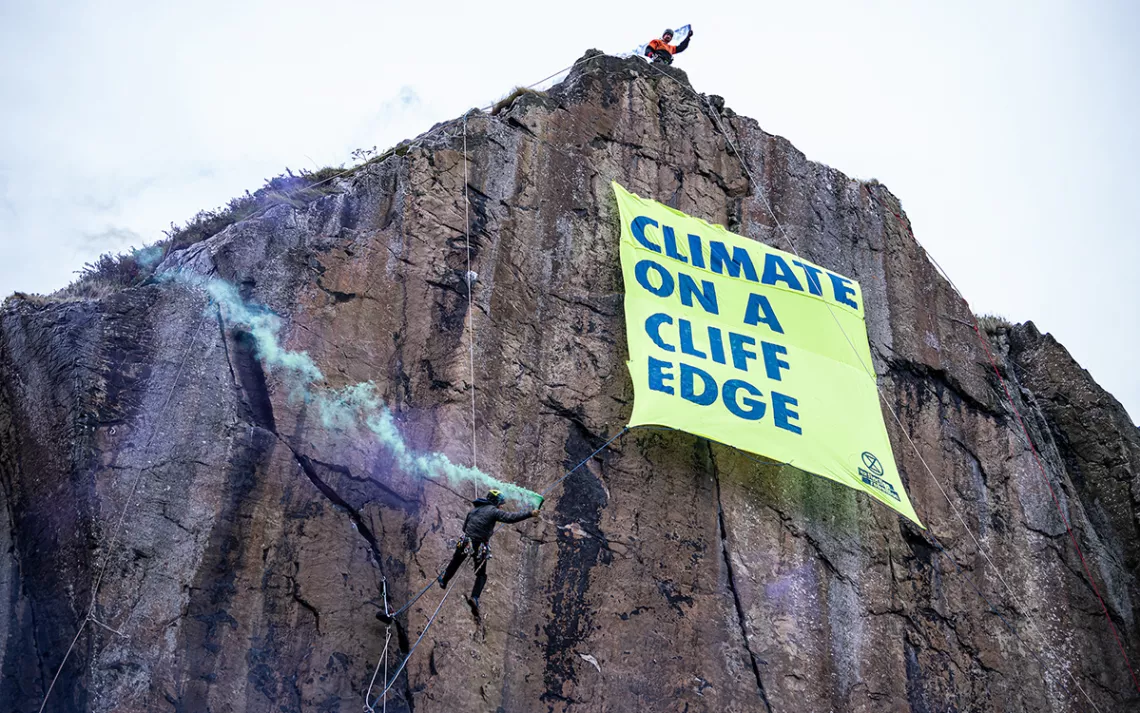

I used to cover COP climate conferences quite closely. Be good if they achieve something but I don’t have much time for them now.
Original article by Hailey Campbell republished from Common Dreams under Creative Commons (CC BY-NC-ND 3.0).
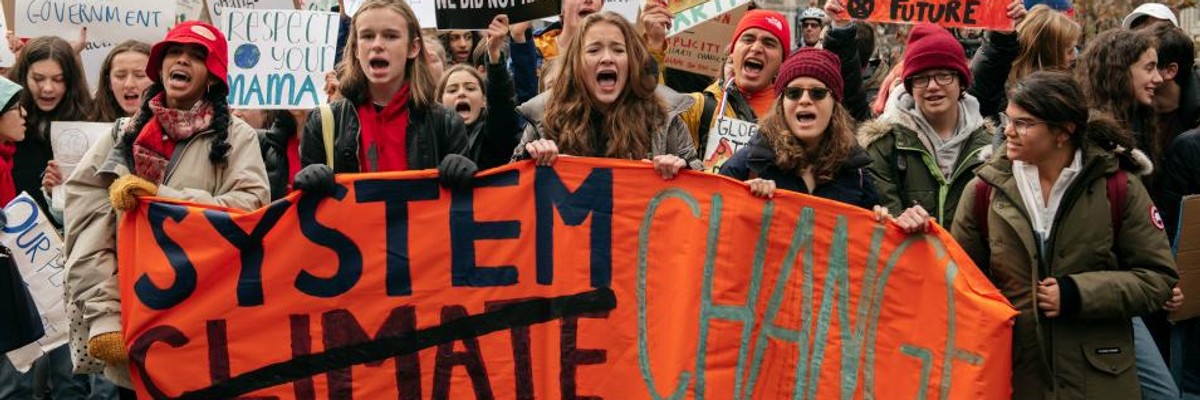
Donald Trump is once again elected president of the United States only days before more than 30,000 people are expected to attend COP29 in Baku, Azerbaijan to negotiate new global commitments on protecting the planet not only for those inhabiting it today, but also for future generations. Trump’s victory is sounding alarm bells in the climate community as his administration has made their disregard for global climate action abundantly clear across their campaign, but the world recognizes we cannot afford inaction.
When Trump announced his plans in 2017 to withdraw the country from the Paris agreement, an international treaty to limit global temperature rises to 1.5°C, Gebru Jember Endalew, chair of the Least Developed Countries group, which represents 48 countries, stated “global climate momentum will continue with or without the U.S.” China also joined the E.U., Canada, and many more governments to reiterate their commitment to the agreement and global climate action.
Even if the Trump administration chooses to ignore the importance of investing in our planet, climate change will continue to affect our lives.
In 1995, the first Conference of the Parties (COP) was held in Berlin, Germany and subsequent COPs have produced targets to curb emissions, appropriate much-needed funds to tackle climate change, and build transparent reporting processes. The U.S. often sets the tone at COP as the country’s decisions around climate ambitions and climate finance have a global ripple effect. This year’s conference will be the fifth COP I’ve attended. It’s always been clear to me that youth climate activists and frontline communities are a crucial part of the COP process—pushing governments, like the U.S., which is the world’s largest historical polluter, to create and abide by ambitious targets and to address loss and damage so the planet is livable for all. And it’ll be no different this year, especially with a Trump win. Youth voices at COP represent the needs of the upcoming generations who will have to either assert our rights to a just climate future or figure out how to survive the catastrophic impacts that accompany a warmer planet.
We need all the help we can get. U.S. state and local officials are stepping up, as they did in 2017. A coalition of more than two dozen governors committed to achieving “the Paris agreement’s goal of keeping temperature increases below 1.5°C” as did large coalitions of U.S. mayors, county officials, and business leaders. In fact, I had the honor of being present as an intern for the City of San Antonio when my mayor signed a resolution with his commitment. The bipartisan group consists of governors from Washington state all the way to Puerto Rico who are committed to curbing emissions and accelerating climate action. States like California have also been working with other nations, such as China, to promote climate policy. Even if the U.S., at a national level, fails to act once again, it’s encouraging to see local and global communities committed to multilateral action.
My first COP was under the first Trump administration, and I remember feeling disappointed and embarrassed seeing my country failing to step up and lead on climate action. While everyone else had pavilions, announcements, and a large presence, the U.S. had a small office. Because of all the advantages the U.S. has gained by exploiting other communities, cultures, and nature, the U.S. had and still has so much historical and current responsibility to do better. Seeing national and global leaders reiterate their climate commitments gave me hope then and serves as a reminder today—efforts to tackle the climate crisis will continue regardless of the U.S. election results.
Even if the Trump administration chooses to ignore the importance of investing in our planet, climate change will continue to affect our lives. Attribution studies show human-induced climate change is making heatwaves, like the ones in the Southwest, hotter and more likely, while hurricanes and droughts have become more severe and destructive. Climate change is severely costing the environment and the economy. According to the World Economic Forum, “climate change is costing the world $16 million per hour.”
This horrific and costly reality isn’t inevitable. Phasing out fossil fuels, the biggest contributor to climate change, and investing in a greener and cleaner future for all are the antidotes. This is not the time to give up on climate cooperation, but rather strengthen the commitment to it. We cannot be paralyzed by fear. We’ll be at Baku calling for equitable and funded climate solutions, because if climate multilateralism is in jeopardy, so is our future, and we can’t afford to give up on either.
Original article by Hailey Campbell republished from Common Dreams under Creative Commons (CC BY-NC-ND 3.0).
Original article by Jessica Corbett republished from Common Dreams under Creative Commons (CC BY-NC-ND 3.0).
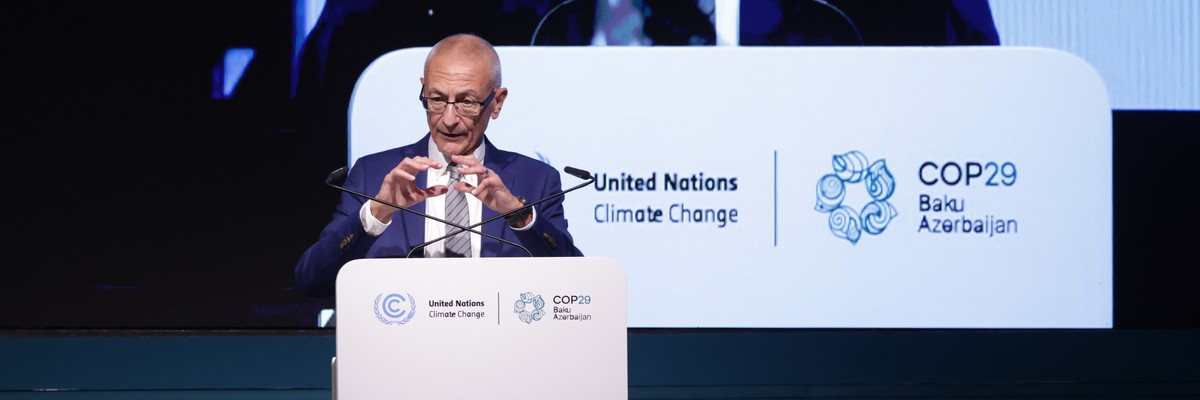
As the U.S. senior adviser to the president for international climate policy addressed the United Nations summit in Azerbaijan on Monday, green groups urged the outgoing Democratic administration to do whatever it can to tackle the global crisis before Republicans seize control of the White House and likely both chambers of Congress.
“I want to address tonight a topic that is on everyone’s mind—the U.S. election,” John Podesta, President Joe Biden’s adviser, told the crowd in Baku on the first day of the United Nations Climate Change Conference (COP29), less than a week after President-elect Donald Trump defeated Vice President Kamala Harris.
Although votes are still being counted, Republicans have secured a majority in the U.S. Senate and are on track to retain control of the House of Representatives—paving the way for Trump’s plans to roll back the Biden-Harris administration’s progress on the climate emergency and “drill, baby, drill,” which would lead to a surge in planet-heating pollution.
“Podesta’s speech must be followed by swift action to limit U.S. fossil fuel expansion and achieve a strong COP29 outcome.”
“For those of us dedicated to climate action, last week’s outcome in the United States is obviously bitterly disappointing,” Podesta acknowledged, “particularly because of the unprecedented resources and ambition President Biden and Vice President Harris brought to the climate fight.”
Noting that Biden pledged to halve emissions this decade, rejoined the Paris agreement, signed the Inflation Reduction Act (IRA) and the Bipartisan Infrastructure Law, and promised $11 billion in international climate funds, Podesta warned that “the next administration will try to take a U-turn and reverse much of this progress.”
“As President Biden said in the Rose Garden last week, setbacks are unavoidable, but giving up is unforgivable. This is not the end of our fight for a cleaner, safer planet. Facts are still facts. Science is still science,” he continued. “This fight is bigger than one election, one political cycle, in one country. This fight is bigger still.”
“We can and will make real progress on the backs of our climate-committed states and cities, our innovators, our companies, and our citizens, especially young people, who understand more than most that climate change poses an existential threat that we cannot afford to ignore,” he added. “Failure or apathy is simply not an option.”
Sorry, this content could not be embedded.
X
Responding to the envoy’s remarks in a Monday statement, Collin Rees, United States program manager at Oil Change International, said that “if John Podesta and President Joe Biden are committed to doing everything possible to continue climate progress despite Donald Trump’s reelection, this moment demands a bold agenda that goes beyond locking in clean energy gains and takes real action toward a just transition off fossil fuels.”
“There is no shortage of critical work to be done before Biden leaves office,” Rees argued. “Here at COP29, the United States must support a new, transformative global finance goal in which rich countries pay their fair share in high-quality, grant-based finance and work to submit a Paris-aligned nationally determined contribution committing to do its fair share of climate action and phase out fossil fuels.”
In the United States, Rees argued, Biden must “finalize studies on the dangerous impacts” of new liquefied natural gas exports, “reject deadly projects like the Dakota Access oil pipeline and pending LNG facilities in the Gulf South,” and urge Congress to block the latest attempt by outgoing Sen. Joe Manchin (I-W.Va.) “to destroy bedrock environmental protections.”
Looking toward next week’s Organization for Economic Cooperation and Development (OECD) meeting, Rees said that “Biden’s administration must support a global agreement to end export credit finance for oil and gas projects, a process which could end tens of billions of dollars in international finance for fossil fuels every year. This agreement would limit the global climate damages Trump and his fossil fuel cronies are able to perpetrate.”
“Podesta’s speech must be followed by swift action to limit U.S. fossil fuel expansion and achieve a strong COP29 outcome,” he stressed. Leaders at other climate organizations—who have often argued that Biden hasn’t gone far enough to tackle the fossil fuel-driven crisis—issued similar demands on Monday.
Sorry, this content could not be embedded.
X
Emphasizing that “climate diplomacy on a boiling planet doesn’t stop for a climate denier,” Ben Goloff, senior campaigner at the Center for Biological Diversity’s Climate Law Institute, called on Biden officials to “use the next two months to set up a bulwark of protections and secure their climate legacy.”
“Beyond urgently getting IRA money out the door, John Podesta must commit the U.S.’s fair share of global climate finance and announce an ambitious NDC climate target,” Goloff said, referring to nationally determined contributions for the Paris agreement.
Biden, he added, “has to make good on last year’s agreement to transition away from fossil fuels by rejecting pending mega-polluting project,” and “should also act quickly to fill all federal judicial vacancies as a wall of defense to Trump’s rampage of legal attacks.”
Jamie Minden, acting executive director of the youth-led movement Zero Hour, also declared that “before Trump takes office, President Joe Biden must reject all pending LNG export permits and stop the expansion of fossil fuels.”
“Our climate is on the brink of collapse, and it is sheer madness that politicians continue to expand and subsidize deadly fossil fuels,” Minden said. “Young people are fighting for our planet because we are facing the worst consequences of the unrelenting greed of these selfish politicians.”
Original article by Jessica Corbett republished from Common Dreams under Creative Commons (CC BY-NC-ND 3.0).
https://www.ecowatch.com/climate-change-extreme-weather-events-global-cost.html

According to a new report by the International Chamber of Commerce and consultancy firm Oxera, extreme weather events over the past 10 years have cost a total of $2 trillion globally. The countries that have faced the biggest losses include the U.S., China and India.
The report tracked nearly 4,000 extreme weather events from 2014 through 2023. In total, the results found that these events affected more than 1.6 billion people and cost around $2 trillion in economic losses.
Over just the past two years, losses linked to extreme weather cost the world $451 billion. According to the report, that is about 19% more than the losses from the previous 8 years analyzed in the study.
“The data from the past decade shows definitively that climate change is not a future problem: major productivity losses from extreme weather events are being felt in the here and now by the real economy,” John W.H. Denton AO, secretary-general of the International Chamber of Commerce, said in a statement.
The report also warned about the increase in frequency of these extreme weather events, noting that there has been an 83% increase in climate disasters when comparing 1980–1999 to 2000–2019.
…
Original article at https://www.ecowatch.com/climate-change-extreme-weather-events-global-cost.html