UK’s £22 Billion Carbon Capture Pledge Follows Surge in Lobbying by Fossil Fuel Industry, Records Show

Original article by TJ Jordan republished from DeSmog

Drax power plant in Yorkshire. Credit: A.P.S. (UK) / Alamy Stock Photo

Scope of corporate influence underscores concerns the technology will be used to prolong demand for planet-heating natural gas.

This story is the third part of a DeSmog series on carbon capture and was developed with the support of Journalismfund Europe and published in partnership with the Guardian.

The UK government’s move to award £22 billion in subsidies to carbon capture projects followed a sharp increase in lobbying by the fossil fuel industry, DeSmog can reveal.  

Oil and gas giants such as Equinor, BP, and ExxonMobil attended 24 out of 44 external ministerial meetings to discuss carbon capture and storage (CCS) in 2023, according to official transparency records

That represented a surge in activity relative to 2020-2022, when ministers held about half as many meetings to discuss the technology, and oil and gas companies would attend seven to 10 of these discussions each year.

Meeting notes obtained via freedom of information requests showed how oil executives were involved in shaping policy, and used their access to underscore the need to continue developing oil and gas. 

During a call in December with three Equinor executives, one of the company’s team told Jeremy Allen, then director of the Department for Energy Security and Net Zero, that Equinor “appreciate[s] the…collaborative approach to policy development.”

An executive from ExxonMobil’s Low Carbon Solutions division “spoke of the outstanding need for oil and gas, at the same time as needing to lower emissions” in a meeting with then energy minister Graham Stuart in March last year at the CERAWeek oil trade show in Houston.

The growing engagement by oil and gas companies has sharpened concerns among climate advocates that industry is skewing the UK’s carbon capture strategy to justify building new gas-fired power plants — prolonging demand for natural gas, a source of planet-heating carbon dioxide (CO2) and methane emissions.

“Fossil fuel companies often have the engineering know-how to build these projects, so the government naturally has to meet with them,” said Laurie Laybourn, environmental policy researcher and associate fellow at the Institute for Public Policy Research think tank. “But that might create a risk whereby these companies unduly influence policy and roll-out in a way that benefits them.”

Others engaging regularly with ministers on CCS policy include heavy manufacturing companies, CCS technology firms, lobby groups, and investment funds.

Researchers, climate groups, and local councils were less well represented, the transparency records showed. No individual organisation from these sectors has attended more than three meetings with ministers on carbon capture since the start of 2020. 

Meanwhile, lobby group the Carbon Capture and Storage Association (CCSA) — which represents dozens of fossil fuel companies — attended 20 meetings, and Equinor 16. BP, ExxonMobil, Scottish power company SSE, and Drax, a biomass power plant and the UK’s biggest CO2 emitter, also attended nine meetings each during the same period.

‘Wrong Pathway’

The new Labour government announced plans last week to extend £22 billion in subsidies for carbon capture over 25 years, saying the strategy can help meet climate goals and support a broader revitalization of British industry.

The policy builds on the previous Conservative administration’s plans to establish four CCS “clusters,” where carbon capture would be used to trap some of the CO2 emitted by fossil-fuel burning factories and power plants. Pipelines would then carry the captured gas underground to be stored in depleted oil and gas reservoirs under the North and Irish Seas.

The government’s plans include backing proposals by Equinor and BP —  two of the companies that have met most frequently with ministers since January 2020 — to build new “low-carbon” gas-fired power stations fitted with carbon capture units, which are slated to be among the first to receive state support.

A group of scientists and campaigners warned last month that such projects would allow the companies to continue extracting and burning natural gas based on the promises of unproven and expensive carbon capture technology — at the taxpayer’s expense.

“Putting the UK on the wrong pathway could be catastrophic,” said the letter, addressed to Secretary of State for Energy Security and Net Zero Ed Miliband.

Carbon Tracker, a financial think tank, warned in a March report that building new gas-fired power plants “could lock consumers into a high-cost and fossil-based future” and urged the UK to focus on deploying carbon capture in hard-to-decarbonise sectors such as cement. 

“These ‘low-carbon’ gas projects are not really low carbon if you look at the whole supply chain,” said the report’s author Lorenzo Sani, referring to the large amount of natural gas, which is mostly comprised of the potent greenhouse gas methane, that leaks during the extraction and transport of the fuel.

“They also continue this paradigm that we have today of linking our economies with fossil fuels, whose markets are volatile and often controlled by external actors to the UK,” Sani added.

‘Struggle to Keep Investors Upbeat

The Intergovernmental Panel on Climate Change and International Energy Agency envisage significant deployments of carbon capture for reaching net zero emissions by mid-century.

However, many environmental groups are sceptical. Researchers point to the frequent failure of projects to meet carbon capture targets, cost-overruns, the need for multi-billion dollar subsidies, and the tendency of the oil and gas industry to use the technology to justify investments in new fossil fuel projects — rather than focus on cleaning up existing dirty industries.

The surge in lobbying by companies seeking public money coincided with the previous Conservative administration’s pledge of £20 billion in subsidies for carbon capture projects in March 2023.

Three months after that funding was announced, lobby group the CCSA told ministers its members were concerned about delays and there was a “struggle to keep investors upbeat”, according to meeting notes. 

The CCSA has attended more government carbon capture meetings (20) than any other organisation since January 2020, including two meetings between January and March 2024, the latest period for which records are available.

The organisation had a presence at both this and last year’s Labour party conferences. The CCSA’s Head of Communications Joe Butler-Trewin has held various organising and research roles within the party, while CEO Ruth Herbert worked as a civil servant under Miliband, when he was Secretary of State for Energy and Climate Change from 2008 to 2010. Miliband was a guest speaker at the CCSA’s annual meeting last year.

Now Secretary of State for Energy Security and Net Zero, Miliband and the new Labour government announced plans last week to extend £22 billion in subsidies for carbon capture over 25 years, saying the strategy can help meet the country’s climate targets and support a broader revitalization of British industry. 

When asked to comment on concerns that their CCS projects may “lock in” fossil fuel dependency, BP and Equinor gave almost identical statements, saying that CCS is essential for the UK’s transition to net zero and will create jobs.

The Department for Energy Security and Net Zero said CCS will play a “vital role” in its plans for a clean energy system by 2030. The department also pointed to independent government advisor the Climate Change Committee’s description of carbon capture as a “necessity, not an option”.

The CCSA did not respond to requests for comment.

‘Outstanding Need for Oil and Gas’

Two meetings with ExxonMobil designated for the discussion of “carbon solutions” were used by both the company and then senior Department for Energy Security and Net Zero minister Graham Stuart to reaffirm the need for continued oil and gas production in the UK, meeting notes show.

On March 8, 2023, Stuart met with at least one executive from ExxonMobil’s Low Carbon Solutions division at the CERAWeek oil trade show. Representatives from the North Sea Transition Authority regulator and the Department for Business and Trade were also present.

According to notes from the meeting, the ExxonMobil executive “spoke of the outstanding need for oil and gas, at the same time as needing to lower emissions.”

Just over three months later, on June 15, Stuart met with representatives from ExxonMobil again to “discuss carbon solutions”.

However, after discussing ExxonMobil’s CCS capabilities, Stuart then told attendees “that the UK government has championed the need for new oil and gas licenses.” An ExxonMobil executive replied that “this was important in attracting new investment.”

Later in the meeting, minutes show that Stuart “reiterated that the Government supports the continued development of oil and gas resources on the UKCS [UK Continental Shelf].”

Four months later, the then Conservative government announced it was granting hundreds of new oil and gas licences in the North Sea.

‘Easily Spun

In the March 2023 meeting, ExxonMobil touted the success of carbon capture projects in the United States that had been used to pump more oil using “enhanced oil recovery” — where CO2 is injected into the ground to extract hard-to-reach oil and gas.

Meeting notes show an ExxonMobil executive told Stuart that the company had “captured 40% of all the CO2 that has ever been captured”.

The ExxonMobil employee’s statement appeared to refer to the approximately 120 million tonnes of CO2 captured by its Shute Creek gas-processing plant in Wyoming, which opened in 1986 and often features in ExxonMobil’s promotional materials.

However, 47 percent of the CO2 captured over Shute Creek’s lifetime had been sold for enhanced oil recovery, according to a 2022 study by U.S.-based think tank the Institute for Energy Economics and Financial Analysis. Another 50 percent of the gas was vented back into the atmosphere when it couldn’t be sold. Just three percent was stored.

The meeting notes did not record any discussion of these caveats.

“CCS is technically complex and difficult for anyone but industry experts to fully understand,” said Lindsey Gulden, a former ExxonMobil climate and data scientist. “That means it can be easily spun to give cover to the oil industry as they attempt to navigate the growing public concern over climate change.”

ExxonMobil did not respond to a request for comment.

Original article by TJ Jordan republished from DeSmog

dizzy: A new government was elected 4 July 2024 while the lobbying will mostly have been with the previous Tory government. It follows that our current government has accepted and progressed with the previous government’s decisions. Is it fair to accuse them of simply rubber-stamping the previous government’s decisions?
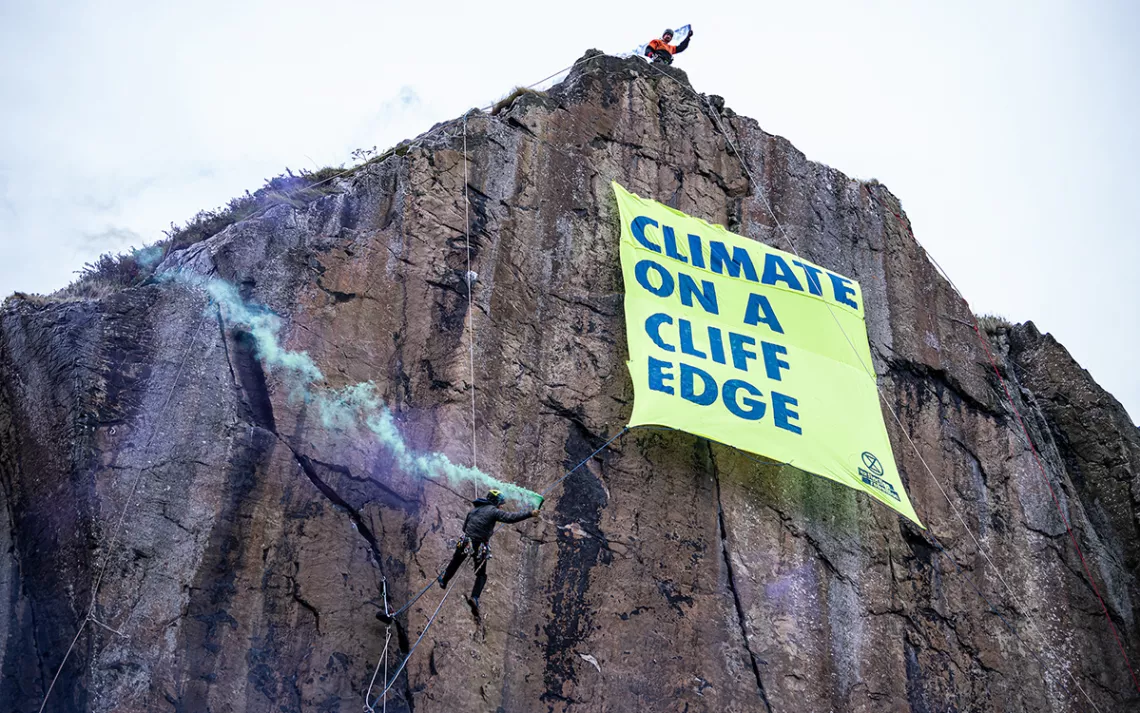
Experienced climbers scale a rock face near the historic Dumbarton castle in Glasgow, releasing a banner that reads “Climate on a Cliff Edge.” One activist, dressed as a globe, symbolically looms near the edge, while another plays the bagpipes on the shores below. | Photo courtesy of Extinction Rebellion and Mark Richards
Continue ReadingUK’s £22 Billion Carbon Capture Pledge Follows Surge in Lobbying by Fossil Fuel Industry, Records Show

Most Britons say the Labour government is ‘sleazy’

https://yougov.co.uk/politics/articles/50640-most-britons-say-the-labour-government-is-sleazy

Over the past few weeks, senior figures in the Labour government, including prime minister Keir Starmer, have faced criticism for accepting thousands of pounds worth of gifts from party donors, including clothes, glasses and tickets to must-see events.

While far from the first allegations of ‘sleaze’ against politicians in recent years, it comes just months after Labour made ‘serving the country’ a key theme of their election campaign, with their manifesto accusing the Conservatives and SNP of failing to “uphold the standards expected in public life”.

Labour and Starmer have stressed that their actions were within the rules, with Starmer also deciding to pay back £6,000 worth of gifts that received as donations, a move that eight in ten Britons (79%) support. Nonetheless, the controversy has left a mark on the government.

https://yougov.co.uk/politics/articles/50640-most-britons-say-the-labour-government-is-sleazy

Keir Starmer commits to restore honesty and integrity to politics and whores out access to all areas of Number 10 to a huge donor.
Keir Starmer commits to restore honesty and integrity to politics and whores out access to all areas of Number 10 to donor Lord Alli.
Continue ReadingMost Britons say the Labour government is ‘sleazy’

‘Increasing Destruction’: Israel Continues Bombing Campaign Across Lebanon

Original article by Common Dreams Staff republished from Common Dreams under Creative Commons (CC BY-NC-ND 3.0).

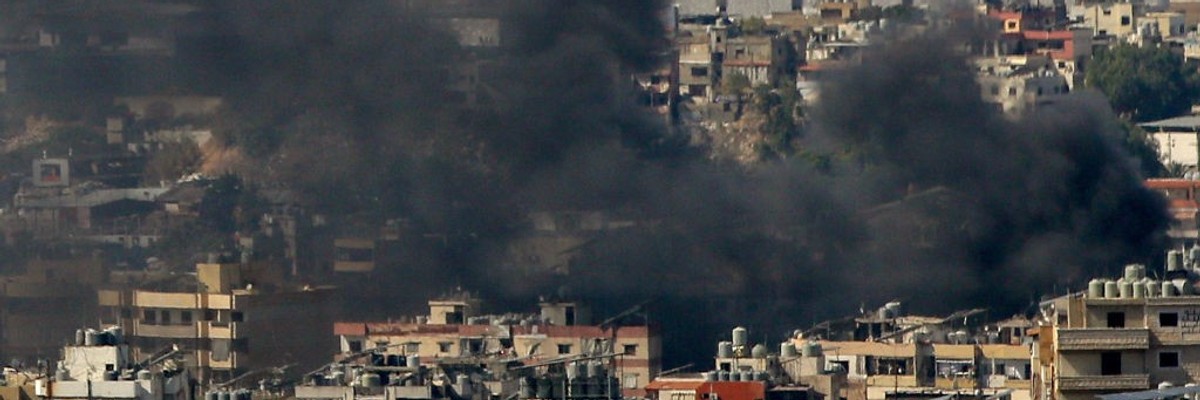
Heavy black smoke billows from the site of an Israeli air raid that targeted an area in a Beirut suburb on October 5, 2024. (Photo: Marwan Naamani/picture alliance via Getty Images)

“Complete blocks are being destroyed one after another,” Al Jazeera reported.

Israeli forces continued attacks on the outskirts of Beirut and in southern Lebanon on Saturday.

There were 13 Israeli strikes on the southern suburbs of Beirut overnight and another five on Saturday, one of which may have been targeted at paramedics, according toAl Jazeera. The number of casualties is not yet clear.

“There is increasing destruction and it’s clear that complete blocks are being destroyed one after another,” Al Jazeera‘s Ali Hashem reported from Beirut.

“One strike hit near the airport, and we understand another missile hit near a paramedic team to prevent them from getting to the scene of the bigger strike,” he reported.

The Israeli military issued evacuation warnings for certain suburban areas south of Beirut on Friday night, indicating attacks would follow, The New York Times reported.

Israeli forces unleashed a “huge strike” on the same area earlier Friday in an attempt to kill Hashem Safieddine, the presumed successor to recently assassinated Hezbollah leader Hassan Nasrallah, according to the TimesAl Jazeera reported that “bunker buster” bombs were believed to be used in the Friday attack, as they were in Nasrallah’s killing. It’s not clear if Safieddine was killed, though media reports indicate that he likely was.

Israel’s military also continued attacks in southern Lebanon on Saturday.

“From northern Israel, I can see dark gray clouds of dust and smoke rising above two [Lebanese] villages as warplanes zoom overhead and the sound of artillery echoes through the area,” the Times‘ Natan Odenheimer reported Saturday.

An Israeli strike in northern Lebanon killed Hamas commander Saeed Ali on Saturday, the armed Palestinian group said. Hamas has a longstanding presence in Lebanon.

According to Al Jazeera, which cited Israeli media reports, the Israeli military is planning to expand its ground incursion into southern Lebanon, which began earlier this week, and to conduct “large-scale assaults” on Lebanon, Iran, and Gaza. The media outlet didn’t provide details.

Iran fired nearly 200 ballistic missiles at Israel on Tuesday, principally targeting military facilities. Iran said the strikes were retaliation for Israeli assassinations of Hezbollah and Hamas leaders. Most of the strikes were intercepted by Israeli and U.S. forces.

Observers are now watching closely to see how Israel responds, and what role the U.S.—Israel’s chief diplomatic ally and military supplier—might play. President Joe Biden said Friday that he’d advise Israel to consider “alternatives” to striking Iranian oilfields.

Original article by Common Dreams Staff republished from Common Dreams under Creative Commons (CC BY-NC-ND 3.0).

Continue Reading‘Increasing Destruction’: Israel Continues Bombing Campaign Across Lebanon

Israel Steps Up Attacks in Gaza and Lebanon

Original article by Common Dreams Staff republished from Common Dreams under Creative Commons (CC BY-NC-ND 3.0).

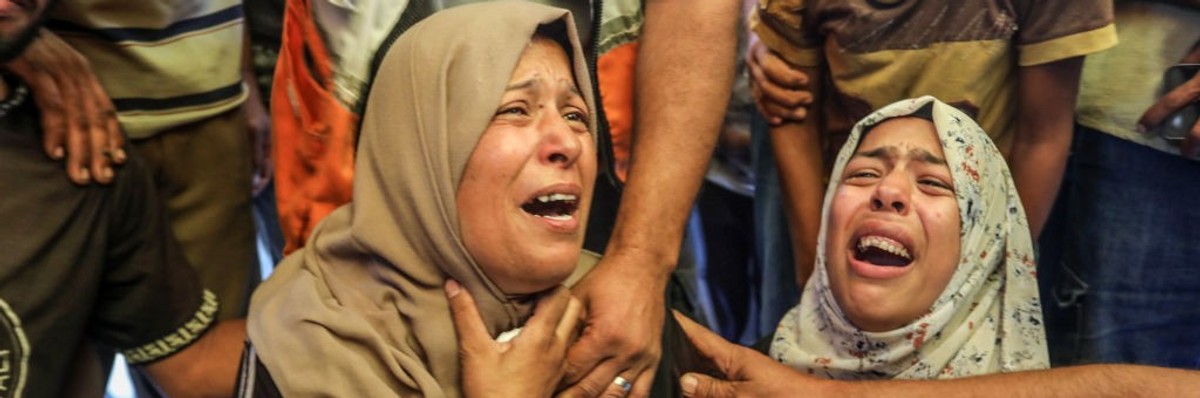
Palestinians mourn the loss of loved ones in Israeli attacks in Khan Younis, Gaza on October 6, 2024. (Photo: Abed Rahim Khatib/Anadolu via Getty Images)

The Israeli military announced a “new phase” of the war in Gaza while conducting its most severe airstrikes so far in Beirut.

Israeli forces stepped up attacks in both the Gaza Strip and Lebanon overnight and into Sunday.

Israeli forces bombed a mosque and a school-turned-shelter in Gaza, killing 26 and injuring dozens more, according to the Palestinian health ministry; the Israeli military described the two sites as Hamas “command and control centers” but provided no evidence.

The Israeli military also on Sunday announced a “new phase” of the war in Gaza, issuing new evacuation orders that cover most of the northern part of the enclave, The New York Timesreported. The military said it would send more soldiers and weapons to Gaza to “destroy terrorist infrastructures and undermine Hamas’ capabilities until all the war’s goals are achieved.”

Al Jazeera‘s Moath al-Kahlout reported that “the situation here in northern Gaza is deteriorating as the Israeli army intensifies its bombing.” He said that children, women, and journalists were among the victims.

“An entire family was killed by the Israeli army in the overnight attacks,” he added.

Meanwhile, Israel conducted the “most severe” airstrikes so far on Beirut, “pounding” the city overnight, according toThe Guardian. The strikes were in southern Beirut and its suburban outskirts, which are seen as a Hezbollah stronghold and have been heavily targeted by Israeli forces for the past two weeks.

Al Jazeera journalist Ali Hashem, reporting from Beirut, described a “massive air strike” on Sunday near the city’s international airport—an area that Israel has been bombarding for days. He said that daytime strikes are particularly harrowing.

“During the nights there are warnings,” Hashem reported. “During the days there are no warnings.”

Hashem said that emergency services have been prevented from getting into the suburban area where many of the strikes are taking place.

The Lebanese health ministry said Sunday that 23 people were killed and 93 injured in Israeli strikes on Saturday.

The Israeli military continues to advance its ground incursion in southern Lebanon. On Sunday, it ordered people in 25 villages to evacuate immediately, “signaling it’s expanding its ground offensive,” Al Jazeera reported

Filippo Grandi, the United Nations’ high commissioner for refugees, visited Beirut on Sunday and called for a cease-fire—saying it was “desperately needed”—and international humanitarian aid.

Original article by Common Dreams Staff republished from Common Dreams under Creative Commons (CC BY-NC-ND 3.0).

Continue ReadingIsrael Steps Up Attacks in Gaza and Lebanon

Israel Killed 28 Lebanese Medical Workers in 24 Hours, 73 Since War’s Start: WHO

Original article by Brett Wilkins republished from Common Dreams under Creative Commons (CC BY-NC-ND 3.0). 

A broken stethoscope and surgical glove are seen after Israeli warplanes bombed a building in the Bachoura area of Beirut, Lebanon on October 3, 2024. (Photo: Murat Sengul/Anadolu via Getty Images)

“I’m afraid first about my safety and about my family’s safety because there’s no safe place in Lebanon now,” said one physician.

The head of the United Nations World Health Organization said Thursday that Israeli forces killed 28 healthcare workers in Lebanon over the previous 24 hours, and that 73 medical personnel are among the nearly 2,000 Lebanese killed during Israel’s bombing and invasion of its northern neighbor.

“In southern Lebanon, 37 health facilities have been closed, while in Beirut, three hospitals have been forced to fully evacuate staff and patients, and another two were partially evacuated,” WHO Director-General Tedros Adhanom Ghebreyesus said during a press conference in Geneva. “And yet healthcare continues to come under attack. In Lebanon alone, 28 health workers have been killed in the last 24 hours.”

Tedros said the WHO “calls on urgent facilitation of flights to deliver health supplies to Lebanon,” adding, “Lives depend on it!”

Lebanese Health Minister Firas Al-Abiad said separately Thursday that more than 40 paramedics and firefighters have been killed by Israeli forces over the previous three days.

Dr. Abdinasir Abubakar, the acting WHO representative in Lebanon, said that “most of those healthcare workers killed in the last 24 hours, most of them—actually, all of them—were on duty.”

“Some of them were in the ambulances, some of them were in the health facilities,” Abubakar added. “They were on duty trying to help civilians who have been wounded in the conflict.”

Dr. Fathalla Fattouh, the head cardiovascular and thoracic surgeon at Rafik Hariri University Hospital (RHUH) in Jnah, just outside Beirut, described the chaos he witnessed firsthand, including “a surge of nearly identical injuries—amputations, eye trauma, and shattered hip and femur bones—straining the hospital’s capacity to a near-breaking point.”

“We were forced to make difficult decisions,” he added. “I believe that we did our best relying on available capacities, but with the escalation of events we need to plan for the worst.”

Sara, a surgeon at the hospital, said that “there are only two hospitals in Lebanon prepared to treat burn patients, and once they were at capacity, we were left with nowhere to send the patients we received.”

“It was a feeling of helplessness that we had never experienced before,” she added.

Some doctors admitted fearing for their lives.

“It’s hard to work in fear,” Dr. Mohammad Taoube, who heads the emergency room at an undisclosed hospital in southern Lebanon, told Sky News on Wednesday. “I’m afraid first about my safety and about my family’s safety because there’s no safe place in Lebanon now.”

According to figures provided by the WHO Regional Office for the Eastern Mediterranean, Israeli forces have killed 1,974 people in Lebanon—including at least 127 children—while wounding 9,384 others in recent weeks.

At least one American has been killed by Israeli bombing of Lebanon this week. Hajj Kamel Ahmad Jawad, 56, of Dearborn, Michigan was killed Tuesday while in Nabatieth in southern Lebanon caring for his sick mother and volunteering to help elderly, disabled, and injured patients at a local hospital.

The Nabatieth area has come under heavy Israeli bombardment. Local journalists said the city’s main hospital “came under direct Israeli fire” on Friday and that two nurses were killed.

Lebanese officials said Friday that more than 1.2 million people have been forcibly displaced amid Israel’s recent bombing and invasion of their country. The Israeli campaign comes amid attacks by the political and paramilitary group Hezbollah, whose rockets and other projectiles have killed or wounded scores of Israelis and forced tens of thousands from their homes.

Residents of southern Lebanon described the terror of coming under Israeli bombardment and having to flee for their lives. One woman, Fatima, and her 14-year-old daughter Zeinab said they were in their home preparing for a school exam when the shelling started.

“My mother told us to pack our things quickly, and we left in a rush,” Zeinab told the U.N. Children’s Fund on Thursday. “My siblings were crying. The journey was terrifying.”

“The shelling was all around us, and the sound of explosions echoed everywhere,” she said while crying. “We miss home dearly and yearn to return.”

Tedros noted that since last October, when Hezbollah began launching rockets at Israel in solidarity with Gaza after Hamas-led militants attacked Israel, over 1 million Lebanese have been displaced, with many seeking refuge in neighboring Syria.

He also said that “since the 7th of October last year, more than 1,500 people have been killed in Israel, almost 42,000 in Gaza, and more than 700 in the West Bank.”

“In addition,” Tedros added, “more than 10,000 people are missing in Gaza, and 1.9 million people are displaced, while 101 hostages taken from Israel remain in Gaza.”

Hundreds of Palestinians working in the health sector have been killed in Gaza by Israeli forces, who have deliberately targeted medical workers. Israeli troops have also allegedly tortured doctors and other medical workers after kidnapping them from the coastal enclave.

Tedros on Thursday stressed the need for “deescalation of the conflict; for healthcare to be protected and not attacked; for access routes to be secured and supplies delivered; and for a cease-fire, a political solution, and peace.”

“The best medicine,” he said, “is peace.”

Original article by Brett Wilkins republished from Common Dreams under Creative Commons (CC BY-NC-ND 3.0). 

Continue ReadingIsrael Killed 28 Lebanese Medical Workers in 24 Hours, 73 Since War’s Start: WHO