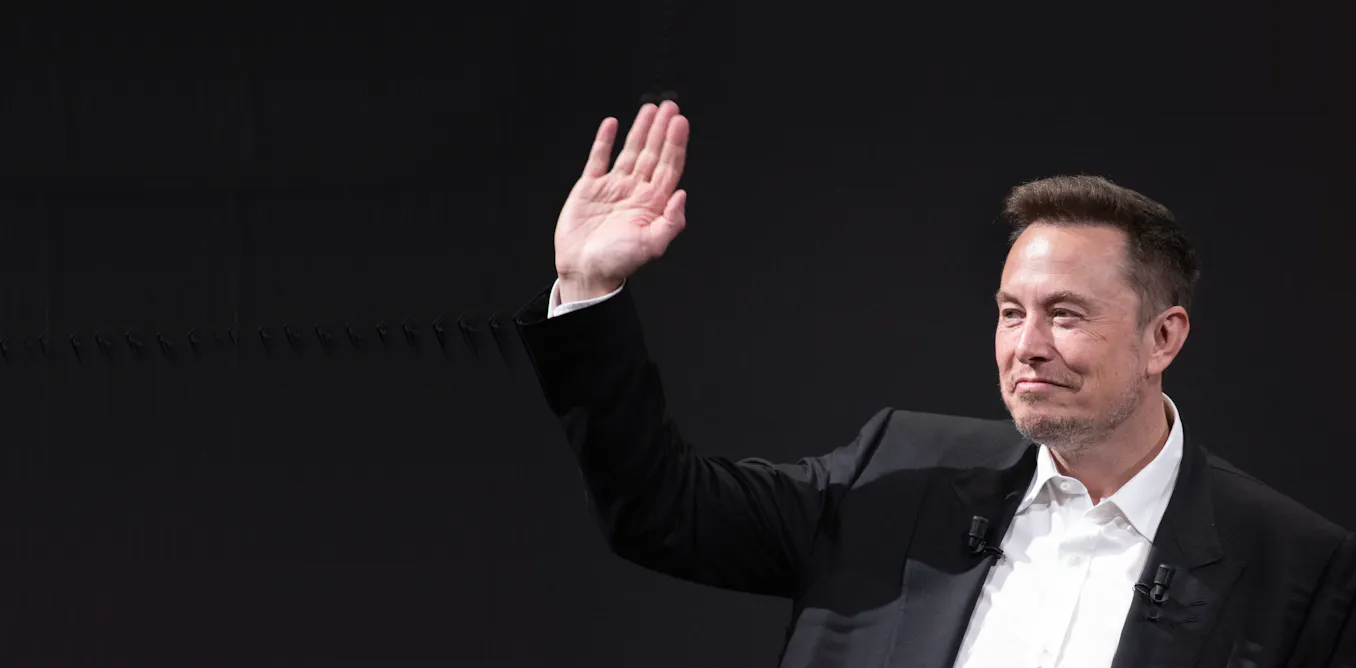
Tech billionaire Elon Musk is on track to become the world’s first trillionaire. It’s a sign markets aren’t working
Richard Denniss, Crawford School of Public Policy, Australian National University
Apparently, the world is about to get its first trillionaire.
A report from the business intelligence agency Informa Connect says, at his present rate of wealth accumulation, tech billionaire Elon Musk is on track to be the world’s first trillionaire, three years from now.
At the moment Musk is said to be worth US$195 billion (A$293 billion), but if his wealth continues growing at the recent rate of 110% per year, he will hit US$1.195 trillion in 2027.
The next trillionaire after Musk should be Indian mining magnate Gautam Adani, followed by Nvidia chief Jensen Huang and Indonesian mining mogul Prajogo Pangestu, all of whom are on track to hit the milestone in 2028.
The nearly 1 billion human beings who don’t yet have electricity connected to their homes will doubtless be looking on with interest as the tech bros and mining bosses vie to crack 13 digits.
Before examining how it is that someone could ever make a trillion-dollar fortune, and what it might mean for the world for so much of the world’s wealth to be held in the hands of one person, it is important to first try to comprehend how big a trillion actually is.
One trillion seconds last 31,000 years
A million is a big number: it is 1,000 thousands. If you managed to retire with that many dollars in superannuation, you would have saved up more than 90% of your fellow retirees.
One billion is 1,000 millions. It takes 12 days for a million seconds to pass, but 31 years for a billion seconds to tick over.
That means a trillion seconds would equal 31,000 years.
If you had $1 trillion and did no more than stick it in the bank where it earned 4% interest per year you would get $40 billion per year in interest.
No one needs $1 trillion, and it is hard to see how anyone could spend it as fast as it grew, which raises important questions about how societies, economies and democracies will be able to function if and when governments allow trillionaires to emerge.
For mortals, a trillion is hard to justify

France’s King Louis XIV spent today’s equivalent of US$200 billion-300 billion building his palace at Versailles, and it was by no means his only palace.
Pyramids and sphinxes didn’t come cheap either, but these sorts of expenditures were seen as needed for beings selected by gods and not entirely mortal.
For mortals, some believe that the entire population benefits when a small minority controls most of the resources on the basis that it builds incentives.
Just as peasants spent millennia awaiting their reward in the afterlife while their rulers enjoyed heaven on earth, in modern economies we are told wealth and prosperity will trickle down to us eventually if we keep working hard.
Unfortunately for most of us, despite the wealth of the richest 200 Australians growing from A$40.6 billion to $625 billion over the past 20 years, neither the Australian economy nor the wages of ordinary Australians are soaring.
High profits are meant to be temporary
Incentives can and do play an important role in our economy.
In the so-called “free market” envisaged by 18th-century economist Adam Smith, if my new farming technique or silicon chip is so good that everyone wants one, it is considered only fair that I get an initial reward.
But after a while, everyone else will be free to compete with me by selling similar goods and in turn stopping me from getting an extraordinary ongoing reward.
The problem is that some markets aren’t free and don’t work properly. It is no accident that the world’s biggest fortunes are held by those who have monopoly rights to sell natural resources or technologies that are protected by patents or systems that lock in users.
That’s bad news for those still waiting patiently for wealth to trickle down or to be spread more evenly.
Technofeudalism keeps profits growing
In his latest book former Greek finance minister Yannis Varoufakis describes the world we now live in as one of technofeudalism in which online platforms have the ongoing opportunity to exploit workers, consumers and producers in ways Smith could not have imagined.
Having created digital platforms where the price of entry is handing over your personal details and preferences, modern tech titans use a new form of alchemy to convert data into knowledge that allows them to keep you on their platform and exploit you or advertisers or suppliers in the belief that you won’t leave.
And while there are physical limits to how big a car factory or fast-food chain can grow, there are almost no physical limits on how much money tech platforms can make by selling ads they didn’t make for products they didn’t make to consumers they know nearly everything about.
Restraining profits is pro-market
It isn’t anti-capitalist to want those profits competed away, it’s pro-market.
When the United States broke up J.D. Rockerfeller’s oil monopoly in the early 20th century, the oil industry prospered rather than vanished. consumers and the businesses that had dealt with Rockerfeller were better off, and so was the economy as a whole.
Democracies have, for now, the power to use taxes and regulations to redistribute the enormous benefits flowing to the new class of billionaires (and soon trillionaires) from the sale of scarce resources and the creation of platforms that keep us trapped.
Whether and how we use that power is up to us, but we mightn’t have it for long. The more the new class of billionaires and trillionaires becomes entrenched, the more it will be able to use the political system to protect their interests rather than those of mere mortals.
Richard Denniss, Adjunct Professor, Crawford School of Public Policy, Australian National University
This article is republished from The Conversation under a Creative Commons license. Read the original article.