Pressure mounts on Labour to ban arms sales to Israel as new foreign secretary meets with ‘war criminals’

https://morningstaronline.co.uk/article/pressure-mounts-on-labour-to-ban-arms-sales-to-israel-as-new-foreign-secretary-meets-with-war-criminals

Israeli tanks stand near the Israel-Gaza border as seen from southern Israel, July 14, 2024

FOREIGN Secretary David Lammy should focus on halting arms exports to Israel instead of associating with war criminals, campaigners charged today.

The calls came as Mr Lammy visited Israel and the occupied Palestinian West Bank on his first trip to the Middle East in his new role.

Today, he shook hands with Israeli President Isaac Herzog, who last December was pictured proudly signing a shell headed for Gaza.

Mr Lammy said he hoped to see a hostage deal emerge “in the coming days” and a ceasefire to bring “alleviation to the suffering and the intolerable loss of life.”

Failing to lift the suspension of vital funding to the UN Relief & Works Agency, which the government gave £35 million last year, he announced that a slimmer sum of £5.5m would be given to medical aid charity UK-Med.

https://morningstaronline.co.uk/article/pressure-mounts-on-labour-to-ban-arms-sales-to-israel-as-new-foreign-secretary-meets-with-war-criminals

Vote For Genocide Vote Labour.
Zionist Keir Starmer is quoted "I support Zionism without qualification." He's asked whether that means that he supports Zionism under all circumstances, whatever Zionists do.
Zionist Keir Starmer is quoted “I support Zionism without qualification.” He’s asked whether that means that he supports Zionism under all circumstances, whatever Zionists do.
Continue ReadingPressure mounts on Labour to ban arms sales to Israel as new foreign secretary meets with ‘war criminals’

Ofwat is now investigating all eleven of England and Wales’ water companies

https://www.cityam.com/ofwat-is-now-investigating-all-eleven-of-england-and-wales-water-companies/

Surfers Against Sewage paddle-outs involve local communities coming together to protest against water companies dumping sewage in the oceans and rivers they use for watersports and swimming. (Photo by Jack Taylor/Getty Images)

Ofwat is opening enforcement cases into four more water companies, meaning it is now investigating every single water and wastewater firm in England and Wales for the mismanagement of their networks and treatment.

On Tuesday the regulator confirmed it has served formal notices on Dŵr Cymru Welsh Water, Hafren Dyfrdwy, Severn Trent and United Utilities to gather evidence for the investigation.

The notices follow a what Ofwat described as a “detailed” analysis of information on firms’ environmental performance and data about the regularity of their spills from storm overflows.

The regulator believes the four firms may not be fulfilling their obligation to protect the environment and minimise pollution, meaning that it is now investigating all 11 water companies in England and Wales.

Investigations into Anglian Water, Northumbrian Water, South West Water and Thames Water, which last week was effectively placed into special measures by Ofwat, are ongoing from 2022, while Southern Water is still subject to monitoring following a case that dates back to 2019.

David Black, Ofwat’s chief executive, said: ““The fact that Ofwat now has enforcement cases with all 11 of the wastewater companies in England and Wales demonstrates how concerned we are about the sector’s environmental performance.

https://www.cityam.com/ofwat-is-now-investigating-all-eleven-of-england-and-wales-water-companies/

Continue ReadingOfwat is now investigating all eleven of England and Wales’ water companies

How will Labour’s new desire to be the party of war shape British politics?

[This article was published 3 July 2024, a day before the UK General Election 2024.]

Original article by Iain Overton republished from OpenDemocracy under a Creative Commons Attribution-NonCommercial 4.0 International licence.

Protest against nuclear war outside Westminster Abbey, London 2019 | Wiktor Szymanowicz/Future Publishing via Getty Images

What’s the difference between the defence policies of Labour and Conservatives? Spoiler alert: there isn’t one

Days after Rishi Sunak announced the country would be going to the ballots, Tory MP Jacob Rees-Mogg released a campaign video in which he declared “security is at the forefront of this general election”.

It was a grand claim, but an astute one. Sunak and Keir Starmer have indeed spent much of the past six weeks fighting over who is leading the party of defence, while the subject has also dominated headlines (or it did until Nigel Farage re-entered politics and made the election considerably more about immigration).

From existential concerns about the size of the British army to debates about who supports Trident (and who doesn’t) and the shock announcement of the possible return of National Service, you’d be forgiven for thinking the election is less about voting red, blue, green or yellow, and more about what shade of camouflage you’d prefer your leaders in. 

But how, exactly, do Labour and the Tories differ when it comes to matters of defence? And how will rising fears from politicians and pundits over threats from Russia, Iran and China affect British politics?

Early on in the election campaign, Labour leader Starmer declared his the ‘party of national security’ – a sentiment echoed by his shadow defence secretary, John Healey, who said “Labour is now the party of defence.” Their claims came weeks after Starmer took to the pages of the Daily Mail, not his natural ally, to proclaim: “We will back our Armed Forces. We will back our nuclear deterrent. We will back Britain.”

This messaging appears to be working. That same pro-Tory paper reported in March that Labour is now more trusted than the Conservatives on defence, with voters reportedly associating the latter with cutting military spending, not increasing it.

This is all quite a reversal. For a time, much of the media painted Labour as actively hostile to the military. It led to the BBC even asking “Has Jeremy Corbyn ever supported a war?” And, in 2019, when a video emerged showing members of the British parachute regiment firing at a poster of the then-Labour leader at a target range in Kabul, it seemed to reflect a wide sentiment that the military and the left were no longer friends. 

Matters military, it was long felt, were best left to the Tories. After all, in 2021, a Byline Times analysis found that 91% of the veterans who sit in either the House of Commons or the Lords were Conservatives. Of the 44 veteran MPs, 40 were Conservative, while only 2 were Labour.

It was not always thus. The 1945 General Election, for instance, held as an army of men returned home from World War Two, saw a massive victory for Labour in the UK. Labour won decisively with 393 seats, the Conservatives securing only 197. Labour’s emphasis on social reform clearly resonated with those who had served – the promise of a better country for those who had been ready to die defending it.

It could be that Starmer is seeking to reignite this spirit, where national defence and the left are not deemed antithetical. And there are some canny election reasons for this.  

At Action on Armed Violence, we analysed the locations of the ten arms manufacturers based in the UK that have received the highest value and quantity of domestic defence contracts over 2022/3 – finding a significant Conservative bias. The ten firms have 130 locations (listed offices or factories)  across 94 parliamentary constituencies – 67% of which are represented by Tory MPs. Labour represents just 16% of the seats. 

Of the 20 constituencies with two or more arms manufacturers present, 14 were held by Conservative MPs and just three by Labour. But predicted voting data suggests the Tories will hold onto just two of them on 4 July, while 13 will switch to Labour.

It is no wonder the Starmer wrote in the Mail: “With Labour, the defence industry will be hardwired into my national mission to drive economic growth across the UK.” If polls are to be believed, the military-industrial complex is about to be painted red – and it’s no coincidence that at least 14 prospective MPs standing for Labour today are ex-military.

Where does this leave the Tories, then? Conservative Campaign Headquarters (CCHQ) is frantically coming up with new, harder-right ideas to separate the party from Labour. Its National Service ploy, Sunak claims, is “to strengthen our country’s security”. Exactly why battalions of 18-year-olds on Salisbury Plain will make the UK more secure than its nuclear arsenals is not clear.

As for other differences, while the Conservatives focus on defence spending and global strategic engagement, Labour emphasises European alliances and a broader security perspective. The Liberal Democrats and SNP, meanwhile, both advocate for strong European ties and proactive foreign policies, and the Greens prioritise environmental security. 

In truth, though, there is seemingly not much to distinguish Labour and Conservatives when it comes to matters of defence. As with Starmer working to avoid the red-tops claiming the nation is not safe in his hands, Labour has been deafeningly silent on issues such as the inquiry into Special Forces’ extra-judicial killings in Afghanistan, the widespread concerns about misogyny, sexual assault and systemic racism in the British military.

When there is not so much as a camouflage fag paper between the defence policies of the right and the left, the danger is that there are no oppositional voices of any merit. And, in a world where sentiments of war seem to be spreading much faster than sentiments of peace, this lack of critique could easily lead us all to very bad places indeed.

Original article by Iain Overton republished from OpenDemocracy under a Creative Commons Attribution-NonCommercial 4.0 International licence.

Simon Jenkins: It’s worrying to see the prime minister cheerleading for war. Will Ukraine turn into Starmer’s Iraq?

Continue ReadingHow will Labour’s new desire to be the party of war shape British politics?

Devastation in Gaza poses an increasingly serious problem for Starmer

Original article by Paul Rogers republished from Open Democracy under a Creative Commons Attribution-NonCommercial 4.0 International licence.

Labour’s stance on Gaza under Keir Starmer cost the party votes at the general election | Chris Kleponis/CNP/Bloomberg via Getty Images.

Starmer’s stance on Gaza has already reduced support for Labour – and that will only worsen in the coming months

The Labour Party’s landslide general election victory on 4 July has been compared to the party’s previous wins under Tony Blair in 1997 and Clement Atlee in 1945. But Keir Starmer won a far smaller vote share than either Blair or Attlee and, unlike in 1997 and 1945, the mood of the victors was hardly euphoric – more damp squib than firework display.

The party’s win was not down to any widespread love of Starmer’s policies, but a deeply embedded antagonism to the 14 years of the Tory rule, aided by Nigel Farage’s Reform Party taking votes from the Conservatives, the collapse of the SNP vote in Scotland and an unusually low national turnout.

Labour was further held back by an unexpectedly large number of voters who abandoned the party – many of whom were motivated by its stance on Israel’s assault on Gaza. The mainstream media has wrongly attributed this to the UK’s substantial Muslim minority, portraying it as just a sectarian issue – ignoring the anger and hurt felt by many on the left.

Independent candidates stood primarily on a pro-Gaza ticket across many parts of the north of England, the Midlands and London. Five were elected – a record for a general election – and many more came close, most notably Leanne Mohamad in Ilford North, who managed to reduce new health secretary Wes Streeting’s majority from 5,218 to just 528.

Overall, in 57 constituencies, Labour’s biggest challenger was an independent or a candidate from the Green Party or the Workers Party. The Greens’ leap forward was particularly notable – they came in second place in 40 seats, all currently held by Labour, up from three in 2019.

As the new independent candidates said repeatedly throughout the election campaign, Gaza is just one reason for dissent from the new Starmer norm. Many traditional Labour supporters are also unhappy that the party is moving decidedly rightwards and embracing Big Business, as revealed last week by openDemocracy. Labour now seems likely to end up as a centre-right party – effectively disenfranchising several million people.

Even so, Labour’s position on Gaza was undeniably a big factor in its fall in majorities in many seats. It presents a problem for Labour in general and Starmer in particular that is simply not going to go away – and has several components.

The first is that Israeli prime minister Binyamin Netanyahu and his far-right Knesset supporters have long espoused the view that defeating Hamas in Gaza requires inflicting punishment on the whole civilian population. It is this so-called Dahiya doctrine that is largely responsible for the appalling loss of life among Palestinians.

The death toll in Gaza is at least 37,000, with as many as 10,000 missing, mostly buried under the rubble, and well over 70,000 wounded. The Lancet, the world’s leading medical journal, recently published a letter that suggested that if indirect deaths – including those due to disease, malnutrition and increased infant mortality – are included then the total number of human lives lost could reach 186,000.

The second is that there is no end in sight for the current war. There are occasions when talks seem to be getting underway but they repeatedly come to nothing, as they have done for the past six months at least. The Palestinian suffering is huge but the Hamas military leadership believes it can persevere, especially as claims by the Israeli Defence Forces (IDF) that most of Gaza has been cleared of Hamas turn out to be false.

Israel’s current leadership has little interest in a long-term ceasefire. Netanyahu will certainly persist with his attack on Gaza until at least the US presidential election in November, now hoping that Donald Trump surviving the recent shooting will help to secure his win. Meanwhile, Israel’s steady encroachment on Palestinian land and people in the West Bank is a further sign of a long-term insistence on permanent control “from the river to the sea”.

Finally, there is one more factor that is rarely understood. The sheer scale of the loss of life and wider Palestinian suffering due to the Israeli assault on Gaza has already caused a long-term – perhaps permanent – shift in attitudes towards Israel and support for Gaza in the UK, which reaches far beyond Muslim communities.

This shift will likely only increase as more and more evidence emerges about the Israeli conduct of the war. Last week the highly experienced foreign correspondent, Chris McGreal, published a report on the IDF’s repeated use of fragmentation artillery shells in densely populated urban areas. Perhaps the most devastating of all such ordnance being used is the Israeli M339 tank shell, whose manufacturer, Elbit Systems, describes it as “highly lethal against dismounted infantry”. No doubt even more so against children.

The deliberate human impact, especially on children, is appalling and causes injuries that would be difficult to treat even in well-equipped and fully functioning hospitals – of which there are none left in Gaza due to Israel’s bombing campaign.

Other similar reports will surely follow McGreal’s and the combined impact will last years, substantially adding to calls for international legal action against Netanyahu and his government.

This is where Starmer is so vulnerable. Thanks largely to the work of a handful of investigative journalists, especially Declassified UK, we know more than the British government would like about the UK’s close links with Israel – including the multiple roles of RAF Akrotiri in Cyprus in aiding Israel and the hundreds of thousands of pounds flowing from the Israeli lobby to Cabinet ministers.

Unless there is a radical change in policy towards Israel now that Starmer is in Downing Street, the assault in Gaza will remain a problem for Labour well into the future. Add to this the wider view that Labour is moving markedly to the right and the huge parliamentary majority may not be as stabilising as it first seemed.

Original article by Paul Rogers republished from Open Democracy under a Creative Commons Attribution-NonCommercial 4.0 International licence.

Vote For Genocide Vote Labour.
Zionist Keir Starmer is quoted "I support Zionism without qualification." He's asked whether that means that he supports Zionism under all circumstances, whatever Zionists do.
Zionist Keir Starmer is quoted “I support Zionism without qualification.” He’s asked whether that means that he supports Zionism under all circumstances, whatever Zionists do.

UK Labour Party Shadow Foreign Secretary repeatedly heckled at a speech to the Fabian Society over his and the Labour Party's support for and complicity in Israel's genocide of Gaza.
UK Labour Party Shadow Foreign Secretary repeatedly heckled at a speech to the Fabian Society over his and the Labour Party’s support for and complicity in Israel’s genocide of Gaza.

dizzy: We get news stories in the UK recently – since the general election and the new Labour government – of Zionists Keir Starmer and Foreign Secretary David Lammy calling on Israel for a ceasefire, even allegedly saying this to Benjamin Netanyahu, etc. That’s very difficult to accept and you can see through their actions e.g. objecting to ICC warrants, that they are fully supportive, assisting, aiding and abetting, complicit in Israel’s actions.

Continue ReadingDevastation in Gaza poses an increasingly serious problem for Starmer

World ‘Cannot Remain Silent in the Face of This Endless Massacre,’ Says Lula

Original article by JAKE JOHNSON republished from Common Dreams under Creative Commons (CC BY-NC-ND 3.0). 
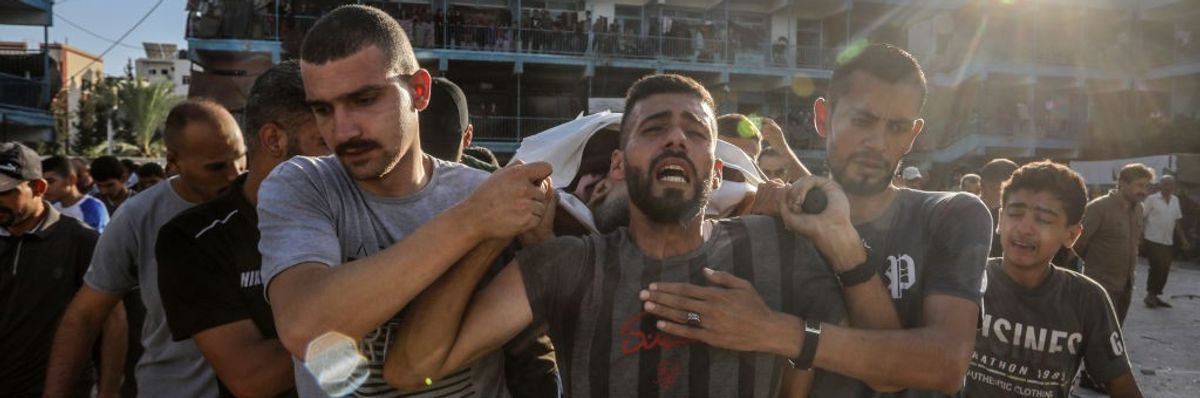
Palestinians, including children, wounded by Israeli airstrikes are pictured at Al-Aqsa Martyr’s Hospital in Deir al-Balah, Gaza on July 15, 2024. 
(Photo: Ashraf Amra/Anadolu via Getty Images)

“The Israeli government continues to sabotage the peace process and the cease-fire in the Middle East,” said the Brazilian president after a deadly weekend of bombings.

Brazilian President Luiz Inácio Lula da Silva condemned the Israeli government on Sunday after bombings across the Gaza Strip killed more than 140 people and wounded hundreds more, adding to the gruesome death toll and worsening the enclave’s humanitarian emergency as cease-fire talks continue.

Lula specifically decried Israel’s Saturday attack on al-Mawasi, an overcrowded town on Gaza’s southern coast to which Israeli forces previously ordered Palestinians to flee. Israel claimed to be targeting Hamas’ military chief in the attack; Hamas said Sunday that the commander was not harmed in the strikes, which killed around 90 people—including children.

The New York Times reported that one of the Israeli strikes “exploded directly in front of two vehicles clearly marked as belonging to Gaza Civil Defense, an emergency services agency, spraying them with shrapnel and apparently killing and injuring first responders.”

Lula said Sunday that “the Israeli government continues to sabotage the peace process and the cease-fire [negotiations] in the Middle East” with its relentless bombing campaign in the Gaza Strip, which has been utterly decimated by Israel’s assault—a military campaign fueled by billions of dollars of weaponry from the United States, Germany, and other major countries.

“It is appalling that they continue to collectively punish the Palestinian people,” Brazil’s president said. “There have already been tens of thousands of deaths in consecutive attacks since last year, many of them in delimited humanitarian zones that should be protected.”

“We, the political leaders of the democratic world, cannot remain silent in the face of this endless massacre,” he added. “The cease-fire and peace in the region need to be priorities on the international agenda. All our efforts must be focused on securing the release of the Israeli hostages and ending the attacks on the Gaza Strip.”

Brazil under Lula’s leadership has backed the South Africa-led genocide case against Israel at the International Court of Justice and been a vocal supporter of a permanent cease-fire and an end to Israel’s decadeslong occupation of Palestinian territory.

“I saw toddlers who are double amputees, children paralyzed and unable to receive treatment, and others separated from their parents.”

Israel’s weekend onslaught in Gaza came as “Hamas and Israel appear closer to some form of a Gaza cease-fire deal than at any time since the brief truce last November,” as Drop Site‘s Jeremy Scahill put it late last week.

“Hamas is considering an approach that would not immediately require a commitment to a permanent cease-fire and complete withdrawal of Israeli forces from Gaza as a precondition to move forward in phased negotiations,” Scahill reported. “This would mark a significant concession by Hamas, which has long insisted any agreement must include defined steps that end Israel’s war. Instead, Hamas officials said, they would consider entering an initial six-week phase that would include a conditional cease-fire and an exchange of Israeli civilian and female soldiers held in Gaza in return for the release of hundreds of Palestinians.”

The Associated Press reported Sunday that Hamas—which led the deadly October 7 attack on Israel—intends to keep participating in cease-fire talks in the face of incessant Israeli airstrikes, though a spokesperson for the group said there is “no doubt that the horrific massacres will impact any efforts in the negotiations.”

Scott Anderson, the United Nations’ deputy humanitarian coordinator, described the appalling scene he witnessed over the weekend at Nasser Hospital, the overwhelmed medical facility in southern Gaza where many wounded Palestinians were taken following Israel’s Saturday attack on al-Mawasi.

“With not enough beds, hygiene equipment, sheeting, or scrubs, many patients were treated on the ground without disinfectants,” said Anderson. “Ventilation systems were switched off due to a lack of electricity and fuel, and the air was filled with the smell of blood. I saw toddlers who are double amputees, children paralyzed and unable to receive treatment, and others separated from their parents. I also saw mothers and fathers who were unsure if their children were alive. Parents told me in despair that they had moved into the ‘so-called humanitarian zone’ in the hope that their children would be safe there.”

“Impediments to humanitarian operations prevent us from supporting people anywhere near the scale necessary,” Anderson continued. “Civilians must be protected at all times. We urgently need a cease-fire, the release of all remaining hostages, respite for the people of Gaza, and a meaningful opportunity for healing to begin.”

Original article by JAKE JOHNSON republished from Common Dreams under Creative Commons (CC BY-NC-ND 3.0). 

Zionist Keir Starmer is quoted "I support Zionism without qualification." He's asked whether that means that he supports Zionism under all circumstances, whatever Zionists do.
Zionist Keir Starmer is quoted “I support Zionism without qualification.” He’s asked whether that means that he supports Zionism under all circumstances, whatever Zionists do.
Continue ReadingWorld ‘Cannot Remain Silent in the Face of This Endless Massacre,’ Says Lula