Two-thirds of global warming since 1990 caused by world’s ‘wealthiest 10%’

Spread the love

Original article by Ayesha Tandon republished from Carbon Brief under a CC license

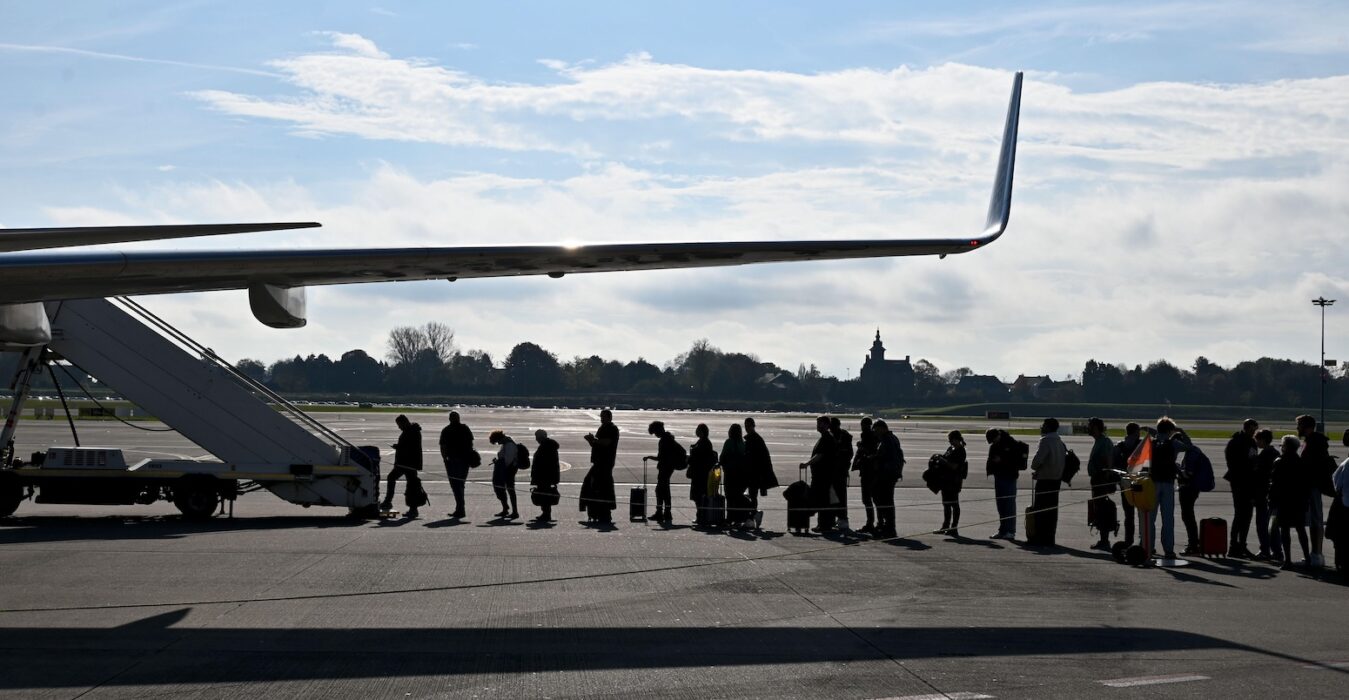
People waiting to get on a plane on the runway. Credit: SJBright / Alamy Stock Photo.

The “wealthiest 10%” of people on the planet are “responsible” for 65% of the 0.61C increase in global average temperatures over 1990-2020, according to new research.

The study, published in Nature Climate Change, uses a field of climate science called “attribution” to determine the contribution of the world’s “wealthiest population groups” to climate change through the greenhouse gases they emit.

The authors also calculate the contribution of these high-income groups to the increasing frequency of heatwaves and droughts.

For example, the study finds the wealthiest 10% of people – defined as those who earn at least €42,980 (£36,605) per year – contributed seven times more to the rise in monthly heat extremes around the world than the global average.  

In another finding, the Amazon rainforest faced a threefold increase in the likelihood of droughts over the period studied, most of which was driven by the wealthiest 10% of the world’s population. 

The authors also explore country-level emissions, finding that the wealthiest 10% in the US produced the emissions that caused a doubling in heat extremes across “vulnerable regions” globally. 

One scientist not involved in the study tells Carbon Brief that efforts to attribute global warming to individual income groups is an “important step towards targeted policies” and could support climate litigation

Emissions inequality

Humans emit more than 40bn tonnes of CO2 into the atmosphere every year. Developed countries are responsible for the majority of global emissions, as a result of the typically more carbon-intensive lifestyles of their residents. 

Meanwhile, the most severe impacts of climate change are disproportionately felt by the poorest and most vulnerable people.

The new study uses an income and wealth inequality dataset from the World Inequality Database to track inequality over 1990-2019, showing how much the world’s wealthiest 10%, 1% and 0.1% of society have contributed to warming over 1990-2020. (For details on the method, see the modelling inequalities section below.)

The world’s wealthiest 10% all earn more than €42,980 (£36,605) per year, according to the database. Meanwhile, the world’s wealthiest 0.1% earn more than €537,770 (£458,011) per year.

Of the 0.61C increase in global average temperatures over 1990-2020, the authors estimate that 65% was due to the emissions of the wealthiest 10% of people on the planet. For the wealthiest 0.1%, the estimate is 8%.

The graph below shows how much global temperatures would have risen over 1990-2020 if everyone in the world emitted as much as the world’s poorest 50% (purple), middle 40% (green), richest 10% (orange), richest 1% (blue) and richest 0.1% (pink) people. The grey bar shows how much global temperatures actually rose. 
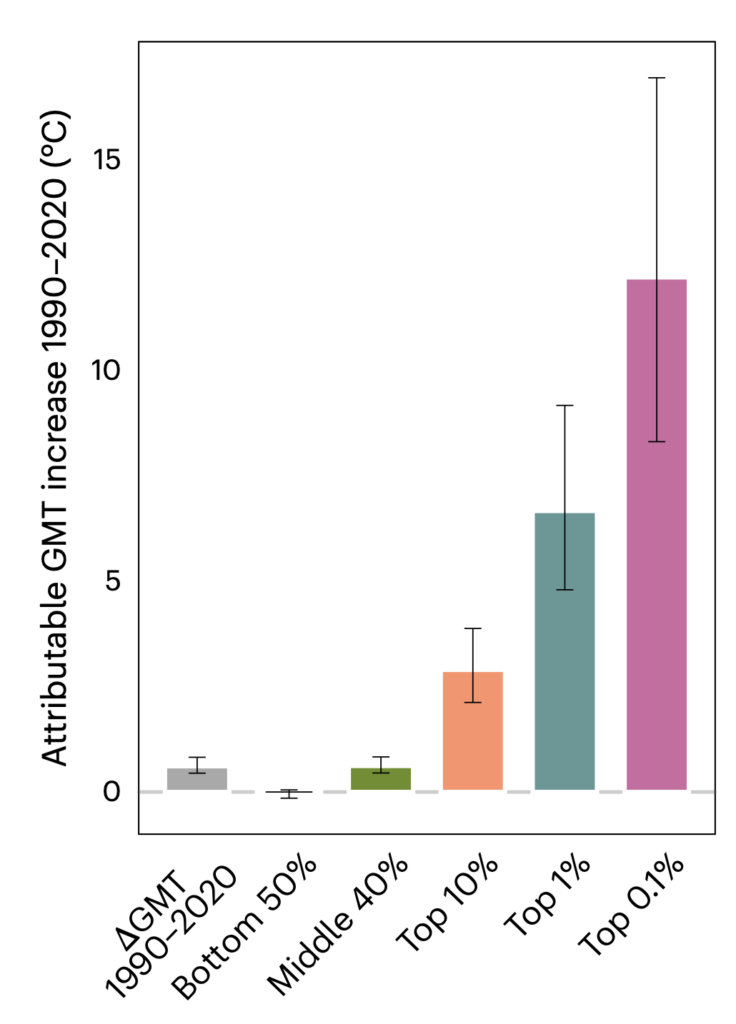
How global temperatures would have risen if everyone in the world emitted the world produced the same amount of emissions, on average, as individuals in the bottom 50% (purple), middle 40% (green), top 10% (orange), top 1% (blue) and top 0.1% (pink) of the world’s emitters.

How global temperatures would have risen if everyone in the world emitted the world produced the same amount of emissions, on average, as individuals in the bottom 50% (purple), middle 40% (green), top 10% (orange), top 1% (blue) and top 0.1% (pink) of the world’s emitters. Source: Schöngart et al (2025).

The authors find that if the whole world had emitted as much as the wealthiest 10% of people over 1990-2020, global average temperatures would have risen by 2.9C, instead of 0.61C. If the global population had emissions as large as the wealthiest 0.1%, temperatures would have risen by 12.2C.

Meanwhile, the study calculates that if the whole world had emissions as low as the poorest 50%, global temperatures would have remained close to 1990 levels.

Hot and dry extremes

As greenhouse gas emissions cause the climate to warm, extreme weather events such as heatwaves and droughts are becoming more intense, frequent and long-lasting. 

The authors use attribution – a field of climate science that aims to identify the “fingerprint” of global warming on these events – to determine the contribution of the emissions of the world’s wealthiest people to the increasing frequency of heatwaves and droughts.

The authors assess “extremely hot” and “extremely dry” months, defined as the most extreme 1% of months in a pre-industrial climate during the hottest month of the year regionally. (In a pre-industrial climate, only one of each extreme would be expected every 100 years on average.)

The graphs below show the number of additional heatwaves (left) and droughts (right) that have occurred since 1990 due to climate change in different regions of the world. 

The full bar shows the total number of additional heatwaves due to human-cased climate change in each region. The green bar shows additional occurrences due to the wealthiest 1%. The green and orange bars combined show the wealthiest 10%.

The numbers in green and orange show how much the wealthiest 1% and 10% of the planet contributed to the extreme, compared to the global average. (For example, an orange number of 7.0 means that the wealthiest 10% of people contributed seven times more to the extreme event than the global average.)
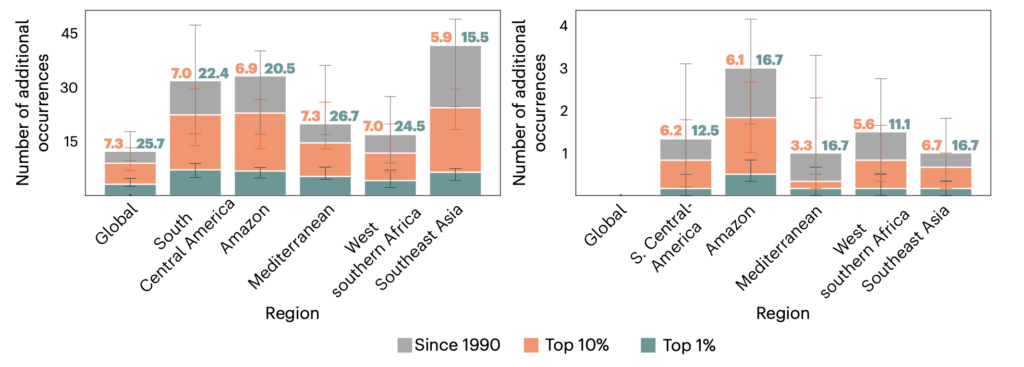
The number of additional heatwaves (left) and droughts (right) that have occurred since 1990 in different regions of the world, caused by the wealthiest 10% (orange) and 1% (green) of the world’s population.
The number of additional heatwaves (left) and droughts (right) that have occurred since 1990 in different regions of the world, caused by the wealthiest 10% (orange) and 1% (green) of the world’s population. The numbers in green and orange show how much more the wealthiest 1% and 10% of the planet contributed to the extreme, compared to the global average. Source: Schöngart et al (2025).

The study finds that an average of 11.5 additional heat events observed in August – the month where the rise in heat extremes is, on average, most pronounced – are attributable to the wealthiest 10%.

It also calculates that emissions from this group resulted in, on average, an additional 2.3 droughts in the Amazon in October – the month with the strongest attributable drying trend in the region. 

Highest emitters

The authors also assess the contributions of the wealthiest people to climate extremes on a country level, identifying the US, the EU, China and India as the world’s four highest emitting regions. 

The graphic below shows the increase in frequency of one-in-100 year peak summer heat extremes in selected regions attributable to the wealthiest 10% of people (left) and 1% of people (right) in China (red), the US (pink), the EU (peach) and India (blue). 
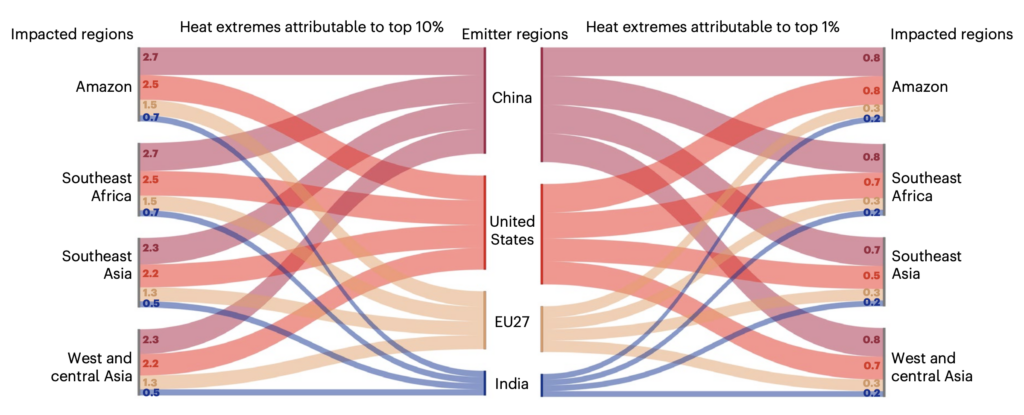
The increase in frequency of one-in-100 year peak summer heat extremes in selected regions.
The increase in frequency of one-in-100 year peak summer heat extremes in selected regions that is attributable to the wealthiest 10% of people (left) and 1% of people (right) in China (red), the US (pink), the EU (peach) and India (blue). Source: Schöngart et al (2025).

Emissions from the wealthiest 10% in the US resulted in an average of 1.3 extra heat events globally, the authors find. However, this increase is distributed unevenly across the globe. 

For example, the authors find this income group was responsible for the emissions that contributed to 2.7 additional heat events in “heat-affected areas” such as the Amazon and south-east Africa.

Emissions from the wealthiest 10% of people in the EU resulted in an additional 1.5 heatwaves in both the Amazon and south-east Africa.

Meanwhile, the Amazon faces 2.1 more heat extremes in 2020 than in 1990 due to the emissions of the richest 1% in the US, China, EU and India. 

While inequalities between one country or region and another are well documented, it should also be noted that “inequalities within developing countries are increasing”, Dr Carl Schleussner, study author and leader of the integrated climate impacts research group at the International Institute for Applied Systems Analysis (IIASA), tells Carbon Brief.

For example, he notes that the paper shows “very high levels” of emissions from “the Chinese middle and upper classes”.

However, he says that many existing global frameworks to address climate change “treat countries as a whole” and fail to “differentiate” between income groups within countries. 

Schleussner argues that the study highlights the need for “progressive policies” for climate action, which involve “tackling particularly high emitters” in all countries. 

Dr Sarah Schöngart, a researcher at ETH Zurich and lead author of the study, tells Carbon Brief that studies such as this could provide important evidence in loss and damage litigation.

Prof Jakob Zscheischler, an Earth system scientist at the Helmholtz Centre for Environmental Research who was not involved in the study, also highlights the ways the findings could be used in climate-change lawsuits. He tells Carbon Brief:

“Quantifying the contribution of individual income groups to global warming and changes in climate extremes is an important step towards targeted policies and further supports climate litigation. Supporting climate injustice with concrete numbers will hopefully help the most vulnerable and least responsible strengthen their case.”

Modelling inequalities

The study uses a range of methods to attribute changes in heat and drought to the emissions of particular wealth groups. To model global greenhouse gas emissions by wealth group, the paper uses a “wealth-based carbon inequality assessment” from a 2022 study.

(See Carbon Brief’s coverage of the 2022 study.)

The study uses income and wealth inequality dataset from the World Inequality Database to track inequality over 1990-2019. It combines economic data with information on per-capita carbon footprints – calculated using “input-output” methodologies combined with data from the “distributional national accounts” project.”

The model considers three factors. The first is private consumption – made up of emissions from the direct use of fossil fuels and emissions embedded into goods and services. The second includes emissions from government spending in that person’s country – such as government administration, public roads or defence. The final component of a person’s carbon footprint is from their investments.

The authors then created a series of “counterfactual” emissions pathways, which imagine the world without the emissions of the wealthiest 10%, 1% and 0.1% of society, respectively. The emissions pathways include CO2, methane and nitrous oxide emissions, expressed as CO2-equivalent. 

Lead author Schöngart tells Carbon Brief that including methane in the models is important, because it has “really high potency and near-term warming”. However, she notes that the team needed to make some assumptions about methane emissions – for example, assuming that each income group emits the same relative amount of methane compared to other greenhouse gas emissions. 

Using a “simple” climate model called MAGICC, the authors model global average temperatures under these counterfactual emissions pathways. This allows them to calculate how much the planet would have warmed over 1990-2020 without the emissions of the 10%, 1% and 0.1% of society, respectively.

The authors use the global average temperature trends to produce temperature and rainfall data for every land-based grid square on Earth via a climate model emulator called MESMER.

Schöngart tells Carbon Brief that an emulator is “an approximation of an Earth system model” which “allows us to generate incredible amounts of data”, while using less computing power and taking less time to run. 

The study authors then use attribution methods to identify how the emissions from the world’s wealthiest members of society have affected the frequency of heatwaves and droughts, by comparing the world as it is to a “counterfactual” world without human-caused climate change.

The graphic below shows these steps. 
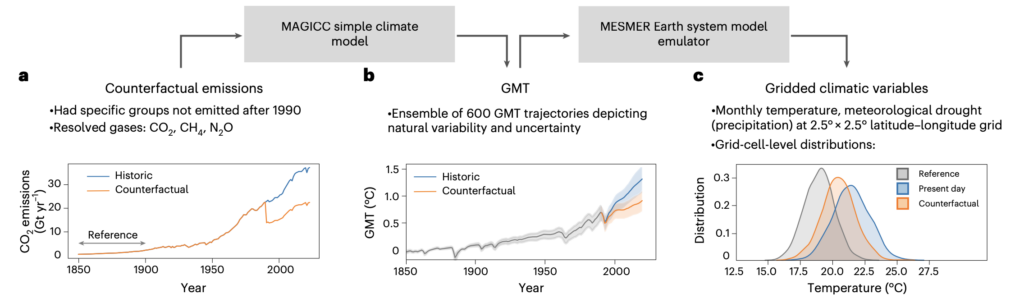
Study method.
Study method. Source: Schöngart et al (2025).

Earth system scientist Zscheischler praises the methods in the study. He tells Carbon Brief that “the main innovation of work lies in its novel combination of relatively simple emulators that capture the most important relationships between emissions and global warming and changes in extremes”.

He adds that emulators have been evaluated in other studies and are “trustworthy for this type of delicate analysis”. 

Prof Wim Thiery – an associate professor at Vrije Universiteit Brussel, who was not involved in the study – also commends the use of emulators. He tells Carbon Brief that “producing the information presented in this study with a suite of full-blown Earth system models is impossible from a computational cost and human effort perspective”. 

Original article by Ayesha Tandon republished from Carbon Brief under a CC license

Continue ReadingTwo-thirds of global warming since 1990 caused by world’s ‘wealthiest 10%’

Top 10% have more financial wealth than the other 90% combined, new figures show

Spread the love

https://morningstaronline.co.uk/article/top-10-have-more-financial-wealth-other-90-combined-new-figures-show

THE top 10 per cent of Britain’s population has more wealth than the other 90 per cent combined, according to TUC analysis of official Office for National Statistics (ONS) figures released today.

The huge inequality between rich and poor has widened under 14 years of Tory rule, which saw an “explosion” in insecure work and a decline in living standards.

Under the Conservatives, real wages grew by just 0.3 per cent a year — compared with 1.5 per cent from 1997 to 2010 under Labour.

The TUC estimates that the average worker would be £117 a week better off had pay increased since 2010 at the same pace as between 1997 and 2010.

Pay growth during Conservative-led governments from 2010-2024 was worse than for any other period of government since the 1920s.

The Tories also oversaw the worst fall in living standards since records began in 1955, the TUC said.

Continues at https://morningstaronline.co.uk/article/top-10-have-more-financial-wealth-other-90-combined-new-figures-show

Continue ReadingTop 10% have more financial wealth than the other 90% combined, new figures show

‘We Are Not Taxing the Very Wealthy Enough’: Runaway Inequality About to Get Worse

Spread the love

Original article by Jake Johnson republished from Common Dreams under Creative Commons (CC BY-NC-ND 3.0).

People participate in a “march on billionaires” event on July 17, 2020 in New York City.
(Photo: Spencer Platt/Getty Images)

“Americans overwhelmingly prefer raising taxes on the ultra-wealthy and huge corporations to making cuts to critical programs like healthcare, medical research, and infrastructure,” said Sen. Elizabeth Warren.

The United States’ astronomical levels of economic inequality are poised to become further entrenched in the coming years as what The New York Timesdescribed Sunday as “the greatest wealth transfer in history” gets underway, with the richest members of the Baby Boomer generation set to pass trillions of dollars in assets on to their descendants—often paying little or nothing in taxes.

“Most will leave behind thousands of dollars, a home, or not much at all. Others are leaving their heirs hundreds of thousands, or millions, or billions of dollars in various assets,” the Times reported. “Of the $84 trillion projected to be passed down from older Americans to millennial and Gen X heirs through 2045, $16 trillion will be transferred within the next decade.”

The newspaper added that thanks to the loophole-ridden U.S. tax system, “heirs increasingly don’t need to wait for the passing of elders to directly benefit from family money, a result of the bursting popularity of ‘giving while living‘—including property purchases, repeated tax-free cash transfers of estate money, and more—providing millions a head start.”

“The trillions of dollars going to heirs will largely reinforce inequality,” the Times observed. “The wealthiest 10% of households will be giving and receiving a majority of the riches. Within that range, the top 1%—which holds about as much wealth as the bottom 90%, and is predominantly white—will dictate the broadest share of the money flow. The more diverse bottom 50% of households will account for only 8% of the transfers.”

Don Moynihan, a professor at Georgetown University’s McCourt School of Public Policy, argued that the Times analysis further demonstrates that “we are not taxing the very wealthy enough.”

The Times noted that individuals in the U.S. can pass nearly $13 million in assets to heirs without paying the federal estate tax, which only applies to around two of every 1,000 American estates.

“As a result, although high-net-worth and ultrahigh-net-worth individuals could inherit more than $30 trillion by 2045, their prospective taxes on estates and transfers is $4.2 trillion,” the Times observed.

The explosion of wealth inequality in the U.S. over the past several decades has prompted growing calls for systemic reform but little substantive action from lawmakers. In 2017, congressional Republicans and then-President Donald Trump contributed to the inequality boom by ramming through tax legislation that disproportionately benefited the wealthiest Americans.

Now in control of the U.S. House, Republicans are trying to make the Trump tax cuts for individuals permanent and eliminate the estate tax altogether—a move that would give the nation’s wealthiest households another $2 trillion in tax breaks.

In April, Sen. Bernie Sanders (I-Vt.) led several of his colleagues in offering an alternative proposal: Legislation that would impose progressively higher taxes on estates worth between $3.5 million and $1 billion, as well as a 65% levy on estates worth more than $1 billion.

“At a time of massive wealth and income inequality, we need to make sure that people who inherit over $3.5 million pay their fair share of taxes,” Sanders said last month. “We do not need to provide a huge handout to multi-millionaires and billionaires. It is unacceptable that working families across the country today are struggling to file their taxes on time and put food on the table, while the wealthiest among us profit off of enormous tax loopholes and giant tax breaks.”

Sen. Elizabeth Warren (D-Mass.), a co-sponsor of Sanders’ legislation, tweeted Monday that “Americans overwhelmingly prefer raising taxes on the ultra-wealthy and huge corporations to making cuts to critical programs like healthcare, medical research, and infrastructure.”

“Congressional Republicans need to get on board,” the senator added.

Morris Pearl, a former managing director at the asset management behemoth BlackRock and the chair of the Patriotic Millionaires, stressed in an interview with the Times that structural changes to the U.S. tax code—not just a crackdown on wealthy tax cheats—are necessary to slow the rise of inequality.

“People are following the law just fine. I generally don’t pay much taxes,” said Pearl, whose group has warned that democracy “will not survive” unless the rich are taxed much more aggressively.

Stressing the ease with which rich families in U.S. are able to pass assets on to their heirs tax-free, Pearl told the Times that he currently holds stock that his wife’s father, “who died a long time ago, bought in the 1970s,” an investment that “has gone from a few thousand dollars to many hundreds of thousands of dollars”—unrealized capital gains that are not subject to taxation.

University of California, Berkeley economists Emmanuel Saez and Gabriel Zucman have estimated that $2.7 trillion of the $4.25 trillion in wealth held by U.S. billionaires is unrealized.

“I’ve never paid a penny of taxes on all that,” Pearl said of his inherited equities, “and I may not ever, because I might not sell and then my kids are going to have millions of dollars in income that’s never taxed in any way, shape, or form.”

Original article by Jake Johnson republished from Common Dreams under Creative Commons (CC BY-NC-ND 3.0).

Continue Reading‘We Are Not Taxing the Very Wealthy Enough’: Runaway Inequality About to Get Worse

Spread the love

Study Warns ‘Luxury’ Pollution by the Global Mega-Rich Is Imperiling the Planet

“The emissions from a single billionaire spaceflight would exceed the lifetime emissions of someone in the poorest billion people on Earth.”

JAKE JOHNSON November 5, 2021

The richest people on the planet, representing a small sliver of the total population, are emitting carbon dioxide at a rate that’s imperiling hopes of keeping global heating below 1.5°C, prompting fresh calls for government action to rein in “luxury” pollution and combat the intertwined crises of inequality and climate change.

New research by the Institute for European Environmental Policy (IEEP) and the Stockholm Environment Institute (SEI) shows that by 2030, the carbon footprints of the wealthiest 1% of humanity are on track to be 30 times larger than the size compatible with limiting global warming to 1.5°C by the end of the century, the Paris Agreement’s more ambitious temperature target.

If current trends continue, the richest 1% will account for 16% of global CO2 emissions in 2030.

The carbon emissions of the poorest half of the global population, meanwhile, “are set to remain well below the 1.5°C-compatible level,” according to the analysis, which was commissioned by Oxfam International and published Friday. The planet has already warmed by roughly 1.1°C, and scientists have said any heating beyond 1.5°C would have destructive consequences worldwide.

“The emissions from a single billionaire spaceflight would exceed the lifetime emissions of someone in the poorest billion people on Earth,” Nafkote Dabi, Oxfam’s climate policy lead, said in a statement. “A tiny elite appear to have a free pass to pollute. Their oversized emissions are fueling extreme weather around the world and jeopardizing the international goal of limiting global heating.”

“The emissions of the wealthiest 10% alone could send us beyond the agreed limit in the next nine years,” Dabi added. “This would have catastrophic results for some of the most vulnerable people on Earth who are already facing deadly storms, hunger, and destitution.”

Oxfam graphic on carbon emissions

Authored by Tim Gore, head of the Low Carbon and Circular Economy program at IEEP, the new research paper notes that “while carbon inequality is often most stark at the global level, inequalities within countries are also very significant.”

“They increasingly drive the extent of global inequality, and likely have a greater impact on the political and social acceptability of national emissions reduction efforts,” the paper reads. “It is therefore notable that in all of the major emitting countries, the richest 10% and 1% nationally are set to have per capita consumption footprints substantially above the 1.5⁰C global per capita level.”

To slash the outsized planet-warming emissions of the global rich, the study calls on policymakers to pursue restrictions on mega-yachts, private jets, and recreational space travel. In a paper published last month, French economist Lucas Chancel estimated that “an 11-minute [space] flight emits no fewer than 75 tonnes of carbon per passenger once indirect emissions are taken into account (and more likely, in the 250-1,000 tonnes range).”

“At the other end of the distribution, about one billion individuals emit less than one tonne per person per year,” Chancel observed. “Over their lifetime, this group of one billion individuals does not emit more than 75 tonnes of carbon per person. It therefore takes a few minutes in space travel to emit at least as much carbon as an individual from the bottom billion will emit in her entire lifetime.”

In addition to targeting sources of “luxury carbon consumption,” the analysis by IEEP and SEI also proposes restrictions on “climate-intensive investments like stock-holdings in fossil fuel industries.”

“The global emissions gap to keep the 1.5°C Paris goal alive is not the result of the consumption of most of the world’s people: it reflects instead the excessive emissions of just the richest citizens on the planet,” Gore said in a statement. “It is necessary for governments to target measures at their richest, highest emitters―the climate and inequality crises should be tackled together.”

Emily Ghosh, a scientist at SEI, agreed, arguing that “carbon inequality must urgently be put at the center of governments efforts to reduce emissions.”

“Our research highlights the challenge of ensuring a more equitable distribution of the remaining and rapidly diminishing global carbon budget,” said Ghosh. “If we continue on the same trajectory as today, the stark inequalities in income and emissions across the global population will remain, challenging the equity principle at the very heart of the Paris Agreement.”


Our work is licensed under Creative Commons (CC BY-NC-ND 3.0). Feel free to republish and share widely.

Continue Reading