‘Dystopian’: UAE Used Global Climate Summit to Push $100 Billion in New Oil Deals

Spread the love

Original article by JULIA CONLEY republished from Common Dreams under Creative Commons (CC BY-NC-ND 3.0). 

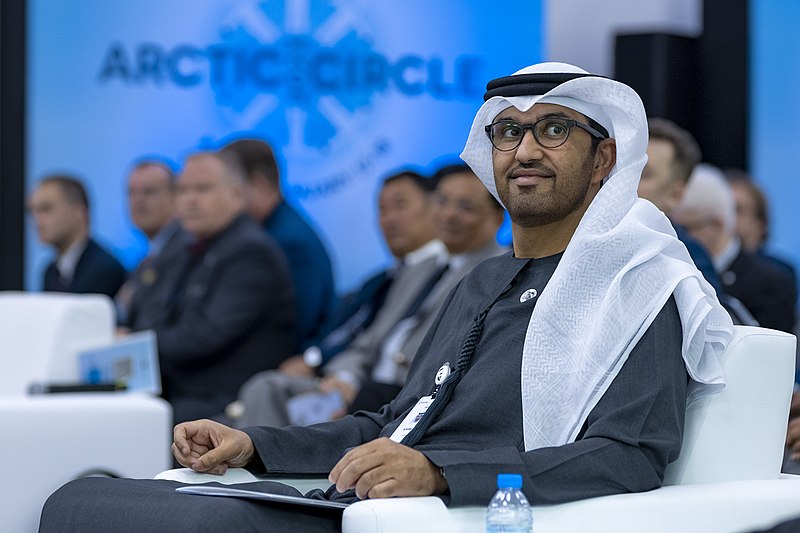
United Arab Emirates’ minister of industry and CEO of the Abu Dhabi National Oil Company, Sultan Ahmed Al Jaber, speaks at an event in Houston on March 6, 2023.  (Photo: Mark Felix/AFP via Getty Images)

“Make no mistake, COP28 was hijacked by the interests of the fossil fuel industry,” said one campaigner.

A new analysis released by human rights and anti-corruption group Global Witness on Wednesday left no room for doubt, said one campaigner, that the host country of last year’s United Nations climate summit, the United Arab Emirates, prioritized fossil fuel interests over the planet.

“Make no mistake, COP28 was hijacked by the interests of the fossil fuel industry,” said Patrick Galey, senior investigator for Global Witness, referring to the 28th Conference of the Parties of the United Nations Framework Convention on Climate Change (UNFCCC).

The analysis showed that the UAE’s Abu Dhabi National Oil Company (ADNOC) used the COP28 presidency of its CEO, Sultan Ahmed Al Jaber, to seek deals worth nearly $100 billion with oil, gas, and petrochemical companies in at least 12 countries.

Fossil fuel firms, said Galey, “weren’t content simply to block or stall genuine climate policy but used the opportunity to pursue more climate-wrecking oil and gas deals.”

Al Jaber previously denied that ADNOC used COP28 to further its business interests after a leak of briefing documents that instructed the company to discuss fossil fuel deals with at least 16 states that were present at the talks.

According to Global Witness, the company sought deals with at least 11 of those countries and at least one other that had not been included in the leaked documents.

The group’s investigation found that the UAE redoubled its investment in oil and gas in Egypt in 2023, the year Al Jaber presided over COP28. ADNOC finalized a deal with TotalEnergies Marketing Egypt, purchasing a 50% stake in the company for a reported $200 million—resulting in the UAE now jointly operating 240 service stations across the country and contributing to its record profits posted in 2023.

Other deals sought by ADNOC with COP28 participants include a joint venture with BP to buy a 50% stake in NewMed Energy in Israel and multiple bids for a stake in Braskem, the largest petrochemical producer in Latin America. The company is part-owned by Brazil’s state-run oil and gas producer Petrobas.

ADNOC also finalized deals worth an estimated $17 billion with Lukoil in Russia and Wintershall in Germany to develop the Hail and Ghasha gas field in the UAE.

Global Witness’ findings bolstered a report by the Center for Climate Reporting and the BBC in November, which showed Al Jaber used his position at COP28 to push for fossil fuel deals with foreign governments.

The report confirms the worst fears of climate campaigners, who were incensed in early 2023 when Al Jaber was named the president of the U.N.’s largest annual climate conference and warned of conflicts of interest due to his position at the helm of ADNOC.

As it turns out, said Galey, “the UAE knew exactly what it was doing and was not let down—COP28 seems to have been molded towards the benefit of its state oil company.”

“As depressing as it is dystopian, climate talks must never be allowed to create more climate chaos,” he added.

The analysis was released weeks after U.S. Sen. Jeff Merkley (D-Ore.) and Rep. Jan Schakowsky (D-Ill.) led 24 Democratic lawmakers in writing to Secretary of State Antony Blinken and White House Senior Advisor John Podesta, urging them to support conflict of interest guidelines ahead of COP29, which is scheduled to take place in November in Baku, Azerbaijan.

With Mukhtar Babayev, the country’s ecology and natural resources minister who worked for a state-owned oil and gas company for more than 20 years, set to preside over the conference, Galey said that “COP28 seems to have provided other petrostates with a sinister playbook to copy and paste from.”

“As the UAE passes the baton onto Azerbaijan, we are now looking at the possibility of consecutive COPs being hijacked for the interests of big polluters and their profits,” said Galey, noting that scientists have warned the planet is “dangerously close” to heating that exceeds 1.5°C.

Global Witness pointed to recently announced plans to partially privatize the State Oil Company of Azerbaijan (SOCAR) ahead of COP29, “with its downstream and petrochemical subsidiaries made available to help attract foreign investments.”

Rep. Rashida Tlaib (D-Mich.), who signed the letter spearheaded by Merkley and Schakowsky, said Global Witness’ report “is a disturbing warning about the potential for further fossil fuel corruption at COP29, which incredibly will also be hosted by another fossil fuel executive.”

“I will continue urging the U.S. and UNFCCC to adopt new policies to prevent these absurd conflicts of interest that frustrate the international community’s work to address the urgent threats of climate change,” she said.

Global Witness reached out to ADNOC, SOCAR, and COP29 for comment regarding its investigation, and was told that ADNOC is working to “secure, reliable, and responsible supply of energy to support a just, orderly, and equitable global energy transition and that allegations regarding Al Jaber’s deal-making at COP28 are “false, not true, incorrect, and not accurate.”

A COP29 spokesperson said Azerbaijan is “100% committed to bringing countries together with the ambition of keeping the 1.5° target within reach.”

Rep. Barbara Lee (D-Calif.), said in a statement Wednesday that Babayev should be removed “from any leadership role at COP29.”

“It is an absolute scandal that the UNFCCC has two years running put an oil and gas executive in charge of this event,” she said, “thus putting foxes in charge of the henhouse.”

Original article by JULIA CONLEY republished from Common Dreams under Creative Commons (CC BY-NC-ND 3.0). 
Continue Reading‘Dystopian’: UAE Used Global Climate Summit to Push $100 Billion in New Oil Deals

COP28 Head Claims There’s ‘No Science’ Behind Fossil Fuel Phaseout

Spread the love
Dr. Sultan al Jaber. Image: Arctic Circle, CC BY 2.0, via Wikimedia Commons

Original article by JAKE JOHNSON republished from Common Dreams under Creative Commons (CC BY-NC-ND 3.0). 

“This dismisses decades of work by IPCC scientists,” said one expert. “Disgraceful.”

Scientists and climate advocates responded with outrage Sunday to COP28 president Sultan Ahmed Al Jaber’s claim that there is “no science” behind the push to rapidly phase out planet-warming fossil fuels, which Al Jaber’s company is extracting on a large scale .

Al Jaber’s comments, first reported by The Guardian on Sunday, came in response to questioning from Elders chair Mary Robinson during a virtual She Changes Climate discussion. Robinson told Al Jaber that “we’re in an absolute crisis that is hurting women and children more than anyone… and it’s because we have not yet committed to phasing out fossil fuel.”

The COP28 chief and Abu Dhabi National Oil Company (ADNOC) CEO responded dismissively, saying he “accepted to come to this meeting to have a sober and mature conversation” and not to take part in “any discussion that is alarmist,” according to audio published by The Guardian .

“There is no science out there, or no scenario out there, that says that the phaseout of fossil fuel is what’s going to achieve 1.5°C,” Al Jaber added. “Please help me, show me the roadmap for a phaseout of fossil fuel that will allow for sustainable socioeconomic development, unless you want to take the world back into caves.”

That position runs directly counter to the outspoken stance of United Nations Secretary-General António Guterres, who said Friday that “the 1.5°C limit is only possible if we ultimately stop burning all fossil fuels,” arguing that “the science is clear.”

Joelle Gergis, a climate scientist and lead author of the Intergovernmental Panel on Climate Change’s (IPCC) Working Group I contribution to the Sixth Assessment Report , called Al Jaber’s remarks “disgraceful.”

“This dismisses decades of work by IPCC scientists,” Gergis wrote on social media.

“‘Sending us back to caves’ is the oldest of fossil fuel industry tropes: it’s verging on climate denial.”

The IPCC, which has synthesized the research of hundreds of climate scientists from around the world, has argued that any successful effort to prevent catastrophic planetary warming “will involve a substantial reduction in fossil fuel use.”

“More than a century of burning fossil fuels as well as unequal and unsustainable energy and land use has led to global warming of 1.1°C above pre-industrial levels,” the IPCC said following the release of its latest report earlier this year. “This has resulted in more frequent and more intense extreme weather events that have caused increasingly dangerous impacts on nature and people in every region of the world.”

Other recent research has warned that rich nations must completely halt oil and gas production by 2034 to give the world a 50% chance of limiting warming to the 1.5°C target set by the Paris Agreement.

Bill Hare, chief executive of Climate Analytics, told The Guardian that Al Jaber’s response to Robinson was “extraordinary, revealing, worrying, and belligerent.”

“‘Sending us back to caves’ is the oldest of fossil fuel industry tropes: it’s verging on climate denial,” said Hare.

Al Jaber’s comments, which he says have been misrepresented , were seen as further confirmation that he is ill-suited to lead a climate summit given his simultaneous role as the top executive at one of the world’s largest fossil fuel firms. A Global Witness analysis released over the weekend found that ADNOC is on track to become the second-largest oil producer in the world by 2050, and Al Jaber has been accused of using his position as COP28 president to pursue oil and gas deals.

“ADNOC plans to produce more oil than any of the ‘Big 5’ supermajors—ExxonMobil, Chevron, Shell, BP, TotalEnergies,” Global Witness found. “In fact, its projected output will positively dwarf that of the European majors; ADNOC’s 35.9 billion barrels is 49% higher alone than the projected 24.1 billion barrels production of Shell, BP, and Total combined.”

On Monday, the COP28 presidency published a summary of the World Climate Action Summit, a gathering of more than 150 heads of state aimed at facilitating coordinated climate action.

The document states that world leaders “highlighted the opportunities to cut emissions in every sector and to accelerate the technology innovation to address scope 3 emissions, as well as the phase-down of fossil fuels in support of a transition consistent with limiting warming to 1.5°C.”

Romain Ioualalen, global policy lead at Oil Change International , said in a statement that “strong support from the leaders’ summit to address fossil fuels in the final COP28 agreement is a promising sign, but it is just good enough.”

“Leaders must raise their ambition above a phase-down, and agree to immediately stop new fossil fuel expansion, and build a fast, full, fair, and funded phaseout of all fossil fuels while rapidly phasing in renewables,” said Ioualalen. “Contrary to the COP28 president’s assertions, the science is abundantly clear that warming will continue as long as we keep producing and burning fossil fuels.”

Original article by JAKE JOHNSON republished from Common Dreams under Creative Commons (CC BY-NC-ND 3.0). 
Continue ReadingCOP28 Head Claims There’s ‘No Science’ Behind Fossil Fuel Phaseout

As disasters and heat intensify, can the world meet the urgency of the moment at the COP28 climate talks?

Spread the love

Shutterstock

Brendan Mackey, Griffith University

Eight years ago, the world agreed to an ambitious target in the Paris Agreement: hold warming to 1.5°C to limit further dangerous levels of climate change.

Since then, greenhouse gas emissions have kept increasing – and climate disasters have become front page news, from mega-bushfires to unprecedented floods.

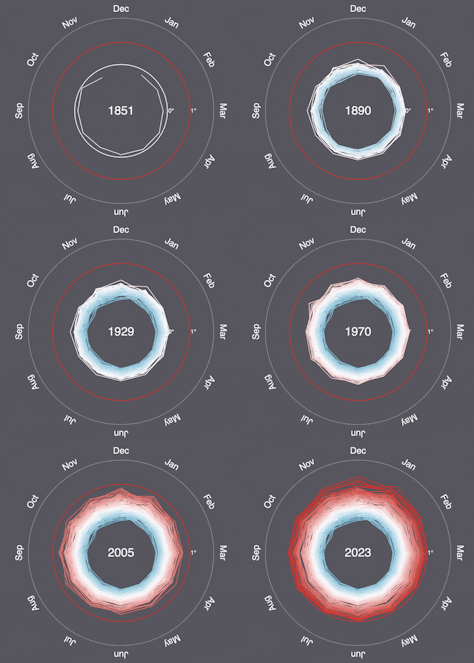
In 2023, the world is at 1.2°C of warming over pre-industrial levels. Heatwaves of increasing intensity and duration are arriving around the world. We now have less than 10 years before we reach 1.5°C of warming.

This week, the COP28 climate talks will begin against a backdrop of evermore strident warnings from climate scientists and world leaders. United Nations chief António Guterres has warned climate action is “dwarfed by the scale of the challenge” and that we have “opened the gates of hell”. In his latest climate letter, Pope Francis quotes bishops from Africa who dub the climate crisis a “tragic and striking example of structural sin”.

Global monthly land and ocean anomalies from 1850, relative to the 1901-2000 average
Global monthly land and ocean anomalies from 1850, relative to the 1901-2000 average.
NOAA, CC BY-SA

In the United Arab Emirates, the 198 nations in the UN’s climate framework will gather for COP28. Can we expect to see real progress – or half-measures?

Watch for these three key issues facing negotiators.

1. Taking stock of progress on climate action

This year, a critical issue will be the global stocktake, the key mechanism designed to ratchet up climate ambition under the 2015 Paris Agreement. This is the first time each nation’s emission cut targets and benefits from climate adaptation or economic diversification plans have been assessed.

The stocktake reveals what track we are on. Do the combined emission cut promises from all countries mean we can limit warming to 1.5°C? If not, what is the “emissions gap” – and how much more ambitious do nation’s emission reductions need to be?

There’s been progress, but not nearly enough. If all national emissions pledges became a reality, global warming would peak between 2.1-2.8°C.

That leaves an emissions gap of around 22.9 gigatonnes of carbon dioxide equivalent over the period to 2030.

It is very good that the worst-case scenarios – unchecked warming and 4+ degrees of global heating by 2100 are now looking unlikely. But a 2°C world would bring unacceptable harm and irreversible damage.

We’ll need much more ambitious targets and support to cut global greenhouse gas emissions 43% by 2030 and 60% by 2035 compared with 2019 levels if we are to reach net zero CO₂ emissions by 2050 globally. A major measure of COP28’s success will be whether the major emitting nations agree on more ambitious emission reduction actions.

2. Who pays for climate loss and damage?

For decades, nations have wrestled over the fraught question of who should pay for loss and damage resulting from climate change.

Now we’re close to finalising arrangements for the new Loss and Damage Fund. This will be the second major issue for negotiators at COP28.

So far, governments have drawn up a blueprint for the new fund. Expect to see debate over who will manage the fund – the World Bank? A UN agency? – and whether emerging economies such as China will provide funds. To date, there’s no target for how much money the fund will hold and disburse. The blueprint must be formally adopted at COP28 before it can begin operating.

Why a new fund? Other climate finance commitments are aimed at cutting emissions or helping societies adapt to climate impacts. This fund deals specifically with the loss and damage from the unavoidable impacts of climate change, like rising sea levels, prolonged heatwaves, desertification, the acidification of the sea, extreme weather and crop failures.

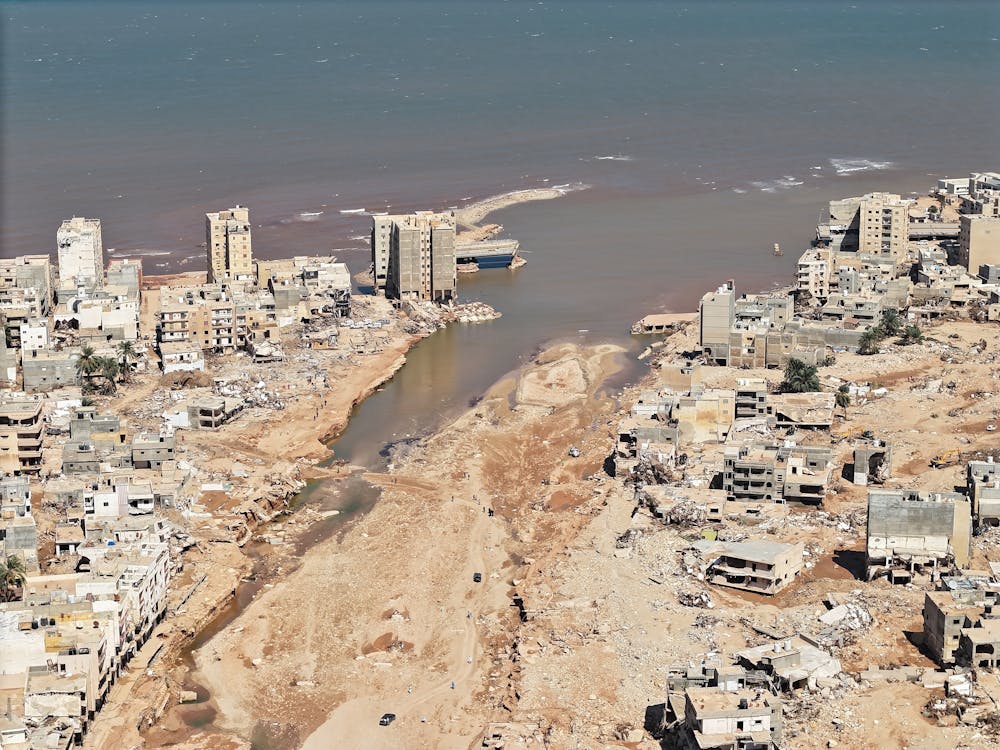
Think of the damage from the unprecedented floods in Pakistan or Libya, for instance.

libya flood, image of destroyed city with floodwater from air
Libya’s devastating floods in September killed thousands.
Shutterstock

3. Where’s the climate finance?

A major issue in climate negotiations is how countries can transform their economies so they are “climate ready”, with lower emissions and boosted resilience. For developing countries, this requires massive levels of investment and new technologies to let them “leapfrog” fossil fuel dependency.

This is likely to be a critical sticking point. To date, climate finance has flowed too slowly. Under the Paris Agreement, rich countries promised to provide funds of A$150 billion a year every year. This has been slow in coming, though it is nudging closer, with $130 billion flowing in 2021.

Unless we see significant progress on climate finance – including making the Loss and Damage Fund a reality and meeting the existing commitments – we’re unlikely to see progress on other key issues such as ratcheting up emission cuts under the stocktake mechanism, phasing out fossil fuels and work on preserving biodiversity.

How do you build a 198-government consensus?

One reason climate negotiations advance slowly is the need for consensus.

All 198 governments must agree on each decision. This means any one nation or group of countries can block a proposal or force the wording to be changed in order for it to be approved.

The votes of less wealthy countries – including small island nations and least developed countries – therefore carry as much weight as the G20 nations, who account for about 85% of global GDP. This has in the past worked to increase the level of climate action, including the focus on 1.5°C as the global warming target.

The COP28 President is Sultan Ahmed al-Jaber, who has attracted controversy due to the fact he heads the Abu Dhabi National Oil Company. Expect to see considerable debate over wording. Will governments agree to the “phasing down of fossil fuels” or just the “phasing down of unabated fossil fuels”?

It might sound like quibbling but it’s not – the second option, for instance, implies the heavy use of yet-to-be-proven carbon capture and storage technologies and offsets.

Sultan al-Jaber has, to his credit, promoted some progressive agenda items including a focus on the conservation, restoration, and sustainable management of nature to help achieve the goals of the Paris Agreement.

Here, there are welcome commonalities with the major global biodiversity pact struck late last year, the Global Biodiversity Framework, aimed at stemming the extinction of species and degradation of ecosystems. Healthy ecosystems store carbon and help people adapt to the climate change already here.

As nations prepare for a fortnight of intense negotiation, the stakes are higher than they have ever been. Now the question is – can the world community seize the moment? The Conversation

Brendan Mackey, Director, Griffith Climate Action Beacon, Griffith University

This article is republished from The Conversation under a Creative Commons license. Read the original article.

Continue ReadingAs disasters and heat intensify, can the world meet the urgency of the moment at the COP28 climate talks?

Venture Fund Set to ‘Take Control’ of Telegraph Has Fossil Fuel Investments

Spread the love

Original article by Sam Bright republished from DeSmog.

The group, which reportedly has UAE state backing, is leading the race to buy the British newspaper.

The Daily Telegraph front page. Credit: Steven May / Alamy

The investment fund that has reportedly reached an agreement to buy the Telegraph Media Group has stakes in several oil and gas companies, DeSmog can report. 

U.S.-based RedBird Capital has entered into a joint venture to take control of The Telegraph alongside International Media Investments (IMI) of Abu Dhabi in the United Arab Emirates (UAE). 

The two groups have reportedly agreed to provide loans to The Telegraph’s existing owners, the Barclay family, to allow them to pay off their £1.16 billion debt to Lloyds Banking Group. The family lost control of The Telegraph and the Spectator magazine, which is also part of the media group, earlier this year due to this outstanding debt. 

News reports suggest that the deal is being backed by Sheikh Mansour bin Zayed Al Nahyan, who serves as the deputy prime minister of the UAE, the head of its state-owned investment company, and the owner of Manchester City football club.

Conservative MPs have voiced concerns over the potential purchase and the danger of foreign influence, asking the UK government to use national security laws to investigate the agreement. Culture Secretary Lucy Frazer has echoed these concerns, warning that the deal could undermine “free expression of opinion” and prevent the “accurate presentation of the news”.

The UAE is a petrostate that has the world’s largest oil expansion plans. The state-owned energy company, the Abu Dhabi National Oil Company (Adnoc), intends to increase its oil production by more than any other fossil fuel firm in the world, according to data from the Global Oil and Gas Exit List (Gogel). Adnoc said that Gogel’s data and assumptions were “incorrect and misleading” but has not provided its own figures.

RedBird-IMI has said that, under its proposal, The Telegraph and Spectator will be managed by RedBird Capital “alone” and IMI would be a “passive investor”.

RedBird Capital trades in a number of core investment sectors, including energy. The firm’s website states that it holds investments in at least six fossil fuel firms: Aethon United, CapturePoint, FireBird Energy, Four Corners Petroleum, Lambda Energy Resources, and Tally Energy Services.

All of these companies are based in the U.S., with a majority operating in Texas.

Aethon United was listed by Enverus Intelligence Research as one of the most prolific private oil and gas producers in the U.S. in 2023. It was reported in 2022 that the firm was considering a public listing that would value it at more than $10 billion.

CapturePoint specialises in carbon capture, utilisation and storage (CCUS), a favoured technology of the fossil fuel industry that it claims will help to limit global warming. The RedBird website claims that CapturePoint is “building out a carbon capture network on the Gulf Coast and in the Midwest”.

There is limited evidence of the efficacy of CCUS at scale. DeSmog recently analysed 12 large-scale CCUS projects around the world and found countless missed carbon capture targets, as well as cost overruns, with taxpayers picking up the tab via billions of dollars in subsidies. Meanwhile, captured carbon is often merely used to extract more oil. 

“If this deal goes through, it will pollute our press and the UK’s fight against climate breakdown,” Alexander Kirk, fossil fuels campaigner at Global Witness, told DeSmog.

RedBird Capital also holds an investment in Majority Strategies, a political strategy firm that claims to have worked for every official Republican presidential nominee since 2000. Majority Strategies received more than $27 million during the 2022 election cycle, including $9.2 million from the Republican Senate Leadership Fund. 

Responding to media speculation about The Telegraph’s future ownership, the paper’s editor Chris Evans sent an internal memo earlier this week. Seen by Politico Playbook, the memo read: “You’ve been asking me how we can be confident that editorial independence would be protected. At the moment I know no more than you will have read.”

Polly Truscott, a foreign policy adviser at Amnesty International UK, told The Times that: “Any Emirati state ownership of the Telegraph may have serious implications for press freedom in the UK and should be carefully scrutinised by the government. In the UAE, anyone who dares to speak out against the Emirati authorities is likely to be at serious risk.”

The UAE ranks 145 out of 180 in the 2023 Press Freedom Index produced by Reporters Without Borders.

Other sources claim that the bidding process for The Telegraph and the Spectator is still ongoing and that no deal has been finalised. Paul Marshall, the co-owner of GB News, is also reportedly interested in buying the titles. DeSmog revealed in October that Marshall’s hedge fund has $2 billion in fossil fuel investments. 

RedBird Capital and the Telegraph Media Group did not respond to our request for comment. 

Climate Attacks

A new DeSmog analysis has found that eight in 10 opinion pieces from The Telegraph on environmental issues downplay the climate crisis. 

Our analysis, for the six months ending 16 October, found that of the 171 articles covering environmental issues, 85 percent were identified as “anti-green” – attacking climate policy, downplaying climate science and ridiculing environmental groups.

Of the 1,930 opinion pieces published by the paper during this period, nearly one in five (17.6 percent) featured an attack on climate science, policy or environmental groups. Ten writers linked to the Global Warming Policy Foundation, the UK’s leading climate science denial group, wrote a total of 144 opinion pieces for The Telegraph during the period. 

The Telegraph’s print circulation at the end of 2019, when it last released the data, was over 300,000. It had an online audience of 13.5 million in September this year. 

World leaders next week gather in Dubai, UAE, to negotiate how to reduce emissions and limit global warming. The COP28 summit is being led by Sultan Al Jaber, the chief executive of Adnoc, which is the world’s 11th largest oil and gas producer. Al Jaber has claimed that fossil fuels should “continue to play a role in the foreseeable future” – a statement labelled as “very dangerous” by former UN climate chief Christiana Figueres.

The UAE has also attempted to emphasise the importance of CCUS in capturing emissions. However, according to an analysis by Global Witness, based on Adnoc’s carbon capture plans, it would take 343 years for the firm to capture all the CO2 emissions it will produce in just the next six years. This week, the Kick Big Polluters Out coalition also revealed that at least 7,200 fossil fuel lobbyists have attended UN-led climate over the last 20 years.

Total trade between the UK and UAE exceeded £25 billion in the year ending Q2 2023, an increase of 47.3 percent compared to the year before. The Gulf state has also pledged to invest £10 billion in “priority” UK industries. 

In the year following Russia’s February 2022 invasion of Ukraine, the UK imported £2.5 billion in fossil fuels from the UAE. The average monthly value of fossil fuel imports from the UAE increased from £84.4 million in the year to February 2022, to £195 million the year after. 

In total, UK fossil fuel imports from authoritarian petrostates surged to £19.3 billion in the year following the invasion – an increase of more than 60 percent. 

Original article by Sam Bright republished from DeSmog.

Continue ReadingVenture Fund Set to ‘Take Control’ of Telegraph Has Fossil Fuel Investments

‘A Real Scandal’: COP28 President Used Role to Pursue Fossil Fuel Deals

Spread the love
Dr. Sultan al Jaber. Image: Arctic Circle, CC BY 2.0, via Wikimedia Commons

Original article by Jake Johnson republished from Common Dreams under Creative Commons (CC BY-NC-ND 3.0). 
“This is exactly the kind of conflict of interest we feared when the CEO of an oil company was appointed to the role,” said a Greenpeace campaigner.

Internal records leaked by a whistleblower show that Sultan Al Jaber—who is simultaneously serving as CEO of Abu Dhabi National Oil Company and president of COP28—used meetings about the upcoming United Nations climate summit to push foreign governments for fossil fuel deals.

The documents, obtained by the Center for Climate Reporting (CCR) and the BBC, include meeting records, briefings, and emails that indicate Al Jaber’s role as CEO of the United Arab Emirates’ state-owned oil company has bled into his responsibilities as president of the critical U.N. climate talks, validating the fears of climate campaigners who opposed his selection to lead the summit that kicks off Thursday in Dubai.

“Al Jaber, who has continued his role as CEO of the Abu Dhabi National Oil Company (ADNOC) despite calls for him to step down during his COP presidency, has held scores of meetings with senior government officials, royalty, and business leaders from around the world in recent months,” CCR said Monday, citing briefings it obtained. “The COP28 team has quietly planned to use this access as an opportunity to increase exports of ADNOC’s oil and gas.”

The investigative group found that “on at least one occasion a nation followed up on commercial discussions brought up in a meeting with Al Jaber” and that “ADNOC’s business interests were allegedly raised during a meeting with another country.”

Kaisa Kosonen, policy coordinator at Greenpeace International, said in a statement that “if the allegations are true, this is totally unacceptable and a real scandal.”

“The climate summit leader should be focused on advancing climate solutions impartially, not backroom deals that are fueling the crisis. This is exactly the kind of conflict of interest we feared when the CEO of an oil company was appointed to the role,” said Kosonen. “This summit is the world’s most powerful forum to avert the biggest threat to the survival of humankind, and we urge the presidency to act accordingly.”

“It looks ever more like a fox is guarding the hen house.”

Advocacy groups and lawmakers have been urging Al Jaber to resign from the COP28 presidency since his appointment earlier this year, citing his glaring conflicts of interest as top executive of ADNOC—a company that is planning to expand fossil fuel production despite scientists’ repeated warnings that no new oil, gas, and coal production is compatible with preventing runaway planetary warming.

Al Jaber, who has the support of the Biden administration and other world powers, has refused to step aside, casting further doubt on the prospects of concrete climate progress at COP28.

“Sultan Al Jaber claims his inside knowledge of the fossil fuel industry qualifies him to lead a crucial climate summit but it looks ever more like a fox is guarding the hen house,” Ann Harrison, Amnesty International’s climate adviser, said in response to CCR’s revelations. “The appointment of the chief executive of one of the world’s largest fossil fuel companies to lead COP28 was always a brazen conflict of interests which undermines the meeting’s ability to reach the outcome we desperately need.”

“Documents suggesting he was briefed to advance business interests in COP meetings only fuel our concerns that COP28 has been comprehensively captured by the fossil fuel lobby to serve its vested interests that put the whole of humanity at risk,” Harrison added.

Internal emails obtained by CCR show that COP28 staffers have been instructed to “always” include talking points for ADNOC and Masdar—the UAE’s state-owned renewable energy company—in summit meetings.

“In statements to CCR and other media outlets, the team has repeatedly denied allegations of undue influence by the oil company,” the group said. “For instance, a summit spokesperson told CCR in September that ‘the COP28 staff are separate from any other entity’ and that the presidency’s ‘operations are fully independent and autonomous.'”

“But the leaked briefings, emails, and meeting records paint a different picture,” CCR continued. ” After questions from CCR, a spokesperson also confirmed that one senior member of the summit team who has been deeply involved in diplomatic efforts, COP28’s director of government affairs Mohammed Al Kaabi, works across Al Jaber’s ‘entire portfolio.'”

CCR previously revealed that Oliver Phillips, an adviser to Al Jaber at ADNOC, played a central role in public relations efforts for COP28, which the head of the U.N. has said must be the catalyst for “dramatic” climate action. In June, The Guardianreported that ADNOC was able to read emails from the COP28 office.

Whistleblowers told CCR that COP28 meetings are still “regularly held” at ADNOC headquarters.

Michael Jacobs, a professor at Sheffield University in the U.K. and an expert on climate politics, told CCR that Al Jaber’s actions appear “breathtakingly hypocritical.”

“The UAE at the moment is the custodian of a United Nations process aimed at reducing global emissions,” said Jacobs. “And yet, in the very same meetings where it’s apparently trying to pursue that goal, it’s actually trying to do side deals which will increase global emissions.”

Kosonen of Greenpeace argued that “if the presidency wants to claw back credibility, it can only do so through actions.”

“That means brokering a global agreement for a just and equitable phaseout of all fossil fuels, in alignment with science, and making polluters pay for the loss and damage they’ve caused to communities,” said Kosonen.

Original article by Jake Johnson republished from Common Dreams under Creative Commons (CC BY-NC-ND 3.0). 

Continue Reading‘A Real Scandal’: COP28 President Used Role to Pursue Fossil Fuel Deals