Here’s DeSmog’s take on what to expect at this year’s climate summit, from Big Oil’s influence, to a new Big Ag agenda, to promotion of sketchy solutions that would keep oil and gas burning for decades to come.
The United Arab Emirates’ pavilion at COP27. Credit: Adam Barnett
The annual United Nations climate negotiations are just a week away. Known as COP28 — since it’s the 28th year of the “conference of the parties” to the United Nations climate agreement — it will be hosted by the United Arab Emirates in Dubai from November 30 through December 12.
COP28 will be especially significant, as it will feature the first-ever “global stocktake,” of how much progress — or lack thereof — countries and other stakeholders have made toward meeting the goal established in 2015’s Paris Agreement of limiting warming to “well below” 2º degrees Celsius.
Negotiators at COP28 will also aim to make progress on key climate issues including loss and damage finance, a just energy transition, and closing the emissions gap.
As the climate crisis accelerates, so, too, do efforts by the fossil fuel industry to derail steep reductions in carbon pollution by mid-century, in part by promoting false solutions. Below, we’ve rounded up recent coverage to help you make sense of the key denial and greenwashing narratives that will be front and center during the event.
A Big Presence from Big Oil
After all, this is the first annual climate conference with a Big Oil exec at the top: COP28 President Sultan Ahmed Al Jaber.
Al Jaber, the person leading these global climate negotiations, is the CEO of the Abu Dhabi National Oil Company (ADNOC). He has openly called for fossil fuel companies’ “help to drive the solutions,” and advocated overcoming “the hurdles to scale up and commercialize hydrogen and carbon capture technologies” — two so-far unproven climate solutions being heavily promoted by the fossil fuel industry. A big presence from Big Oil would be in line with trends at the past two summits: 636 fossil fuel lobbyists registered to attend last year’s conference in Sharm el-Sheikh, Egypt, while 503 registered for 2021’s gathering in Glasgow.
The fossil fuel industry will paint carbon capture and storage (CCS) as a climate solution during this year’s conference. Critics argue it is anything but.
Of the 32 commercial CCS facilities operating worldwide, 22 use most, or all, of their captured carbon dioxide (CO2) to pump more oil out of depleted wells. Burning that oil creates far more CO2 than what is captured.
DeSmog recently analyzed 12 large-scale CCS projects around the world and found countless missed carbon capture targets, as well as cost overruns, with taxpayers picking up the tab via billions of dollars in subsidies. Despite these failures, Big Oil publicly champions CCS and pushes projects over communities’ objections. Privately, the industry shares critics’ concerns.
With the Biden administration channeling billions of dollars into investments and tax credits for CCS, the United States is likely to be a key CCS supporter at the conference.
This year’s climate conference is coming on the heels of the world’s hottest year, with devastating floods around the world affecting the global food supply, and more than 330 million people worldwide facing famine. So COP28 leaders have released a four-point “food and agriculture” agenda for the summit that calls for governments and industry to collaborate on finding new solutions to climate change–driven food insecurity.
However, some of the biggest companies in agribusiness, are using greenwashing to shift the debate away from meaningful action. DeSmog has debunked six concepts that the world’s largest food and farming companies will be co-opting in hopes of swaying debates and discussions in Dubai — including “regenerative agriculture,” “nature-based solutions,” and “climate neutrality.” Stay tuned for DeSmog’s coverage from Dubai — our team will be keeping a close eye on Big Ag.
Ever wonder how a top oil-producing nation like the United Arab Emirates earned hosting duties for this year’s climate summit, or why the chief of UAE’s state oil company ADNOC, Sultan Ahmed Al Jaber, has ascended to one of the top roles in global climate negotiations? Reporting by DeSmog revealed that from 2007 to 2009, Edelman, the largest public relations firm in the world, ran a campaign to bolster the UAE and Al Jaber’s green images.
Disinformation strategies and narratives will be on display throughout the summit — much as we reported during COP27, where fossil fuel-linked groups spent around $4 million on social media ads that spread false climate claims.
The disinformation may flow thicker and faster than ever during COP28. As DeSmog has reported, over the past five years climate greenwashing has “gone through the roof,” as major polluters turn to greenwashing to avoid accountability for the climate crisis. In part, this may be a response to the increasing number of climate lawsuits and legal complaints against misleading climate claims. Attorneys general across the U.S. have charged fossil fuel companies with defrauding consumers by lying about the impacts of burning coal, oil, and gas — while activists and campaigners in Europe seek to hold Big Oil accountable under regulations against misleading advertising.
To understand disinformation tactics and where they come from, dig into DeSmog’s reporting about past greenwashing campaigns. We recently shone a light on the way the gas industry borrowed Big Tobacco’s tactics to promote doubt over the health effects of gas stoves. Or read our investigation into how corporate polluters and their political allies have been using the same rhetoric of delay for the past six decades when faced with the prospect of regulation.
The oil industry’s push to portray carbon capture as a climate solution at COP28 obscures how the technology is really being used.
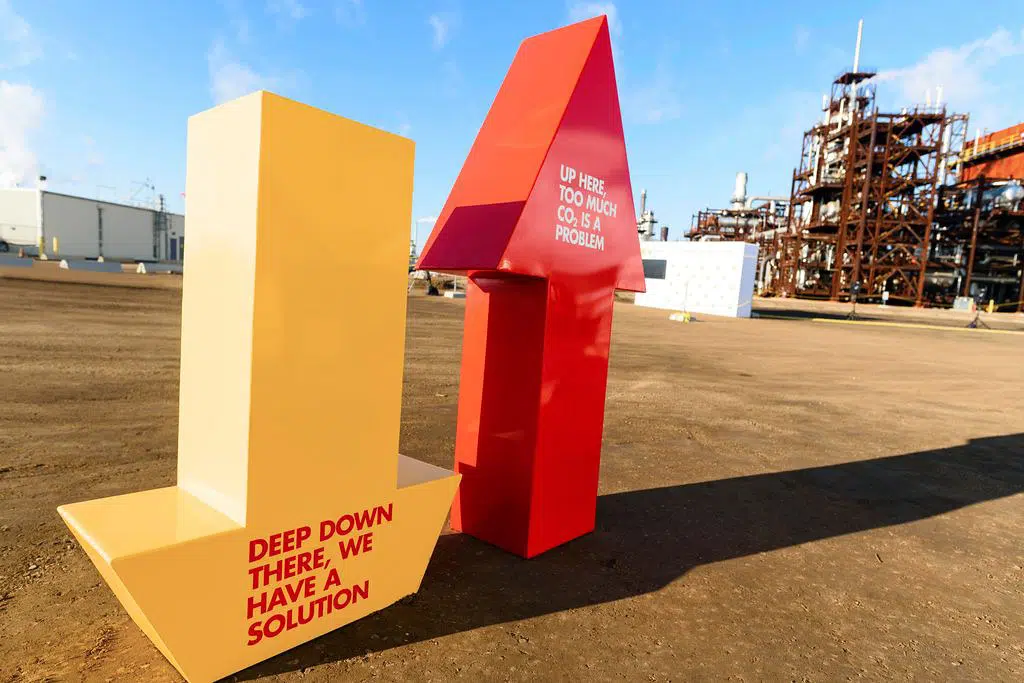
Shell and its joint venture partners have a Quest carbon capture and storage (CCS) project at its Scotford Complex near Fort Saskatchewan, Canada. Credit: Government of Alberta, CC BY-NC-ND 2.0
When Sultan Ahmed Al Jaber opens the 28th annual UN climate conference in Dubai in November, he will be juggling two roles – convincing the world of the United Arab Emirates’ leadership in reducing greenhouse gas emissions, while preserving the very industry that’s causing them.
In addition to his job as summit president, Al Jaber heads the Abu Dhabi National Oil Company (ADNOC), which plans to increase its oil and gas output by 11 percent by 2027. The company says that more oil will mean less emissions, however — provided the industry builds enough facilities to capture carbon dioxide (CO2), the main gas causing the climate crisis.
“We must be laser-focused on phasing out fossil fuel emissions, while phasing up viable, affordable zero carbon alternatives,” Al-Jaber said at a pre-COP 28 event in Bonn in June. The statement was widely interpreted as a pitch for carbon capture.
On September 6, ADNOC finalized a deal to build a carbon capture and storage (CCS) project in the UAE’s Habshan oil and gas field, extending the company’s existing CCS operations at a steel plant. Now projected to become one of the largest carbon capture plants in the Middle East, ADNOC says the facility will have the equivalent climate impact of removing 500,000 cars from the road.
In fact, the project will be used to squeeze even more oil from the ground. Most of the CO2 ADNOC already captures is pumped into existing oil wells, forcing residual crude to the surface in a process known as “enhanced oil recovery” or “EOR”.
It is a trend reflected across the sector: Of the 32 commercial CCS facilities operating worldwide, 22 use most, or all, of their captured CO2 to push more oil out of already tapped reservoirs. This fleet accounts for approximately 31 million tonnes of the world’s roughly 42 million tonnes of operational carbon capture capacity, according to figures published by the industry-backed Global CCS Institute, U.S. Energy Information Administration and other sources.
But the fact that existing carbon capture projects are mostly used to bring more oil to the surface has not stopped oil and gas companies championing the technology as a climate solution in the run-up to COP28.
In January, ExxonMobil Tweeted a video interview with a safety and environment supervisor at its LaBarge CCS project in Wyoming.
“Welcome to La Barge — the industrial facility that has captured the most CO2 emissions on earth to date,” says a caption at the start of the clip.
Nowhere does the video mention that most of the CO2 captured from the LaBarge gas processing plant is being injected underground to extract more oil. Research by the Institute for Energy Economics and Financial Analysis, a nonprofit energy think tank, shows that 97 percent of CO2 captured by the La Barge facility has been sold for EOR since the plant began operations in 1986. In times when EOR was not profitable, CO2 was simply vented into the atmosphere.
While CCS is proving a boon for the fossil fuel industry, a DeSmog review of 12 of the world’s biggest projects has found a litany of missed carbon capture targets; cost overruns; and multi-billion-dollar bills to taxpayers in the form of subsidies.
DeSmog’s research also raises questions over an oft-cited claim that industry captures 41 million tonnes of CO2 annually — or 0.1 percent of the world’s approximately 37 billion tonnes of energy-related CO2 emissions.
Beyond the consistent underperformance of many CCS projects, DeSmog found that most either strip out CO2 in the process of refining fossil fuels, or use their captured CO2 to push more oil out of the ground — or both. The result: existing CCS projects are enabling the release of a much greater amount of overall CO2 emissions into the atmosphere than they are storing underground.
For examples, see a summary of the 12 projects DeSmog analysed here.
From Oilman’s Dream to “Climate Solution”
The process of using carbon dioxide to produce more oil, now known industry-wide as enhanced oil recovery, or “CO2-EOR”, was born in the oil fields of Texas in the early 1970s.
Petroleum engineers from leading oil producers such as Shell, Exxon, and Chevron had discovered that injecting CO2 at high pressure into “mature” or “previously developed” oil reservoirs helped increase the flow of otherwise stubborn hydrocarbons — in essence squeezing more volume out of aging wells.
Though initial tests found that each ton of injected CO2 could push out an additional two or more barrels of oil, the lack of readily available CO2 made the technique expensive. That changed when companies began siphoning off CO2 emitted from several Texas gas processing plants, and piping it to an oil field to boost productivity. To ensure a steady supply, industry agents scoured the region and purchased the rights to mine naturally occurring CO2 deposits in Colorado, New Mexico, and Arizona — eventually building hundreds of miles of dedicated pipelines to transport the gas to oil-field injection points.
By the late 1970s, amid growing concerns over what was then known as the “greenhouse effect,” industry executives began to propose that capturing CO2 and burying it underground could allow the world to continue generating power from fossil fuels far into the future. In 1992, the Paris-based International Energy Agency (IEA) and other energy organizations established a research program to support developers seeking to prove CCS at scale.
By the time of the first U.N. climate conferences in the mid-1990s, the oil industry had begun marketing carbon capture as a technological “silver bullet” capable of making coal “clean,” and rendering oil and gas as “low carbon” — a strategy employed by oil majors to this day.
However, capturing CO2 is not the same as avoiding its climate impacts. If that CO2 is then used to directly produce more oil, or if CCS “abatement” is used to suggest that additional oil and gas production is climate-friendly — or in some cases both — then those CCS projects are invariably acting as a net harm to the climate, by actually increasing overall CO2 pollution.
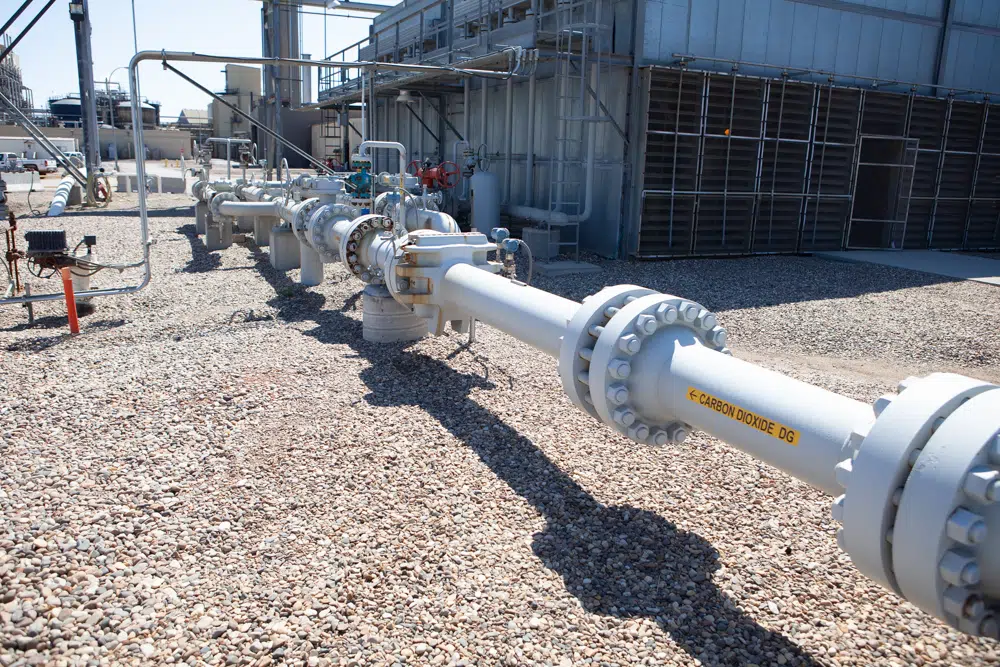
Carbon dioxide runs through pipes at a North Dakota CCS plant. Credit: Buchsbaum Media.
For example, the fossil fuel industry often points to Norway’s pioneering Sleipner CCS facility — which has captured and buried approximately one million tons of CO2 per year under the North Sea since 1996 — as proof that carbon capture works. But that figure does not account for all the additional CO2 that’s emitted when fossil gas produced by the plant is burned by end-users.
Energy expert Michael Barnard, estimates that even though Sleipner has stored about 23 million tons of CO2 from 1996-2019, burning the gas refined by the plant over that time has released some 581 million tons of CO2 into the atmosphere — or more than 25 times the amount that was sequestered. (For more details on Sleipner, see DeSmog’s review of 12 CCS facilities).
Profit Driver
Now an established technique worldwide, producers generally use CO2-EOR to recover oil from older “depleted” fields, where less sophisticated recovery methods have left up to two-thirds of the original oil behind. If the geology and economics are favorable, using EOR techniques can extend the productive life of developed oil fields for several more decades.
To put the significance of this approach to the oil industry into perspective, according to the U.S. National Energy Technology Laboratory, of the 600 billion barrels of oil that have been discovered in the U.S., approximately 400 billion are unrecoverable by conventional means. But half of that unrecoverable oil — or 200 billion barrels — could be squeezed to the surface through CO2-EOR.
Today, the oil industry pumps some 80 million tonnes of CO2 underground each year to extract more oil, much of it in the U.S. — the world’s leading oil and gas producer, and biggest user of CCS-EOR, which drives six percent of the country’s daily output. In some cases, the technique can squeeze up to four or five additional barrels from otherwise declining fields for every ton of injected CO2. Though geology plays a role, one of the main factors inhibiting even greater EOR volume is the lack of cheaply available CO2.
Despite many EOR projects simply being intended to extend oil production, companies often label them as climate-friendly “carbon capture” facilities since about half the CO2 injected underground remains there, depending on local geological conditions.
However, climate claims made on the basis of CCS projects also often ignore the fact that much of the CO2 the industry “captures” for EOR purposes is mined from naturally occurring underground deposits, and reburying this gas in an oil field does nothing to reduce the amount of emissions humans are releasing into the atmosphere by burning fossil fuels.
Government Backing
While costs for proven zero-carbon emitting renewable energy technologies are plummeting, CCS projects have remained dependent on subsidies and tax breaks that often incentivise some of the world’s richest and most polluting companies to capture CO2 to produce more oil.
Governments worldwide have awarded at least $19 billion in subsidies to CCS projects over the last 20 years, according to data compiled by Oil Change International, a research and advocacy organization. This number includes more than $4 billion in failed projects, including the troubled Kemper Facility, a now-abandoned “clean coal” and EOR scheme. (For details, please see DeSmog’s review of 12 CCS projects).
Carbon capture technology used at a coal mine in 2014. Credit: Peabody Energy, Wikimedia Commons (CC BY-2.0)”>Wikimedia Commons Wikimedia Commons (CC BY-2.0)”>CC BY-2.0
By far and away, the United States has extended the most government support for CCS, estimated at $15 billion since 2010. Canada, Australia, and the European Union have also poured billions into the technology. Norway’s state-owned Statoil, now Equinor, was also an early CCS adopter, and the government continues to pour billions into new, more sophisticated projects. Likewise, state-owned companies in China, as well as Brazil’s Petrobras, Saudi Arabia’s Aramco, and the United Arab Emirates’ ADNOC are receiving support to develop and expand their existing CCS operations.
U.S. Doubles Down
Despite the fact that almost three-quarters of existing CCS projects are used to pump more oil, new climate policies on both sides of the Atlantic are driving more government support.
In August last year, U.S. President Joe Biden’s Inflation Reduction Act (IRA) – which contained sweeping climate provisions — significantly expanded tax credits for investments in CCS beyond an existing $12 billion in government support. Under the revised “45Q” credits section, companies can now claim $60 per ton of CO2 captured for EOR — up from $35 before the Act was passed — and $85 per ton of CO2 captured for geological storage, up from $50.
Additionally, the IRA reduces the requirements for eligible CCS projects while locking in a seven-year extension to qualify for the tax credit, meaning that developers have until January 2033 to begin construction.
The industry-backed Global CCS Institute reckons these tax breaks and other enhancements could increase CCS deployment in the U.S. 13-fold to more than 110 million tonnes per year by 2030.
Since there has been no cap set as to how much the U.S. government can pay through new carbon capture credits, Bloomberg New Energy Finance and Credit Suisse caution these subsidies could balloon to a vast $50 to $100 billion in CCS giveaways over the next decade.
Flurry of Deals
More than 50 new CCS projects were announced within months of the passage of the IRA — spurred on by even more support from the Biden administration.
In July, ExxonMobil, which boasts more CCS experience than any other company, spent over $5 billion to acquire independent oil and gas producer Denbury Resources and its 1,300 miles of CO2 pipeline infrastructure. In projects almost entirely devoted to EOR, Denbury has been injecting over four million tonnes a year of carbon captured from industrial and natural sources into various oil fields in 10 onshore sequestration sites across the Gulf region of the U.S.
Buying Denbury allows ExxonMobil to not only advance its various carbon capture deals, but also gives it a great potential revenue source as polluting companies increasingly resort to buying carbon credits to meet climate targets. With an expanding CO2 pipeline network already in place, ExxonMobil can now offer itself up as an emissions disposal company and cash in on the associated tax credits.
Looking ahead, ExxonMobil says that CCS and other “carbon management” schemes could develop into a $4 trillion global market by 2050.
‘Preserve our Industry’
The deal-making continued in August, when the White House and the Emirati government endorsed a new partnership between ADNOC and Texas-based Occidental Petroleum to “supercharge and accelerate decarbonization solutions” in the UAE, the United States, and around the world. Both partners are currently running large-scale carbon capture projects specifically aimed at producing “low carbon” oil.
One of the technologies the partnership will explore is “direct air capture,” which involves sucking air through giant fans and filtering out CO2 with a chemical-lined filter. The CO2 can then be stored underground or piped to petroleum wells to help extract oil. Bonus funds in Biden’s IRA are now available to prove this experimental technology is viable.
Currently the world’s first large-scale direct air capture plant in Iceland stores about 4,000 tonnes of CO2 a year, about 0.001 percent, of global carbon capture capacity, according to data from the Global CCS Institute. That’s less than four second’s worth of global emissions. However, these modest beginnings have not tempered oil industry enthusiasm for the technique.
“We believe that our direct capture technology is going to be the technology that helps to preserve our industry over time,” Occidental Petroleum Chief Executive Vicki Hollub told a major fossil fuel conference in Houston in March. The company is already the U.S. leader in carbon capture operations, and Hollub says new advances could serve as a lifeline for the oil industry, extending operations “60, 70, or 80 years in the future,” she noted.
Direct air capture plants could soon be used to trap CO2 for enhanced oil recovery operations in the US, the UAE and beyond. In 2021, ADNOC announced plans to produce “low carbon” petroleum, and last year Occidental signed its first contract for “net-zero oil”.
European Commission President Ursula von der Leyen requested a Dutch foreign official to examine CCS as a climate solution. Credit: WikiMedia Commons, CC BY-NC-ND 2.0“>WikiMedia Commons
Europeans Follow Suit
Aggressive support for CCS from the Biden administration has found echoes across the Atlantic. In March, the European Commission proposed that the EU should target 50 million tonnes per year of CO2 capture capacity by 2030, from almost zero today. The target forms part of the draft Net-Zero Industry Act, a key piece of climate legislation aiming to drive the clean energy transition.
European Commission president Ursula von der Leyen has since instructed Wopke Hoekstra, a former Dutch foreign minister who has worked for Shell, to examine CCS as a climate solution before he takes over as climate commissioner in October.
Against this backdrop of positive policy signals, the oil industry has announced a spate of ambitious carbon capture plans in Europe, a continent with little existing CCS infrastructure outside of Norway – almost all of which plan to store CO2 under the North Sea.
In the UK, the North Sea Transition Authority, which regulates the country’s oil and gas industry, this month awarded 21 licenses to 14 companies to store captured CO2 into blocks for formerly productive oil and gas fields under the seabed. The combined CCS plan aims to store 30 million tonnes of CO2 annually by 2030.
Around the world, hundreds of new carbon “abatement” projects reliant on CCS to clean up fossil-fueled electrical generation, steel and cement output, as well as hydrogen production, are now scheduled to come online by the end of the decade.
This, in turn, has triggered a scramble by companies seeking to enter the rapidly emerging CO2 logistics, handling, shipping and disposal markets.
Despite all this activity, announced global schemes to capture and bury CO2 constitute only a tiny fraction of what would be needed to slow climate change, critics say. Based on the current project pipeline, the International Energy Agency predicts that by 2030, the world’s annual carbon capture capacity from both new construction and retrofits could amount to a total of 205 million tonnes of CO2, only about 0.5 percent of current global energy-related emissions.
Moreover, the core of the IEA’s Net Zero scenario, as well as similar roadmaps for avoiding the worst impacts of climate change, rests on rapidly accelerating the shift to renewables from fossil fuels, regardless of whether a portion of CO2 emissions are “abated” through capture and storage.
Aware of the risks of the oil industry presenting CCS as a catch-all climate solution at COP28, some governments are pushing back. In July, ministers from Germany, France, Denmark, the Netherlands and more than a dozen other nations published a joint letter warning that CCS and “abatement technologies must not be used to green-light continued fossil fuel expansion.” Instead, such technologies “must be considered in the context of steps to phase out fossil fuel use, and should be recognised as having a minimal role to play in decarbonization.”
With the Emirati hosts seemingly determined to champion carbon capture, and the oil industry planning to market ever more barrels of “net-zero” oil, the battle over the future of a 50-year-old technology may have only just begun.
Click here for case studies from a DeSmog review of 12 of the world’s leading CCS projects, and their impact on the climate.