NHS news review

Spread the love

40 health care experts warn that the Destroy the NHS / Health and Social Care Bill will “[usher in] a significantly heightened degree of commercialisation and marketisation that will lead to the harmful fragmentation of patient care; aggravate risks to individual patient safety; erode medical ethics and trust within the healthcare system; widen health inequalities; waste much money on attempts to regulate and manage competition; and undermine the ability of the health system to respond effectively and efficiently to communicate disease outbreaks and other public health emergencies”.

David Cameron responds: “Of course there are doctors and others within the NHS that are wary about parts of our proposals, about greater choice for patients, about greater competition with the NHS.

“There have always been opponents to that, but the point of the exercise we held in the summer, when we paused and restarted the reforms, was to bring more of the health service on board, and many GPs, many doctors and many in the health service recognise that change is necessary if we are going to drive up standards in the health service, in which we invest and care about so much.”

He added: “I think the reforms are right, I think they will improve patient care. Above all, they will be good for patients. They are going to give you more power and control over the care you get, a greater choice too, which I think patients will welcome.”

It appears that there is a choice between 40 accomplished health professionals and a former Bullingdon Clubber with a track record of lying and broken promises to get elected.

Professor Norman Williams, head of the Royal College of Surgeons warns that rationing operations in the short term will cost more in the long term.

Andrew Lansley to address the NHS-destroying Conservative Party Conference today.
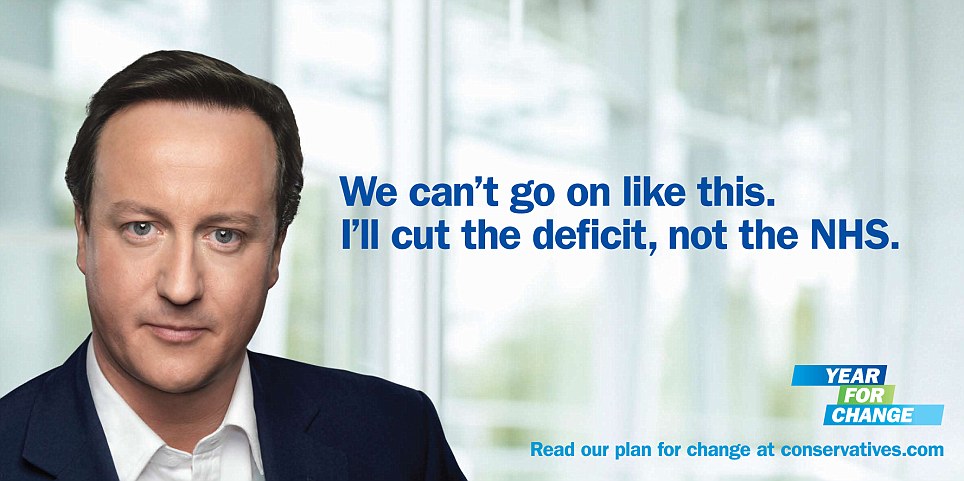
Conservative election poster 2010

A few recent news articles about the UK’s Conservative and Liberal-Democrat coalition government – the ConDem’s – brutal attack on the National Health Service.

Scrap NHS reforms, doctors tell Lords | Society | The Guardian

Experts including 40 directors of public health say government’s health and social care bill will cause ‘irreparable harm’

Sarah Boseley

More than 400 senior doctors and public health experts are calling on the House of Lords to throw out the government’s health and social care bill, saying it will do “irreparable harm to the NHS, to individual patients and to society as a whole”.

The signatories include Professor Sir Michael Marmot, the author of several reports on the links between wealth and health that suggest children born into poverty are penalised for life.

Marmot has until now not been openly critical of the coalition’s approach, and instead has offered encouragement for David Cameron and Andrew Lansley’s apparent enthusiasm for public health.

But Marmot and others in senior positions have now concluded the bill will damage all aspects of the health service.

“While we welcome the emphasis placed on establishing a closer working relationship between public health and local government, the proposed reforms as a whole will disrupt, fragment and weaken the country’s public health capabilities,” says the letter.

“The government claims that the reforms have the backing of the health professions. They do not. Neither do they have the general support of the public.”

The letter details the harms the experts believe the health reform bill will do.

“It ushers in a significantly heightened degree of commercialisation and marketisation that will lead to the harmful fragmentation of patient care; aggravate risks to individual patient safety; erode medical ethics and trust within the healthcare system; widen health inequalities; waste much money on attempts to regulate and manage competition; and undermine the ability of the health system to respond effectively and efficiently to communicate disease outbreaks and other public health emergencies,” the letter says.

In their judgment, the signatories say, the bill “will erode the NHS’s ethical and co-operative foundations” and “will not deliver efficiency, quality, fairness or choice”.

The signatories include around 40 directors of public health from around the country who have taken the difficult decision to go public with their concerns. There are also two senior members of the Faculty of Public Health, one of whom, Dr John Middleton, is a vice-president. Other well-known names include Professor John Ashton, director of public health in Cumbria, and Professor Michel Coleman from the London School of Hygiene and Tropical Medicine.

Dr David McCoy, consultant in public health medicine at the Inner North West London primary care trust, one of the organisers of the letter, said he was surprised at the number of people prepared to sign. “I think if we had continued to collect signatures, I’m quite sure we would have collected another 200 It is having a snowball effect,” he said. “I think the feeling is incredibly strong.”

There was a lot of debate about whether we should call for outright rejection or amendments, but there is a feeling the whole package of reforms is harmful and we need to express our position in the strongest terms. I think there was a feeling the forthcoming reading in the House of Lords is the last chance of minimising the harm and damage.”

The public health community has not spoken out in this way before. “I think there has been an attempt to work with the reforms and work behind the scenes to optimise the proposed reforms,” said Dr McCoy.

Dr Middleton said there was no great opposition to the planned move to place public health services such as smoking cessation within local authorities. “But the letter is a recognition from the public health community that the reforms proposed around the NHS are deeply damaging to the public health in themselves,” he said. There was concern that they would lead to inequalities in healthcare and less access for the poorest and most deprived to the services they need.

Cameron defends coalition NHS reforms – UK Politics, UK – The Independent


Mr Cameron told ITV1’s Daybreak: “Of course there are doctors and others within the NHS that are wary about parts of our proposals, about greater choice for patients, about greater competition with the NHS.

“There have always been opponents to that, but the point of the exercise we held in the summer, when we paused and restarted the reforms, was to bring more of the health service on board, and many GPs, many doctors and many in the health service recognise that change is necessary if we are going to drive up standards in the health service, in which we invest and care about so much.”

He added: “I think the reforms are right, I think they will improve patient care. Above all, they will be good for patients. They are going to give you more power and control over the care you get, a greater choice too, which I think patients will welcome.”

Commentary: these reforms will leave NHS a poorer service – Telegraph

* Dr David McCoy is a Consultant in Public Health Medicine in Inner North West London and Senior Clinical Research Fellow at the Centre for International Health and Development, University College London

[snipped a long but interesting section on the health service in Apartheid South Africa]

Now in the midst of the NHS’s transformation, I am struck by the contrasts to South Africa. Instead of strengthening the functional integrity of the health system, the reforms have created chaos and disorganisation.

Instead of protecting the public and patients from the corrosive effects of commercialisation, competition, private capital and the financial motive is being encouraged. And instead of directing more money towards benefiting patients, a rising proportion of expenditure will be siphoned out of the NHS as surplus value for private profit or on the infrastructure required to“manage competition”.

The NHS may remain publicly funded and mostly free at the point of service. But it will become a poorer service; and it will stop being a single, comprehensive and universal system for all. It will become a more fragmented and uneven collection of service points operating in parallel to systems of private insurance and with multiple tiers of care.

As for public health, when the reforms were first announced, many professionals saw the glint of a silver lining. The government was proposing to elevate the profile of public health by creating a dedicated public health agency and ringfencing public health budgets.

The proposal to move certain functions to local government was welcomed as a means of placing greater emphasis on ‘upstream’ determinants of health such as education, housing, diet, leisure and exercise. Even the ‘Big Society’ chimed with the evidence that social empowerment and solidarity underpin good health.

However, there are a many threats to public health. Organisational disruption has resulted in huge amounts of money, time and energy being diverted from real work, including the sustained development of shared knowledge, understanding and trust across the different elements of the health care system, local government and communities – vital for the building of participatory and integrated responses to rising unemployment, youth alienation, fuel poverty, social inequality and homelessness.

Public health will also be downsized and subjected to competition and commercialisation, including a ‘reductionism’ in which it will be broken up into discrete interventions, some of which will be commoditised and outsourced.

The direct involvement of businesses in the formulation of public health policy, contrary to professional advice and evidence,also signals a backward step in the urgent need to regulate the food, alcohol, sugar and tobacco industries.

The relationship between public health and clinical care may also become more distant. At the moment, local public health and clinical budgets are mostly held together within Primary Care Trusts.

But in the future, public health and clinical budgets will be spread across different organisations, potentially undermining the public health function of bridging clinical medicine with the social context and physical environment of families and patients. Cancer screening, immunisations and communicable disease control will become harder and more costly to deliver.

Critics of the reforms are frequently labelled as being ‘anti-privatisation’. But it is commercialisation, the intrinsic tendency for health care markets to fail and the damage that competition does to patient care, trust and ethical practice that lie at the heart of most objections.

Health is a lottery in out-of-control NHS, warns top surgeon – Health News, Health & Families – The Independent

A postcode lottery has returned to the NHS with “a vengeance”, the leader of Britain’s surgeons warned yesterday, as hospitals look to secretly cut costs without consulting doctors or patients.

Professor Norman Williams, the new head of the Royal College of Surgeons, said some hospitals were now rationing operations that would have otherwise saved the NHS money in the long term, because of a short-term desire to cut costs.

“We are back at the moment to a postcode lottery with a vengeance,” he told a fringe meeting at the Conservative party conference. “This is happening without any transparency of public debate and often without clinical involvement.”

Today Andrew Lansley, the Health Secretary, will address the conference and highlight some of the progress the NHS has made in investing in frontline services by taking away “bureaucracy” from the NHS. He will also announce new mandatory language checks for NHS doctors to ensure only those who can speak “a good level of English” are allowed to practise.

Highlighting some of the problems thrown up by the Government’s reorganisation of the NHS, Professor Williams said some health authorities were now unilaterally restricting operations which had significant clinical benefit.

Some were refusing to give gastric bands to morbidly obese patients while others who needed hip or hernia operations were also being denied them.


27/11/13 Having received a takedown notice from the Independent newspaper for a different posting, I have reviewed this article which links to an article at the Independent’s website in order to attempt to ensure conformance with copyright laws.

I consider this posting to comply with copyright laws since
a. Only a small portion of the original article has been quoted satisfying the fair use criteria, and / or
b. This posting satisfies the requirements of a derivative work.

Please be assured that this blog is a non-commercial blog (weblog) which does not feature advertising and has not ever produced any income.

dizzy

Continue ReadingNHS news review

NHS news review

Spread the love

There are two main news stories concerning the NHS in the past few days: Opposition to privatisation of the NHS at the Labour Party Conference and campaigners succeeding in – at least temporarily – preventing NHS Gloucestershire from transferring NHS staff and facilities to a private ‘Community Interest Company’.

A report by the Royal College of Surgeons identifies poor and inconsistent levels of critical care contributing to deaths.

NHS Direct to close three call centres.

Cherry Blair intends to profit from NHS privatisation.

Conservative election poster 2010

A few recent news articles about the UK’s Conservative and Liberal-Democrat coalition government – the ConDem’s – brutal attack on the National Health Service.

Tories not to be trusted with the NHS, Miliband warns | GPonline.com

Labour leader Ed Miliband has hit out at the government’s plans for NHS reform, warning that the changes will ‘betray the values of the NHS’.

Speaking at the Labour party annual conference in Liverpool on Tuesday, Mr Miliband received a standing ovation and the largest applause during his speech when he warned ‘you can’t trust the Tories with the NHS’.

He said the government’s reform plans will undermine the values of the NHS as the reorganisation will create a ‘free-market healthcare system’.

The Labour leader also criticised prime minister David Cameron, outlining that he ‘betrayed voters’ trust’ by U-turning on his election promise to end top-down reorganisations in the NHS.

Mr Miliband said: ‘When I look at everything this Tory government is doing, frankly it is the NHS that shocks me most. Why? Because David Cameron told us he was different. You remember. The posters. The soundbites.

‘David Cameron knew the British people did not trust the Tories with the NHS. So he told us he wasn’t the usual type of Tory. And he asked for your trust. And then he got into Downing Street. And within a year he’d gone back on every word he said.’

NHS hospitals will not be privatised under Labour, Healey says | Society | The Guardian

John Healey, the shadow health secretary, has pledged that a Labour government would ensure NHS hospitals remain in public sector hands as he rounded on government plans to open up all parts of the NHS to private companies.

Healey also seized on the crisis witnessed at Southern Cross care homes earlier this year to admit that Labour “did not act before” against predatory fund managers who saw “elderly people as commodities”.

But he promised that a future Labour government would do so by regulating the care home sector not just on the basis of best care standards but also on “best business practices”.

Healey delivered a combative speech to the Labour party conference in Liverpool after delegates debated a motion condemning the government’s controversial health and social care bill as unnecessary and representing “the biggest top-down reorganisation in the history of the NHS at a time when finances are squeezed”.

Despite changes to the bill, the motion stated that health professionals are still opposed to it “because the essential elements … remain in place, which will fragment the NHS through exposing the NHS to the full force of EU and UK competition law with a commercial regulated market designed to give the impression of patent choice”. The new NHS commissioning board will be “the largest quango the world has ever seen”, it said.

Healey warned that the battle was “not over” against the legislative plans in the health and social care bill, which would break up the national service and set it up as a “full scale market, ruled for the first time by the full of competition law”.

Accusing David Cameron of betrayal, he said. “No one wants this. No one voted for this.”

He said the proposals threatened to destroy Labour’s “golden legacy” to NHS patients, as he hailed the founding of the NHS under a post-war Labour government, and the great improvements he said patients saw under the party’s 13 years in power through investment and reform.

Referring to reports that ministers were privately eyeing up the “huge opportunities for the private sector”, Healey said any move to privatise NHS hospitals would drive a wedge between hospitals and the wider health service as private companies driven by the bottom line to make profits would refuse to collaborate with others. But he ruled out barring private sector involvement in any shape in the NHS.

Healey, whose predecessors introduced independent treatment centres, said Labour believed there would always be an important contribution for non-NHS providers, “including private providers” in the NHS, but as supplements to, not substitutes for, the NHS.

But loud applause followed when he drew a line on private companies moving in to run NHS hospitals.

“Hospitals are at the heart of our NHS. They should be in public not private hands, dedicated totally to patients, not profits. So we will oppose any move to privatise NHS hospitals. We will guarantee under Labour that the NHS hospitals remain in the NHS.”

Campaigners halt NHS service transfer to social enterprise – Civil Society – Finance – News – providing news and in-depth coverage of charities, voluntary organisations and not-for-profits

Gloucestershire NHS has reportedly agreed to delay the proposed transfer of primary health services and 3,000 staff to a community interest company after local campaigners threatened legal action.

In an eleventh-hour legal challenge, the campaign group Stroud Against Cuts has issued a ‘letter before claim’ to the NHS management warning that it plans to seek a judicial review of the decision to farm out local Primary Care Trust services.

NHS Gloucestershire had awarded a contract to deliver primary and community care services, including nine hospitals, to Gloucestershire Care Services, creating the largest Community Interest Company in the UK. No competitive tendering process took place.

The contract, reportedly worth around £100m a year for three years, was due to start on 1 October but according to the campaigners, the NHS has now agreed to delay it while it takes legal advice on its position.
First example

Campaign co-ordinator James Beecham told civilsociety.co.uk: “We believe this is the first example where a social enterprise has got this far and been halted by a legal challenge.

“The current state of play is that the transfer is off while NHS Gloucestershire management assess their legal position.

“In the meantime they have given us an absolute guarantee that they won’t transfer anyone or anything out of the NHS without giving us three days clear notice.”
NHS would not confirm delay

However, NHS Gloucestershire refused to confirm or deny this was true, only saying that it was still assessing the legal situation. In a statement, its chief executive Jan Stubbings said: “We are responding to the correspondence received.

“In deciding on the future management of our community services to meet local needs and circumstances, we have followed all applicable policy and guidance.

“Through this process, we believe we have identified the most appropriate solution for the future. We now have a clear direction with the majority of our community health services becoming part of a social enterprise – working in the community interest and for the social good.

“With a membership model, the new organisation will give staff and service users a stronger voice on how services are run for the benefit of local communities.”
Lawsuit on behalf of service-user

The action is being brought by local resident Michael Lloyd, a user of the PCT’s services, with backing from Stroud Against Cuts. Lloyd’s costs are covered by legal aid but the campaign group is fundraising to cover the community element of the lawsuit.

The campaigners want the services to remain in public hands, fearing that contracting them out is the first step to NHS privatisation.
Contract ‘unlawful’

Caroline Molloy of Stroud Against Cuts said: “We have been advised that NHS Gloucestershire is acting unlawfully. It cannot just hand over all its NHS Primary Care Trust services to an unaccountable social enterprise or community interest company.

“It must either keep the NHS services itself, or have a proper process that would allow services to be provided by another NHS body. Both these options would keep our health services in the NHS, and accountable to the public.”

Lloyd’s solicitor, Rosa Curling of Leigh Day & Co, added: “If the PCT intends to enter into arrangements with a community interest company, it is first required in law to go through a process which allows other economic operators the opportunity of being awarded those contracts.

“No such opportunity has been given and the attempt by the PCT to enter into a contract with a company outside the NHS, in such circumstances, constitutes an unlawful procurement process.”

The campaign brought hundreds of people out onto the streets of Stroud last weekend in protest at the plans (pictured).

Yesterday Stroud District Council hosted a heated ‘extraordinary meeting’ on the issue and passed a motion calling on the local Health Community and Care Scrutiny Committee to examine the proposed move.

Poor critical care ‘risking lives’ – Health News, Health & Families – The Independent

Thousands of patients needing emergency surgery are having their lives put at risk by poor NHS care and delays in accessing treatment, according to a damning report.

The Royal College of Surgeons study found that only a minority of patients who need critical care following surgery receive it, while some die or suffer major complications because of delays in finding space in operating theatres.

Junior staff are often left in charge of dealing with post-surgical complications, which can rapidly lead to death if not treated promptly, the report went on.

A patient’s chance of survival also varies widely between NHS hospitals, and even within the same hospital depending on the day of the week.

NHS Direct to close three call centres | Healthcare Network | Guardian Professional

NHS Direct is to close three of its call centres next year, following landlord East of England ambulance service trust, giving it notice to quit two of the sites in Chelmsford and Norwich. A third site in Ipswich will close because it is supported by the other two.

A spokeswoman for the digital and telephone advice service said the closures were regrettable, but NHS Direct had no choice. A total of 120 staff will be affected, the majority of whom are nurses, although the organisation is hoping to redeploy where possible.

Nick Chapman, the chief executive of NHS Direct trust, said: “There is much work we need to do to understand the full implications of these closures, before a final plan can be agreed by the trust board.”

“Every option will be explored to redeploy those staff affected. We already have over 100 members of our nursing staff currently working from home permanently and there are sites in surrounding areas. No decision has been made to make staff redundant at this time.”

Related: UNISON Press | Press Releases Front Page

Cherie Blair “stands to gain from NHS privatisation” – Telegraph

Cherie Blair is a director of a company which is preparing to profit from the growing privatisation of the health service, it can be disclosed.

The wife of the former Labour prime minister is one of the founders of a business planning to open private clinics in supermarkets.

Her choice of venture is likely to prove controversial among Labour supporters, who will today set out their opposition to greater private involvement in the health system.

Party members jeered at a mention of Tony Blair’s name earlier this week during Ed Miliband’s conference speech.

The company is thought to represent Mrs Blair’s first foray into commerce. It is approaching City financiers just as her husband’s business interests have come under renewed scrutiny.

Mrs Blair was thought to have concentrated on her legal career since he stood down as prime minister in 2007 but she now appears to be seeking to capitalise on Coalition plans to open parts of the NHS to more private sector involvement.

Mee, the company she is involved in, claims that it will provide a “revolutionary new way of delivering health care”.

A prospectus adds that there is “potential to grow into other primary health areas in line with the new proposals for the health services”.

27/11/13 Having received a takedown notice from the Independent newspaper for a different posting, I have reviewed this article which links to an article at the Independent’s website in order to attempt to ensure conformance with copyright laws.

I consider this posting to comply with copyright laws since
a. Only a small portion of the original article has been quoted satisfying the fair use criteria, and / or
b. This posting satisfies the requirements of a derivative work.

Please be assured that this blog is a non-commercial blog (weblog) which does not feature advertising and has not ever produced any income.

dizzy

Continue ReadingNHS news review

NHS news review

Spread the love

‘Health Secretary’ Andrew Lansley’s claims yesterday that 22 NHS trusts had contacted him saying that they had difficulties meeting PFI payments backfired. Lansley’s claims were exposed as misleading and factually incorrect. That Lansley makes misleading and factually incorrect statements is no surprise to those of us that have been watching progress of the Destroy the NHS Bill.

Campaign group UK Uncut intend to occupy Westminster bridge.

Conservative election poster 2010

A few recent news articles about the UK’s Conservative and Liberal-Democrat coalition government – the ConDem’s – brutal attack on the National Health Service.

Hospitals furious at Lansley’s debt claim – Health News, Health & Families – The Independent

Health Secretary ‘undermining stability’ for political ends

Hospitals across the country turned on the Health Secretary Andrew Lansley last night, accusing him of making misleading claims that parts of the NHS were “on the brink of financial collapse” for party political gain.

Senior NHS managers expressed anger that Mr Lansley had singled out 22 trusts, whose “clinical and financial stability” was being undermined by having to pay for prohibitively expensive private finance contracts – used to build their new hospitals.

Mr Lansley claimed the trusts had contacted him saying that they “cannot afford” to pay for their schemes which were agreed by the previous Labour government.

But when contacted by The Independent a number of NHS trusts on the list expressed bemusement and anger that they had been included, and said the first they knew of the supposed financial difficulties over PFI (private finance initiatives) was when they read about Mr Lansley’s comments.

Privately some accused the Health Secretary of attempting to blame PFI for the wider problem of cuts to hospital budgets, which will require the NHS to save £20bn over the next four years. They also expressed concern that Mr Lansley was unnecessarily worrying patients that their local hospital was in danger of going bankrupt. “To suggest that our financial problems are about PFI is nonsense,” said one trust executive. “And we certainly never contacted the Department to say that. The problems that we face are about having to cut our budgets by 4 per cent every year for the next four years.”

UK Uncut plan to block Westminster Bridge in protest against NHS reforms | UK news | guardian.co.uk

Thousands expected to join direct action on 9 October and block bridge leading to parliament

Anti-cuts campaigners are planning to close one of the busiest bridges in central London in protest against the government’s planned shake up of the NHS.

UK Uncut has announced an “act of mass civil disobedience” at Westminster Bridge in protest against the health and social care bill which is due before parliament next month.

Organisers say they are expecting thousands of people to block the bridge that links St Thomas’s hospital in the south to parliament to the north on 9 October.

“Yes, it will be disruptive. Yes, it will stop the traffic. But this is an emergency and if we want to save our NHS we need to shout as loud as we can,” the group said in a statement.

Activists say they have been talking to unions, NGOs and other direct action groups who all support the action.

UK Uncut supporter Samina Khan said: “A leading doctor has said that this bill will ‘produce an underclass of patients with chronic, debilitating illness’, which isn’t surprising when you invite private companies to exploit people’s sickness for profit. I’ll be on the bridge so that when my kids ask me what happened to the NHS, I can at least say ‘I tried’.”


27/11/13 Having received a takedown notice from the Independent newspaper for a different posting, I have reviewed this article which links to an article at the Independent’s website in order to attempt to ensure conformance with copyright laws.

I consider this posting to comply with copyright laws since
a. Only a small portion of the original article has been quoted satisfying the fair use criteria, and / or
b. This posting satisfies the requirements of a derivative work.

Please be assured that this blog is a non-commercial blog (weblog) which does not feature advertising and has not ever produced any income.

dizzy

Continue ReadingNHS news review

NHS news review

Spread the love

Cathy Warwick, General Secretary of the Royal College of Midwives (RCM) suggests abandoning the controversial Destroy the NHS / Health and Social Care Bill.

Falling ill at the weekend could literally cost you your life, according to a report on London hospitals.

The NHS and the Liberal Democrats may be heading for a “catastrophic train crash” by pressing ahead with the coalition Government’s controversial health reforms, an MP has warned.

£12.7bn computer scheme to create patient record system is to be scrapped after years of delays

22 trusts struggling to cope with growing burden of PFI contracts.

dizzy: The spin is turning towards the Labour Party causing the collapse of the NHS by bankrupting it through PFI ( & the IT initiative).

Conservative election poster 2010

A few recent news articles about the UK’s Conservative and Liberal-Democrat coalition government – the ConDem’s – brutal attack on the National Health Service.

Is the only future for NHS reforms to scrap the bill? – Royal College of Midwives

The general secretary of the RCM has questioned whether the only way forward for NHS reforms is to pull the controversial health bill.

Cathy Warwick told Midwives that all changes which the government wants could be achieved without the bill.

She added that it is hard to believe the bill isn’t just a move towards privatisation.

‘We are close to feeling that the only way forward for the bill is for it to be withdrawn,’ she said.

‘My feeling is quite strong that everything we are being told the government wants to achieve would be possible without this bill.

‘So it is hard to believe that the bill is about anything other than ideology and privatisation.’

NHS London report says being ill at weekend could kill you – Health – London 24

Falling ill at the weekend could literally cost you your life, according to a report on London hospitals.

More than 500 people needlessly die every year in hospital because of too few doctors.

Patients are not seen promptly enough by a consultant on Saturdays and Sundays in accident and emergency, found NHS London.

“Reduced service provision at weekends is associated with this higher mortality rate,” it stated.

That lack of availability puts patients at risk of death.

“Stark” differences exist in the number of hours worked by consultants during weekends at hospitals in London, it found in Acute medicine and emergency general surgery – case for change.

Lib Dem warns of NHS ‘train crash’ – UK Politics, UK – The Independent

The NHS and the Liberal Democrats may be heading for a “catastrophic train crash” by pressing ahead with the coalition Government’s controversial health reforms, an MP has warned.

Lib Dem MP Andrew George, a vocal opponent of the Health and Social Care Bill, told members at the party’s autumn conference in Birmingham that the plans represented the “biggest upheaval” in the NHS’s history at precisely the time when it needed stability and certainty.

The St Ives MP said: “I want to do my best to save the NHS from what I believe may be a catastrophic train crash, which I fear may take the party with it.”

Mr George, who is a member of the Commons Health Select Committee, said the proposals raised the “very real risk” of producing an NHS driven more by private profit than concern with patient care.

He claimed the reforms represented “a major missed opportunity” to produce a service which was more accountable to communities and patients.

He said: “I think the future fate of both this party and this coalition Government needs to take heed of the concept that, actually,’it’s the NHS, stupid’.”

Charles West, from Shrewsbury and Atcham, who has been a prominent figure in the Lib Dem grassroots opposition to the reforms, compared the Bill to a “leaky ship”.

“If it sails at all it will go in the wrong direction,” he said. “I’m more worried that the ship will sink and that the NHS will sink with it, and if our name is on that ship we will go down as well.

“And, friends, we deserve to.”

NHS told to abandon delayed IT project | Society | The Guardian

£12.7bn computer scheme to create patient record system is to be scrapped after years of delays

An ambitious multibillion pound programme to create a computerised patient record system across the entire NHS is being scrapped, ministers have decided.

The £12.7bn National Programme for IT is being ended after years of delays, technical difficulties, contractual disputes and rising costs.

Health secretary Andrew Lansley, Cabinet Office minister Francis Maude and NHS chief executive Sir David Nicholson have decided it is better to discontinue the programme rather than put even more money into it. The axe may be wielded , with ministers likely to criticise the last Labour government for initiating the project but doing too little to ensure it delivered its objectives.

PFI schemes ‘taking NHS trusts to brink of financial collapse’ | Politics | guardian.co.uk

Health secretary says he has been contacted by 22 trusts struggling to cope with growing burden of private finance contracts

The rising costs of paying for hospitals under private finance initiative schemes is bringing NHS trusts to the “brink of financial collapse” and putting patient care at risk, the health secretary has warned.

Andrew Lansley said he had been contacted by 22 trusts that are struggling to cope with the growing burden of the PFI contracts, a policy of the former Labour government under which private capital is used to build hospitals and the NHS is left with an annual fee or “mortgage”. Between them, the trusts run more than 60 hospitals.

Speaking on BBC Radio 4’s Today programme, Lansley said: “We’re not going to let hospitals collapse financially.

“But if we were simply to carry on as the Labour party did in government, we would be seeing hundreds of millions of pounds every year being taken from what could provide improving services for patients in order to pay for PFI projects that roll forward for decades.”

He added that patient care could be jeopardised in the areas covered by the 22 trusts, saying: “We’re looking at a risk to services in their areas.”

Buckinghamshire, Oxford Radcliffe, North Bristol and Portsmouth are understood to be among the trusts in difficulty.


27/11/13 Having received a takedown notice from the Independent newspaper for a different posting, I have reviewed this article which links to an article at the Independent’s website in order to attempt to ensure conformance with copyright laws.

I consider this posting to comply with copyright laws since
a. Only a small portion of the original article has been quoted satisfying the fair use criteria, and / or
b. This posting satisfies the requirements of a derivative work.

Please be assured that this blog is a non-commercial blog (weblog) which does not feature advertising and has not ever produced any income.

dizzy

Continue ReadingNHS news review

NHS news review

Spread the love

Monitor to employ 600 at an average salary of over £50,000.

Private health firms are experiencing a boost in business from NHS cuts.

The ConDem coalition government eases information requirments for private healthcare providers.

The ConDem coalition government hides the cost of reforming the NHS until after the third reading of the Destroy the NHS / Health and Social Care Bill. It is disappointing that the government resorts to such subterfuge.

Conservative election poster 2010

A few recent news articles about the UK’s Conservative and Liberal-Democrat coalition government – the ConDem’s – brutal attack on the National Health Service.

NHS ‘watchdog’ set to become ‘bureaucratic monster’, says Unite

Monitor – the government’s revamped organisation to regulate competition in the NHS – is set to become ‘a bloated bureaucratic monster’, Unite, the largest union in the country, has warned.

Unite said that Monitor’s running costs were set to soar from £72 million-a-year to £82 million – with a 600-strong staff being paid twice the national average wage of £26,000.

Unite said that ministers were creating a bloated, old fashioned bureaucracy which would be responsible for handing over lucrative NHS contracts to the ‘government’s friends’ in the private healthcare sector.

Monitor was expecting to spend a further £14 million-a-year on consultants and £4 million in legal fees, according to the Department of Health’s own Impact Assessment report.

Monitor is a lynchpin of the government’s Health and Social Care Bill, currently before Parliament, with the remit of promoting choice, competition and collaboration – which Unite says are contradictory and confusing aims.

Unite national officer for health, Rachael Maskell said: ‘It is equally disgraceful that the Impact Assessment team have been unable “to develop a robust monetary estimate of the benefits of changes to the regulatory regime”.

‘All this indicates that a revamped Monitor is not being geared for the benefit of patients, but as a conduit to channel lucrative NHS contracts to private healthcare companies, many of whom have bankrolled the Tory party since David Cameron became leader.’

‘Monitor anticipates employing about 600 staff at an average cost of £84,000 each, which would include salaries, National Insurance contributions, any pension provision and other costs.’

‘This works out at average annual salary levels of more than £50,000 – double that of the average national salary of £26,000. A bloated bureaucratic monster is being created – so much for all the ministerial chatter about efficiency savings. This is being paid for by cuts to frontline services, as well as staff pay and terms and conditions.’

Grasp the nettle now – before it’s too late / Features / Home – Morning Star

As Andrew Lansley’s hugely controversial and largely unaltered Health and Social Care Bill faced its crucial vote in the Commons, unelected Tory Health Minister Lord Howe was smugly assuring a conference of grasping private-sector companies that the Bill offers them “genuine opportunities” to take over large chunks of the NHS.

There would be profitable opportunities galore – both in the provision of certain profitable services and in supplying management expertise to help GPs decide how to spend local budgets.

Howe recognised that “the NHS will not give up their patients easily.”

But of course that’s why the Bill, which sailed through a docile Commons with a majority of 65, will stack the odds against public-sector providers and open up most of the £100 billion NHS budget in England to cherry-picking private companies.

It will scrap any pretence at strategic planning or equitable provision by abolishing primary care trusts and strategic health authorities and strip away the thin veneer of local accountability, putting a new national body, the NHS Commissioning Board, and the regulator Monitor – led by pro-market fundamentalist and former McKinsey consultant David Bennett, who was also at the conference with Howe bigging up the private sector – firmly in charge.

Monitor will draw up the list of “any qualified providers” which GPs will have to offer as “choices” when patients need further treatment.

The Bill, coupled with the massive £20bn cuts programme to be achieved by 2014, will also pull the financial rug from under dozens of major NHS hospitals, forcing them to close services, merge with neighbouring trusts and axe staff to stay afloat.

At the same time it will encourage many foundation trusts to maximise the numbers of wealthy private patients they treat, by removing all limits on the amount of money they can make.

While David Cameron and his arrogant, lying ministers falsely claimed support from “the Royal College of GPs, the Royal College of Physicians, the nurses, people working in the Health Service,” we all know that quite the opposite is the case.

The Bill is even opposed by a large majority of GPs, who are the only people apparently set to benefit from its proposals, making Lansley possibly the first politician in history to seek to force £80bn in commissioning budgets into the hands of people who insist they don’t want it.

The Bill is also rejected by the BMA, which has promised to step up its lobbying against the Bill in the Lords, by Royal Colleges, and by almost every academic and think tank not in the pay of the neoliberal right wing.

Every health union is also against the Bill, but the mass campaign that was needed to stop it has still not taken off – a year after the TUC voted unanimously against the outlines of the Bill, as set out in Lansley’s white paper.

NHS rationing boosts private healthcare firms – report | Business | The Guardian

NHS costs squeeze means longer waiting lists – and growing numbers of patients opting to pay for operations, say private firms

by Denis Campbell

Private healthcare firms are experiencing an increase in business caused by the financial squeeze across the NHS in England, a new report on the sector shows.

Independent providers are benefitting from the growing number of patients who are choosing to pay for their own care after having treatment delayed or denied altogether by an NHS primary care trust (PCT).

In a survey of 101 influential industry figures – including chief executives, investors and advisers – 34% said budgetary pressure in the NHS had led to increased demand for private healthcare.

While the reasons were not given, experts said the NHS’s need to cut costs was prompting patients to fund their own hip or knee replacement, hernia repair or cataract removal. “We are certainly picking up that some patients are being asked to wait longer than they would have expected and are therefore deciding to pay for themselves rather than wait,” said David Worskett, chief executive of the NHS Partners Network, which represents more than 30 firms – both for-profit and not-for-profit – that work with the NHS.

Worskett said “misguided” decisions of many PCTs to force patients to wait many months for treatment, often until the next financial year, lay behind the growing trend. Many PCTs are rationing access to care as the NHS struggles to adjust to a 0.1% annual increase in its budget, after years of big rises, and the need to make £20bn of efficiency savings by 2015.

The trend is a boost for a UK private health market which that was hit hard by the downturn in 2008 and for which recovery since has lagged behind that seen elsewhere in Europe, according to Credit Suisse. It is contained in HealthInvestor magazine’s annual study of the industry’s fortunes in conjunction with law firm Nabarro, called The Healthcare Industry Barometer 2011, which is published today.

The NHS will soon be less accountable: that’s good news for the health reform lobby | openDemocracy

While battle rages over the government’s controversial reforms of the NHS, the Department of Health has sneaked out two toxic changes that could seriously damage your health by promoting ignorance and restricting your rights as a citizen.

The two changes appear to be unconnected but are extremely helpful to new private providers of NHS medical services. One will limit the information that the private firms have to provide under the Freedom of Information Act to patients and relatives, the other will help them by abolishing the collection of health statistics on the services they provide and the quality of staff they employ.

The first has been revealed by the authoritative Campaign for Freedom of Information who are rightly demanding that Andrew Lansley, the health secretary, amends the law so patients can be protected. See their letter .

The second comes from a very convoluted consultation exercise launched the day after the August bank holiday and trumpeted by Anne Milton, the public health minister, as a drive against “red tape”.

This proposes to slash the collection of statistics by the Department of Health by 25 per cent in a rather uneven and unclear way. But it is clear that the aim is to “minimise the burden” on the NHS and in particular the new private providers.

Half the statistics collected on the NHS workforce – which are used to improve staff training and forecast the need for skilled staff – are to be dropped. The consultation document says: “This will be of significance for non-NHS providers of NHS services as it will determine the minimum workforce information they would be required to provide.”

Ministers ”hid impact of NHS reforms” – Public Service

Labour’s shadow health secretary John Healey has attacked the government for slipping out details on the cost of reforming the NHS the day after the House of Commons finished debating the legislation.

The Department of Health published the revised impact assessment on 8 September but, Healey said, this was prepared and signed off on 1 September.

Healey said in the Commons: “Last week MPs were asked to debate, amend and pass the Health and Social Care Bill with no new information of the costs and consequences of the biggest reorganisation in NHS history because the government had promised a new impact assessment following the Future Forum recommendations.

“The day after the debate, the new impact assessment was then smuggled out with no press statement. It shows Monitor, the new economic regulator, plan to employ 600 staff at an average cost of £84,000. And most importantly, it shows a health minister signed off the assessment on 1 September – a full five days before the Bill was debated last week.

“It’s a disgrace these facts were kept hidden from MPs and the public before such a critical and controversial debate.”

UNISON News | The public service union | ‘Save the NHS – kill the bill’

“Save the NHS and kill the bill.” That was the rallying cry from UNISON president Eleanor Smith as the TUC debated the government’s NHS plans and the All Together for the NHS campaign to defeat them.

“Our NHS is number one in equity, number one in quality and number one in safety,” said Ms Smith, who works in the health service as a theatre nurse.

But just a week ago, she recalled: “MPs began a two-day debate to wash their hands of the NHS. And on Wednesday night they voted to pass the Health and Social Care Bill.”

Now, she said, in terms of Parliament “all that stands between the government and our NHS is the House of Lords.”

And make no mistake, she added, “the bill hasn’t changed. Yes, they had what they laughingly called a listening exercise. Yes, there have been tweaks. But all the essentials are still there.”

The bill still removes the health secretary’s responsibility to deliver a health service in England, “any qualified provider” remains, allowing private companies to provide services instead of the NHS and the cap on NHS hospitals treating private patients has been lifted.

And in an age of austerity and cuts, warned Ms Smith, “hospitals will be forced to do all they can to raise cash from whatever source”.

‘There is still time to protect the NHS,’ TUC Congress told | The Chartered Society of Physiotherapy

The government’s proposed health service changes have nothing to do with improving the NHS, promoting better integration, or keeping the NHS safe for future generations, the CSP told the TUC Congress today.

CSP industrial relations committee chair Alex MacKenzie said the Any Qualified Provider policy and the Health and Social Care Bill would put the free market above all other considerations, leading to fragmented services, a postcode lottery for care, rationing and the undermining of professional collaboration.

Seconding composite motion 10 at Congress, which ‘deplored’ the government’s health reforms because they would ‘break up the NHS and put profits ahead of patients’, Ms MacKenzie said ‘overseas healthcare companies are rubbing their hands. The Coalition is waving to them – ‘come over here, Britain’s open for business, the rest of the country might be struggling, but there’s money to be made on the NHS’.

Pointing out that the NHS was ranked number one in the world for quality, equity and safety despite costing less per head than many other major developing countries, Ms MacKenzie said there was no case for radical upheaval. The CSP and other health unions would continue to oppose the reforms, she said.

‘It isn’t all over yet.’

‘The Bill has still to go through the House of Lords and then back to the Commons.

‘There is still time to protect the NHS.’

The vote was carried.


Continue ReadingNHS news review