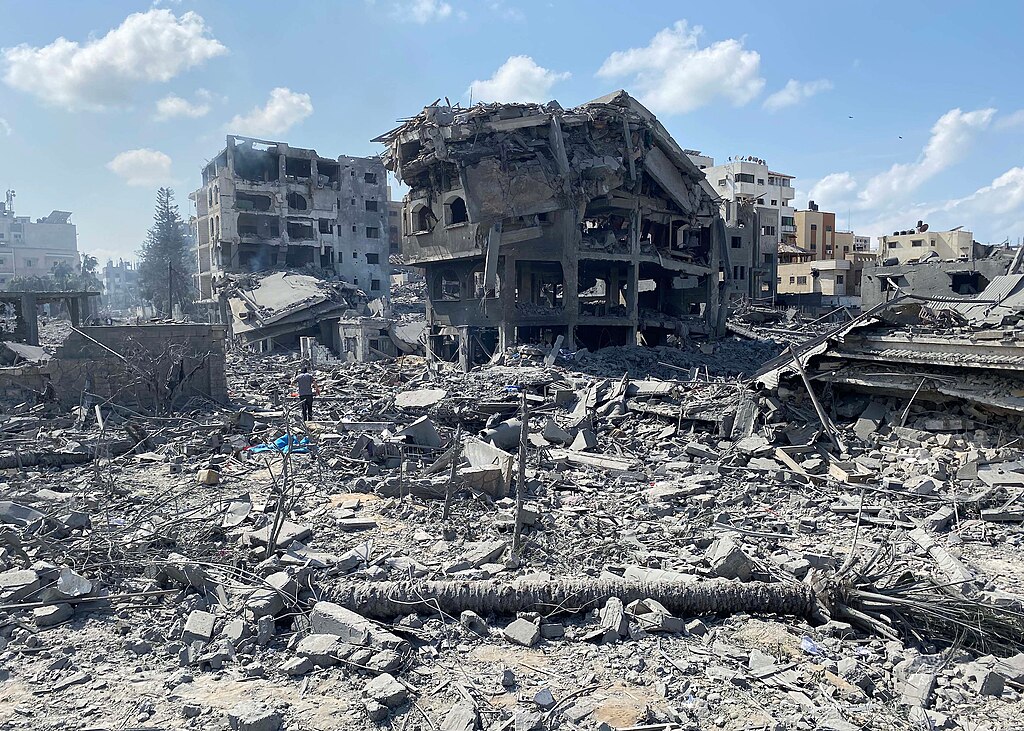
Palestinians in the Bureij Refugee Camp, strive to maintain their routines under challenging conditions, surrounded by destroyed buildings, as the implementation of a ceasefire agreement is anticipated in the coming days in Gaza City, Gaza on January 17, 2025. [Moiz Salhi – Anadolu Agency]
Qatar’s Foreign Ministry announced on Saturday that the ceasefire agreement for the Gaza Strip will go into effect at 8.30 a.m. local time (0630GMT) on Sunday, Jan. 19, Anadolu Agency reports.
Ministry spokesperson Majed Al-Ansari confirmed the development on X: “As coordinated by the parties to the agreement and the mediators, the ceasefire in the Gaza Strip will begin at 8:30 a.m. on Sunday, January 19, local time in Gaza.”
“We advise the inhabitants to take precaution, exercise the utmost caution, and wait for directions from official sources,” he added.
The Israeli army also issued a statement confirming its readiness to implement the deal.
“The agreement will take effect on Sunday, January 19, at 08:30,” the Israeli army said in a statement, noting that its forces “will carry out the operational plan in the field in accordance with the established agreements.”
Meanwhile, the Interior and National Security Ministry in Gaza announced preparations to deploy its forces in the enclave after the ceasefire enters into force.
Qatar announced a three-phase ceasefire agreement on Wednesday to end more than 15 months of deadly Israeli attacks on the Gaza Strip with the ceasefire set to take effect on Sunday.
Nearly 46,900 Palestinians, mostly women and children, were killed and more than 110,600 injured in Israel’s genocidal war on Gaza since Oct. 7, 2023, according to local health authorities.
The International Criminal Court issued arrest warrants in November for Israeli Prime Minister Benjamin Netanyahu and his former Defense Minister Yoav Gallant for war crimes and crimes against humanity in Gaza.
Israel also faces a genocide case at the International Court of Justice for its war on the enclave.
Israeli Prime Minister Benjamin Netanyahu (L) holds a meeting with the Security Cabinet after Iran’s missile attacks on Israel in West Jerusalem on October 01, 2024. [Avi Ohayon (GPO) / Handout – Anadolu Agency]
Israel said it had delayed holding a cabinet meeting on Thursday to ratify a ceasefire with Hamas, blaming the group for the hold-up, as Palestinian authorities said Israeli air strikes overnight had killed 77 people in Gaza, Reuters reports.
Hamas senior official, Izzat el-Reshiq, said the group remained committed to the ceasefire deal, agreed a day earlier, that was scheduled to take effect from Sunday to bring an end to 15-months of bloodshed.
President Joe Biden’s envoy, Brett McGurk, and President-elect Donald J. Trump’s envoy, Steve Witkoff were in Doha with Egyptian and Qatari mediators working to resolve the last remaining dispute, a US official, who spoke on condition of anonymity, said.
The dispute involves the identities of several prisoners Hamas is demanding be released and it is expected to be resolved soon, the US official said.
Israeli government spokesperson, David Mencer, told reporters Israeli negotiators were in Doha to reach a solution.
The complex ceasefire accord emerged on Wednesday after mediation by Qatar, Egypt and the US to stop the war that has devastated the coastal territory and inflamed the Middle East.
The deal outlines a six-week initial ceasefire with the gradual withdrawal of Israeli forces from the Gaza Strip, where tens of thousands have been killed. Hostages taken by Hamas, which controls the enclave, would be freed in exchange for Palestinian prisoners detained in Israel.
The deal also paves the way for a surge in humanitarian aid for Gaza, where the majority of the population has been displaced and is facing acute food shortages, food security experts warned late last year.
Rows of aid trucks were lined up in the Egyptian border town of El-Arish waiting to cross into Gaza, once the border is reopened.
Israel’s acceptance of the deal will not be official until it is approved by the country’s security cabinet and government, and a vote had been slated for Thursday.
However, Israeli Prime Minister, Benjamin Netanyahu, has delayed the meeting, accusing Hamas of making last-minute demands and going back on agreements.
“The Israeli cabinet will not convene until the mediators notify Israel that Hamas has accepted all elements of the agreement,” a statement from Netanyahu’s office said.
Hardliners in Netanyahu’s government were still hoping to stop the deal, though a majority of ministers were expected to back it.
Finance Minister Bezalel Smotrich’s Religious Zionism Party said in a statement that its condition for remaining in the government would be a return to fighting at the end of the first phase of the deal, in order to destroy Hamas and bring all the hostages back. Far-right police minister, Itamar Ben-Gvir, has also threatened to quit the government if the ceasefire is approved.
In Jerusalem, some Israelis marched through the streets carrying mock coffins in protest at the ceasefire, blocking roads and scuffling with police.
Despite the hold-up to the cabinet meeting, political commentators on Israel’s public broadcaster, Kan, said the latest delay would likely be resolved and that the ceasefire was a done deal.
Calls for faster implementation
For some Palestinians, the deal could not come soon enough.
“We lose homes every hour. We demand for this joy not to go away, the joy that was drawn on our faces – don’t waste it by delaying the implementation of the truce until Sunday,” Gazan man, Mahmoud Abu Wardeh, said.
The accord requires 600 truckloads of humanitarian aid to be allowed into Gaza every day of the ceasefire, with 50 carrying fuel. The first phase of the agreement will also see Israel releasing more than 1,000 Palestinian prisoners.
While people celebrated the pact in Gaza and Israel, Israel’s military conducted more attacks, the civil emergency service and residents said.
Gaza’s Health Ministry said at least 81 people had been killed over the past 24 hours and about 188 injured. The Palestinian Civil Emergency Service said at least 77 of those were killed since the ceasefire announcement.
The Israeli military is looking into the reports, a military spokesperson said.
Israel secured major gains over Iran and its proxies, mainly Hezbollah, as the Gaza conflict spread. In Gaza, however, Hamas may have been crippled, but without an alternative administration in place, it has been left standing.
If successful, the ceasefire will halt fighting that has razed much of heavily urbanised Gaza, killed over 46,000 people, and displaced most of the tiny enclave’s pre-war population of 2.3 million, according to Gaza authorities.
That, in turn, could defuse tensions across the wider Middle East.
With 98 foreign and Israeli hostages remaining in Gaza, phase one of the deal entails the release of 33 of them, including all women, children and men over 50.
Global reaction to the ceasefire was enthusiastic.
Israel launched its campaign in Gaza after Hamas-led gunmen burst into Israeli border-area communities on 7 October, 2023, killing 1,200 soldiers and civilians and abducting over 250 hostages, according to Israeli tallies.
However, since then, it has been revealed by Haaretz that helicopters and tanks of the Israeli army had, in fact, killed many of the 1,139 soldiers and civilians claimed by Israel to have been killed by the Palestinian Resistance.
Rep. Mike Waltz (R-Fla.), President-elect Donald Trump’s national security adviser pick, walks to a Senate hearing on January 14, 2025 in Washington, D.C. (Photo: Kayla Bartkowski/Getty Images)
Journalist Jeremy Scahill noted that Mike Waltz’s comments echo “a plan Netanyahu has hinted at: Israel views this deal as only one phase to get the Israeli and U.S. hostages out.”
U.S. President-elect Donald Trump’s pick to serve as national security adviser said late Wednesday that the incoming administration will support future Israeli attacks on Gaza even as Trump hailed the tenuous new cease-fire and hostage-release agreement as a signal “to the entire world that my administration would seek peace.”
In an appearance on Fox News late Wednesday after the agreement was announced, Rep. Mike Waltz (R-Fla.) said that “we’ve made it very clear to the Israelis, and I want the people of Israel to hear me on this: If they need to go back in [to Gaza], we’re with them.”
“Hamas is not going to continue as a military entity and it’s certainly not going to govern Gaza,” Waltz added.
The national security adviser nominee expressed a similar position in a podcast appearance prior to the announcement of the cease-fire deal, which is currently in jeopardy as Israeli Prime Minister Benjamin Netanyahu accuses Hamas of reneging on the terms of the agreement—a claim Hamas has rejected.
Asked whether a cease-fire agreement would mean “the war is over,” Waltz said, “Hamas would like to believe that.”
“But we’ve been clear that Gaza has to be fully demilitarized, Hamas has to be destroyed to the point that it cannot reconstitute, and that Israel has every right to fully protect itself,” he added. “All of those objectives are still very much in place.”
“We need to get our people out,” Waltz continued, “and then we need to achieve those objectives in this war.”
https://twitter.com/i/status/1879851130693488889
Drop Site‘s Jeremy Scahill noted that the approach Waltz laid out mirrors “a plan Netanyahu has hinted at: Israel views this deal as only one phase to get the Israeli and U.S. hostages out.”
Last month, Netanyahu said that Israeli forces would “return to fighting” once hostages are freed.
“There is no point in pretending otherwise,” said Netanyahu, “because returning to fighting is needed in order to complete the goals of the war.”
Under the first phase of the deal announced Wednesday, a six-week cease-fire would begin as soon as Sunday and 33 hostages would be freed in exchange for the release of more than 1,000 Palestinian detainees. The second and third stages of the deal are contingent upon negotiations that will take place during the first.
The text also stipulates the “withdrawal of Israeli forces eastwards from densely populated areas along the borders of the Gaza Strip” and a reduction of Israeli troop presence in the Philadelphi corridor—an issue that has repeatedly emerged as a sticking point in cease-fire negotiations.
The agreement states that “the Israeli side will gradually reduce the forces in the corridor area during stage 1 based on the accompanying maps and the agreement between both sides.”
“After the last hostage release of stage one, on day 42, the Israeli forces will begin their withdrawal and complete it no later than day 50,” the text continues.
But Netanyahu’s office insisted Thursday that the same number of forces would remain in the corridor during the deal’s first phase—a position that critics said runs counter to the agreement.
While Trump and his allies celebrated the announced agreement as a master stroke of dealmaking and aid groups voiced hope for some reprieve for devastated Palestinians in Gaza, Netanyahu’s spokesman told The New York Times in a text message that “there isn’t any deal at the moment.”
Israel’s cabinet was expected to vote on the deal Thursday, but Netanyahu delayed the meeting and accused Hamas of trying to “extort last-minute concessions.”
Hamas officials denied the charge, saying they are committed to the agreed-upon text.
Ruby Chen, the father of a 19-year-old Israeli-American soldier who was taken captive by Hamas on October 7, 2023, suggested Thursday that Netanyahu “might be looking to get out of” the deal as he faces backlash from far-right members of his coalition.
Citing unnamed sources, The Washington Post reported Thursday that “behind closed doors, Netanyahu has been promising his far-right allies that the war could resume after the first, 42-day phase of the cease-fire, when Hamas is to release 33 hostages in exchange for the release of more than 1,000 Palestinian prisoners.”
Paul Pillar, a non-resident fellow at the Quincy Institute for Responsible Statecraft, wrote Thursday that “there remains the possibility that a renewed war in Gaza will, beginning a few weeks from now, become a problem for Trump just as it was for Biden.”
“But two main factors will incline President Trump not to exert any pressure on the Israeli government to turn away from renewing its devastation and ethnic cleansing in the Gaza Strip,” Pillar predicted. “One is Trump’s relationship with his domestic evangelical political base, with its unconditional support for most anything Israel does. The other is that his ally Netanyahu has done him a big favor with his handling of the ceasefire negotiations, and now Trump owes Netanyahu favors in return.”
According to one Israeli report, Trump offered Netanyahu a “gift bag” of concessions in exchange for accepting a pre-inauguration cease-fire deal, including sanctions relief for violent Israeli settlers in the illegally occupied West Bank.
U.S. President Joe Biden (L) and Prime Minister Benjamin Netanyahu (R) meet in Tel Aviv, Israel on October 18, 2023. (Photo: GPO/ Handout/Anadolu via Getty Images)
One Middle East expert said that it’s “hard to avoid the conclusion” that the U.S. administration’s ultimatums to Israel “have all just been a smokescreen.”
New reporting published Wednesday details the impotence and insincerity of President Joe Biden’s “multiple threats, warnings, and admonishments” to Israel as it annihilated the Gaza Strip, killing tens of thousands of Palestinian civilians while receiving tens of billions of dollars in U.S. arms and unwavering diplomatic support.
Writing for ProPublica, Brett Murphy showed how multiple “red lines” issued by Biden administration officials were ignored by Israel with impunity. Murphy highlighted Secretary of State Antony Blinken’s October 2024 demand that Israel take “urgent and sustained actions” to improve humanitarian conditions in Gaza—mainly by allowing far more aid into the embattled strip—within 30 days or face a military aid cutoff.
“Netanyahu’s conclusion was that Biden doesn’t have enough oomph to make him pay a price.”
Thirty days came and went without significant improvement or letup in Israel’s onslaught. Yet the Biden administration insisted it found no indication that Israel was using U.S.-supplied weapons illegally. The arms flow continued.
As Murphy reported:
That choice was immediately called into question. On November 14, a U.N. committee said that Israel’s methods in Gaza, including its use of starvation as a weapon, was “consistent with genocide.” Amnesty International went further and concluded a genocide was underway. The International Criminal Court also issued arrest warrants for Israeli Prime Minister Benjamin Netanyahu and his former defense minister for the war crime of deliberately starving civilians, among other allegations.
“Government officials worry Biden’s record of empty threats have given the Israelis a sense of impunity,” wrote Murphy.
This reporting is so utterly damning.www.propublica.org/article/bide…
Ghaith al-Omari, a senior fellow at the Washington Institute, told Murphy that “Netanyahu’s conclusion was that Biden doesn’t have enough oomph to make him pay a price, so he was willing to ignore him.”
“Part of it is that Netanyahu learned there is no cost to saying ‘no’ to the current president,” al-Omari added.
Conversely, Murphy noted: “On Wednesday, after months of negotiations, Israel and Hamas reached a cease-fire deal. While it will become clear over the next days and months exactly what the contours of the agreement are, why it happened now, and who deserves the most credit, it’s plausible that [U.S. President-elect Donald] Trump’s imminent ascension to the White House was its own form of a red line.”
“Early reports suggest the deal looks similar to what has been on the table for months,” he added, “raising the possibility that if the Biden administration had followed through on its tough words, a deal could have been reached earlier, saving lives.”
As Stephen Walt, a professor of international affairs at Harvard Kennedy School, told Murphy, “It’s hard to avoid the conclusion that [Biden’s] red lines have all just been a smokescreen.”
“The Biden administration decided to be all-in and merely pretended that it was trying to do something,” Walt added, as Israel kept killing Palestinians with U.S.-supplied weapons and continued a “complete siege” blamed for widespread starvation and sickness in the Gaza Strip.
Murphy wrote that Trump “will inherit a demoralized State Department” in which many officials who haven’t already resignedhave “become disenchanted with the lofty ideas they thought they represented.”
As one senior department official told Murphy, Gaza “is the human rights atrocity of our time.”
“I work for the department that’s responsible for this policy. I signed up for this,” the official added. “I don’t deserve sympathy for it.”