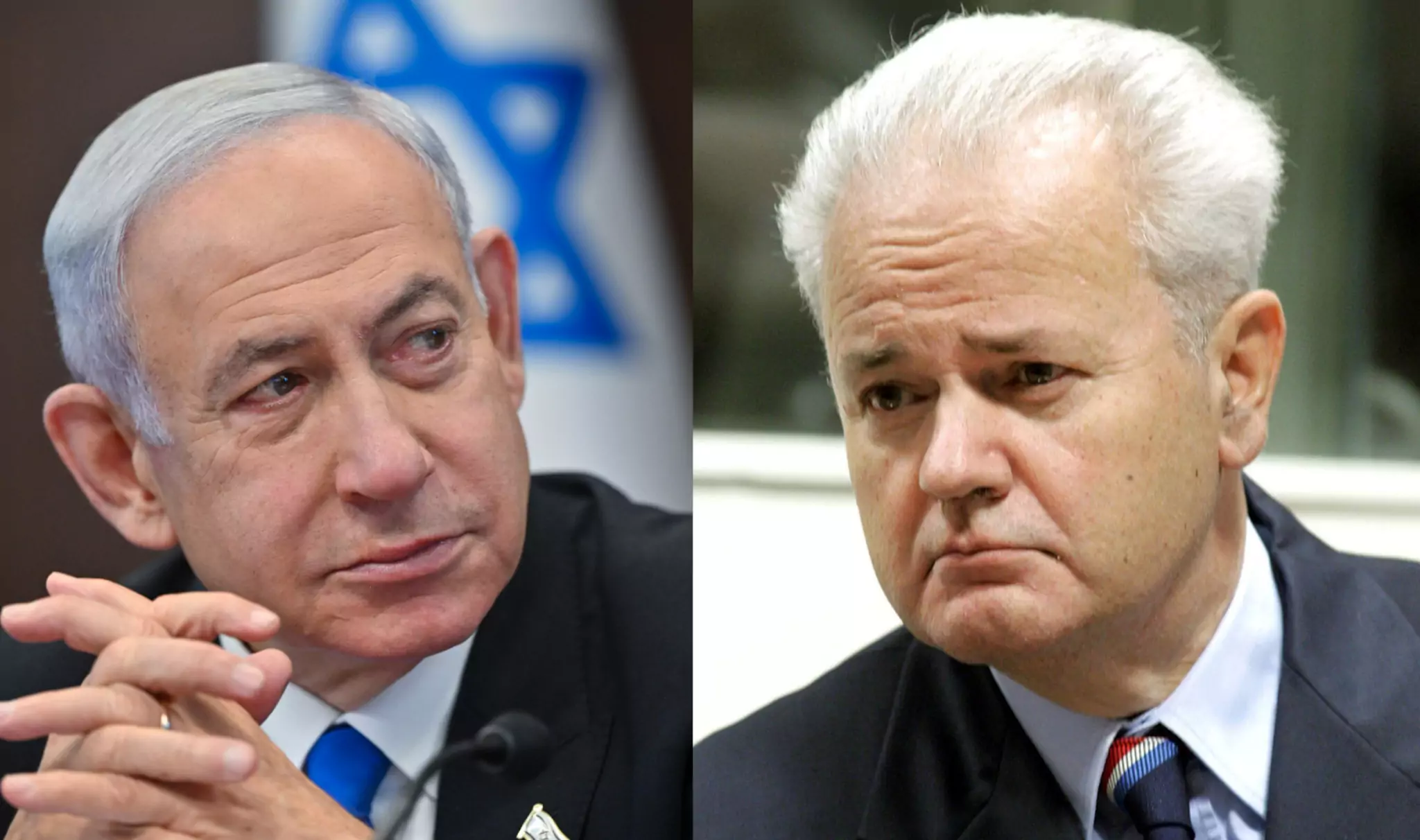
Tony Blair sent the SAS to hunt down suspected Bosnian war criminals in the 1990s who were accused of lesser abuses than Benjamin Netanyahu and Yoav Gallant.
…
Whitehall’s weak reaction to ICC arrest warrants for Netanyahu and Gallant stands in contrast to the exertions it made towards the former Yugoslavia and, more recently, Russia.
When the ICC announced an arrest warrant for Russian ruler Vladimir Putin in March 2023, the UK increased funding to the organisation and hosted an international conference in London.
“The ICC plays a vital role in global efforts to end impunity for war crimes”, the UK Ministry of Justice said.
A year earlier the UK had galvanised a group of governments to refer Russian atrocities in Ukraine to the ICC to enable it to proceed straight to an investigation – a process known as ‘state party referral’.
David Lammy described the ICC’s arrest warrant for Putin as “an historic step”, adding that “President Putin is now a wanted man”.
By contrast, the current foreign secretary has only grudgingly conceded that, in the cases of Netanyahu and Gallant, “there is an obligation on me to transmit to the courts should those named seek to come in to our country”.
When in 2006 former Liberian president Charles Taylor was undergoing a war crimes trial in The Hague for aiding rebels in Sierra Leone notorious for hacking off limbs of civilians, the British government offered to house him in a UK jail if convicted.
Sentenced to 50 years imprisonment, Taylor began serving his conviction at HMP Frankland near Durham. It seems inconceivable that Netanyahu and Gallant will ever see the inside of a British jail.
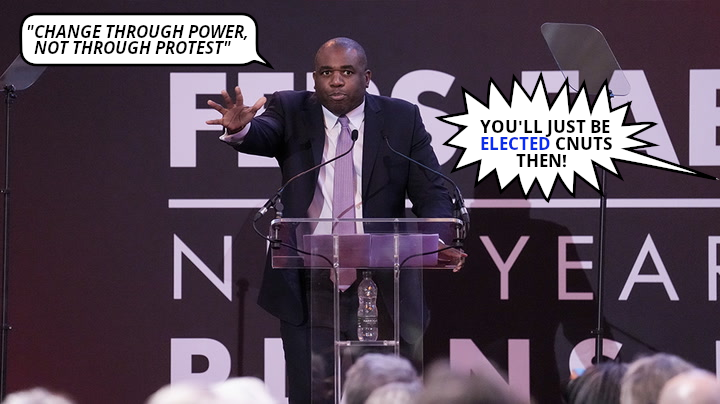
UK Foreign Minister David Lammy confirms that UK government and military are active participants in Israel’s genocides and that the F-35 parts that they suspended from supplying to Israel are instead simply diverted via the United States. He says see https://youtu.be/QILgUHrdWREGenocide denier and Current UK Prime Minister Keir Starmer is quoted that he supports Zionism without qualification. He also confirms that UK air force support has been essential in Israel’s mass-murdering genocide. Includes URLs https://www.declassifieduk.org/keir-starmers-100-spy-flights-over-gaza-in-support-of-israel/ and https://youtu.be/O74hZCKKdpAUK Labour Party Shadow Foreign Secretary repeatedly heckled at a speech to the Fabian Society over his and the Labour Party’s support for and complicity in Israel’s genocide of Gaza.
People gather with banners and Israeli flags to protest against Israeli Prime Minister Benjamin Netanyahu and his government for not signing the ceasefire agreement with Gaza and to demand hostage swap deal in Tel Aviv, Israel on September 28, 2024. [Nir Keidar – Anadolu Agency]
Israel opposition leader and Chairman of National Unity camp, Benny Gantz, has accused Prime Minister Benjamin Netanyahu of “sabotaging” prisoner swap deal negotiations with Hamas, Israel’s Yedioth Ahronoth newspaper reported.
According to the outlet, Gantz criticised Netanyahu’s address to foreign press about the deal. “We are in sensitive days – life and death are truly controlled by the tongue,” he said.
Gantz’s statements came two days after the Wall Street Journal published an interview with Netanyahu in which he said: “I will not agree to end the war [in Gaza] before eliminating Hamas.”
Gantz said: “As Netanyahu himself said just a week ago, the less we talk, the better, while the negotiators are working, Netanyahu is sabotaging the negotiations again.”
Netanyahu, Gantz explained, “does not have a mandate to thwart the return of our hostages again for political reasons. Their return is the right thing to do.”
In response, Netanyahu’s office said Gantz, can not preach “about the need to eliminate Hamas and the sacred mission of returning our captives.”
“It is no coincidence that since Gantz left the government for political reasons, the prime minister has led painful blows against Hamas, the destruction of Hezbollah, and direct operations against Iran – steps that led to the fall of the Assad regime in Syria.”
Yedioth Ahronoth quoted Einav Tsinguker, mother of the detained occupation soldier Matan Tsinguker, as saying that the soldiers’ families’ greatest fear is that the “Israeli government will leave the kidnapped behind.”
“The prime minister is being blackmailed by extremists in his government who want to build settlements on the backs of those kidnapped. We need to end the war in exchange for reaching a comprehensive deal,” she added.
Palestinians living in makeshift tents and ruined buildings in Jabalia Camp try to continue their daily lives under Israeli attacks in Gaza Strip on December 18, 2024. [Dawoud Abo Alkas – Anadolu Agency]
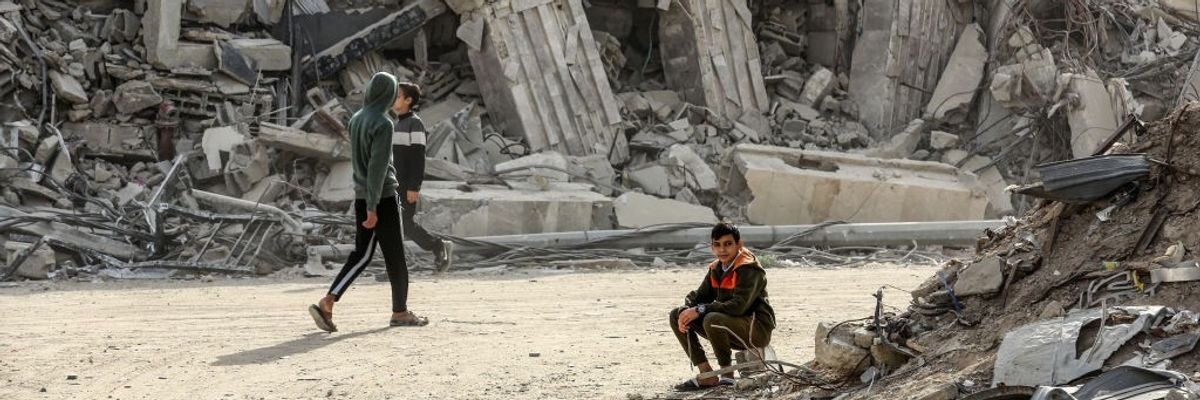
The Jabalia refugee camp in the northern Gaza Strip has become a “ghost town” with around 70% of homes and buildings completely destroyed in Israel’s deadly onslaught in the area, Israeli media said on Sunday, Anadolu Agency reports.
“As far as the eye can see lie miles and miles of destroyed homes. It’s hard to look away from the devastated remains of Jabalia’s refugee camp in northern Gaza,” Amos Harel, a military affairs analyst, writes in Haaretz newspaper.
The Israeli army estimates that 70% of the refugee camp’s buildings were completely destroyed.
“I could see that even the few buildings that are still standing were badly damaged,” Harel said.
Israel has launched a large-scale ground operation in northern Gaza since Oct. 5 to allegedly prevent the Palestinian group Hamas from regrouping. Palestinians, however, accuse Israel of seeking to occupy the area and forcibly displace its residents.
Since then, no sufficient humanitarian aid including food, medicine, and fuel has been allowed into the area, leaving the remaining population on the verge of imminent famine.
“The IDF (army) operated here twice before, in December 2023 and May 2024. But this time, the camp was taken apart,” Amos said.
“Jabalia has become a ghost town. Outside, you mainly see pack after pack of stray dogs roaming around and hunting for scraps of food.”
The Israeli onslaught in northern Gaza was the latest episode in a brutal Israeli war on the Gaza Strip that has killed more than 45,200 people, mostly women and children, since Oct. 7, 2023.
Last month, the International Criminal Court issued arrest warrants for Israeli Prime Minister Benjamin Netanyahu and former Defense Minister Yoav Gallant for war crimes and crimes against humanity in Gaza.
Israel also faces a genocide case at the International Court of Justice for its war on Gaza.
Israeli Prime Minister Benjamin Netanyahu addresses a press conference in Tel Aviv on July 13, 2024 [NIR ELIAS/POOL/AFP via Getty Images]
Israeli Prime Minister Benjamin Netanyahu will not participate in the 80th anniversary of the liberation of the Nazi death camp Auschwitz for fear of being arrested following the arrest warrant issued against him by the International Criminal Court (ICC) in The Hague.
The warrant was issued on charges of committing war crimes and crimes against humanity in the war on Gaza, according to reports by Polish newspaper Rzeczpospolita on Friday.
The newspaper quoted Wladyslaw Bartoszewski, Poland’s deputy foreign minister, who is organising the ceremony scheduled to be held on 27 January, saying that his country is committed to respecting the decision of the ICC in The Hague.
The ceremony commemorating the liberation of Auschwitz is expected to be attended by many world leaders. The Polish newspaper predicts Israel will be represented by its Foreign Minister Gideon Sa’ar, but Israeli media quoted Israeli officials saying that Education Minister Yoav Kisch will represent Israel in the ceremony.
The Polish newspaper reported that Israel did not request Netanyahu’s participation in the ceremony and that the Israelis knew how Warsaw would react if Netanyahu arrived in Poland.
Israeli President Isaac Herzog is not expected to participate in the ceremony. His predecessor, Reuven Rivlin, participated in the 75th anniversary of the liberation of Auschwitz.
On 21 November, the ICC issued two international arrest warrants against Netanyahu and former Defence Minister Yoav Gallant on charges of committing war crimes and crimes against humanity in the Gaza Strip, including starving Palestinians.
Spain, the Netherlands, Belgium, Ireland, Lithuania and Slovenia have all confirmed they will arrest Netanyahu if he enters their territory, and outgoing Belgian Prime Minister Alexander De Croo asserted: “There can be no double standards.”
Leaders from several countries are expected to attend the commemoration of the liberation of Auschwitz, including French President Emmanuel Macron, Spanish King Felipe VI, British King Charles, German President Frank-Walter Steinmeier and Hungarian President Tamas Sulyok.
Poland has invited US President-elect Donald Trump to the ceremony, but he is expected to be represented by his vice president, JD Vance, or his secretary of state, Marco Rubio, the Polish newspaper reported.
Palestinians are surrounded by buildings destroyed by Israeli attacks in Khan Younis, Gaza on December 10, 2024. (Photo: Abed Rahim Khatib/Anadolu via Getty Images)
“Failure to do so not only risks our leverage in ceasefire negotiations, it undermines our country’s own national security and weakens America’s commitment to human rights as a cornerstone of our foreign policy.”
Twenty progressives in the U.S. House of Representatives on Tuesday wrote to top Biden administration officials arguing that “the United States government must suspend offensive weapons” to Israel over its destruction of the Gaza Strip, citing federal and international law.
Led by Reps. Summer Lee (D-Pa.) and Greg Casar (D-Texas), the incoming Congressional Progressive Caucus chair, the lawmakers began by thanking U.S. Secretary of State Antony Blinken and Secretary of Defense Lloyd Austin for their October 13 letter threatening to cut off weapons to Israeli Prime Minister Benjamin Netanyahu’s government if it did not dramatically improve humanitarian conditions in Gaza.
“However, despite your administration acknowledging that the Netanyahu government did not fully address the United States’ concerns over Gaza and has failed to meet all of the conditions stipulated in this letter, the State Department decided not to take further action, including the suspension of offensive military assistance, to ensure full compliance,” the Democrats wrote.
“We believe continuing to transfer offensive weapons to the Israeli government prolongs the suffering of the Palestinian people and risks our own national security by sending a message to the world that the U.S. will apply its laws, policies, and international law selectively,” they continued. “Furthermore, a failure to act will put Israeli lives in danger by prolonging Netanyahu’s war, isolating Israel on the international stage, and creating further instability in the region.”
The new letter comes just over a month away from President Joe Biden leaving office and follows one from last week signed by 77 House Democrats—including Casar—that demanded “a full assessment of the status of Israel’s compliance with all relevant U.S. policies and laws, including National Security Memorandum 20 (NSM-20) and Section 620I of the Foreign Assistance Act.”
This one goes further, explicitly urging the Biden administration to suspend offensive military transfers and warning that “failure to do so not only risks our leverage in cease-fire negotiations, it undermines our country’s own national security and weakens America’s commitment to human rights as a cornerstone of our foreign policy.”
“We remain committed to saving Palestinian and Israeli lives. This means doing everything possible to prioritize the release of hostages, secure a lasting cease-fire deal, and move toward long-term peace,” the 20 progressives concluded.
In addition to Lee and Casar, Tuesday’s letter was signed by Democratic Reps. Jamaal Bowman (N.Y.), Cori Bush (Mo.), Joaquin Castro (Texas), Lloyd Doggett (Texas), Veronica Escobar (Texas), Jesús “Chuy” García (Ill.), Al Green (Texas), Sara Jacobs (Calif.), Pramila Jayapal (Wash.), Hank Johnson (Ga.), Jim McGovern (Mass.), Alexandria Ocasio-Cortez (N.Y.), Ilhan Omar (Minn.), Mark Pocan (Wis.), Ayanna Pressley (Mass.), Delia C. Ramirez (Ill.), Rashida Tlaib (Mich.), and Bonnie Watson Coleman (N.J.).
It came on the same day as a lawsuit filed by Palestinians and Palestinian Americans accusing the U.S. State Department of creating “unique, insurmountable processes to evade the Leahy Law requirement to sanction abusive Israeli units.”
As of Tuesday, the 14-month Israeli assault on Gaza in retaliation for the Hamas-led October 7, 2023 attack has killed at least 45,059 people and wounded another 107,041, according to local officials. Israel’s slaughter and starvation of Palestinian civilians have led to a genocide case at the International Court of Justice as well as International Criminal Court arrest warrants for Netanyahu and his former defense minister, Yoav Gallant.