Despite Trump-Musk Feud, CO2 Milestone Is the ‘Important News of the Day’

Spread the love

Original article by Olivia Rosane republished from Common Dreams under Creative Commons (CC BY-NC-ND 3.0). 
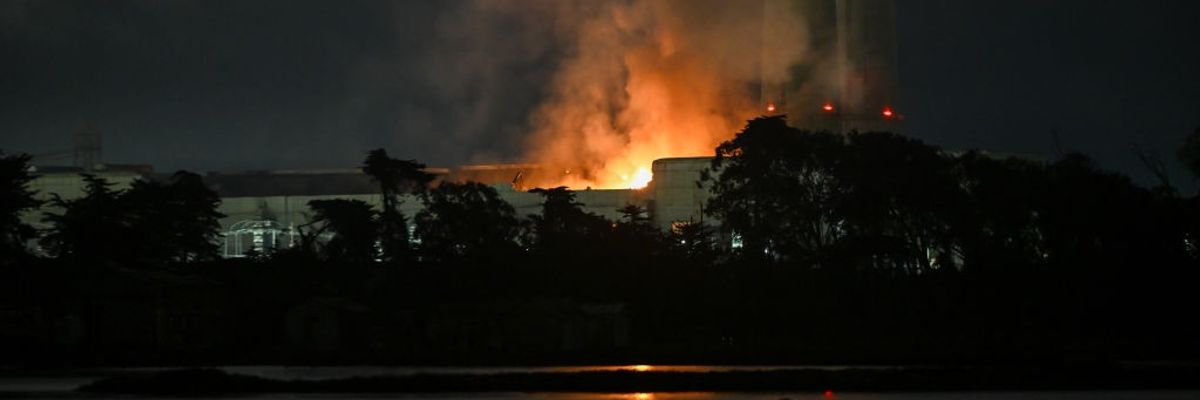
A view of flames and giant smoke is seen over the sky as a fire erupted at the natural gas Moss Landing Power Plant in Moss Landing of Monterey Bay, California, United States on January 17, 2025. (Photo: Tayfun Coskun/Anadolu via Getty Images)

Scientists said that atmospheric carbon dioxide concentrations peaked above 430 parts per million for the first time in perhaps 30 million years.

The concentration of carbon dioxide in the atmosphere peaked above 430 parts per million in 2025—the highest it has been in millions of years—according to data released by the National Oceanic and Atmospheric Administration and Scripps Institution of Oceanography at the University of California, San Diego on Thursday.

The news was overshadowed by the explosive feud between U.S. President Donald Trump and his erstwhile backer Elon Musk, but climate activist Bill McKibben argued that it was ultimately more consequential.

“In the long run, this is actually going to be the important news of the day—CO2 in the atmosphere passes another grim milestone,” McKibben wrote on social media.

In the long run, this is actually going to be the important news of the day–co2 in the atmosphere passes another grim milestone

Bill McKibben (@billmckibben.bsky.social) 2025-06-05T20:33:11.672Z

Carbon dioxide has been accumulating in the atmosphere due primarily to the human burning of fossil fuels, as well as by the clearing of forests and other natural carbon sinks. There, it acts as a greenhouse gas, trapping heat from the Earth, and is the primary gas responsible for the rise of global temperatures by approximately 1.1°C from the 1850 -1900 average. This warming has already had a host of dramatic impacts, from extreme weather events to sea-level rise to polar ice melt, and scientists warn these impacts will only accelerate under current energy policies, which put the world on track for around 3°C of warming by 2100.

The last time that atmospheric CO2 concentrations topped 430 ppm was most likely more than 30 million years ago, Ralph Keeling, who directs the Scripps CO2 Program, told NBC News.

“It’s changing so fast,” he said. “If humans had evolved in such a high-CO2 world, there would probably be places where we wouldn’t be living now. We probably could have adapted to such a world, but we built our society and a civilization around yesterday’s climate.”

“While largely symbolic, passing 430 ppm should be a wake-up call.”

Scripps and National Oceanic and Atmospheric Administration both measure carbon dioxide levels from NOAA’s Mauna Loa Observatory in Hawaii, where Charles Keeling began taking measurements in 1958. As CO2 levels rise over time, they also follow a seasonal cycle—peaking in May before falling in the Northern Hemisphere summer and rising again in the fall.

This May, Scripps Oceanography calculated an average of 430.2 ppm for 2025, which is 3.5 ppm over the average for May 2024. NOAA’s Global Monitoring Laboratory, meanwhile, calculated a monthly average of 430.5 ppm, a 3.6 ppm jump from the year before and the second-steepest yearly climb since 1958.

“Another year, another record,” Keeling said in a statement. “It’s sad.”

The news comes two months after Mauna Loa daily measurements surpassed 430 ppm for the first time in March, which Plymouth Marine Laboratory professor Helen Findlay called “extremely disappointing and worrying.”

“While largely symbolic, passing 430 ppm should be a wake-up call, especially given the accelerated response we are seeing of glaciers and ice sheets to current warming,” Dr. James Kirkham, chief scientist of the Ambition on Melting Ice coalition of governments, said at the time.

“This upward trajectory is a direct result of continued fossil fuel use, likely exacerbated by emissions from extreme wildfires last year, methane leaks from fossil fuel extraction and possibly greater permafrost emissions, alongside decreased ability of very warm oceans to absorb CO2,” Kirkham said.

The monthly record also comes a little more than a week after a United Nations report warned that there was a small chance global temperatures could surpass 2°C in at least 1 of the next 5 years, only a decade after world leaders pledged in the Paris agreement to keep global temperatures “well-below” that level.

“Carbon emissions are still rising, and the atmosphere is going to keep heating further until greenhouse gas concentrations stabilize,” Matt Kean, who chairs Australia’s Climate Change Authority, wrote in response to the Scripps and NOAA figures. “What sort of climate do we want to leave our children and those who come after them?”

Original article by Olivia Rosane republished from Common Dreams under Creative Commons (CC BY-NC-ND 3.0). 

Orcas discuss Donald Trump and the killer apes' concept of democracy. Front Orca warns that Trump is crashing his country's economy and that everything he does he does for the fantastically wealthy.
Orcas discuss Donald Trump and the killer apes’ concept of democracy. Front Orca warns that Trump is crashing his country’s economy and that everything he does he does for the fantastically wealthy.
Neo-Fascist Climate Science Denier Donald Trump says Burn, Baby, Burn.
Elon Musk urges you to be a Fascist like him, says that you can ignore facts and reality then.
Continue ReadingDespite Trump-Musk Feud, CO2 Milestone Is the ‘Important News of the Day’

Climate Crisis to Cost Global Economy $38 Trillion a Year by 2050

Spread the love

Original article by OLIVIA ROSANE republished from Common Dreams under Creative Commons (CC BY-NC-ND 3.0). 

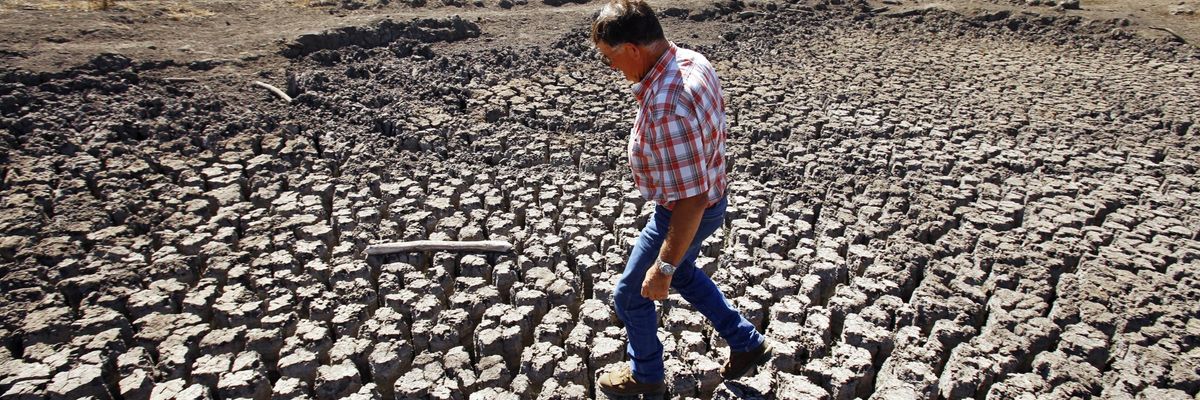
Rancher Jon Pedotti walks on the cracked remains of a parched lake bed of his 1,561-acre ranch located along San Simeon Creek in the Santa Lucia Mountain foothills of Cambria, California during a drought on October 1, 2014. (Photo: Al Seib/Los Angeles Times via Getty Images)

“This clearly shows that protecting our climate is much cheaper than not doing so, and that is without even considering noneconomic impacts such as loss of life or biodiversity,” a new study’s lead author said.

The climate crisis will shrink the average global income 19% in the next 26 years compared to what it would have been without global heating caused primarily by the burning of fossil fuels, a study published in Nature Wednesday has found.

The researchers, from the Potsdam Institute for Climate Impact Research (PIK), said that economic shrinkage was largely locked in by mid-century by existing climate change, but that actions taken to reduce emissions now could determine whether income losses hold steady at around 20% or triple through the second half of the century.

“These near-term damages are a result of our past emissions,” study lead author and PIK scientist Leonie Wenz said in a statement. “We will need more adaptation efforts if we want to avoid at least some of them. And we have to cut down our emissions drastically and immediately—if not, economic losses will become even bigger in the second half of the century, amounting to up to 60% on global average by 2100.”

“I am used to my work not having a nice societal outcome, but I was surprised by how big the damages were.”

Put in dollar terms, the climate crisis will take a yearly $38 trillion chunk out of the global economy in damages by 2050, the study authors found.

“That seems like… a lot,” writer and climate advocate Bill McKibben wrote in response to the findings. “The entire world economy at the moment is about $100 trillion a year; the federal budget is about $6 trillion a year.”

This means that the costs of inaction have already exceeded the costs of limiting global heating to 2°C by six times, the study authors said. However, limiting warming to 2°C can still significantly reduce economic losses through 2100.

“This clearly shows that protecting our climate is much cheaper than not doing so, and that is without even considering noneconomic impacts such as loss of life or biodiversity,” Wenz said.

The damages predicted by the study were more than twice those of similar analyses because the researchers looked beyond national temperature data to also incorporate the impacts of extreme weather and rainfall on more than 1,600 subnational regions over a 40-year period, The Guardian explained.

“Strong income reductions are projected for the majority of regions, including North America and Europe, with South Asia and Africa being most strongly affected,” PIK scientist and first author Maximilian Kotz said in a statement. “These are caused by the impact of climate change on various aspects that are relevant for economic growth such as agricultural yields, labor productivity, or infrastructure.”

However, Wenz told the paper that the paper’s projected reduction was likely a “lower bound” because the study still doesn’t include climate impacts such as heatwaves, tropical storms, sea-level rise, and harms to human health.

Unlike previous studies, the research predicted economic losses for most wealthier countries in the Global North, with the U.S. and German economies shrinking by 11% by mid-century, France’s by 13%, and the U.K.’s by 7%. However, the countries set to suffer the most are countries closer to the equator that have lower incomes already and have historically done much less to contribute to the climate crisis. Iraq, for example, could see incomes drop by 30%, Botswana 25%, and Brazil 21%.

“Our study highlights the considerable inequity of climate impacts: We find damages almost everywhere, but countries in the tropics will suffer the most because they are already warmer,” study co-author Anders Levermann, who leads Research Department Complexity Science at PIK, said in a statement. “Further temperature increases will therefore be most harmful there. The countries least responsible for climate change, are predicted to suffer income loss that is 60% greater than the higher-income countries and 40% greater than higher-emission countries. They are also the ones with the least resources to adapt to its impacts.”

Wenz told The Guardian that the results were “devastating.”

“I am used to my work not having a nice societal outcome, but I was surprised by how big the damages were. The inequality dimension was really shocking,” Wenz said.

Levermann said the paper presented society with a clear choice:

It is on us to decide: Structural change towards a renewable energy system is needed for our security and will save us money. Staying on the path we are currently on, will lead to catastrophic consequences. The temperature of the planet can only be stabilized if we stop burning oil, gas, and coal.

McKibben, meanwhile, argued that the findings should persuade major companies to embrace climate action for self-interested reasons. He noted that most corporate emissions come from how company money is invested by banks, particularly in the continued exploitation of fossil fuel resources.

“If Amazon and Apple and Microsoft wanted to avoid a world where, by century’s end, people had 60% less money to spend on buying whatever phones and software and weird junk (doubtless weirder by then) they plan on selling, then they should be putting pressure on their banks to stop making the problem worse. They should also be unleashing their lobbying teams to demand climate action from Congress,” McKibben wrote.

“These people are supposed to care about money, and for once it would help us if they actually did,” he continued. “Stop putting out ads about how green your products are—start making this system you dominate actually work.”

Original article by OLIVIA ROSANE republished from Common Dreams under Creative Commons (CC BY-NC-ND 3.0). 

Continue ReadingClimate Crisis to Cost Global Economy $38 Trillion a Year by 2050