Brexit has ‘damaged the practical ability’ of doctors to offer NHS patients life-saving new drugs via international trials, according to the 54-page report. Photograph: Dmitrii Dikushin/Alamy
Guardian Exclusive: Britons found to have ‘lost out’ while rest of Europe benefits from golden age of research and treatments
British cancer patients are being denied life-saving drugs and trials of revolutionary treatments are being derailed by the red tape and extra costs brought on by Brexit, a leaked report warns.
Soaring numbers are being diagnosed with the disease amid a growing and ageing population, improved diagnosis initiatives and wider public awareness – making global collaborations to find new medicines essential.
But five years after the UK’s exit from the EU, the most comprehensive analysis of its kind concludes that while patients across Europe are benefiting from a golden age of pioneering research and novel treatments, Britons with cancer have “lost out” thanks to rising prices and red tape.
Brexit has “damaged the practical ability” of doctors to offer NHS patients life-saving new drugs via international clinical trials, according to the 54-page report obtained by the Guardian.
In some cases, the cost of importing new cancer drugs for Britons has nearly quadrupled as a result of post-Brexit red tape. Some trials have had shipping costs alone increase to 10 times since Brexit.
The extra rules and costs have had a “significant negative impact” on UK cancer research, creating “new barriers” that are “holding back life-saving research” for Britons, the report says.
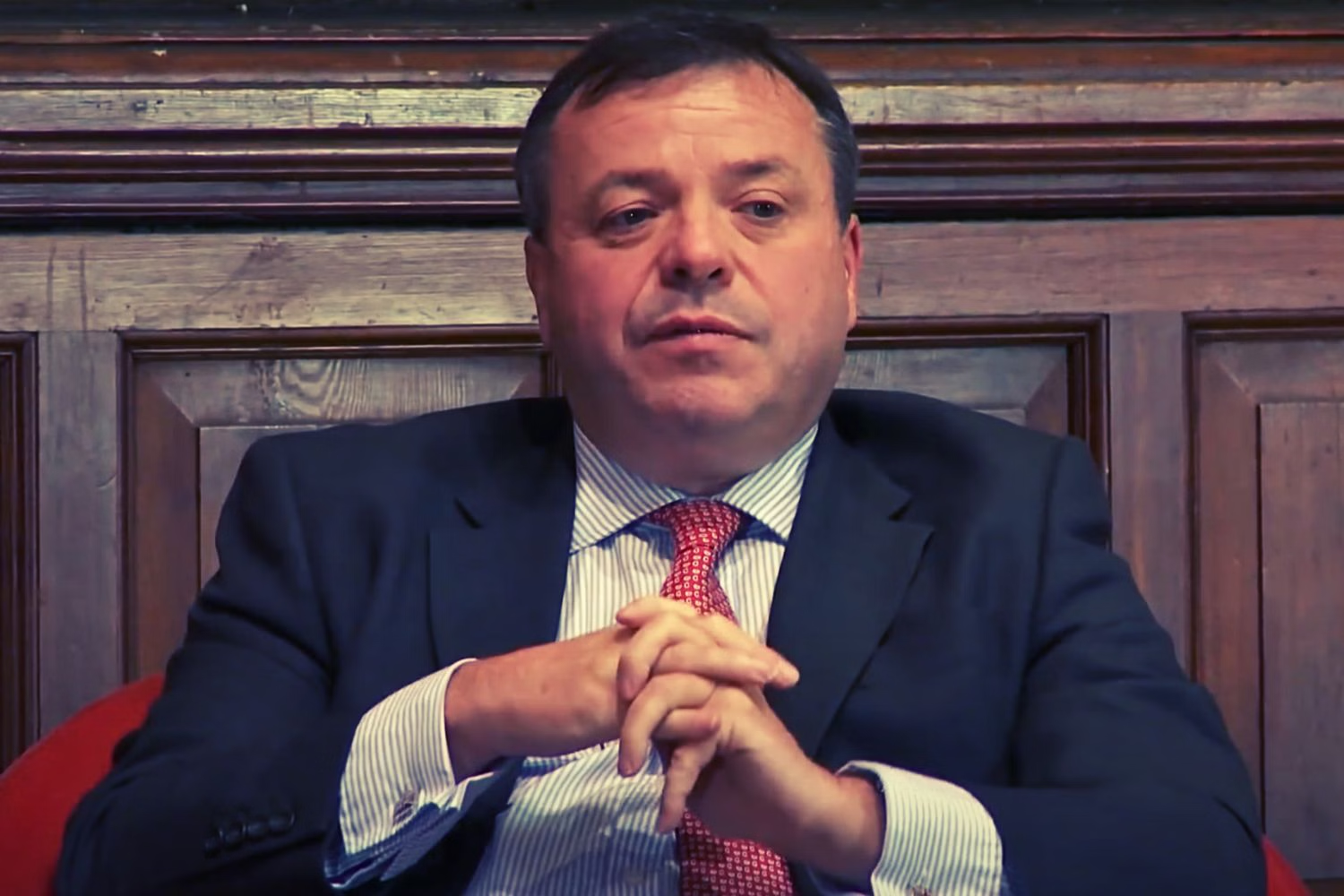
Reform UK’s Arron Banks. Credit: Oxford Union / YouTub
The multi-millionaire Brexit funder has claimed “CO2 and climate change is the ultimate hoax”.
Arron Banks, who is standing as Nigel Farage’s Reform UK candidate for West of England Mayor, has repeatedly rejected elemental climate facts.
The right-wing populist Reform UK describes itself as an “environmentalist” party. However, its leaders and candidates – including Banks – have frequently attacked the science of human-induced climate change.
In a trail of social media posts on X (formerly Twitter), Banks has attacked the notion of climate change as “rubbish”, “absolute cock”, “a scam”, and “the ultimate hoax”.
Reform is standing in several regional mayoral contests in May and has talked up its chances of gaining large numbers of council seats in the local elections.
Banks, the businessman who helped to fund Farage 2016 Brexit campaign, is standing for West of England Mayor, which encompasses Bristol, South Gloucestershire, Bath, and North East Somerset.
Reform UK, an anti-immigration party, campaigns to scrap the UK’s 2050 net zero emissions target and to expand fossil fuel extraction.
As DeSmog revealed, the party received £2.3 million between the 2019 and 2024 general elections from climate science deniers, fossil fuel interests, and major polluters.
However, the views of Reform UK and Banks don’t appear to match those of voters in the West of England.
Polling from the area in 2022 found that 65 percent of people supported net zero, while only 11 percent opposed the 2050 target. And while Reform UK has pledged to strip renewable companies of state subsidies, an overwhelming 87 percent of people said they supported renewable projects in their local area.
Reform UK and Banks were approached for comment.
Climate Denial Posts
In his social media posts, Banks has publicly attacked the science of human-induced emissions causing climate change.
In January 2024, responding to Conservative MP Chris Skidmore resigning over the government’s support for new oil and gas projects, Banks posted: “CO2 & climate change is the ultimate hoax.”
In December 2023, Banks made the familiar argument that the climate has always changed regardless of human emissions. He posted: “Climate change has been in constant flux since the planet was created. A miniscule amount of CO2 in the atmosphere isn’t the likely driver.”
In January 2024, he mocked the notion that carbon emissions were causing climate change and extreme weather. “The climate is in permanent flux”, he posted, “20,000 years ago an Ice sheet covered Scotland & half of England.” Banks added an attack on climate activist Greta Thunberg, writing: “Luckily we didn’t have Greta around to tell us a tiny bit of CO2 was the cause. We’ve always had floods & extreme weather like 1953 floods.”
The UN’s Intergovernmental Panel on Climate Change (IPCC), the world’s top climate science body, has stated that carbon dioxide “is responsible for most of global warming” since the late 19th century, and has increased the “severity and frequency of weather and climate extremes, like heat waves, heavy rains, and drought”.
Climate scientists working for the IPCC have also said that “it is a statement of fact, we cannot be any more certain; it is unequivocal and indisputable that humans are warming the planet”.
As stated by Dr Philipp Breul, a climate scientist from Imperial College London: “We are causing the climate to change significantly faster than it has, to the best of our knowledge, in the last million years.”
‘Snow on the Ground’
Banks – who attended Donald Trump’s inauguration as U.S. President in January – has also suggested that cold weather disproves the rise in global temperatures.
In December 2022, Banks posted: “I’ve got to say global warming is coming on a treat, snow on the ground and shaping up to be the coldest December on record. It would be very funny if they got it all wrong and we entering a new ice age.”
When challenged, he dismissed climate models as “worthless”.
“The climate is in constant flux and always changing”, he posted. “The sheer number of mathematical variables in any climate model render them worthless. Scientists can forecast all they like but guesses remain guesses… enjoy the snow and ice.”
In fact, climate models have accurately predicted global temperature rises, and observed warming has tracked with the forecasts.
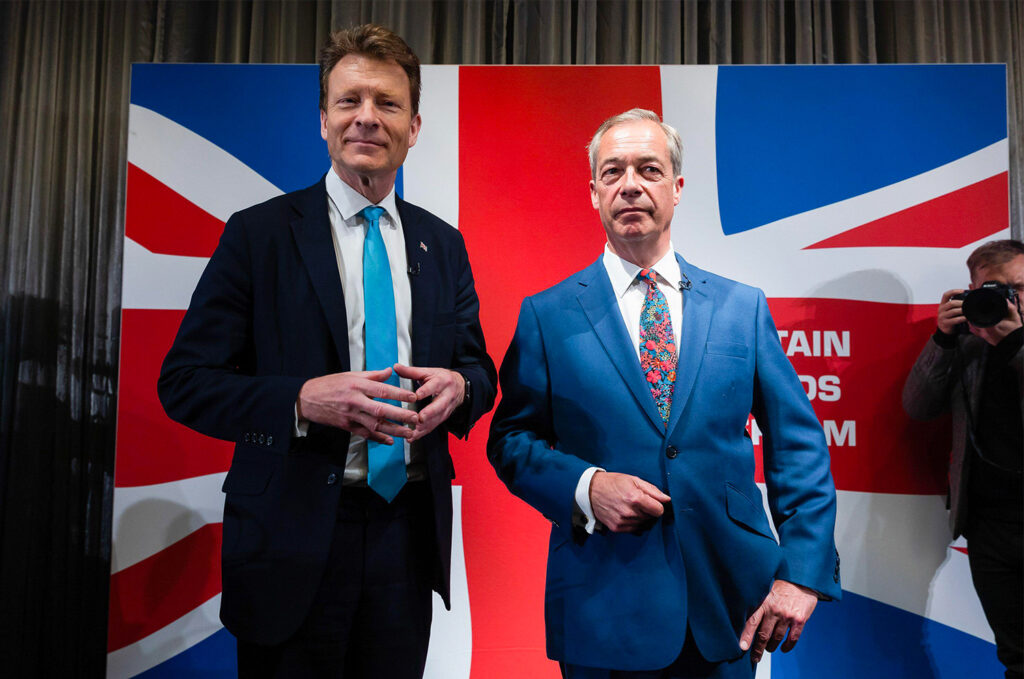
Reform UK leader Nigel Farage, and deputy leader Richard Tice. Photo: Sipa US / Alamy
In January 2024, Banks responded to reports of cold temperatures in Sweden by posting: “-43c … global warming knocking it out of the park. Let’s hope the windmills can keep us warm.”
Despite cold weather in winter, global average temperatures have been rising over the past century, with some of the hottest years on record taking place in the last decade.
In October 2022, Banks shared a post by Reform UK’s then leader Richard Tice, with a (now deleted) article from the Daily Skeptic, which falsely claimed that “global warming has largely stopped in its tracks”.
Banks commented: “It would be almost amusing to find after bankrupting the western world in pursuit of the net zero cult that the climate is cooling… just like [Covid] lockdown everybody lost their mind.”
Net Zero ‘Scam’
Banks has also attacked efforts to cut emissions to net zero by 2050, which scientists agree is the only way to limit temperatures to 1.5C.
The Reform UK candidate has attacked net zero as a “religion”, a “cult”, and a “scam”.
In July 2021, he posted: “Net zero is the new religion for stupid people” and, in April 2023 he said: “Net zero and climate change have all the hallmarks of a scam.”
When the UK was hosting the COP26 climate summit in November 2021, Banks posted that “protecting the environment is essential but totally different to the absolute cock that is climate change”. He added: “The climate has been changing since the start of time!”
A few weeks earlier, Banks had posted: “I own a country park with tens of thousands of trees and have seen no ill affects of climate change.”
The following summer, Banks once again pitted environmentalism against climate action, posting: “There is a huge difference between global climate change & looking after the natural world. One is complete rubbish the other is an absolute necessity.”
Bankrolling Farage
Banks was a major funder of campaigns for the UK to leave the European Union.
A former Conservative Party donor, he gave £1 million in 2014 to Nigel Farage’s UK Independence Party (UKIP), which also campaigned against climate policies.
During the 2016 EU referendum, Banks gave £8.4 million to Leave.EU, the unofficial Brexit campaign, which was led by Farage and chaired by Tice.
In January this year, Farage helped to launch a new UK/Europe branch of the Heartland Institute, a notorious U.S. climate denial think tank.
Interviewed at the Alliance for Responsible Citizenship conference in February, the Reform UK leader claimed it was “absolutely nuts” that CO2 is considered to be a pollutant, while admitting that he is “not a scientist”.
Original article by Andrew Wasley republished from TBIJ under a Creative Commons Attribution-NonCommercial-NoDerivs 3.0 Unported License.
British consumers were exposed to drug-resistant salmonella because border checks took years to come into force
UK health chiefs privately admitted that a lack of border inspections in the wake of Brexit left British consumers exposed to diseased meat, the Bureau of Investigative Journalism (TBIJ) can reveal.
Delays in implementing checks on imported food meant hundreds of people, including children, were poisoned by imported meat during a series of major salmonella outbreaks.
Previous TBIJ investigations uncovered a host of failings in the government’s handling of outbreaks of drug-resistant salmonella spread by supermarket chicken from Poland. Illnesses connected to the outbreaks – which also affected eggs – peaked at different points between 2020 and 2024, and Poland has since continued to export contaminated meat to the UK.
Documents now reveal that in a series of high-level meetings in late 2023, food safety and health bosses admitted that the UK’s borders could have been allowing infected meat to enter the country unchecked.
Minutes from the meetings attended by the UK Health Security Agency (UKHSA), the Food Standards Agency (FSA) and its devolved partners acknowledge there were “no current border controls in place”, and that paperwork and physical checks on imported goods were not due to start until the following year.
“This could change,” officials noted. “However, [the] FSA have decided that they can’t wait for border controls to come in as a control measure.”
Following the UK’s departure from the EU, Boris Johnson’s government announced that hygiene inspections on meat imports from Europe would begin in 2021. However the checks were repeatedly delayed and weren’t implemented until 2024.
“We didn’t do any checks on EU imports at our border control posts for three years,” said Helen Buckingham, a trade policy expert. She pointed to a recent report published by the National Audit Office that was highly critical of the UK’s post-Brexit border controls. She added: “Delays on introducing a new regime of incoming checks for EU goods [were seen as being] risky for the UK in public and animal health terms, because our borders were weak.”
Although checks on some UK meat and poultry imports – typically between 1% and 30% – are now being carried out, concerns have been raised that funding cuts to inspection staff at some ports could see large volumes of substandard meat coming into the UK, as reported in the Grocer.
Tim Lang, professor emeritus of food policy at City St George’s, University of London, said: “Food flows depend on trust. And that depends on believing that systems are in place to protect us from known harm. Five years from Brexit, we see not fewer, but persistence of problems. We’ve put up borders but haven’t invested in the inspection.”
Following the publication of details of the government’s planned border controls in 2023, the FSA chair Susan Jebb said that border controls were “critical to maintaining the UK’s high food and feed safety standards” and that they “must be a priority”. The FSA had previously raised concerns that food products imported from the EU were not being subjected to inspections.
According to Buckingham, the post-Brexit inspections phased in last year do represent a more stringent system than was previously in place. “Pre-Brexit, we didn’t check EU products of animal origin because […] the principle of ‘free circulation of goods’ applied between member states.”
TBIJ’s revelations come as Parliament’s environment, food and rural affairs select committee prepares to launch an inquiry into animal and plant health next Tuesday. Imported animal products will be a central focus of an initial evidence gathering session that will assess the effectiveness of import controls on biosecurity, food hygiene and public health.
The internal UKHSA records obtained by TBIJ also reveal that while a ban on Polish poultry products was among the measures being considered by the FSA, concerns remained about its potential effects on the meat industry. They included the possibility that the UK could import chicken from other countries with food safety “hazards”. No ban was subsequently implemented.
Although earlier FSA interventions brought about a reduction in reported cases, rates were still “outside of the tolerance that the FSA Board can accept of salmonella entering the UK from the EU”.
Officials were also worried that the salmonella contamination had become more widespread, involving multiple producers from Poland and a greater number of food products, the documents show. While attention had initially focussed on breaded chicken and other highly processed products, testing had revealed that fresh chicken and raw pet food was also implicated.
Richard Griffiths, chief executive of the British Poultry Council, said: “We expect our trading partners to meet their responsibilities with regard to safe food. If they cannot, and their own authorities cannot enforce the appropriate controls, then we want our own regulators to have the powers and resources to stop unsafe meat entering the country.”
The BPC previously called for every consignment of Polish poultry to be checked at UK borders.
Tests revealed that in 2024, at least 138 consignments of exported poultry from Poland contained salmonella, including variants that can be highly harmful to human health, according to EU data. The UK was among the affected countries. The figures were only slightly down from 2023, when there had been 149 recorded cases of contaminated products.
In June 2023, TBIJ reported that some of the salmonella linked to Polish poultry that poisoned UK consumers was resistant to multiple antibiotics, limiting treatment options for those falling seriously ill. The UK government was found to have allowed food companies linked to the outbreak to continue supplying supermarkets even after contaminated meat had been linked to the deaths of four people, and the poisoning of hundreds more.
Investigations also found that even though some of the salmonella was known to be antibiotic resistant, food safety and health officials did not disclose this to frontline health workers, including those treating victims. Nor did they inform the Polish authorities, impeding possible investigations into practices on the farms involved.
Bacteria such as salmonella can easily spread on poultry farms, particularly where there are unhygienic or overcrowded conditions, and go on to infect the wider supply chain.
The use of antibiotics on farms can enable potentially lethal bacteria to develop resistance, meaning the drugs will no longer work to treat infections. Antibiotic use in Polish livestock production has been a cause for concern in recent years, with increases in usage of some types of drugs important for humans.
Anjali Juneja, director of UK and international affairs at the FSA, said it has been working with the Polish authorities on measures to enhance the safety and compliance of imported poultry meat and eggs. These include increased testing and other interventions at the farm and manufacturer level.
“We continue to actively monitor the situation, including through in-country audits of Polish food safety controls and of poultry producers exporting to the UK. If we see any information of concern, we will take the necessary action,” Juneja said.
She added that the FSA welcomed the enhanced border checks implemented last year, which have become “a crucial part of our food safety system” that she said helps uphold the UK’s high standards.
A Defra spokesperson said: “This government will never waver in its duty to support the UK’s biosecurity and preserve our food supply.”
The Polish Veterinary Inspectorate told TBIJ that food safety alerts relating to poultry from Poland decreased from 2020-2024, demonstrating that it had been taking appropriate and effective action.
It said that a thorough investigation is undertaken whenever a salmonella case is detected and, in the event, will withdraw the food in question, as well as taking measures to minimise recurrence. And it said antibiotics are only used on farm animals when prescribed by a vet.
Kath Dalmeny, chief executive of the Sustain food and farming alliance said the latest findings expose “just how vital it is for the government to uphold high food standards in international trade deals, especially for high-risk foods such as Polish chicken”.
“They must also ensure there are enough vets and food hygiene inspectors to check that British and imported meat is fit to eat – health protection roles that have been in worrying decline for several years,” she added.
Ron Spellman, a veteran meat inspector, said the issue ultimately needed to be tackled at source. “The European Commission, as well as the Polish authorities and poultry industry, carry responsibility to protect all consumers who buy Polish poultry products, they must resolve this problem.”
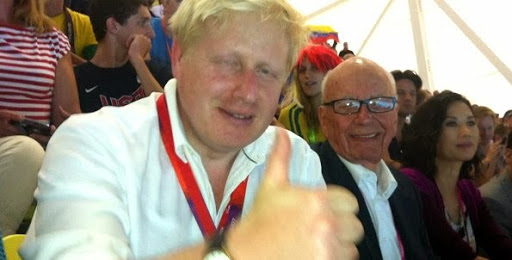
Boris Johnson confirms his thumbs up from Rupert Murdoch
Our investigation reveals secretive funding sources for think tanks that boast of influencing the government
Influential right-wing UK think tanks with close access to ministers have received millions in ‘dark money’ donations from the US, openDemocracy can reveal.
The TaxPayers’ Alliance, the Institute of Economic Affairs (IEA), Policy Exchange, the Adam Smith Institute and the Legatum Institute have raised $9m from American donors since 2012. Of this, at least $6m has been channelled to the UK, according to tax returns filed with US authorities – representing 11% of the think tanks’ total UK receipts, with the figure reaching 23% for the Adam Smith Institute.
In that time, all five have steadily increased their connections in the heart of government. Between them, they have secured more than 100 meetings with ministers and more than a dozen of their former staff have joined Boris Johnson’s government as special advisers.
Representatives from right-wing think tanks – many of whom are headquartered at 55 Tufton Street in central London – frequently appear in British media and have been credited with pushing the Tories further to the right on Brexit and the economy.
As openDemocracy revealed yesterday, ExxonMobil gave Policy Exchange $30,000 in 2017. The think tank went on to recommend the creation of a new anti-protest law targeting the likes of Extinction Rebellion, which became the Police, Crime, Sentencing and Courts Act 2022.
None of these think tanks disclose their UK donors. With the exception of the Adam Smith Institute, none provide any information about the identity of donors to their US fundraising arms.
But an investigation by openDemocracy has identified dozens of the groups’ US funders by analysing more than 100 publicly available tax filings.
The Scottish National Party MP Alyn Smith said that the findings showed that the UK’s lobbying laws were not tough enough.
“He who pays the piper calls the tune,” he told openDemocracy. “We urgently need to rewrite the laws governing this sort of sock puppet funding so that we can see who speaks for who.”
Last month, Smith asked an IEA representative who funded the think tank on BBC’s flagship question time show.
Among the US-organisations who have donated to UK think tanks are oil companies and several of the top funders of climate change denial in the US.
The think tanks’ US arms received $5.4m from 18 donors who have also separately donated a combined $584m towards a vast network of organisations promoting climate denial in the US between 2003 to 2018, according to research from climate scientists.
The John Templeton Foundation, founded by the late billionaire American-British investor, has donated almost $2m to the US arms of the Adam Smith Institute and the IEA. Researchers claim that the John Templeton Foundation has a “history of funding what could be seen as anti-science activities and groups (particularly concerning climate-change and stem-cell research)”.
The National Philanthropic Trust, a multi-billion-dollar fund that does not disclose its own donors, has given almost $2m to the IEA, Policy Exchange, TaxPayers’ Alliance and the Legatum Institute’s US fundraisers. The trust has donated $22m to climate denial organisations, one of which described it as a “vehicle” for funnelling anonymous donations from the fossil fuel industry.
The Sarah Scaife Foundation, founded by the billionaire heir to an oil and banking fortune, has given $350,000 to the Adam Smith Institute and the Legatum Institute. The foundation is one of the biggest funders of climate denial in the US, contributing more than $120m to 50 organisations promoting climate denial since 2012. Last month, openDemocracy revealed that the foundation, which has $30m in shares in fossil fuel companies, gave $210,525 to a UK climate sceptic group.
Policy Exchange, the influential conservative think tank, published a report in 2019 – two years after taking money from ExxonMobil – claiming that Extinction Rebellion were “extremists” and calling for the government to introduce new laws to crack down on the climate protest group.
New anti-protest laws passed under the Police, Crime, Sentencing and Courts Act last month appear to have been directly inspired by the report. The Home Office did not deny that it considered the recommendations when approached for comment.
The American Friends of the IEA also received a $50,000 donation from ExxonMobil in 2004, while the main UK branch of the IEA has received donations from BP every year since 1967.
The Legatum Institute has received $154,000 from the Charles Koch Foundation in 2018 and 2019. The foundation was set up by the American billionaire co-owner of Koch Industries, one the biggest fossil fuel companies in the US.
Andy Rowell, co-author of “A Quiet Word: Lobbying, Crony Capitalism and Broken Politics in Britain”, told openDemocracy: “For years, there have been calls for think tanks, who are so often joined at the hip with government, to be transparent and disclose who funds them.
“The fact that so much dark money is behind these groups, and much of it is linked to climate denial groups, is a political scandal that can’t be allowed to continue, especially given our climate emergency.”
In all, US donors account for more than a tenth of the overall income of the IEA, Policy Exchange, Adam Smith Institute and TaxPayers’ Alliance.
Anti-green lobbying
While all the think tanks say they do not dispute the science on climate change, many are campaigning to increase the UK’s dependency on fossil fuels and deregulate energy markets in response to the cost of living crisis.
The TaxPayers’ Alliance, Adam Smith Institute and the IEA have all called for the UK’s ban on fracking to be overturned. In April, the government agreed to review the moratorium it had imposed in 2019, when scientists deemed fracking unsafe. The U-turn came after concerted pressure from anti-net zero Tory MPs and lobby groups.
The IEA has also called for the government to approve the opening of a new coal mine in Cumbria, while the TaxPayers’ Alliance has called for the government to scrap green energy bill levies. Tory MP Ben Bradley has cited the TaxPayers’ Alliance in Parliament while claiming that levies will exacerbate the cost of living crisis.
Environmental groups say cutting the levies, which are used to invest in energy efficiency measures and renewable energy, would be self-defeating and merely delay the UK’s longer-term transition away from fossil fuels.
Johnson’s think tank cabinet
Right-wing think tanks like the IEA have come to play an increasingly influential role in shaping British politics, despite the lack of transparency around their funding.
The IEA has boasted that 14 members of Boris Johnson’s cabinet – including the home secretary Priti Patel, the foreign secretary Liz Truss and the business secretary Kwasi Kwarteng, are “alumni of IEA initiatives”.
Ministers have recorded 26 meetings with the think tank since 2012, but there may be additional, undeclared private meetings. In 2020, Truss, who was then the secretary of state for trade, failed to declare two meetings with the IEA, arguing that they were made in a personal capacity.
Mark Littlewood, the director of the IEA, has boasted of securing access to ministers and MPs for his corporate clients, including BP, telling an undercover reporter in 2018 that he was in “the Brexit influencing game”.
Others like Policy Exchange, which was co-founded by the ‘levelling up’ secretary Michael Gove, can claim to have had some of their policy ideas taken up by the government.
Gove’s recently announced plan to allow residents to vote on whether to allow developments on their street was first proposed by Policy Exchange last year. Campaigners said the plan will not help increase the supply of affordable housing.
Several of the think tanks were accused by a whistleblower of coordinating with one another to advocate for a hard break from the European Union following the referendum vote.
Shamir Sanni, a former pro-Brexit campaigner who worked for TaxPayers’ Alliance before going public with his claims, alleged that the organisation regularly met with the IEA, the Adam Smith Institute to agree on a common line on issues relating to Brexit.
Sanni subsequently won an unfair dismissal case against the TaxPayers’ Alliance. The organisations he identified have all denied they act as lobbyists or coordinate.
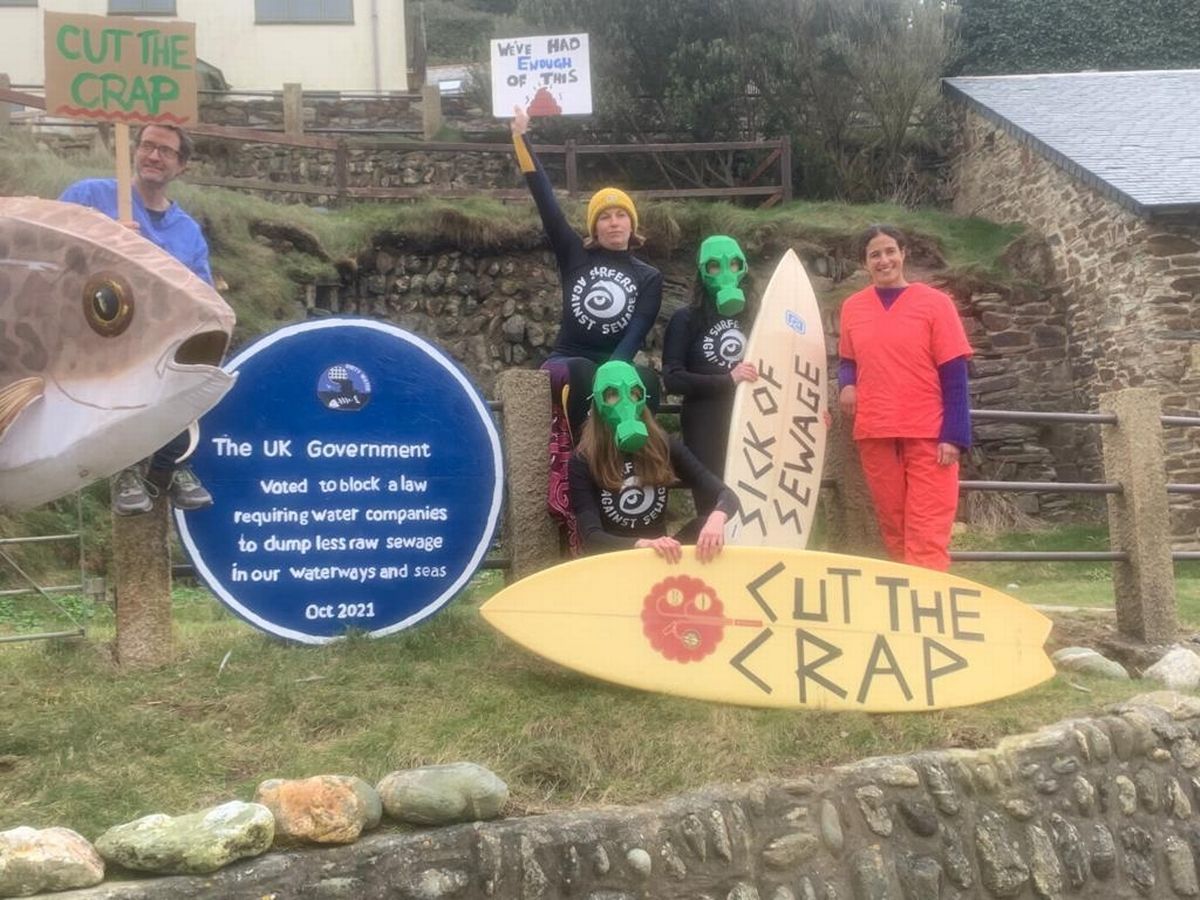
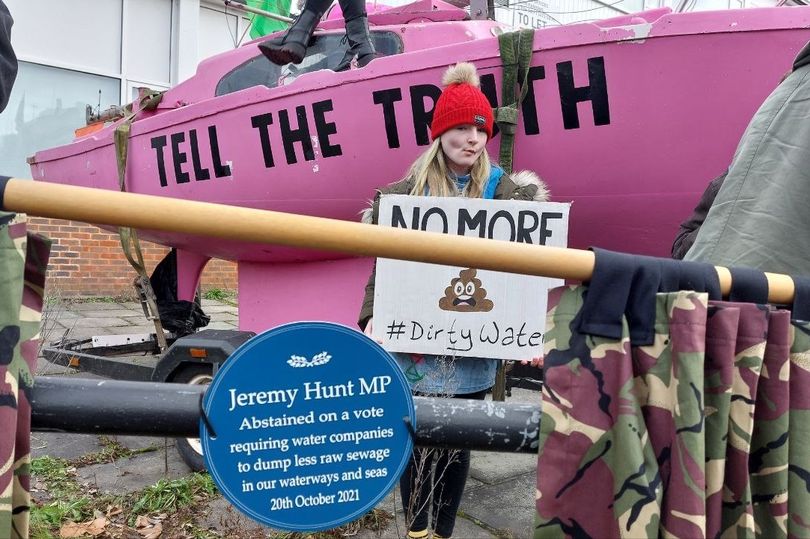
UK Extinction Rebellion joined with other groups on Saturday’s Dirty Water national day of action protesting UK government’s policy of open sewers throughout UK.
Targets to clean up the majority of England’s rivers, lakes and coastal waters suffering from a cocktail of agricultural and sewage pollution have been pushed back from 2027 to 2063.
…
Until Brexit the UK government was signed up to the water framework directive, which required countries to make sure all their waters achieved “good” chemical and ecological status by 2027 at the latest. The UK government later reduced the target to 75% of waterways reaching the single test of good ecological status by 2027 at the latest. The target for the majority of waterways to achieve good status in both chemical and ecological tests has now been pushed back to 2063, according to the documents.
By 2027, only 4% of waters are currently on track to be in good overall condition.
…
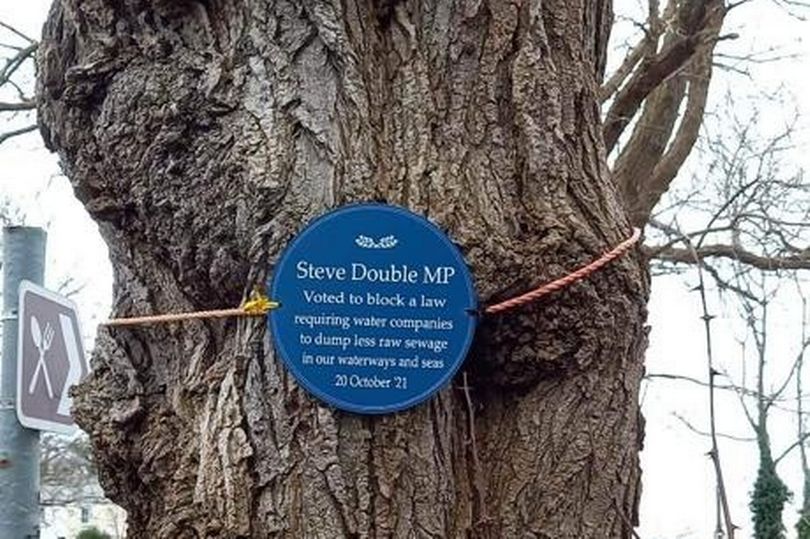
Surfers Against Sewage and Extinction Rebellion protests in St Agnes, Perranporth, Truro and Charlestown which unveiled spoof Blue Plaques to the MPs and Conservative Government who allowed raw sewage to be dumped in the sea (Image: Barry West)Surfers Against Sewage and Extinction Rebellion protests in St Agnes, Perranporth, Truro and Charlestown which unveiled spoof Blue Plaques to the MPs and Conservative Government who allowed raw sewage to be dumped in the sea (Image: Surfers Against Sewage)XR’s pink boat and Dirty Water protestor at Godalming